
Yes, iridium spark plugs are generally better than platinum spark plugs in terms of electrode durability, ability to use a very fine center electrode, and long-term ignition performance. Iridium is harder and has a higher melting point than platinum, allowing manufacturers to create extremely small, wear-resistant firing tips that require relatively little voltage to produce a reliable spark.
That does not mean installing iridium plugs automatically gives every engine more horsepower, better fuel economy, or smoother operation. The correct spark plug specified for your engine is more important than choosing the most expensive electrode material. If your vehicle was engineered for a particular double-platinum plug, replacing it with a random iridium plug is not automatically an upgrade.
Both materials are significant improvements over conventional nickel electrodes when long service life is the goal. Platinum plugs can provide excellent durability and are still appropriate for many ignition systems. Iridium simply allows manufacturers to combine exceptional wear resistance with an even finer center electrode.
There is another important distinction: not every iridium spark plug is designed as a long-life plug. Some performance-oriented iridium plugs use an extremely fine iridium center electrode but a conventional ground electrode, giving excellent ignitability without necessarily providing the same replacement interval as an OE-style double precious-metal plug.
In this guide, I’ll explain whether iridium spark plugs are better than platinum, how the two materials differ, which lasts longer, whether iridium improves performance or fuel economy, and when sticking with platinum is actually the smarter choice.
Iridium vs. Platinum Spark Plugs at a Glance
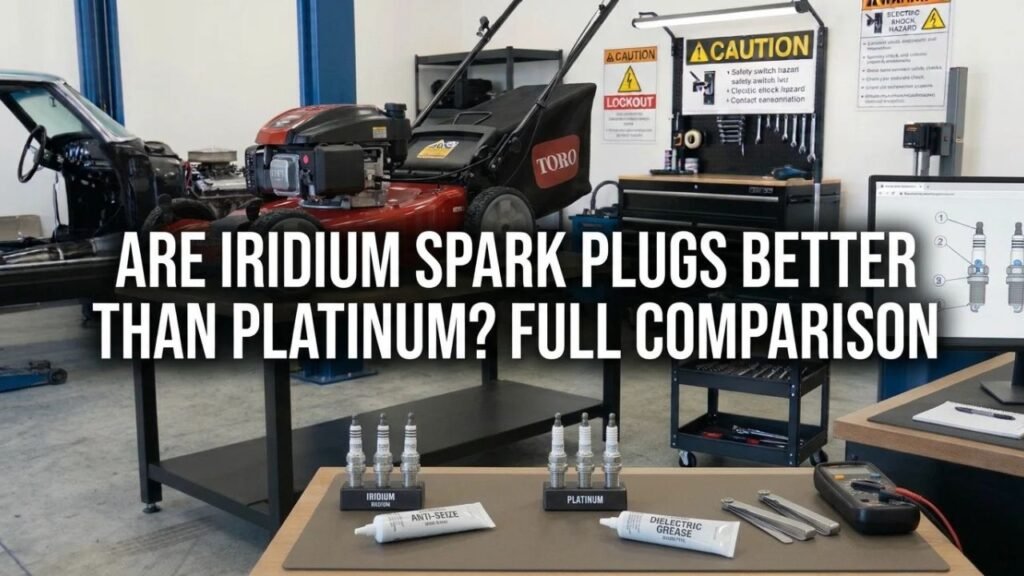
For most modern passenger vehicles, iridium has several technical advantages over platinum.
| Feature | Iridium Spark Plugs | Platinum Spark Plugs |
| Electrode wear resistance | Excellent | Very good |
| Melting point | Higher | Lower than iridium |
| Possible center-electrode size | Extremely fine | Fine |
| Ignitability | Excellent | Very good |
| Required firing voltage | Can be relatively low with fine-wire design | Low to moderate depending on design |
| Typical longevity | Excellent on long-life designs | Excellent on long-life designs |
| Cost | Usually higher | Usually lower |
| Best use | Modern engines, long-life OE applications, fine-wire designs | Many OE applications, distributorless/waste-spark systems, lower-cost long-life replacement |
| Automatic performance increase | No | No |
The overall winner is usually iridium, but only when comparing equivalent-quality plugs designed for the same application.
A high-quality OE double-platinum plug that correctly matches an engine can be a much better choice than an incorrect iridium plug.
Why Is Iridium Considered Better Than Platinum?
The difference starts with the physical properties of the electrode materials.
The firing end of a spark plug experiences extreme heat, repeated electrical discharge, pressure changes, and chemical exposure. Every ignition event removes an extremely small amount of electrode material.
Over thousands or millions of firing cycles, that erosion increases the spark plug gap.
As the gap increases, the ignition system generally needs more voltage to create the spark.
Eventually, ignition performance can deteriorate.
Iridium Has a Higher Melting Point
Iridium’s melting point is substantially higher than platinum’s.
This makes it particularly suitable for a component that repeatedly operates in an extremely hot combustion environment.
Manufacturers actually use specialized iridium alloys rather than simply attaching a chunk of pure iridium to the spark plug.
These alloys are engineered to resist both electrical erosion and high-temperature deterioration.
Iridium Is Extremely Hard
Iridium also provides exceptional hardness and wear resistance.
Because the firing tip wears slowly, manufacturers can make the center electrode extremely small without sacrificing acceptable durability.
Some iridium spark plugs use center electrodes around 0.4 to 0.6 mm in diameter, depending on the manufacturer and product design.
A conventional nickel center electrode needs to be much larger because the material would wear too quickly if manufactured at the same tiny diameter.
Platinum allows a smaller center electrode than ordinary nickel, but iridium can generally go even finer.
Why a Fine Center Electrode Helps
The smaller firing tip concentrates the electric field around the electrode.
That can reduce the amount of voltage needed to initiate the spark.
A fine electrode also blocks less of the developing flame kernel immediately after ignition.
This is why fine-wire iridium plugs can provide excellent ignitability even though the physical spark plug dimensions and basic operating principle remain similar to older designs.
Key Takeaways:
- Iridium is harder and has a higher melting point than platinum.
- Its durability allows manufacturers to use extremely fine center electrodes.
- A fine center electrode can improve ignitability without requiring an unusually large spark gap.
Do Iridium Spark Plugs Last Longer Than Platinum?
Often, but the answer depends on the complete spark plug design rather than just the center-electrode material.
A long-life iridium plug with precious metal on both the center and ground electrodes can last exceptionally well.
A double-platinum plug can also offer very long service life.
Meanwhile, a performance-oriented iridium plug with an iridium center electrode but an ordinary ground electrode may have a much shorter recommended replacement interval than an OE long-life double-platinum plug.
This surprises many vehicle owners.
Why Both Electrodes Matter
When the spark jumps across the gap, both the center and ground electrodes experience wear.
Some ignition systems can place greater wear on one electrode than another.
Using precious metal on both firing surfaces therefore helps maintain the gap over a long service interval.
This is why you’ll see terms such as:
Double platinum
and
Iridium with platinum ground electrode
on long-life plugs.
The design of the ground electrode can matter just as much as the material at the center electrode when comparing replacement intervals.
Don’t Judge Lifespan by the Word “Iridium”
A spark plug package saying “Iridium” does not automatically mean it is a 100,000-mile plug.
Some iridium plugs are specifically designed for high ignitability and performance rather than maximum longevity.
Always follow the replacement interval for the specific spark plug and vehicle.
What Is a Platinum Spark Plug?
A platinum spark plug uses platinum on at least one of its firing surfaces.
Platinum offers far better resistance to electrode erosion than ordinary nickel alloys.
This allows a platinum plug to maintain its firing gap for much longer under normal conditions.
Single-Platinum Spark Plugs
A single-platinum plug typically has platinum on the center electrode.
The ground electrode may remain a conventional material.
This design provides better center-electrode durability than a basic nickel plug while keeping manufacturing cost relatively moderate.
Double-Platinum Spark Plugs
A double-platinum plug uses platinum on both the center and ground firing surfaces.
This can be particularly useful with certain distributorless ignition systems that use a waste-spark arrangement.
In those systems, paired spark plugs can experience current flow in opposite directions.
One plug may fire from center to ground while its paired plug effectively fires in the opposite polarity.
A single-platinum design may therefore protect the electrode that wears most heavily on one cylinder but not necessarily the opposite firing surface on its paired cylinder.
Double-platinum plugs address wear on both sides.
This is one reason you should not replace an OE-specified double-platinum plug with a random single-platinum plug just because the latter physically fits.
What Is an Iridium Spark Plug?
An iridium spark plug uses an iridium-alloy firing tip, usually at the center electrode.
Because iridium is exceptionally hard and heat resistant, the center electrode can be manufactured with a very small diameter.
This fine-wire construction is one of iridium’s biggest advantages.
Performance Iridium Plugs
Some aftermarket iridium plugs emphasize ignitability and throttle response.
They may use an extremely fine center electrode but not necessarily a precious-metal ground electrode designed for maximum service life.
These plugs can be excellent products, but they should not automatically be assumed to outlast every platinum plug.
OE Long-Life Iridium Plugs
Many modern vehicles leave the factory with long-life iridium plugs.
These often pair an iridium center electrode with a platinum or other precious-metal pad on the ground electrode.
That design provides both fine-wire ignition characteristics and excellent durability.
For vehicles that originally use this type of plug, replacing them with the correct OE-style iridium plug is usually the best approach.
Which Has Better Ignition Performance?
In equivalent applications, iridium generally has the advantage.
A very small iridium center electrode can require less voltage to initiate a spark than a larger electrode.
This can help the ignition system maintain reliable combustion during challenging conditions such as cold starting, acceleration, and high cylinder pressure.
However, the difference should not be exaggerated.
If your engine is already operating correctly with the manufacturer-specified platinum spark plugs, changing only the electrode material may produce little or no noticeable difference from the driver’s seat.
Modern ignition systems are engineered around specific plug designs.
Once reliable ignition is occurring, creating a spark with a slightly different electrode does not suddenly make the engine produce dramatically more power.
Do Iridium Spark Plugs Give More Horsepower Than Platinum?
Normally, not enough to treat the change as a horsepower upgrade.
A healthy engine using the correct platinum plugs should already be igniting its air-fuel mixture reliably.
Installing iridium plugs may provide excellent ignition characteristics, but there is no extra fuel or air entering the cylinder simply because the center electrode is made from iridium.
Therefore, large horsepower gains should not be expected.
Why Some Drivers Feel an Improvement
Suppose you remove old platinum plugs with 80,000 miles of wear and install fresh iridium plugs.
The engine may idle more smoothly, start more easily, and respond better.
That does not necessarily mean iridium is creating extra power compared with brand-new platinum plugs.
Much of the improvement may come from replacing worn plugs with new ones.
The proper comparison would be:
new correct platinum plugs vs. new correct iridium plugs
rather than:
old worn platinum plugs vs. new iridium plugs.
Key Takeaways:
- Iridium generally provides superior fine-wire ignition characteristics.
- It should not be treated as a major horsepower modification.
- Apparent performance gains often come from replacing worn plugs, not simply changing electrode material.
Do Iridium Spark Plugs Improve Fuel Economy?
Possibly under some circumstances, but do not expect a dramatic fuel-economy increase simply by changing from healthy platinum plugs to iridium.
A reliable spark helps the engine burn its mixture consistently.
Fine-wire iridium plugs can provide excellent ignitability and maintain that performance as the plug ages.
But the engine’s fuel system, ignition timing, air-fuel ratio, compression, driving conditions, and vehicle weight have far greater influence on fuel economy.
If old plugs are misfiring or badly worn, replacing them can restore lost efficiency.
Whether the new plug is platinum or iridium matters less than whether it is the correct, properly functioning plug.
Are Iridium Spark Plugs Better for Cold Starting?
They can be.
Fine-wire electrodes generally require less firing voltage than larger conventional electrodes, which can support reliable ignition during cold starts.
Cold starting is demanding because fuel vaporization and combustion conditions are not as favorable as they are once the engine reaches operating temperature.
A good iridium plug can therefore provide strong starting characteristics.
Again, though, a properly functioning engine equipped with the correct platinum plugs should also start normally.
If a vehicle is difficult to start, don’t assume upgrading spark plug material is the solution.
Battery condition, ignition coils, fuel pressure, injectors, engine sensors, compression, and several other systems can cause hard starting.
Are Iridium Spark Plugs Better for High-Mileage Cars?
They can be an excellent option, but high mileage by itself does not determine which plug you should install.
A 200,000-mile engine should still receive the correct heat range, thread reach, seat design, and electrode configuration specified for that application.
If the manufacturer lists an iridium replacement that correctly supersedes an older platinum plug, using it can make sense.
But installing a random iridium plug will not compensate for:
Oil consumption, weak compression, worn valve seals, leaking injectors, failing ignition coils, or other age-related engine problems.
If an old engine repeatedly fouls plugs with oil, an expensive iridium plug may foul just as effectively as a platinum plug.
Fix the underlying problem where practical.
Are Iridium Spark Plugs Better for Turbocharged Engines?
Iridium plugs are commonly used in turbocharged and other high-output engines because their fine, durable electrodes perform well under demanding combustion conditions.
However, electrode material is only one part of choosing a plug for a modified or forced-induction engine.
Heat range and spark gap become especially important.
Higher boost increases cylinder pressure, making the spark more difficult to initiate.
Modified engines may require a colder heat range, a smaller gap, or a specialized electrode design.
Never choose a spark plug solely because it says “iridium racing” on the package.
For a modified turbo or supercharged engine, use the specification recommended by the tuner, engine builder, or spark plug manufacturer for that exact setup.
Are Iridium Plugs Better for Older Cars?
Sometimes, but not universally.
Older engines designed around conventional nickel or platinum plugs may run perfectly well on a compatible iridium upgrade.
Manufacturers offer many iridium replacements for older applications.
The important word is compatible.
The new plug still needs the proper heat range, thread dimensions, reach, seat, resistor characteristics, projection, and gap.
Older Waste-Spark Ignition Systems Need Attention
If an older vehicle originally specifies double-platinum plugs because of a waste-spark ignition system, do not automatically substitute a single-iridium plug that has precious metal only at the center electrode.
The ground electrode may wear faster on cylinders that experience reverse-polarity firing.
An appropriate long-life iridium design with protection on both firing surfaces can be an upgrade, but the exact plug design matters.
Platinum vs. Iridium Spark Plug Cost
Iridium spark plugs generally cost more than comparable platinum plugs.
The extra cost comes from the precious-metal material, manufacturing processes, and fine-electrode construction.
Whether that premium is worth paying depends on your vehicle.
If the manufacturer specifies iridium, the answer is simple: use the correct iridium plug.
If the engine specifies platinum and you have a compatible iridium upgrade available, consider:
How difficult the plugs are to access, how long you intend to keep the vehicle, and the recommended replacement intervals.
Labor Can Matter More Than Plug Price
On an easy four-cylinder engine with spark plugs directly accessible from the top, replacing plugs may take very little time.
On some transverse V6 engines, however, reaching the rear bank may require removing the upper intake manifold.
On certain vehicles, plug replacement can therefore involve significant labor.
Paying slightly more for a correctly specified long-life iridium plug can be worthwhile if it reduces how often that labor needs to be repeated.
Should You Replace Platinum Plugs With Iridium?
Only when the iridium plug is explicitly listed as compatible with your engine.
Do not select a replacement solely by thread diameter or spark plug gap.
Two plugs can screw into the same cylinder head yet have different:
Heat ranges, thread reach, firing-tip projection, resistor values, seat styles, and ground-electrode designs.
These differences can affect combustion, plug temperature, mechanical clearance, and ignition-system behavior.
When Iridium Is a Good Upgrade
Switching can make sense when a reputable manufacturer lists an iridium plug specifically for your vehicle and the design provides better longevity or ignitability.
It is particularly attractive when spark plug access is difficult.
When I Would Stay With Platinum
If the engine’s OE specification calls for double-platinum plugs and there is no application-approved iridium alternative, I would keep using the correct platinum plug.
There is nothing inherently outdated or inadequate about platinum when the engine was designed around that plug.
Can You Mix Iridium and Platinum Spark Plugs?
I would not intentionally mix them within the same engine unless the manufacturer specifically designs the engine that way.
All cylinders should normally use the same specified plug design, heat range, and gap.
Mixing electrode technologies can introduce differences in wear characteristics and ignition behavior.
If one plug fails and the others are relatively new, install the same correct plug type.
If all of the plugs are near their service interval, replacing the entire set is often more sensible.
Do Iridium Plugs Need a Different Gap Than Platinum?
Not simply because they are iridium.
Spark plug gap is determined by the engine, ignition system, and exact plug design.
Sometimes a manufacturer supersedes an older platinum plug with a newer iridium plug using a different gap. In that case, follow the current replacement specification.
Do not assume that an old platinum plug’s gap must automatically be transferred to every iridium replacement.
Likewise, don’t reduce the gap just because the new plug has an iridium center electrode.
Use the application-specific recommendation.
Are Iridium Spark Plugs Pre-Gapped?
Many are factory-gapped, but they should still be checked according to the spark plug manufacturer’s instructions.
Fine-wire iridium electrodes require careful handling.
If adjustment is permitted, bend only the ground electrode.
Never pry against the iridium center electrode.
Some OE iridium manufacturers advise replacing a plug that is significantly out of specification rather than attempting to regap it.
The correct procedure depends on the particular plug.
Do Iridium Plugs Need Anti-Seize?
Most modern iridium spark plugs from major manufacturers do not require anti-seize because their metal shells use corrosion-resistant plating.
Manufacturers such as NGK specifically advise against applying anti-seize to their plated spark plug threads.
Anti-seize lubricates the threads and changes the relationship between torque wrench reading and actual clamping force.
That can contribute to overtightening when you use a torque value intended for dry threads.
Follow the installation instructions supplied for the exact plug.
The same general principle applies to modern platinum plugs.
The electrode material does not determine whether the threads require lubricant.
Key Takeaways:
- Replace platinum with iridium only when the iridium plug is approved for your engine.
- Spark plug gap does not depend solely on whether the electrode is platinum or iridium.
- Modern plated iridium and platinum plugs are commonly installed dry without anti-seize.
Iridium vs. Double Platinum: Which Is Better?
This comparison is more meaningful than comparing iridium with a basic single-platinum plug.
A good double-platinum spark plug can provide exceptional durability because both firing surfaces resist erosion.
A long-life iridium plug that pairs an iridium center electrode with precious metal on the ground electrode can offer that same type of dual-surface durability while allowing an even finer center electrode.
In that like-for-like comparison, I would generally give the technical advantage to the long-life iridium plug.
However, the practical difference may be small in an engine originally designed for double platinum.
If both plugs provide the required service interval and reliable ignition, the correct OE specification matters more than theoretical material superiority.
Iridium vs. Platinum vs. Copper/Nickel
“Copper spark plug” is a somewhat misleading common term because many spark plugs, including precious-metal plugs, use copper inside the center electrode for heat transfer.
What people normally mean by a copper plug is a conventional nickel-alloy firing electrode with a copper core.
Conventional nickel plugs are inexpensive and can perform extremely well, particularly in engines designed for them.
Their disadvantage is electrode wear.
Platinum improves durability substantially.
Iridium allows an even finer, extremely durable center electrode.
The general progression is therefore:
Conventional nickel: lowest cost, shorter service life.
Platinum: improved wear resistance and longer service life.
Iridium: excellent wear resistance plus very fine electrode capability.
But this should never override the application requirements.
How Long Do Iridium and Platinum Plugs Actually Last?
There is no universal mileage number for either material.
Platinum plugs can be designed for long service intervals, including around 60,000 to 100,000 miles in certain applications.
Long-life iridium plugs are also commonly used for extended intervals around 100,000 miles and sometimes beyond, depending on the vehicle manufacturer’s maintenance schedule.
But some performance iridium plugs have substantially shorter recommended lives.
Driving conditions also matter.
Frequent short trips, oil consumption, rich operation, severe engine modifications, and other conditions can reduce plug life.
Always follow the maintenance schedule for your vehicle and the exact spark plug installed rather than assuming every iridium plug lasts 100,000 miles.
How Do You Know Which One Your Car Needs?
Start with the vehicle manufacturer’s specification.
Look up the plug by:
Year, make, model, engine, and ideally engine code or VIN information when needed.
Then compare current application information from a reputable spark plug manufacturer.
If your engine specifies iridium, use the appropriate iridium plug.
If it specifies double platinum, use double platinum unless an approved iridium supersession exists.
Avoid choosing based only on advertisements such as “premium,” “high performance,” or “racing.”
The technically best material is irrelevant if the plug has the wrong heat range or dimensions.
Common Mistakes When Choosing Iridium vs. Platinum
One common mistake is assuming iridium will automatically increase horsepower or fuel economy.
It can provide excellent ignitability, but a properly functioning ignition system does not gain large amounts of power simply from changing electrode materials.
Another mistake is assuming every iridium plug lasts longer than every platinum plug. The complete electrode design determines service life.
Waste-spark systems create another common error. Replacing double-platinum plugs with a single precious-metal design can shorten electrode life on the reverse-polarity cylinders.
Finally, never choose a spark plug only because it physically screws into the engine.
Correct heat range, reach, seat, projection, and application are essential.
FAQs About Are Iridium Spark Plugs Better Than Platinum
Are iridium spark plugs better than platinum?
Generally, yes. Iridium is harder, has a higher melting point, and allows manufacturers to use a finer center electrode with excellent wear resistance. However, the correct application-specific plug remains more important than material alone.
Do iridium spark plugs last longer than platinum?
Long-life iridium plugs can last longer, but not every iridium plug is designed for maximum lifespan. Some performance iridium plugs may have shorter replacement intervals than OE double-platinum plugs.
Do iridium plugs make more horsepower?
Usually not enough to consider them a horsepower modification. A healthy engine with correctly functioning platinum plugs may show little measurable difference after switching.
Do iridium plugs improve acceleration?
Fine-wire iridium plugs offer excellent ignitability and may improve response compared with worn or less efficient plugs, but don’t expect dramatic gains on an otherwise healthy stock engine.
Do iridium spark plugs improve fuel economy?
They can help maintain reliable combustion, but switching from healthy platinum plugs normally does not produce a major fuel-economy increase.
Are platinum spark plugs still good?
Yes. Platinum plugs offer excellent durability and remain the correct OE choice for many engines.
Is double platinum better than single platinum?
For ignition systems where both firing polarities cause electrode wear, such as certain waste-spark systems, double platinum can provide significantly better durability.
Is iridium better than double platinum?
Technically, a long-life iridium design can combine a finer center electrode with excellent durability. However, an OE double-platinum plug can still be the correct choice for a particular engine.
Can I replace platinum plugs with iridium plugs?
Yes, if the iridium plug is specifically approved for your vehicle. Do not choose by thread size alone.
Can I replace double platinum with single iridium?
Not automatically. Some waste-spark systems need precious-metal protection at both firing surfaces. Use an application-approved replacement.
Are iridium plugs better for older cars?
They can be when a compatible application is available, but older engines do not automatically need iridium plugs.
Are iridium plugs better for turbo engines?
They are commonly used in turbocharged engines because of their fine, durable electrodes, but correct heat range and gap are also critical.
Do iridium plugs run hotter than platinum?
Electrode material does not determine spark plug heat range. An iridium plug can be made in multiple heat ranges just like platinum or nickel plugs.
Are iridium spark plugs pre-gapped?
Many are factory-set, but the gap should still be verified according to the manufacturer’s instructions.
Do iridium spark plugs need anti-seize?
Most modern plated iridium plugs do not. Follow the spark plug manufacturer’s installation instructions.
Can I mix iridium and platinum plugs in one engine?
It is generally better to use a matching set of the correct specified plug design.
Why are iridium plugs more expensive?
Iridium is an expensive precious metal, and producing tiny, precisely welded electrode tips requires specialized manufacturing.
What happens if I use platinum instead of iridium?
If the engine specifically requires iridium, using a different plug may change longevity or ignition performance. Follow the current OE specification rather than downgrading solely to save money.
Which is best for a 100,000-mile service interval?
An OE-approved long-life iridium or double precious-metal plug is generally appropriate when the vehicle manufacturer specifies that interval. Do not assume every iridium plug qualifies.
Are expensive spark plugs always better?
No. The best spark plug is the one correctly designed for the engine. An expensive but incorrect plug can perform worse than the correct lower-cost plug.
Conclusion
So, are iridium spark plugs better than platinum? In a direct materials comparison, generally yes. Iridium is harder and has a higher melting point than platinum, giving it exceptional resistance to electrode wear and allowing manufacturers to create extremely fine center electrodes.
That fine electrode is iridium’s biggest technical advantage. It can support excellent ignitability while maintaining durability under the severe heat and electrical erosion inside an engine.
However, this does not mean every iridium spark plug is automatically superior to every platinum plug.
A long-life double-platinum plug may outlast a performance-focused single-iridium design whose ground electrode uses conventional material. Likewise, an engine engineered around double-platinum plugs—particularly certain waste-spark systems—should not receive an arbitrary single-iridium replacement simply because iridium sounds more advanced.
You should also keep performance expectations realistic. Switching from healthy platinum plugs to iridium is unlikely to create a dramatic horsepower or fuel-economy increase. The biggest benefits of iridium are usually fine-wire ignitability, resistance to electrode wear, stable performance over time, and potentially long service life when the plug is specifically designed for longevity.
My recommendation is to start with your vehicle manufacturer’s specification. If the engine was designed for iridium, use the correct OE-style iridium plug. If it specifies platinum, a compatible iridium upgrade can be worthwhile when the spark plug manufacturer explicitly lists it for your engine—but there is nothing wrong with continuing to use the correct platinum plug.
In short, iridium is usually the more advanced electrode material, but the best spark plug is not simply the one made from the most expensive metal. It is the plug with the correct heat range, dimensions, electrode design, gap, and application for your engine.