
Are spark plugs reverse threaded? No. Nearly all automotive spark plugs use standard right-hand threads, which means you loosen them by turning counterclockwise and tighten them by turning clockwise when viewed from the top of the plug. In other words, the familiar rule “lefty-loosey, righty-tighty” normally applies to spark plugs.
If a spark plug seems to tighten when you turn it counterclockwise or refuses to loosen normally, that usually does not mean it has reverse threads. More likely causes include corrosion, carbon deposits, excessive previous torque, damaged cylinder-head threads, or simply working from an awkward angle where the direction is easy to misjudge.
Spark plugs are threaded directly into the cylinder head, and many modern heads are aluminum. Because aluminum threads can be damaged more easily than the steel spark plug threads, removal and installation should be done carefully. Applying excessive force in the wrong direction can strip the head, break the plug, or make removal much more difficult.
Some other automotive fasteners have used left-hand threads in specific applications, which is probably one reason this question comes up. Spark plugs, however, are overwhelmingly conventional right-hand threaded fasteners.
In this guide, I’ll explain which way spark plugs turn, how to remove a stuck plug safely, why a plug may feel like it is reverse threaded, how to avoid cross-threading, and what to do if a spark plug will not loosen.
Which Way Do Spark Plugs Loosen?
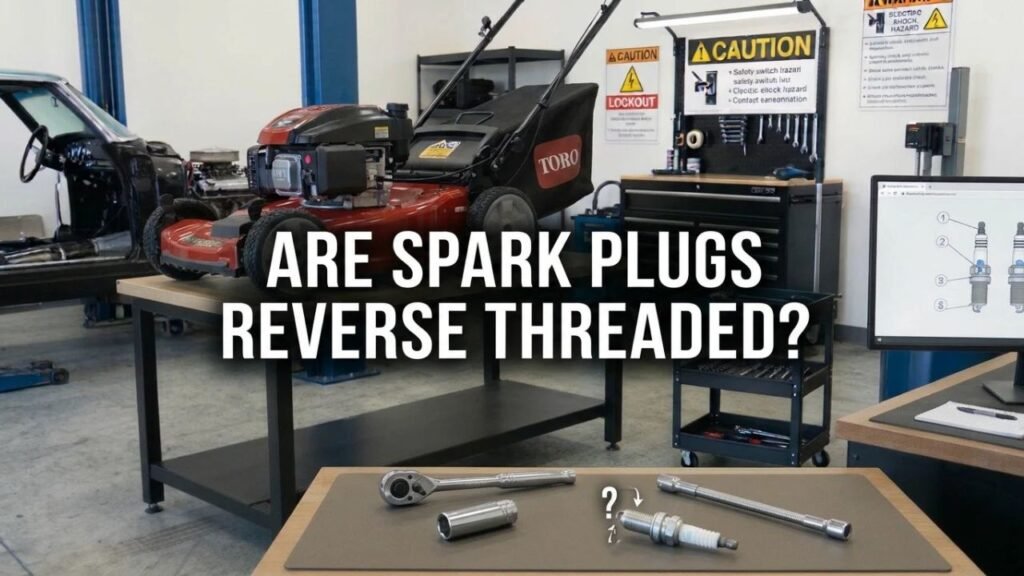
Spark plugs normally loosen counterclockwise.
Stand where you can look down the length of the spark plug or socket extension.
Then turn the ratchet counterclockwise.
That is the loosening direction for a standard right-hand thread.
To tighten the plug, turn clockwise.
Easy Way to Remember
For ordinary spark plugs:
Counterclockwise = loosen
Clockwise = tighten
This is the same thread direction used on most conventional bolts, nuts, and screws.
Why Direction Can Feel Confusing
Spark plugs are often located deep inside wells or at unusual angles.
On V6 and V8 engines, some plugs may face toward the firewall, fender, or underside of the vehicle.
When your ratchet is positioned sideways or upside down, it can be surprisingly easy to lose track of the direction.
Instead of relying on the movement of your hand, think about the rotation of the socket itself as viewed from the top of the spark plug.
Are All Spark Plugs Right-Hand Threaded?
Virtually all standard automotive spark plugs use right-hand threads.
The spark plug industry relies on standardized thread diameters and pitches, such as common M14, M12, M10, and other metric sizes.
The normal thread direction is right-hand.
You generally do not need to check whether a replacement automotive plug is left-hand threaded.
If it is the correct plug for the engine, it should screw in clockwise and come out counterclockwise.
Are There Any Exceptions?
Specialized industrial equipment, experimental engines, or unusual machinery can theoretically use nonstandard thread arrangements.
But for normal passenger cars, trucks, motorcycles, lawn equipment, generators, and common gasoline engines, you should expect conventional right-hand spark plug threads.
Do not assume a stuck plug has reverse threads simply because it resists normal removal.
Key Takeaways:
- Automotive spark plugs are normally right-hand threaded.
- Turn counterclockwise to remove them.
- Turn clockwise to install and tighten them.
- A plug that will not loosen is usually stuck, not reverse threaded.
Why Aren’t Spark Plugs Reverse Threaded?
There is no practical need for them to be.
Spark plugs are not normally subjected to a rotational force that would loosen a conventional right-hand thread during engine operation.
Combustion pressure acts primarily along the plug’s axis rather than twisting it.
The plug is retained by thread engagement and the clamping force created when it is tightened to specification.
Using a standard thread direction also simplifies manufacturing, service, tooling, and replacement.
Mechanics can remove spark plugs using normal sockets and ratchets without having to remember a different rotation for each engine.
Why Does My Spark Plug Feel Reverse Threaded?
A spark plug can resist removal for several reasons.
This resistance sometimes makes people wonder whether they are turning it the wrong way.
It Was Overtightened
A previous installer may have applied too much torque.
This is especially problematic in aluminum cylinder heads.
An overtightened plug can become extremely difficult to break loose.
Do not assume that because it requires substantial force, the thread direction must be reversed.
Carbon Deposits Are on the Threads
In some engines, part of the spark plug thread extends into the combustion chamber.
Carbon can build up on exposed thread surfaces.
When you begin removing the plug, those deposits may drag through the cylinder-head threads and make the plug feel unusually tight.
The plug may loosen slightly and then become harder to turn.
This is one reason forcing a resistant plug continuously can damage the head.
Corrosion Has Developed
Steel spark plugs and aluminum cylinder heads are different metals.
Over long periods, corrosion can contribute to difficult removal, particularly where moisture has entered the plug well.
Rust or corrosion on the plug shell can also make removal harder.
The Threads Are Damaged
Cross-threading or previous overtightening may deform the cylinder-head threads.
A damaged plug may bind as it turns.
If resistance remains unusually high throughout removal, stop and inspect rather than simply applying more leverage.
You’re Viewing the Ratchet From an Unusual Angle
This is more common than many people realize.
A plug facing horizontally can make clockwise and counterclockwise feel reversed when your ratchet handle is pointing toward you.
Visualize the spark plug itself rather than the ratchet handle.
How to Remove a Spark Plug Correctly
Removing a spark plug is normally straightforward when the plug and threads are in good condition.
1. Let the Engine Cool
Unless the manufacturer specifies another procedure, work on a cool engine.
This is especially important with aluminum cylinder heads.
Aluminum expands when hot, and servicing threads at high temperature can increase the risk of damage.
A cool engine also prevents burns.
2. Clean Around the Spark Plug
Before removing the plug, clear loose dirt and debris from the plug well or surrounding area.
You do not want grit falling into the combustion chamber after the plug comes out.
Compressed air can be useful if used carefully, but avoid blowing debris toward your eyes.
A vacuum is another option.
3. Remove the Coil or Plug Wire
On coil-on-plug engines, disconnect and remove the ignition coil.
On engines with conventional spark plug wires, pull from the boot rather than yanking on the wire itself.
Twisting the boot gently can help break the seal.
4. Use the Correct Spark Plug Socket
Common spark plug socket sizes include 5/8 inch, 13/16 inch, 14 mm, and others depending on plug design.
Use the correct size so the hex is fully supported.
A spark plug socket often contains a rubber insert or magnetic retainer to help lift the plug out of a deep well.
5. Turn Counterclockwise
Attach the ratchet and turn the spark plug counterclockwise.
Use smooth, controlled force.
Once the plug breaks loose, it should normally begin turning more easily.
6. Stop if Resistance Becomes Abnormal
If the plug loosens slightly but then becomes much harder to turn, do not force it.
Carbon buildup or thread damage may be present.
Depending on the engine, careful back-and-forth movement may help.
For engines known for difficult spark plug removal, follow the manufacturer’s specific service procedure.
What if the Spark Plug Will Not Loosen?
A stuck spark plug requires patience.
More leverage is not always the answer.
Confirm the Direction First
Make absolutely certain you are turning counterclockwise as viewed from the plug’s top.
This sounds obvious, but it is worth confirming before applying significant force.
Apply Controlled Pressure
Use a quality ratchet and properly fitting spark plug socket.
Maintain the extension as straight as possible.
Side-loading the plug can increase the risk of cracking the ceramic or damaging the hex.
Avoid Excessive Breaker-Bar Force
A breaker bar can generate far more torque than a small ratchet.
That may be useful in some situations, but it can also break a seized spark plug.
If force becomes excessive, stop and investigate why the plug is stuck.
Follow Engine-Specific Procedures
Certain engines have well-known spark plug removal considerations.
Some require the engine to be at a particular temperature or the plug to be loosened in stages.
Others may require carbon-removal procedures.
The correct method depends on the engine, so specific service information takes priority over generic advice.
Key Takeaways:
- A stuck spark plug should still loosen counterclockwise.
- Do not assume severe resistance means reverse threads.
- Excessive force can break the plug or damage the cylinder head.
- Use engine-specific removal procedures when known.
Can You Use Penetrating Oil on a Stuck Spark Plug?
Sometimes, but it should be used cautiously.
Penetrating oil can help with corrosion around exposed plug threads, but spark plugs are installed directly into the combustion chamber.
Applying excessive liquid can create unnecessary contamination.
If you use penetrating oil, use only a small amount and allow time for it to work.
Avoid flooding the spark plug well.
Also remember that carbon inside the combustion chamber may be the real source of resistance rather than corrosion outside the head.
Penetrating oil will not necessarily solve that problem.
What Happens if You Turn a Spark Plug the Wrong Way?
If the plug is installed and you turn clockwise instead of counterclockwise, you are tightening it further.
If it was already correctly torqued, additional force can overtighten it.
Possible consequences include:
- Stripped cylinder-head threads
- Over-crushed sealing washer
- Distorted plug shell
- Cracked ceramic
- Difficult future removal
This is particularly serious with aluminum cylinder heads.
If you are uncertain about the direction, stop before applying significant torque.
Can Overtightening Make a Spark Plug Seem Reverse Threaded?
Yes.
An overtightened spark plug can require unusually high force to loosen.
This can create the impression that counterclockwise rotation is somehow tightening it.
In reality, the plug may simply be extremely tight.
Once the plug breaks loose, inspect the threads carefully.
Look for aluminum debris or damaged thread crests.
If metal from the cylinder head comes out with the plug, thread repair may be necessary.
What Is Cross-Threading?
Cross-threading occurs when the spark plug enters the cylinder-head threads at the wrong angle.
Instead of following the existing spiral, the steel plug threads cut across or deform the softer head threads.
The plug may feel tight almost immediately.
That is a warning.
A correctly aligned spark plug should usually thread several turns by hand with relatively little resistance.
Why Cross-Threading Is Dangerous
Cylinder-head repair can be expensive.
If you force a cross-threaded plug with a ratchet, you may destroy enough threads that the hole can no longer hold the plug.
A thread insert may then be required.
This is one reason spark plugs should always be started by hand.
How to Avoid Cross-Threading Spark Plugs
The best method is simple.
Thread the plug in with your fingers, a spark plug socket and extension without the ratchet attached, or a short piece of rubber hose.
The plug should rotate smoothly.
If it becomes tight after only one or two turns, back it out and start again.
Never use the ratchet to “pull” a plug into the threads.
Why a Rubber Hose Works
A small piece of rubber hose fitted over the top of the plug provides enough grip to turn it.
If the plug begins cross-threading, the hose tends to slip before you can apply enough torque to cause serious damage.
This can be particularly useful for plugs located deep in cylinder-head wells.
Which Way Do You Tighten a Spark Plug?
Turn it clockwise.
But once the plug is seated, do not continue tightening based purely on feel.
Use the correct torque specification whenever possible.
Spark plug torque depends on:
- Thread diameter
- Cylinder-head material
- Plug seat design
- Gasket or tapered seat
- Engine manufacturer
There is no universal torque value that applies to every spark plug.
Should You Use a Torque Wrench?
Yes, especially on modern aluminum cylinder heads.
A torque wrench helps apply the intended clamping load without overtightening.
Thread the plug in completely by hand first.
Then use the torque wrench for final tightening.
Make sure the torque wrench units match the specification.
Confusing lb-in with lb-ft can cause severe damage.
What if You Don’t Have a Torque Wrench?
Some spark plug manufacturers provide a turn-angle method.
For example, the plug may be seated by hand and then tightened an additional fraction of a turn.
The required angle differs depending on plug type and whether the sealing washer is new or previously compressed.
Do not assume a universal quarter-turn or half-turn method.
Use the instructions for the exact spark plug.
Are Tapered-Seat Spark Plugs Reverse Threaded?
No.
A tapered-seat plug uses a different sealing design, not a different thread direction.
Instead of a crush washer, the lower metal shell has a tapered surface that seals against a matching seat in the cylinder head.
It still normally uses right-hand threads.
Counterclockwise removes it.
Clockwise installs it.
Are Gasket-Seat Spark Plugs Reverse Threaded?
No.
Gasket-seat plugs use a crush washer or sealing gasket beneath the plug hex.
They also use standard right-hand threads.
The gasket design affects tightening procedure and torque but does not change rotational direction.
Are Motorcycle Spark Plugs Reverse Threaded?
Normally, no.
Motorcycle spark plugs use conventional right-hand threads.
Turn counterclockwise to remove and clockwise to install.
Because motorcycle cylinder heads are often aluminum and plug sizes may be small, careful torque control is especially important.
Are Lawn Mower Spark Plugs Reverse Threaded?
No.
Most lawn mower, generator, pressure washer, and small-engine spark plugs use standard right-hand threads.
The same rule applies:
Counterclockwise to remove.
Clockwise to tighten.
Small engines often provide easy spark plug access, but do not overtighten them.
Many use aluminum cylinder heads just like automotive engines.
Are Diesel Glow Plugs Reverse Threaded?
Glow plugs are not spark plugs, but they also generally use standard right-hand threads.
However, glow plug removal has its own risks because long, narrow glow plugs can seize and break in the cylinder head.
Do not automatically apply spark-plug removal techniques to glow plugs.
What About Spark Plug Boots?
Spark plug boots are not threaded.
A boot may feel stuck because heat and age cause the rubber to adhere to the ceramic insulator.
Twist the boot slightly to break the seal before pulling upward.
Do not unscrew the boot expecting it to come off like a threaded component.
Some ignition leads have threaded terminal connections internally, but that is separate from the spark plug’s cylinder-head threads.
Why Are Some Automotive Parts Reverse Threaded?
Left-hand threads are used when normal rotational forces could loosen a right-hand fastener.
Historically, some wheel lug nuts, fan clutches, pulleys, and rotating components have used left-hand threads for this reason.
A spark plug does not experience the same type of rotational loading.
Combustion pressure tries to push the plug outward, but proper thread engagement and torque resist that force.
There is no need to reverse the thread direction.
Can a Spark Plug Unscrew Itself?
Yes, if it was installed too loosely or the threads are damaged.
A loose spark plug can gradually back out due to vibration and combustion forces.
Symptoms can include:
- Ticking or puffing noise
- Combustion gas leakage
- Misfire
- Damaged coil boot
- Burn marks around the plug
- Eventually, the plug blowing out
This is not caused by right-hand thread direction.
It is caused by insufficient clamping force or damaged threads.
What Happens if a Spark Plug Blows Out?
If the cylinder-head threads can no longer retain the plug, combustion pressure can force it out.
The event may produce a loud pop followed by rapid ticking or exhaust-like noise.
The ignition coil or plug wire may be damaged.
The cylinder will usually misfire badly.
Do not simply install another plug and tighten it harder.
The threads need to be inspected.
If they are stripped, a proper thread insert repair may be required.
Can Damaged Threads Be Repaired?
Often, yes.
Spark plug thread-repair inserts can restore damaged cylinder-head threads.
The process involves creating new threads and installing a durable insert with the original spark plug thread size.
Accuracy is critical.
The insert must be installed straight and at the correct depth.
Metal chips must also be kept out of the cylinder.
For severe damage or limited access, professional repair may be the safest option.
Why Spark Plugs Sometimes Break During Removal
A spark plug can break because of corrosion, carbon deposits, overtightening, long service intervals, or a known design issue in a specific engine.
The shell and ceramic experience thousands of heating and cooling cycles during their service life.
If the plug becomes heavily seized, the torque required for removal may exceed what part of the plug can tolerate.
This is why a stuck plug should not be treated like an ordinary stubborn bolt.
If it does not respond normally, find the correct procedure before increasing force.
Key Takeaways:
- Spark plugs use right-hand threads even when they have tapered seats or crush washers.
- Motorcycle and small-engine plugs are also normally right-hand threaded.
- If a plug is unusually difficult to remove, diagnose the cause before increasing leverage.
Should You Use Anti-Seize on Spark Plug Threads?
Do not automatically apply anti-seize.
Many modern spark plugs have plated threads designed to be installed dry.
Adding lubricant changes thread friction.
That means a torque wrench can produce greater actual clamping force at the same indicated torque.
This can unintentionally contribute to overtightening.
Use anti-seize only if the engine or spark plug manufacturer specifically recommends it.
Can Anti-Seize Make the Plug Easier to Remove?
Lubrication can reduce friction, but that does not make it automatically appropriate.
Manufacturers account for thread coating and friction when specifying torque.
If the plug is designed for dry installation, changing the lubrication condition changes the relationship between torque and clamping force.
The better way to ensure future removal is to use the correct plug, clean undamaged threads, and proper torque.
Should You Remove Spark Plugs Hot or Cold?
For most routine service, a cool engine is the safer general approach.
This is especially true with aluminum heads.
However, some engines have manufacturer-specific procedures that may call for a particular temperature range to reduce breakage.
If your engine has a known spark plug removal issue, follow the service procedure for that model rather than relying on a universal rule.
Common Mistakes When Removing Spark Plugs
One mistake is assuming the plug must be reverse threaded because it feels stuck.
Another is using a breaker bar immediately without checking why the plug is resisting.
Using the wrong socket size is another problem because it can round the hex or damage the plug.
A long extension used at an angle can also side-load the plug.
Finally, installing the replacement plug with the ratchet from the very first turn is risky.
Always start threads gently by hand.
FAQs about Are Spark Plugs Reverse Threaded
Are spark plugs reverse threaded?
No. Almost all automotive spark plugs use normal right-hand threads.
Turn counterclockwise to loosen and clockwise to tighten.
Which way do you unscrew a spark plug?
Turn it counterclockwise when viewed from the top of the spark plug.
Which way do you tighten a spark plug?
Turn it clockwise.
Once seated, tighten it to the engine manufacturer’s specified torque.
Is lefty-loosey righty-tighty correct for spark plugs?
Yes.
That rule applies to nearly all normal automotive spark plugs.
Why won’t my spark plug loosen counterclockwise?
It may be overtightened, seized by corrosion, affected by carbon deposits, or have damaged threads.
Do not assume it is reverse threaded.
Can spark plugs be left-hand threaded?
Special nonstandard equipment may theoretically exist, but normal automotive spark plugs are right-hand threaded.
Are Chevy spark plugs reverse threaded?
No.
Chevrolet gasoline-engine spark plugs normally use conventional right-hand threads.
Are Ford spark plugs reverse threaded?
No.
Ford spark plugs also normally use right-hand threads, although certain engines have model-specific removal concerns.
Are motorcycle spark plugs reverse threaded?
No.
Motorcycle spark plugs are generally standard right-hand threaded.
Are lawn mower spark plugs reverse threaded?
No.
Common small-engine spark plugs use right-hand threads.
Are NGK spark plugs reverse threaded?
No.
Normal NGK automotive and small-engine spark plugs use conventional right-hand threads appropriate for their applications.
Are iridium spark plugs reverse threaded?
No.
Electrode material does not determine thread direction.
Iridium, platinum, and conventional plugs all normally use right-hand threads.
Are tapered spark plugs reverse threaded?
No.
A tapered seat changes how the plug seals, not which direction the threads turn.
Why does my spark plug get tighter when I try to remove it?
You may be turning it clockwise, or the threads may be damaged or contaminated with carbon.
Stop if resistance becomes unusually high.
What happens if I turn a spark plug clockwise while removing it?
You are tightening it.
Excessive additional torque can damage the plug or cylinder-head threads.
Can I use a breaker bar to remove a spark plug?
A breaker bar can generate substantial torque, so use caution.
If a plug requires extreme force, diagnose why it is stuck rather than simply applying more leverage.
Can I spray penetrating oil on a stuck spark plug?
A small amount may help in some situations, but follow engine-specific guidance and avoid flooding the plug well or cylinder.
Can a spark plug strip the cylinder head?
Yes.
Overtightening or cross-threading can damage the head, particularly when it is aluminum.
How do I avoid cross-threading a spark plug?
Start the plug by hand and make sure it rotates several turns smoothly before applying final torque.
Should spark plugs be installed with a torque wrench?
Yes, whenever practical.
A torque wrench helps prevent both under-tightening and over-tightening.
Should I put anti-seize on spark plug threads?
Only if the engine or spark plug manufacturer specifically recommends it.
Many modern plugs are intended to be installed dry.
Why is my spark plug stuck after years of use?
Corrosion, carbon buildup, long service intervals, previous overtorque, or thread damage may all contribute.
Can a stuck spark plug break?
Yes.
Excessive removal force can break the shell or ceramic and leave part of the plug in the cylinder head.
Conclusion
So, are spark plugs reverse threaded? No. Nearly all automotive spark plugs use standard right-hand threads.
That means you turn a spark plug counterclockwise to loosen it and clockwise to tighten it when viewed from the top of the plug.
If a spark plug refuses to loosen in the normal direction, do not assume it has left-hand threads. More likely causes include previous overtightening, carbon buildup, corrosion, cross-threading, or damaged cylinder-head threads.
This is especially important on aluminum heads. The spark plug itself is typically steel, so excessive force can damage the softer aluminum threads before the plug threads fail.
When removing a plug, work on a cool engine unless the manufacturer specifies another procedure, use the correct socket, keep the extension straight, and apply controlled counterclockwise force. If resistance becomes abnormal, stop and investigate rather than immediately reaching for a longer breaker bar.
When installing the replacement, start it by hand, turn it clockwise, and use the specified torque.
The simple rule is: spark plugs follow normal thread direction—counterclockwise out, clockwise in.