
When comparing iridium vs platinum vs copper spark plugs, iridium generally offers the longest service life and a very fine center electrode, platinum provides a good balance of durability and cost, while conventional copper-core plugs are inexpensive and often work well in older engines but usually require more frequent replacement. The best spark plug, however, is not automatically the most expensive one. It is the plug type and exact part number specified for your engine.
One important clarification is that what people commonly call a copper spark plug normally does not have a bare copper firing electrode. Most conventional plugs use a copper core inside the center electrode for excellent heat transfer, while the exposed firing surface is usually a nickel-alloy material. Platinum and iridium plugs also commonly contain copper internally; their names refer primarily to the precious metal used at the firing tip.
Iridium is extremely hard and resistant to erosion, allowing manufacturers to make a very small center electrode that can fire reliably for a long time. Platinum is also much more wear-resistant than conventional nickel and can provide a substantial increase in service life. Conventional copper-core/nickel plugs are simpler and cheaper but generally wear faster.
That does not mean switching an older engine from copper to iridium will automatically increase horsepower, nor does installing copper plugs in a modern iridium-equipped engine create a performance upgrade. Spark plug heat range, reach, seat type, resistor design, gap, electrode projection, and ignition-system compatibility matter just as much as electrode material.
In this guide, I’ll compare iridium vs platinum vs copper spark plugs in detail, including lifespan, price, firing voltage, performance, fuel economy, cold starting, turbocharged engines, older vehicles, wasted-spark ignition systems, and how to choose the right type for your engine.
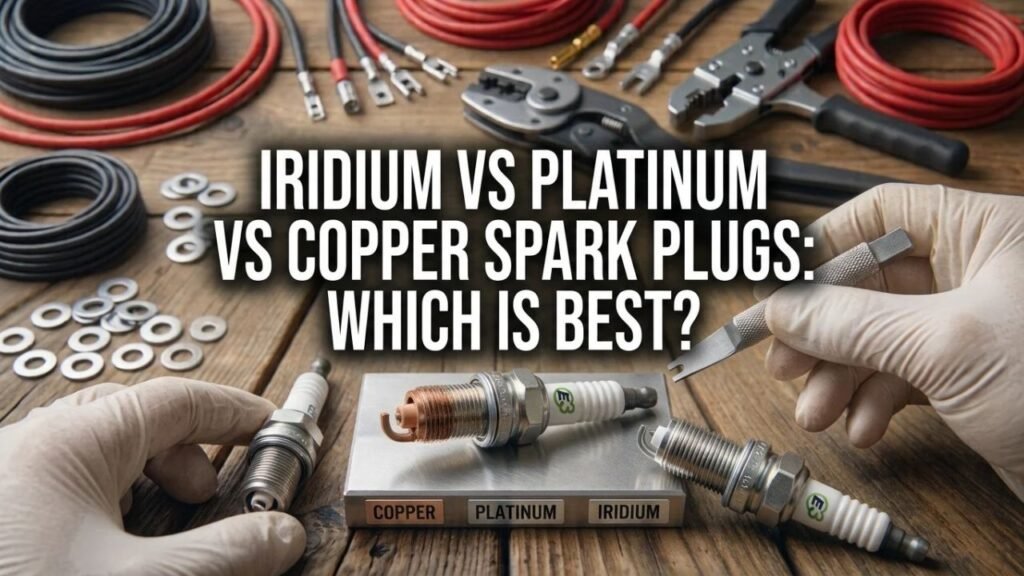
Iridium vs Platinum vs Copper Spark Plugs: Quick Comparison
Here is the basic difference:
| Feature | Copper-Core/Nickel | Platinum | Iridium |
| Typical initial price | Lowest | Medium | Highest |
| Electrode wear resistance | Lowest | High | Very high |
| Typical service life | Shorter | Long | Usually longest |
| Fine center electrode | Usually larger | Smaller | Can be extremely fine |
| Firing-voltage requirement | Depends on design | Generally low with fine-wire design | Often very low with fine-wire design |
| Best for older engines | Often excellent | Application dependent | Application dependent |
| Modern OEM use | Less common | Common | Very common |
| Long maintenance intervals | Less suitable | Good | Excellent |
| Performance gain by upgrading | Usually minimal | Usually minimal | Usually minimal |
| Main advantage | Low cost and proven design | Durability/value | Durability and fine-wire ignition |
These are general characteristics rather than universal rules.
A high-quality conventional plug designed specifically for an engine can be better for that engine than an expensive iridium plug with the wrong dimensions or heat range.
The Most Important Rule
Use the spark plug specification recommended for your exact vehicle and engine.
Do not select spark plugs based only on electrode material.
Key Takeaways:
- Iridium generally provides the best wear resistance and longest service intervals.
- Platinum is a strong middle ground between conventional and iridium designs.
- Conventional copper-core/nickel plugs remain excellent in engines designed for them.
- The correct OEM specification matters more than choosing the most expensive material.
What Are Copper Spark Plugs?
The term “copper spark plug” can be misleading.
Copper is an excellent conductor of both electricity and heat, so spark plug manufacturers commonly use it inside the center electrode.
However, copper is relatively soft and would erode quickly if exposed directly to combustion as the firing surface.
For that reason, a conventional copper-core spark plug typically has a nickel-alloy firing electrode surrounding the copper core.
When people compare copper plugs with platinum or iridium plugs, they are usually comparing traditional nickel-electrode plugs against precious-metal designs.
Why Copper Is Used Inside Spark Plugs
Copper transfers heat very efficiently.
That helps move heat away from the firing end and into the plug shell and cylinder head.
Copper can therefore be found inside many types of spark plugs—including some platinum and iridium designs.
The presence of platinum or iridium does not necessarily mean copper has disappeared from the internal construction.
Main Advantages of Conventional Copper-Core Plugs
The biggest advantage is cost.
Conventional plugs are inexpensive, widely available, and have been used successfully for decades.
They can also be ideal for older ignition systems designed around traditional electrode dimensions.
Performance engines that receive frequent plug changes may also use conventional plugs because long service life is less important when the plugs are routinely inspected and replaced.
Their main disadvantage is electrode wear.
Nickel-alloy firing surfaces erode more quickly than platinum or iridium, so their gaps tend to increase sooner.
What Are Platinum Spark Plugs?
A platinum spark plug uses a small amount of platinum at the firing surface to reduce electrode wear.
Platinum is harder and more resistant to erosion than conventional nickel.
That allows the plug to maintain its electrode shape and gap for significantly longer periods.
There are two major types:
Single platinum and double platinum.
Single Platinum Spark Plugs
A single-platinum plug normally has a platinum disc or tip on the center electrode.
The ground electrode remains a conventional material.
This design can provide a substantial durability improvement in ignition systems where wear primarily occurs at the center electrode.
Double Platinum Spark Plugs
A double-platinum plug uses platinum at both relevant firing surfaces—typically on the center electrode and the ground electrode.
This becomes particularly important in some distributorless wasted-spark ignition systems.
In a wasted-spark system, one coil can fire two spark plugs simultaneously.
One plug may fire with conventional polarity while the paired plug fires with reverse polarity.
Electrode wear can therefore occur differently on the two plugs.
A double-platinum design helps provide durable precious-metal surfaces regardless of spark direction.
Replacing a specified double-platinum plug with a single-platinum version can therefore increase electrode wear in some engines.
What Are Iridium Spark Plugs?
Iridium spark plugs use a small iridium firing tip on the center electrode.
Iridium is extremely hard, has a very high melting point, and resists electrical erosion exceptionally well.
Because it is so durable, manufacturers can use a very small-diameter center electrode.
A fine center electrode is one of the biggest technical advantages of iridium.
Why a Fine Electrode Matters
Electrical fields become concentrated around smaller, sharper electrode surfaces.
That allows a fine-wire spark plug to initiate a spark with relatively low voltage compared with a large, rounded electrode under otherwise similar conditions.
The small electrode also physically blocks less of the initial flame kernel.
This does not mean an iridium plug somehow produces additional ignition-coil energy.
Instead, its geometry allows efficient use of the available ignition energy.
Long Service Life
Iridium’s resistance to erosion allows many modern OEM iridium plugs to remain in service for very long manufacturer-specified intervals.
That can be particularly valuable on engines where spark plugs are difficult to reach.
If replacing plugs requires removing an intake manifold or other components, paying somewhat more for long-life plugs can make excellent economic sense.
Which Lasts Longer: Iridium, Platinum, or Copper?
In general:
Iridium lasts longest, platinum comes next, and conventional nickel plugs wear fastest.
However, exact mileage should not be assigned solely based on electrode material.
Spark plug life depends on:
Engine design.
Combustion temperature.
Ignition system.
Electrode geometry.
Plug gap.
Oil consumption.
Fuel quality.
Engine tuning.
Driving conditions.
Specific plug construction.
Manufacturer maintenance interval.
Some conventional plugs may need replacement relatively frequently, while long-life platinum and iridium plugs can operate for many tens of thousands of miles.
Certain OEM precious-metal plugs are designed around extremely long service intervals.
Always follow the vehicle maintenance schedule rather than assuming an internet mileage number applies to every plug.
Why Gaps Increase With Wear
Every ignition event removes microscopic amounts of electrode material.
As the electrodes erode, the distance the spark must jump gradually becomes larger.
A larger gap requires greater firing voltage.
Eventually, the gap can become wide enough that the ignition system begins struggling under demanding conditions.
Hard acceleration and high cylinder pressure are often where a worn plug first begins misfiring.
Iridium and platinum slow this erosion substantially.
Key Takeaways:
- Precious metals primarily improve electrode durability.
- Iridium generally resists erosion better than platinum, while platinum outlasts conventional nickel.
- Actual replacement intervals should come from the vehicle manufacturer, not material type alone.
Which Spark Plug Produces the Strongest Spark?
This question is often misunderstood.
The ignition coil supplies the electrical energy.
Changing from copper to iridium does not automatically make the coil produce more energy.
What electrode material and geometry can influence is how easily the spark initiates and how consistently the electrodes maintain their shape over time.
A fine-wire iridium plug can require less firing voltage than a large worn conventional electrode.
That can provide more ignition margin under high cylinder pressure.
But if a healthy engine already fires its OEM conventional plugs reliably, installing iridium does not necessarily produce a more powerful combustion event.
Once the mixture is successfully ignited, extra electrode cost does not automatically translate into extra horsepower.
Iridium vs Platinum Spark Plugs
Iridium and platinum are both long-life precious-metal technologies.
Iridium usually has the advantage in hardness and erosion resistance.
That allows extremely small center electrodes and potentially longer service life.
Platinum remains highly durable and can be an excellent value.
If an engine originally specifies platinum plugs, installing the correct OEM-style platinum plug is perfectly reasonable.
You should not assume iridium is required simply because it is newer or more expensive.
When Iridium Has the Advantage
Iridium is particularly attractive when:
The manufacturer specifies it.
Spark plug access is difficult.
Long service intervals matter.
The ignition system uses fine-wire plugs by design.
High cylinder pressure makes firing efficiency important.
When Platinum Makes Sense
Platinum can make sense when:
The manufacturer specifies platinum.
You want more durability than a conventional nickel plug.
The engine uses a wasted-spark system requiring double platinum.
The correct platinum plug costs significantly less than an equivalent iridium option.
The best decision still comes down to application compatibility.
Platinum vs Copper Spark Plugs
Platinum’s main advantage over a conventional copper-core/nickel plug is durability.
The conventional plug may perform extremely well when new.
The difference becomes more noticeable after many miles because the nickel electrode wears faster.
As the conventional plug gap increases, ignition requirements change.
Platinum maintains its firing surface longer.
Does Platinum Conduct Better Than Copper?
This is where terminology creates confusion.
Copper is a much better electrical and thermal conductor than platinum.
But remember that a “platinum spark plug” can still use a copper core.
The platinum exists mainly at the tiny firing surface because it resists erosion.
Therefore, spark plug selection is not simply a competition over which bulk metal conducts electricity better.
The design uses different materials for different jobs.
Copper handles heat transfer effectively.
Platinum provides a durable firing surface.
Iridium vs Copper Spark Plugs
When comparing iridium against conventional plugs, durability is the largest difference.
A fresh conventional copper-core/nickel plug can ignite the mixture perfectly well.
An iridium plug simply maintains its fine firing geometry for much longer.
Does Iridium Improve Performance?
If you replace badly worn conventional plugs with new iridium plugs, the engine may:
Start better.
Idle more smoothly.
Misfire less.
Accelerate more cleanly.
Regain lost fuel economy.
But those improvements may primarily come from replacing worn plugs.
If you had installed new correct conventional plugs instead, much of the same improvement could occur.
This is why “I installed iridium and gained power” does not necessarily prove iridium itself produced more horsepower.
The old plugs may simply have been worn.
Which Spark Plug Is Best for Horsepower?
For most stock engines, use the manufacturer’s specified plug.
Do not expect a measurable horsepower increase merely by switching electrode materials.
Performance depends more on selecting the correct:
Heat range.
Gap.
Electrode projection.
Plug design.
Ignition system.
Engine calibration.
In heavily modified engines, tuners sometimes select different spark plug constructions based on boost, compression, fuel, nitrous use, and cylinder pressure.
Even then, heat range and gap frequently matter more than whether the plug says iridium or copper on the box.
Racing Engines Can Be Different
Some racing engines use conventional plugs precisely because they are inexpensive and frequently replaced.
Long-life precious-metal electrodes offer little advantage when plugs are removed after short service intervals for combustion inspection.
Other racing engines use specialized iridium plugs because fine-wire electrodes improve firing under severe conditions.
There is no universal racing winner.
Which Spark Plug Is Best for Fuel Economy?
None of the three should be treated as an MPG upgrade.
Correctly functioning spark plugs help the engine burn its mixture consistently.
A worn plug that causes misfire can reduce efficiency.
Replacing it can restore lost fuel economy.
However, installing iridium instead of a perfectly functioning OEM platinum plug does not automatically improve gas mileage.
Fuel economy depends much more on engine calibration, driving conditions, air-fuel ratio, vehicle load, tire pressure, and numerous other factors.
Choose plugs for compatibility and reliable ignition, not fuel-saving claims.
Which Is Best for Cold Starting?
A fine-wire iridium plug can provide excellent ignitability because the small electrode geometry requires relatively low firing voltage.
This can be useful under difficult starting conditions.
However, cold-start performance depends on the entire system.
A weak battery, poor fuel delivery, incorrect mixture, low compression, or failing ignition coil will not be fixed by installing expensive plugs.
If the manufacturer specifies conventional or platinum plugs and the engine starts correctly, there is usually no need to change materials for winter use alone.
Which Spark Plugs Are Best for Turbocharged Engines?
Use the exact type recommended by the manufacturer or experienced tuner.
Turbocharged engines create higher cylinder pressure, which generally makes the spark more difficult to establish.
Modern turbocharged production engines commonly use fine-wire precious-metal plugs because they combine reliable firing with long service life.
Modified high-boost engines may require:
A colder heat range.
Reduced gap.
Different electrode configuration.
More frequent replacement.
A tuner may sometimes recommend a different plug material as well.
Do not make the decision based solely on “iridium is best.”
The correct heat range and gap can be critical in a high-boost engine.
Which Spark Plugs Are Best for Older Cars?
If an older engine was designed for conventional copper-core/nickel plugs, there may be no compelling reason to change.
Older ignition systems, distributors, plug wires, and combustion chambers were engineered around those plugs.
A quality conventional plug may deliver excellent performance at very low cost.
Switching to iridium or platinum is reasonable only when a reputable spark plug application catalog lists an appropriate replacement.
Do not simply find an expensive plug with matching threads.
Thread reach, heat range, resistor type, projection, and seat must also match.
Classic Cars
Classic engines can be particularly sensitive to plug selection.
Some use ignition systems with less voltage reserve than modern coil-on-plug systems.
Some also operate with carburetors that create different fouling conditions.
A conventional plug that can be cleaned and replaced economically may actually be more practical.
Which Is Best for Modern Cars?
Generally, use whichever precious-metal plug the manufacturer originally specified.
Many modern engines use iridium, platinum, double platinum, or combinations of precious-metal electrode designs.
Long replacement intervals are part of the engine’s maintenance strategy.
Installing a cheap conventional plug may physically work at first but could drastically shorten the service interval.
It may also alter firing characteristics.
If the car came with iridium plugs, replacing them with equivalent OEM-spec iridium plugs is normally the safest choice.
What Is Double Iridium?
Like double platinum, some spark plugs use precious metal on both sides of the firing gap.
A double-iridium or iridium-enhanced ground-electrode design can reduce wear on both electrodes and support long service intervals.
Manufacturers may use a small precious-metal pad or specialized ground electrode rather than constructing the whole strap from iridium.
Because these designs are engineered as a complete system, they should not be compared solely by marketing labels.
Check the actual application.
Do Iridium Spark Plugs Need a Smaller Gap?
Not automatically.
The correct gap comes from the engine and spark plug specification.
A fine-wire iridium electrode can fire efficiently, but that does not mean you should arbitrarily reduce the gap.
Some engines use a relatively large factory iridium gap.
Others, especially modified boosted engines, may use a smaller gap.
Follow the correct specification.
Be Careful When Gapping Iridium
Fine-wire iridium center electrodes are delicate.
If adjustment is required and permitted, bend only the ground electrode.
Do not pry against the center electrode.
If a new precious-metal plug is dramatically outside specification, verify the part number and inspect for shipping damage before attempting a large adjustment.
Does Copper Run Cooler Than Iridium or Platinum?
This is another common misconception.
Copper is an excellent heat conductor, but the plug’s heat range is determined by the complete internal design, particularly how heat travels through the insulator nose into the shell and cylinder head.
You can buy hot and cold plugs in different electrode materials.
A copper-core plug is not automatically a colder plug.
Likewise, iridium does not automatically mean hotter.
When tuning an engine, select the correct rated heat range rather than trying to infer temperature from electrode material.
Do Iridium Plugs Cause Ignition Coil Problems?
Correctly specified iridium plugs should not harm healthy ignition coils.
Problems arise when the plug gap is incorrect, the wrong plug is installed, or plugs are allowed to wear excessively.
An overly large gap can require additional firing voltage and increase stress on the ignition system.
That issue is not unique to iridium.
In fact, fine-wire electrode designs can make the spark easier to initiate.
Use the correct part number and replacement interval.
Can You Mix Copper, Platinum, and Iridium Spark Plugs?
I do not recommend it in a normal engine.
All cylinders should generally use matching spark plugs with the same part number and specifications.
Mixing different electrode designs can produce differences in firing characteristics and wear.
Even if the engine appears to run, there is little benefit.
When replacing plugs, install a complete matched set unless the manufacturer specifically specifies something unusual.
Can You Upgrade From Copper to Platinum or Iridium?
Sometimes, but only with a properly cross-referenced plug.
A legitimate upgrade needs to maintain the original:
Heat range.
Thread diameter.
Reach.
Seat type.
Electrode projection.
Resistor specification.
Required gap.
Physical clearance.
A spark plug manufacturer’s application catalog can identify compatible precious-metal alternatives.
Do not choose an iridium plug just because it has the same thread.
Will an Upgrade Increase Power?
Usually not.
The main gain is often longer plug life and more stable gap over time.
If the engine already runs perfectly on its specified conventional plugs, horsepower is unlikely to change meaningfully.
Key Takeaways:
- Precious-metal plugs are primarily durability and electrode-design upgrades, not guaranteed horsepower upgrades.
- Modern engines should generally retain the OEM-specified plug technology.
- Older engines may work perfectly with conventional copper-core plugs.
- Never substitute based only on thread size or price.
Are Copper Spark Plugs Better for Performance Cars?
Sometimes, but not because copper itself creates more horsepower.
Conventional plugs can be attractive in racing because they are cheap enough to replace frequently.
Racers also read spark plug coloration and condition as part of tuning.
If plugs are being removed constantly anyway, paying for extremely long iridium service life may offer little benefit.
On the other hand, high-boost or high-pressure engines may benefit from specialized fine-wire racing plugs.
This is why you will see both conventional and precious-metal plugs in motorsports.
The engine combination determines the answer.
Which Type Is Cheapest to Own?
If you look only at purchase price, conventional copper-core plugs usually win.
But total ownership cost can tell a different story.
Imagine an engine where spark plugs are buried beneath an intake manifold.
Even if conventional plugs cost much less, replacing them several times as often can create substantial labor expense.
An iridium plug with a long manufacturer-approved interval may therefore cost less over the life of the vehicle.
For an easy-to-service older four-cylinder engine, conventional plugs may remain very economical.
The installation labor matters.
Is Platinum Better Value Than Iridium?
Sometimes.
Platinum often occupies the middle ground.
It provides much better wear resistance than conventional nickel without always costing as much as premium iridium.
If your engine specifies platinum, there may be no practical reason to pay extra for iridium unless a compatible upgrade offers a clear maintenance advantage.
However, if your vehicle originally uses long-life iridium plugs, downgrading to platinum to save a few dollars may reduce service life and create more maintenance later.
What About Ruthenium Spark Plugs?
Ruthenium is another precious-metal technology now available in some spark plug lines.
It can offer excellent durability and advanced electrode geometries.
However, it does not make iridium, platinum, or conventional plugs obsolete.
Just like the other materials, the correct choice depends on whether the exact spark plug is approved for your engine.
Material marketing should never replace application compatibility.
How to Choose Between Iridium, Platinum, and Copper Spark Plugs
Start with the owner’s manual or a reputable spark plug application catalog.
Identify the exact recommended part number or specification.
If the manufacturer calls for iridium, use iridium or an explicitly approved equivalent.
If the engine specifies double platinum because of its ignition-system design, do not replace it with single platinum simply because both contain platinum.
If the engine was designed for a conventional nickel plug, you can continue using it confidently.
A properly cross-referenced iridium or platinum upgrade may provide longer life, but it should come from an established manufacturer application chart.
Don’t Choose Based Only on Price
A $15 spark plug is not automatically three times better than a $5 plug.
And a $3 plug is not automatically inferior.
The cheapest correct plug can outperform the most expensive incorrect one.
Common Myths About Iridium, Platinum, and Copper Spark Plugs
One common myth is that copper plugs always create a stronger spark because copper conducts electricity better.
This ignores the fact that many precious-metal plugs still use copper cores and that firing voltage depends heavily on electrode geometry.
Another myth is that iridium automatically creates more horsepower.
Usually, it does not.
Its major advantages are durability and the ability to use a very fine electrode.
A third myth is that iridium plugs never need replacement.
They last a long time, but electrodes still wear and engines still contaminate plugs.
Another misconception is that platinum and iridium cannot foul.
They can.
Oil, fuel, carbon, coolant, and combustion problems can foul any spark plug.
Finally, a more expensive plug cannot correct an underlying engine problem.
If the engine is burning oil or has a weak coil, changing electrode metal will not solve the cause.
FAQs About Iridium vs Platinum vs Copper Spark Plugs
Which is better, iridium, platinum, or copper spark plugs?
For most modern vehicles requiring long service intervals, iridium is generally the premium option. Platinum provides excellent durability, while conventional copper-core/nickel plugs remain appropriate for many older engines.
The best plug is still the manufacturer-specified one.
Do iridium spark plugs last longer than platinum?
Generally, yes.
Iridium is extremely resistant to wear and allows a durable fine-wire electrode, although exact service life varies by plug and engine.
Does platinum last longer than copper spark plugs?
A platinum firing surface normally resists electrode erosion much better than a conventional nickel electrode, so platinum plugs generally maintain their gap longer.
Are copper spark plugs actually made of copper?
They usually contain a copper core, but their exposed firing electrode is generally nickel alloy rather than bare copper.
Do iridium spark plugs increase horsepower?
Not normally in a healthy stock engine.
Replacing worn plugs may restore lost performance, but simply changing electrode material does not guarantee additional horsepower.
Do iridium spark plugs improve MPG?
They can help maintain reliable combustion over a long service life, but they are not a guaranteed fuel-economy upgrade.
Do platinum spark plugs increase performance?
They primarily improve durability compared with conventional electrodes.
A healthy engine usually will not gain significant power simply by switching to platinum.
Are copper plugs better for racing?
They can be useful because they are inexpensive and easy to replace frequently, but some race engines benefit from specialized iridium or other fine-wire plugs.
What is the main benefit of iridium plugs?
Very high electrode wear resistance combined with the ability to use an extremely fine center electrode.
What is the main benefit of platinum plugs?
Longer electrode life than conventional nickel plugs at a price often lower than premium iridium.
What is the main benefit of copper-core plugs?
Low cost, excellent thermal conductivity through the copper core, and suitability for many engines originally designed around conventional plugs.
Are iridium plugs worth the extra cost?
They often are when the engine specifies them, plug access is difficult, or long service intervals are valuable.
Can I replace copper plugs with iridium?
Only if a reputable application catalog lists an iridium replacement for your exact engine.
Do not select one based only on matching threads.
Can I replace platinum with iridium?
Often there are compatible iridium upgrades, but you should confirm the exact application.
A wasted-spark system may have specific electrode-wear requirements.
Can I replace iridium plugs with copper?
The engine may run, but you could greatly shorten the replacement interval and deviate from the OEM ignition design.
I recommend retaining the specified iridium technology.
What is double platinum?
A double-platinum plug uses platinum on both sides of the spark gap, helping resist wear in ignition systems where spark polarity can differ between cylinders.
Is double platinum better than iridium?
Not universally.
Double platinum may be exactly what a particular wasted-spark ignition system requires, while iridium may be preferable in another engine.
Application matters more than ranking the materials.
Which spark plug starts easier in cold weather?
Fine-wire iridium plugs can offer excellent ignitability, but proper starting depends on the complete ignition, fuel, battery, and engine system.
Which plug is best for turbo engines?
Use the manufacturer or tuner’s recommended plug, heat range, and gap. Many modern turbo engines use iridium, but heavily modified engines may require different specifications.
Do copper spark plugs run colder?
Not automatically.
Heat range is determined by the plug’s overall thermal design, not simply the firing-electrode material.
Can iridium spark plugs foul?
Yes.
Oil, excessive fuel, coolant, carbon deposits, or poor engine conditions can foul an iridium plug just like other types.
Can I mix iridium and platinum plugs?
I would not.
Use a matched set with the same correct part number unless the vehicle manufacturer specifically states otherwise.
Which spark plugs are best for older vehicles?
Often the conventional plug originally specified by the manufacturer. A compatible platinum or iridium upgrade may offer longer life, but it is not always necessary.
Which spark plugs are best for a modern daily driver?
Use the OEM-specified technology. Many modern vehicles use long-life platinum or iridium plugs because maintenance intervals and ignition systems were designed around them.
Conclusion
When comparing iridium vs platinum vs copper spark plugs, there is no single material that is automatically best for every engine.
Iridium generally provides the highest electrode wear resistance and allows an extremely fine center electrode. That makes it particularly well suited to modern engines, difficult-to-service plug locations, and long manufacturer-specified replacement intervals.
Platinum offers excellent durability at a moderate price. Single-platinum plugs work well in appropriate ignition systems, while double-platinum designs are particularly important in some wasted-spark systems where both electrodes need increased wear resistance.
What people call copper spark plugs are usually conventional copper-core plugs with nickel-alloy firing surfaces. They are inexpensive, proven, and can be exactly the right choice for older engines or applications where plugs are changed frequently. Their primary disadvantage is shorter electrode life.
Do not assume iridium provides more horsepower simply because it costs more. A fresh conventional plug can ignite the mixture perfectly well in an engine designed for it. Precious metals mainly allow the spark plug to maintain its firing geometry for a much longer period and can support fine-wire electrode designs.
My recommendation is straightforward: use the spark plug type specified by your vehicle manufacturer unless a reputable spark plug application guide lists a compatible upgrade.
If your vehicle came with iridium, stay with the correct iridium plug. If it specifies double platinum, retain that design. If an older engine was designed around conventional copper-core/nickel plugs, there is nothing inherently wrong with continuing to use them.
The correct heat range, reach, seat, gap, resistor design, and application are ultimately more important than whether the box says copper, platinum, or iridium.