
Cracked spark plug symptoms commonly include engine misfires, rough idling, hesitation, reduced power, hard starting, and a check engine light. You may also find a visible crack, chipped ceramic, or a dark electrical track on the plug insulator.
A spark plug uses a ceramic insulator to prevent ignition voltage from escaping before it reaches the electrode gap. When that ceramic cracks, electrical energy may leak through the damaged area instead of producing a reliable spark inside the combustion chamber.
Some cracks are obvious when the plug is removed. Others are extremely thin and may cause problems only when the engine is hot, under acceleration, or operating under a heavy load.

What Happens When a Spark Plug Cracks?
A cracked spark plug may no longer control the path of the ignition voltage correctly.
The ignition coil sends high voltage through the spark plug’s center conductor. Under normal conditions, the voltage travels to the firing tip and jumps across the spark plug gap, igniting the compressed air-fuel mixture.
The ceramic insulator keeps that voltage separated from the grounded metal shell. If the ceramic develops a crack, the voltage may escape through the damaged area or travel down the outside of the insulator.
This is known as spark leakage, flashover, or electrical tracking.
As a result, the affected cylinder may receive:
- A weak spark
- An intermittent spark
- A spark at the wrong location
- No usable spark at all
DENSO notes that a damaged or broken insulator can cause spark leakage and affect the plug’s thermal behavior. Champion also identifies damaged spark plugs, including cracked insulators, as a possible cause of ignition misfires.
Common Cracked Spark Plug Symptoms
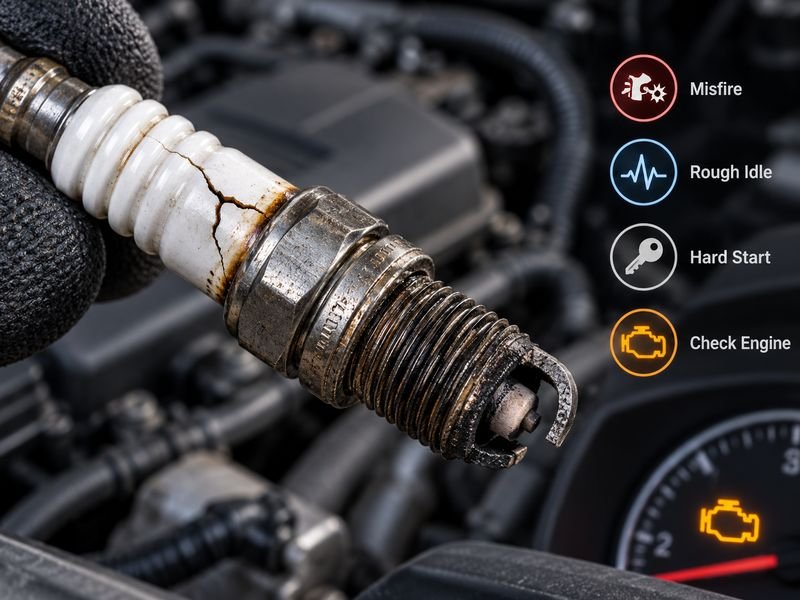
The exact symptoms depend on the crack’s location and severity.
A small external crack may cause an occasional misfire. A badly broken insulator may prevent the cylinder from firing consistently or allow ceramic material to separate from the plug.
1. Engine Misfires
An engine misfire is one of the most common cracked spark plug symptoms.
When ignition voltage escapes through a crack, the spark may not jump correctly between the center and ground electrodes. The air-fuel mixture in that cylinder may ignite weakly, ignite late, or fail to ignite.
You may notice:
- A sudden interruption in engine power
- Jerking or stumbling while driving
- Uneven exhaust pulses
- Intermittent shaking
- A misfire that comes and goes
- Poor operation under acceleration
A small crack may not cause a constant misfire. The engine may run normally at idle but misfire when cylinder pressure rises during acceleration.
Higher cylinder pressure makes it more difficult for the spark to cross the electrode gap. Escaping through a damaged insulator may become the easier electrical path.
NGK lists damaged spark plugs, including those with cracked insulators, among the possible causes of misfires.
2. Rough or Unstable Idle
A cracked spark plug can cause the engine to idle roughly.
At idle, the engine depends on each cylinder producing a controlled combustion event at regular intervals. If one plug fires inconsistently, engine speed may fluctuate and the vehicle may vibrate more than usual.
Common signs include:
- Shaking through the steering wheel or seat
- Uneven engine rhythm
- Periodic drops in RPM
- A pulsing exhaust sound
- An engine that feels as though it may stall
DENSO states that a cracked insulator can lead to misfires and poor idling and recommends replacing the affected plug.
Rough idle is not unique to a cracked plug. Vacuum leaks, fuel injector problems, ignition coil faults, and compression loss can produce similar behavior.
A cracked plug becomes a stronger suspect when the rough idle begins shortly after spark plug installation or affects one specific cylinder.
3. Hesitation During Acceleration
A vehicle with a cracked spark plug may hesitate when you press the accelerator.
Acceleration increases the amount of air and fuel entering the cylinders. It also increases the voltage demand placed on the ignition system.
A minor crack may allow the plug to work under light conditions but leak voltage when the engine is under load.
You may experience:
- A delay after pressing the accelerator
- Brief stumbling during takeoff
- Jerking while climbing a hill
- Hesitation during highway merging
- Misfiring during hard acceleration
- Normal operation after releasing the throttle
This load-related pattern can make the problem difficult to identify. The engine may appear normal while parked but run poorly during a road test.
4. Reduced Engine Power
A cracked plug can prevent one cylinder from contributing its full share of engine power.
If combustion is weak or incomplete, the engine may feel less responsive. In severe cases, the affected cylinder may stop producing useful power almost entirely.
Possible signs include:
- Slower acceleration
- Reduced throttle response
- Difficulty maintaining speed uphill
- Weak performance while towing
- Loss of power at higher RPM
- An engine that feels unusually strained
The degree of power loss depends partly on the engine design.
A single cracked plug may be especially noticeable in a three-cylinder or four-cylinder engine because each cylinder represents a larger percentage of total output. The same fault may feel less dramatic in an engine with more cylinders, although it should still be repaired.
5. The Check Engine Light Turns On
A cracked spark plug may trigger the check engine light when the engine control module detects repeated misfires.
The light may remain steady when the misfire occurs occasionally. It may flash when the misfire is severe enough to create an immediate risk to the catalytic converter.
A scan tool may display:
- A random or multiple-cylinder misfire
- A misfire associated with one cylinder
- A pending misfire code
- Freeze-frame data showing when the problem occurred
A cylinder-specific misfire does not automatically prove that the spark plug is cracked. The ignition coil, fuel injector, wiring, or mechanical condition of that cylinder may be responsible.
However, the spark plug should be physically inspected before more expensive components are replaced.
6. Hard Starting
A cracked spark plug may make the engine difficult to start, particularly when the crack causes substantial voltage leakage.
During cranking, the ignition system must produce enough energy to ignite the mixture while battery voltage may already be reduced by starter operation.
You may notice:
- Longer cranking than usual
- Starting only after several attempts
- Starting followed by immediate stumbling
- Difficult cold starts
- Difficult hot restarts
- A strong gasoline smell after repeated attempts
Hard starting is more likely when the crack is severe or when multiple plugs are damaged.
A single cracked plug in a multi-cylinder engine may still allow the engine to start, but the engine may shake or run unevenly immediately afterward.
7. Poor Fuel Economy
A cracked spark plug can reduce fuel economy when the affected cylinder fails to burn fuel efficiently.
The engine control system may continue delivering fuel even when ignition in that cylinder is weak or inconsistent. Some of that fuel may leave the cylinder without producing useful power.
Possible signs include:
- Fewer miles from a tank of gasoline
- More frequent refueling
- Reduced trip-computer fuel economy
- A gasoline odor from the exhaust
- Increased fuel use combined with a misfire
Poor fuel economy alone is not enough to diagnose a cracked spark plug.
Low tire pressure, short trips, cold weather, fuel-system problems, oxygen sensor faults, and driving conditions can also increase consumption. The plug becomes more relevant when reduced economy appears with a cylinder misfire or visible insulator damage.
8. Fuel Smell or Unusual Exhaust Behavior
A badly cracked spark plug may allow unburned or partially burned fuel to enter the exhaust.
This can produce:
- A raw gasoline smell
- Uneven exhaust pulses
- Dark exhaust under some conditions
- Popping from the exhaust
- Higher hydrocarbon emissions
Continued misfiring may expose the catalytic converter to unburned fuel. Champion warns that misfire conditions created by electrical leakage paths can contribute to catalyst damage.
A fuel smell may also indicate an external gasoline leak. If fuel is leaking from the tank, lines, injectors, or engine compartment, stop operating the vehicle and address the leak immediately.
9. Visible Cracks, Chips, or Electrical Tracks
Physical damage is the clearest indication that a spark plug should be replaced.
After removing the plug, you may find:
- A hairline crack in the white ceramic
- A chipped upper insulator
- A split near the plug terminal
- A broken firing-end insulator
- Missing ceramic around the center electrode
- A loose piece of ceramic
- A vertical black line down the outside of the insulator
The vertical dark line may be a carbon track created by voltage traveling down the outside of the ceramic instead of through the intended electrode gap.
Champion describes flashover as black burn marks running vertically down the insulator toward the metal shell. It may be associated with a worn or poorly fitting spark plug boot and commonly causes misfiring.
Not every brown or dark mark indicates a crack. Some harmless discoloration can form around the lower part of the external ceramic because of corona discharge.
A true carbon track generally appears as a defined line running lengthwise along the insulator. A corona stain usually appears as a broader ring or patch near the metal shell and does not necessarily affect plug operation.
Cracked Spark Plug Symptoms at a Glance
| Symptom | What You May Notice | How a Crack Can Cause It |
| Engine misfire | Jerking, stumbling, or missed combustion | Voltage escapes through the damaged insulator |
| Rough idle | Shaking or unstable RPM | The affected cylinder fires inconsistently |
| Acceleration hesitation | Stumbling under throttle | Higher cylinder pressure increases ignition demand |
| Power loss | Weak acceleration or poor load performance | The cylinder produces incomplete combustion |
| Check engine light | Steady or flashing warning light | The control module detects repeated misfires |
| Hard starting | Extended cranking | The plug cannot ignite the mixture reliably |
| Poor fuel economy | Increased gasoline use | Fuel burns incompletely |
| Fuel smell | Raw gasoline odor from the exhaust | Unburned fuel enters the exhaust |
| Visible damage | Cracks, chips, or carbon tracks | The ceramic insulation has physically failed |
What Does a Cracked Spark Plug Look Like?
A cracked spark plug does not always look completely broken.
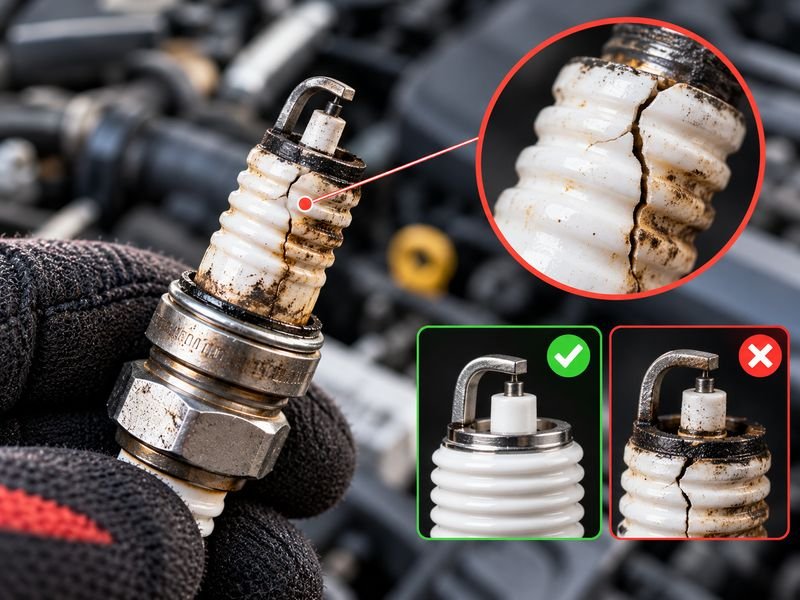
Some damage appears as a thin line that is visible only under bright light. Other plugs may have missing ceramic, broken electrodes, or clear burn marks.
Hairline Crack on the Upper Insulator
A hairline crack may form on the white ceramic section above the metal hex.
This type of crack can result from:
- A socket pressing sideways during installation
- Dropping the spark plug
- Impact from a tool
- Excessive tightening
- A damaged spark plug boot being forced into place
The crack may be difficult to see while the plug is installed. Rotate the removed plug under a bright light and inspect the ceramic from several angles.
Crack Near the Firing Tip
The firing-end insulator surrounds the center electrode inside the combustion chamber.
Cracks in this area may appear as:
- A split in the ceramic nose
- A chipped edge
- Missing material
- Small black or gray spots
- A loosened ceramic section
Damage near the firing end can be associated with abnormal combustion, excessive heat, detonation, or physical damage.
Champion states that severe detonation can crack or break the insulator or ground electrode, potentially causing poor running and engine damage.
Broken or Missing Ceramic
If part of the ceramic insulator is missing, do not reinstall the spark plug.
The missing material may have fallen outside the engine during removal, remained in the plug well, or entered the combustion chamber.
A loose fragment inside a cylinder may contact the piston, cylinder wall, or valves. DENSO notes that broken insulator damage can contribute to overheating, pre-ignition, and, in some cases, engine damage.
Avoid repeatedly cranking or starting the engine when a plug is removed with a significant piece missing. The cylinder may need to be inspected before the engine is operated again.
Black Carbon Track on the Ceramic
A narrow black line down the plug’s outer ceramic surface may indicate that voltage has been escaping externally.
The track can become conductive and continue directing voltage away from the firing gap, even after the original cause is addressed.
Inspect the inside of the ignition coil boot or spark plug wire boot as well. A matching track may appear inside the boot.
Replacing only the plug may not permanently solve the problem if the damaged boot continues to provide a leakage path.
How to Confirm a Cracked Spark Plug
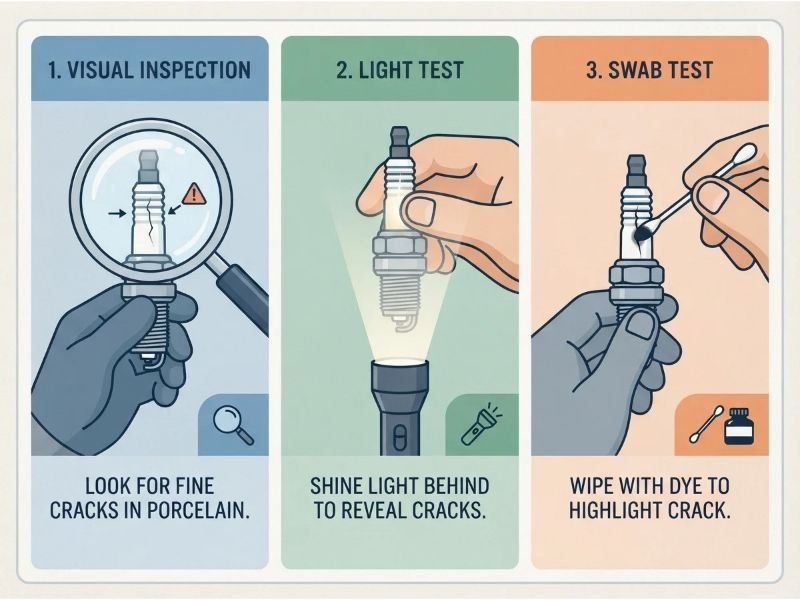
I recommend confirming the problem through physical inspection rather than relying on engine symptoms alone.
Let the Engine Cool
Spark plugs and cylinder heads become extremely hot during operation.
Allow the engine to cool before removing a plug. Removing a plug from a hot aluminum cylinder head may increase the risk of thread damage.
Clean Around the Plug Well
Remove dirt, sand, oil, and loose debris from around the spark plug before removal.
Debris can fall into the cylinder once the plug is removed. A dirty plug well can also hide carbon tracking or damage to the ignition boot.
Remove the Plug With the Correct Socket
Use a properly sized spark plug socket and keep the extension aligned with the plug.
Avoid applying sideways force to the ceramic. A socket or extension operating at an angle can place stress on the insulator and may create new damage during removal.
Inspect the Ceramic Under Bright Light
Rotate the plug slowly and inspect the complete insulator.
Look for:
- Thin dark lines
- Surface splits
- Chipped edges
- Burn marks
- Loose ceramic
- Missing pieces
- Discoloration that follows a crack
A magnifying glass can help reveal a fine crack that is difficult to see with the unaided eye.
Compare the Suspected Plug With the Others
Compare the damaged plug with the plugs removed from the other cylinders.
A cracked plug may look noticeably different because of:
- A carbon track
- Abnormal deposits
- A damaged firing tip
- Uneven discoloration
- Missing ceramic
- Signs of overheating
Keep track of which cylinder each plug came from. Mixing the plugs may make it harder to connect the physical damage with a cylinder-specific misfire.
Inspect the Ignition Boot
Check the coil boot or spark plug wire boot for:
- A matching carbon track
- Tears or cracks
- Oil contamination
- Moisture
- A loose terminal
- Burned areas
A defective boot can allow voltage to travel down the outside of a new plug. Champion recommends replacing affected plugs and leads when external flashover has created carbon tracking.
What Causes a Spark Plug to Crack?
A spark plug can crack because of installation damage, abnormal combustion, excessive heat, or physical impact.
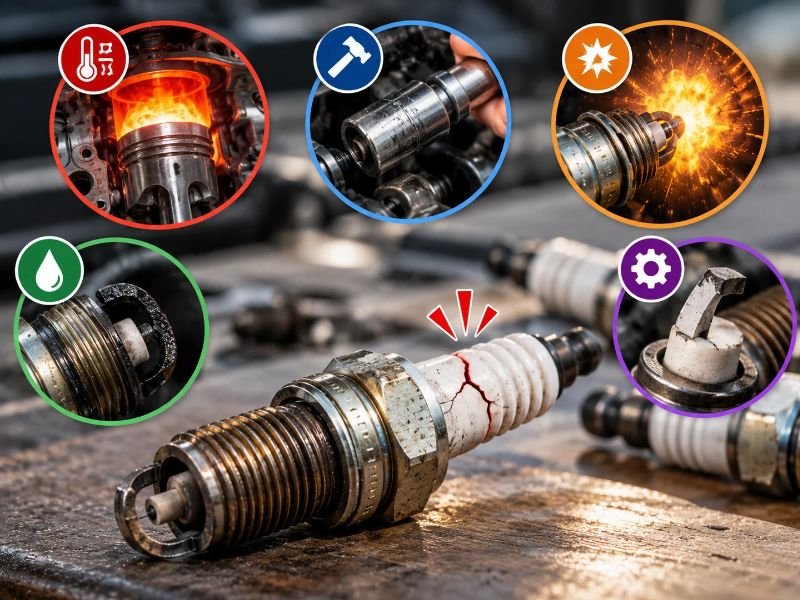
Excessive Installation Torque
Overtightening can deform the plug housing and place mechanical stress on the ceramic insulator.
DENSO identifies excessive tightening torque as a common cause of cracked insulators. The company recommends using the engine or plug manufacturer’s specified torque.
A plug should not be tightened based only on guesswork. The correct specification varies according to plug design, thread diameter, gasket type, and cylinder-head material.
Side Pressure From the Socket
A spark plug socket or extension that is not aligned with the plug can push against the ceramic.
This is more likely in deep or angled plug wells where access is restricted. Using a universal joint at a severe angle may also make it difficult to control side loading.
Dropping the Spark Plug
Ceramic is hard but brittle.
A plug may develop a small crack after being dropped onto concrete or struck against a hard surface. The damage may not be immediately visible.
A dropped plug should be inspected carefully before installation.
Detonation or Abnormal Combustion
Detonation creates rapid pressure changes and shock waves inside the combustion chamber.
Severe detonation may crack the firing-end insulator or damage an electrode. Possible contributing conditions include incorrect fuel octane, an excessively lean mixture, improper ignition timing, or an engine-control fault.
Replacing the cracked plug without addressing repeated detonation may allow the damage to return.
Excessive Heat
Overheating can weaken or damage the firing-end insulator.
Possible contributors include:
- An incorrect spark plug heat range
- A lean air-fuel mixture
- Engine overheating
- Incorrect ignition timing
- A loose spark plug
- Pre-ignition
A plug exposed to excessive heat may have a chalky white, blistered, or glazed appearance in addition to ceramic damage. Champion recommends replacing burned plugs and correcting the condition that caused the overheating.
Incorrect Spark Plug
A plug with the wrong dimensions, reach, seat type, or heat range may not operate safely in the engine.
A plug that extends too far into the combustion chamber may contact internal components. A plug with the wrong heat range may also operate at an unsuitable temperature.
Always match the replacement plug to the vehicle or engine manufacturer’s specification.
Can a Cracked Spark Plug Still Work?
A cracked spark plug may continue working temporarily, especially when the crack is small.
The plug may fire normally under light load but misfire when:
- The engine becomes hot
- Acceleration increases
- Cylinder pressure rises
- Humidity increases
- The ignition system demands higher voltage
Temporary normal operation does not make the plug safe to reuse.
Once the ceramic insulator has cracked, it can no longer be relied on to contain the ignition voltage or remain structurally stable.
Can You Drive With a Cracked Spark Plug?
Driving with a cracked spark plug is not recommended.
An occasional misfire can develop into a constant misfire without warning. Continued operation may also send unburned fuel into the catalytic converter.
Stop driving and arrange an inspection when:
- The check engine light is flashing
- The engine shakes severely
- Power drops suddenly
- Loud knocking begins
- The plug has missing ceramic
- A broken piece may have entered the cylinder
A short trip with a mild misfire is still a risk rather than a reliable solution. Replacing the damaged plug promptly is usually less expensive than repairing ignition, catalytic converter, or internal engine damage.
Can a Cracked Spark Plug Be Repaired?
No. A cracked spark plug should be replaced.
Cleaning cannot repair a ceramic crack. Adhesive, sealant, or epoxy should not be applied because the plug operates under high voltage, extreme temperature, and combustion pressure.
Replace the plug with the correct:
- Thread diameter
- Thread reach
- Seat design
- Heat range
- Electrode type
- Manufacturer-specified part number
The ignition boot should also be inspected and replaced when it has burns, tears, or carbon tracking.
Cracked Spark Plug vs. Carbon Tracking
A ceramic crack and a carbon track are related but not identical.
A ceramic crack is a physical break in the spark plug insulator. A carbon track is a conductive burn path formed when voltage repeatedly travels down the outside of the insulator.
A cracked plug can create a leakage path that develops into carbon tracking. However, carbon tracking may also occur on an uncracked plug when the ignition boot is worn, loose, dirty, or contaminated.
| Condition | Typical Appearance | Main Problem |
| Cracked ceramic | Thin split, chip, or missing porcelain | Physical insulator failure |
| Carbon tracking | Narrow black line down the ceramic | External voltage leakage |
| Corona stain | Broad brown or tan discoloration | Usually harmless surface staining |
| Carbon fouling | Dry black soot around the firing tip | Deposits interfere with ignition |
This distinction prevents a normal corona stain from being incorrectly diagnosed as a cracked plug.
Frequently Asked Questions
What Are the First Symptoms of a Cracked Spark Plug?
The first symptoms are often an intermittent misfire, slight hesitation, or roughness under acceleration.
A small crack may not affect the engine continuously. The problem can appear only when the engine is hot or under load because those conditions increase ignition-voltage demand.
Will a Cracked Spark Plug Always Cause a Misfire?
No. A very small crack may not produce an obvious misfire under every operating condition.
However, the crack can expand or begin leaking voltage as temperature and cylinder pressure change. Any confirmed ceramic crack is sufficient reason to replace the plug.
Can a Cracked Spark Plug Cause a Check Engine Light?
Yes. A cracked spark plug can cause a check engine light when voltage leakage results in repeated combustion misfires.
The stored diagnostic code may identify the affected cylinder, but the plug, ignition coil, injector, wiring, and mechanical condition should still be checked.
Can a Cracked Spark Plug Cause Knocking?
A cracked plug usually causes misfiring, hesitation, or rough running rather than true mechanical knocking.
However, a broken ceramic fragment inside the cylinder could create abnormal impact noise. Detonation may also crack a spark plug and produce a pinging or knocking sound. Stop the engine if a plug is missing ceramic and new mechanical noise is present.
Can Overtightening Crack a Spark Plug?
Yes. Excessive tightening can deform the plug body and place stress on the ceramic insulator.
DENSO specifically identifies overtorque as a cause of cracked insulators. Use the torque value and installation procedure specified for the engine and spark plug.
Can a Cracked Spark Plug Damage an Ignition Coil?
A damaged plug can increase stress on the ignition system when voltage cannot travel through the intended spark gap.
DENSO notes that damaged or worn spark plugs can contribute to ignition-coil voltage overload and internal coil damage.
Inspect the coil boot and coil whenever a cracked plug has been causing an extended misfire.
Should I Replace One Cracked Plug or All Spark Plugs?
A recently installed set may require replacement of only the damaged plug, provided the other plugs are correct and in good condition.
If all plugs have similar mileage, replacing the complete set may provide more consistent performance. Use the manufacturer-specified plug and inspect the cause of the crack before installation.
Conclusion
Cracked spark plug symptoms include engine misfires, rough idle, hesitation, reduced power, hard starting, poor fuel economy, a check engine light, and visible ceramic damage or carbon tracking.
The most useful confirmation is a close physical inspection of the spark plug and ignition boot. A genuine crack may be extremely thin, so examine the complete ceramic insulator under bright light and look for chips, splits, missing material, or a narrow black electrical track.
I recommend replacing any spark plug with confirmed ceramic damage. A cracked insulator cannot be cleaned or repaired reliably, and continuing to use it may worsen misfires or place additional stress on the ignition and exhaust systems.
The replacement plug should match the exact engine specification and be installed using the recommended procedure and torque. If the original plug cracked because of detonation, overheating, a damaged ignition boot, or incorrect installation, that underlying cause should also be corrected.