
If you are wondering can a broken glow plug damage an engine, the answer is yes—especially if part of the glow plug breaks off and falls into the combustion chamber. A loose glow plug tip can be struck by the piston, become trapped against a valve or cylinder head, damage the piston crown, score the cylinder, or break into smaller pieces that cause additional internal damage.
However, a broken glow plug does not always mean the engine is already damaged. If the plug breaks during removal and the broken portion remains securely stuck in the cylinder head, you may be able to extract it without any internal engine damage.
The most important rule is simple: if you know or strongly suspect that a piece of the glow plug has entered the cylinder, do not crank or start the engine until the piece is located and removed.
Glow plugs are small, but the clearances inside a diesel combustion chamber are extremely tight. A piston traveling upward at engine speed does not have room for a loose metal fragment.
In this guide, I’ll explain how a broken glow plug can damage an engine, what happens when the tip falls into a cylinder, how to recognize different types of glow plug breakage, whether you can drive with a broken plug, and the safest ways to deal with one.
How Can a Glow Plug Break?
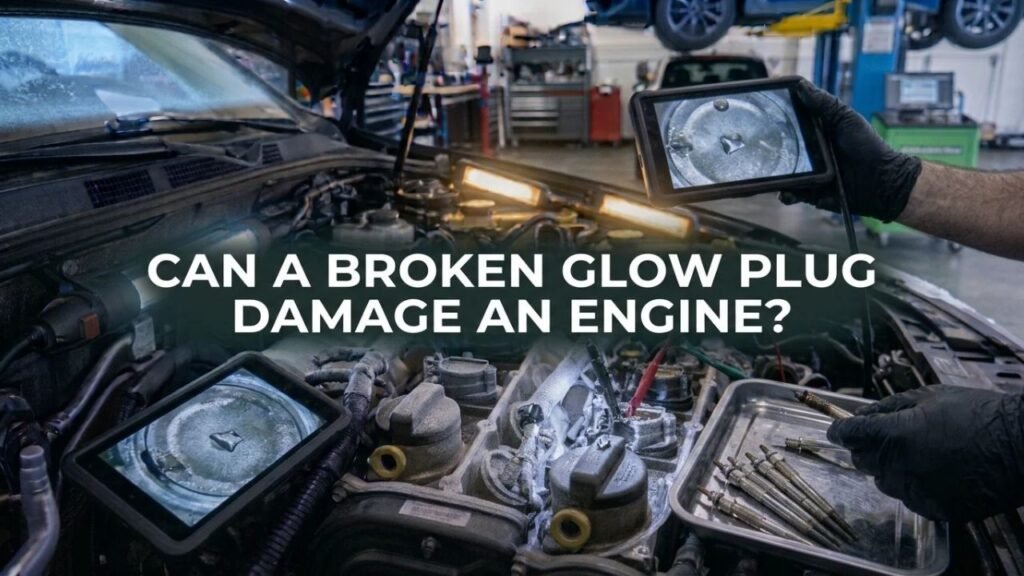
A glow plug is threaded into the cylinder head with its heating tip extending into or near the combustion chamber.
Over years of service, heat cycles, combustion deposits, corrosion, and carbon buildup can make removal difficult.
Several different failures are possible.
The plug can break at the hex or threaded body during removal.
The upper electrical terminal can break.
The plug can unscrew normally while the heating tip remains stuck in the head.
Or the heating tip itself can break off and fall into the cylinder.
These situations do not carry the same level of risk.
A broken terminal outside the cylinder may be inconvenient but normally cannot damage internal engine components.
A detached heating tip inside the combustion chamber is much more serious.
Why a Broken Glow Plug Tip Is Dangerous
The glow plug tip is made from heat-resistant metal or, on some designs, ceramic material.
Normally, it remains fixed in a precise position where the piston never touches it.
Once the tip becomes loose, that controlled relationship disappears.
The piston can then strike the fragment as it approaches top dead center.
Diesel engines often operate with high compression ratios and very small combustion clearances. A small foreign object can therefore experience enormous impact forces.
Possible Piston Damage
The piston crown can strike the broken glow plug tip repeatedly.
A small fragment may leave dents or impact marks.
A larger or harder piece can damage the piston surface more seriously.
In extreme cases, the impact can crack the piston, damage the combustion bowl, or create sharp areas that become hot spots during combustion.
Cylinder-Head Damage
The fragment may become trapped between the piston and cylinder head.
Repeated impacts can mark or damage the combustion-chamber surface.
Aluminum cylinder heads are especially vulnerable to hard metal debris.
Valve Damage
Depending on combustion-chamber design, a loose piece can move toward an intake or exhaust valve.
If it becomes trapped as a valve closes, the valve or seat can be damaged.
A bent valve can result in low compression, misfire, or complete loss of compression in that cylinder.
Cylinder-Wall Damage
A fragment can also become trapped between the piston and cylinder wall.
If that happens, it may scratch or score the cylinder bore.
Cylinder-wall damage can lead to increased oil consumption, loss of compression, and expensive engine repairs.
Turbocharger Damage
There is another potential path people sometimes overlook.
If a small fragment survives combustion-chamber impacts and exits through the exhaust valve, it may travel through the exhaust manifold toward the turbocharger.
A high-speed turbine wheel can be damaged by foreign material.
So even if the fragment somehow leaves the cylinder, that does not necessarily mean the danger is over.
Key Takeaways:
- A loose glow plug tip can damage the piston, valves, cylinder head, or cylinder wall.
- Small fragments can potentially travel into the exhaust and damage a turbocharger.
- If a piece may be inside the cylinder, do not start the engine.
Does Every Broken Glow Plug Cause Engine Damage?
No.
The phrase “broken glow plug” can describe several very different problems.
If only the electrical terminal breaks off above the cylinder head, the engine’s internal components may be completely unaffected.
If the threaded shell breaks but remains in the glow plug bore, internal damage may also be avoided.
Likewise, a heating tip can sometimes remain tightly carboned into its bore even after the upper part of the plug has been removed.
That situation requires extraction, but the tip may not yet be loose inside the cylinder.
The dangerous situation begins when the broken piece is free to move inside the combustion chamber.
Broken Does Not Mean Dropped
If you break a glow plug during removal, do not immediately assume a piece has fallen into the cylinder.
Inspect the removed portion.
Compare it with a new glow plug of the same type.
Determine whether the heating tip is still attached.
If the removed plug is visibly incomplete, the missing section must be located before the engine is cranked.
What Happens If a Glow Plug Tip Falls Into the Cylinder?
If the tip falls completely into the cylinder, gravity may initially leave it sitting on the piston crown.
The exact position depends on where the piston stopped when the engine was shut down.
If you crank the starter, the piston will begin moving rapidly.
The fragment may then bounce around the combustion chamber.
The first impact may not destroy the engine, but repeated impacts can quickly cause damage.
A diesel starter may rotate the engine only a few hundred rpm, but that still means the piston can move up and down several times every second.
If the engine actually starts, the risk becomes much greater because engine speed immediately increases.
For this reason, starting the engine to “blow the glow plug out” is not a good general strategy.
Even if the fragment eventually exits through the exhaust, it can cause damage before that happens.
Can You Drive With a Broken Glow Plug?
It depends entirely on what is broken.
If the glow plug has simply failed electrically but remains physically intact, the vehicle may still run. Cold starting may become more difficult, but an electrically failed plug is not necessarily an immediate mechanical threat.
If the upper terminal is damaged but the plug remains securely installed and sealed, the engine may also continue running, although the plug should be repaired.
But if the glow plug is physically broken and part of it may be loose inside the cylinder, do not drive the vehicle.
Continuing to run the engine turns a potentially manageable extraction job into a possible engine-rebuild problem.
Can a Glow Plug Break While the Engine Is Running?
Yes, although breakage during removal is more commonly discussed.
Glow plug tips experience extreme temperature changes.
A damaged, defective, overheated, or incorrect glow plug can deteriorate.
Certain failure conditions can cause the heating element or tip to swell, crack, or separate.
Abnormal combustion can also contribute to physical damage.
If a tip breaks while the engine is running, the driver may notice an unusual knocking sound, misfire, smoke, loss of power, or other abnormal behavior.
But symptoms are not guaranteed.
A small fragment may leave the cylinder quickly, while another may remain and cause severe damage.
If inspection reveals that a glow plug is missing part of its tip, assume the fragment must be accounted for.
Why Do Glow Plug Tips Swell?
Some glow plug failures involve a swollen or enlarged tip.
This is especially associated with certain older metal glow plug designs and can occur because of overheating, electrical problems, incorrect plugs, or age-related deterioration.
A swollen tip may allow the glow plug to unscrew from its threads but prevent it from sliding out through the narrow bore.
This is a dangerous moment.
The plug may feel completely loose, yet it cannot be removed.
Do not pull violently.
Excessive force can snap the swollen tip off.
Once the tip separates, it may fall into the cylinder.
What Should You Do With a Swollen Glow Plug?
Stop applying heavy force.
Use an engine-specific extraction method.
Specialized tools may allow the plug or its tip to be pulled through the bore while controlling debris.
In some engines, removing an injector provides additional access.
In more serious cases, cylinder-head removal may be the safest solution.
The correct approach depends heavily on engine design.
What If the Glow Plug Breaks While Removing It?
First, stop.
Do not immediately try to start the engine.
Inspect exactly what came out.
Compare the broken plug to an intact replacement.
You need to determine whether the problem is:
A broken terminal.
A broken threaded shell.
A stuck heating element.
A detached heating tip.
A broken ceramic element.
If the missing piece remains in the glow plug bore, specialized extraction may be possible without opening the engine.
If it has fallen into the cylinder, you need a plan for retrieving it.
How Can You Tell If a Piece Fell Into the Cylinder?
A borescope is extremely useful.
A small inspection camera can often be inserted through the glow plug opening or injector opening, depending on the engine.
Rotate the engine only when appropriate and only after you understand where the broken part is.
If the piston can safely be positioned lower in the bore without trapping the fragment, a technician may gain enough room to inspect the combustion chamber.
However, if you already know there is a loose metal object above the piston, rotating the crankshaft without a plan can move the fragment into a damaging position.
This is an area where professional diesel experience can be valuable.
Can a Magnet Remove a Broken Glow Plug Tip?
Sometimes, if the broken component is magnetic and accessible.
But not every glow plug material responds strongly enough to a magnet.
Some plugs use different alloys, while ceramic glow plug fragments obviously cannot be retrieved magnetically.
Even when the material is magnetic, the fragment may be sitting where a magnetic pickup tool cannot reach through the small glow plug bore.
A flexible magnet can be useful in the right circumstances, but it should not be assumed to solve every case.
Can a Vacuum Remove a Broken Glow Plug Piece?
Sometimes technicians use small vacuum tools in combination with borescopes or other extraction methods.
The success depends on fragment size, shape, location, and access.
A heavy metal tip may be too large or dense for ordinary suction.
Compressed air may also be used in certain engine-specific procedures to move debris, but blowing air blindly into a combustion chamber can move the fragment to a less accessible location.
Do not improvise without understanding the cylinder geometry.
Can You Remove the Injector to Retrieve the Glow Plug Tip?
On some diesel engines, injector removal provides a larger opening into the combustion chamber.
That can make borescope inspection and fragment retrieval easier.
However, modern diesel injectors can be difficult and expensive to remove.
Common-rail systems also operate at extremely high fuel pressures, and injector seals or calibration procedures may be required during reassembly.
Injector removal should therefore be treated as an engine-specific repair procedure, not a universal first step.
When Does the Cylinder Head Need to Come Off?
Cylinder-head removal may become necessary when:
The broken piece cannot be safely retrieved through existing openings.
The glow plug shell is severely seized.
The tip is embedded or inaccessible.
A fragment has already caused internal damage.
A valve or piston may be damaged.
The glow plug threads or bore require extensive repair.
Removing the head is obviously much more labor intensive, but it provides direct access and visibility.
When the alternative is risking major engine damage, cylinder-head removal can be the safer and ultimately less expensive choice.
Can a Broken Glow Plug Cause Low Compression?
Yes, depending on the damage.
The broken glow plug itself may also prevent the glow plug hole from sealing correctly.
More seriously, a loose fragment can damage a valve, valve seat, piston, or cylinder wall.
Any of these can reduce cylinder sealing.
Symptoms may include:
Hard starting.
Rough running.
Persistent misfire.
Excessive crankcase pressure.
Low power.
Abnormal smoke.
A compression or leak-down test may be needed if the engine ran after the breakage and now has persistent symptoms.
Can a Broken Glow Plug Cause a Knocking Noise?
Yes.
A foreign object bouncing between the piston and cylinder head can create a metallic knock or tapping sound.
If a new mechanical noise starts immediately after suspected glow plug breakage, shut the engine off.
Do not continue running it to see whether the sound disappears.
Mechanical impact inside the cylinder can become significantly more expensive with every revolution.
Can a Broken Glow Plug Cause a Misfire?
Yes.
The failure may affect combustion in several ways.
A broken glow plug may no longer provide cold-start heating.
If the fragment causes valve or piston damage, cylinder compression can fall.
A damaged plug can also interfere with proper sealing at the glow plug bore.
A cold-start misfire caused solely by loss of heating may disappear after warm-up.
A misfire caused by internal mechanical damage is more likely to remain after the engine is hot.
Can a Broken Glow Plug Cause White Smoke?
Yes, particularly if the plug no longer heats its cylinder during a cold start.
The injector may spray fuel normally, but the cold cylinder may not ignite it completely.
That unburned or partially burned diesel can appear as white or light-gray exhaust smoke.
However, white smoke is not proof that a plug has physically broken.
Ordinary electrical glow plug failure can produce the same symptom.
Injector problems, low compression, timing issues, and coolant entering the cylinder can also cause white smoke.
What Damage Should You Check for After Retrieving a Broken Tip?
If a piece was definitely inside the combustion chamber and the engine was cranked or run, inspection is worthwhile even after the fragment has been removed.
A borescope can reveal:
Piston impact marks.
Damage to the combustion bowl.
Cylinder-wall scoring.
Visible valve damage.
Foreign-material marks on the head.
If the engine runs poorly afterward, compression testing can provide additional information.
The engine may also need inspection of the exhaust side if a fragment cannot be accounted for.
On a turbocharged diesel, unexplained turbine damage after a glow plug tip failure should not be ignored.
Key Takeaways:
- Retrieving the broken piece does not always prove that no damage occurred.
- If the engine ran with debris inside, inspect the cylinder before assuming everything is fine.
- Persistent misfire, knock, low compression, or smoke after the repair deserves further diagnosis.
What Not to Do With a Broken Glow Plug
Do not crank the engine repeatedly hoping the piece will disappear.
Do not start the engine intentionally to blow a broken tip out.
Do not pull violently on an unthreaded glow plug that refuses to come out.
Do not hammer the glow plug into the cylinder.
Do not drill blindly without controlling metal chips.
And do not assume a missing tip must have exited through the exhaust.
Every fragment should be accounted for whenever reasonably possible.
Can Drilling Out a Broken Glow Plug Damage the Engine?
Yes, if performed incorrectly.
Drilling may be part of a legitimate extraction procedure, but it introduces several risks.
The drill can damage the cylinder-head threads.
Metal chips can fall into the combustion chamber.
The drill can go off-center and damage the glow plug bore.
An extractor can break inside the plug, creating an even harder material to remove.
Professional extraction kits often include guides that keep the drill centered and tools designed to remove the plug shell while controlling debris.
If you have not used one before, a difficult broken glow plug is often a good job for a diesel specialist.
Can a Broken Glow Plug Be Extracted Without Removing the Head?
Often, yes.
Specialized glow plug removal kits exist for many engines.
Depending on the break, the technician may drill and thread the remaining plug body, attach a puller, and extract it from the head.
This is most successful when the broken piece has not fallen into the cylinder.
Even a stuck tip can sometimes be removed through the original bore.
The exact success rate depends on how badly seized, swollen, or broken the component is.
How to Prevent Breaking Glow Plugs
Prevention begins before applying removal torque.
Work with the correct socket and keep it straight.
Clean dirt away from the glow plug bore.
If the plug feels abnormally tight, do not simply increase leverage indefinitely.
Depending on the engine manufacturer, controlled warming of the engine may sometimes be part of the recommended removal procedure because thermal expansion can help release carboned plugs.
Other engines may call for removal when cool.
Always follow the engine-specific service information.
Penetrating products may sometimes be useful around accessible threaded areas, but avoid allowing inappropriate chemicals into the cylinder.
Work the plug gradually rather than forcing it.
If it loosens but stops coming out, suspect carbon or tip swelling instead of continuing to pull.
Do Cheap Glow Plugs Break More Easily?
Quality matters, but brand alone does not determine whether a plug will break.
The correct glow plug must match the engine’s:
Voltage requirements.
Heating rate.
Physical length.
Thread dimensions.
Tip design.
Control strategy.
Using an incorrect plug can result in overheating or swelling.
A high-quality OEM or reputable application-specific glow plug generally reduces uncertainty.
For engines known to be sensitive to particular glow plug designs, using the specified manufacturer part is especially important.
Can the Wrong Glow Plug Damage an Engine?
Potentially.
If a glow plug is too long, it may project too far into the combustion chamber and risk mechanical contact.
If its heating characteristics are wrong, it can overheat, swell, or fail prematurely.
A plug that breaks apart can then become an internal engine hazard.
Never select a glow plug simply because the threads fit.
Use the correct application-specific part number.
Broken Glow Plug vs. Failed Glow Plug
These terms should not be treated as interchangeable.
A failed glow plug may simply have an open internal heating circuit.
It stays physically intact but no longer heats.
That usually causes cold-start symptoms rather than mechanical damage.
A broken glow plug has suffered physical damage.
If all broken portions remain outside the combustion chamber, it can still be an extraction problem without engine damage.
If a fragment enters the cylinder, the situation becomes mechanically dangerous.
This distinction is critical when diagnosing a diesel that shows a glow plug fault code.
An electrical code does not automatically mean the plug has physically broken.
FAQs About Can a Broken Glow Plug Damage an Engine
Can a broken glow plug destroy an engine?
It can cause serious damage if a metal or ceramic fragment falls into the combustion chamber and is struck by the piston.
The severity ranges from small impact marks to piston, valve, cylinder-head, cylinder-wall, or turbocharger damage.
What happens if a glow plug tip falls into the engine?
The tip can bounce around the combustion chamber, become trapped between moving parts, or potentially leave through the exhaust.
Do not crank or start the engine until it has been retrieved or its location is known.
Can I start the engine to blow a broken glow plug out?
I do not recommend it.
The fragment may damage the piston, valves, head, or turbocharger before it exits.
Can I drive with a broken glow plug?
Not if part of the plug may be loose in the cylinder.
An electrically failed but physically intact glow plug is a different situation.
Can a glow plug tip break off without me knowing?
Yes.
If a plug fails internally or breaks during operation, the tip may separate.
Inspection of removed plugs is important so you know whether every component came out intact.
What if the glow plug unscrews but will not come out?
Stop pulling.
The tip may be swollen or carboned into the bore.
Use a proper extraction procedure rather than forcing it until the tip snaps.
Can a broken glow plug damage the piston?
Yes.
The piston can repeatedly strike a loose fragment, damaging its crown or combustion bowl.
Can a broken glow plug bend a valve?
Potentially.
If the fragment becomes trapped near a closing valve, it can damage the valve or valve seat.
Can a broken glow plug score the cylinder wall?
Yes.
A loose metal piece trapped between the piston and cylinder wall can create scoring.
Can a broken glow plug damage the turbo?
Potentially.
A small fragment that exits through the exhaust valve may travel toward the turbocharger turbine.
Can a broken glow plug cause low compression?
Yes, particularly if the fragment damages a piston, valve, valve seat, or cylinder wall.
Can a broken glow plug cause a misfire?
Yes.
The plug may no longer heat correctly, and any resulting mechanical damage can also cause persistent misfire.
Can a broken glow plug cause knocking?
Yes.
A loose piece inside the combustion chamber can create metallic tapping or knocking as it contacts the piston or head.
Can a broken glow plug cause white smoke?
Yes, if the affected cylinder does not receive enough heat for clean cold combustion.
White smoke can have many other causes as well.
Can a broken glow plug be removed without removing the cylinder head?
Often, yes.
Specialized extraction tools can remove many broken plugs through the original bore.
More severe cases may require head removal.
Can I drill out a broken glow plug myself?
It is possible with the correct engine-specific tools and procedure, but incorrect drilling can damage the cylinder head or introduce metal debris into the engine.
How do I know if the glow plug tip is still in the cylinder?
Compare the removed glow plug with an intact replacement and inspect the combustion chamber with a borescope when necessary.
What if I cannot find the missing tip?
Do not assume it is safe to run the engine.
Further inspection may be required through the glow plug or injector bore.
Can glow plugs swell?
Yes.
A damaged or overheated metal glow plug can develop an enlarged tip that prevents removal even after the threads are fully disengaged.
Why do glow plugs break during removal?
Common contributors include carbon buildup, corrosion, excessive removal force, tip swelling, age, and years of heat cycling.
Should I replace all glow plugs if one breaks?
The breakage itself does not automatically mean every plug must be replaced.
However, if the set is old, inspecting or testing the remaining plugs makes sense.
Is a broken ceramic glow plug more dangerous?
Ceramic glow plug material can also cause serious internal damage.
It cannot normally be retrieved with a magnet, making location and removal more difficult.
Conclusion
So, can a broken glow plug damage an engine? Yes. A broken glow plug can cause serious internal engine damage if its heating tip or another fragment enters the combustion chamber.
The piston can strike the loose piece, potentially damaging the piston crown, valves, cylinder head, or cylinder wall. Small debris can also potentially travel through the exhaust system and reach a turbocharger.
But not every broken glow plug means the engine is damaged.
If the plug breaks during removal while the broken section remains stuck securely in the glow plug bore, a proper extraction procedure may remove it without affecting the combustion chamber.
The critical distinction is whether any piece is loose inside the cylinder.
If you remove a glow plug and discover that part of its tip is missing, do not crank or start the engine until you know where that piece is.
Inspect with a borescope where possible and use an engine-specific extraction method. In difficult cases, removing an injector or even the cylinder head may be safer than risking major internal damage.
Likewise, if a glow plug fully unthreads but refuses to pull out, do not force it. The tip may be swollen or carboned into place, and aggressive pulling can snap it off.
A failed glow plug is often a relatively minor cold-start repair. A broken glow plug tip inside a running cylinder can become a major engine repair.
The safest rule is therefore straightforward: if a glow plug breaks, stop the job, account for every piece, and do not rotate or run the engine until you are confident nothing is loose inside the combustion chamber.