
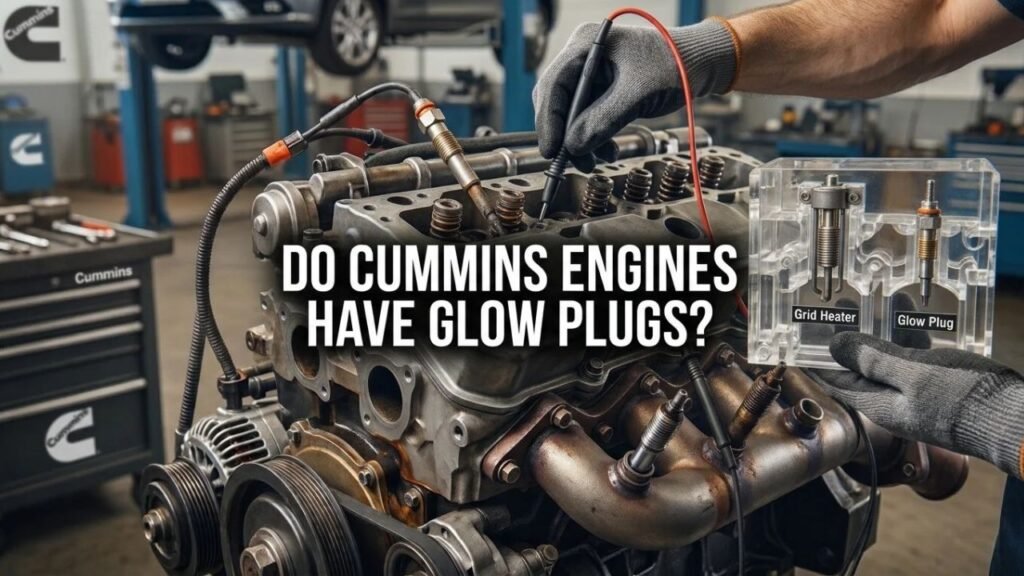
If you are wondering do Cummins engines have glow plugs, many well-known Cummins truck engines—especially the 5.9L and 6.7L Cummins used in Ram pickups—do not use conventional glow plugs. Instead, they commonly use an intake grid heater to warm the incoming air during cold starts. However, Cummins manufactures a very large range of engines, so you should not assume that every Cummins engine uses exactly the same cold-start system.
This is one of the biggest differences people notice when comparing Cummins diesels with engines such as the Ford Power Stroke or GM Duramax. Those engines commonly use individual glow plugs for each cylinder, while many Cummins pickup engines use a centralized electric heating element in the intake manifold.
Both systems have the same basic goal: make cold diesel combustion easier.
The difference is where the heat is added.
A glow plug heats the combustion area inside an individual cylinder.
A grid heater warms the intake air before that air enters the cylinders.
The diesel engine still relies on compression ignition in either case.
In this guide, I’ll explain why many Cummins engines do not have glow plugs, how Cummins grid heaters work, which popular Cummins engines use them, how to recognize a grid-heater problem, whether a Cummins can start without one, and how glow plugs compare with the intake-heater system.
Why Many Cummins Engines Do Not Use Glow Plugs
Diesel engines ignite fuel through compression rather than an electrical spark.
Air enters the cylinder and is compressed strongly by the piston.
As the pressure rises, the air temperature rises as well.
Diesel fuel is then injected into that hot compressed air.
If the temperature is high enough, the fuel ignites.
The problem is that cold metal inside the engine absorbs heat.
On a cold morning, the cylinder head, piston, block, intake manifold, and incoming air may all be cold enough to make initial combustion more difficult.
Engine manufacturers solve this in different ways.
Many diesel passenger cars use glow plugs.
Many Cummins truck engines use an intake grid heater.
Why an Intake Heater Works
Instead of placing a heating element in every cylinder, a grid heater is positioned in the intake-air path.
When current flows through the heater, it becomes hot.
The incoming air passes across the heated grid before entering the cylinders.
That warmer air then becomes even hotter during compression.
This gives the injected diesel fuel a better environment for ignition.
It is a simple and effective approach for many Cummins engine designs.
What Is a Cummins Grid Heater?
A grid heater is a high-current electrical heating element located in the engine’s intake system.
It resembles a heavy-duty electrical heating grid rather than a spark plug.
When the engine is cold, the control system energizes the heater.
The heater draws a substantial amount of electrical current and rapidly warms the intake air.
On many Ram Cummins trucks, the system may cycle the heater before starting and continue cycling it after the engine starts under certain cold conditions.
You may notice the truck’s voltmeter move slightly or the headlights dim momentarily when the grid heater cycles.
That can be normal.
The electrical load is significant.
Why Cummins Uses a Grid Instead of Six Glow Plugs
A six-cylinder Cummins truck engine could theoretically use one glow plug per cylinder.
However, the intake-heater design works well with the engine’s direct-injection combustion system.
A single centralized heater can warm the air supplied to all six cylinders.
This reduces the need for six separate heating elements threaded into the cylinder head.
It also keeps glow-plug hardware out of the combustion chambers.
That does not necessarily mean a grid heater is universally superior.
It simply reflects the cold-start strategy selected for the engine.
Key Takeaways:
- Many Cummins pickup diesels do not use conventional glow plugs.
- They commonly use an electrically heated intake grid instead.
- Glow plugs and grid heaters perform similar cold-start functions in different locations.
Does the 5.9 Cummins Have Glow Plugs?
The well-known 5.9L Cummins used in Dodge and Ram pickups does not use conventional individual glow plugs.
It uses intake-air heating instead.
This applies across the familiar generations of 5.9L Cummins pickup engines, although the exact heater hardware and control strategy changed over the years.
The 5.9 Cummins appeared in several major configurations, including:
12-valve mechanical-injection engines.
24-valve electronically controlled engines.
Later common-rail 5.9L engines.
Although their fuel systems differ greatly, individual cylinder glow plugs are not part of the normal pickup-engine cold-start design.
First-Generation 5.9 Cummins
The early 12-valve engines used intake heating to help with cold starting.
The system relied on electrical heater elements that warmed the air entering the engine.
These engines are mechanically simple compared with modern diesels, but the cold-start concept is fundamentally similar.
Second-Generation 5.9 Cummins
Later 12-valve and 24-valve engines continued to use intake heating.
Electrical relays control the large current required by the heater.
Cold weather can make grid-heater operation much more noticeable.
Common-Rail 5.9 Cummins
The common-rail 5.9 also uses intake heating rather than conventional glow plugs.
Even though high-pressure common-rail injection improves fuel atomization and starting behavior, intake heat remains useful under cold conditions.
Does the 6.7 Cummins Have Glow Plugs?
The 6.7L Cummins used in Ram trucks also generally does not use conventional glow plugs.
It uses an intake grid-heater system for cold starting.
The grid heater is located in the intake path and is electronically controlled.
The engine-management system decides when heating is required based on operating conditions such as intake-air and engine temperature.
Modern 6.7L engines may start very quickly, so drivers sometimes assume no preheating is happening.
In reality, the system can operate automatically with very little driver involvement.
Why Does a Power Stroke Have Glow Plugs but a Cummins Does Not?
This comes down primarily to engine design philosophy.
Ford Power Stroke engines commonly use individual glow plugs.
Each cylinder receives its own heating element.
Many Cummins pickup engines instead use a centralized intake-air heater.
Both engines still use compression ignition.
Neither system changes the fundamental way diesel combustion occurs.
Power Stroke Approach
Individual glow plugs provide heat very close to the fuel spray and combustion area.
This can offer precise cylinder-level preheating.
Cummins Approach
The grid heater warms the intake charge for all cylinders before compression.
A large inline-six engine can respond very well to this strategy.
There is no simple rule that one approach is always better.
Both have advantages and disadvantages.
Cummins Grid Heater vs. Glow Plugs
The difference becomes easier to understand in a direct comparison.
| Feature | Cummins-Style Grid Heater | Glow Plugs |
| Location | Intake system | Cylinder head |
| Number of heaters | Usually centralized | Often one per cylinder |
| Heats | Incoming air | Local combustion area |
| Electrical load | Very high when active | High combined load |
| Common on Ram Cummins | Yes | Generally no |
| Common on many Power Strokes | No grid as primary system | Yes |
| Helps cold starting | Yes | Yes |
The end goal is the same.
The systems simply introduce heat at different points.
Does Cummins Call It a Glow Plug Heater?
No.
People sometimes casually refer to any diesel preheating system as “glow plugs,” but that is technically inaccurate.
If your Ram with a Cummins diesel has a wait-to-start indicator, that does not mean it necessarily has glow plugs.
The indicator tells you the engine’s cold-start heating system is operating.
On many Cummins trucks, that system is the intake heater.
If you go searching around the cylinder head for six glow plugs, you may not find any because they are not part of that engine design.
What Does the Wait-to-Start Light Mean on a Cummins?
The wait-to-start indicator tells the driver that the engine’s cold-start preparation is in progress.
When conditions are cold enough, the engine controller activates the intake heater.
You should wait until the indicator goes out or until the vehicle gives the normal start indication.
In warm conditions, the wait time may be extremely short.
In very cold weather, it may stay active longer.
Modern trucks automate much of this process, so starting procedure should follow the owner’s manual for the specific model.
Does the Cummins Grid Heater Stay On After Starting?
It can cycle after startup.
This is similar in concept to post-glow operation on engines equipped with glow plugs.
After the engine starts, additional intake heating can help stabilize cold combustion.
You may notice changes in:
Engine sound.
Idle quality.
Electrical-system voltage.
Headlight brightness.
Charging-system load.
The heater may switch on and off as commanded by the engine computer.
Because the system draws so much current, the effect can be noticeable.
Why Do the Lights Dim on a Cummins When It Is Cold?
The intake grid heater can draw substantial electrical power.
When it switches on, system voltage can temporarily drop.
The alternator and batteries must support that load along with the running engine and other electrical accessories.
As a result, headlights or interior lighting may dim slightly while the heater cycles.
This can be normal.
However, severe voltage drop can also point to:
Weak batteries.
Poor battery cable connections.
Failing grid-heater relays.
Charging-system problems.
Corroded terminals.
Do not assume every electrical symptom is normal simply because the grid heater is operating.
Can a Cummins Start Without the Grid Heater?
Yes, depending on conditions.
A healthy Cummins diesel can often start without intake heating when the ambient temperature is warm.
Compression alone may generate enough heat to ignite the injected fuel.
Cold weather changes the situation.
When temperatures fall, a nonfunctional grid heater may cause:
Long cranking.
Hard starting.
Rough initial idle.
White smoke.
Incomplete combustion.
Delayed start.
The colder the engine becomes, the more useful intake heating is.
Engine Condition Matters
A high-compression healthy engine starts more easily than a worn engine.
Battery condition also matters enormously.
Diesels need high cranking speed.
Weak batteries reduce starter speed, making compression heating less effective.
So a truck with a failed grid heater and weak batteries may struggle much more than a truck with only one of those problems.
Can a Cummins Start in Winter Without Glow Plugs?
Yes, because the Cummins pickup engines we are discussing were not designed around glow plugs in the first place.
They use the grid heater.
A healthy grid-heater system, strong batteries, correct oil viscosity, good fuel, proper compression, and adequate starter speed all contribute to reliable winter starting.
At extremely low temperatures, a block heater can make an enormous difference as well.
Does a Cummins Have a Block Heater?
Many Cummins-powered trucks are equipped with or can be fitted with an engine block heater.
A block heater is different from the intake grid heater.
The grid heater operates around the time of starting and warms incoming air.
A block heater is connected to external electrical power while the truck is parked and warms the engine itself.
This can improve extremely cold starts by keeping the block, coolant, and surrounding engine components warmer.
Benefits can include:
Faster starting.
Less cold cranking.
Faster cabin heat.
Reduced initial engine wear.
Smoother startup.
Less white smoke.
In very cold climates, the block heater and grid heater can complement each other.
What Happens When a Cummins Grid Heater Fails?
Symptoms vary depending on outside temperature.
In warm weather, you may notice almost nothing.
In cold weather, failure becomes much more apparent.
The truck may take longer to start.
It may produce white smoke immediately after firing.
The engine may idle roughly for a short period.
A warning light or diagnostic trouble code may appear on electronically controlled engines.
The Heater Element Is Not the Only Possible Failure
The system also includes:
Heavy electrical wiring.
Relays.
Connections.
Control circuits.
Engine-management inputs.
A bad relay or corroded high-current connection can prevent a perfectly good heater element from receiving enough power.
Diagnosis should cover the complete circuit.
What Are Cummins Grid Heater Relays?
The intake heater draws much more current than a normal small electrical circuit can safely carry through a basic dashboard switch.
Heavy-duty relays are therefore used to control the heater current.
The engine computer energizes the control side of the relay.
The relay then connects battery power to the high-current heater circuit.
A relay can fail mechanically or electrically.
Its contacts can burn or develop excessive resistance.
That may reduce current to the heater even though the relay appears to activate.
Can You Test a Cummins Grid Heater?
Yes.
Diagnosis can include checking:
Battery voltage.
Voltage at the heater.
Voltage drop across relays.
Heater resistance.
Current draw.
Relay operation.
Stored diagnostic trouble codes.
Because the heater circuit carries very high current, testing requires caution.
A loose tool accidentally shorting a high-current grid-heater terminal can create severe arcing, burns, wiring damage, or fire.
Disconnect battery power before disassembling high-current connections.
Is a Bad Grid Heater the Same as Bad Glow Plugs?
Functionally, the symptoms can be similar, but mechanically they are completely different systems.
A Power Stroke with failed glow plugs may crank longer and smoke white when cold.
A Cummins with a failed grid heater can show similar symptoms.
The diagnosis and repair procedure are not interchangeable.
If someone tells you to replace the glow plugs on a 5.9 or 6.7 Ram Cummins, first verify exactly what they mean.
They may actually be referring to the intake-heater system.
Can a Cummins Grid Heater Cause Engine Problems?
A failed heater that simply stops heating usually creates cold-start problems rather than immediate internal engine damage.
However, the intake heater assembly and electrical connections should remain mechanically secure.
Any intake component that becomes physically damaged or loose deserves immediate attention because foreign material entering a diesel engine can cause severe damage.
Some owners modify or remove grid-heater components for performance or reliability reasons, but doing so can affect cold starting, emissions compliance, engine calibration, warranty, and other systems.
For a street vehicle, maintaining the factory system is generally the safest approach.
Do You Need to Wait Before Starting a Cummins?
Follow the wait-to-start indicator and the owner’s manual.
Older trucks may require a more obvious waiting period in cold weather.
Modern electronic systems often complete the necessary heating very quickly.
Do not repeatedly cycle the key in an attempt to force excessive grid-heater operation unless the vehicle’s instructions specifically call for it.
The control system is designed to manage heater timing automatically.
Does Cycling the Grid Heater Drain the Batteries?
It uses a lot of battery power.
That is normal.
Repeated unnecessary cycling, especially without running the engine long enough for the alternator to recharge the batteries, can contribute to low battery state of charge.
Cold temperatures already reduce battery performance.
Combining cold batteries, repeated preheating, and prolonged starter operation can quickly create a no-start situation.
Healthy batteries are critical on a Cummins diesel.
Why Are Two Batteries Common on Cummins Trucks?
Diesel engines require substantial starter power because of their high compression.
The grid heater creates another large electrical load.
Dual batteries provide the current capacity needed for cold starting and intake heating.
Both batteries should be tested as a pair.
One weak battery can pull down the entire system.
Replacing only one aging battery when the other is equally old can sometimes lead to continued starting problems.
Do Industrial Cummins Engines Have Glow Plugs?
Cummins produces far more engines than the familiar Ram pickup engines.
Its product range includes engines used in:
Generators.
Construction equipment.
Agricultural machinery.
Marine applications.
Commercial trucks.
Industrial equipment.
Mining machinery.
Power generation.
Because these engines vary enormously, you should not generalize that no Cummins engine anywhere uses glow plugs.
Different engine families and applications can use different cold-start systems.
Some may use intake heating.
Some may use block or coolant heaters.
Certain smaller engines or specialized applications may have other preheat arrangements.
The correct statement is that the popular Cummins pickup engines such as the 5.9L and 6.7L are well known for using intake heating instead of conventional individual glow plugs.
Do Cummins Generators Have Glow Plugs?
It depends on the generator engine.
A small diesel generator using one Cummins engine family can have a very different starting system from a large industrial standby generator.
Large stationary engines may use jacket-water heaters so the engine is already warm when an emergency start is required.
Some systems use intake heaters.
Always check the exact engine model rather than assuming the Ram pickup setup applies.
Do Cummins Marine Engines Have Glow Plugs?
Again, model-specific design matters.
Cummins marine engines range from relatively compact powerplants to much larger commercial units.
Their cold-start needs are different from an automotive engine exposed to a freezing parking lot.
Some marine installations may rely on intake heating or other preheating methods.
Use the specific engine manual to identify the system.
Grid Heater vs. Block Heater on a Cummins
These two components are frequently confused.
A grid heater heats intake air immediately before or after starting.
A block heater warms the engine while it is parked.
The grid heater uses power from the truck’s batteries and charging system.
The block heater typically uses external household electrical power.
Both can improve winter starting, but they do so differently.
A truck can have both.
In extremely cold conditions, using a block heater can reduce how hard the starting system must work.
Glow Plugs vs. Grid Heater vs. Block Heater
Here is the simple comparison:
| System | What It Heats | When It Works | Power Source |
| Glow plug | Individual combustion chamber | Before/after cold start | Vehicle electrical system |
| Grid heater | Intake air | Before/after cold start | Vehicle electrical system |
| Block heater | Engine/coolant area | While parked | Usually external AC power |
All three can help with cold weather, but they are not interchangeable parts.
Why Does the Cummins Start So Well Without Glow Plugs?
Several characteristics help.
The inline-six Cummins design generally has strong diesel compression characteristics.
Direct fuel injection delivers fuel where it needs to be.
Later common-rail engines use extremely precise high-pressure injection.
The grid heater provides additional intake temperature when necessary.
The engine’s electronic controls can also adjust fuel delivery and timing for starting conditions.
Taken together, these systems allow reliable starting without individual glow plugs.
Can a Cummins Run Without a Grid Heater?
Once started and warmed, yes in many cases.
Just like glow plugs on another diesel, the grid heater is not what continuously ignites the fuel.
Compression ignition keeps the engine running.
A grid-heater problem is therefore often most noticeable before and immediately after a cold start.
If a warm Cummins has persistent rough running, low power, or heavy smoke, do not immediately blame the grid heater.
Investigate other possibilities such as:
Fuel delivery.
Injectors.
Boost leaks.
Turbocharger problems.
Compression.
Sensors.
Airflow.
Engine calibration.
The grid heater is fundamentally a cold-start aid.
Key Takeaways:
- A bad grid heater usually shows itself most clearly during cold starts.
- Warm-engine performance problems usually require broader diagnosis.
- Battery, relay, wiring, and heater condition all matter to grid-heater performance.
How Can You Tell Whether Your Cummins Has Glow Plugs?
Start with the engine model.
If you have the familiar 5.9L or 6.7L Cummins in a Dodge or Ram pickup, you are generally dealing with an intake-heater system rather than individual glow plugs.
You can also inspect the engine.
A glow-plug-equipped diesel normally has small individual electrical heating plugs installed in the cylinder head.
A grid-heater-equipped Cummins has heavy electrical connections going to a heating assembly in the intake system.
The wiring size provides a clue because the intake heater handles very high current.
The owner’s manual and service documentation are the best confirmation.
Common Misconceptions About Cummins Glow Plugs
A common statement is that “all diesels have glow plugs.”
That is false.
Glow plugs are only one method of cold-start assistance.
Another misconception is that a Cummins must have hidden glow plugs because it has a wait-to-start light.
The light can represent grid-heater operation.
Some people also assume that the intake heater creates the actual ignition event.
It does not.
The heater simply raises the air temperature.
Compression still creates the conditions for diesel fuel to ignite.
Finally, a Cummins grid heater is not the same as an engine block heater.
They work at different times and heat different parts of the engine.
FAQs About Do Cummins Engines Have Glow Plugs
Do Cummins engines have glow plugs?
Many well-known Cummins pickup engines, including the 5.9L and 6.7L, do not use conventional glow plugs. They use intake-air heating instead.
Does a 5.9 Cummins have glow plugs?
No conventional individual glow plugs are used on the familiar 5.9L Cummins pickup engine.
It uses an intake-heater system.
Does a 6.7 Cummins have glow plugs?
The Ram 6.7L Cummins uses intake grid heating rather than conventional individual cylinder glow plugs.
What does a Cummins use instead of glow plugs?
Many Cummins pickup engines use an electric intake grid heater.
What does a grid heater do?
It heats incoming intake air before the air enters the cylinders, making cold compression ignition easier.
Is a grid heater better than glow plugs?
Not universally.
Both systems work effectively when matched to the engine design.
Does every Cummins use a grid heater?
No.
Cummins manufactures many different engine families and applications.
Always verify the exact engine.
Does a Cummins need the grid heater in summer?
It may need little or no intake heating in warm conditions.
The control system decides when heating is required.
Can a Cummins start without a grid heater?
Often yes in warm weather.
Cold starting can become much more difficult if the intake heater is not working.
Why does my Cummins have a wait-to-start light if it has no glow plugs?
The indicator can tell you that the intake-heater system is operating.
It is not proof that the engine uses glow plugs.
Why do my headlights dim on a cold Cummins?
The grid heater draws a large amount of electrical current, which can temporarily lower system voltage.
Does the grid heater operate after the engine starts?
It can cycle after startup when the engine is cold.
Does a Cummins grid heater use a relay?
Yes, high-current relays or equivalent control devices are commonly used to switch the large electrical load.
Can a bad grid heater cause white smoke?
Yes.
Poor cold ignition can leave partially burned fuel in the exhaust, producing white smoke after startup.
Can a bad grid heater cause hard starting?
Yes, especially in cold weather.
Will a bad grid heater cause poor power when warm?
Usually not by itself.
Persistent warm-engine performance problems generally point toward other systems.
Are Cummins grid heaters powered by the batteries?
Yes.
They draw substantial current from the truck’s electrical system.
Why do Cummins trucks have two batteries?
High-compression diesel starting and grid-heater operation require significant electrical power.
Is a grid heater the same as a block heater?
No.
A grid heater warms intake air. A block heater warms the engine while parked using external electricity.
Does a 12-valve Cummins have glow plugs?
The familiar 12-valve 5.9L Cummins used in Dodge pickups does not use conventional individual glow plugs.
Does a 24-valve Cummins have glow plugs?
The familiar 24-valve 5.9L pickup engine also uses intake heating rather than conventional individual glow plugs.
Do common-rail Cummins engines have glow plugs?
The common-rail Cummins pickup engines use intake heating rather than the individual glow-plug arrangement common on some other diesel brands.
Do Power Stroke engines use the same system as Cummins?
Generally, no.
Many Power Stroke engines use individual glow plugs, while Ram Cummins engines commonly use an intake grid heater.
Does Duramax use glow plugs?
Many Duramax engines use individual glow plugs, making their cold-start system different from the common Cummins pickup-engine approach.
Can I remove my Cummins grid heater?
It may be physically possible on some engines, but removing factory cold-start hardware can affect cold starting, emissions compliance, engine controls, and reliability.
For a normal street truck, retaining the correct factory system is the safer approach.
Conclusion
So, do Cummins engines have glow plugs? Many of the Cummins engines most people mean when they ask this question—particularly the 5.9L and 6.7L Cummins used in Dodge and Ram pickups—do not use conventional individual glow plugs.
Instead, they use an intake grid heater.
The grid heater warms the incoming air before it enters the cylinders. Once that warmer air is compressed, its temperature rises enough to make cold diesel combustion easier.
That accomplishes the same basic goal as glow plugs but through a different design.
A glow plug heats an individual combustion chamber.
A Cummins-style grid heater heats the intake air supplied to all cylinders.
Neither device normally creates the actual ignition event. The engine still relies on compression ignition.
If a Cummins grid heater fails, the truck may still start normally in warm weather. Problems are much more likely to appear during cold conditions, when you may experience longer cranking, rough initial running, or temporary white smoke.
Before blaming the heater itself, remember that the system also depends on healthy batteries, high-current relays, heavy wiring, good connections, and proper electronic control.
And because Cummins manufactures an enormous variety of diesel engines for trucks, construction equipment, generators, marine vessels, agriculture, and industry, do not assume every Cummins engine has the exact same cold-start equipment.
For the common Ram pickup application, though, the simple answer is:
5.9L and 6.7L Cummins diesels generally use an intake grid heater instead of conventional glow plugs.