
If you are wondering do glow plugs affect fuel consumption, the answer is yes—but usually indirectly and most noticeably when the diesel engine is cold. Properly functioning glow plugs help the engine achieve stable, complete combustion during starting and warm-up. When one or more glow plugs fail, cold combustion can become less efficient, potentially causing longer cranking, rough running, incomplete fuel burning, additional smoke, and in some modern diesels problems with emissions-control functions such as DPF regeneration.
That does not mean a single bad glow plug will suddenly reduce your fuel economy by several miles per gallon. Once a healthy diesel engine reaches normal operating temperature, compression heat normally provides everything necessary for ignition, and traditional preheating becomes much less important. A vehicle with one failed plug may therefore show almost no measurable fuel-economy change during a long highway trip.
Modern diesel engines complicate the answer because their glow plugs do more than start the engine. Many systems use post-glow after startup and can reactivate the plugs during certain driving conditions to improve combustion and support emissions systems. This means a failed glow system can potentially affect efficiency even after the starter has stopped turning.
In this guide, I’ll explain how glow plugs affect fuel consumption, whether bad glow plugs can lower MPG, why cold weather makes the difference more noticeable, how glow plugs interact with the DPF and EGR systems, and when poor fuel economy probably has another cause.
Do Glow Plugs Affect Fuel Consumption Directly?
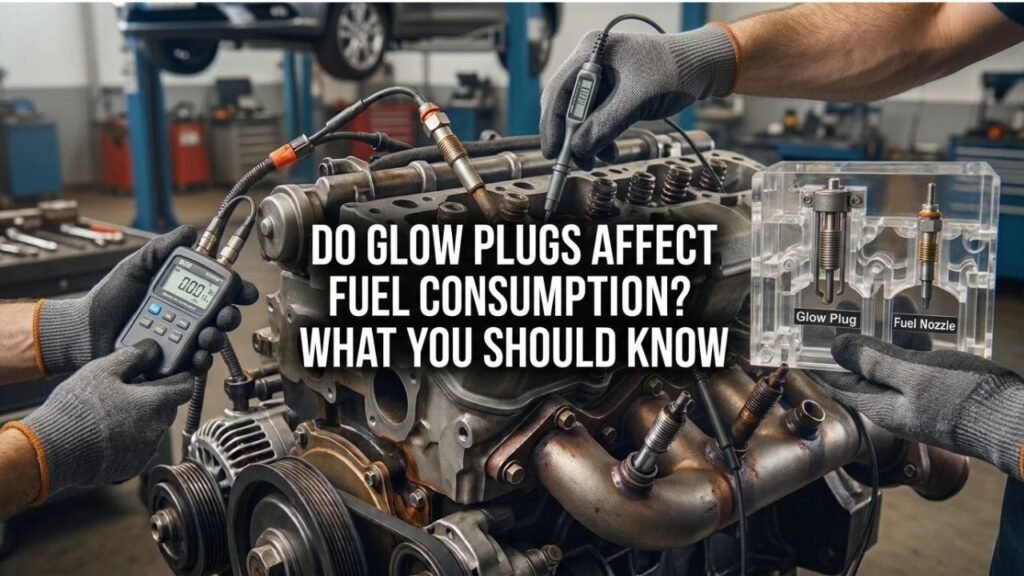
Glow plugs themselves consume electrical energy, not diesel fuel directly.
When activated, each plug acts as a high-output electric heater. That electricity ultimately comes from the battery and alternator.
Because the alternator is driven by the engine, producing additional electrical power does require a small amount of engine energy and therefore indirectly consumes some fuel.
However, this electrical load is not normally the important fuel-consumption issue.
The more meaningful effect is what glow plugs do to combustion.
A properly functioning glow system helps diesel fuel ignite and burn cleanly when combustion-chamber temperatures are low. Better combustion means less injected fuel is wasted through incomplete burning during the cold-start and warm-up phases.
Modern glow plug manufacturers also specifically design post-glow systems to improve combustion stability and contribute to low fuel consumption and reduced emissions.
The Effect Is Greatest When the Engine Is Cold
Once a diesel reaches normal operating temperature, the compressed air inside each cylinder becomes hot enough to ignite injected fuel reliably without depending on preheating in the same way.
Therefore, the difference between good and bad glow plugs tends to be greatest:
During cold starts, immediately after startup, during short trips, and in cold weather.
If most of your driving consists of 30-mile highway trips after one morning start, a weak glow plug may have very little impact on your average fuel economy.
If you make several short cold trips every day during winter, the effect can be more noticeable.
How Bad Glow Plugs Can Increase Fuel Consumption
A glow plug does not meter fuel.
The injector performs that job.
However, the effectiveness with which the engine burns that injected fuel can change when the cylinder is cold.
Incomplete Combustion During Cold Starts
Diesel fuel requires sufficiently hot compressed air to ignite properly.
When an engine is cold, metal surfaces in the combustion chamber absorb heat rapidly.
The glow plug adds localized heat and helps initiate stable combustion.
If a glow plug has failed, fuel injected into that cylinder may not burn completely during the first few combustion cycles.
Some of the fuel’s chemical energy is therefore not converted efficiently into useful pressure pushing the piston downward.
You may notice this as:
- Rough running immediately after startup
- White or gray exhaust smoke
- Longer cranking
- Uneven combustion or diesel knocking
All of these can accompany inefficient cold combustion.
The Engine May Need More Fuel During Warm-Up
Modern diesel engines electronically control injection quantity and timing during cold operation.
The engine-management system may make adjustments to stabilize idle, control emissions, and warm components.
If combustion quality is poor because the glow system is not functioning correctly, the engine may spend more time operating inefficiently before conditions stabilize.
Again, this does not necessarily create a dramatic MPG decrease.
But repeated cold-start inefficiency accumulates, particularly on short-trip vehicles.
Key Takeaways:
- Glow plugs influence fuel economy mainly by improving cold combustion, not by directly controlling fuel delivery.
- One failed plug may have little effect once the engine is fully warm.
- Repeated cold starts and short trips make glow-plug-related fuel waste more noticeable.
Can Bad Glow Plugs Reduce MPG?
Yes, they can, but usually by a relatively small amount unless multiple plugs or the wider glow-control system have failed.
There is no reliable universal figure such as:
“A bad glow plug reduces fuel economy by 10%.”
The actual effect depends on the diesel engine, ambient temperature, number of failed plugs, trip length, driving pattern, and whether the glow system participates in emissions-control functions.
One Failed Glow Plug
A six-cylinder diesel with one failed plug may still start and run reasonably well, particularly in warm weather.
You might notice slight roughness for the first several seconds but no measurable difference at the fuel pump.
Several Failed Glow Plugs
With multiple failures, cold combustion deteriorates more significantly.
The engine may crank longer, smoke more, idle roughly, and take longer to settle into efficient operation.
Fuel-consumption effects become more plausible.
Complete Glow System Failure
If a relay, controller, fuse, or wiring fault prevents every glow plug from operating, cold-start efficiency can suffer substantially.
In very cold conditions, the engine may not start at all.
Even when it eventually starts, repeated cranking and poor initial combustion are hardly efficient.
Do Glow Plugs Affect Fuel Consumption After the Engine Starts?
On older diesel systems, the role of glow plugs was heavily focused on starting.
Modern diesel glow systems are different.
Many current glow plugs continue operating after the engine starts through a process called post-glow.
This can last from seconds to several minutes, depending on the system and operating conditions.
Why Post-Glow Matters
The engine does not instantly reach normal combustion temperature after starting.
Cylinder walls, the head, piston crowns, and surrounding components remain relatively cold.
Post-glow adds heat during this transition.
The result can be smoother combustion and more complete burning of injected fuel.
It can also reduce hydrocarbons, carbon monoxide, white smoke, and cold diesel combustion noise.
Some modern glow plug designs can remain active for extended periods during warm-up.
So although glow plugs are commonly described as starting aids, their contribution to combustion can continue long after the engine first fires.
Can Glow Plugs Improve Fuel Economy?
Properly functioning glow plugs can help the engine maintain the fuel efficiency it was designed to achieve.
That wording is more accurate than saying that installing new glow plugs automatically “improves MPG.”
If your existing plugs are healthy, replacing them with another healthy set will probably not produce a meaningful fuel-economy gain.
If several old plugs are malfunctioning and causing poor combustion, replacing them may restore lost efficiency.
Don’t Treat Glow Plugs as an MPG Upgrade
You will not turn a 30-MPG diesel into a 35-MPG diesel simply by installing premium glow plugs.
Glow plugs are maintenance and combustion-management components.
Their job is to help the engine operate correctly.
The biggest improvements after replacement typically occur when the old plugs were causing obvious cold-start problems.
Why Cold Weather Makes the Fuel-Economy Effect Worse
Cold weather already lowers diesel fuel economy for several reasons unrelated to glow plugs.
The engine takes longer to warm.
Engine oil and transmission fluid are thicker.
Tire pressures can drop.
Winter diesel formulations may have different energy content.
Cabin heaters, defrosters, heated seats, and electrical accessories may increase load.
Short trips keep the engine in inefficient warm-up operation for a larger percentage of driving time.
Add failed glow plugs to that situation and cold combustion becomes even worse.
The Same Bad Plug May Be Invisible in Summer
Imagine one glow plug fails in May.
Through summer, your diesel starts immediately and fuel economy appears normal.
You might never know anything is wrong.
Then winter arrives.
The engine cranks longer, shakes for ten seconds after startup, and emits white smoke.
The plug did not necessarily fail that morning.
Warm weather was simply masking the problem.
This is also why glow-plug-related fuel-economy problems are difficult to quantify using annual averages.
Key Takeaways:
- Modern glow plugs can remain active through post-glow after startup.
- New glow plugs usually restore lost efficiency rather than create extra fuel economy beyond the engine’s design.
- Cold weather and short-trip driving magnify the consequences of weak glow plugs.
Do Bad Glow Plugs Cause White Smoke and Higher Fuel Consumption?
They can.
White exhaust smoke immediately after a cold diesel start often indicates fuel that has not burned completely.
A cylinder with insufficient temperature may receive normal fuel injection but fail to combust that fuel efficiently.
The vaporized or partially burned fuel can leave the exhaust as white or light gray smoke.
If the smoke disappears when the engine warms up, glow plug performance belongs on the diagnostic list.
However, white smoke can have other causes, including:
Injector problems, low compression, incorrect injection timing, coolant entering the combustion chamber, or other mechanical issues.
Do not diagnose glow plugs based on smoke color alone.
Can Bad Glow Plugs Cause Black Smoke?
Glow plug failures are much more strongly associated with poor cold ignition and potentially white or gray smoke than with classic heavy black smoke.
Black diesel smoke generally indicates excessive fuel relative to available oxygen or poor combustion caused by another issue.
Common causes can include faulty injectors, inadequate intake airflow, boost problems, EGR faults, or sensor issues.
A severely malfunctioning engine may have several overlapping problems, but replacing glow plugs should not be your first response to black smoke without diagnosis.
Do Glow Plugs Affect DPF Regeneration?
On some modern diesels, yes.
A diesel particulate filter (DPF) traps soot particles from the exhaust.
The accumulated soot periodically needs to be oxidized at high temperature in a process called regeneration.
Modern engine-management systems use several strategies to increase exhaust temperature sufficiently for this process.
Depending on the vehicle, activating the glow plugs can be one of those strategies.
Why This Can Affect Fuel Economy
DPF regeneration itself commonly requires additional engine-management measures that can increase fuel consumption temporarily.
If a glow-system fault prevents the emissions system from operating as designed, regeneration may be delayed, interrupted, or handled differently depending on the vehicle.
A vehicle experiencing repeated or unsuccessful regeneration events can show worse fuel economy.
However, this should not be simplified into:
“Bad glow plug equals bad DPF equals high fuel consumption.”
DPF strategy differs dramatically among vehicles.
If you have glow plug trouble codes together with DPF regeneration problems or declining fuel economy, diagnose the complete system.
Can Glow Plugs Affect the EGR System?
Modern glow systems can also support exhaust gas recirculation (EGR) operation.
At low exhaust temperatures, soot and carbon deposits can accumulate in the EGR system.
Some engine strategies use intermediate glow operation while the engine is running to help keep combustion and exhaust temperatures in a useful range.
This can reduce conditions that promote EGR carbon buildup.
Again, this is a modern diesel function that has little to do with simply starting the engine on a cold morning.
Glow plugs should increasingly be viewed as part of the diesel’s broader thermal and emissions-management system.
Do Glow Plugs Use Enough Electricity to Reduce MPG?
Technically, every electrical load on a running engine requires energy.
When the alternator supplies current to the glow plugs, mechanical energy from the engine drives the alternator.
Therefore, post-glow consumes a small amount of fuel indirectly.
But it would be misleading to conclude that disabling glow plugs saves fuel.
Manufacturers operate them because the combustion and emissions benefits justify the electrical energy they consume.
The ECU is also designed to activate them only when useful.
A correctly operating glow system therefore supports overall engine efficiency rather than representing unnecessary electrical waste.
Can a Stuck Glow Plug Relay Increase Fuel Consumption?
Potentially, although battery and glow plug damage are usually bigger concerns.
If an older glow plug relay sticks closed, the plugs may remain powered far longer than intended.
That creates a heavy electrical load.
While the engine is running, the alternator must supply that current, increasing mechanical load slightly.
If the vehicle is shut off while the relay remains stuck, the glow plugs can drain the battery.
Extended uncontrolled operation may also overheat or destroy the glow plugs.
Signs that justify investigating the relay include abnormal electrical load, plugs repeatedly failing, hot glow components after they should be inactive, or a battery that goes dead while parked.
Does a Faulty Glow Plug Control Module Affect Fuel Economy?
It can.
Modern glow plug control modules do much more than simply switch battery voltage on and off.
Depending on the vehicle, the module can independently regulate individual plugs, control their heating profile, monitor current, and communicate faults to the engine computer.
A faulty module might:
Fail to activate the plugs, keep them active incorrectly, supply improper power, or interfere with post-glow and emissions functions.
Any resulting fuel-economy impact is secondary to poor combustion or incorrect system operation.
A stored glow plug module code deserves diagnosis even if the engine still starts normally.
Will Replacing Glow Plugs Improve Fuel Economy?
It depends on their current condition.
If your glow plugs are working correctly, replacing them early is unlikely to noticeably change fuel economy.
If several plugs have failed and the engine currently suffers from poor cold starts, rough warm-up operation, smoke, or glow-system fault codes, replacement may restore normal combustion and therefore improve efficiency.
Look for Improvement in Cold Operation First
After replacing genuinely defective glow plugs, the most obvious changes are likely to be:
Faster cold starting, less startup smoke, smoother initial idle, and reduced cold combustion noise.
A fuel-economy improvement may follow, especially if your driving consists of many short trips.
But it may be too small to measure accurately over one tank.
Fuel economy naturally varies with weather, traffic, idle time, regeneration events, tire pressure, and driving style.
What Else Causes High Fuel Consumption in a Diesel?
If your only symptom is poor fuel economy and the diesel starts perfectly, glow plugs would not be at the top of my diagnostic list.
There are many more common causes.
Fuel Injector Problems
A leaking or poorly atomizing injector can directly increase fuel consumption and cause rough running, smoke, or fuel dilution of engine oil.
Injector correction or balance information from a scan tool can be useful during diagnosis.
DPF Regeneration Problems
Frequent active regenerations can noticeably reduce fuel economy because the engine uses additional fuel or altered injection strategies to increase exhaust temperature.
Frequent regeneration may be caused by excessive soot production, short-trip use, sensor faults, EGR issues, or problems elsewhere in the engine.
Thermostat Problems
A thermostat stuck open can prevent the engine from reaching normal operating temperature efficiently.
The ECU may keep the engine in warm-up-oriented operating strategies longer than intended.
Cabin heat may also be weak.
Low Tire Pressure
This has nothing to do with combustion but can have a noticeable impact on fuel consumption because rolling resistance increases.
Intake and Boost Leaks
Turbocharged diesels depend on controlled boost pressure and airflow.
A boost leak can reduce efficiency, increase smoke, and force the driver to use more throttle to obtain the desired performance.
EGR and Sensor Problems
Faulty airflow, boost, temperature, oxygen, NOx, or pressure sensors can alter engine-management decisions.
An EGR valve that is stuck or heavily carboned can also affect performance and efficiency.
Driving Conditions
Short trips, heavy idling, towing, aggressive acceleration, winter operation, and city traffic can all produce major fuel-economy changes even when the diesel engine is mechanically perfect.
Key Takeaways:
- If the engine starts and warms normally, investigate other causes before blaming poor MPG solely on glow plugs.
- Frequent DPF regeneration, injector faults, low operating temperature, and boost problems can have much larger effects on fuel consumption.
- Glow plug replacement is most likely to help fuel economy when there are clear cold-combustion or glow-system symptoms.
How Do You Know if Glow Plugs Are Bad?
Common symptoms include difficult cold starting, extended cranking, rough running immediately after startup, white smoke, and glow-system warning lights or trouble codes.
You can test many glow plugs with a digital multimeter.
With the glow plug electrically isolated and the circuit unpowered, measure resistance between the plug terminal and ground.
Identical plugs should normally have reasonably similar low resistance, although the exact specification varies dramatically among glow plug types.
An open circuit commonly indicates a failed heating element.
Modern systems may also require current testing or scan-tool diagnosis.
Do not apply direct 12-volt battery power to an unknown modern glow plug. Some plugs are designed for substantially lower voltages and can be destroyed rapidly by uncontrolled battery voltage.
Can One Bad Glow Plug Affect Fuel Consumption?
Potentially, but the effect is usually small.
The other cylinders continue operating normally, and once the engine warms, even the cylinder with the failed plug may combust normally through compression heat.
A single failed plug is more likely to produce a brief rough cold start than a dramatic MPG reduction.
If fuel consumption has suddenly increased 20% while the only identified fault is one bad glow plug, I would continue looking for another problem.
Can Four Bad Glow Plugs Affect Fuel Consumption?
Yes, multiple failures create a much greater opportunity for inefficient cold operation.
If four plugs are faulty in a six- or eight-cylinder engine, cold starting and warm-up combustion can deteriorate substantially.
You may need longer cranking, and several cylinders may burn fuel poorly until enough engine heat develops.
The effect depends strongly on temperature.
In hot summer weather, even several failed plugs may be less noticeable than one might expect.
In freezing conditions, the same failures can create severe starting problems.
Do Glow Plugs Affect Fuel Consumption in Warm Weather?
Much less from a pure starting perspective.
Warm intake air and warmer combustion-chamber surfaces reduce the amount of supplementary heat needed to ignite diesel fuel.
However, a modern engine may still activate its glow plugs for post-glow, intermediate glow, or emissions-system functions.
Therefore, saying glow plugs “do nothing in summer” is inaccurate.
A failed plug can also remain hidden throughout warm weather and become obvious only when winter arrives.
Should You Replace All Glow Plugs if One Is Bad?
Not always.
If one relatively new plug has failed because of an isolated defect, replacing only that plug may be reasonable when the manufacturer allows it.
If all the plugs have high mileage and are the same age, replacing the set can make more practical sense.
Access matters as well.
If considerable disassembly is required to reach the glow plugs, repeating that labor when another old plug fails soon afterward may be undesirable.
Before replacing anything, make sure the problem really is the plug.
A wiring fault or control-module problem can create a cylinder-specific code that looks like a glow plug failure.
Can Bad Glow Plugs Cause Poor Acceleration?
Once the engine is fully warm, failed glow plugs generally should not be the primary cause of persistent poor acceleration on a conventional diesel.
If power remains low at normal operating temperature, investigate:
Turbo boost, fuel pressure, injectors, airflow restriction, EGR function, DPF restriction, engine sensors, and compression.
On a modern diesel where the glow system participates in emissions control, a fault may contribute to related issues, but it still should not be automatically blamed for every performance problem.
Can Bad Glow Plugs Cause a Check Engine Light?
Yes.
Modern diesel engine-management systems can monitor glow plug current and control circuits.
A failed plug, wiring fault, or control-module problem may store a diagnostic trouble code and illuminate the Check Engine light or glow plug warning indicator.
The code may identify a particular cylinder or the overall control circuit.
Read the code before clearing it.
It can save considerable diagnostic time.
FAQs About Do Glow Plugs Affect Fuel Consumption
Do glow plugs affect fuel consumption?
Yes. They can affect fuel consumption indirectly by improving combustion during cold starting and warm-up. The overall MPG effect is usually modest.
Do bad glow plugs use more diesel?
They can lead to inefficient cold combustion, meaning some injected fuel is not converted into useful power as efficiently as intended.
Can one bad glow plug reduce MPG?
Possibly, but the difference is usually small, especially after the engine reaches normal temperature.
Will new glow plugs improve fuel economy?
Only if the old plugs were defective enough to reduce combustion efficiency. Replacing healthy glow plugs is unlikely to produce a noticeable MPG gain.
Do glow plugs work while the engine is running?
Yes, on many modern diesels. Post-glow and other controlled glow functions can operate after startup.
Do glow plugs help DPF regeneration?
They can on certain modern diesel systems by helping increase combustion and exhaust temperature during regeneration strategies.
Can faulty glow plugs cause frequent DPF regeneration?
They may contribute to emissions-system or regeneration problems on some engines, but frequent DPF regeneration has many possible causes and requires proper diagnosis.
Can bad glow plugs cause white smoke?
Yes. Insufficient heat during a cold start can cause incomplete combustion and white or gray exhaust smoke.
Do bad glow plugs cause black smoke?
They are not a primary cause of persistent black smoke. Injector, airflow, turbo, EGR, and other combustion problems are more typical causes.
Do glow plugs consume fuel themselves?
No. They consume electricity. The alternator eventually supplies that electrical energy using mechanical power from the engine, but their primary fuel-economy effect is through combustion quality.
Does a stuck glow plug relay use more fuel?
While driving, a stuck relay can create unnecessary electrical load on the alternator. More importantly, it can overheat glow plugs and potentially drain the battery after shutdown.
Can bad glow plugs affect fuel economy in summer?
The starting-related effect is usually smaller in warm weather, though modern plugs may still serve emissions and after-glow functions.
Are glow plugs important after the engine warms up?
Traditional starting assistance becomes much less important, but some modern systems reactivate glow plugs for specific combustion or emissions-control strategies.
Can bad glow plugs cause rough idle?
Yes, particularly immediately after a cold start. Persistent rough idle after full warm-up usually suggests another problem.
Can bad glow plugs cause hard starting?
Yes. Hard cold starting is one of the most common symptoms of failed glow plugs.
Can poor fuel economy be caused by something other than glow plugs?
Absolutely. Injectors, DPF regeneration, thermostat problems, boost leaks, EGR faults, sensors, tires, driving conditions, and many other factors can have a greater influence.
Conclusion
So, do glow plugs affect fuel consumption? Yes, but their effect is usually indirect and most important during cold starting and engine warm-up. Glow plugs help cold diesel fuel ignite more completely, stabilize combustion, reduce smoke, and allow the engine to transition more smoothly toward normal operating temperature.
When one glow plug fails, the overall fuel-economy difference may be so small that you cannot measure it. The affected cylinder may run poorly for only a few seconds before engine heat takes over.
When several plugs fail—or when the entire glow plug control system stops working—the consequences can become more substantial. Longer cranking, repeated starting attempts, incomplete cold combustion, smoke, and extended inefficient warm-up can all contribute to increased fuel use.
Modern diesel engines make functioning glow plugs even more important because their job does not necessarily end when the engine starts. Post-glow can continue for several minutes, and some systems use glow-plug heating during normal operation to support combustion, EGR operation, and DPF regeneration.
That said, glow plugs should not be the first thing you replace simply because fuel economy has dropped. If the engine starts easily, produces no cold smoke, reaches operating temperature normally, and has no glow-system codes, look at other common causes such as injectors, frequent DPF regeneration, thermostat faults, boost leaks, EGR problems, low tire pressure, and driving conditions.
If you do have hard cold starts, white smoke, rough initial idle, and glow plug trouble codes along with increased fuel consumption, testing the glow system makes sense.
The practical takeaway is straightforward: healthy glow plugs help a diesel use its fuel efficiently when combustion conditions are difficult, while faulty glow plugs can waste fuel indirectly—especially during cold starts, warm-up, and repeated short-trip operation.