
Do glow plugs go bad? Yes. Glow plugs are electrical heating components, and they can eventually fail from age, repeated heating cycles, electrical problems, carbon buildup, incorrect voltage, or abnormal combustion. A bad glow plug may cause hard cold starting, longer cranking, rough idle immediately after startup, white smoke, or a glow-plug-related warning code.
Glow plugs are especially important when a diesel engine is cold. A diesel normally ignites fuel using heat created by high compression rather than a spark, but cold engine parts absorb some of that heat. Glow plugs warm the combustion area so fuel can ignite more reliably during startup.
As the engine warms, it becomes less dependent on glow plugs. That is why a diesel with one failed glow plug may still run perfectly once hot, while becoming difficult to start on a cold morning.
Modern glow plugs can last a long time, but there is no universal replacement interval. Some may operate for well over 100,000 miles, while others fail much sooner because of engine condition, electrical faults, injector problems, or severe operating conditions.
In this guide, I’ll explain why glow plugs go bad, how long they typically last, the symptoms of failure, whether one bad plug matters, how to test them, and whether you should replace one plug or the entire set.
What Is a Glow Plug?
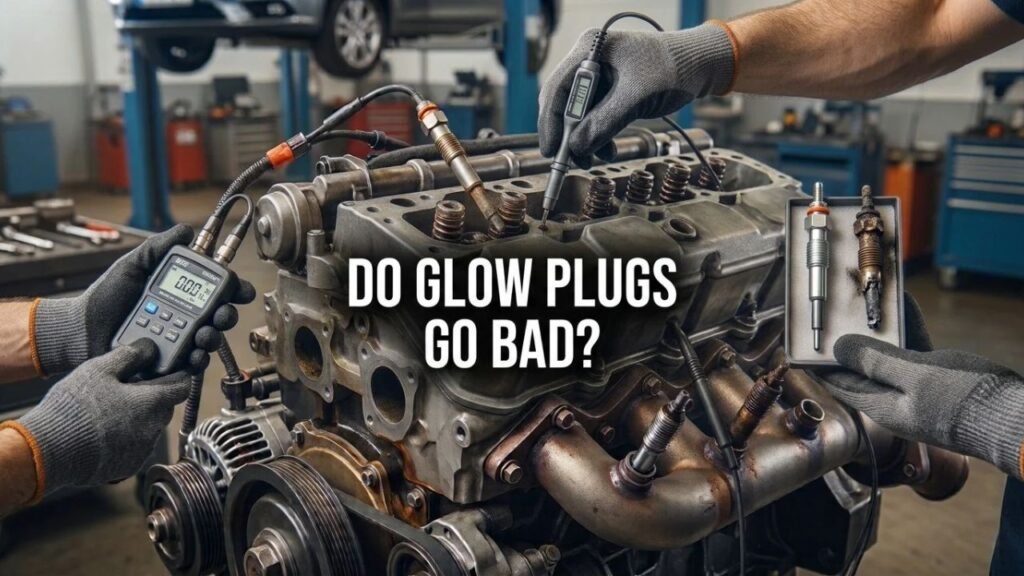
A glow plug is an electrically heated component used in many diesel engines.
It screws into the cylinder head and extends a heating tip into or near the combustion chamber.
When the glow system is activated, electrical current passes through the internal heating element and rapidly raises the temperature of the tip.
That heat helps cold diesel fuel ignite.
Unlike a gasoline spark plug, a glow plug does not create an electrical arc across a gap.
It works more like a highly specialized heater.
Why Diesels Need Glow Plugs
Diesel engines use compression ignition.
The piston compresses air so intensely that the air temperature rises enough to ignite fuel when it is injected.
When the engine is cold, however, the cylinder head, piston, and combustion chamber absorb heat.
That makes ignition more difficult.
The glow plug provides additional localized heat until combustion becomes stable.
Once the engine is sufficiently warm, normal compression heat usually takes over.
Do Glow Plugs Wear Out?
Yes.
Glow plugs experience repeated cycles of extreme heating and cooling.
Every time the diesel engine starts cold, the heating element may rise from ambient temperature to several hundred degrees Celsius within seconds.
Over thousands of cycles, this thermal stress can eventually degrade the internal element.
Electrical resistance may change.
The heating element can burn open.
The tip may swell, crack, or become physically damaged.
Carbon can also accumulate around the plug.
So although glow plugs can last many years, they are not permanent components.
Key Takeaways:
- Glow plugs can fail from age, electrical stress, heat cycles, or combustion problems.
- A failed glow plug usually causes its worst symptoms during cold starts.
- Warm-engine operation may remain normal even when one plug has failed.
How Long Do Glow Plugs Last?
There is no exact mileage that applies to every diesel.
Many glow plugs last somewhere in the range of tens of thousands of miles, and some can exceed 100,000 miles.
However, mileage alone does not determine lifespan.
An engine that experiences many cold starts may cycle its glow plugs much more often than a vehicle driven long highway distances in a warm climate.
Modern glow plug systems may also operate the plugs after startup, which adds additional heating cycles.
Factors That Affect Glow Plug Lifespan
The condition of the electrical and fuel systems matters significantly.
Glow plug life can be shortened by:
- Excessive voltage
- Faulty glow plug controller
- Bad relay
- Injector spray problems
- Carbon buildup
- Incorrect glow plug type
- Engine overheating
- Abnormal combustion
- Frequent extreme cold starts
A healthy engine with the correct plugs and properly functioning controller may keep the original set working for a very long time.
What Are the Symptoms of Bad Glow Plugs?
The most common symptoms occur when the engine is cold.
Hard Starting
A diesel with one or more bad glow plugs may take longer to start.
Instead of firing immediately, the starter may need to crank the engine for several seconds.
The colder the weather, the more noticeable the problem usually becomes.
Rough Idle After Startup
A cylinder with a failed glow plug may not begin burning fuel as cleanly as the others.
The engine may shake, stumble, or sound uneven for several seconds after starting.
As combustion-chamber temperature rises, the roughness may disappear.
White Smoke
Poor initial combustion can allow unburned or partially burned diesel fuel to enter the exhaust.
This may appear as white or light-gray smoke immediately after startup.
If the smoke disappears as the engine warms, a glow plug problem is one possible cause.
Persistent white smoke can also indicate injector, compression, timing, or coolant-related problems.
Longer Cranking Time
A gradual increase in cold cranking time can be an early sign.
The engine may still start every time, but it takes noticeably longer than it used to.
Glow Plug Warning Light
Many diesel vehicles monitor the glow plug system.
A failed plug or circuit may trigger a dashboard warning indicator or store a diagnostic trouble code.
A flashing glow plug light may indicate a broader engine-management fault on some vehicles, so diagnostic codes should be checked before replacing parts.
Can One Glow Plug Go Bad?
Yes.
Glow plugs frequently fail individually.
You do not need all of them to fail at the same time.
If one plug fails in a four-cylinder diesel, three cylinders may begin combustion normally while the remaining cylinder struggles until it warms.
That can produce a rough start without preventing the engine from running.
Will One Bad Glow Plug Stop the Engine From Starting?
Usually not in mild weather.
A healthy diesel with good compression may still start with one failed glow plug.
In very cold weather, however, the same failure becomes much more noticeable.
The effect also depends on cylinder count.
One failed plug in a four-cylinder engine represents 25% of the cylinders.
One failed plug in a V8 represents a much smaller proportion of the engine.
Can Multiple Glow Plugs Go Bad at Once?
They can.
Glow plugs installed together have generally experienced similar mileage, heat cycles, and operating conditions.
If one fails from age, others may be approaching the same point.
However, several plugs failing simultaneously can also indicate a shared electrical problem.
For example, excessive voltage from a malfunctioning controller can damage multiple plugs.
A wiring or power-supply fault may also make several plugs appear dead even though the plugs themselves are fine.
Do Not Replace All Plugs Without Testing
If several glow plug codes appear at once, check the system before assuming every plug failed independently.
Inspect:
Glow plug fuse, relay, control module, wiring, connectors, grounds, and power supply.
A single controller problem can affect the entire bank.
Why Do Glow Plugs Go Bad?
Several failure mechanisms are possible.
Normal Age and Heat Cycling
This is one of the most common causes.
The heating element expands when hot and contracts when it cools.
Thousands of cycles eventually weaken internal components.
The plug may develop an open circuit and stop heating.
Excessive Voltage
Glow plugs are designed for a specific electrical system.
Some modern glow plugs operate at much less than 12 volts and rely on an electronic control module.
Applying excessive voltage can overheat them and cause rapid failure.
This is one reason direct battery testing is risky with modern plugs.
Faulty Glow Plug Controller
The controller determines when and how strongly the plugs are energized.
If it supplies current for too long or at the wrong voltage, the glow plugs may overheat.
A failed controller can sometimes destroy new plugs shortly after replacement.
Injector Problems
A faulty injector can spray fuel directly onto the glow plug tip or create abnormal combustion conditions.
This may overheat, erode, or physically damage the plug.
If one cylinder repeatedly destroys new glow plugs, inspect the injector rather than simply continuing to replace the plug.
Carbon Buildup
Carbon can accumulate around the glow plug tip.
This may affect heat transfer and make removal difficult.
Heavy carbon can also cause the plug to bind in the cylinder head.
Incorrect Glow Plug
Glow plugs that look similar are not necessarily interchangeable.
They can differ in:
Voltage, resistance, length, tip diameter, heating rate, control strategy, and material.
Installing the wrong plug can result in poor starting or premature failure.
Key Takeaways:
- Age is a common cause, but electrical or injector problems can shorten glow plug life dramatically.
- Multiple early failures may indicate a control-system problem.
- Repeated failure in one cylinder can point toward injector or combustion issues.
Can Glow Plugs Fail Without Warning?
Yes.
A glow plug can electrically fail suddenly.
The internal heating element may burn open from one heating cycle to the next.
However, drivers may not notice immediately.
If the weather is warm, the engine may still start normally.
The fault may only become obvious when temperatures drop.
Modern vehicles may detect the electrical failure and store a trouble code even before you notice any starting problem.
Can Glow Plugs Go Bad From Sitting?
Simply sitting unused does not normally wear out the heating element.
However, long-term storage can contribute indirectly.
Moisture can cause corrosion in electrical connectors.
Battery condition may deteriorate.
Rodents can damage wiring.
Carbon and corrosion already present around the glow plug threads may make future removal more difficult.
But glow plugs primarily wear from electrical heating cycles and engine operation rather than from inactivity alone.
Can Cold Weather Make Glow Plugs Go Bad?
Cold weather does not necessarily cause a healthy glow plug to fail immediately.
However, winter places much greater demand on the glow system.
The plugs may operate longer or more frequently.
A marginal plug that seemed fine in summer may finally reveal itself during freezing weather.
Cold weather also reduces battery performance and increases oil viscosity, making the engine harder to crank.
That combination can make a glow plug problem appear much worse.
Can Bad Glow Plugs Cause a No-Start?
Yes, especially if several plugs have failed and the weather is cold.
The starter may crank normally, but combustion may not begin because the cylinders remain too cold.
In warmer conditions, the same engine may eventually start from compression heat alone.
No-Start Does Not Always Mean Glow Plugs
Other causes include:
Weak battery, slow starter, fuel delivery problems, air in fuel lines, failed crankshaft sensor, low compression, injector problems, or immobilizer faults.
Glow plugs should be tested rather than assumed.
Can Bad Glow Plugs Cause a Misfire?
Yes, mainly during cold operation.
A cylinder that does not receive enough heat may fail to ignite fuel consistently.
The engine can shake or stumble until that cylinder warms.
Once the engine reaches normal temperature, the misfire often disappears.
A persistent warm-engine misfire is less likely to be caused solely by glow plugs.
Can Bad Glow Plugs Cause White Smoke?
Yes.
White smoke immediately after startup is a classic possible symptom.
Poor combustion leaves some diesel fuel unburned or partially burned.
That fuel can appear as white smoke from the exhaust.
If the smoke continues after the engine is fully warm, investigate additional causes such as:
Injector problems, low compression, incorrect timing, or coolant leakage.
Can Bad Glow Plugs Cause Black Smoke?
Usually not as the main cause.
Black smoke generally means too much fuel relative to available air.
Common causes include:
Boost leaks, turbo problems, clogged air filter, excessive fueling, injector faults, or EGR issues.
A bad glow plug may contribute to poor cold combustion, but persistent black smoke under acceleration normally points elsewhere.
Can Bad Glow Plugs Cause Loss of Power?
They can cause temporary weakness while the engine is cold.
If one or more cylinders are not combusting properly, the engine may hesitate or feel underpowered.
Once the engine is warm, normal compression ignition usually takes over.
Persistent warm-engine power loss should lead you to investigate other systems.
Glow plugs do not directly control turbo boost or fuel delivery during normal hot operation.
Can Glow Plugs Affect Fuel Economy?
They can affect efficiency slightly during cold operation.
Poor combustion means some fuel is not converted into useful power.
However, one failed glow plug usually does not cause a dramatic long-term MPG drop once the engine is warm.
If fuel economy has fallen substantially, look for additional causes such as:
Injector problems, DPF regeneration issues, thermostat faults, turbo problems, tire pressure, or driving conditions.
Can Bad Glow Plugs Drain the Battery?
A failed glow plug itself does not normally drain the battery when the vehicle is parked.
However, a stuck glow plug relay or defective controller could keep current flowing longer than intended.
Glow plugs draw significant electrical current.
That can discharge the battery quickly.
Bad glow plugs can also indirectly drain the battery because the driver must crank the engine much longer to start it.
Can Glow Plugs Damage the Engine When They Fail?
Most electrical failures do not directly damage the engine.
A plug that simply stops heating usually causes starting problems.
Physical failure is more serious.
Broken Glow Plug Tip
If the heating tip breaks off and falls into the combustion chamber, it can potentially damage:
Piston, valves, cylinder head, or combustion chamber.
If a removed glow plug is missing part of its tip, do not start the engine until the missing piece has been located or the cylinder has been inspected appropriately.
How Do You Test Whether a Glow Plug Is Bad?
One of the simplest checks is a resistance test with a digital multimeter.
The exact acceptable resistance depends on the glow plug design.
Many glow plugs have very low resistance, so meter accuracy matters.
Resistance Test
Turn the engine off and disconnect the glow plug electrical connector as required.
Set the multimeter to a low-ohms range.
Touch the meter leads together first and note the resistance of the leads.
Then place one probe on the glow plug terminal and the other on a good ground or plug body according to the service procedure.
A completely open plug may show:
OL or infinite resistance.
That strongly suggests the internal heating element has failed.
Compare All Cylinders
Comparison can be very useful.
If seven plugs measure similarly and one shows open circuit or a dramatically higher reading, that plug is suspicious.
Always use the engine-specific specification where available.
Can a Glow Plug Pass a Resistance Test and Still Be Bad?
Yes.
A resistance test confirms electrical continuity but does not always show how quickly or evenly the plug heats.
A weak plug may still show continuity.
Current-draw testing can sometimes provide more information.
Modern control modules may also detect heating performance through current monitoring.
If symptoms persist even though resistance looks normal, test the entire circuit.
Can You Test Glow Plugs With a Battery?
Some older metal glow plugs can be bench-tested with an appropriate electrical supply.
However, direct 12-volt battery testing should not be treated as a universal method.
Many modern glow plugs use lower voltages and electronic pulse control.
Connecting one directly to 12 volts can destroy it quickly.
Ceramic glow plugs can also be damaged by improper testing.
Use the manufacturer-approved procedure.
How Can You Tell if the Glow Plug Relay Is Bad Instead?
If all or several glow plugs test good but do not receive power, investigate the shared control components.
A failed relay can prevent current from reaching the plugs.
The symptoms can be almost identical to having several failed glow plugs.
Possible Relay or Controller Clues
- No power to multiple glow plugs
- Multiple cylinder glow plug codes
- Glow system does not preheat
- Relay behaves abnormally
- Battery drains because plugs remain powered
- All plugs fail to heat at once
Check the fuse, controller, wiring, and ground before replacing a full set of plugs.
Should You Replace One Bad Glow Plug or All of Them?
There is no universal rule.
Replacing only the failed plug can be reasonable when the set is relatively new and the other plugs test correctly.
Replacing the full set may make sense when:
All plugs are old, access is difficult, mileage is high, or several plugs are showing similar deterioration.
Labor is an important factor.
If replacing one plug requires removing an intake manifold or other major components, replacing all serviceable plugs at the same time can prevent repeating the same labor soon.
Use Matching Glow Plugs
Use the same correct specification throughout the engine.
Do not randomly mix different voltage ratings, technologies, or incompatible metal and ceramic designs.
Is It Hard to Replace Glow Plugs?
It depends on the engine.
Some are easily accessible.
Others are buried beneath intake components.
The bigger concern is that old glow plugs can seize.
Why Glow Plugs Get Stuck
Years of heat cycles can lead to corrosion and carbon buildup.
Carbon can accumulate around the tip where it protrudes into the combustion chamber.
When you attempt removal, the plug may resist turning or pulling out.
Because glow plugs are long and relatively thin, excessive force can break them.
Can a Stuck Glow Plug Break?
Yes.
This is one of the major risks of glow plug replacement.
A broken glow plug may leave part of its threaded body or heating tip inside the cylinder head.
Special extraction tools may be required.
In severe cases, cylinder-head removal may be necessary.
Follow the engine manufacturer’s removal procedure, including any recommendation about engine temperature.
Do not simply apply a longer breaker bar when the plug feels unusually tight.
Key Takeaways:
- Test the glow plug and its circuit before replacing parts.
- A failed relay or controller can mimic several bad glow plugs.
- Stuck glow plugs require careful removal because they can break in the cylinder head.
Can You Clean a Bad Glow Plug?
Cleaning does not repair an electrically failed heating element.
If the plug has an open circuit, it needs replacement.
Carbon deposits can sometimes be removed from the area around a serviceable glow plug, but cleaning should not be treated as a cure for an internal electrical failure.
If heavy carbon repeatedly accumulates, investigate combustion quality and injector condition.
Can Glow Plugs Be Repaired?
Generally, no.
Glow plugs are sealed electrical components.
If the internal heating element fails, the practical solution is replacement.
Attempting to rebuild a glow plug is neither economical nor reliable.
How Much Does Glow Plug Replacement Cost?
Cost varies considerably depending on the engine.
The plugs themselves may be relatively affordable.
Labor can be more significant.
A simple four-cylinder diesel with easy access may be inexpensive to service.
A larger engine or one that requires intake removal can cost much more.
A seized or broken glow plug can dramatically increase repair cost because extraction becomes specialized.
This is why early diagnosis can be worthwhile.
Can You Drive With Bad Glow Plugs?
Often, yes.
If the engine starts and runs normally after warming, one failed plug may not prevent normal driving.
However, ignoring it is not ideal.
Cold starting may become worse.
Additional plugs may fail.
Long cranking can wear the starter and drain the battery.
Poor cold combustion can also increase smoke and emissions.
Repairing the system before winter is usually the best approach.
How Long Can You Drive With One Bad Glow Plug?
There is no fixed mileage limit.
Some drivers may continue for months in warm weather with little noticeable difference.
That does not mean the failure should be ignored.
Cold weather can suddenly turn a minor inconvenience into a no-start situation.
If a warning code confirms a failed plug, repair it when practical.
Do Glow Plugs Need Routine Replacement?
Not always.
Many manufacturers treat glow plugs as condition-based components rather than giving a strict replacement interval.
They may be replaced only when testing identifies a failure.
Other vehicles may include inspection recommendations in the maintenance schedule.
Follow the exact vehicle’s service information.
Replacing perfectly healthy glow plugs early is not automatically beneficial.
Can New Glow Plugs Go Bad Quickly?
Yes, but rapid failure usually suggests another problem.
If a new set fails after only a short time, investigate:
Incorrect glow plug voltage, faulty control module, charging-system overvoltage, incorrect part number, injector problems, or improper installation.
Repeated failure is not normal.
Do not keep installing new plugs without finding the cause.
Can a Bad Injector Ruin a Glow Plug?
Yes.
A faulty injector can produce an incorrect spray pattern.
Fuel may strike the glow plug tip directly.
This can create abnormal thermal stress or physical erosion.
Repeated damage to the same cylinder’s glow plug should raise suspicion about injector condition.
Can Glow Plugs Swell?
Yes.
Some failed glow plugs can develop swollen tips.
This can happen from overheating, electrical problems, or abnormal combustion.
A swollen tip may prevent the plug from sliding out of the cylinder head even after the threads have been loosened.
Forcing it can break the tip.
Special carbon-removal or extraction procedures may be required.
Do Glow Plugs Go Bad More Often Than Spark Plugs?
It depends on the engine and component design.
Spark plugs gradually wear because electrical arcs erode their electrodes during every combustion cycle.
Glow plugs do not fire continuously in the same way.
Their wear comes mainly from heating cycles, electrical stress, and thermal exposure.
Modern long-life spark plugs and glow plugs can both last many years.
Comparing them directly is not particularly useful because they perform different jobs.
How to Make Glow Plugs Last Longer
There is no maintenance trick that guarantees a specific lifespan, but keeping the surrounding systems healthy helps.
Use the correct glow plug specified for the engine.
Maintain a healthy battery and charging system.
Fix injector problems promptly.
Do not bypass the factory controller.
Avoid repeatedly cycling the glow plugs manually.
And never apply unregulated battery voltage unless the plug is specifically designed for it.
Proper installation torque also matters because overtightening can damage the plug or cylinder-head threads.
Common Mistakes When Diagnosing Bad Glow Plugs
One common mistake is replacing the glow plugs because the engine starts poorly.
Hard starting can also be caused by weak compression, a weak battery, slow starter, fuel problems, or injectors.
Another mistake is replacing every glow plug after one trouble code appears.
The actual problem could be the wiring or controller.
Direct battery testing modern plugs is another risky mistake.
Finally, do not ignore repeated plug failures.
If the same cylinder destroys multiple glow plugs, investigate why.
FAQs about Do Glow Plugs Go Bad
Do glow plugs go bad?
Yes.
Glow plugs can fail from age, repeated heating cycles, electrical problems, overheating, carbon buildup, or abnormal combustion.
How do I know if my glow plugs are bad?
Common signs include hard cold starting, long cranking, rough idle after startup, white smoke, and glow-plug-related trouble codes.
How long do glow plugs last?
There is no universal lifespan.
Some last well over 100,000 miles, while others fail much sooner depending on engine and electrical conditions.
Can one glow plug go bad?
Yes.
Individual failures are common.
A diesel may still start and run with one failed plug, especially in warm weather.
Can all glow plugs fail at once?
They can, but simultaneous failure may indicate a relay, controller, fuse, wiring, or voltage problem rather than normal wear.
Can bad glow plugs cause hard starting?
Yes.
Hard cold starting is one of the most common symptoms.
Can bad glow plugs cause a no-start?
Yes, particularly when several plugs have failed and temperatures are low.
Can bad glow plugs cause white smoke?
Yes.
Incomplete cold combustion can produce white exhaust smoke.
Can bad glow plugs cause black smoke?
They are not a common cause of persistent black smoke.
Black smoke usually points toward excessive fuel or insufficient air.
Can bad glow plugs cause a misfire?
Yes, especially immediately after a cold start.
Can bad glow plugs cause rough idle?
Yes.
The engine may run unevenly until the affected cylinders warm.
Can bad glow plugs cause loss of power?
They may cause temporary weakness while cold but usually do not cause major warm-engine power loss.
Can bad glow plugs drain the battery?
Not normally by themselves.
A stuck relay or controller can, and extended cranking caused by failed plugs can also discharge the battery.
Can a bad glow plug damage the engine?
A simple electrical failure usually does not.
A physically broken tip inside the cylinder can potentially cause serious damage.
Can glow plugs be cleaned?
Cleaning does not repair a failed heating element.
Electrically defective plugs should be replaced.
Can glow plugs be repaired?
Generally no.
They are sealed components and are normally replaced when defective.
Can a glow plug test good and still be bad?
Yes.
Some plugs have continuity but heat too slowly or unevenly.
Additional current or performance testing may be needed.
Should I replace all glow plugs if one is bad?
Not always.
Test the remaining plugs and consider their age, mileage, and replacement labor.
Can new glow plugs fail quickly?
Yes, especially if the wrong plug was installed or an electrical, controller, or injector problem remains.
Can bad injectors damage glow plugs?
Yes.
An abnormal injector spray pattern can expose the glow plug tip to excessive heat or fuel impact.
Do glow plugs need to be replaced at a certain mileage?
Not universally.
Follow the maintenance guidance for your exact diesel engine.
Conclusion
So, do glow plugs go bad? Yes. Glow plugs are wear-prone electrical heating components, and they can eventually fail from repeated heat cycles, age, electrical faults, carbon buildup, incorrect voltage, or combustion problems.
The most common symptoms are hard cold starting, longer cranking, rough running immediately after startup, and white smoke. A modern diesel may also store a glow plug circuit code or illuminate a warning light.
One failed plug does not necessarily prevent a diesel from starting. In warm weather, the engine may run almost normally. As temperatures drop—or as more plugs fail—the problem becomes much more noticeable.
A glow plug can also fail because of another fault. A bad controller may overheat several plugs, while a faulty injector can repeatedly damage the plug in one cylinder. That is why repeated or multiple failures should trigger a broader diagnosis.
Testing with a multimeter is a useful first step, but resistance alone does not reveal every type of failure. Current testing, circuit checks, and scan-tool diagnostics may be needed on modern systems.
If replacement is required, use the exact glow plug specified for the engine and be careful during removal. Old plugs can seize or develop carbon around their tips, and forcing them can cause breakage inside the cylinder head.
The bottom line is simple: glow plugs absolutely can go bad, but they should be tested along with the relay, controller, wiring, battery, and engine condition before parts are replaced.