
Glow plugs help diesel fuel ignite, but they do not ignite diesel in the same way spark plugs ignite gasoline. A diesel engine primarily relies on compression ignition: air is compressed until it becomes extremely hot, and when diesel fuel is injected into that hot air, the fuel begins to burn. Glow plugs provide additional heat when the engine is too cold for compression alone to create ideal ignition conditions.
This distinction is important.
A gasoline spark plug creates an electrical spark at a precisely controlled moment during every combustion cycle. A diesel glow plug is essentially an electric heating element. It becomes extremely hot before and sometimes after startup, raising the temperature around the combustion chamber so the injected diesel can ignite more easily.
So, in everyday language, you could say glow plugs help ignite diesel fuel. Technically, however, the primary ignition mechanism remains heat generated by compression rather than a spark or a timed ignition event from the glow plug.
Modern glow plugs also do more than help the engine start. Depending on the diesel system, they can remain active during warm-up to improve combustion stability, reduce white smoke and emissions, and support certain emissions-control functions.
In this guide, I’ll explain do glow plugs ignite diesel, how compression ignition works, what exactly a glow plug does during startup, whether diesel can ignite without glow plugs, and how glow plugs differ from gasoline spark plugs.
Do Glow Plugs Directly Ignite Diesel Fuel?
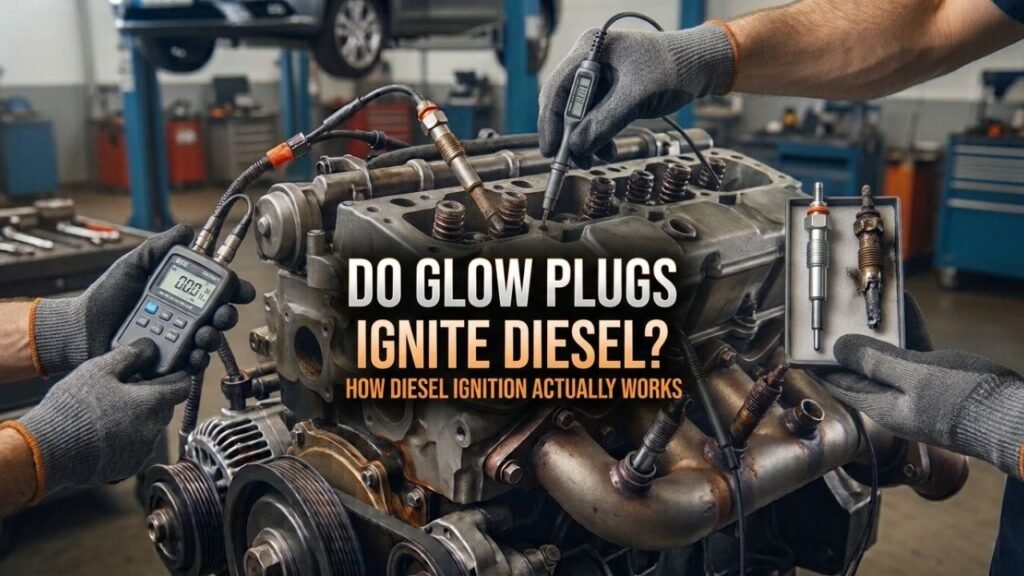
Not in the conventional spark-ignition sense.
A glow plug does not produce a spark that jumps across electrodes.
Instead, electricity passes through a heating element inside the glow plug, causing its tip to become extremely hot.
That heat raises the local temperature inside the combustion chamber.
When fuel is injected, the combination of hot compressed air and additional glow-plug heat creates conditions in which diesel fuel can ignite.
This means glow plugs are part of the ignition process during cold starting, but they are not normally the primary ignition source once the diesel engine is running at normal temperature.
Compression Is the Main Ignition Source
Diesel engines have relatively high compression ratios.
During the compression stroke, the piston moves upward and squeezes the air inside the cylinder into a much smaller space.
As the air is compressed, its temperature rises dramatically.
Near the end of the compression stroke, the fuel injector sprays a finely atomized quantity of diesel into that hot compressed air.
The fuel begins to ignite without requiring an electrical spark.
This is why diesel engines are referred to as compression-ignition engines.
Where the Glow Plug Helps
When the engine is cold, the metal surfaces surrounding the combustion chamber absorb heat.
The cylinder head, piston, cylinder wall, and valves can pull enough heat away from the compressed air to make initial ignition more difficult.
The glow plug compensates by adding heat.
Once combustion begins and the engine warms, the heat generated naturally inside the cylinders becomes sufficient to sustain ignition.
Key Takeaways:
- Diesel fuel primarily ignites because compression makes the air extremely hot.
- Glow plugs provide extra heat rather than an electrical spark.
- They are most important during cold starts and the warm-up period.
How Does Diesel Fuel Ignite Without a Spark?
The process starts before fuel even enters the cylinder.
During the intake stroke, the engine draws air into the cylinder.
The piston then rises during the compression stroke.
Unlike many gasoline engines, which compress an air-fuel mixture, a diesel engine normally compresses primarily air before fuel injection.
Compressing that air raises its pressure and temperature.
By the time the piston is close to the top of its compression stroke, the air can be hot enough to ignite diesel fuel.
The injector then sprays fuel into the chamber at very high pressure.
The finely atomized fuel mixes with the hot air and begins to burn.
Why Diesel Fuel Does Not Need a Spark Plug
Gasoline engines generally use lower compression ratios and rely on a controlled spark to initiate combustion.
Diesel engines are deliberately designed so the compressed air itself becomes hot enough for ignition.
That is why ordinary diesel engines do not use spark plugs.
Their injectors control when fuel enters the cylinder, and the fuel’s contact with sufficiently hot compressed air initiates combustion.
What Does a Glow Plug Actually Do?
A glow plug is an electrical heater positioned so its heating tip reaches into or very near the combustion area.
When the glow-plug control system supplies electricity, electrical resistance inside the plug produces heat.
Modern plugs can reach extremely high temperatures very quickly.
This heat performs several useful functions.
Preheating Before Starting
Before the starter turns the engine—or during the initial cranking period—the glow plugs heat the combustion area.
This is called pre-glow.
The colder the engine and outside temperature, the more valuable this additional heat becomes.
Some older diesel engines required drivers to wait several seconds before cranking.
Modern fast-heating systems may complete the process so quickly that the driver notices only a brief glow-plug indicator on the dashboard.
Assisting Combustion During Cranking
Once the starter begins rotating the engine, compressed air enters the hot area near the glow-plug tip.
When fuel is injected, it has a much better chance of igniting consistently.
The glow plug therefore helps create the conditions required for combustion.
Heating After Startup
Many modern glow-plug systems remain active after the engine has started.
This is called post-glow.
Post-glow helps cold cylinders continue burning fuel more consistently while the engine itself is warming.
This can reduce rough idle, smoke, noise, and emissions.
Why Do Diesels Need Glow Plugs if Compression Ignites the Fuel?
The key word is cold.
Under normal operating conditions, a diesel produces plenty of internal heat.
After the engine has been running, the cylinder head, pistons, valves, and combustion chambers are already warm.
Starting is much easier.
After sitting overnight in freezing conditions, the situation changes.
Cold Metal Steals Heat
The air heats as it is compressed, but cold metal surfaces immediately absorb some of that energy.
If too much heat is lost, fuel may not ignite cleanly during the first few revolutions.
A glow plug introduces extra heat exactly when the engine needs it most.
Cranking Speed Is Relatively Low
The starter rotates an engine much more slowly than the engine runs after startup.
Slow cranking can make compression heating less effective.
A weak battery or worn starter can make the situation even worse.
Glow plugs help compensate by increasing combustion-chamber temperature.
Do Glow Plugs Touch the Diesel Fuel?
The glow plug tip is exposed to the combustion environment, so injected fuel or the developing fuel-air mixture can be present around it.
However, a glow plug does not normally function like a flame or spark directly touching and lighting a stream of liquid diesel.
Diesel injection produces a fine spray.
The fuel droplets mix with extremely hot compressed air.
Ignition begins when local temperature and mixture conditions become suitable.
The glowing tip provides a very hot region that assists that process during cold operation.
It Is Better to Think of Glow Plugs as a Heat Source
Saying “the glow plug lights the fuel” is an oversimplification.
A more accurate description is:
The glow plug heats the combustion chamber so compression ignition can happen reliably.
That explanation applies especially well to modern direct-injection diesel engines.
Are Glow Plugs Like Spark Plugs?
No.
They serve different purposes and operate differently.
| Feature | Glow Plug | Spark Plug |
| Common engine type | Diesel | Gasoline |
| Main function | Produce heat | Produce electrical spark |
| Creates spark? | No | Yes |
| Needed every combustion cycle? | Normally no | Yes |
| Most important when engine is cold? | Yes | Not specifically |
| Primary ignition mechanism | Compression heat | Electrical spark |
| May remain active after startup? | Some modern systems do | Continuously fires while engine runs |
A gasoline engine generally cannot continue running correctly if its spark plugs stop firing.
A diesel engine can continue running after its conventional glow plugs switch off because normal combustion generates enough heat for compression ignition.
Do Glow Plugs Fire in a Certain Order?
Not like spark plugs.
Spark plugs must fire according to the engine’s firing order and at a precise crankshaft position.
Glow plugs are heaters rather than timed ignition devices.
The control system may energize several or all glow plugs simultaneously.
Modern controllers can monitor or regulate plugs individually, but this is still fundamentally different from firing them sequentially to ignite each combustion event.
Diesel Injectors Control Combustion Timing
In a diesel engine, combustion timing is largely determined by when and how the fuel is injected.
Modern common-rail systems can perform several injection events during one combustion cycle, including pilot, main, and post injections.
The glow plug does not replace that injection timing function.
Do Glow Plugs Stay On While Driving?
Some do for a limited period or under selected operating conditions.
Older systems often used glow plugs mainly before starting.
Modern systems can be considerably more sophisticated.
Post-Glow Operation
The glow plugs may continue heating after startup while the engine warms.
This improves combustion stability and helps reduce cold-start emissions.
Intermediate Glow
Some engine-management systems may activate glow plugs again under selected conditions to maintain favorable combustion temperatures.
Emissions-System Support
On certain modern diesels, glow-plug operation can contribute to exhaust-temperature strategies associated with emissions systems, including diesel particulate filter regeneration.
This means a modern glow plug can remain important even after the engine starts easily.
Key Takeaways:
- Glow plugs are not timed according to firing order like spark plugs.
- Modern diesels may use glow plugs after startup, not just before cranking.
- Fuel injection timing—not glow-plug timing—largely determines when diesel combustion begins.
Can Diesel Ignite Without Glow Plugs?
Yes.
Diesel fuel can ignite without glow plugs because compression heat is the engine’s fundamental ignition mechanism.
Whether a particular engine will start easily without glow plugs is a different question.
Warm Engine
A fully warm diesel often starts easily even if the glow-plug system is not operating.
The engine components already retain enough heat to support ignition.
Warm Weather
Some modern direct-injection engines can start relatively well in warm ambient conditions even with one or more failed glow plugs.
The problem may remain unnoticed until winter.
Cold Weather
As temperature falls, functioning glow plugs become much more important.
An engine with several failed plugs may crank for a long time, produce white smoke, run roughly after starting, or fail to start altogether.
Older Indirect-Injection Engines
Older indirect-injection diesels can depend particularly heavily on glow plugs.
Their prechamber designs lose substantial heat when cold.
Some of these engines become extremely difficult to start when the glow system fails.
Why Do Some Diesel Engines Have No Glow Plugs?
Not every diesel uses individual glow plugs.
Some engines use an intake-air heating system instead.
Grid Heaters
A grid heater is an electric heating element placed in the engine’s intake path.
Rather than heating each cylinder individually, it warms incoming air before that air enters the cylinders.
The warm air is then compressed, raising its temperature further.
Flame-Start Systems
Some diesel applications use a system that creates heat or a controlled flame in the intake tract to assist cold starts.
Engine Heaters
Block heaters and coolant heaters can warm the engine before starting.
They serve a different role from cylinder glow plugs but can greatly improve cold-start performance.
This is why you cannot assume that every diesel has one glow plug per cylinder.
What Happens if a Glow Plug Fails?
The symptoms depend strongly on temperature and how many plugs have failed.
With one failed glow plug, the engine may still start almost normally during warm weather.
In cold conditions, the affected cylinder may struggle to ignite its fuel immediately.
Hard Starting
The starter may need to crank longer.
If multiple glow plugs are bad, the difficulty can become severe.
Rough Cold Idle
One or more cylinders may initially contribute little or no useful power.
The engine can shake and sound uneven.
White or Gray Smoke
Fuel injected into a cylinder that is too cold to burn completely can leave the exhaust as unburned or partially burned fuel.
This commonly produces light-colored smoke during cold starting.
Misfire-Like Operation
A cold cylinder can temporarily fail to combust properly, producing behavior that feels like a misfire.
As the cylinder warms, combustion may stabilize and the engine becomes smooth.
Does a Bad Glow Plug Stop Diesel From Igniting?
It can prevent or delay ignition in the affected cylinder when the engine is cold.
However, the situation is temperature-dependent.
Suppose one cylinder has a failed glow plug.
At 80°F outside, compression may create enough heat for the fuel to ignite normally despite the failed plug.
At 10°F, the same cylinder might fail to combust properly for several seconds.
That is why bad glow-plug symptoms can appear seasonal.
A Failed Plug Does Not Necessarily Disable the Cylinder Permanently
Once combustion heat raises the cylinder temperature, the affected cylinder can begin operating normally even though its glow plug remains defective.
This differs from a completely failed spark plug in a gasoline engine, where the cylinder may continue misfiring because there is no ignition spark.
Do Glow Plugs Ignite Diesel During DPF Regeneration?
Not directly in the sense of lighting fuel inside the diesel particulate filter.
The DPF traps soot in the exhaust system and periodically needs high temperature to oxidize that soot.
Some modern engines use glow-plug operation as one part of a strategy to increase or stabilize combustion and exhaust temperatures.
Fuel injection strategies and other engine controls also contribute.
The glow plugs therefore may support the conditions needed for regeneration, but they are not physically inside the DPF setting soot on fire.
How Hot Do Glow Plugs Get?
Modern glow plugs can reach extremely high temperatures—well above normal household-heating-element temperatures.
Exact operating temperature depends on glow-plug construction and the engine-control strategy.
Metal and ceramic glow plugs can have different heating characteristics.
Modern fast-heating designs may become operational within seconds.
This high temperature explains why glow plugs are effective at improving cold ignition.
It also explains why they should be tested and powered correctly.
Can You Test a Glow Plug by Watching It Glow?
Older mechanics sometimes removed a glow plug, connected it directly to power, and observed whether the tip became red hot.
That method is not appropriate for every modern glow plug.
Some modern plugs are designed for controlled voltages lower than normal battery voltage.
Applying a full 12 volts directly can overheat or destroy them extremely quickly.
Proper testing may involve resistance measurements, current testing, scan-tool diagnosis, or a manufacturer-specific test procedure.
Always identify the plug system first.
Do Glow Plugs Ignite Diesel Continuously?
No.
Normal diesel combustion does not require a glow plug to initiate every cylinder event.
Once the engine reaches operating temperature, heat generated by compression and ongoing combustion is normally sufficient.
A modern control system may still operate glow plugs under selected conditions, but the plugs are not continuously acting like gasoline ignition sparks.
Why the Engine Does Not Stop When Glow Plugs Turn Off
Once the combustion chambers are hot, every compression stroke generates enough temperature for newly injected diesel fuel to ignite.
The previous combustion events also keep the engine components hot.
This process becomes self-sustaining as long as fuel injection and adequate compression continue.
Glow Plug vs. Compression Ignition: Which Actually Starts Combustion?
Compression ignition is the fundamental mechanism.
The glow plug is an assist.
A helpful way to think about it is that compression provides the basic ignition system, while the glow plug improves the environment when conditions are unfavorable.
In warm operating conditions, compression alone is enough.
In freezing conditions, glow plugs make the process much more reliable.
Why This Distinction Matters
Understanding the difference helps diagnose starting problems.
If a diesel runs poorly only for the first few seconds when cold, the glow system could be responsible.
If it continuously misfires when fully warm, the problem is more likely related to fuel injection, compression, airflow, engine timing, or another system.
Can Bad Glow Plugs Cause Unburned Diesel?
Yes.
If a cold cylinder cannot reach sufficient temperature for reliable combustion, fuel may be injected without burning completely.
This can produce white or gray smoke and a strong fuel smell.
Repeated poor cold combustion is one reason glow-plug faults should not simply be ignored.
However, unburned fuel can also result from injector problems or low compression.
Diagnose the entire system if symptoms persist.
Do Gasoline Engines Ever Use Glow Plugs?
Conventional gasoline automotive engines use spark plugs, not diesel-style glow plugs.
There are specialized combustion systems outside typical passenger vehicles that may use hot surfaces or glow elements, but that is not how a standard gasoline engine operates.
In a normal gasoline engine, spark timing is essential to combustion.
In a normal diesel, fuel injection and compression heat are fundamental.
Can Glow Plugs Cause Diesel Knock?
A glow-plug fault is more commonly associated with difficult starting, rough cold operation, white smoke, and incomplete combustion.
Delayed ignition in a cold diesel can change combustion noise and make the engine sound unusually harsh.
However, persistent diesel knock can have many other causes, particularly injector problems or combustion timing issues.
Do not replace glow plugs solely because the engine sounds louder than usual.
Should You Wait for the Glow Plug Light Before Starting?
Follow the owner’s manual for the vehicle.
On many diesels, switching the ignition on illuminates a coil-shaped glow-plug or preheat indicator.
When the light goes out, the system has generally completed the driver-visible portion of its preheating sequence.
On modern vehicles, the actual glow strategy may continue before, during, or after cranking even after the dashboard lamp changes state.
In warm weather, the light may stay on only briefly.
Why Does a Diesel Start Better After Cycling the Glow Plugs Twice?
On an older diesel with a marginal glow system, cycling the preheat system multiple times can sometimes add additional heat and make starting easier.
However, needing to do this regularly may indicate a problem.
Possibilities include weak glow plugs, a controller issue, low compression, poor battery performance, slow starter speed, or fuel-system problems.
Modern electronically controlled glow systems should generally be allowed to manage heating themselves rather than being repeatedly cycled as a routine workaround.
Key Takeaways:
- A glow plug can help prevent unburned fuel during cold startup by improving combustion temperature.
- Glow-plug faults usually affect cold operation more than fully warmed operation.
- Repeatedly cycling the glow system should not replace diagnosis of an underlying starting problem.
FAQs about Do Glow Plugs Ignite Diesel
Do glow plugs ignite diesel?
Glow plugs help diesel fuel ignite by adding heat to the combustion chamber, but the primary ignition process is compression ignition. They do not create a timed electrical spark like gasoline spark plugs.
What actually ignites diesel fuel?
The heat created when air is highly compressed inside the cylinder ignites the injected diesel fuel.
Do diesel engines need a spark?
No.
Normal diesel engines rely on compression ignition rather than spark ignition.
Why do diesels have glow plugs if compression ignites the fuel?
Cold engine components absorb compression heat. Glow plugs add heat so the fuel can ignite reliably during cold starts and warm-up.
Do glow plugs create a spark?
No.
A glow plug contains a heating element that becomes extremely hot when electricity passes through it.
Are glow plugs the diesel equivalent of spark plugs?
Not exactly.
Both are associated with combustion, but spark plugs create precisely timed sparks while glow plugs primarily provide heat.
Do glow plugs ignite fuel every time the cylinder fires?
No.
Once a diesel is warm, normal compression heat is generally sufficient to ignite each injection event.
Can a diesel engine run without glow plugs?
Yes, once conditions are warm enough. Many engines can continue running normally even if the glow plugs are inactive.
Can a diesel start without glow plugs?
Sometimes.
Modern direct-injection diesels may start without them in warm weather. Cold weather and older indirect-injection engines make functioning glow plugs much more important.
Do glow plugs stay on after starting?
Many modern systems use post-glow for a period after startup to improve combustion stability and reduce emissions.
How does diesel fuel ignite when the engine is cold?
Compression still provides much of the necessary heat, while glow plugs add extra thermal energy to help the first injections burn reliably.
What happens if the glow plugs do not heat?
The engine may crank longer, start roughly, misfire when cold, produce white smoke, or fail to start in very cold weather.
Can one bad glow plug stop a diesel from starting?
Usually not by itself on a healthy multi-cylinder modern diesel, especially in warm weather. But cold starting can become rougher, and multiple failures can eventually cause a no-start.
Do direct-injection diesels use glow plugs?
Many do.
Modern direct-injection systems can still benefit from glow plugs for cold starting, warm-up combustion, emissions, and other control strategies.
Do all diesel engines have glow plugs?
No.
Some diesels use grid heaters, intake-air heaters, flame-start systems, or other cold-start aids.
Does a grid heater ignite diesel?
No.
A grid heater warms incoming air so compression can create sufficiently high combustion temperatures.
Can bad glow plugs cause white smoke?
Yes.
A cold cylinder may fail to burn its injected fuel completely, allowing unburned or partially burned diesel to enter the exhaust.
Can bad glow plugs cause a misfire?
Yes, particularly during a cold start.
A cylinder without sufficient preheating can temporarily fail to combust properly.
Are glow plugs used during DPF regeneration?
On some modern diesel engines, glow plugs can support the combustion and exhaust-temperature conditions used during regeneration strategies.
Can you test a glow plug directly with a battery?
Not every glow plug.
Some modern glow plugs operate at controlled voltages below full battery voltage and can be damaged by direct 12-volt power.
Conclusion
Do glow plugs ignite diesel? They help diesel fuel ignite, especially when an engine is cold, but they are not the primary ignition mechanism and they do not work like spark plugs. A diesel engine fundamentally relies on compression ignition.
The piston compresses air until its temperature becomes extremely high. Diesel fuel is then injected into that hot compressed air and begins burning without an electrical spark.
Glow plugs become important when cold engine components absorb too much of that compression heat. By heating the area around the combustion chamber, they create better conditions for the first injections of fuel to ignite consistently.
That is why a diesel with faulty glow plugs may crank longer, shake after starting, misfire when cold, or produce white smoke—yet run perfectly normally once it has warmed up.
Modern glow plugs can also remain active after startup through post-glow and other control strategies. This helps stabilize combustion, reduce cold emissions, and, on some engines, support emissions-system operation.
The simplest way to remember the difference is this: spark plugs create the ignition spark in a gasoline engine; glow plugs create extra heat that helps a diesel engine achieve compression ignition.