
If you are wondering do glow plugs make noise, the glow plugs themselves are normally almost silent because they are electrical heating elements with no moving parts. However, the glow-plug relay, control module, electrical connections, or the diesel engine during a cold start can produce clicking, ticking, buzzing, or rough combustion sounds that may seem like they are coming from the glow plugs.
A glow plug works by passing electrical current through a resistance element that becomes extremely hot. There is no mechanical movement inside a normal glow plug, so it should not click, knock, or rattle during operation.
The sound many drivers associate with glow plugs usually comes from another part of the glow system. Older diesel vehicles often use a high-current relay that can make a noticeable click when the glow plugs switch on or off. Some systems may cycle the relay more than once. Modern electronic controllers can also produce faint electrical sounds, although they are generally quieter.
Cold diesel combustion creates another source of confusion. When one or more glow plugs fail, the engine may start roughly, knock, shake, or produce an uneven exhaust note for several seconds. In that case, the failed glow plug is contributing to the noise indirectly because the cylinder is not burning fuel cleanly while cold.
In this guide, I’ll explain whether glow plugs make noise, what normal clicking sounds mean, why a bad glow plug can make a diesel sound rough, what buzzing or repeated relay clicking can indicate, and how to determine whether the sound actually points to a glow-system problem.
Do Glow Plugs Make Noise by Themselves?
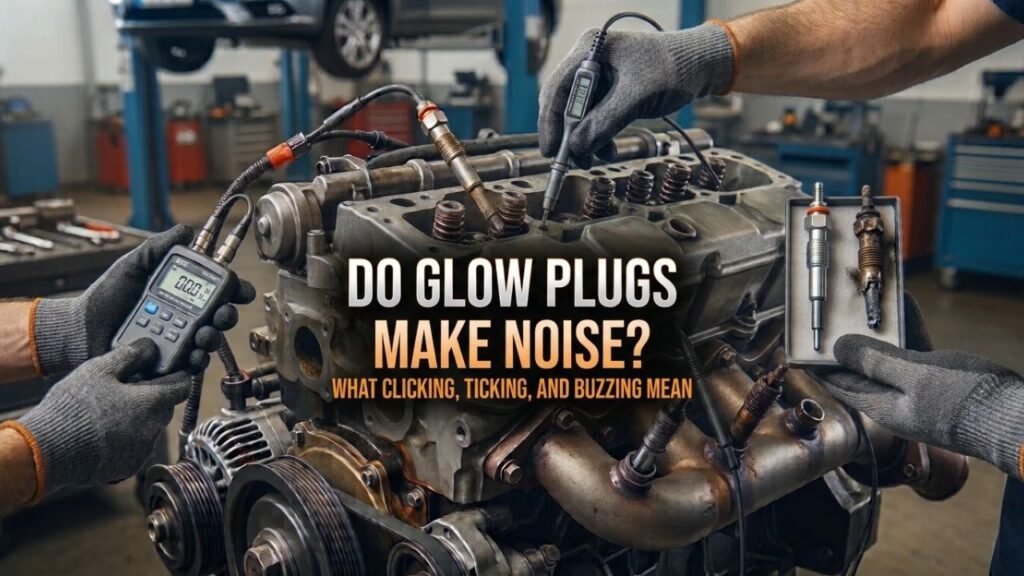
Normally, no.
A glow plug has no moving internal mechanism.
Its basic job is to convert electrical energy into heat.
When the glow-plug controller supplies current, the heating element inside the plug increases in temperature and heats the tip located in or near the combustion chamber.
That heating process is essentially silent.
If you hear an obvious click immediately after turning the ignition on, you are usually hearing a relay or control component, not the glow plug itself.
Why Glow Plugs Are Different From Relays
A traditional glow-plug relay contains electrical contacts that physically open and close.
When those contacts move, they can make a distinct click.
A glow plug contains a fixed heating element.
There is nothing inside it that should mechanically snap back and forth.
That distinction makes diagnosis easier.
If you hear electrical clicking before the engine starts, investigate the glow-plug relay or control system rather than assuming each glow plug is physically clicking.
Is It Normal to Hear a Click When Glow Plugs Turn On?
Yes, on many diesel vehicles.
A single click when the ignition is switched on can be completely normal.
That sound can come from the glow-plug relay connecting battery power to the heating circuit.
You may hear another click several seconds later when the relay switches off or changes operating state.
Older diesel systems tend to make these sounds more obvious than modern electronic systems.
What the Relay Is Doing
Glow plugs draw substantial electrical current.
Instead of routing that high current directly through the ignition switch, many systems use a heavy-duty relay.
The ignition or engine control system activates the relay, and the relay then supplies power to the glow plugs.
Because the relay has relatively large internal contacts, engagement can produce a noticeable mechanical sound.
One Click vs. Repeated Clicking
One or two clicks during a normal preheat cycle may be nothing to worry about.
Rapid repeated clicking is different.
It can indicate unstable power supply, weak battery voltage, poor electrical connections, relay problems, or abnormal controller behavior.
The exact system design matters, so repeated cycling is not automatically a fault, but it deserves investigation if it is accompanied by starting problems or abnormal warning lights.
Key Takeaways:
- Glow plugs themselves are normally silent.
- A click during preheating often comes from the glow-plug relay.
- Rapid or erratic clicking can point to a battery, relay, wiring, or control problem.
Why Does My Diesel Click Before Starting?
A click before starting is often the glow-plug relay engaging.
You may notice the sound immediately after turning the key to the ON position.
At the same time, the glow-plug or wait-to-start light may illuminate on the dashboard.
The system is preparing the combustion chambers for cold starting.
Older Diesels Often Make More Noticeable Relay Noise
Traditional diesel glow systems may use a relatively large electromechanical relay.
These can make a fairly strong click.
Some older systems also cycle the glow plugs after startup, so you may continue hearing occasional relay operation for a short period.
Modern Diesels May Be Quieter
Many newer diesel engines use electronic glow-plug modules rather than simple relays.
These modules can control individual plugs and vary power electronically.
You may hear little or nothing from them.
The absence of a click therefore does not mean the glow-plug system is not operating.
Can a Bad Glow Plug Make a Clicking Noise?
A failed glow plug itself usually does not click.
If its heating element burns open, it simply stops drawing current and producing the intended heat.
However, the system around the glow plug may behave differently after a fault.
For example, a controller may cycle or attempt to manage the failed circuit.
A relay may operate repeatedly if voltage is unstable.
A poor electrical connection can also create unusual electrical behavior.
But the bad glow plug itself still does not normally make a mechanical clicking sound.
Can Bad Glow Plugs Make the Engine Knock?
They can contribute to rough, noisy cold combustion.
A cold diesel cylinder depends on heat and compression to ignite injected fuel efficiently.
If one glow plug is not working, that cylinder may initially be too cold to burn fuel at the same time or as cleanly as the others.
This can produce a rough, uneven, or harder diesel combustion sound.
Cold Diesel Knock
Diesel engines naturally produce more combustion noise when cold.
The ignition delay between fuel injection and combustion can be greater.
If glow-plug assistance is poor, that delay can become more noticeable in affected cylinders.
The engine may sound harsh, clattery, or irregular until it warms.
Noise That Disappears After Warm-Up
If the engine sounds unusually rough for the first few seconds or minutes and then becomes smooth, the glow system is one possible cause.
Other possibilities include injectors, fuel quality, compression differences, timing, and cold-engine operating characteristics.
Do not diagnose glow plugs from sound alone.
Can a Bad Glow Plug Cause Ticking?
Indirectly, possibly, but a true repetitive ticking noise should not automatically be blamed on a glow plug.
Glow plugs do not normally create a ticking sound mechanically.
A ticking diesel engine may instead have noise from injectors, valvetrain components, exhaust leaks, relays, fuel-system components, or normal diesel combustion.
Injector Ticking
Diesel injectors operate rapidly and can produce distinct clicking or ticking sounds.
Modern high-pressure common-rail systems can be particularly noticeable depending on engine design.
That sound may be completely normal.
Exhaust Leak Ticking
A small exhaust leak near the cylinder head or manifold can create a rhythmic tick that speeds up with engine RPM.
This is easy to confuse with valvetrain or injector noise.
Relay Ticking
A glow relay that repeatedly switches on and off may also sound like ticking, particularly when the engine is not yet running.
The location and timing of the sound help distinguish the source.
Why Does My Glow-Plug Relay Keep Clicking?
Repeated relay clicking deserves more attention than one normal engagement click.
Possible causes include low battery voltage, corroded connections, poor grounds, worn relay contacts, control-module problems, or a system that intentionally cycles the plugs.
Weak Battery
Glow plugs draw substantial current.
When they activate, battery voltage can drop.
If the battery is weak, voltage may fall low enough that the relay or controller disengages.
Voltage then rises again, causing the relay to engage once more.
This can create a rapid clicking cycle.
Corroded Battery Connections
Loose or corroded battery terminals can cause similar voltage instability.
The glow system may pull enough current to expose a poor connection that appears acceptable under a light electrical load.
Worn Glow-Plug Relay
Relay contacts can wear, burn, or develop excessive resistance.
A failing relay may chatter instead of remaining firmly engaged.
Control-System Cycling
Some systems intentionally cycle glow-plug power after startup.
That can produce periodic relay sounds without indicating a fault.
The vehicle’s specific operating strategy determines what is normal.
Can Glow Plugs Buzz?
Glow plugs themselves should not normally make a noticeable buzzing sound.
A buzzing noise is more likely to come from a relay, electronic controller, solenoid, or another electrical component.
Relay Buzzing
A relay can buzz or chatter when its coil is not receiving stable voltage.
Weak battery voltage or a poor connection is a common cause.
Electronic Control Module Sounds
Certain electronic components can emit faint high-frequency sounds under load.
This is usually much less noticeable than mechanical relay clicking.
If the buzzing is loud, new, or accompanied by heat, burning smell, starting trouble, or warning lights, inspect the system.
What Does a Bad Glow Plug Sound Like During Startup?
A failed glow plug usually reveals itself through how the engine sounds rather than through noise from the plug.
You may hear uneven cranking followed by rough combustion.
The engine can sound as though one cylinder is joining the others a few seconds late.
It may shake, clatter, or produce an irregular exhaust rhythm.
White Smoke May Accompany the Noise
A cold cylinder that is not burning diesel efficiently can send partially burned fuel into the exhaust.
That can produce white or gray smoke.
If rough sound, white smoke, and hard starting all occur together when cold, the glow system becomes a stronger suspect.
The Sound Often Improves Quickly
As the cylinder warms from compression and neighboring combustion, it may begin firing normally.
The roughness and smoke then disappear.
This cold-only behavior is characteristic of glow-related problems, although it is not exclusive to them.
Are Glow Plugs Supposed to Make a Hissing Sound?
No.
A normal glow plug should not hiss.
A hissing noise around the engine bay is more likely to come from an intake leak, boost leak, vacuum system, compressed air movement, cooling system, or another source.
If you hear hissing near a glow plug location while the engine runs, inspect the surrounding area carefully.
A combustion leak around a loose component or damaged sealing area would require attention, although glow plugs generally use threaded sealing designs that should not leak when correctly installed.
Can a Loose Glow Plug Make Noise?
Potentially, yes.
A glow plug that is not properly seated could allow combustion gases to leak around its threads or sealing surface.
That can produce a puffing, ticking, or chuffing noise.
This is not normal glow-plug operation.
Why a Loose Glow Plug Is Serious
A glow plug must seal combustion pressure inside the cylinder.
If it is loose, hot gases can damage the threads, sealing area, wiring, or surrounding components.
The plug may also overheat because proper contact with the cylinder head affects heat transfer.
If you suspect a loose glow plug, do not simply tighten it blindly with excessive force.
Use the engine manufacturer’s torque specification and inspect the threads if necessary.
Key Takeaways:
- A failed heating element usually causes no noise by itself.
- Rough cold-engine noise can result from poor combustion caused by failed glow plugs.
- A loose glow plug can produce abnormal leaking or ticking sounds and should be inspected.
What Noise Is Normal From a Diesel Glow System?
Normal sounds depend on the design.
An older diesel may produce one distinct relay click when preheating starts and another when it ends.
You may hear additional periodic clicks during post-glow.
A modern electronically controlled diesel may be almost silent.
Neither situation automatically indicates a problem.
Normal Sounds May Include
A single click, occasional relay cycling, normal diesel injector ticking, and slightly louder combustion when the engine is cold.
The important factor is whether the sound is consistent with the vehicle’s usual behavior.
A new rapid chatter or loud electrical buzzing deserves more attention.
What Noise Indicates a Glow-System Problem?
There is no single sound that definitively diagnoses bad glow plugs.
However, several sound patterns can justify testing.
Rapid electrical clicking before startup can indicate power-supply instability.
Severe roughness immediately after cold starting can indicate one or more cylinders are not receiving proper preheat.
A loud chuffing near a glow-plug location may indicate sealing trouble.
Persistent buzzing from a relay or module may indicate an electrical fault.
Combine Noise With Other Symptoms
The diagnosis becomes much stronger if the sound occurs with:
Hard cold starting, long cranking, white smoke, glow-plug warning lights, check-engine codes, or poor battery voltage.
Sound by itself is rarely enough.
Can Glow-Plug Noise Change With Temperature?
The glow system itself may behave differently depending on temperature.
Cold conditions usually require longer or stronger preheating.
This can make relay operation more noticeable.
In warm weather, the controller may shorten or completely skip the pre-glow cycle.
So hearing a relay click in winter but rarely hearing it in summer may be normal.
Why Does My Diesel Sound Louder When Cold?
Diesel combustion is naturally noisier when the engine is cold.
Cold fuel, cold combustion surfaces, thicker oil, and different injection strategies can all contribute.
Glow plugs help stabilize combustion during this period.
If they are failing, normal cold diesel clatter can become more severe.
Combustion Delay
When diesel fuel is injected into a cold cylinder, it may take longer to begin burning.
More fuel can accumulate before ignition occurs.
When combustion finally begins, pressure can rise more abruptly, creating a sharper knocking sound.
Glow-plug heat helps shorten that delay.
Can Glow Plugs Cause Engine Vibration?
Yes, indirectly.
If one or more cylinders are slow to ignite during a cold start, the engine may run unevenly.
That uneven torque production creates vibration.
Once the cylinder warms and starts firing normally, the vibration may disappear.
This is very different from a glow plug physically vibrating or rattling.
Can a Glow-Plug Control Module Make Noise?
It can, depending on its design.
Older relay-based systems make the most obvious mechanical sounds.
A solid-state electronic controller may operate quietly.
If a control module suddenly begins making loud buzzing or repeated clicking and the engine has starting problems, investigate the electrical supply and module operation.
Does a Glow-Plug Warning Light Make Any Sound?
Normally, the dashboard glow-plug indicator itself does not make noise.
Some vehicles may produce a general warning chime associated with engine faults, but that is part of the vehicle’s warning system rather than the glow plug.
A flashing glow-plug symbol on certain vehicles can indicate a broader engine-management problem.
Always scan for codes if the warning behaves abnormally.
How to Check Glow Plugs if You Hear an Unusual Noise
If you suspect the glow system, begin with basic electrical diagnosis rather than replacing parts.
Scan for Trouble Codes
Modern diesel engines may store codes for individual glow plugs or the control module.
Cylinder-specific codes can help narrow the problem.
Check the Battery
Measure battery condition and inspect the terminals.
A weak battery is particularly important when relay chatter occurs during preheating.
Measure Glow-Plug Resistance
With the ignition switched off and the plug circuit disconnected as required, use a digital multimeter to compare resistance across all plugs.
An open-circuit plug or one dramatically different from the others may be faulty.
Verify Glow-Plug Power
A good plug cannot heat without electrical power.
If none of the plugs receives appropriate power, investigate the fuse, relay, controller, wiring, and power supply.
Can You Hear a Glow Plug Heating Up?
Normally, no.
The heating element may reach very high temperature rapidly, but this process does not create enough mechanical movement to produce an audible sound.
If you bench-test a glow plug and hear crackling, popping, or another obvious noise, stop the test.
The plug could be damaged, improperly powered, contaminated, or failing.
Remember that many modern glow plugs are not designed for direct 12-volt battery testing.
Can a Broken Glow Plug Rattle?
A damaged glow plug is more likely to cause mechanical concern than a normal plug.
If part of the tip has broken, the consequences can be serious because fragments may enter the combustion chamber.
However, a rattle inside the engine should never be diagnosed as a broken glow plug based on sound alone.
If glow-plug tip damage is suspected, do not continue running the engine unnecessarily.
Professional inspection may be required.
Can a Glow Plug Explode or Pop?
A normal glow plug should not pop or explode during operation.
Incorrect voltage, controller failure, severe overheating, incorrect plug specification, or physical damage can cause catastrophic plug failure.
If you hear a sudden pop followed by rough running or an electrical fault, inspect the engine rather than continuing to operate it.
Modern glow plugs must match the exact engine because some are designed for operating voltages well below nominal battery voltage.
Glow Plug Noise vs. Injector Noise
This is a common source of confusion.
Diesel injectors are active mechanical or electromechanical components and can produce noticeable ticking.
Glow plugs are stationary heating elements.
If the sound continues steadily after the engine is fully warm and changes directly with RPM, injector or valvetrain noise becomes more likely than the glow plugs.
Injector Noise Typically Follows Engine Speed
As RPM rises, injector events occur more frequently.
The ticking therefore speeds up.
Glow-relay clicking does not normally track RPM in the same way.
This timing difference can help locate the source.
Glow Plug Noise vs. Valve Ticking
Valve-train ticking may also increase with engine speed.
Hydraulic lifters, rocker arms, valve lash, or lubrication problems can produce rhythmic mechanical noise.
A glow-system relay click typically occurs according to electrical control timing rather than once per engine cycle.
If the noise continues after warm-up and comes from beneath the valve cover, the glow plugs may have nothing to do with it.
Glow Plug Noise vs. Exhaust Leak
A small exhaust manifold leak can sound like a sharp tick, particularly when the engine is cold.
As metal expands with heat, the leak may become quieter.
That pattern can resemble glow-related cold-engine noise.
Look for soot around the manifold or gasket area and diagnose the actual source before replacing glow plugs.
Should You Replace Glow Plugs Because They Are Noisy?
Not simply because you hear a noise.
Glow plugs should be replaced when testing confirms they are electrically or physically faulty, or when appropriate diagnostic codes and symptoms support the diagnosis.
Replacing a good glow plug will not fix a noisy injector, relay, exhaust leak, or valvetrain component.
Test Before Replacing
Resistance checks, current-draw testing, voltage testing, and scan-tool diagnosis provide much better evidence than sound alone.
If the vehicle starts well, has no glow-system codes, and the only sound is one normal relay click, replacement is unnecessary.
Key Takeaways:
- Do not replace glow plugs based only on clicking or ticking sounds.
- Determine whether the noise comes from the relay, injectors, exhaust, or engine itself.
- Electrical tests are more reliable than sound for confirming a bad glow plug.
Can Bad Glow Plugs Damage the Engine?
A failed glow plug generally causes starting and cold-combustion problems rather than immediate mechanical engine damage.
However, repeated difficult starts and poor cold combustion are not desirable.
Long cranking stresses the battery and starter.
Unburned fuel can increase smoke and emissions.
A physically damaged glow plug is a different matter because a broken tip can create serious mechanical risk.
Can You Drive With a Bad Glow Plug?
Usually, once the engine is running and warm, it may drive normally.
The biggest concern is being unable to restart it after it cools down, especially in cold weather.
If the glow system is making unusual electrical noises or the relay is rapidly chattering, diagnose the problem rather than assuming it is harmless.
Electrical faults can worsen and may eventually prevent proper preheating entirely.
How Long Should Glow Plugs Stay On?
There is no universal time.
Some modern plugs reach operating temperature in only a few seconds.
Others may continue operating after startup through a post-glow strategy.
The engine computer decides based on temperature and other conditions.
A relay remaining active longer during a cold winter morning than during summer can be completely normal.
Why Is My Glow-Plug Relay Clicking After the Engine Starts?
Post-glow may be the reason.
Some diesel systems continue cycling or controlling glow-plug power after startup to stabilize combustion and reduce smoke.
Older relay-based systems can make this process audible.
If the clicking is controlled, periodic, and consistent with normal vehicle behavior, it may not indicate failure.
Rapid erratic chatter is different and should be checked.
FAQs about do glow plugs make noise
Do glow plugs make noise?
The glow plugs themselves are normally silent because they have no moving parts.
Clicking usually comes from the relay or controller.
Is it normal to hear a click before starting a diesel?
Yes.
On many older glow-plug systems, that click is the relay engaging.
Why does my glow-plug relay click?
The relay clicks when its internal contacts open or close to control electrical power to the glow plugs.
Why is my glow-plug relay clicking repeatedly?
Possible causes include normal system cycling, weak battery voltage, poor connections, a failing relay, or controller problems.
Can a bad glow plug make a ticking noise?
The plug itself normally does not tick.
A failed plug can cause rough cold combustion that may make the engine sound harsher or more irregular.
Can bad glow plugs make a diesel knock?
They can contribute to harder or noisier combustion immediately after a cold start.
Persistent knocking after warm-up should be investigated separately.
Can glow plugs buzz?
The heating element itself should not normally buzz.
A relay or control module may produce buzzing when voltage or electrical operation is abnormal.
What does a bad glow plug sound like?
There is no specific sound unique to a failed glow plug.
You may instead hear rough cold running, irregular combustion, or increased diesel clatter.
Can a loose glow plug make noise?
Yes.
A loose glow plug may allow combustion gas leakage, potentially creating ticking or chuffing sounds.
Does a glow plug click when it heats?
No.
The clicking comes from the control system, not the heating element.
Should I hear the glow-plug relay every time?
Not necessarily.
Modern systems may operate silently, and warm conditions may reduce or eliminate preheating.
Why does my diesel click with the ignition on?
It may be the glow relay, another engine-management relay, a fuel-system component, or another electrical device.
Can a weak battery make the glow relay click?
Yes.
Voltage may collapse when the glow plugs draw current, causing a relay to chatter.
Why does my diesel run rough for a few seconds after starting?
Failed glow plugs are one possible cause, especially if the problem occurs only when the engine is cold.
Injectors, compression, fuel delivery, and other faults can produce similar symptoms.
Can bad glow plugs cause white smoke?
Yes.
Poor cold combustion can produce white or gray smoke until the engine warms.
Can glow plugs cause vibration?
Indirectly.
A cold cylinder that does not ignite properly can make the engine run unevenly and vibrate.
Do modern glow plugs make less noise?
The glow plugs themselves remain silent, but modern solid-state control systems generally make less audible relay noise.
Can a glow-plug controller click?
Traditional relay-style controllers can.
Electronic solid-state modules are usually quieter.
Can a broken glow plug make noise?
A damaged glow plug can potentially create serious engine problems, but sound alone cannot confirm that the tip has broken.
Should I replace glow plugs if I hear clicking?
Not automatically.
Test the glow plugs and control circuit first because normal relay operation also produces clicking.
What is the best way to test a noisy glow system?
Scan for fault codes, check battery voltage, test plug resistance or current draw, and verify relay or controller operation.
Conclusion
If you are asking do glow plugs make noise, the answer is that the glow plugs themselves are normally silent.
They are electrical heating elements with no moving parts, so they should not click, tick, buzz, or knock while heating.
The sound commonly associated with glow plugs usually comes from the glow-plug relay or control system. On older diesel engines, a distinct click when the ignition is switched on can be completely normal. You may hear another click when the relay switches off or during post-glow operation.
What deserves more attention is rapid relay chatter, loud buzzing, or a new electrical clicking sound accompanied by hard starting. Those symptoms can indicate weak battery voltage, poor connections, a failing relay, or a control-system fault.
Bad glow plugs can also make the engine sound rough indirectly. If one cylinder does not receive enough preheating, it may burn diesel poorly for the first few seconds after a cold start. That can create shaking, harsher diesel clatter, an uneven exhaust note, and sometimes white smoke.
I would not replace glow plugs simply because you hear a ticking or clicking noise. First determine where the sound comes from. A relay click can be normal, injector ticking can be normal, and exhaust or valvetrain noises can easily be mistaken for glow-system sounds.
The simplest rule is: a glow plug heats silently; the components controlling it—or the engine reacting to a failed one—are what you are most likely to hear.