
Do glow plugs stay on all the time? No. Glow plugs do not normally remain continuously powered whenever a diesel engine is running. They are controlled by a relay or electronic glow plug control module that switches or pulses them according to engine temperature, ambient temperature, operating conditions, and emissions requirements. However, modern glow plugs can stay active for seconds or several minutes after startup and may switch back on intermittently while driving.
This is why the old idea that glow plugs operate only until the engine starts is also incorrect for many modern diesels.
Traditional diesel systems mainly used glow plugs for preheating before a cold start. Modern systems may use several operating stages, including pre-glow, starting glow, post-glow, intermediate glow, and regeneration glow.
During post-glow, the plugs continue operating after the engine starts to improve cold combustion and reduce smoke. Certain advanced ceramic glow plugs can support after-glow for more than ten minutes under appropriate conditions.
Some diesel engines can also reactivate their glow plugs while driving to support EGR operation or help raise exhaust temperature during diesel particulate filter regeneration.
Therefore, a glow plug does not simply have two states—on before starting and permanently off afterward.
In this guide, I’ll explain when glow plugs turn on, how long they stay active, whether they operate while driving, why the dashboard glow plug light can be misleading, and what it means if your glow plugs truly remain powered continuously.
Do Glow Plugs Stay On All the Time?
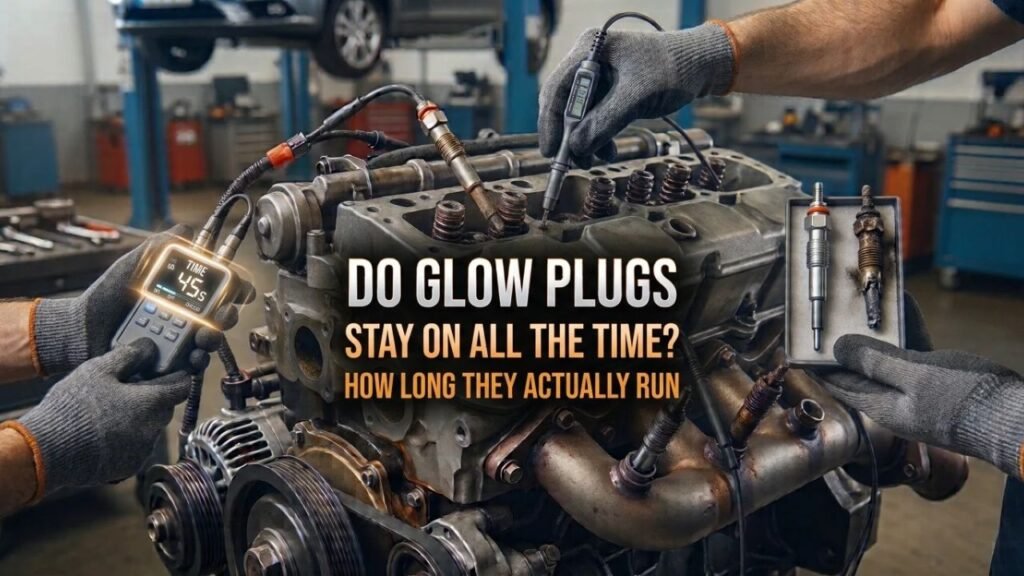
No. Under normal operation, glow plugs are not continuously energized for the entire time the engine is running.
The engine control system decides when additional combustion heat is useful.
On a simple older diesel, the operating sequence might look approximately like this:
Preheat → engine starts → short post-glow or glow plugs switch off.
A modern diesel can use a much more sophisticated sequence:
Pre-glow → start glow → post-glow → plugs off → intermediate glow when needed → regeneration glow when needed.
The plugs may therefore switch on and off several times during a trip.
Electronic controllers can also regulate the amount of power instead of merely applying full voltage constantly. Some modern low-voltage glow plugs are controlled using rapid electrical pulses.
Typical Glow Plug Operating Stages
| Operating Stage | When It Happens | Main Purpose |
| Pre-glow | Before starting | Warm combustion chamber |
| Start glow | During cranking | Help fuel ignite |
| Post-glow | After engine starts | Smooth combustion and reduce emissions |
| Intermediate glow | During certain driving conditions | Maintain combustion/exhaust temperature |
| Regeneration glow | During some DPF regeneration events | Help increase exhaust temperature |
| Off | When extra heat is unnecessary | Protect plugs and save electrical power |
Exactly which stages your vehicle uses depends on its engine-management system.
Key Takeaways:
- Glow plugs normally do not stay continuously powered throughout every drive.
- Modern diesels can operate their glow plugs after startup and reactivate them while driving.
- The ECU or glow plug control module determines when and how strongly the plugs operate.
How Long Do Glow Plugs Stay On Before Starting?
Pre-glow time varies dramatically between diesel engines.
Older diesel engines can require several seconds or considerably longer in cold weather.
Modern quick-heating glow plugs can reach useful operating temperatures in only a few seconds, and some advanced designs reach more than 1,000°C in less than two seconds.
This is why a modern diesel can often start almost as quickly as a gasoline vehicle.
Temperature Makes a Major Difference
The colder the engine, the more glow assistance it generally requires.
On a warm day with an already-warm engine, the pre-glow period may be extremely short or practically unnoticeable.
On a freezing morning, the engine-control system may command a longer heating period.
Inputs can include:
engine coolant temperature, intake or ambient temperature, battery voltage, engine operating state, and other application-specific information.
The driver usually does not have to calculate any of this.
Turn on the ignition and allow the vehicle’s control system to perform the heating sequence.
Does the Glow Plug Light Show How Long the Plugs Are On?
Not necessarily.
This is one of the most common misunderstandings about diesel glow systems.
The dashboard glow plug indicator primarily tells the driver about the starting or pre-glow phase.
When it goes out, it normally means the engine is ready to be started.
It does not necessarily mean electrical power to the glow plugs has completely stopped.
The plugs may remain active after the warning light disappears.
Example
Imagine the glow plug indicator illuminates for three seconds.
The light goes out, and you start the engine.
The engine is now running, but the ECU may continue supplying controlled power to the glow plugs for another minute or several minutes.
From the driver’s seat, it appears that the glow system has shut off because the warning light is gone.
Electrically, the glow plugs may still be performing post-glow.
This behavior is normal.
Do Glow Plugs Stay On After Starting?
Yes, many modern glow plugs remain active after the engine starts.
This operating stage is called post-glow or after-glow.
Its purpose is not primarily to make the engine start—the engine is already running.
Instead, post-glow improves combustion while the engine and combustion chambers are still cold.
Why Post-Glow Is Needed
A cold diesel engine does not instantly reach normal combustion temperature when it fires for the first time.
Cylinder walls, pistons, cylinder heads, and intake air remain relatively cold.
Without additional heating, combustion can be less stable.
Post-glow helps produce:
smoother idle, less diesel knock, reduced white or blue-white startup smoke, lower hydrocarbon emissions, lower carbon monoxide emissions, and faster stabilization of combustion.
This is particularly important in modern low-compression diesel engines designed to meet strict emissions requirements.
How Long Does Post-Glow Last?
There is no single universal time.
Some systems continue post-heating for roughly one to three minutes.
Certain glow plug designs can maintain post-heating for several minutes.
Advanced ceramic glow plugs can support after-glow for more than ten minutes under certain operating strategies.
The actual duration depends on the engine and conditions rather than being permanently fixed.
For example, a cold engine on a winter morning may require much more post-glow than an engine restarted after sitting for ten minutes.
Examples of Modern Post-Glow Capability
Different glow plug technologies can be designed for substantially different after-glow periods.
Some systems use approximately 60–180 seconds of extended heating.
Other metal glow plug technologies can maintain post-heating for several minutes.
Advanced ceramic designs are capable of much longer periods at extremely high temperatures.
These are design capabilities rather than a rule that every vehicle keeps its plugs on for exactly that duration.
The ECU decides how much assistance the engine actually needs.
Key Takeaways:
- The glow plugs may remain active even after the dashboard glow light switches off.
- Post-glow can last from seconds to several minutes depending on the engine.
- Advanced ceramic systems can support very long after-glow periods when required.
Do Glow Plugs Stay On When the Engine Is Warm?
Usually they require much less assistance for starting, but modern glow systems may still activate under certain conditions.
A fully warm diesel normally generates enough compression heat for reliable combustion without conventional starting glow.
That does not necessarily mean the plugs will never be energized.
Modern engine-management systems can command glow operation for emissions or temperature-control purposes even while driving.
This is sometimes called intermediate glow.
What Is Intermediate Glow?
Intermediate glow occurs when the ECU switches the glow plugs back on during normal engine operation.
One purpose is helping maintain appropriate combustion or exhaust temperature under low-load conditions.
For example, a vehicle descending a long hill may use very little fuel.
Exhaust temperature can fall significantly.
Depending on the engine strategy, glow operation can help prevent temperatures from becoming too low for efficient emissions-system operation.
Intermediate glow can also help reduce carbon accumulation in systems such as EGR.
The exact strategy differs by manufacturer, so not every diesel operates its glow plugs in the same way.
Do Glow Plugs Turn On While Driving?
Yes, some modern diesel engines can activate their glow plugs while the vehicle is being driven.
That does not mean they remain constantly on.
The ECU activates them when it determines additional heating is useful.
This can happen during:
cold-engine warm-up, low-load operation, emissions-management events, start-stop operation, or DPF regeneration.
Older diesel vehicles may not have these functions at all.
This is one reason diagnosing a modern glow system based entirely on how older diesel engines behaved can lead to incorrect conclusions.
Do Glow Plugs Stay On During DPF Regeneration?
They can on vehicles whose engine-management strategy uses glow assistance for regeneration.
A diesel particulate filter traps soot from the exhaust.
Eventually, the soot must be burned away.
This process requires very high exhaust temperatures.
The ECU can use several methods to increase temperature during an active regeneration event.
Depending on the engine, activating the glow plugs can be one of them.
The glow plugs increase combustion-chamber heat, helping raise exhaust-gas temperature and support the conditions required for regeneration.
Are They On for the Entire Regeneration?
Not necessarily.
The ECU controls their operation according to its programmed strategy.
Power may be pulsed, adjusted, or removed as operating conditions change.
Therefore, even during regeneration, it is inaccurate to assume every glow plug receives continuous full electrical power from beginning to end.
Why Modern Glow Plugs Can Stay On Longer Than Old Ones
Diesel engine technology has changed considerably.
Older engines commonly had higher compression ratios and comparatively simple emissions systems.
The glow plugs were primarily cold-starting devices.
Modern diesels may use lower compression, sophisticated direct injection, EGR, oxidation catalysts, DPFs, start-stop systems, and tightly controlled combustion strategies.
Glow plugs have evolved accordingly.
A modern plug has become an engine-management and emissions component, not merely a cold-start heater.
This explains why current metal and ceramic glow plug designs need to withstand repeated and extended heating.
Are Glow Plugs Constantly Glowing During Post-Glow?
Not necessarily at maximum power.
Many modern glow systems electronically regulate the plug temperature.
A control module can use pulse-width modulation or similar techniques to switch electrical current extremely rapidly.
Instead of simply connecting the plug directly to battery voltage continuously, the module controls the average energy delivered to it.
This allows the plug to heat quickly and then maintain an appropriate temperature without overheating.
Why This Matters With Low-Voltage Glow Plugs
Some modern glow plugs are designed to operate at voltages far below the vehicle’s nominal 12-volt electrical system.
The glow control module regulates them accordingly.
This is why you should never connect an unidentified modern glow plug directly to a 12-volt battery just to see whether it gets hot.
A low-voltage plug can overheat and fail almost immediately.
What Happens if Glow Plugs Really Stay On Continuously?
If a glow system that is supposed to shut down continues delivering excessive power indefinitely, something may be wrong.
Possible causes include a stuck glow plug relay, failed control module, wiring short, or incorrect control signal.
This is different from normal electronically controlled post-glow or intermittent regeneration operation.
A genuine always-on fault can damage the plugs and place a heavy load on the electrical system.
Glow Plug Overheating
Glow plugs reach extremely high temperatures.
If an older plug designed for limited heating is powered for far longer than intended, its heating element can overheat.
Possible damage includes:
swelling of the heating tip, burned or melted elements, internal open circuits, cracked tips, and premature failure.
Incorrect voltage can make the problem even worse.
Battery and Charging-System Load
Glow plugs consume substantial electrical current.
A four-, six-, or eight-cylinder glow system can represent a significant electrical load.
If the plugs remain powered unnecessarily, the alternator must continually supply that demand.
With the engine off, an energized glow circuit can quickly discharge the battery.
If you suspect the relay is stuck after shutting the engine down, the problem should be diagnosed promptly.
Key Takeaways:
- Normal post-glow is different from a faulty relay keeping the plugs continuously energized.
- Excessive uninterrupted power can overheat glow plugs and stress the electrical system.
- Persistent power to the plugs after the engine is shut off indicates a fault that needs diagnosis.
Can a Stuck Glow Plug Relay Keep the Plugs On?
Yes.
Older glow systems often use a relatively conventional high-current relay.
If its internal contacts weld together or stick, battery power can continue flowing to the glow plugs after the control system tries to switch them off.
Symptoms may include a rapidly draining battery, overheated glow plugs, unusually warm glow plug wiring or relay, and repeated glow plug failures.
Modern vehicles frequently use electronic glow plug control modules instead of simple relays, but control failures can still occur.
What Should You Do?
Do not repeatedly install new glow plugs if they continue failing unusually quickly.
Test the control circuit.
A set of new plugs can be damaged again if excessive voltage or excessive heating time is the real problem.
Electrical diagnosis may include scan-tool testing, current measurement, voltage checks, and glow module testing according to the service manual.
Can a Bad Glow Plug Control Module Keep Them On?
Yes.
The control module decides how much electrical power reaches the plugs and when.
A failure can potentially cause incorrect duration, incorrect voltage, no power, or other abnormal operation.
Modern control modules can also monitor individual glow plug circuits.
If one plug draws an abnormal current, the module or engine control unit may store a diagnostic trouble code.
Because current draw can be substantial, glow circuits should be diagnosed using the correct procedure rather than randomly jumping terminals.
How Can You Tell if Glow Plugs Are Staying On Too Long?
One clue is repeated premature glow plug failure.
If a complete new set develops swollen or burned tips after a short period, excessive electrical power should be investigated.
Another clue is unusually high electrical load after the engine has already warmed completely.
A DC current clamp can allow a technician to monitor glow plug current without disconnecting the circuit.
Modern diagnostic equipment may also display commanded glow operation.
Do Not Diagnose It From the Dashboard Light
Remember that the warning lamp and actual electrical operation are not necessarily synchronized.
A glow indicator that goes out does not prove the plugs are off.
Likewise, a warning light that flashes while driving may indicate an engine-management fault rather than showing that the plugs are physically glowing continuously.
Read diagnostic codes.
Does a Glow Plug Use Power the Entire Time It Is Active?
Yes, but the amount can vary considerably.
During initial rapid heating, current can be very high.
As the plug becomes hot, its electrical characteristics change, and the control system may reduce the supplied power.
Self-regulating plugs are designed so that resistance increases as temperature rises, naturally limiting current to some extent.
Electronic controllers provide another layer of regulation.
This means “on” does not necessarily mean “receiving maximum battery power.”
Do Glow Plugs Stay On With the Ignition Key On?
They can operate when the ignition is switched on, particularly during a cold pre-glow cycle.
However, the system normally limits how long they remain energized if the engine is not started.
This prevents unnecessary battery drain and glow plug overheating.
The exact timeout differs between vehicles.
Repeatedly cycling the ignition simply to activate the plugs again is usually unnecessary on a healthy modern diesel.
The ECU already determines the appropriate heating period from engine temperature.
Should You Wait for the Glow Plug Light Before Starting?
On vehicles that display a preheat indicator, the normal practice is to switch the ignition on and wait until the glow plug indicator goes out before cranking, especially in cold weather.
Modern diesels can have very short preheating periods, so the wait may be only a second or two.
Follow the owner’s manual for your particular vehicle.
Does Waiting Longer Help?
Once the ECU has completed its programmed pre-glow strategy, simply waiting an extra 20 or 30 seconds with the ignition on does not necessarily provide additional heat.
The control system decides how long the glow plugs operate.
Repeatedly cycling the ignition to force additional preheating is also generally unnecessary unless an older vehicle’s manufacturer specifically describes such a procedure.
Do Glow Plugs Turn Off When the Engine Reaches Operating Temperature?
Traditional post-glow usually ends after the engine has warmed sufficiently.
However, that does not guarantee the glow plugs can never come back on during the trip.
A modern ECU may subsequently command intermediate or regeneration glow.
So the more accurate answer is:
The plugs normally stop their warm-up glow when it is no longer necessary, but the control system may reactivate them later.
This distinction is especially important on DPF-equipped modern diesel engines.
Do Glow Plugs Work in Warm Weather?
Yes, depending on the engine.
Warm ambient temperatures can greatly reduce the amount of preheating required.
Some direct-injection diesel engines can start without meaningful pre-glow when conditions are warm enough.
However, modern glow systems may still use post-glow or emissions-related heating after startup.
Therefore, summer weather does not mean the glow plugs are completely unused.
This is one reason a glow plug fault can remain hidden for months and become obvious only when colder weather arrives.
Do Glow Plugs Stay On in Start-Stop Vehicles?
They can be incorporated into start-stop thermal management.
A start-stop diesel repeatedly shuts down and restarts during normal driving.
Engine temperature can fluctuate, particularly during urban traffic.
Advanced glow systems can provide heat when needed to maintain reliable combustion and emissions performance through these cycles.
Again, operation is controlled electronically rather than simply leaving the glow plugs permanently energized.
Do All Diesel Engines Use the Same Glow Strategy?
No.
Glow plug strategies differ enormously between engine generations and manufacturers.
An older indirect-injection diesel may rely heavily on a relatively long pre-glow period.
A modern common-rail direct-injection diesel might use an almost instant pre-glow followed by extended electronically controlled post-glow.
Another vehicle may use ceramic plugs for sophisticated emissions management.
This is why statements such as “glow plugs shut off as soon as the engine starts” or “glow plugs stay on for exactly three minutes” cannot be applied to every diesel.
The service information for the exact engine is the proper reference.
Can You Drive if Glow Plugs Do Not Turn Off?
If you have confirmed that a glow system is receiving uncontrolled continuous power because of a faulty relay or control module, the problem should be repaired promptly.
Continuing to operate the system can shorten plug life and stress the electrical system.
There is also a difference between confirmed electrical over-activation and simply noticing that your modern vehicle uses post-glow.
Post-glow is normal.
A stuck relay is not.
Do not disconnect a modern glow system simply because you discover the plugs operate after startup. You could interfere with cold combustion, emissions control, and DPF regeneration.
How to Check Glow Plug Operation
On modern vehicles, the safest method is usually to start with a diagnostic scan.
Look for glow plug, controller, DPF, and engine-management trouble codes.
Electrical operation can then be checked with appropriate equipment.
A technician may measure individual plug current with a clamp meter or use a dedicated tester.
A scan tool may show commanded glow status or glow control module information on certain vehicles.
Direct voltage measurement may also be useful, but remember that electronically controlled low-voltage systems can pulse rapidly, making a simple multimeter reading difficult to interpret.
Avoid Random Direct-Battery Testing
Before supplying external power to a removed plug, identify its rated voltage.
Some modern plugs are designed for substantially less than 12 volts.
Full battery voltage can destroy them.
For current diesel systems, use the vehicle manufacturer’s testing procedure whenever possible.
FAQs about Do Glow Plugs Stay On All the Time
Do glow plugs stay on after starting?
Many modern glow plugs do.
They can remain active during a post-glow period to improve combustion, reduce smoke, lower emissions, and smooth engine operation.
How long do glow plugs stay on after the engine starts?
It varies.
Some operate for roughly 60–180 seconds, others for several minutes, and certain advanced ceramic systems can support after-glow for more than ten minutes.
Are glow plugs supposed to stay on while driving?
They can switch on while driving in modern diesels.
Intermediate glow and regeneration glow may be used for emissions and temperature management.
Do glow plugs stay on when the engine is warm?
They usually do not need continuous warm-up glow, but the ECU may reactivate them for specific functions such as emissions management or DPF regeneration.
Does the glow plug light mean the plugs are on?
Not necessarily for their entire operating period.
The dashboard indicator mainly communicates the starting/preheating phase to the driver. The plugs can remain energized after the light turns off.
Why do glow plugs stay on after the light goes out?
Because the engine can still benefit from post-glow after startup.
The indicator goes out when the driver can start the engine, not necessarily when all glow activity ends.
Can glow plugs stay on for 10 minutes?
Certain advanced ceramic glow plug technologies can support after-glow lasting more than ten minutes when the engine-management strategy requires it.
That is not normal for every vehicle.
Do glow plugs turn off automatically?
Yes.
A properly functioning glow control system manages their operation automatically according to temperature and engine conditions.
Can a glow plug relay get stuck on?
Yes.
A failed relay can potentially keep the circuit energized longer than intended, resulting in excessive electrical load and premature plug failure.
Can glow plugs drain the battery?
Yes, if they are energized with the engine off because of an electrical fault.
Glow plugs consume substantial current.
Can glow plugs burn out from staying on?
Yes, if they receive excessive voltage or are continuously powered beyond what their design can tolerate.
Modern plugs designed for controlled extended operation are different from an uncontrolled electrical fault.
Do glow plugs run continuously during DPF regeneration?
Some vehicles use glow plugs to support DPF regeneration, but the ECU controls their operation. They are not necessarily supplied with constant maximum power throughout the entire regeneration.
Do glow plugs work in summer?
Yes, depending on the diesel system.
Pre-glow may be extremely short, but post-glow and emissions-related operation can still occur.
Are glow plugs only for cold starting?
No.
Modern glow plugs can also reduce emissions, improve warm-up combustion, support EGR operation, and assist DPF regeneration.
Should I cycle the key twice to heat the glow plugs longer?
Normally no on a healthy modern diesel.
The ECU calculates the appropriate glow duration automatically. Follow the vehicle manufacturer’s starting procedure.
How do I know if my glow plug relay is stuck?
Abnormally high electrical load after the glow period, repeated plug failure, battery drain, or confirmed current flow when the system should be off can indicate a stuck relay or control fault.
Conclusion
So, do glow plugs stay on all the time? No. They are not supposed to receive uncontrolled continuous power for the entire time a diesel engine is running.
However, modern glow plug operation is much more complicated than simply switching on before starting and switching off the instant the engine fires.
A modern diesel may use pre-glow before starting, glow during cranking, post-glow for minutes after startup, intermediate glow during certain driving conditions, and regeneration glow to support DPF operation.
This means your glow plugs may still be active even after the dashboard glow plug light has gone out.
Some systems use post-glow for around a minute or several minutes, while advanced ceramic glow plugs can support after-glow lasting more than ten minutes under appropriate conditions.
The ECU may also switch them back on later during the drive.
What is not normal is a failed relay or control module supplying uncontrolled power to the plugs indefinitely. That can overheat the plugs, shorten their life, increase alternator load, and potentially drain the battery when the engine is off.
If you suspect your glow plugs genuinely never switch off, do not diagnose the system from the dashboard indicator alone. Check commanded glow operation, electrical current, fault codes, and the glow control module.
For most drivers, there is no need to manually control or repeatedly cycle the glow plugs. The modern diesel ECU determines exactly when they are needed and adjusts their electrical power automatically.
So while glow plugs do not stay on all the time, they can operate far more often—and for much longer after startup—than many diesel owners realize.