
What causes glow plugs to fail? The most common causes are normal age and repeated heating cycles, excessive voltage or excessive heating time, a faulty glow plug relay or control module, incorrect fuel injection, carbon buildup, oil entering the combustion chamber, and improper installation. A wrong glow plug with the incorrect voltage or heating characteristics can also fail extremely quickly.
Glow plugs operate in one of the harshest environments in a diesel engine. Their tips repeatedly heat to extremely high temperatures while being exposed to combustion pressure, soot, fuel spray, vibration, and rapid temperature changes.
Modern glow plugs can have an even harder job because they may operate before starting, during cranking, after startup, and sometimes during emissions-control events such as diesel particulate filter regeneration.
Eventually, normal thermal cycling can wear them out. However, a glow plug that fails unusually early—especially when several new plugs fail within a short period—often indicates another problem in the engine or glow control system.
Replacing the plug without finding that problem can simply destroy the replacement.
In this guide, I’ll explain what causes glow plugs to fail, what different types of glow plug damage can tell you, how injectors and electrical problems shorten glow plug life, and what you should check before installing a new set.
What Causes Glow Plugs to Fail?
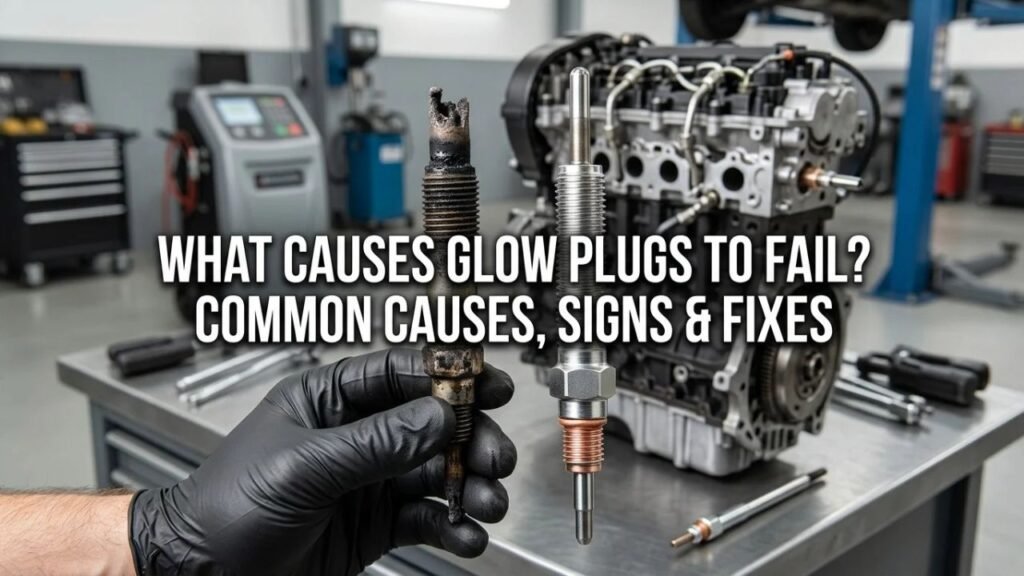
Glow plug failures can be divided into several broad categories:
electrical overload, excessive combustion temperature, contamination, mechanical damage, incorrect parts, and normal wear.
DENSO identifies excessive voltage and heat as two of the major causes of premature glow plug failure.
A properly functioning glow system carefully controls how much electrical energy reaches each plug.
If that control is lost, the plug can become hotter than it was designed to tolerate.
Likewise, an injector problem can expose the glow plug tip to abnormal fuel spray or combustion temperature.
The appearance of the failed plug can often provide clues about which condition occurred.
Common Glow Plug Failure Causes
| Cause | Possible Glow Plug Damage |
| Normal age and thermal cycling | Open circuit or slow heating |
| Excessive voltage | Swollen, cracked, melted, or broken tip |
| Faulty relay/control module | Overheated or burned-out plug |
| Wrong glow plug | Rapid overheating or poor heating |
| Bad fuel injector | Broken, melted, or carbon-covered tip |
| Incorrect injection timing | Severe overheating or tip damage |
| Carbon buildup | Restricted heating, sticking, premature failure |
| Engine oil entering cylinder | Swollen or contaminated tip |
| Poor installation | Broken terminal, damaged threads, cracked plug |
| Excessive tightening torque | Mechanical damage or distortion |
| Low-quality plug | Early electrical or structural failure |
The exact failure pattern varies, so the plug should be examined along with the electrical and fuel systems.
Key Takeaways:
- Excessive voltage and excessive heat are major causes of premature glow plug failure.
- Injector and fuel-system problems can physically damage glow plug tips.
- If new plugs fail quickly, diagnose the engine and glow control system before installing another set.
Normal Age and Repeated Heating Cycles
Glow plugs are wear components.
Even when the engine has no faults, they eventually deteriorate.
Every time the glow plug heats and cools, its internal heating element expands and contracts.
One cycle is insignificant, but thousands of cycles gradually stress the materials.
A modern diesel may activate the plugs more frequently than many drivers realize.
The plug can operate during pre-glow before starting, while the starter is cranking, during post-glow after startup, and under certain emissions-control conditions.
A vehicle used for frequent short journeys can therefore put many more heating cycles on its plugs than a long-distance highway vehicle covering the same mileage.
How Normal Wear Usually Appears
A normally aged glow plug may simply stop conducting electricity.
The internal heating element can eventually break, producing an open circuit.
Some plugs fail more gradually and become slower to reach operating temperature.
The driver may initially notice that the engine takes slightly longer to start during cold weather.
Eventually, cold-start performance becomes obviously worse.
If an old original glow plug fails after substantial service and the others have the same history, replacing the full set can make sense.
Excessive Voltage
Excessive electrical voltage is one of the most damaging conditions for a glow plug.
A glow plug is essentially a carefully engineered electrical heater.
Its voltage specification is critical.
If the plug receives substantially more voltage than intended, its temperature can rise too quickly and too far.
The heater tube may swell, crack, split, melt, or break.
Modern Glow Plugs May Not Be 12-Volt Plugs
A common mistake is assuming that every glow plug in a 12-volt vehicle is designed to receive 12 volts continuously.
That is not true.
Many modern diesel engines use low-voltage glow plugs controlled electronically.
The glow plug module rapidly regulates the electrical supply so the plug heats extremely quickly without being destroyed.
Connecting one of these plugs directly to a 12-volt battery can damage it.
Likewise, installing a glow plug with the wrong voltage rating can create immediate problems.
The plug may physically fit perfectly while being electrically incompatible.
Faulty Glow Plug Relay or Control Module
The glow plug itself may not be the original cause of its failure.
A bad relay or electronic control module can keep supplying power for too long or provide inappropriate electrical control.
The result is overheating.
Older glow systems often use a relatively simple high-current relay.
If the relay contacts stick together, the plugs can remain energized longer than intended.
Modern systems use sophisticated electronic modules that may regulate individual plugs with pulse-width modulation.
A failed module can also produce abnormal heating.
Warning Sign: Several Plugs Fail Together
If several glow plugs fail at approximately the same time, especially after recent replacement, inspect the control system.
It is possible for plugs of the same age to fail naturally around the same period, but repeated simultaneous failures can point toward excessive supply voltage or incorrect control.
Replacing another set without checking the module can become expensive.
Charging-System Problems
The vehicle’s alternator and voltage regulator also affect the glow system.
If charging voltage becomes abnormally high, the glow plug control circuitry can be exposed to conditions outside its intended range.
Modern electronics usually provide substantial regulation and protection, but charging-system faults should still be investigated when glow plugs show obvious overvoltage damage.
This is particularly important if other electrical symptoms are present, such as abnormally bright lights, battery problems, or electrical fault codes.
A charging-system test is relatively straightforward and can prevent repeated component failure.
Installing the Wrong Glow Plug
One of the easiest ways to destroy a glow plug is to install the wrong one.
Glow plugs differ in:
voltage, resistance, heating speed, heating-tip length, thread dimensions, construction material, and control strategy.
Two plugs can look almost identical.
They may even have the same thread and fit the cylinder head.
That does not mean they are interchangeable.
Low-Voltage Plug in the Wrong System
A plug designed for a low-voltage electronic control system can overheat almost immediately if exposed to excessive voltage.
High-Voltage Plug in a Low-Voltage System
The opposite mismatch may cause the plug to heat too slowly or fail to reach the temperature the engine requires.
This can create hard starting, smoke, and diagnostic codes even if the plug itself does not immediately burn out.
Always select glow plugs using the exact vehicle, engine, and approved part number.
Key Takeaways:
- Glow plug voltage must match the engine’s control strategy exactly.
- A 12-volt vehicle does not necessarily use glow plugs intended for continuous 12-volt power.
- Physical fit does not prove electrical compatibility.
Faulty Fuel Injectors
Injector problems are another major cause of damaged glow plugs.
A diesel injector is designed to spray fuel in a precise pattern.
The fuel should be atomized into extremely small droplets and directed into the intended combustion area.
If an injector becomes worn, contaminated, damaged, or fails to close correctly, the spray pattern can change.
Fuel may strike the glow plug directly.
That can subject the glowing tip to severe thermal shock.
Leaking Injector
A leaking injector can continue allowing fuel into the cylinder when it should be closed.
That can create abnormal combustion and excessive local temperatures.
The glow plug may develop:
a cracked tip, melted area, swollen heater tube, or broken heating element.
If the same cylinder repeatedly destroys new glow plugs, injector testing should be high on your diagnostic list.
Simply installing another plug may only reproduce the failure.
Incorrect Fuel Injection Timing
Injection timing determines when diesel fuel enters the cylinder relative to piston position.
If fuel is injected too early, combustion pressure and temperature can develop at the wrong point in the cycle.
Glow plug manufacturers identify overly advanced or otherwise incorrect injection timing as a potential cause of plug-tip overheating and damage.
On older mechanically controlled diesels, pump timing may be adjustable.
Modern common-rail systems control injection electronically, so incorrect timing may relate to sensor information, mechanical synchronization, fuel-system faults, or other control issues.
A plug with a severely melted or fractured tip deserves more investigation than simply an electrical resistance test.
Carbon Buildup Around the Glow Plug
Carbon deposits are common inside diesel combustion systems.
Some soot is normal, but heavy deposits around the glow plug can cause problems.
Carbon may accumulate on the heating tip or inside the narrow glow plug bore in the cylinder head.
This can interfere with normal heat transfer and potentially contribute to overheating.
It can also make the plug extremely difficult to remove.
How Carbon Can Cause Internal Failure
In certain glow plug designs, heavy carbon around the heater tube can interfere with normal thermal behavior.
The plug’s regulating system may not respond as intended, potentially allowing excessive current through the heating element.
Eventually the heating coil can break.
Heavy deposits may also place mechanical pressure around the tip as the plug expands and contracts.
Why the Glow Plug Bore Should Be Clean
When replacing glow plugs, manufacturers often recommend inspecting and, where appropriate, cleaning the bore with the correct reamer or service tool.
This removes carbon that could damage the new plug or prevent it from seating properly.
The procedure must be performed carefully so debris does not enter the cylinder unnecessarily.
Oil Entering the Combustion Chamber
Glow plug damage can sometimes reveal a more serious engine problem.
Oil entering the combustion chamber can expose the glow plug tip to abnormal thermal and chemical conditions.
DENSO associates swollen glow plug probes with oil entering the cylinder from engine wear.
Possible sources include:
worn piston rings, cylinder wear, turbocharger seal problems, or crankcase ventilation faults.
Look for Other Symptoms
If oil is entering the combustion chamber, the vehicle may also show:
increased oil consumption, blue or blue-gray smoke, oily deposits, turbocharger problems, or excessive crankcase pressure.
Replacing the glow plugs will not correct those conditions.
If the new plug is returned to the same unhealthy cylinder, it may fail again.
Coolant or Water Entering the Cylinder
Liquid contamination can also create severe thermal shock.
A glow plug tip may be glowing at extremely high temperature when a comparatively cool liquid contacts it.
Repeated thermal shock can damage or crack the heater.
Coolant entering a diesel cylinder may result from a head-gasket problem, cracked cylinder head, EGR cooler failure in some engines, or another internal leak.
Symptoms can include persistent white exhaust, falling coolant level, cooling-system pressure, or difficult starting.
A cracked glow plug should therefore not always be viewed as an isolated electrical failure.
Excessive Combustion Temperature
Glow plugs are designed to survive very high temperatures, but they still have limits.
Abnormal combustion can exceed those limits.
Causes may include incorrect injection, injector malfunction, engine mechanical problems, or inappropriate plug selection.
Overheated glow plugs may show discoloration, melting, cracking, swelling, or missing material.
If part of a glow plug tip is missing, determine where it went.
A fragment inside the combustion chamber can potentially damage the piston, valves, cylinder head, or turbocharger downstream.
Improper Installation Torque
Installation error can destroy a perfectly good glow plug before it ever has a chance to wear out.
Glow plugs are slender components, and their tightening torques are often relatively low.
Overtightening can deform the plug body, damage the threads, crack a ceramic element, or break the electrical terminal.
Undertightening creates different problems.
A loose glow plug may not seat correctly against the cylinder head.
This can interfere with heat transfer and sealing while exposing the plug to abnormal vibration and combustion conditions.
Use a Torque Wrench
Glow plug torque depends on thread diameter, plug design, and engine.
Do not tighten them based on feel alone.
Use the specification supplied for the exact vehicle or plug.
Also follow the plug manufacturer’s guidance regarding thread lubrication. Many glow plugs are intended for dry installation, and adding lubricant can change friction enough to cause overtightening even when the torque wrench appears to show the correct value.
Damage During Removal or Installation
An old glow plug can become tightly stuck because of corrosion and carbon buildup.
Applying excessive force can snap the plug.
This is technically a removal failure rather than an operational glow plug failure, but it is one of the most expensive problems associated with glow plugs.
Part of the plug may remain inside the cylinder head.
Special extraction equipment may then be required.
Ceramic Glow Plugs Need Extra Care
Ceramic glow plugs are particularly capable of rapid, high-temperature operation but require careful handling.
Dropping one or applying excessive side force during installation can crack the ceramic heating element.
The crack may not always be obvious immediately.
Later thermal cycling can cause the damaged element to break.
Follow the service procedure closely when working with ceramic plugs.
Key Takeaways:
- Incorrect tightening torque can damage the plug or prevent proper seating.
- Carbon buildup makes old glow plugs harder and riskier to remove.
- Ceramic glow plugs require especially careful handling because physical damage can lead to later failure.
Poor-Quality or Counterfeit Glow Plugs
Glow plugs must withstand extreme temperatures, vibration, electrical current, and combustion pressure.
Material quality matters.
An inexpensive low-quality plug may use inferior heating elements, insulation materials, seals, or manufacturing tolerances.
Bosch notes that poor-quality imitation plugs can suffer heater tube swelling or rupture related to inadequate internal construction.
Counterfeit parts are also a concern with well-known automotive brands.
A counterfeit package can look convincing while the actual plug uses completely different materials.
For an engine where a broken glow plug tip can create serious damage, saving a small amount on questionable parts is rarely worthwhile.
Use reputable OE or established aftermarket suppliers.
Short Trips and Frequent Engine Starts
Short-trip driving does not necessarily cause an immediate glow plug failure, but it can shorten service life by increasing the number of thermal cycles relative to mileage.
Consider two diesel vehicles that each travel 50,000 miles.
One travels long highway distances and may be started only once or twice each day.
The other is used for deliveries and starts 20 times per day.
The second vehicle exposes its glow plugs to far more heating cycles.
Modern plugs may also post-glow after every cold start.
Therefore, mileage alone is not a perfect measurement of glow plug life.
Frequent cycling contributes to normal aging and can expose marginal components sooner.
DPF Regeneration and Glow Plug Workload
Some modern diesel engines use glow plugs as part of emissions-control strategies.
The ECU may operate them to help increase combustion and exhaust temperatures during diesel particulate filter regeneration.
This means the glow plugs can accumulate operating time even after the engine is fully warm.
Normal regeneration use is something the plugs are designed to handle.
However, repeated emissions-system problems can increase unusual operating demands.
If the engine repeatedly attempts regeneration because of a clogged DPF, failed sensor, or persistent soot problem, the entire combustion and emissions system deserves diagnosis.
Can a Bad Battery Cause Glow Plug Failure?
A weak battery is more likely to cause poor glow performance and hard starting than direct overvoltage damage.
Battery voltage can drop substantially while glow plugs and the starter are drawing current.
The plugs may not heat as effectively, and the engine may crank slowly.
However, low system voltage is different from the overvoltage conditions that typically melt or swell a glow plug.
A failing charging system or control module capable of delivering excessive voltage is generally more concerning for direct plug damage.
Still, battery and charging-system health are important because the glow system is a high-current electrical load.
Can a Bad Alternator Damage Glow Plugs?
Potentially, yes—particularly if the alternator or voltage regulator creates an overcharging condition.
Excessive system voltage can affect glow plug operation and other electronic components.
If failed plugs show signs consistent with electrical overheating, charging voltage should be checked.
Do not focus solely on the plugs themselves.
Why Does the Same Glow Plug Keep Failing?
Repeated failure in the same cylinder is a strong diagnostic clue.
Instead of blaming the glow plug brand immediately, investigate what is unique about that cylinder.
Possible causes include:
a bad injector, abnormal compression, oil entering the cylinder, coolant contamination, carbon buildup in the glow plug bore, damaged cylinder-head threads, or incorrect seating.
Comparing the failed plug’s appearance with plugs from the other cylinders can be extremely useful.
If only one has a melted or swollen tip, something cylinder-specific is likely happening.
Why Did All My New Glow Plugs Fail?
If several recently installed plugs fail, check system-wide factors.
Possible causes include:
incorrect plug part numbers, excessive supply voltage, a faulty relay or controller, charging-system overvoltage, or incorrect installation.
It is unlikely for a full set of quality plugs to fail almost simultaneously through ordinary aging shortly after installation.
Do not install a third or fourth set without diagnosing the electrical supply.
What Different Glow Plug Damage Can Tell You
The physical appearance of the failed plug can provide useful clues.
Swollen or Enlarged Tip
A swollen tip can indicate excessive voltage or severe overheating.
Oil contamination and abnormal engine conditions can also contribute to certain swelling patterns.
Melted Tip
A melted heating element points toward severe thermal overload.
Potential causes include excessive electrical supply, incorrect fuel injection, abnormal combustion, or the wrong plug.
Broken Tip
A fractured tip can result from excessive heat, injector spray problems, severe carbon deposits, mechanical damage, or thermal shock.
Missing pieces require additional caution.
Heavy Carbon Deposits
Carbon buildup can indicate poor combustion, injector problems, incorrect injection timing, or insufficient air.
The deposits can themselves interfere with glow plug operation.
Broken Terminal
A damaged electrical terminal is commonly associated with incorrect tools or excessive tightening during installation.
How to Tell if a Glow Plug Has Failed
Typical symptoms include difficult cold starting, rough running immediately after startup, white or light-gray exhaust smoke, increased cranking time, and glow-system warning lights.
Modern diesels can also store cylinder-specific glow plug circuit codes.
However, these symptoms do not prove the glow plug itself is defective.
A failed wiring harness or controller can prevent a perfectly good plug from receiving power.
Likewise, low compression or a bad injector can imitate a glow plug problem.
Electrical testing is therefore important.
How to Test Glow Plugs Safely
Many plugs can be tested while still installed in the engine.
Possible methods include resistance measurement, current-draw testing, voltage checks, scan-tool diagnostics, or a dedicated glow plug tester.
Modern plugs can have extremely low resistance, so inexpensive multimeters may not provide enough resolution to distinguish small differences accurately.
Current measurement can sometimes give more useful information because a failed open-circuit plug draws no current.
Avoid Blind Battery Testing
Do not connect an unknown modern glow plug directly to a 12-volt battery.
Some modern plugs are designed for much lower voltage under electronic control.
Direct battery voltage can destroy them almost instantly.
Use the test procedure specified for the vehicle or glow plug type.
Should You Replace All Glow Plugs When One Fails?
Often, yes, if the plugs are old and have similar mileage.
All cylinders’ plugs have generally experienced similar heating cycles.
When one reaches the end of its normal service life, the others may not be far behind.
Replacing the full set also creates consistent heating performance across all cylinders.
However, if a relatively new plug fails because one injector is malfunctioning, replacing all of the plugs without correcting the injector does not solve the real problem.
Diagnose the failure pattern first.
How to Prevent Premature Glow Plug Failure
The best prevention is using the correct parts and keeping the diesel engine healthy.
Always install the exact glow plug specified for the engine.
Use the proper torque and installation procedure.
If the old plugs show unusual damage, inspect the injector system, glow controller, charging system, and engine condition before installing replacements.
Keep the intake and fuel systems properly maintained.
Investigate oil consumption, coolant loss, abnormal smoke, and injector faults rather than allowing them to continue.
And if new glow plugs repeatedly fail, stop replacing them until the underlying cause has been found.
FAQs about What Causes Glow Plugs to Fail
What is the most common cause of glow plug failure?
Normal age is common over long service periods, while excessive voltage and excessive heat are among the leading causes of premature failure.
A bad controller, relay, injector, or incorrect plug can create those conditions.
Can a bad glow plug relay burn out glow plugs?
Yes.
A relay that keeps the plugs energized too long can cause excessive heating and premature failure.
Can a bad glow plug control module damage the plugs?
Yes.
Modern control modules regulate glow plug power. Incorrect voltage or excessive heating duration can overheat the plugs.
Can bad injectors damage glow plugs?
Yes.
Incorrect or leaking injector spray can create abnormal combustion and thermal shock at the glow plug tip.
Can carbon buildup cause glow plug failure?
Yes.
Heavy carbon deposits can interfere with heat transfer and plug operation and can make the plug difficult to remove.
Can oil damage glow plugs?
Oil entering the combustion chamber can create abnormal conditions and may contribute to swollen or damaged glow plug tips.
Investigate the reason for oil consumption.
Can too much voltage destroy a glow plug?
Yes.
Excessive voltage can cause rapid overheating, swelling, cracking, melting, or breakage.
Can a wrong glow plug burn out quickly?
Absolutely.
A physically compatible plug with the wrong voltage or heating characteristics can fail almost immediately.
Can an alternator cause glow plug failure?
An overcharging alternator or faulty voltage regulator can contribute to excessive electrical supply and should be checked when plugs show overvoltage damage.
Do glow plugs fail from old age?
Yes.
Repeated heating and cooling cycles eventually wear the internal heating element.
Can short trips wear out glow plugs faster?
Potentially.
Frequent short journeys create many starting and heating cycles relative to mileage.
Why does one glow plug keep failing?
A repeated failure in one cylinder can indicate a bad injector, oil or coolant contamination, carbon buildup, low compression, or a mechanical installation problem.
Why do all my glow plugs keep burning out?
Check for excessive voltage, the wrong glow plug specification, a faulty relay/control module, and charging-system problems.
Can overtightening damage a glow plug?
Yes.
Excessive torque can damage the plug body, threads, terminal, or ceramic element.
Can undertightening damage a glow plug?
Yes.
An improperly seated plug can experience abnormal heat transfer, vibration, and combustion exposure.
Can ceramic glow plugs break easily?
They are designed for severe engine operation, but ceramic elements require careful handling during removal and installation.
Impact or excessive installation force can create fractures.
Can glow plugs fail without any warning?
Yes.
One plug can fail electrically without immediately creating obvious symptoms, especially in warm weather.
The problem may become noticeable only during colder starting conditions.
How long should glow plugs last?
Many quality glow plugs can last around 100,000 miles or more, but actual life depends heavily on engine condition, plug technology, and the number of heating cycles.
Should I replace a failed glow plug or diagnose the engine first?
For an old plug that has simply worn out, replacement may be enough.
For unusual physical damage or premature failure, identify the underlying electrical, injector, or engine problem first.
Conclusion
So, what causes glow plugs to fail? Glow plugs eventually wear out through normal heating and cooling cycles, but premature failures are most commonly associated with excessive voltage, excessive heat, faulty glow plug relays or control modules, incorrect fuel injection, carbon buildup, engine oil contamination, wrong glow plugs, and installation errors.
The condition of the failed plug can provide important diagnostic clues.
A swollen, cracked, or melted heating tip may indicate electrical or thermal overload. Heavy carbon deposits can point toward injector, combustion, or airflow problems. Repeated damage to the same cylinder’s plug can indicate an injector or mechanical engine fault.
When several new glow plugs fail together, suspect a system-wide problem such as incorrect voltage, a defective controller, wrong replacement plugs, or charging-system trouble.
My recommendation is to avoid treating every failed glow plug as an isolated component failure.
If an old plug simply develops an open circuit after years of normal service, wear may be the entire explanation. But if a plug melts, swells, cracks, breaks, or fails shortly after replacement, investigate the cause before installing another one.
Check that the correct part number was used, verify the glow control system, inspect charging voltage, evaluate injector operation, and look for abnormal oil, coolant, or carbon contamination.
Installing the right plug with the correct torque into a healthy diesel engine gives it the best chance of reaching its normal service life.
And if glow plugs repeatedly fail, solving the underlying engine or electrical problem is far more important than repeatedly buying new plugs.