
The most common failing spark plug symptoms include intermittent misfires, rough idle, longer starting time, hesitation, weak acceleration, reduced fuel economy, and a check engine light. These problems often begin occasionally and become more frequent as the plug deteriorates.
A failing spark plug is not necessarily completely dead. It may still produce a spark under light operating conditions but fail during cold starts, acceleration, high engine load, or increased cylinder pressure.
This gradual decline is what separates a failing plug from one that has already stopped working. Recognizing the early signs can prevent severe misfires, ignition coil stress, and catalytic converter damage.
What Does a Failing Spark Plug Mean?
A failing spark plug is a plug that can no longer ignite the air-fuel mixture consistently.
The plug may have worn electrodes, an enlarged gap, carbon deposits, oil contamination, a damaged insulator, or another condition that interferes with ignition.
During normal operation, the ignition coil sends high voltage to the spark plug. The voltage travels through the center electrode and jumps across the spark plug gap to the ground electrode.
A healthy plug creates a strong and repeatable spark. A failing plug may produce a weak, delayed, or intermittent spark.
The engine may continue running because the plug still works during some combustion cycles. However, engine performance usually becomes less stable as the condition worsens.
Common Failing Spark Plug Symptoms
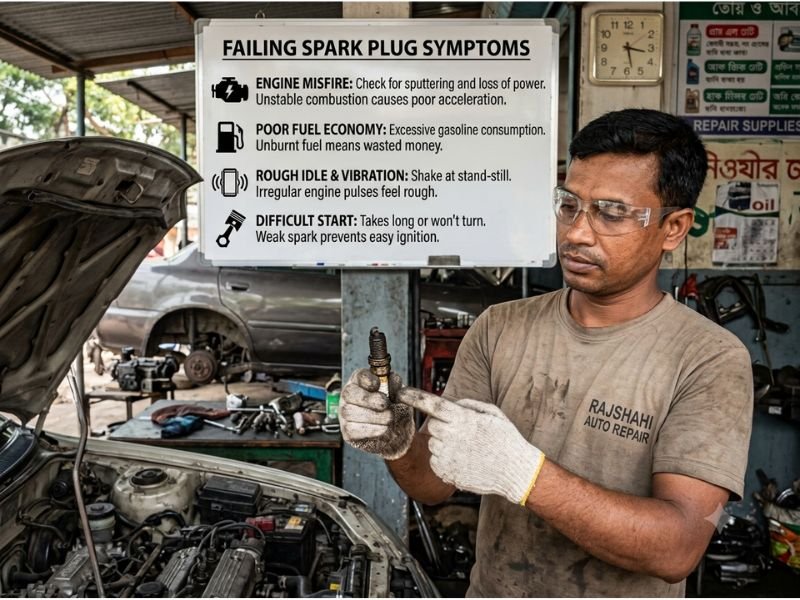
The symptoms of a failing plug may not be constant. They can appear only during certain temperatures, engine speeds, or driving conditions.
Intermittent Engine Misfires
An intermittent misfire is one of the clearest signs of a spark plug beginning to fail.
The engine may run normally for several minutes and then briefly jerk, stumble, or lose power. The problem may disappear before returning later.
This happens when the plug ignites some combustion cycles but fails during others.
The misfire may become more noticeable when accelerating, climbing a hill, or operating at higher RPM. These conditions increase cylinder pressure and make it harder for a weak spark to cross the electrode gap.
A deteriorating plug may initially misfire only once in a while. As electrode wear or contamination increases, the misfire can become constant.
Rough Idle That Comes and Goes
A failing spark plug may cause an unstable or uneven idle.
The engine may feel smooth immediately after starting but begin vibrating once it warms up. In other cases, the roughness may occur during a cold start and improve as engine temperature rises.
You may feel occasional shaking through the steering wheel, seat, or floor. Engine RPM may fluctuate slightly, and the exhaust rhythm may sound uneven.
A plug that is only beginning to fail may cause a brief stumble every few seconds rather than continuous rough running.
Vacuum leaks, dirty injectors, ignition coil faults, and low compression can produce similar symptoms. A failing plug becomes more likely when the rough idle appears alongside delayed starting or load-related hesitation.
Longer Cranking Before Startup
A spark plug that is losing its ability to fire consistently may make the engine take longer to start.
During cranking, the battery is powering the starter motor while the ignition system is trying to generate enough voltage for combustion. A worn or contaminated plug may not produce a strong spark during the first engine revolutions.
The engine may crank normally but require several extra seconds before starting.
This symptom can be more noticeable in cold weather because the air-fuel mixture is more difficult to ignite. It may also appear when the battery is slightly weak, since less voltage is available to the ignition system.
A completely failed plug may prevent one cylinder from firing at all. A failing plug usually creates a more gradual change in starting performance.
Hesitation When Accelerating
A failing spark plug may cause the engine to hesitate when the accelerator is pressed.
The vehicle may pause briefly before responding, stumble during takeoff, or jerk while merging into traffic.
Acceleration increases the amount of air and fuel inside the cylinders. It also raises cylinder pressure, which increases the voltage required to create a spark.
A plug that works at idle may fail under this higher electrical demand.
This is why hesitation under load can appear before a constant idle misfire develops. The spark plug is still functioning, but it no longer has enough ignition margin for demanding conditions.
Gradual Loss of Engine Power
A failing spark plug can make the engine feel weaker over time.
The vehicle may accelerate more slowly, struggle more on hills, or require additional throttle to maintain speed.
The change may be subtle because plug deterioration often happens gradually. Drivers may adapt to the reduced performance without realizing how much power has been lost.
When a plug misfires, the affected cylinder produces less combustion pressure. The remaining cylinders must work harder to provide the requested power.
The loss is especially noticeable in smaller engines, where one weak cylinder represents a larger portion of the engine’s total output.
Declining Fuel Economy
Reduced fuel economy can develop when a failing spark plug does not burn the air-fuel mixture efficiently.
A weak or missed spark may leave part of the fuel unburned. The driver may also press the accelerator farther to compensate for reduced power.
You may notice fewer miles from a full tank or a slow decrease in the vehicle’s average fuel economy reading.
Fuel consumption can change because of tire pressure, weather, driving habits, fuel quality, or sensor problems. Spark plug failure becomes more likely when poor economy occurs with hesitation, rough idle, or misfires.
Check Engine Light
A failing spark plug may cause the check engine light to turn on after the vehicle’s computer detects repeated misfires.
The light may appear only occasionally during the early stages. A pending misfire code may be stored even when the warning light later turns off.
A steady check engine light usually indicates a fault that requires diagnosis. A flashing light often means the misfire is severe enough to threaten the catalytic converter.
A scan tool may identify a specific misfiring cylinder. However, the code does not prove that the spark plug is responsible.
The ignition coil, fuel injector, wiring, and mechanical condition of the cylinder may produce the same code.
Strong Fuel Smell From the Exhaust
A spark plug that fails to ignite the mixture may allow unburned gasoline to enter the exhaust system.
The exhaust may smell unusually rich, especially during startup or after repeated misfires.
You may also hear occasional popping or notice uneven exhaust pulses.
A strong fuel smell can result from injector leakage, excessive fuel pressure, or an overly rich mixture. An external fuel leak is also possible and requires immediate attention.
When the odor appears with a cylinder misfire and visibly worn or fouled plug, incomplete ignition becomes a more likely cause.
Failing Spark Plug Symptoms at a Glance
| Symptom | When It May Appear | Why the Plug Causes It |
| Intermittent misfire | Acceleration or high RPM | The plug fires inconsistently |
| Rough idle | Cold or warm idle | Combustion becomes uneven |
| Longer cranking | Startup | The mixture does not ignite immediately |
| Hesitation | Throttle application | Higher pressure increases spark demand |
| Reduced power | Hills or heavy load | The cylinder produces less output |
| Poor fuel economy | Normal driving | Fuel burns incompletely |
| Check engine light | Repeated misfires | The computer detects combustion failure |
| Fuel smell | Startup or active misfire | Unburned fuel enters the exhaust |
Why Failing Spark Plug Symptoms May Be Intermittent
A spark plug does not always fail completely at once.
Its performance can change according to engine temperature, moisture, cylinder pressure, ignition voltage, and plug contamination.
A fine crack in the ceramic insulator may leak voltage only after the plug becomes hot. A worn electrode gap may cause misfires only under heavy acceleration. Carbon deposits may become more conductive when damp.
This can create confusing patterns. The engine may run normally during a short inspection but misfire later during driving.
Intermittent symptoms should not be ignored simply because they disappear temporarily. A plug that repeatedly fails under specific conditions is no longer operating reliably.
What Does a Failing Spark Plug Look Like?
A failing spark plug may appear worn, fouled, overheated, or physically damaged.
The plug’s appearance can help identify why it is becoming unreliable.
Rounded or Eroded Electrodes
The center and ground electrodes gradually lose material as the plug fires.
The edges may become rounded, and the gap may widen. This increases the voltage required to produce a spark.
A clean-looking plug can still be failing if its electrodes are heavily worn.
Dry Black Carbon Deposits
Dry black soot indicates carbon fouling.
The deposits can provide an electrical path across the insulator and weaken the spark. The plug may fire normally at times and misfire when deposits become more conductive.
Carbon fouling may be related to a rich fuel mixture, short trips, excessive idling, or restricted airflow.
Wet Oil Deposits
A dark, glossy coating on the firing tip may indicate oil fouling.
Oil can interfere with the spark and collect additional combustion deposits.
Replacing the plug may temporarily improve performance, but the new plug can foul again if oil continues entering the cylinder.
Wet Gasoline
A plug wet with gasoline may indicate that fuel is reaching the cylinder but is not being ignited consistently.
This condition can occur after repeated starting attempts or an active ignition misfire.
Fuel-fouled plugs usually have a strong gasoline smell and a thinner coating than oil-fouled plugs.
Cracked Ceramic
A crack in the white ceramic insulator can allow ignition voltage to escape before reaching the firing gap.
The crack may be extremely thin and visible only under bright light.
A plug with confirmed ceramic damage should be replaced rather than cleaned or reused.
White or Burned Firing Tip
A white, blistered, or burned plug may have been exposed to excessive combustion heat.
An overheated plug may misfire intermittently before failing more severely.
The underlying cause should be identified because simply installing another plug may not prevent repeated damage.
What Causes a Spark Plug to Start Failing?
Spark plugs can begin failing because of normal wear, contamination, overheating, physical damage, or incorrect installation.
Normal electrode erosion is one of the most common causes. Each spark removes a small amount of metal, gradually widening the gap.
Oil or fuel contamination can coat the electrodes and insulator. Carbon deposits may form when the engine runs rich, operates primarily on short trips, or does not reach normal temperature.
A loose spark plug may transfer heat poorly and overheat. An overtightened plug may suffer shell or insulator damage.
The wrong plug heat range, thread reach, or electrode design can also cause premature failure.
Ignition coil problems may sometimes imitate a failing spark plug. A weak coil may not provide enough voltage even when the plug itself is still usable.
Failing Spark Plug vs. Worn Spark Plug
A worn spark plug and a failing spark plug are closely related, but the terms are not identical.
A worn spark plug specifically has electrode erosion caused by extended use. A failing spark plug is any plug that is becoming unreliable, regardless of the cause.
| Condition | Main Characteristic | Typical Cause |
| Worn spark plug | Rounded electrodes and increased gap | Long-term service |
| Failing spark plug | Intermittent or weak ignition | Wear, fouling, cracks, or overheating |
| Fouled spark plug | Deposits cover the firing area | Oil, fuel, or carbon contamination |
| Failed spark plug | Little or no usable spark | Severe damage or advanced deterioration |
A worn plug may still work normally for a period. It becomes a failing plug once the wear starts affecting ignition performance.
Failing Spark Plug vs. Bad Ignition Coil
A failing plug and a bad ignition coil can produce almost identical symptoms.
Both may cause rough idle, misfires, hesitation, hard starting, and a check engine light.
The spark plug should be inspected for worn electrodes, deposits, cracks, and an incorrect gap. The ignition coil and boot should be checked for carbon tracking, heat damage, corrosion, or electrical arcing.
During diagnosis, a technician may move the suspected coil to another cylinder. If the misfire follows the coil, the coil is likely responsible.
A worn plug can also place additional voltage demand on the coil. In some cases, both components may be damaged.
How to Confirm a Failing Spark Plug
I recommend combining the vehicle’s symptoms with plug inspection, gap measurement, and cylinder-specific diagnosis.
Allow the engine to cool before removing the ignition coils or spark plug wires. Clean dirt and debris from the plug wells first.
Keep each plug associated with its original cylinder. This allows you to compare the plug from the misfiring cylinder with the others.
Inspect the electrodes, ceramic insulator, deposits, and threads under bright light. Measure the spark plug gap and compare it with the exact engine specification.
A plug may be unreliable even when it produces a visible spark outside the engine. Open-air testing does not reproduce the pressure inside a running cylinder.
The final diagnosis is stronger when a cylinder-specific misfire is combined with abnormal plug wear or when normal operation returns after installing the correct replacement plug.
Can a Failing Spark Plug Still Produce a Spark?
Yes. A failing spark plug may still produce a visible spark.
The spark may be strong enough in open air or during light engine operation but insufficient under cylinder pressure.
This is why an intermittent plug problem can be difficult to confirm with a simple visual spark test.
The plug’s service age, measured gap, electrode condition, and behavior under load are also important.
A visible spark does not guarantee that the plug can ignite the mixture consistently inside the engine.
Can You Drive With a Failing Spark Plug?
A car may continue operating with a failing spark plug, but the problem can worsen unexpectedly.
A mild hesitation may develop into continuous misfiring, severe vibration, stalling, or sudden power loss.
Continued misfires can send unburned fuel into the catalytic converter. The resulting heat may damage the converter and increase repair costs.
Driving should be avoided when the check engine light flashes, the engine shakes heavily, acceleration becomes unsafe, or a strong gasoline smell is present.
Replacing a failing plug early is generally less expensive than repairing related ignition or exhaust damage.
Will Replacing the Spark Plug Fix the Symptoms?
Replacing the plug can restore normal performance when the plug itself is worn, fouled, cracked, or overheated.
However, a new plug will not correct an ignition coil fault, injector problem, vacuum leak, low compression, or incorrect fuel mixture.
A replacement plug may also fail prematurely if the original cause is not corrected.
For example, an engine that burns oil can foul the new plug. A leaking injector can make it wet with fuel, and an overheating condition can damage its electrodes.
The removed plug should be inspected before disposal because its condition may reveal the underlying engine problem.
When Should a Failing Spark Plug Be Replaced?
A failing spark plug should be replaced when it shows physical damage, significant electrode erosion, severe fouling, overheating, or an uncorrectable gap.
Replacement is also appropriate when the plug causes a confirmed misfire or has reached the manufacturer’s scheduled service interval.
Cleaning may temporarily improve a lightly carbon-fouled conventional plug. It will not repair worn electrodes, cracked ceramic, or damaged precious-metal tips.
When the plugs have similar mileage, replacing the complete set usually provides more consistent ignition performance.
Frequently Asked Questions
What Is the First Sign of a Failing Spark Plug?
The first sign is often occasional hesitation, longer cranking, or a brief rough idle.
These symptoms may appear only during cold starts or acceleration. As the plug deteriorates, the misfire usually becomes more frequent.
Can a Failing Spark Plug Cause Intermittent Problems?
Yes. Intermittent symptoms are common during the early stages of failure.
A plug may work under light conditions but misfire when it becomes hot, damp, or exposed to higher cylinder pressure.
Can a Failing Spark Plug Cause a Car to Shake?
Yes. If one cylinder fires inconsistently, the engine may shake or vibrate.
The shaking is often most noticeable at idle, while stopped in gear, or during acceleration.
Can a Failing Spark Plug Cause Slow Acceleration?
Yes. A weak plug may fail to ignite the mixture consistently when cylinder pressure increases.
The vehicle may hesitate, jerk, or respond slowly when the accelerator is pressed.
Can a Failing Spark Plug Cause a No-Start Condition?
A single failing plug usually does not prevent a multi-cylinder engine from starting, but the engine may run roughly.
Several badly fouled or damaged plugs can cause extended cranking or a complete no-start condition.
Can a Failing Spark Plug Damage the Catalytic Converter?
Yes. A severe misfire may allow unburned fuel to enter the exhaust and overheat the catalytic converter.
A flashing check engine light is an important warning of this risk.
Can Cleaning a Failing Spark Plug Fix It?
Cleaning may temporarily help a lightly carbon-fouled plug.
It cannot restore worn electrodes, repair cracks, correct severe overheating, or stop oil contamination. Replacement is more reliable when physical deterioration is present.
Should I Replace All Spark Plugs if One Is Failing?
If the plugs were installed together and have similar mileage, replacing the complete set usually makes sense.
A single nearly new plug may be replaced individually when it was damaged during installation or affected by a cylinder-specific issue.
Conclusion
The most common failing spark plug symptoms are intermittent misfires, rough idle, longer cranking, hesitation, reduced power, declining fuel economy, and a check engine light.
A failing plug may still work under light conditions, which is why the problem often appears only during startup, acceleration, high RPM, or heavy engine load.
I recommend inspecting the plug’s electrodes, ceramic insulator, deposits, and gap rather than relying on symptoms alone. A plug that is worn, cracked, heavily fouled, or overheating should be replaced with the exact type specified for the engine.
Finding and correcting the underlying cause is also important. Otherwise, oil contamination, excess fuel, abnormal heat, or ignition system problems may cause the replacement plug to fail again.