
The main spark plugs worn symptoms are delayed starting, rough idle, hesitation, misfires under load, reduced engine power, and declining fuel economy. Worn plugs may also have rounded electrodes, enlarged gaps, and uneven firing surfaces.
Spark plugs do not usually wear out suddenly. Their electrodes gradually lose material every time a spark crosses the gap. As this wear continues, the ignition system must produce more voltage to ignite the compressed air-fuel mixture.
An engine may continue running with worn plugs, but performance often becomes less consistent. The first changes may appear only during cold starts, acceleration, hill climbing, or other high-load conditions.
What Does It Mean When Spark Plugs Are Worn?
Worn spark plugs have lost some of the material and shape needed to produce an efficient spark.
A new spark plug has clearly defined electrode edges. These edges concentrate electrical energy and help the spark jump across the gap.
After thousands of combustion cycles, the electrode edges become rounded or eroded. The space between the center and ground electrodes may also increase.
This gradual change can lead to:
Higher ignition-voltage demand, inconsistent firing, delayed combustion, weaker performance under load, and increased stress on ignition coils.
Spark plug wear is different from spark plug fouling. A fouled plug is covered with fuel, oil, carbon, or ash. A worn plug has physically lost electrode material.
A plug can be worn and fouled at the same time, but cleaning deposits will not restore worn electrodes.
Common Spark Plugs Worn Symptoms
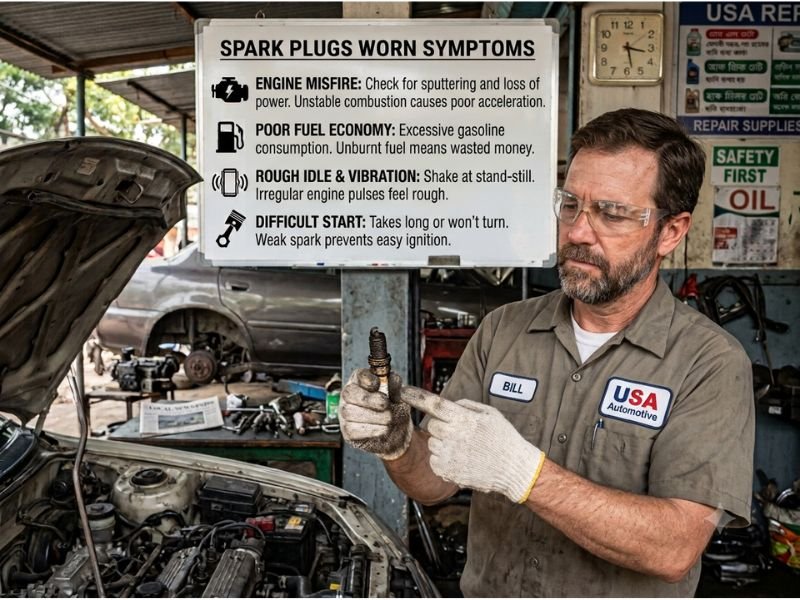
The symptoms usually develop gradually. Drivers may initially adapt to the change and notice the performance difference only after installing a new set of plugs.
Delayed Engine Starting
An engine with worn spark plugs may take longer than normal to start.
During cranking, the starter motor draws substantial electrical power from the battery. At the same time, the ignition system must generate enough voltage to fire the plugs.
Worn electrodes and enlarged gaps increase the voltage required to produce a spark. If the ignition system cannot meet that demand consistently, the engine may need several additional revolutions before combustion begins.
You may notice longer cranking after the car has been parked overnight. The symptom can become more obvious in cold weather because a cold air-fuel mixture is more difficult to ignite.
The engine may still start on the first attempt, but the process feels slower than it did with newer plugs.
Battery weakness, fuel-pressure loss, and injector problems can also delay starting. Worn plugs become more likely when starting performance has declined gradually and the plugs are near their scheduled replacement interval.
Rough or Uneven Idle
Worn spark plugs can cause an unstable idle because one or more cylinders may not fire consistently.
The engine may vibrate through the steering wheel, seat, or floor. Its exhaust rhythm may sound uneven, and the tachometer may show small changes in RPM.
Early wear may cause only an occasional stumble. More advanced wear can create continuous shaking or make the engine feel as though it is close to stalling.
The idle problem may be more noticeable when the air conditioner is running or when an automatic-transmission vehicle is stopped in gear. These conditions place additional load on the engine.
A rough idle can also come from vacuum leaks, dirty injectors, ignition coil faults, or worn engine mounts. The plug condition and gap should therefore be inspected before assuming that wear is the only cause.
Misfires During Acceleration
Misfiring under acceleration is a common sign that spark plugs are reaching the end of their useful life.
Pressing the accelerator increases cylinder pressure. The denser mixture inside the cylinder creates greater resistance to the electrical spark.
A plug with worn electrodes may fire normally at idle but fail when the engine is under load.
The car may jerk, stumble, or briefly lose power while merging, passing, or climbing a hill. The problem may disappear after the throttle is reduced.
This symptom is sometimes described as a load-related ignition misfire.
As the electrodes continue wearing, the misfire may begin happening during normal cruising or idle instead of only during hard acceleration.
Weak Throttle Response
Worn spark plugs can make the engine feel slow to respond.
The vehicle may hesitate briefly after the accelerator is pressed. It may also require more throttle than usual to reach the desired speed.
This happens because weak or delayed ignition reduces the amount of useful pressure produced during combustion. The affected cylinders may still fire, but they do not contribute their full power consistently.
The loss of response is often gradual. A driver may not realize how sluggish the vehicle has become until the plugs are replaced and normal acceleration returns.
Weak throttle response can also result from restricted airflow, low fuel pressure, transmission problems, or exhaust restriction. Worn plugs are more likely when hesitation occurs with longer starting and load-related misfires.
Reduced Power on Hills or Under Load
An engine with worn spark plugs may perform normally during light cruising but feel weak under heavier demand.
The loss of power may become noticeable when climbing a steep road, towing, carrying additional passengers, or operating at higher RPM.
Each cylinder must ignite its mixture consistently to produce the engine’s full output. A worn plug may skip combustion cycles or produce weaker combustion when ignition demand increases.
The vehicle may lose speed more easily on hills or require a lower transmission gear than before.
This symptom can be more noticeable in engines with fewer cylinders because one weak cylinder represents a larger percentage of total engine power.
Gradually Declining Fuel Economy
Worn spark plugs may contribute to reduced fuel efficiency.
When combustion is incomplete or inconsistent, some gasoline fails to produce useful engine power. The driver may also press the accelerator farther to compensate for weaker performance.
The change is usually gradual. You may notice shorter driving range, more frequent refueling, or a slow decrease in the average fuel economy display.
Fuel economy can be affected by tire pressure, traffic, temperature, driving style, and sensor faults. A mileage change alone does not confirm worn plugs.
However, reduced economy combined with delayed starting, rough idle, and hesitation supports the diagnosis.
Check Engine Light and Misfire Codes
Advanced spark plug wear may cause the check engine light to appear.
The engine control module monitors changes in crankshaft speed to identify cylinders that are not contributing normal combustion.
A scan tool may reveal a cylinder-specific misfire or a random multiple-cylinder misfire.
The light may remain steady when the problem is occasional. It may flash when the misfire is severe and unburned fuel could overheat the catalytic converter.
A misfire code does not automatically confirm worn spark plugs. Ignition coils, injectors, wiring, and mechanical cylinder problems can create the same code.
Plug age, physical condition, and measured gap should be considered before replacing other components.
Increased Ignition Coil Demand
Worn spark plugs can force the ignition coils to work harder.
As the electrode gap grows, more voltage is required to make the spark cross it. A healthy coil may compensate for this increased demand for some time.
Eventually, the higher voltage can search for another path through the coil boot, plug insulator, or damaged insulation.
Possible clues include misfires that worsen under load, burn marks inside the coil boot, or thin black carbon tracks along the plug ceramic.
Spark plug wear does not guarantee coil failure. However, leaving severely worn plugs in service can increase electrical stress on the ignition system.
Spark Plugs Worn Symptoms at a Glance
| Symptom | Where It Is Most Noticeable | Why Worn Plugs Cause It |
| Delayed starting | Cold or hot startup | Enlarged gaps require more voltage |
| Rough idle | Engine idling | Some combustion cycles fire weakly |
| Acceleration misfire | Heavy throttle | Higher cylinder pressure resists the spark |
| Weak response | Pulling away or passing | Combustion produces less usable power |
| Load-related power loss | Hills, towing, or high RPM | The plugs cannot fire consistently |
| Poor fuel economy | Everyday driving | Incomplete combustion wastes fuel |
| Check engine light | Repeated misfires | The computer detects uneven combustion |
| Coil stress | High ignition demand | Coils must produce increased voltage |
What Do Worn Spark Plugs Look Like?
Worn plugs may look relatively clean. Their most important signs are usually changes in the electrodes rather than heavy deposits.
Rounded Electrode Edges
A new center electrode has defined edges that help concentrate voltage.
As the plug wears, the edges become rounded. The ground electrode may also develop a curved or uneven firing surface.
Rounded electrodes require more voltage to create a reliable spark.
This wear cannot be reversed through cleaning.
A Wider-Than-Specified Gap
Electrode erosion gradually increases the distance between the center and ground electrodes.
The gap may become excessive even when the ground electrode has not been manually bent.
A wider gap can cause difficult starting and misfires under load because the ignition coil must generate additional voltage.
The gap should be measured with a proper tool and compared with the specification for the exact engine.
A Thin Center Electrode
Extended use can make the center electrode appear thinner or uneven.
This sign is easier to recognize on conventional nickel plugs. Platinum and iridium plugs are designed with very fine center electrodes, so they should be compared with a new plug of the same model.
A missing or damaged precious-metal tip is not normal and requires replacement.
Worn Ground Electrode
The ground electrode may become thin, rounded, uneven, or visibly eroded.
In some plugs, a small precious-metal pad is attached to the ground electrode. If that pad is damaged or missing, the plug should be replaced.
Bending a worn ground electrode inward may reduce the measured gap, but it cannot replace the metal that has been lost.
Similar Wear Across the Full Set
Spark plugs installed at the same time usually develop a similar level of wear.
If every plug has rounded electrodes and enlarged gaps, the set has likely reached the end of its normal service life.
One plug that looks substantially different may indicate a cylinder-specific problem rather than ordinary set-wide wear.
For example, a single oily, overheated, or heavily fouled plug may point to an injector, ignition, valve, or compression issue in that cylinder.
Worn Spark Plugs vs. Dirty Spark Plugs
Worn and dirty plugs can produce similar engine symptoms, but their physical conditions are different.
| Plug Condition | Typical Appearance | Main Problem |
| Worn plug | Rounded electrodes and enlarged gap | Electrode material has eroded |
| Carbon-fouled plug | Dry black soot | Deposits interfere with the spark |
| Oil-fouled plug | Wet, shiny dark coating | Oil contaminates the firing tip |
| Fuel-fouled plug | Wet with gasoline | The mixture is not igniting |
| Overheated plug | White, blistered, or burned | Excessive heat damages the firing surfaces |
A lightly fouled conventional plug may sometimes be cleaned for diagnosis.
A worn plug cannot be restored by cleaning because the electrode shape and material have already changed.
Why Do Spark Plugs Wear Out?
Spark plugs operate in a harsh environment containing high voltage, combustion heat, pressure, and corrosive gases.
Every firing event removes a microscopic amount of material from the electrodes. Over millions of sparks, this erosion becomes visible.
The rate of wear depends on the electrode material.
Traditional nickel-alloy plugs generally wear faster than platinum or iridium plugs. Precious-metal plugs resist erosion and can maintain their firing surfaces for longer periods.
Engine condition also affects plug life. Overheating, abnormal combustion, an incorrect heat range, or excessive ignition demand may accelerate electrode damage.
A loose plug may run hotter because it cannot transfer heat correctly into the cylinder head. Incorrect installation torque can also damage the shell, threads, or ceramic insulator.
Why One Spark Plug May Wear Faster Than the Others
All plugs in an engine do not always wear at exactly the same rate.
One cylinder may operate differently because of fuel delivery, oil entry, cooling, ignition coil strength, or mechanical condition.
A single plug may deteriorate faster because of a leaking injector, worn valve seal, weak coil, vacuum leak near one intake runner, or low cylinder compression.
Uneven plug wear is therefore useful diagnostic evidence.
When inspecting the set, keep each plug associated with its original cylinder. Mixing them makes it harder to connect an abnormal wear pattern with a specific cylinder.
A plug that is significantly more worn than the others should not simply be replaced without considering why the difference developed.
How to Check Whether Spark Plugs Are Worn
I recommend combining the maintenance history with physical inspection and gap measurement.
Allow the engine to cool before removing the ignition coils or plug wires. Clean debris from around the plug wells to prevent dirt from entering the cylinders.
Remove each plug using the correct socket and keep it labeled by cylinder.
Inspect the center electrode, ground electrode, ceramic insulator, deposits, and threads under bright light. Compare the plugs with one another and, when possible, with a new plug of the same design.
Measure each gap using a tool suitable for the electrode type.
A plug can be considered worn when its electrodes are substantially rounded, its precious-metal firing surfaces are damaged, or erosion has increased the gap beyond specification.
A simple open-air spark test is not enough to confirm plug condition. A worn plug may produce a visible spark outside the engine but fail under actual cylinder pressure.
Can Worn Spark Plugs Be Regapped?
Some worn conventional spark plugs can be bent back to the specified gap, but that does not restore their original condition.
Regapping changes the distance between the electrodes. It does not rebuild eroded metal or restore sharp firing edges.
A used plug with substantial wear may therefore continue requiring more voltage even after the gap has been reduced.
Regapping is more appropriate for a new plug that was incorrectly set during shipping or handling, provided the manufacturer permits adjustment.
Fine-wire platinum and iridium plugs require extra care. Pressing a gapping tool against the center electrode may damage the small precious-metal tip.
When visible erosion is present, replacement is generally more reliable than adjustment.
Do All Worn Spark Plugs Need to Be Replaced Together?
Replacing the full set is usually appropriate when all plugs have similar mileage and wear.
A matched set helps provide consistent ignition performance across every cylinder. Replacing only one heavily aged plug may leave the remaining cylinders operating with enlarged gaps and higher voltage demand.
Individual replacement may make sense when one nearly new plug was physically damaged or affected by a cylinder-specific problem.
Before installing a replacement, identify why that plug failed earlier than the others.
The new plugs must match the manufacturer’s specified part number, heat range, thread reach, seat design, and electrode configuration.
Can You Drive With Worn Spark Plugs?
A vehicle may continue running with worn spark plugs, but its performance can deteriorate without much warning.
Early wear may cause only slightly longer starting or mild hesitation. More advanced wear can lead to severe misfires, reduced acceleration, stalling, and catalytic converter damage.
A flashing check engine light, heavy engine shaking, strong gasoline odor, or sudden power loss indicates that driving should be stopped as soon as it is safe.
Replacing the plugs before severe symptoms develop can reduce stress on ignition coils and prevent unburned fuel from entering the exhaust system.
Will New Spark Plugs Improve Performance?
New spark plugs may improve starting, idle quality, acceleration, and fuel efficiency when worn plugs are the actual cause of the problem.
The difference can be especially noticeable when the old plugs have badly rounded electrodes or gaps far beyond specification.
However, new plugs cannot correct a weak ignition coil, dirty injector, vacuum leak, fuel-pressure problem, or low compression.
The removed plugs should be examined before disposal. Their wear patterns may reveal whether the engine has a separate issue that could shorten the life of the new set.
Frequently Asked Questions
What Are the First Signs That Spark Plugs Are Worn?
The first signs are often longer cranking, slight hesitation, or an occasional misfire under acceleration.
These symptoms may appear before the engine develops a rough idle or check engine light because higher-load conditions reveal ignition weakness earlier.
Can Worn Spark Plugs Cause a Rough Idle?
Yes. Worn electrodes and enlarged gaps can cause inconsistent ignition at idle.
The engine may shake, stumble, or show small RPM fluctuations. Similar symptoms can also result from injector, vacuum, coil, or compression problems.
Can Worn Spark Plugs Cause Poor Acceleration?
Yes. Worn plugs may struggle to ignite the denser mixture created during acceleration.
The vehicle may hesitate, jerk, or feel less responsive when additional power is requested.
Can Worn Spark Plugs Increase Fuel Consumption?
Yes. Misfires and weak combustion can prevent some gasoline from producing useful power.
The driver may also use more throttle to compensate for reduced performance, leading to lower fuel economy.
Can Worn Spark Plugs Cause a Check Engine Light?
Yes. If worn plugs cause repeated misfires, the engine control module may activate the check engine light.
A scan tool may identify one cylinder or show random multiple-cylinder misfires.
Can Spark Plugs Be Worn Without Looking Dirty?
Yes. A plug can be clean but still have rounded electrodes and an enlarged gap.
Color and deposits alone are not enough to judge plug wear. The electrode shape and measured gap are more useful.
Can Worn Spark Plugs Damage Ignition Coils?
Worn plugs can increase the voltage that ignition coils must produce.
This additional demand may contribute to insulation breakdown, carbon tracking, or premature coil failure, particularly when the plugs remain in service far beyond their intended interval.
How Do I Know Whether the Plugs or Coils Are Bad?
Worn plugs may show rounded electrodes, increased gaps, or damaged firing surfaces.
A faulty coil may show heat damage, electrical tracking, or a misfire that moves when the coil is transferred to another cylinder. Both components may need inspection because worn plugs can place extra stress on coils.
Conclusion
The primary spark plugs worn symptoms are delayed starting, rough idle, acceleration misfires, weak throttle response, reduced power, declining fuel economy, and increased ignition coil demand.
Worn plugs may appear clean while still having rounded electrodes and gaps that exceed the engine specification. This is why visual inspection should focus on electrode shape and measured spacing rather than plug color alone.
I recommend inspecting the complete plug set and keeping each plug matched to its original cylinder. When several plugs show similar erosion, replacing them together usually provides more consistent ignition.
Cleaning or regapping cannot restore lost electrode material. Installing the correct replacement plugs is the more dependable solution once significant wear has developed.