
If you are wondering do you have to change wires when changing spark plugs, the answer is no, not automatically. Spark plug wires can usually be reused if they are in good condition, fit securely, and show no signs of cracking, arcing, excessive resistance, or damaged boots.
However, replacing the spark plugs is a good opportunity to inspect the ignition wires carefully. Old or deteriorated wires can cause misfires, rough idle, hard starting, hesitation, and a Check Engine light, even when the new spark plugs are working correctly.
It is also important to know that many modern vehicles do not have traditional spark plug wires at all. They use a coil-on-plug ignition system, where an individual ignition coil sits directly on each spark plug. In that case, there are no conventional plug wires to replace.
This guide explains when spark plug wires should be replaced, how to inspect them, what symptoms indicate failure, and whether new wires can improve engine performance after a spark plug change.
Do You Have to Change Wires When Changing Spark Plugs?

No, you do not have to change wires when changing spark plugs unless the wires are worn, damaged, or due for replacement according to the vehicle manufacturer’s maintenance recommendations.
Spark plugs and spark plug wires perform different jobs.
The spark plug creates the electrical spark inside the combustion chamber.
The spark plug wire carries high-voltage electricity from the ignition coil or distributor to the spark plug.
A new spark plug does not require a new wire simply because the plug was replaced.
If the existing wires are:
- Flexible
- Free of cracks
- Secure at both ends
- Not burned or melted
- Not contaminated with oil
- Not showing signs of electrical leakage
they may continue working normally.
On the other hand, if the wires are already old or questionable, replacing them at the same time can prevent future ignition problems.
Do All Cars Have Spark Plug Wires?
No.
Many newer vehicles use coil-on-plug ignition, often abbreviated COP.
With this system, each spark plug has its own ignition coil mounted directly above it.
There is no long high-voltage spark plug wire running between the coil and plug.
Instead, the ignition coil connects to the spark plug through a short rubber coil boot.
Older or differently designed ignition systems may use:
- Distributor and spark plug wires
- Coil packs with plug wires
- Waste-spark ignition systems
- Individual ignition coils with short plug wires
So before buying replacement wires, confirm that your engine actually uses them.
What Do Spark Plug Wires Do?
Spark plug wires carry thousands of volts from the ignition system to the spark plugs.
The voltage must travel through the wire without leaking into nearby metal components.
A quality spark plug wire contains several layers designed to:
- Carry ignition voltage
- Insulate the electrical current
- Resist engine heat
- Reduce electrical interference
- Protect against moisture and contamination
At each end of the wire is a boot that connects to either the spark plug or ignition coil/distributor.
If the insulation or internal conductor deteriorates, some of the ignition energy may never reach the spark plug.
Why Change Spark Plug Wires During a Spark Plug Replacement?
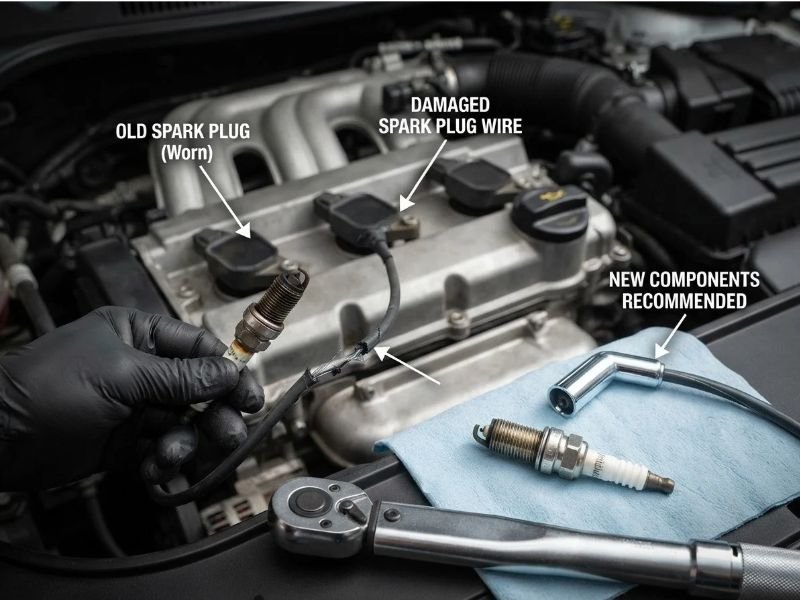
You do not have to replace them together, but there are practical reasons people often do.
The Wires Are Already Accessible
Changing spark plugs usually requires removing the wires from the plugs.
That gives you an easy opportunity to inspect:
- Boots
- Terminals
- Insulation
- Routing
- Connections
If the wires are already deteriorated, replacing them adds relatively little additional work.
Old Wires Can Cause Misfires With New Plugs
Installing new spark plugs will not fix a failing ignition wire.
If one wire is leaking voltage, the engine may continue misfiring even though the plugs are brand new.
Removing Old Wires Can Damage Them
Aged spark plug boots can become brittle or stick tightly to the plugs.
Removing them may reveal cracks or cause a weakened boot to tear.
This is one reason old wires sometimes fail shortly after spark plug replacement.
When Should Spark Plug Wires Be Replaced?
There is no single replacement interval that applies to every vehicle.
Some spark plug wires last a long time, while others deteriorate earlier because of:
- Engine heat
- Age
- Oil contamination
- Poor routing
- Physical damage
- Moisture
- Repeated removal
Follow the maintenance guidance for your specific vehicle and inspect the wires whenever the spark plugs are serviced.
Replace the wires if they show clear signs of deterioration.
Signs Your Spark Plug Wires Need Replacement
Several symptoms can indicate damaged or worn ignition wires.
Cracked Insulation
Look closely at the outer covering.
Cracks can allow high voltage to escape before it reaches the spark plug.
Cracking is especially common near:
- Boots
- Sharp bends
- Hot engine components
Burned or Melted Areas
Spark plug wires routed too close to exhaust components can become overheated.
Replace a wire if its insulation is:
- Melted
- Hardened
- Discolored
- Burned
Also correct the routing problem so the new wire does not suffer the same damage.
Damaged Boots
The rubber boot must fit securely around the spark plug and terminal.
Replace wires with boots that are:
- Torn
- Split
- Loose
- Burned
- Oil-soaked
A damaged boot can allow moisture or ignition voltage to escape.
Visible Arcing
Electrical leakage may sometimes be visible as small sparks or arcs around damaged ignition wires, particularly in dark conditions.
Do not place your hands near the ignition system while the engine is running. Ignition systems can produce very high voltage.
Misfire
A weak or leaking wire can cause one or more cylinders to misfire.
Possible symptoms include:
- Rough idle
- Shaking
- Hesitation
- Loss of power
- Check Engine light
A misfire has many possible causes, so testing should be done before assuming the wire is responsible.
Hard Starting
Weak ignition can make an engine harder to start, especially in wet or humid conditions.
Moisture can make deteriorated insulation more likely to leak voltage.
Poor Acceleration
A weak spark may become more noticeable when the engine is under load.
You may notice:
- Hesitation
- Surging
- Reduced power
Again, these symptoms are not exclusive to spark plug wires.
Should You Replace All Spark Plug Wires at Once?
If one wire has failed because the entire set is old or deteriorated, replacing the complete wire set is usually more practical than replacing only one.
All the wires have generally experienced similar:
- Heat
- Age
- Mileage
- Environmental exposure
Replacing the set can provide consistent ignition performance and reduce the chance that another old wire will fail shortly afterward.
However, if a relatively new wire was damaged accidentally while the rest are in excellent condition, replacing only the damaged wire may sometimes be reasonable if the correct individual replacement is available.
Can Old Spark Plug Wires Be Reused With New Spark Plugs?
Yes.
Good spark plug wires can normally be reused with new spark plugs.
Before reinstalling them, inspect:
- Wire insulation
- Spark plug boots
- Coil or distributor boots
- Internal terminals
- Routing clips
Make sure each wire snaps securely onto the new spark plug.
A loose connection can cause misfires or electrical arcing.
Should You Change Spark Plug Wires Just Because They Are Old?
Age alone is worth considering, but condition matters more.
Rubber and insulation can deteriorate over time even if the vehicle has relatively low mileage.
An older wire set that is:
- Brittle
- Cracked
- Hard
- Loose-fitting
should probably be replaced.
If the wires remain flexible, clean, undamaged, and electrically sound, they may not require immediate replacement solely because the spark plugs are being changed.
How Do You Inspect Spark Plug Wires?
Inspect one wire at a time so you do not accidentally mix up the firing order.
Check the Entire Wire
Run your eyes along the complete insulation.
Look for:
- Cracks
- Cuts
- Burn marks
- Abrasion
- Swelling
- Oil contamination
Inspect Both Boots
Look inside the spark plug and coil/distributor boots.
Check for:
- Corrosion
- Carbon tracking
- Damaged terminals
- Torn rubber
Check the Fit
The terminal should fit securely onto the spark plug.
A loose wire can produce intermittent ignition problems.
Check Wire Routing
Spark plug wires should normally be kept away from:
- Exhaust manifolds
- Sharp edges
- Moving belts
- Pulleys
Use the original wire separators and clips where possible.
Can You Test Spark Plug Wires With a Multimeter?
Yes, many traditional spark plug wires can be checked for electrical resistance with a digital multimeter.
Resistance specifications vary significantly by wire design and vehicle.
Some wires intentionally contain resistance to reduce radio-frequency interference, so a resistance reading by itself is not meaningful unless you know the acceptable specification.
A wire may need replacement if:
- It shows an open circuit
- Resistance is far outside specification
- Reading changes dramatically when the wire is gently moved
Always compare results with vehicle or wire-manufacturer specifications.
Should You Pull Spark Plug Wires by the Wire?
No.
Always grip the boot, not the cable itself.
Pulling directly on the wire can separate the internal conductor from the terminal while leaving the outside insulation looking normal.
If the boot is difficult to remove, gently twist it first to break the seal.
A dedicated spark plug boot removal tool can also help in tight spaces.
Do You Need Dielectric Grease on Spark Plug Wires?
A small amount of dielectric grease is sometimes used inside spark plug boots to help prevent moisture intrusion and make future removal easier.
The grease is electrically insulating, so it should not be packed heavily onto the metal terminal.
If your vehicle or replacement wire manufacturer recommends dielectric grease, use only a small amount in the appropriate area of the boot.
More is not necessarily better.
Should You Replace Spark Plug Boots Too?
If your engine uses traditional plug wires, the boots are generally part of the wire assembly and are replaced with the wires.
On a coil-on-plug engine, the rubber ignition coil boots may sometimes be replaceable separately from the coils.
Replace a coil boot if it is:
- Cracked
- Torn
- Burned
- Carbon-tracked
- Oil-soaked
- No longer fitting securely
A bad boot can allow high voltage to leak even when the ignition coil itself is still functional.
Do You Need to Replace Ignition Coils When Changing Spark Plugs?
No.
Ignition coils do not normally need to be replaced simply because the spark plugs are being changed.
A properly functioning coil can usually continue to be used.
Replace or diagnose an ignition coil when there is evidence of:
- Coil failure
- Misfire
- Cracked housing
- Electrical fault
- Burned connector
- Internal failure
Replacing every coil unnecessarily can make a routine spark plug service much more expensive.
Spark Plug Wires vs. Ignition Coils
These components are often confused on modern vehicles.
| Component | Purpose |
| Spark plug | Creates spark inside cylinder |
| Spark plug wire | Carries high voltage to spark plug |
| Ignition coil | Generates high ignition voltage |
| Coil boot | Connects coil to plug on COP systems |
Older engines often use one or more coils plus long plug wires.
Modern coil-on-plug engines usually eliminate traditional plug wires.
Can Bad Spark Plug Wires Damage New Spark Plugs?
Bad wires do not usually physically damage a new spark plug immediately, but poor ignition can cause combustion problems that affect plug condition over time.
A weak spark can contribute to:
- Misfires
- Carbon buildup
- Poor combustion
This is another reason to inspect the ignition system rather than assuming new plugs alone will solve a misfire.
Should You Replace Wires Before or After Spark Plugs?
If both are being replaced, they can be serviced during the same job.
A useful approach on engines with multiple plug wires is to work one cylinder at a time.
For example:
- Remove one old wire.
- Remove and replace that spark plug.
- Install the matching new wire.
- Move to the next cylinder.
This reduces the risk of mixing up the wire routing or firing order.
What Happens If Spark Plug Wires Are Installed in the Wrong Order?
On engines using a distributor or certain coil-pack systems, incorrect wire placement can cause serious running problems.
The engine may:
- Fail to start
- Misfire badly
- Backfire
- Run extremely rough
Before removing several wires at once, label them or follow the original routing.
The correct firing order is critical.
Is It Better to Replace Spark Plugs and Wires Together?
It can be convenient, especially when both are old, but it is not mandatory.
Replacing both makes sense when:
- Wires are visibly deteriorated
- Vehicle maintenance calls for inspection or replacement
- Engine has ignition-related symptoms
- Wires have very high age or service exposure
- Boots are damaged during plug removal
Replacing wires unnecessarily provides little benefit if the existing set is healthy.
Can New Spark Plug Wires Improve Performance?
If the old wires were defective, yes.
Replacing leaking or high-resistance wires can restore:
- Smooth idle
- Proper acceleration
- Reliable starting
- Correct combustion
However, replacing perfectly good wires generally will not add horsepower or noticeably improve fuel economy.
The purpose is to restore proper ignition performance, not create extra engine power.
FAQs About Do You Have to Change Wires When Changing Spark Plugs
Do you have to replace spark plug wires every time you change plugs?
No. Spark plug wires can be reused if they remain in good condition and pass inspection.
How do I know if my spark plug wires are bad?
Look for cracks, burn marks, damaged boots, visible arcing, corrosion, or loose connections. Misfires, rough idle, and hesitation may also indicate a problem.
Can I put new spark plugs on old wires?
Yes. Healthy existing wires can be connected to new spark plugs without a problem.
Should I replace all spark plug wires if one is bad?
If the entire set is old, replacing all of them is generally sensible because the other wires have experienced similar wear and heat exposure.
Do modern cars have spark plug wires?
Many do not. Modern vehicles commonly use coil-on-plug ignition, where an ignition coil sits directly on each plug.
Do I need new ignition coils when replacing spark plugs?
No. Ignition coils should generally be replaced only when faulty or damaged, not automatically during a spark plug change.
Can bad spark plug wires cause a Check Engine light?
Yes. A failing wire can cause an ignition misfire, which may trigger the Check Engine light and a misfire-related diagnostic trouble code.
Can spark plug wires go bad without visible damage?
Yes. Internal conductors or terminals can fail even when the external insulation looks acceptable. Electrical testing may be needed if a wire-related problem is suspected.
Conclusion
So, do you have to change wires when changing spark plugs? No. If your vehicle uses traditional spark plug wires and they are still flexible, undamaged, securely connected, and electrically sound, you can normally reuse them with the new spark plugs.
Replacing the spark plugs is still an ideal time to inspect every wire for cracks, burned insulation, damaged boots, corrosion, or other signs of deterioration. If the wires are old or failing, replacing the entire set during the spark plug service can prevent future misfires and save you from repeating much of the same work.
And if your vehicle uses a modern coil-on-plug ignition system, you may not have conventional spark plug wires at all. In that case, inspect the ignition coil boots and coils rather than buying a plug-wire set.