
Spark plugs are small components, but they play a direct role in how efficiently a gasoline engine burns fuel. Each spark plug must ignite the air-fuel mixture inside its cylinder at the correct time and with enough energy for the combustion process to work properly. As spark plugs wear, become fouled, or develop excessive electrode gaps, ignition can become less reliable and engine efficiency may decline.
Healthy spark plugs usually do not dramatically increase fuel economy, but worn or misfiring spark plugs can reduce MPG, and replacing them can restore fuel economy that was lost because of poor ignition.
So, how much do spark plugs affect fuel economy? There is no universal MPG percentage because the effect depends on how badly the plugs are worn, the engine design, driving conditions, and whether misfires are occurring. A vehicle with slightly worn plugs may show little or no noticeable fuel-economy change. An engine with badly fouled or misfiring plugs can use significantly more fuel because combustion is incomplete or inconsistent.
Replacing old spark plugs should therefore be viewed mainly as maintenance that restores proper combustion, not as a guaranteed fuel-saving modification. If the existing plugs are already in good condition and meet the manufacturer’s specifications, installing new or more expensive plugs is unlikely to produce a major MPG improvement.
This guide explains how spark plugs influence fuel economy, why worn plugs can increase fuel consumption, how much improvement you might realistically notice after replacement, and how to tell whether your spark plugs are contributing to poor gas mileage.
How Much Do Spark Plugs Affect Fuel Economy?
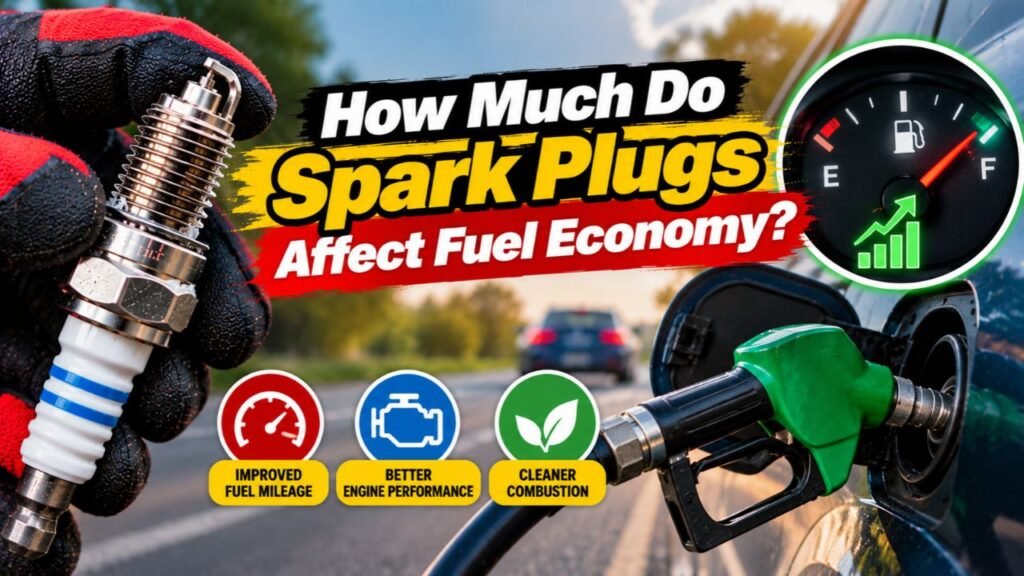
The effect of spark plugs on fuel economy ranges from almost nothing to a noticeable MPG loss depending on their condition.
If the spark plugs are healthy, correctly gapped, and firing normally, replacing them usually produces little measurable improvement in fuel economy.
If they are worn, fouled, or causing misfires, replacing them may restore lost MPG.
The key distinction is between improving fuel economy beyond normal and restoring fuel economy that deteriorated because of worn ignition components.
New spark plugs do not make an efficiently running engine suddenly use much less gasoline. Their benefit becomes significant when the old plugs are no longer igniting the mixture properly.
How Spark Plugs Affect Fuel Consumption
A gasoline engine creates power by burning a mixture of fuel and air inside its cylinders.
The basic process is:
- Air enters the cylinder.
- Fuel is added.
- The piston compresses the mixture.
- The spark plug creates an electrical spark.
- The mixture burns.
- Expanding gases push the piston downward.
- The engine converts that movement into usable power.
For the engine to operate efficiently, combustion must occur consistently.
If the spark plug produces a weak or unreliable spark, some of the air-fuel mixture may not burn as effectively as intended.
The engine may then need more fuel to produce the same amount of usable power.
Why Worn Spark Plugs Can Reduce MPG
Spark plugs do not stay new forever.
Every time a spark jumps between the electrodes, a tiny amount of electrode material can wear away.
Over many thousands of ignition events, the gap can increase.
A larger-than-specified gap may require more voltage to create the spark.
Eventually, ignition performance can deteriorate.
Other spark plug problems can include:
- Carbon deposits
- Oil fouling
- Fuel fouling
- Worn electrodes
- Cracked insulator
- Incorrect gap
- Overheating
- Incorrect plug type
These problems can interfere with normal combustion and increase fuel consumption.
Misfires Have the Biggest Effect on Fuel Economy
A misfire occurs when combustion in a cylinder does not happen correctly.
Misfires can be caused by spark plugs, although plugs are only one possible cause.
If a cylinder misfires, some of the fuel entering that cylinder may leave without producing normal power.
The driver may compensate by pressing the accelerator farther.
That can increase overall fuel consumption.
Misfires may also cause the engine computer to adjust fuel delivery as it tries to maintain stable operation.
For this reason, badly worn plugs that are actually causing misfires can affect fuel economy much more than plugs that are simply approaching their scheduled replacement interval.
How Much MPG Can Bad Spark Plugs Cost You?
There is no reliable single number that applies to every vehicle.
A mildly worn spark plug may have virtually no noticeable effect.
A badly misfiring engine may experience a substantial decrease in fuel economy.
The actual MPG loss depends on:
- Number of affected cylinders
- Severity of the misfire
- Engine size
- Driving style
- Vehicle weight
- Fuel-management strategy
- Road conditions
- Whether other mechanical problems are present
Instead of expecting a fixed percentage, compare the vehicle’s current fuel economy with its normal long-term MPG.
A sudden or gradual MPG drop combined with ignition symptoms makes worn plugs more suspicious.
Will New Spark Plugs Improve Gas Mileage?
They can if the old plugs were reducing combustion efficiency.
After replacing worn spark plugs, you may notice:
- Smoother idle
- Easier starting
- Better acceleration
- Reduced hesitation
- Fewer misfires
- Restored fuel economy
If your old plugs were already operating properly, you may notice little or no MPG difference.
This is normal.
The new plugs are maintaining proper engine operation rather than creating extra efficiency beyond the engine’s original design.
Can New Spark Plugs Increase MPG Above Factory Levels?
Normally, no.
Spark plugs cannot overcome the fundamental efficiency limits of the engine.
Replacing factory-specification plugs with premium plugs does not automatically make the vehicle more fuel-efficient than it was designed to be.
If the engine was running properly before replacement, an MPG increase may be too small to distinguish from normal variations caused by:
- Traffic
- Temperature
- Fuel formulation
- Tire pressure
- Driving speed
- Wind
- Air-conditioning use
Spark plugs should be selected for correct engine compatibility rather than promises of dramatic fuel savings.
How Worn Spark Plug Gaps Affect Fuel Economy
The spark plug gap is the distance between the center electrode and ground electrode.
The spark must jump across this gap.
As electrodes wear, the gap can become larger.
If the gap becomes excessive, the ignition system may struggle to create a reliable spark, particularly:
- Under acceleration
- Under heavy load
- At high cylinder pressure
A weak or intermittent spark can cause incomplete combustion and misfires.
That can reduce both performance and fuel economy.
Always use the gap specified for your engine.
Can a Spark Plug Gap That Is Too Small Hurt MPG?
Potentially.
A gap that is too small may create a shorter spark that does not expose as much of the mixture to the ignition event.
However, modern engines are designed around specific plug and gap requirements.
The practical lesson is not to intentionally increase or decrease the gap in search of better MPG.
Use the manufacturer’s specification.
Fouled Spark Plugs and Fuel Economy
A fouled spark plug has deposits on the electrode or insulator that interfere with normal operation.
Several types of fouling can occur.
Carbon Fouling
Dry black deposits can sometimes develop because of:
- Rich air-fuel mixture
- Excessive idling
- Ignition problems
- Incorrect heat range
- Certain engine operating conditions
Carbon can provide an unwanted path for electrical energy and weaken ignition.
Oil Fouling
Oil deposits on a spark plug can indicate oil entering the combustion chamber.
Possible causes include internal engine wear or valve-related problems.
Replacing the plug may temporarily improve operation, but the underlying oil-consumption problem should also be diagnosed.
Fuel Fouling
A wet fuel-covered plug may appear after repeated failed starting attempts or when a cylinder is receiving fuel without proper ignition.
The cause needs to be corrected rather than simply installing another spark plug.
Can Old Spark Plugs Make the Engine Run Rich?
Not directly in every case, but ignition problems can affect how the engine management system responds.
A rich condition means the engine is receiving more fuel relative to air than intended.
Bad spark plugs generally do not control fuel delivery themselves.
Fuel mixture is influenced by components such as:
- Oxygen sensors
- Mass airflow sensor
- Fuel injectors
- Engine coolant temperature sensor
- Engine control module
However, misfires can cause unusual oxygen readings in the exhaust and may complicate fuel-control behavior.
Therefore, spark plugs can contribute to poor fuel economy without necessarily being the original reason the engine runs rich.
Signs Spark Plugs May Be Hurting Fuel Economy
Poor MPG alone is not enough to diagnose spark plugs.
Look for other symptoms such as:
- Rough idle
- Engine hesitation
- Hard starting
- Reduced acceleration
- Engine shaking
- Check engine light
- Misfire codes
- Poor throttle response
- Increased fuel consumption
The more of these symptoms that appear together, the more reasonable it becomes to inspect the ignition system.
Can Bad Spark Plugs Trigger the Check Engine Light?
Yes.
If worn or damaged plugs cause repeated misfires, the engine computer may detect them and illuminate the check engine light.
Common misfire-related diagnostic trouble codes include:
- P0300 — random or multiple-cylinder misfire
- P0301 — cylinder 1 misfire
- P0302 — cylinder 2 misfire
Additional P030X codes identify other cylinders.
A misfire code does not automatically mean the spark plug is bad.
Possible causes also include:
- Ignition coil failure
- Fuel injector problem
- Vacuum leak
- Low compression
- Wiring fault
Diagnosis should confirm the cause before parts are replaced.
A Flashing Check Engine Light Needs Attention
A flashing check engine light often indicates an active misfire severe enough to potentially overheat the catalytic converter.
Unburned fuel can enter the exhaust and burn inside the converter.
That can generate extreme heat.
If the check engine light is flashing and the engine is running badly, avoid continuing to drive unnecessarily and have the problem diagnosed promptly.
Do Iridium Spark Plugs Improve Fuel Economy?
Iridium spark plugs can provide long service life and stable ignition when specified for the engine.
However, changing from properly functioning standard plugs to iridium plugs does not automatically create a meaningful increase in fuel economy.
Their advantages can include:
- Small center electrode
- Good durability
- Strong resistance to electrode wear
- Long service intervals in compatible engines
If your vehicle was designed to use iridium plugs, install the correct specification.
Do not assume that a more expensive plug is automatically better for an engine designed for something else.
Do Platinum Spark Plugs Improve MPG?
The same basic rule applies to platinum spark plugs.
Platinum helps reduce electrode wear and can provide long service life.
Its main advantage is durability, not a guaranteed fuel-economy boost.
Correct plug design matters more than simply choosing the most expensive electrode material.
Copper vs Platinum vs Iridium for Fuel Economy
| Spark Plug Type | Main Advantage | Fuel Economy Effect |
| Copper/nickel | Good conductivity, affordable | Normal MPG when correct for engine |
| Platinum | Longer electrode life | Maintains efficiency over service life |
| Double platinum | Useful in some ignition systems | No guaranteed MPG increase |
| Iridium | Long life and fine electrode design | Helps maintain reliable ignition |
| Double iridium | High durability in compatible engines | No automatic MPG advantage |
The best spark plug is normally the one that meets the manufacturer’s specifications.
Can Performance Spark Plugs Save Gas?
Claims about dramatic MPG improvements from performance spark plugs should be treated cautiously.
A spark plug’s job is to reliably ignite the mixture.
Once combustion is occurring properly, there is limited opportunity for a different spark plug alone to dramatically reduce fuel consumption.
Performance-oriented plugs may provide benefits in specialized engines, but they should not be treated as a universal fuel-saving modification.
How Often Should You Replace Spark Plugs for Good Fuel Economy?
There is no universal spark plug replacement mileage.
Intervals vary considerably depending on:
- Spark plug material
- Engine design
- Manufacturer requirements
- Vehicle use
Some conventional plugs have relatively short service intervals, while modern platinum or iridium plugs may be designed for much longer use.
Follow the maintenance schedule for your specific vehicle.
Waiting far beyond the recommended interval may increase:
- Misfire risk
- Ignition coil stress
- Starting problems
- Performance loss
Replacing plugs far earlier than necessary generally does not improve fuel economy.
Can Worn Spark Plugs Damage Ignition Coils?
They can contribute to extra ignition-system stress.
As the spark plug gap becomes excessive, more voltage may be required for the spark to jump.
The ignition coil must work harder to create that voltage.
Over time, an excessively worn plug can contribute to:
- Coil stress
- Insulation breakdown
- Misfires
This is another reason to follow recommended plug replacement intervals rather than waiting until the engine runs badly.
What Else Causes Poor Fuel Economy?
If new spark plugs do not improve MPG, other factors may be responsible.
Common causes include:
Low Tire Pressure
Underinflated tires increase rolling resistance.
That means the engine needs more energy to move the vehicle.
Aggressive Driving
Hard acceleration and high speeds can substantially reduce fuel economy.
Heavy Idling
A stationary engine consumes fuel while adding zero miles to the odometer.
Dirty or Faulty Sensors
Problems with sensors controlling engine operation can affect fuel delivery.
Fuel Injector Problems
Leaking or poorly performing injectors can increase consumption or create uneven combustion.
Oxygen Sensor Problems
The engine relies on oxygen-sensor information to manage the air-fuel mixture.
An inaccurate sensor can contribute to poor fuel economy.
Thermostat or Coolant Temperature Problems
An engine that remains too cool may stay in a fuel-rich operating strategy longer than intended.
Brake Drag
A sticking brake caliper creates resistance that the engine must overcome.
Wheel Alignment
Poor alignment can increase rolling resistance.
Driving Conditions
Stop-and-go traffic, cold weather, short trips, hills, and heavy loads naturally reduce MPG.
How to Know Whether Spark Plugs Are Causing Your MPG Loss
Start with several pieces of information rather than replacing plugs based only on fuel mileage.
Check Maintenance History
Find out when the plugs were last replaced.
If they are well beyond the recommended interval, inspection or replacement may be reasonable.
Scan for Trouble Codes
An OBD-II scanner can reveal stored misfire codes.
This can help identify which cylinder needs investigation.
Inspect the Spark Plugs
A removed plug can reveal useful clues.
Check for:
- Excessive electrode wear
- Carbon buildup
- Oil deposits
- Cracks
- Abnormal coloration
- Incorrect gap
Examine Other Ignition Components
Depending on the vehicle, also inspect:
- Ignition coils
- Coil boots
- Spark plug wires
- Electrical connectors
A new spark plug cannot correct a failed ignition coil.
How to Measure Fuel Economy Correctly
If you want to know whether spark plug replacement improved fuel economy, calculate MPG over several fuel tanks rather than judging one trip.
A simple method is:
- Fill the fuel tank completely.
- Reset the trip odometer.
- Drive normally.
- Refill the tank.
- Record gallons added.
- Divide miles driven by gallons used.
For example:
300 miles ÷ 10 gallons = 30 MPG
Repeat the calculation across several tanks.
This reduces the effect of temporary factors such as traffic or weather.
Why Dashboard MPG May Not Tell the Whole Story
Many modern vehicles display estimated fuel economy.
These displays are useful for trends but may not perfectly match hand-calculated MPG.
For accurate before-and-after comparisons, use the same measurement method over several tanks.
Also keep driving conditions similar whenever possible.
Should You Replace Spark Plugs Just to Improve MPG?
Not if the existing plugs are healthy and still within their intended service interval.
Replace spark plugs because:
- The maintenance schedule calls for it.
- They are worn.
- They are fouled.
- They are damaged.
- Testing identifies an ignition problem.
If worn plugs are causing poor combustion, fuel economy may improve afterward.
If the plugs were already functioning correctly, do not expect a dramatic fuel-saving benefit.
Can Spark Plug Wires Also Affect Fuel Economy?
Yes, on engines that use traditional spark plug wires.
Damaged ignition wires can leak high voltage and cause weak ignition or misfires.
Possible symptoms include:
- Rough running
- Hesitation
- Poor acceleration
- Misfires
- Reduced MPG
Modern coil-on-plug engines usually do not have traditional long spark plug wires.
Instead, each cylinder has an ignition coil positioned directly over or close to the spark plug.
Can Ignition Coils Affect MPG?
Yes.
A weak or failing ignition coil can cause intermittent or continuous misfires.
If the spark plug is new but the coil cannot reliably fire it, fuel economy may remain poor.
This is why simply replacing spark plugs is not always enough to solve a misfire.
Can Incorrect Spark Plugs Reduce Fuel Economy?
Yes.
Spark plugs must have the correct:
- Thread size
- Reach
- Heat range
- Electrode design
- Gap
- Resistance specification
Installing the wrong plug can affect combustion, engine performance, or even cause mechanical damage in some situations.
Always use plugs approved for the exact engine.
Common Mistakes When Replacing Spark Plugs
Expecting Huge MPG Gains
New plugs restore proper ignition. They are not a magic fuel-saving device.
Installing the Wrong Plug
Use the correct manufacturer-specified part or approved equivalent.
Incorrect Gap
Do not assume every new plug is automatically ready for every application.
Some fine-wire spark plugs can also be damaged by aggressive gap adjustment.
Overtightening
Excessive torque can damage threads or the spark plug.
Undertightening
A loose plug may not transfer heat correctly and can allow combustion gases to escape.
Use the specified torque when possible.
Ignoring the Real Cause of Fouling
If a plug becomes oil-fouled repeatedly, simply installing another plug will not repair the engine problem causing the oil contamination.
FAQs About How Much Do Spark Plugs Affect Fuel Economy
Can Bad Spark Plugs Reduce Gas Mileage?
Yes.
Bad spark plugs can reduce fuel economy when they cause weak combustion, incomplete ignition, or misfires.
The amount of MPG loss depends on how severe the problem is.
Will Changing Spark Plugs Give Me Better MPG?
Changing spark plugs can restore MPG if the old plugs were worn or malfunctioning.
If the existing plugs were functioning normally, the improvement may be very small or nonexistent.
How Much Fuel Can New Spark Plugs Save?
There is no universal amount.
Fuel savings depend entirely on how much efficiency was being lost because of the old spark plugs.
A healthy engine with good plugs may show no meaningful change.
Do Expensive Spark Plugs Improve Fuel Economy?
Not necessarily.
The most important factor is using the correct spark plug specification for your engine.
Premium materials such as iridium mainly provide durability and reliable long-term performance rather than guaranteed MPG increases.
Can Worn Spark Plugs Cause High Fuel Consumption Without a Check Engine Light?
Yes.
Minor ignition deterioration may affect drivability or efficiency before it becomes severe enough to trigger a diagnostic code.
However, poor fuel economy has many possible causes, so plugs should not automatically be blamed.
Can Spark Plugs Affect Highway MPG?
Yes, but the effect is usually most noticeable if the plugs are worn enough to cause inefficient combustion or misfires under load.
Healthy spark plugs normally maintain the engine’s intended highway efficiency rather than increasing it beyond normal.
Can Spark Plugs Affect City MPG?
Yes.
Frequent acceleration in city driving places changing loads on the ignition system. Worn plugs may contribute to hesitation or poor combustion during acceleration.
Still, traffic and idling usually have a much larger effect on city MPG than healthy spark plugs.
How Do I Know If New Spark Plugs Improved Fuel Economy?
Measure fuel economy over several tanks before and after replacement under similar driving conditions.
Miles driven divided by gallons used provides a more useful comparison than relying on one short trip.
Conclusion
So, how much do spark plugs affect fuel economy? The answer depends mainly on their condition. Healthy spark plugs already provide the ignition needed for efficient combustion, so replacing good plugs usually will not create a large MPG increase.
Worn, fouled, incorrectly gapped, or misfiring spark plugs are different. They can reduce combustion efficiency, weaken performance, and increase fuel consumption. Replacing those plugs can restore some or all of the fuel economy that was lost.
If your MPG has dropped, check the spark plug condition and maintenance history, but do not assume the plugs are automatically responsible. Tire pressure, driving habits, sensors, ignition coils, fuel delivery, brake drag, and many other factors can also affect fuel economy. The best result comes from diagnosing the actual cause and keeping the entire engine and vehicle properly maintained.