
Are all glow plugs the same? No. Glow plugs can differ significantly in voltage, heating technology, material, resistance, physical dimensions, thread size, heating-tip length, temperature capability, connector design, and the way the engine control module operates them. Two glow plugs may look almost identical and even screw into the same cylinder head, yet still be electrically incompatible.
Using the wrong glow plug can cause hard starting, poor cold operation, diagnostic trouble codes, premature plug failure, or damage to the glow plug control system. A low-voltage fast-heating glow plug connected to a system designed for a higher-voltage plug can overheat extremely quickly.
Modern diesel glow plugs are also much more sophisticated than the simple heaters used in older diesel engines. Depending on the system, they may preheat the combustion chamber before cranking, remain active after the engine starts, support smoother cold combustion, reduce emissions, and help raise exhaust temperature for diesel particulate filter regeneration.
Glow plugs generally fall into two major construction categories: metal-sheathed and ceramic. Within those categories are standard, self-regulating, quick-glow, low-voltage, extended-post-glow, and other application-specific designs.
In this guide, I’ll explain why glow plugs are not all the same, the major types available, how voltage and resistance differ, whether ceramic and metal plugs can be interchanged, and how to choose the correct glow plug for your diesel engine.
Are All Glow Plugs the Same?
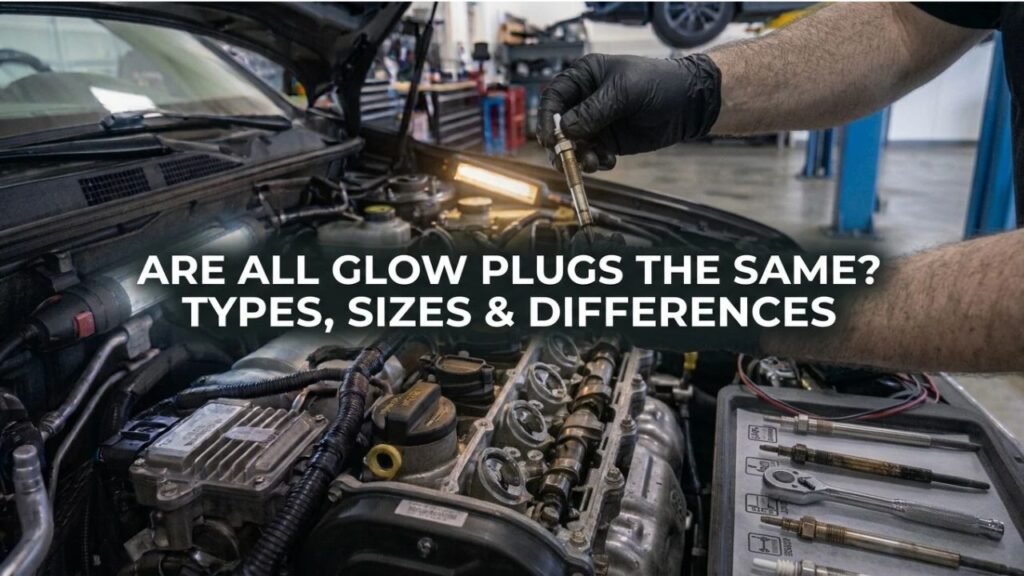
No. A glow plug should be treated as an engine-specific electrical and mechanical component, not a universal diesel heater.
Manufacturers design glow plugs to work with a particular combustion chamber, engine management strategy, electrical system, and glow control module.
Important differences include:
| Glow Plug Feature | What Can Differ |
| Heating element | Metal or ceramic |
| Operating voltage | Can range from low-voltage modern systems to traditional higher-voltage systems |
| Heat-up speed | Less than 2 seconds to several seconds |
| Maximum temperature | Can exceed 1,000°C |
| Post-glow capability | Seconds to many minutes |
| Thread size | Varies by engine |
| Thread reach | Different lengths |
| Overall length | Application-specific |
| Heating-tip length | Application-specific |
| Electrical resistance | Varies considerably |
| Terminal connection | Different designs |
| Control method | Direct, relay-controlled, PWM/electronically controlled |
| Regulating technology | Standard, self-regulating, quick-glow, advanced systems |
Bosch, for example, produces glow plug designs operating at substantially different voltages. Some of its metal designs use approximately 11 volts, while certain electronically controlled rapid-heating metal plugs operate around 4.4–5 volts. Bosch ceramic systems can also use different voltage designs.
This demonstrates why selecting a glow plug based only on appearance is risky.
Key Takeaways:
- Glow plugs can look similar while having very different electrical requirements.
- Voltage, heating technology, dimensions, and control strategy must all match the engine.
- Always select glow plugs by exact vehicle and engine application rather than appearance.
What Are the Main Types of Glow Plugs?
Modern automotive glow plugs can broadly be divided into metal-sheathed glow plugs and ceramic glow plugs.
Both perform the same basic task: producing heat inside or near the diesel combustion chamber.
How they create and manage that heat can be very different.
Metal-Sheathed Glow Plugs
Metal glow plugs are extremely common.
Inside the narrow metal heating tube is an electrical heating element. Heat-resistant insulating material surrounds and supports the internal coils while also helping transfer heat toward the outer surface.
Many metal designs use magnesium oxide around the heating coil because it transfers heat effectively while protecting the coil from vibration and mechanical shock.
The glowing tip can become extremely hot in only a few seconds.
Standard Metal Glow Plugs
Older and simpler metal glow plugs may use a relatively straightforward heating coil.
They typically require a longer preheating period than the newest rapid-glow systems.
Drivers of older diesel vehicles may recognize the familiar routine of turning the ignition on and waiting several seconds for the glow plug indicator to go out before cranking.
Although still effective, these systems operate differently from a modern electronically controlled low-voltage glow system.
Self-Regulating Metal Glow Plugs
Self-regulating glow plugs contain heating and regulating elements designed so that electrical resistance changes as temperature increases.
As the plug becomes hot, current is controlled to prevent continuous uncontrolled temperature rise.
This allows faster heating while protecting the glow plug from overheating.
Self-regulating designs have been important in making glow systems faster, safer, and more durable.
Quick Glow Systems
Modern quick-glow designs can reach useful temperatures very rapidly.
Manufacturers may use different names, such as QGS or AQGS—Quick Glow System and Advanced Quick Glow System.
These plugs can reach very high temperatures in only a few seconds and may operate at significantly lower voltages than older designs.
That lower operating voltage is one reason they must never be replaced casually with a physically similar conventional plug.
The engine control unit and glow control module regulate electrical power precisely.
Ceramic Glow Plugs
Ceramic glow plugs represent another major technology.
Instead of relying on a conventional metal heating tube as the primary hot surface, these plugs use specialized electrically conductive ceramic material in the heating element.
Ceramic technology can tolerate extremely high operating temperatures and rapid heating.
Some modern ceramic plugs can exceed 1,000°C in less than two seconds and continue post-glowing at very high temperatures for several minutes.
Certain ceramic glow plugs can operate at temperatures approaching 1,300–1,350°C.
That capability is useful in modern low-compression diesel engines, where cold combustion can be particularly difficult.
Why Ceramic Glow Plugs Are Used
Modern diesel engines are engineered for lower emissions, quieter operation, high efficiency, and rapid warm-up.
Ceramic glow plugs can support these goals because they heat extremely quickly and tolerate extended high-temperature operation.
They are particularly useful for prolonged post-glow.
After the engine starts, the glow plug can remain active to stabilize combustion while the combustion chamber is still relatively cold.
This can reduce smoke, unburned hydrocarbons, and cold-start noise.
Metal vs Ceramic Glow Plugs
Metal and ceramic plugs both heat diesel combustion chambers, but their characteristics differ.
| Feature | Metal Glow Plug | Ceramic Glow Plug |
| Heating material | Metallic heating element | Conductive ceramic heating element |
| Heat-up speed | Fast to very fast | Extremely fast in advanced designs |
| Maximum temperature | High | Usually higher |
| Extended post-glow | Available | Excellent capability |
| Physical durability | Generally robust | Requires careful handling |
| Cost | Often lower | Often higher |
| Modern emissions support | Good | Excellent in appropriate applications |
| Interchangeable? | No, unless specifically approved | No, unless specifically approved |
A ceramic glow plug is not automatically an upgrade for an engine using metal plugs.
The control module, voltage, resistance characteristics, heating curve, dimensions, and combustion strategy must all be compatible.
Key Takeaways:
- Metal and ceramic are the two major modern glow plug technologies.
- Ceramic glow plugs can heat exceptionally quickly and withstand very high temperatures.
- Never replace a metal plug with ceramic—or ceramic with metal—unless the manufacturer specifically approves that substitution.
Are All Glow Plugs 12 Volts?
No.
This is one of the most important misconceptions about glow plugs.
A diesel vehicle may have a 12-volt electrical system while using glow plugs that operate at substantially less than 12 volts.
Modern electronic glow control modules can pulse and regulate power extremely quickly.
For example, some rapid-heating Bosch metal plugs operate around 4.4 to 5 volts, while other Bosch metal designs are approximately 11 volts.
Ceramic designs can also be produced for different operating voltages.
Older heavy-duty vehicles may use 24-volt electrical systems and corresponding glow plug technologies.
Why Would a 12-Volt Vehicle Use a 5-Volt Glow Plug?
Because the plug is not necessarily connected continuously to full battery voltage.
The glow control module regulates the electrical supply.
It may use pulse-width modulation or another switching strategy to deliver precisely controlled energy.
During the initial heat-up stage, the module may apply substantial power to heat the plug quickly.
It then reduces the effective electrical load to maintain the required temperature without destroying the plug.
This makes extremely rapid warm-up possible.
What Happens if You Apply 12 Volts to a Low-Voltage Glow Plug?
The plug can overheat very quickly.
The heating element may swell, burn, melt, or fail.
This is one reason directly connecting an unknown modern glow plug to a battery for testing can be dangerous.
A battery test that was acceptable for certain old 12-volt glow plugs can destroy some modern low-voltage designs.
Always identify the plug’s electrical specification before bench testing it.
Are Glow Plug Resistance Values All the Same?
No.
Resistance varies according to plug technology and operating temperature.
Glow plugs commonly have very low resistance when cold.
Values can be low enough that inexpensive multimeters have difficulty distinguishing a good plug from a partially degraded one.
The resistance also changes as the heating element becomes hot.
Self-regulating glow plugs intentionally use this behavior to control current.
Why Resistance Matters
Electrical current is related to voltage and resistance.
If you install a glow plug with electrical characteristics different from what the control module expects, current flow can be incorrect.
A plug may heat too slowly, become too hot, or trigger an electrical fault.
The control module itself may also be stressed.
This is why matching thread size while ignoring electrical characteristics is not enough.
Are Glow Plug Sizes All the Same?
No.
Glow plugs differ in several physical dimensions, including thread diameter, thread pitch, overall length, heating-tip length, terminal design, and hex size.
Modern diesel cylinder heads are tightly packaged, so manufacturers may use small-diameter glow plugs to fit between valves, injectors, coolant passages, and other components.
Even two plugs with the same thread size can have different tip lengths.
Why Glow Plug Length Matters
The heating tip must sit in the correct location relative to the combustion chamber or prechamber.
If it is too short, it may not heat the intended region effectively.
If it extends too far, it can potentially interfere with combustion, suffer abnormal heat exposure, or in extreme cases risk mechanical contact.
Glow plug projection is therefore an engineered dimension.
Never choose a replacement merely because it screws into the cylinder head.
Do All Glow Plugs Use the Same Thread Size?
No.
Glow plug thread diameters vary widely.
Common modern sizes can include 8 mm, 9 mm, 10 mm, 12 mm, and other configurations depending on engine design.
Older engines can use larger designs.
Thread pitch also matters.
A plug that appears to have the same diameter but uses a different pitch can damage the cylinder head if forced into place.
Modern diesel cylinder heads are commonly aluminum, making their internal threads softer than the steel glow plug body.
Always start a replacement by hand and never force resistance with a wrench.
Are All Glow Plug Tips the Same Length?
No.
Tip geometry is highly application-specific.
The glowing area has to reach exactly the location intended by the combustion chamber designer.
Diesel engines use different chamber arrangements, injector orientations, piston bowl designs, and cylinder-head layouts.
A glow plug that protrudes farther than intended may be exposed to abnormal combustion forces.
A plug that is too short may not provide enough heat where it is required.
This is another reason universal glow plugs do not exist.
Do All Glow Plugs Heat at the Same Speed?
No.
Heat-up time varies dramatically.
Older glow systems may need several seconds or longer before the engine is ready to crank.
Advanced modern systems can reach effective operating temperature in roughly two seconds or even less.
Bosch examples illustrate the range well. Depending on technology, some metal designs reach approximately 850°C in less than five seconds, newer low-voltage metal designs can reach around 950°C in less than three seconds, and advanced ceramic plugs may reach roughly 1,000°C in under two seconds.
These figures are examples of how much technology can vary, not universal specifications for every glow plug.
Why Heating Speed Matters
The engine control unit expects a particular heating curve.
If a slow plug replaces a fast one, the engine may begin cranking before sufficient heat is available.
Cold starting can become difficult.
If a very fast low-voltage plug is installed in an older high-voltage circuit, the plug may be destroyed.
Matching heating characteristics is therefore just as important as physical fit.
Do All Glow Plugs Reach the Same Temperature?
No.
Maximum temperature depends on the design.
Traditional metal plugs may reach temperatures somewhat above 1,000°C.
Advanced ceramic plugs can operate closer to 1,300°C or higher in certain applications.
More temperature is not automatically better.
The engine manufacturer selects the heating profile needed for the combustion system.
An unnecessarily hot plug can create durability problems.
The correct goal is the specified temperature at the specified time—not simply the hottest glow plug available.
What Is Post-Glow?
Post-glow means the glow plugs continue operating after the engine has started.
Older drivers often think glow plugs switch off as soon as the engine fires, but modern diesel systems can continue operating them for minutes.
Post-glow helps improve:
cold combustion stability, idle quality, warm-up speed, smoke control, emissions, and engine noise.
Different glow plug technologies support different post-glow durations.
Some advanced ceramic systems can remain active for more than ten minutes under specific operating conditions.
This is one reason modern glow plugs experience more operating cycles than many people realize.
Do All Glow Plugs Help With DPF Regeneration?
No—not every diesel uses the same strategy.
However, many modern diesel engines use glow plug operation as part of their emissions-control strategy.
During diesel particulate filter regeneration, exhaust temperature must become high enough to burn accumulated soot.
The engine control system may activate the glow plugs under certain conditions to help increase combustion and exhaust temperatures.
The exact strategy varies by manufacturer.
A glow plug fault on some vehicles can therefore interfere with DPF regeneration even when the engine still starts normally.
This is why a modern glow plug warning should not simply be ignored because the weather is warm.
Can You Mix Different Glow Plug Brands?
Technically, different brands can sometimes manufacture plugs that meet the same OE specification.
But I generally recommend installing a matched set of the same correct part number or equivalent specification, especially when replacing all plugs.
The critical issue is not the logo.
It is electrical and thermal matching.
If a Bosch, NGK, DENSO, Beru, or another quality manufacturer lists a direct replacement meeting the correct OE requirements, it may be suitable.
However, randomly mixing several glow plug designs because they physically fit is not good practice.
Should All Cylinders Have the Same Glow Plug?
Normally, yes.
For a standard multi-cylinder diesel engine, all cylinders generally use the same specified glow plug.
That ensures consistent heat-up behavior and current demand.
If one cylinder receives a plug with different heating characteristics, cold combustion can become uneven.
The glow control module may also detect an unusual current draw.
Key Takeaways:
- All cylinders normally use matching glow plugs with the same electrical and heating characteristics.
- Different brands can be acceptable only when they genuinely meet the same application specification.
- Mixing random glow plugs based on physical fit can create uneven heating and electrical faults.
Can You Replace One Glow Plug With a Different Type?
Not unless it is a manufacturer-approved equivalent.
For example, suppose an engine uses an advanced low-voltage metal plug.
Installing a conventional 11-volt plug into one cylinder because the threads fit would not create a proper repair.
That cylinder could heat much more slowly than the others.
Likewise, installing a low-voltage rapid-glow plug into a higher-voltage circuit could destroy it.
The replacement must match the original electrical behavior as well as the dimensions.
Can You Replace Metal Glow Plugs With Ceramic Ones?
Not automatically.
Ceramic plugs can offer faster heating and higher temperature capability, but the engine’s control system must be designed to operate them.
A ceramic plug can have a completely different electrical resistance and voltage requirement from a metal plug that looks physically similar.
NGK specifically warns that metal and ceramic glow plug types can differ substantially in resistance and voltage and are not interchangeable simply because they resemble each other.
Unless an official supersession or application catalog lists the ceramic plug as a correct replacement, retain the specified technology.
Can You Replace Ceramic Glow Plugs With Metal Ones?
The same rule applies in reverse.
An engine engineered around ceramic plugs may depend on their extremely fast warm-up and extended post-glow behavior.
Installing a slower metal plug can reduce cold-start performance and emissions control.
The engine computer may also detect incorrect electrical behavior.
Always follow the approved part number.
Can the Wrong Glow Plug Damage an Engine?
Potentially, yes.
Some incorrect glow plugs may simply produce hard starting or a fault code.
Others can fail physically.
An over-volted glow plug may overheat, causing the tip to swell, crack, or melt.
A swollen plug can become extremely difficult to remove from the cylinder head.
A physically incorrect plug may protrude too far into the combustion chamber.
A broken tip can create a much more serious repair if material enters the cylinder.
Incorrect glow plug selection should therefore be treated as more than a minor electrical inconvenience.
Can the Wrong Glow Plug Damage the Control Module?
It is possible.
The glow plug control module is designed to supply and monitor a particular electrical load.
If replacement plugs draw substantially different current, the module can detect a fault and may potentially experience abnormal electrical stress.
Modern glow systems are sophisticated electronic circuits.
Do not treat the glow control module as a simple old-fashioned on/off relay.
The safest approach is to use the exact specified plugs.
Why Do Some Glow Plugs Have Different Connectors?
The electrical terminal at the top of the glow plug can also vary.
Older designs may use threaded terminals and nuts.
Modern vehicles commonly use push-on electrical connectors integrated into a wiring harness.
Terminal diameter and shape can differ.
Even if the cylinder-head thread matches, the vehicle harness may not connect to another glow plug.
Never modify the wiring simply to make an incorrect plug fit.
Are 12-Volt and 24-Volt Glow Plugs Interchangeable?
No.
Heavy-duty trucks, agricultural equipment, industrial engines, and older systems may operate at different electrical-system voltages.
A plug intended for a 24-volt system behaves differently from one intended for a 12-volt design.
Installing the wrong version can result in extremely slow heating or immediate overheating.
Use the correct part number associated with the actual glow control system.
Are Glow Plugs Universal Between Diesel Engines?
No.
Even two engines with similar displacement can have completely different requirements.
A 2.0-liter diesel from one manufacturer may use ceramic low-voltage plugs controlled individually by an electronic module.
Another 2.0-liter diesel may use metal self-regulating plugs with different resistance and dimensions.
Engine displacement tells you almost nothing about glow plug compatibility.
Year, manufacturer, engine code, and sometimes production date are much more useful.
How to Find the Correct Glow Plug for Your Diesel
The easiest method is to use the vehicle manufacturer’s specification or a reputable glow plug manufacturer’s application catalog.
Identify the exact:
year, make, model, engine displacement, engine code when available, and sometimes VIN or production date.
Do not order solely from the part number printed on a random glow plug already installed in the engine unless you know those plugs were correct.
A previous owner may have installed the wrong parts.
Compare Part Numbers Carefully
Glow plug part numbers may differ by only one letter or number while having different heating characteristics.
A superseded part number may also exist.
An official manufacturer cross-reference can determine whether the newer part is an approved replacement.
Do not assume that similar numbering means interchangeability.
Should You Replace All Glow Plugs at the Same Time?
If one older glow plug has failed, replacing the complete set often makes sense.
The plugs have generally experienced similar heating cycles and engine conditions.
If one reaches the end of its useful life, the remaining plugs may not be far behind.
Replacing the set also ensures that all cylinders have matching heating performance.
If one relatively new plug fails because of an isolated wiring or manufacturing problem, individual replacement can sometimes be reasonable.
Before replacing multiple failed plugs, however, make sure the control module and electrical system are functioning correctly.
A faulty module can damage a new set.
What Happens if You Mix Old and New Glow Plugs?
An old functional glow plug and a new plug of the exact same specification can technically operate together.
However, aging can alter heating performance.
A new plug may reach temperature more quickly than a heavily aged one.
On older high-mileage engines, replacing the entire set can therefore improve consistency.
This is especially worthwhile when access is difficult and much of the labor is shared between all cylinders.
How to Tell What Type of Glow Plug You Have
The safest method is the part number.
Trying to identify technology solely by appearance is unreliable.
A metal and ceramic glow plug can look surprisingly similar from outside.
Check the manufacturer’s catalog for the exact number.
It should identify the plug family, voltage or control technology where appropriate, dimensions, and vehicle application.
If the markings are unreadable, use the engine information rather than guessing.
Can You Test Any Glow Plug Directly With a Battery?
No.
This deserves special emphasis.
Some older glow plugs can be bench tested briefly using an appropriate power source.
Many modern low-voltage glow plugs cannot safely receive full battery voltage.
Connecting a 4–5-volt plug directly to a 12-volt battery can overheat and destroy it almost instantly.
Modern ceramic plugs may also heat extremely rapidly.
For newer vehicles, resistance testing, current measurement, scan-tool diagnosis, or a dedicated glow plug tester is much safer.
Follow the service manual.
FAQs about Are All Glow Plugs the Same
Are all diesel glow plugs the same?
No.
Glow plugs vary by voltage, size, material, resistance, heat-up speed, maximum temperature, control method, and application.
Are all glow plugs 12 volts?
No.
A vehicle with a 12-volt battery can use glow plugs operating at much lower effective voltage because the electronic control module regulates power.
Do all glow plugs have the same resistance?
No.
Resistance depends on heating technology and changes with temperature.
Different glow plug systems can have significantly different resistance characteristics.
Are all glow plugs the same size?
No.
Thread diameter, pitch, overall length, tip length, hex size, and connector design can differ.
Are ceramic and metal glow plugs interchangeable?
Generally, no.
They can have very different electrical and heating characteristics even when they look similar.
Use only an officially approved replacement.
Are ceramic glow plugs better?
Ceramic plugs can heat faster and tolerate higher temperatures, but they are not automatically better for an engine designed around metal plugs.
The correct plug is the one specified for the engine.
Can I use any glow plug that fits?
No.
Physical fit is only one requirement.
Voltage, resistance, heating profile, and tip position must also be correct.
Can I mix glow plug brands?
You can use a reputable equivalent brand if every plug meets the correct OE specification.
For consistency, using a matching set is preferable.
Do all cylinders use the same glow plug?
Normally, yes.
A standard diesel engine typically uses the same specified plug in each cylinder.
Can one wrong glow plug cause problems?
Yes.
It can heat too slowly, overheat, generate a fault code, create uneven cold combustion, or potentially fail physically.
Can I replace only one glow plug?
Yes, but when an older plug fails, replacing the full set is often recommended because the other plugs have undergone similar wear.
Why are some glow plugs only 5 volts?
Modern electronic control modules can regulate low-voltage glow plugs precisely, allowing extremely rapid heating without applying full battery voltage continuously.
What happens if I install the wrong voltage glow plug?
It may heat too slowly or overheat and fail rapidly.
The glow control module may also record electrical faults.
Can I test a glow plug with 12 volts?
Only if the specific glow plug and manufacturer-approved procedure allow it.
Do not apply 12 volts directly to an unknown modern low-voltage or ceramic glow plug.
How do I know which glow plugs my diesel needs?
Use the vehicle’s year, make, model, exact engine, engine code, and manufacturer application catalog to identify the correct part number.
Conclusion
So, are all glow plugs the same? No. Although most perform the basic job of heating the diesel combustion chamber, their electrical and mechanical characteristics can be dramatically different.
The two major technologies are metal-sheathed and ceramic glow plugs, but even within those categories there are standard, self-regulating, quick-glow, low-voltage, and extended-post-glow designs.
Operating voltage is one of the most important differences. A diesel vehicle with a 12-volt battery does not necessarily use 12-volt glow plugs. Modern electronically controlled systems may use plugs operating around 4–5 volts or other application-specific voltages, with the glow control module rapidly regulating the electrical supply.
Glow plugs also differ in resistance, thread size, overall length, heating-tip projection, terminal type, heat-up speed, maximum temperature, and post-glow capability.
That means a glow plug that physically fits your cylinder head is not necessarily compatible with your engine.
Metal and ceramic plugs should not be interchanged unless the manufacturer specifically approves the replacement. Likewise, do not substitute different-voltage plugs or connect an unknown modern glow plug directly to a 12-volt battery for testing.
My recommendation is to identify glow plugs using the exact vehicle and engine application rather than appearance or dimensions alone. Use the correct OE number or a verified aftermarket cross-reference from a reputable manufacturer.
When replacing an older failed glow plug, replacing the complete matched set can also make sense because all cylinders then receive similar heating performance.
Glow plugs may look like simple heating elements, but modern diesel engines rely on precisely controlled glow systems for cold starting, smooth warm-up, lower emissions, and sometimes DPF regeneration. Choosing the exact correct glow plug is therefore much more important than simply finding one that screws into the hole.