
Yes, E3 spark plugs can be good when the correct E3 plug is specifically listed for your engine, but I would not choose them solely because of promises of extra horsepower or fuel economy. E3 uses a distinctive DiamondFIRE ground-electrode design instead of the traditional J-shaped ground strap found on many conventional spark plugs. The company says this design exposes the spark more directly to the air-fuel mixture and improves combustion characteristics.
For a properly running stock vehicle, however, the most important factors are still correct heat range, thread reach, seat type, resistor design, firing position, gap, and compatibility with the ignition system. A spark plug with an unusual electrode design is not automatically better than the NGK, Denso, Motorcraft, ACDelco, Bosch, or Champion plug originally specified for the engine.
E3 currently backs its automotive spark plugs with a five-year or 100,000-mile warranty, which is substantial. However, a warranty period should not be interpreted as proof that every engine will experience measurable increases in power or fuel economy, nor does it replace the maintenance schedule for your specific vehicle.
In this guide, I’ll explain whether E3 spark plugs are worth buying, how the DiamondFIRE design works, how long E3 plugs may last, their advantages and disadvantages, whether they improve horsepower or gas mileage, and when I would choose the factory-recommended OEM-style plug instead.
What Are E3 Spark Plugs?
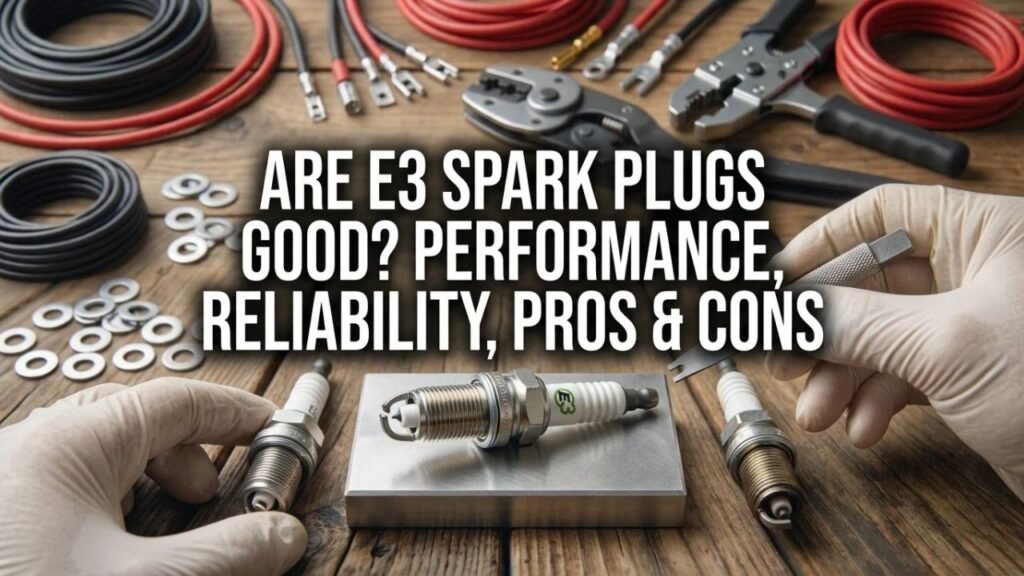
E3 is an aftermarket ignition brand best known for its DiamondFIRE ground electrode.
Instead of using a simple curved J-wire ground strap positioned over the center electrode, E3 uses a more open, multi-edge ground-electrode shape.
According to E3, the design is intended to expose the spark kernel more directly to the combustion mixture and provide multiple sharp edges from which the electrical discharge can occur. The company describes three main elements of the design: an open ground electrode, forward projection into the spark zone, and edge-to-edge spark discharge.
That makes an E3 plug visually different from a conventional spark plug.
However, the basic job remains exactly the same.
It must seal the combustion chamber, operate at the correct firing-tip temperature, carry ignition voltage, and reliably ignite the compressed air-fuel mixture.
Are E3 Spark Plugs Legitimate?
Yes.
E3 is a real aftermarket spark plug manufacturer with automotive, powersports, racing, and lawn-and-garden applications.
This is different from an unbranded novelty plug sold solely around vague performance claims.
The important question is therefore not whether E3 is a legitimate company.
The more useful question is whether an E3 plug is the best choice for your particular engine.
That answer depends heavily on application.
How Does the E3 DiamondFIRE Electrode Work?
A conventional spark plug often has one ground strap curving over the center electrode.
The electrical spark jumps between those two points.
E3 changes the geometry of the ground electrode so the spark region is more open to the combustion chamber.
The company argues that this helps the initial flame kernel enter the surrounding air-fuel mixture without as much obstruction from a traditional ground strap.
From an engineering standpoint, electrode geometry can matter.
The shape and location of the electrodes influence electric-field concentration, flame-kernel exposure, heat transfer, and how combustion begins near the plug.
That does not mean one electrode shape is universally superior in every engine.
Combustion chambers differ substantially.
A plug design that performs well in one chamber may offer little meaningful advantage in another engine whose ignition system and combustion chamber were optimized around a specific OEM plug.
Multiple Edges Do Not Mean Multiple Simultaneous Sparks
A common misconception is that a plug with several electrode edges produces several full-power sparks at once.
That is not how a conventional single ignition event normally works.
The electrical discharge follows the path that requires the least breakdown voltage at that moment.
The multiple edges provide alternative areas where the spark can form.
You should not interpret the DiamondFIRE shape as several separate ignition coils firing several sparks simultaneously.
Key Takeaways:
- E3 uses a distinctive DiamondFIRE ground electrode rather than a conventional J-wire design.
- Electrode geometry can influence ignition, but it does not automatically make one plug best for every combustion chamber.
- E3 plugs should still be selected primarily by exact engine compatibility.
Are E3 Spark Plugs Good for Daily-Driven Cars?
They can be.
If E3’s catalog specifically lists a plug for your exact vehicle and engine, the plug is designed as an aftermarket replacement for that application.
A correctly matched E3 plug can provide normal starting, idle quality, acceleration, and ignition reliability.
Where I become more conservative is with vehicles that are known to be particularly sensitive to spark plug design.
Some modern direct-injected, turbocharged, or high-output engines use very specific fine-wire plugs with tightly controlled projection, heat range, electrode material, and factory gap.
In those applications, I usually prefer the exact OEM specification unless there is a good reason to change.
OEM Matching Matters More Than Brand Reputation
Spark plugs are not interchangeable simply because they share the same thread diameter.
Important differences include:
thread reach, seat design, heat range, resistor value, firing-tip projection, electrode configuration, shell dimensions, and gap.
Using the wrong heat range is particularly important.
A plug that runs too cold may foul.
A plug that runs too hot can reduce the safety margin against overheating and pre-ignition. Major spark plug manufacturers emphasize that correct heat range is fundamental to proper plug operation.
So if you use E3, use the exact plug its application catalog specifies rather than choosing by physical appearance.
Do E3 Spark Plugs Increase Horsepower?
E3 markets its electrode design around improved combustion and performance, and its current automotive warranty language references an experience of more power on less fuel compared with standard plugs.
I would keep expectations realistic.
If your existing spark plugs are badly worn, fouled, incorrectly gapped, or misfiring, replacing them with fresh E3 plugs may make the engine feel noticeably stronger.
But much of that improvement comes from restoring proper ignition.
A healthy stock engine with fresh, correct OEM plugs is already designed to ignite the mixture reliably.
Replacing those healthy plugs with E3 plugs should not automatically be expected to produce a dramatic horsepower increase.
Why Some Drivers Feel an Improvement
Imagine an engine running with 80,000-mile-old plugs whose gaps have widened substantially.
The ignition coils have to work harder, and the vehicle occasionally hesitates during acceleration.
You install new E3 plugs.
The hesitation disappears and acceleration feels sharper.
The improvement is real.
However, comparing brand-new E3 plugs with worn-out old plugs is not the same as comparing new E3 plugs with new OEM plugs under controlled conditions.
That distinction matters when evaluating performance claims.
Do E3 Spark Plugs Improve Gas Mileage?
They may help restore normal fuel economy if the old plugs were contributing to poor combustion or misfires.
I would not buy them expecting a guaranteed dramatic MPG increase in an otherwise healthy engine.
Fuel economy depends on far more than the spark plug.
Tire pressure, driving style, traffic, vehicle speed, engine temperature, fuel trims, oxygen sensors, injectors, aerodynamics, transmission operation, and weather can all change mileage.
A small fuel-economy difference is therefore difficult to attribute confidently to a plug swap without controlled testing.
E3 does specifically market reduced fuel consumption as one benefit of its DiamondFIRE design.
That is a manufacturer performance claim, not a guarantee that every vehicle will show a noticeable MPG increase.
How Long Do E3 Spark Plugs Last?
E3 currently provides a five-year or 100,000-mile warranty on its automotive spark plugs for eligible household use.
That is encouraging from a product-support standpoint.
However, I would still follow your engine’s required inspection or replacement schedule rather than interpreting the warranty as a universal instruction to leave every E3 plug installed for exactly 100,000 miles.
Operating conditions matter.
An engine that burns oil can foul a plug rapidly.
A rich-running engine can cover the electrodes in carbon.
Coolant entering a cylinder can contaminate the plug.
An ignition-system problem can create abnormal electrical erosion.
Do E3 Plugs Last Longer Than Copper Plugs?
Potentially, depending on the exact products being compared.
Traditional conventional plugs with nickel-alloy firing surfaces can wear faster than long-life precious-metal designs.
But E3’s unusual ground electrode means you should compare specific plug constructions rather than assuming every E3 model behaves exactly like a standard iridium or platinum plug.
The practical rule is simple: monitor engine performance and follow the applicable vehicle and plug guidance.
Are E3 Spark Plugs Pre-Gapped?
Many current E3 automotive plugs use a fixed DiamondFIRE gap that E3 says cannot be adjusted.
For example, current product listings for E3.53, E3.62, and E3.82 identify them as fixed-gap designs.
This is important.
Do not approach every E3 plug with a conventional coin-style gapping tool and start bending the electrode.
The DiamondFIRE electrode is structurally different from a normal J-wire plug.
What If the Gap Looks Wrong?
First, verify that you purchased the correct E3 part number for the engine.
Do not attempt to modify a fixed-gap E3 plug simply because it does not visually resemble the OEM plug.
If the electrode appears damaged from shipping, replace or return the plug rather than trying to reshape the DiamondFIRE structure.
Some E3 products outside the automotive range may have different gap instructions, so always check the exact part rather than applying one rule to the entire brand.
Key Takeaways:
- Many E3 automotive spark plugs use a fixed gap that should not be manually adjusted.
- A five-year/100,000-mile warranty does not mean every engine should ignore its normal maintenance schedule.
- If an E3 plug looks damaged or incorrect, verify the part number before modifying anything.
Are E3 Spark Plugs Good for Older Cars?
They can be, but I would evaluate the engine individually.
Older engines often use relatively simple ignition systems and conventional spark plugs.
If the E3 catalog lists a direct application and the engine is stock, an E3 plug may operate perfectly well.
However, classic engines can be sensitive to heat range, carburetor tuning, oil consumption, and ignition condition.
An unusual plug cannot compensate for a carburetor that is too rich or piston rings that are allowing substantial oil into the cylinders.
For a vintage engine with a long history of running well on a particular Champion, NGK, Autolite, or AC plug, I generally see little reason to change unless you are trying to solve a specific problem and have confirmed the E3 cross-reference.
Are E3 Spark Plugs Good for Small Engines?
E3 has a substantial lawn-and-garden spark plug range and currently offers a separate warranty for non-commercial household small-engine applications.
They can be a practical choice for lawn mowers, generators, trimmers, pressure washers, and other equipment when the E3 application guide lists the correct plug.
Small engines are also an area where plug condition can deteriorate because of carburetor problems, choke misuse, dirty air filters, oil burning, or seasonal storage.
If an E3 plug repeatedly becomes black and fouled after only a few hours, investigate the engine rather than assuming the plug is the cause.
Are E3 Spark Plugs Good for Performance Engines?
This depends heavily on the engine.
E3 sells racing-specific plugs, including cold-range non-resistor models for specialized high-compression applications.
That does not mean an ordinary E3 automotive plug should automatically be installed in a modified turbocharged, supercharged, nitrous, or racing engine.
Modified engines may require changes to:
spark plug heat range, electrode projection, resistor configuration, and gap.
Boost pressure is particularly important because increased cylinder pressure makes the spark more difficult to initiate.
A tuner may intentionally specify a colder plug or smaller gap.
If you have a substantially modified engine, follow the recommendation of the engine builder or tuner who understands the actual combination rather than selecting a performance plug based on marketing alone.
E3 Spark Plugs Pros and Cons
E3’s biggest advantage is that it offers a genuinely different electrode architecture rather than simply repackaging a conventional plug.
Its automotive warranty is also noteworthy.
At the same time, the nontraditional design means you need to be more careful about application selection and gap assumptions.
| Factor | E3 Spark Plugs |
| Electrode design | Unique DiamondFIRE ground electrode |
| Automotive warranty | 5 years/100,000 miles |
| Gap adjustment | Many automotive models are fixed-gap |
| Vehicle coverage | Broad aftermarket catalog |
| Performance claims | Manufacturer claims improved combustion/power/fuel use |
| Best use | Correctly cross-referenced stock or supported engines |
| Main caution | Do not assume they outperform the OEM plug in every engine |
| Modified engines | Follow tuner/engine-builder specification |
What I Like About Them
The plug design is distinctive, and E3 provides application-specific products rather than one universal plug.
The warranty is also stronger than what many buyers might expect from an aftermarket ignition component.
For owners who want to try an alternative plug and have a clearly listed E3 application, there is nothing inherently unreasonable about choosing them.
What I Would Be Careful About
I would avoid assuming that a different electrode automatically means more horsepower.
I would also avoid E3 in an engine where the vehicle manufacturer specifies an unusually specialized fine-wire plug unless I could verify that the E3 replacement matches every critical parameter.
And because many automotive E3 plugs are fixed-gap designs, they are less suitable for applications where a tuner needs to set a very specific custom plug gap.
E3 Spark Plugs vs. NGK
NGK has exceptionally broad OEM and aftermarket coverage and produces conventional, platinum, ruthenium, and iridium designs.
For many Japanese and modern turbocharged engines, NGK is frequently an OEM or OEM-style choice.
E3 differentiates itself primarily through the DiamondFIRE electrode.
If my stock vehicle originally came with a specific NGK iridium plug and the engine has a reputation for being sensitive to plug selection, I would generally remain with the exact NGK specification.
If E3 lists a direct replacement and the vehicle is not especially plug-sensitive, E3 becomes a reasonable alternative.
E3 Spark Plugs vs. Denso
Denso is another major OEM-level ignition supplier with extensive fine-wire iridium technology.
Denso’s documentation emphasizes matching gap, projection, reach, and heat range to the vehicle-specific application rather than relying only on broad cross-references.
That principle applies equally when considering E3.
If the factory Denso plug is readily available and has a proven service history in your engine, staying with it is the conservative choice.
E3 makes more sense when you specifically want its electrode design and have verified correct fitment.
E3 Spark Plugs vs. Champion
Champion offers conventional, platinum, double-platinum, and iridium spark plugs using more familiar electrode designs.
E3’s main differentiator is DiamondFIRE.
Neither brand is automatically better.
If both provide correct replacements, I would compare price, expected service life, engine sensitivity, and whether you prefer the OEM-style design or E3’s alternative electrode.
For an older basic engine, either may work very well.
E3 Spark Plugs vs. Motorcraft and ACDelco
Motorcraft and ACDelco have an advantage in Ford and GM applications respectively: they often represent the easiest way to stay very close to the original vehicle specification.
That does not mean an E3 equivalent will not work.
It means there may be little practical reason to experiment when the exact factory-style plug is inexpensive and easily available.
For difficult-to-service engines where plug replacement requires considerable labor, I place even more value on using the proven OEM plug.
Key Takeaways:
- E3 can compete with major brands when its plug is correctly matched to the engine.
- OEM-style plugs remain the conservative choice for sensitive modern engines.
- Do not choose a spark plug by brand alone; heat range, dimensions, gap strategy, and electrode design matter more.
What Do Mechanics and Owners Say About E3 Spark Plugs?
Online opinions are mixed.
Some owners report satisfactory operation or perceived improvements, while others report misfires, corrosion, gap-related concerns, or no noticeable benefit over OEM plugs.
Anecdotal reports should be treated carefully because installation quality, engine condition, plug application, mileage, and vehicle modifications differ substantially. For example, mechanic-oriented Reddit discussions include both skepticism about performance gains and individual reports of poor experiences, but those stories do not establish a universal failure rate.
This is one reason I would not make a brand decision entirely from reviews.
A spark plug that works poorly in one F-150 tells you very little about how the correct E3 plug will behave in a lawn mower or naturally aspirated sedan.
Likewise, one owner’s reported fuel-economy increase does not prove every engine will see the same result.
Can E3 Spark Plugs Cause Misfires?
Any spark plug can contribute to a misfire if it is incorrect, damaged, fouled, or incompatible with the engine.
With E3 plugs, start by verifying the part number because the unusual electrode design makes visual comparison with the original plug less intuitive.
If a misfire begins immediately after installing E3 plugs, check:
the plug application, ignition coil connections, coil boots, installation torque, and whether any plug was damaged during installation.
If possible, scan the vehicle for cylinder-specific misfire codes.
Do not immediately assume the DiamondFIRE design is responsible.
What If the Engine Ran Better With the OEM Plugs?
If the engine ran perfectly with the correct OEM plugs and develops a repeatable misfire immediately after installing E3 plugs, returning to the known correct OEM plug is a sensible diagnostic step.
There is no reason to continue forcing an aftermarket plug to work simply because it is marketed as a performance upgrade.
Reliable ignition is more important than the brand on the ceramic.
Do E3 Spark Plugs Need Anti-Seize?
Do not automatically add anti-seize.
Spark plug installation depends on the plug and engine manufacturer’s instructions.
Thread lubricant changes friction and therefore changes the relationship between torque-wrench reading and actual clamping force.
If the plug is intended for dry installation, adding anti-seize can increase the risk of overtightening.
The same principle applies to E3 as to other modern spark plugs.
Always verify the installation requirements for your exact part and engine.
Can E3 Spark Plugs Fix a Rough Idle?
Only if the existing spark plugs are actually contributing to the rough idle.
If your old plugs are worn, fouled, or misfiring, replacing them with correct E3 plugs may restore smooth operation.
But rough idle can also come from:
vacuum leaks, ignition coils, fuel injectors, low compression, dirty throttle bodies, intake deposits, incorrect valve timing, or PCV problems.
Do not use E3 plugs as a general cure for an undiagnosed engine problem.
Are E3 Spark Plugs Worth the Money?
For some buyers, yes.
Current E3 automotive plugs are priced as premium aftermarket alternatives rather than ultra-cheap conventional plugs, and the company provides a long automotive warranty.
They make the most sense if:
the exact E3 application is available, you want to try the DiamondFIRE electrode, and the price difference from the OEM plug is small.
I am less enthusiastic when:
the OEM plug already has an excellent reputation in that engine, plug replacement requires substantial labor, the engine is highly modified, or the E3 fixed gap conflicts with a custom tuning requirement.
My Practical Recommendation
For a stock daily driver, I would first check what the engine was designed to use.
If Ford specifies a Motorcraft plug, Toyota specifies a Denso or NGK-style application, or GM has a proven ACDelco plug, staying OEM is the lowest-risk choice.
If E3 offers a verified replacement and you want to try it, E3 is a legitimate alternative—not something I would automatically avoid.
Common Mistakes When Buying E3 Spark Plugs
The biggest mistake is choosing an E3 plug based on thread size alone.
Use the E3 application catalog.
Another mistake is trying to manually gap a fixed-gap DiamondFIRE automotive plug.
Many current models explicitly state that the gap cannot be adjusted.
Some drivers also expect a plug replacement to solve mechanical engine problems.
No spark plug can repair worn piston rings, a leaking injector, low compression, or a failing ignition coil.
Finally, avoid interpreting marketing performance claims as guaranteed results for every vehicle.
Your engine’s condition and calibration determine whether any measurable improvement is possible.
FAQs about Are E3 Spark Plugs Good
Are E3 spark plugs good?
Yes, E3 spark plugs can be good when the correct plug is used for the engine. They are legitimate aftermarket plugs with a distinctive DiamondFIRE electrode design.
Are E3 spark plugs better than regular spark plugs?
Not universally. Their electrode design is different, but whether that produces a meaningful advantage depends on the engine. A correct OEM plug may perform equally well or better in a particular application.
Do E3 spark plugs increase horsepower?
E3 markets its plugs around improved combustion and performance, but I would not expect a dramatic horsepower increase in a healthy stock engine solely from changing spark plug brands.
Do E3 spark plugs improve gas mileage?
They may restore fuel economy if old plugs were worn or misfiring. E3 also claims reduced fuel consumption from its design, but real-world improvement varies by engine and driving conditions.
How long do E3 spark plugs last?
E3 currently warrants its automotive plugs for five years or 100,000 miles under its stated warranty conditions. Follow the maintenance requirements of your specific engine as well.
Are E3 spark plugs pre-gapped?
Many current E3 automotive plugs use a fixed DiamondFIRE gap. Check the exact product specification because several models specifically state that their gap cannot be adjusted.
Can you gap E3 spark plugs?
Do not adjust an E3 plug labeled as fixed-gap. Changing the DiamondFIRE electrode could damage its intended geometry.
Are E3 plugs good for older vehicles?
They can be if E3 lists the correct application. For a well-running classic engine already using a proven conventional plug, changing designs may offer little practical advantage.
Are E3 spark plugs good for lawn mowers?
E3 produces a dedicated lawn-and-garden range and can be a good choice when the correct plug is specified for the engine.
Are E3 spark plugs good for turbo engines?
Potentially, but turbocharged engines can be sensitive to heat range and gap. For stock turbo engines, I generally favor the exact factory-specified plug unless E3 explicitly supports the application.
Are E3 spark plugs good for racing?
E3 sells dedicated racing plugs, but racing engines require application-specific heat ranges and ignition setups. Use the specification from the engine builder or tuner.
Are E3 spark plugs better than NGK?
Not universally. NGK has extensive OEM coverage and is a conservative choice for many engines. E3 offers a different electrode design that some owners may prefer.
Are E3 spark plugs better than Denso?
Neither is automatically better. Denso is widely used as OEM equipment, while E3 offers its DiamondFIRE design. Correct application is more important than brand alone.
Are E3 spark plugs better than Champion?
Both are established spark plug options. Champion uses more conventional plug families, while E3 differentiates itself with its ground-electrode design.
Can E3 spark plugs cause misfires?
An incorrect, damaged, contaminated, or incompatible E3 plug can contribute to misfires just like any other spark plug. Verify the part number and ignition system before blaming the brand.
Are E3 spark plugs worth buying?
They can be if your engine has a verified E3 application and you want an aftermarket alternative. For vehicles that are highly sensitive to plug design, the factory-specified plug remains the safer choice.
Conclusion
So, are E3 spark plugs good? Yes, they can be. E3 is a legitimate spark plug manufacturer, and its DiamondFIRE electrode is a genuinely different design rather than a conventional J-wire plug with different packaging.
E3 also currently provides a strong five-year or 100,000-mile automotive warranty, and the company offers plugs for automotive, racing, powersports, and small-engine applications.
However, I would not choose E3 solely because you expect an automatic horsepower or fuel-economy increase.
If your existing spark plugs are worn or misfiring, any correct new plug can make the engine feel substantially better. The meaningful comparison is between a new E3 plug and a new, correct OEM-spec plug—not between E3 and a worn-out set that needed replacement anyway.
For a stock engine, my priority would be the correct heat range, reach, seat, resistor configuration, firing position, and gap strategy. If the exact E3 application matches those requirements, I would consider it a reasonable aftermarket option.
For a modern turbocharged engine, a vehicle known to be sensitive to spark plugs, or an engine where plug replacement requires substantial labor, I would lean toward the proven factory-specified NGK, Denso, Motorcraft, ACDelco, Champion, or other OEM plug unless there is a clear reason to switch.
Overall, E3 spark plugs are good enough to consider, but proper application matters more than the DiamondFIRE name or any performance claim. Choose them because they correctly fit your engine and meet its ignition requirements—not because you expect a spark plug alone to transform a healthy stock engine.