
If you are wondering are glow plugs needed in warm weather, a healthy diesel engine may be able to start without much—or sometimes any noticeable—glow-plug preheating when temperatures are warm, but that does not mean the glow plugs are unnecessary. Modern diesel engines can use glow plugs before, during, and after startup to stabilize combustion, reduce smoke and emissions, assist exhaust-system operation, and support functions such as diesel particulate filter regeneration.
The difference between “the engine can start without glow plugs” and “the engine doesn’t need working glow plugs” is important. In warm weather, compression alone may heat the air inside the cylinders sufficiently to ignite diesel fuel. That is why a diesel with one or more failed glow plugs can sometimes start normally all summer and then suddenly become difficult to start when temperatures drop.
Modern glow systems make the issue even more complicated. The glow plugs may remain active after the dashboard glow indicator has gone out. Some systems can energize them intermittently while the engine is running to improve combustion or help control emissions. As a result, you cannot determine whether glow plugs are being used simply by watching the Wait to Start light.
Older direct-injection diesels may depend relatively little on glow plugs in warm conditions, while older indirect-injection engines can rely on them much more heavily. Modern common-rail diesels generally allow the engine control module to decide exactly when and how strongly the plugs should operate.
In this guide, I’ll explain whether glow plugs are needed in warm weather, why a diesel may start with failed plugs during summer, what modern glow plugs do after startup, and whether it is safe to ignore a glow plug fault until winter.
Are Glow Plugs Needed in Warm Weather?
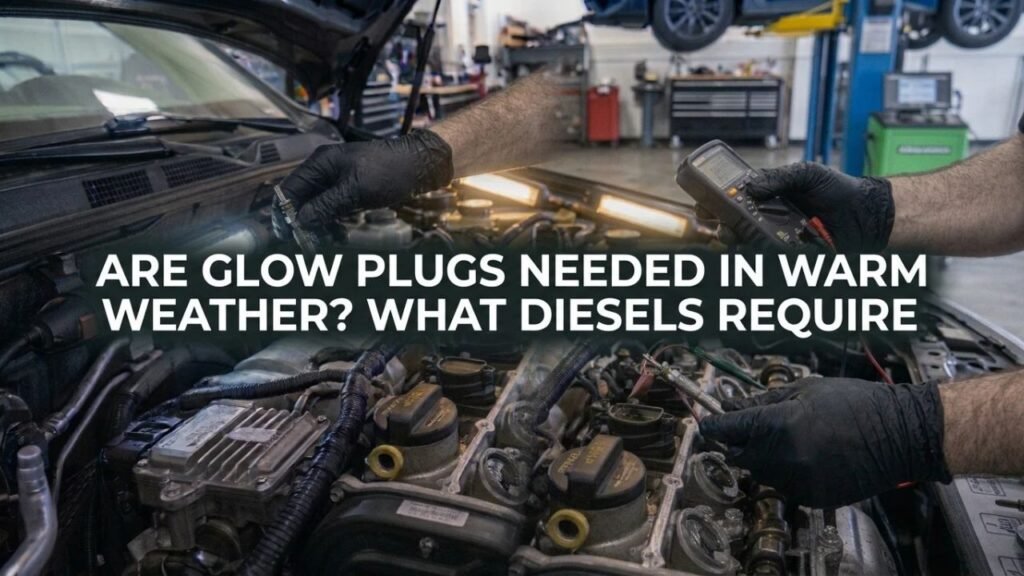
For starting alone, some diesel engines need very little glow-plug assistance when ambient and engine temperatures are high enough.
Diesel engines ignite fuel through compression rather than an electrical spark.
As the piston compresses the intake air, its temperature rises dramatically. When fuel is injected into this hot compressed air, it can ignite spontaneously.
During cold weather, several things work against that process.
The cylinder head, piston, valves, and combustion chamber surfaces are cold and absorb heat from the compressed air. The intake air itself also starts at a lower temperature.
Glow plugs provide additional heat so combustion can begin reliably.
When the weather is warm, much less heat is lost to cold engine components. The compressed air may therefore become hot enough for ignition without a long preheat cycle.
However, whether glow plugs actually operate depends on the engine.
| Situation | Glow Plug Importance |
| Warm engine on a hot day | Little or no pre-glow may be required |
| Cold engine on a warm day | Short pre-glow may still occur |
| Cold engine in freezing weather | Glow plugs become much more important |
| Modern diesel during warm-up | Post-glow may operate regardless of mild weather |
| DPF regeneration on some modern diesels | Glow plugs may be activated while driving |
| Older indirect-injection diesel | Often more dependent on glow plugs |
So the correct answer is not simply yes or no.
A diesel might start without them in warm weather while still using them for other purposes.
Why Can a Diesel Start Without Glow Plugs When It’s Warm?
The engine already creates most of the heat required for ignition through compression.
The glow plugs are supplemental heating devices.
When everything is warm enough, the supplemental heat may not be necessary to achieve the minimum conditions for ignition.
Compression Creates Heat
Imagine rapidly compressing air inside a sealed cylinder.
Pressure rises, and so does temperature.
Diesel engines use high compression ratios partly because this allows the air to become hot enough to ignite injected diesel fuel without spark plugs.
When the outside temperature is high, the incoming air starts warmer.
The metal surrounding the combustion chamber also starts warmer.
Less heat is therefore removed from the compressed air.
A Warm Engine Needs Even Less Help
Ambient temperature and engine temperature are not the same thing.
A diesel that has been parked overnight at 80°F has a warm ambient environment, but the engine is still relatively cold compared with normal operating temperature.
A diesel that was running ten minutes ago may have a cylinder head near operating temperature.
The second engine needs far less starting assistance.
This is why the glow indicator may illuminate briefly after an overnight summer start but not appear noticeably when restarting a fully warmed engine.
Key Takeaways:
- Warm weather reduces how much glow-plug heating is needed for starting.
- A fully warmed engine usually requires even less preheating than a cold engine on a warm day.
- The engine control system decides how much glow time is necessary on modern diesels.
Warm Weather Does Not Mean the Glow Plugs Are Turned Off Permanently
This is one of the biggest misconceptions about diesel glow systems.
People often think glow plugs operate only for several seconds before a winter start.
That description fits some older systems reasonably well.
It does not fully describe many modern diesel engines.
Modern glow plugs can perform several different functions:
Pre-glow: Heating before the starter turns.
Start glow: Heating during engine cranking.
Post-glow: Continuing to operate after the engine starts.
Intermediate glow: Activating under certain operating conditions while the engine is running.
Regeneration glow: Helping increase combustion and exhaust temperature for emissions-system functions such as DPF regeneration.
The driver may never notice most of these operations.
The engine computer controls them automatically.
Why Modern Diesels Use Glow Plugs After Starting
Starting the engine is only the first challenge.
A newly started diesel is still cold.
Cold combustion is generally less stable and can produce more unburned hydrocarbons, carbon monoxide, smoke, and combustion noise.
Keeping the glow plugs hot temporarily helps stabilize the process.
Post-Glow Helps the Engine Run Smoothly
After startup, the engine may continue supplying controlled electrical power to the glow plugs.
This is known as post-glow or after-glow.
Depending on the system and conditions, it can continue for considerably longer than the short preheat period you see on the dashboard.
The added heat helps diesel fuel burn more completely while the engine warms.
This can reduce the uneven, knocking combustion sound sometimes associated with cold diesels.
It Can Reduce White or Blue-Gray Startup Smoke
White diesel smoke during a cold start often means fuel has not burned completely.
Additional combustion-chamber heat can improve ignition and reduce this unburned-fuel smoke.
That is one reason a modern diesel can benefit from functioning glow plugs even when it would technically start without them.
Glow Plugs Can Help With Emissions
Modern diesel emissions systems require precise temperature management.
Manufacturers may use glow plug operation to help achieve cleaner combustion during warm-up.
Therefore, a glow plug fault on a newer diesel can matter even when the owner notices absolutely no starting problem.
Can Glow Plugs Help With DPF Regeneration?
On some modern diesel systems, yes.
A diesel particulate filter traps soot from the exhaust.
Periodically, the exhaust temperature must become high enough to oxidize or burn much of that accumulated soot.
This is known as DPF regeneration.
Engine-control systems have several techniques for increasing exhaust temperature during regeneration.
Depending on the vehicle, glow plug operation can be one part of that strategy.
By increasing combustion temperature, the system can help raise exhaust temperature.
This means the glow plugs may be used while the engine is already running and fully capable of starting without them.
Why This Matters in Summer
DPF soot does not stop accumulating because the weather is warm.
If the vehicle’s control strategy uses glow plugs during regeneration, those plugs remain useful throughout the year.
This is one reason modern glow plugs should not be treated simply as “winter starting parts.”
Glow Plugs Can Also Support EGR Operation
Some modern diesel systems use intermediate glow strategies to help maintain suitable combustion and exhaust temperatures under particular operating conditions.
This can reduce conditions that promote heavy carbon accumulation in the exhaust gas recirculation system.
Again, this occurs independently of whether the driver needed a long glow cycle before starting.
The broader lesson is that modern glow plugs are combustion-management components, not merely starting heaters.
Key Takeaways:
- Modern glow plugs can continue working after the engine starts.
- They can help reduce cold-running smoke, noise, and emissions.
- Some diesel systems also use glow-plug operation to support EGR and DPF functions throughout the year.
Can You Drive in Summer With Bad Glow Plugs?
Possibly, but I would not treat warm weather as a reason to ignore a confirmed glow plug fault.
If only one plug has failed, a healthy diesel may start almost normally on a warm morning.
Once the engine reaches normal operating temperature, you may notice no obvious performance difference.
That does not mean the failed plug is harmless.
Warm-weather starting can mask glow plug problems.
Suppose a four-cylinder diesel has one failed plug.
During summer, the remaining three plugs plus warm ambient conditions may provide enough heat for the engine to start.
When freezing weather arrives, the same engine may crank for much longer, smoke, run roughly after startup, or fail to start.
This is why summer can give diesel owners false confidence about the condition of the glow system.
Modern Emissions Functions May Be Affected
On a newer diesel, the concern is not limited to starting.
A failed plug may interfere with the way the engine manages warm-up emissions or other temperature-related functions.
The engine computer may detect the problem and store a trouble code even when the vehicle appears to drive normally.
If a glow plug code is present, diagnose it rather than planning to wait until cold weather.
Can a Diesel Start With All Glow Plugs Bad in Warm Weather?
Some can, but the answer depends heavily on engine design and condition.
A healthy direct-injection diesel with strong compression, a good battery, adequate cranking speed, and warm ambient temperatures may start even if the glow system is not contributing much heat.
That does not mean every diesel will.
An older indirect-injection engine can be much more dependent on preheating.
An engine with marginal compression may also rely more heavily on glow plugs than a new engine of the same design.
Engine Condition Makes a Big Difference
Consider two identical diesel engines.
One has excellent compression and a strong battery.
The other has worn piston rings, a weak starter, and slow cranking speed.
On a warm day, the healthy engine may start with little glow assistance.
The worn engine may struggle badly.
Glow plug dependence therefore changes as engines age.
Direct Injection vs. Indirect Injection Glow Plug Needs
Combustion-chamber design greatly affects glow plug dependence.
Direct-Injection Diesel Engines
In a direct-injection diesel, fuel is injected directly into the main combustion chamber.
Many DI engines can generate suitable ignition conditions relatively easily when ambient temperatures are mild or warm.
Some can start at moderately low temperatures with little glow-plug help when everything else is healthy.
Modern common-rail direct injection has made diesel cold-start performance even better through highly precise fuel control and rapid glow technology.
Indirect-Injection Diesel Engines
Older indirect-injection diesels inject fuel into a prechamber or swirl chamber.
These designs generally lose more heat because of their larger combustion-chamber surface area.
As a result, glow plugs can be far more important.
An older IDI engine may require preheating in conditions where a newer DI engine starts immediately.
This explains why general statements such as “diesels don’t need glow plugs above 40°F” are unreliable.
Engine design matters enormously.
Why Does the Glow Plug Light Still Come On in Summer?
Because the engine may still be cold even though the weather is warm.
The control module can consider coolant temperature and other inputs when deciding whether to preheat.
An overnight engine at 75°F is much warmer than an engine at 10°F, but it is still far below its normal operating temperature.
The computer may command a very short preheat period.
You might see the glow indicator for:
A few seconds, one second, or so briefly that you almost miss it.
This can be completely normal.
What If the Light Doesn’t Come On?
That can also be normal under sufficiently warm conditions or during a hot restart.
Some vehicles barely display a preheat indication when glow time is extremely short.
However, if the vehicle normally shows the light during cold starts and suddenly stops doing so while also becoming difficult to start, investigate the system.
Possible faults include the glow plug controller, relay, fuse, temperature sensor, wiring, or the indicator circuit itself.
Do You Still Need to Wait for the Glow Plug Light in Summer?
Yes, if the vehicle displays a Wait to Start or glow plug indicator.
Turn the ignition on and allow the indicator to go out before cranking.
The wait will often be very short in warm weather.
There is no benefit to intentionally ignoring the dashboard instruction simply because it is July rather than January.
Don’t Add an Arbitrary Extra Wait
Once the glow indicator goes out, start normally.
You do not need to count an additional 10 or 20 seconds “just in case.”
Modern glow systems regulate themselves.
Some push-button-start diesel vehicles automate the entire process and delay cranking as needed.
Should You Cycle the Glow Plugs in Warm Weather?
Normally, no.
Cycling means turning the ignition on, letting the glow cycle complete, switching it off, and repeating the process before cranking.
A properly functioning modern diesel should not require this in warm weather.
If it regularly starts only after two or three glow cycles on a warm day, something may be wrong.
Potential causes include:
Weak glow plugs, a failing glow module, low battery voltage, slow starter operation, injector problems, or low engine compression.
Repeated cycling may temporarily mask the problem, but it does not diagnose or repair it.
Do Bad Glow Plugs Affect a Warm Engine?
A fully warmed diesel may start and run with very little obvious dependence on traditional pre-glow.
However, modern engine management may still command glow operation for emissions or temperature-control reasons.
There is another important distinction:
A warm engine can hide a glow plug fault even more effectively than warm weather.
If you test-drive a used diesel after the seller has already warmed it up, it may start instantly despite having glow plug or compression problems.
Cold-start behavior is much more informative when evaluating a diesel’s starting system.
What Are the Signs of Bad Glow Plugs in Warm Weather?
The symptoms can be subtle.
You may notice almost nothing.
Possible signs include a slightly longer crank after the vehicle sits overnight, rough running for the first few seconds, small amounts of white smoke at startup, or a warning light.
A modern vehicle may store a diagnostic trouble code before you notice any physical symptom.
As temperatures fall, the symptoms generally become easier to recognize.
One Failed Plug
One failed plug may cause almost no warm-weather starting problem.
The affected cylinder may take a moment longer to establish stable combustion.
Several Failed Plugs
Multiple failed plugs make symptoms more likely.
Even in mild weather, you may experience longer cranking, rough startup, smoke, and noticeable shaking.
All Plugs or the Controller Fail
A complete glow-system failure can still allow certain healthy DI engines to start in warm temperatures, but others may struggle considerably.
The absence of a starting problem is therefore not a reliable glow plug test.
Key Takeaways:
- One failed glow plug can remain almost invisible during summer.
- Multiple failures usually become more noticeable as temperatures fall.
- The fact that a diesel starts normally when warm does not prove its glow plugs are good.
Should You Replace Bad Glow Plugs Before Winter?
Yes, if testing confirms they are defective.
Waiting until the first freezing morning creates unnecessary risk.
A plug can be tested using an appropriate resistance test, current test, or manufacturer-specified diagnostic procedure.
Modern glow plug modules can also store cylinder-specific fault codes.
If one plug has failed and all the plugs are old, replacing the entire set may make sense depending on accessibility and manufacturer recommendations.
However, do not automatically replace every glow plug because of one fault code.
The actual problem could involve wiring or the control module.
Diagnosis first is preferable.
Does Warm Climate Mean Glow Plugs Last Longer?
Not necessarily.
Cold-start cycles place obvious demands on glow plugs, so a consistently warm climate may reduce some preheating duty.
But modern plugs can still operate for post-glow and emissions functions.
Their life also depends on:
Electrical control, injector condition, combustion temperature, engine design, number of start cycles, and the quality of the glow plug itself.
A faulty injector, for example, can expose the glow plug to excessive heat and damage.
A defective controller can also apply inappropriate voltage.
Climate is therefore only one factor in glow plug life.
Do Glow Plugs Stay On While Driving in Warm Weather?
On some modern engines, they can be energized under selected conditions.
They are not necessarily continuously glowing throughout every trip.
Instead, the ECU can activate them when needed.
Possible reasons include helping stabilize combustion during warm-up, managing emissions, supporting low-load operation, or assisting DPF regeneration.
This behavior is automatic.
The driver does not need a manual control or dashboard indication each time the ECU activates a plug.
Older diesels generally have much simpler glow systems and may shut the plugs off once the starting or short after-glow period ends.
Can You Remove Glow Plugs If You Live Somewhere Warm?
No.
Even if your diesel starts easily all year where you live, removing the glow plugs is not an appropriate modification.
Glow plugs seal openings in the cylinder head and are engineered as part of the combustion system.
A modern engine computer may also monitor their electrical operation.
Deleting or disabling them can create starting, emissions, diagnostic, or engine-management problems.
If the vehicle was designed to have functioning glow plugs, keep the correct plugs installed.
Do All Diesel Engines Have Glow Plugs?
No.
Some diesel engines use different cold-start aids.
Certain large diesel engines can start without individual cylinder glow plugs because of their combustion design, compression, and operating requirements.
Some systems use an intake-grid heater or intake-air heater instead.
Others may combine multiple starting aids.
That is why you should verify the system your particular diesel uses rather than assuming every diesel has one glow plug in each cylinder.
Glow Plugs vs. Intake Grid Heaters in Warm Weather
An intake grid heater heats incoming air before it reaches the cylinders.
Glow plugs heat locally within or near the combustion chamber.
Both are intended to improve combustion when the engine is cold, but they operate differently.
Like glow plugs, an intake heater may be used for a shorter time—or not at all—when conditions are warm.
The vehicle’s control module normally makes that decision automatically.
A truck with a grid heater rather than individual glow plugs should therefore be diagnosed according to its actual starting-aid system.
Common Misconceptions About Glow Plugs in Summer
A common belief is that glow plugs do absolutely nothing above a specific outside temperature.
There is no universal temperature that applies to every diesel.
Another misconception is that a diesel starting successfully proves the plugs are working.
Warm conditions can hide failed plugs.
It’s also incorrect to assume the plugs shut off the instant the dashboard light disappears.
Modern systems frequently continue with post-glow after startup.
Finally, don’t assume glow plugs matter only to starting. In modern emissions-controlled diesels, they can contribute to combustion quality, emissions reduction, EGR management, and DPF regeneration.
FAQs About Are Glow Plugs Needed in Warm Weather
Are glow plugs needed in warm weather?
They may not be essential for starting some healthy diesel engines in warm temperatures, but modern diesels can still use them for post-glow, emissions control, combustion stability, and DPF-related functions.
Will a diesel start without glow plugs in summer?
Many direct-injection diesels can, particularly when the engine is healthy and temperatures are high. Older indirect-injection engines may depend on glow plugs much more heavily.
At what temperature are glow plugs not needed?
There is no universal temperature. Engine design, compression, coolant temperature, glow system, and ambient temperature all influence whether preheating is needed.
Why does my glow plug light come on when it’s hot outside?
The engine itself may still be relatively cold after sitting. The controller may command a brief preheat even on a warm day.
Is it normal for the glow plug light to disappear quickly in summer?
Yes. Modern fast-glow systems can require only a very short preheat period when temperatures are mild.
Do glow plugs work after the engine starts?
Many modern systems use post-glow for seconds or minutes after startup to improve combustion and reduce emissions.
Do glow plugs work while driving?
Some modern glow systems can activate plugs intermittently during certain operating conditions, including emissions-related strategies.
Can glow plugs help DPF regeneration?
Yes, on some diesel systems the ECU can use glow plug operation as part of its strategy for increasing temperature during DPF regeneration.
Can one bad glow plug go unnoticed in summer?
Absolutely. Warm temperatures may allow the engine to start almost normally with one defective plug.
What happens when winter arrives?
A glow plug fault that was barely noticeable in summer can cause longer cranking, rough startup, white smoke, or a no-start when temperatures drop.
Can all glow plugs be bad and the engine still start?
Some healthy direct-injection engines can start without glow assistance in sufficiently warm conditions, but this varies greatly by engine.
Should I fix a glow plug fault during summer?
Yes. A confirmed failure should be diagnosed and repaired rather than waiting for cold weather.
Do glow plugs affect fuel economy in warm weather?
Their direct effect on fuel economy is usually small, but functioning glow systems can contribute to efficient combustion and emissions strategies in modern diesels.
Should I wait for the glow plug light in summer?
Yes. If the indicator appears, wait until it goes out before starting. The wait will generally be short in warm conditions.
Should I cycle the glow plugs twice in summer?
No, not under normal conditions. If the engine needs repeated glow cycles on a warm day, diagnose the starting system.
Do glow plugs turn off when the dashboard light goes out?
Not necessarily. They may continue operating during cranking and after startup.
Are glow plugs only cold-start devices?
Not on many modern engines. They can also support warm-up combustion, emissions control, EGR operation, and particulate-filter regeneration.
Does a warm engine need glow plugs?
It may need little or no pre-glow for restarting, although the ECU can still operate the glow system for other functions.
Are direct-injection diesels less dependent on glow plugs?
Generally, direct-injection diesels can be less dependent on glow assistance for starting in mild conditions than older indirect-injection designs.
Should I remove the glow plugs if I live in a hot climate?
No. Keep the engine’s factory glow system functional even if cold-start assistance is rarely needed where you live.
Conclusion
So, are glow plugs needed in warm weather? For simply getting the engine started, some healthy diesel engines can operate with little or no glow-plug assistance when the ambient temperature and engine are warm enough. That is especially true of many direct-injection diesel engines.
But that does not mean glow plugs become unnecessary during summer.
A modern diesel may use its glow plugs before startup, during cranking, for several minutes after startup, or intermittently while driving. Post-glow can improve combustion while the engine warms, reduce smoke and emissions, and provide smoother cold-engine operation. Some vehicles can also use glow-plug heat as part of EGR or DPF management strategies.
Warm weather can actually make a bad glow plug harder to notice. An engine with one failed plug may start perfectly well throughout summer because compression produces enough heat without much assistance. When winter arrives, the same vehicle may suddenly crank longer, smoke heavily, idle roughly, or fail to start.
Older indirect-injection diesels are generally more dependent on glow plugs than many direct-injection engines, so there is no universal outside temperature above which every diesel can ignore its glow system.
If your vehicle displays a glow plug or Wait to Start light in warm weather, simply follow it. Wait for the indicator to go out and then start normally. You do not need to add an arbitrary extra delay or cycle the plugs several times.
Most importantly, do not ignore a confirmed glow plug fault just because the engine starts normally in July. Modern glow plugs are year-round engine-management components, and fixing a problem while the weather is warm can prevent a much more obvious starting problem when temperatures eventually fall.