
Yes, most NGK spark plugs are pre-gapped at the factory, but that does not mean you should automatically install every NGK plug without checking it. NGK sets each spark plug to a predetermined factory gap, yet the same plug part number may fit multiple engines that call for different gap specifications. NGK therefore recommends verifying the gap against the vehicle manufacturer’s specification before installation.
This distinction is especially important with NGK Iridium, Laser Iridium, Platinum, Ruthenium, and other fine-wire spark plugs. Their factory gaps are normally close to the intended specification, but careless adjustment can damage the small precious-metal center electrode. If adjustment is necessary, NGK recommends moving only the ground electrode and avoiding pressure against the center electrode or ceramic insulator.
NGK also recommends using a round-wire or pin-style gap gauge rather than forcing a wedge-style tool between delicate electrodes. For fine-wire plugs, the goal should be to verify the gap first and adjust only when genuinely necessary.
In this guide, I’ll explain whether NGK spark plugs are pre gapped, why a factory gap may differ from your engine specification, how to check NGK Iridium and Platinum plugs safely, what the numbers such as “-11” can mean on some NGK part numbers, and what can happen if you install a plug with the wrong gap.
Are NGK Spark Plugs Pre Gapped From the Factory?
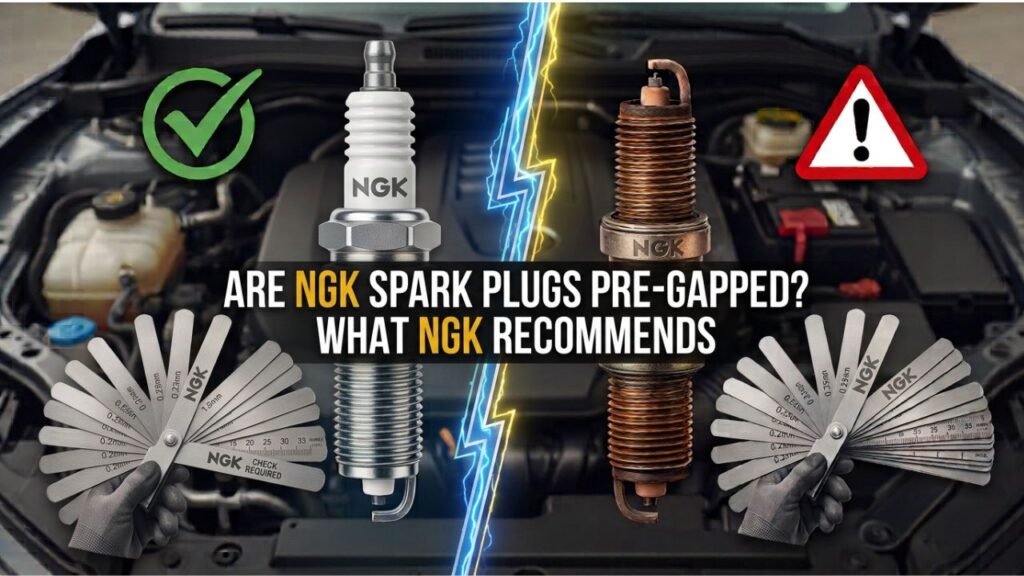
Yes. NGK spark plugs leave the factory with a preset spark plug gap.
NGK measures and sets the electrode spacing during manufacturing rather than shipping automotive plugs with an arbitrary gap.
However, NGK makes an important distinction between being factory-gapped and being guaranteed to have the exact required gap for every engine that accepts that plug.
A single NGK spark plug part number may have physical characteristics that allow it to be used in numerous vehicles and engines.
Those engines may not all specify precisely the same electrode gap.
For that reason, NGK’s own technical guidance recommends checking the spark plug gap before installation and comparing it with the engine manufacturer’s specification.
The practical answer is therefore:
Yes, NGK spark plugs are pre-gapped, but you should still verify the gap.
That is different from automatically regapping every new plug.
If the plug arrives at the correct specification, leave it alone.
Pre-Gapped Does Not Mean “Never Check”
A new spark plug can also be affected during shipping, handling, or storage.
The ground electrode projects beyond the center electrode and can potentially be bumped.
Even a slight impact may alter the gap.
You do not need to assume every new spark plug is damaged, but a quick check before installation is inexpensive insurance.
This is particularly worthwhile when replacing multiple plugs because finding one incorrectly gapped plug after everything has been reassembled can mean repeating significant labor.
Why Would a Pre-Gapped NGK Plug Need Adjustment?
The main reason is that factory preset gap and vehicle-required gap are not always identical.
Suppose an NGK plug leaves the factory at 0.044 inch but is approved for another application requiring 0.040 inch.
The basic plug design may still be correct for both engines, but one application may need a slight adjustment.
NGK therefore tells installers to use the specification for the actual vehicle or engine as the final authority.
This also prevents another common mistake: assuming the gap found in an online listing for a spark plug automatically overrides the vehicle manufacturer’s specification.
The Same Plug Can Fit Multiple Applications
Spark plug compatibility involves much more than electrode gap.
The plug also needs the correct:
Thread diameter, thread reach, seat type, heat range, resistor characteristics, electrode projection, and overall design.
A manufacturer may use one plug design across several applications while specifying slightly different gaps.
That is why checking your vehicle’s specification remains important even when the parts catalog confirms that you purchased the correct NGK part number.
Key Takeaways:
- Most NGK spark plugs are factory pre-gapped.
- A factory-set gap may still need verification for your exact vehicle.
- If the gap already matches the required specification, do not change it unnecessarily.
Are NGK Iridium Spark Plugs Pre Gapped?
Yes. NGK Iridium spark plugs are supplied with a factory-set gap.
This includes popular lines such as NGK Iridium IX and many Laser Iridium applications.
The important difference is that fine-wire iridium electrodes require much more careful handling than conventional nickel spark plugs.
Iridium allows NGK to use an extremely small center electrode because the material has excellent temperature and wear resistance.
That fine tip improves ignitability, but it can also be damaged by an incorrect gap-adjustment technique.
Should You Gap NGK Iridium Spark Plugs?
Check them—yes.
Automatically change them—no.
If the factory gap is already correct for your application, install the plug without altering the electrode.
If your specific application requires an adjustment and NGK allows the change, move only the ground electrode.
Never use the thin iridium center electrode as the leverage point for the tool.
NGK recommends limiting adjustment to approximately 0.008 inch in either direction from the factory preset gap.
If the required gap is dramatically different from the factory setting, double-check whether you actually have the correct spark plug part number rather than trying to bend the ground electrode a large distance.
Why Large Gap Changes Are a Problem
The center and ground electrodes are designed to maintain a particular relationship.
Bending the ground strap excessively can alter that geometry.
It may also create a poorly aligned gap where the two electrode surfaces are no longer reasonably parallel.
If your engine calls for a gap far outside the plug’s factory setting, selecting the correct plug is usually better than making an extreme adjustment.
Are NGK Laser Iridium Spark Plugs Pre Gapped?
Yes.
NGK Laser Iridium plugs are OE-oriented spark plugs designed to meet particular original-equipment requirements.
They are factory-gapped, and many applications can be installed without changing that setting after it has been verified.
These plugs commonly use precious metal on both the center electrode and the ground electrode to provide long service life.
Because the electrodes are specialized and relatively small, avoid unnecessary bending or scraping.
If you bought the exact Laser Iridium plug specified for your stock engine and its measured gap agrees with the required specification, I would leave the factory setting untouched.
Are NGK Iridium IX Spark Plugs Pre Gapped?
Yes. Iridium IX plugs also arrive with a predetermined factory gap.
Iridium IX is different from Laser Iridium in its intended positioning.
Laser Iridium plugs are generally designed to closely match original-equipment requirements and longevity, while Iridium IX is a performance-oriented aftermarket line used in many automotive and powersports applications.
The same gap principle applies to both:
Verify the factory gap against your specific engine specification before installing the plug.
Do not assume that the fact that a plug is labeled “Iridium IX” means every application using it requires the same electrode spacing.
Are NGK Ruthenium Spark Plugs Pre Gapped?
NGK Ruthenium HX spark plugs are also manufactured with controlled electrode dimensions and factory gap settings.
As with other NGK plugs, the correct approach is to verify that setting for your vehicle rather than immediately bending the electrode.
Ruthenium plugs use advanced fine-electrode designs, so the same care you would use with iridium plugs is appropriate.
Avoid forcing a wedge against a delicate center electrode.
Use the correct measuring tool, and only adjust the ground electrode if an adjustment is actually required.
Are NGK Platinum Spark Plugs Pre Gapped?
Yes. NGK Platinum spark plugs are also factory-gapped.
Depending on the product, the spark plug may use platinum on the center electrode, ground electrode, or both.
Because precious-metal electrodes can be smaller and more delicate than conventional nickel designs, avoid rough gap adjustment.
The fact that a Platinum plug is supplied pre-gapped does not eliminate the need to confirm your vehicle’s required gap.
Again, check first and adjust only if necessary.
How to Check the Gap on a New NGK Spark Plug
Checking the gap is a simple process, but the tool you choose matters.
NGK recommends a round-wire-style or pin gauge for checking spark plug gaps.
A wire gauge uses individual wires of known diameter.
The correct wire should pass through the gap with a light, controlled drag.
1. Find the Correct Gap Specification
Before touching the spark plug, determine what your engine actually requires.
Good references include the vehicle owner’s manual, factory service information, under-hood emission label where applicable, or the current spark plug application information for the exact year and engine.
Do not guess based on engine displacement alone.
For example, two engines with the same displacement but different generations, ignition systems, or plug designs may use different gaps.
2. Inspect the Spark Plug
Before inserting a gauge, look at the plug.
Make sure the ground strap has not been visibly bent during shipping.
Check the ceramic insulator for cracks.
Inspect the threads and firing end for damage.
If a new precious-metal spark plug appears physically damaged, replacement is usually preferable to attempting to straighten severely distorted components.
3. Insert the Correct Wire Gauge
Choose the wire corresponding to your required gap.
Slide it carefully between the center electrode and ground electrode.
You should feel light resistance rather than needing significant force.
Do not repeatedly scrape the wire across a fine iridium or platinum tip.
The goal is measurement, not abrasion.
4. Determine Whether Adjustment Is Necessary
If the correct gauge passes with appropriate light drag and the gap matches specification, stop.
The plug is ready from a gap standpoint.
Do not make an adjustment simply because you own a gapping tool.
If the gap is slightly incorrect and the plug can safely be adjusted, move the ground electrode carefully.
Key Takeaways:
- Check NGK plugs with a round-wire or pin-style gap gauge.
- Verify the engine specification before measuring.
- If the factory gap is already correct, leave the electrodes alone.
How to Gap an NGK Spark Plug Correctly
If an adjustment is required, the ground electrode is the part you move.
The ground electrode is the curved metal strap extending over the center electrode.
A proper spark plug gapping tool allows you to bend this strap slightly without putting pressure on the center electrode.
To Make the Gap Smaller
Gently move the ground strap closer to the center electrode using an appropriate tool.
Do not strike the electrode against a workbench or hard surface.
That may damage the plug and makes precise adjustment difficult.
To Make the Gap Larger
Use the gapping tool to pull the ground electrode slightly outward.
The tool should act on the ground strap itself.
Do not insert a tool against the center electrode and pry upward.
After every small adjustment, measure again.
It is much easier to make two or three tiny adjustments than to overshoot the specification and repeatedly bend the electrode back and forth.
Do Not Exceed NGK’s Recommended Adjustment Range
NGK recommends avoiding adjustments greater than approximately plus or minus 0.008 inch from the factory preset gap.
If you need a much larger change, verify the spark plug application.
For example, if the plug arrives at 0.028 inch and your engine supposedly requires 0.044 inch, that large difference should make you stop and confirm the part number before bending anything.
What Do -8, -9, -10, and -11 Mean on NGK Spark Plugs?
On many conventional NGK spark plug part-number systems, a number after a dash indicates the factory spark gap in tenths of a millimeter.
For example:
| Common NGK Suffix | Nominal Gap |
| -8 | 0.8 mm / about 0.031 in. |
| -9 | 0.9 mm / about 0.035–0.036 in. |
| -10 | 1.0 mm / about 0.039–0.040 in. |
| -11 | 1.1 mm / about 0.043–0.044 in. |
| -13 | 1.3 mm / about 0.051 in. |
| -14 | 1.4 mm / about 0.055 in. |
| -15 | 1.5 mm / about 0.059 in. |
For example, BPR6ES-11 commonly indicates a BPR6ES plug manufactured with approximately a 1.1 mm gap.
This is useful when comparing NGK plugs, but do not treat the suffix system as a universal decoding rule for every NGK product series.
Specialty and racing plug numbering can use characters or numbers differently.
Your vehicle application and the official part specification are still more reliable than trying to decode every plug name yourself.
Is an NGK -11 Plug Already Gapped to 0.044 Inch?
Approximately, yes, for NGK plug families where “-11” represents the spark gap.
The -11 designation corresponds to 1.1 mm, which converts to approximately 0.0433 inch and is commonly treated as roughly 0.044 inch in automotive specifications.
That does not necessarily mean -11 is correct for your engine.
If your engine requires 0.040 inch, a plug with a 1.1 mm factory gap may require a small adjustment if that exact plug is approved for the application.
Conversely, if your engine requires 0.044 inch, an appropriately specified -11 plug may already be ready after verification.
Should You Trust the Gap Printed on the NGK Box?
You can use the manufacturer’s specification as valuable information, but you should still confirm that it matches your vehicle application.
The box tells you how the plug was manufactured.
Your vehicle specification tells you what your engine requires.
Those two numbers will often match perfectly when you have the exact application-specific plug.
When they do not, investigate before making a large change.
You may be looking at an alternative application, an incorrect plug, or an engine specification that has changed through a manufacturer service update.
Can Shipping Change a Pre-Gapped Spark Plug?
Yes, although quality packaging makes significant damage uncommon.
The ground strap is exposed at the firing end.
If the box is crushed or the plug suffers a hard impact, the ground electrode can be bent inward.
A plug that should have a 0.044-inch gap could therefore arrive noticeably tighter.
This is one reason NGK’s recommendation to check the gap remains sensible even when the plug is advertised or supplied as pre-gapped.
It takes only a short time and may prevent a frustrating misfire after installation.
What Happens If an NGK Spark Plug Gap Is Too Wide?
A wider electrode gap requires a higher voltage for the spark to jump across it.
If the gap becomes larger than the ignition system can reliably fire, misfires can occur.
The problem often becomes more noticeable under acceleration or heavy load because increased cylinder pressure makes it harder for the spark to cross the gap.
Possible symptoms include rough running, hesitation, loss of power, misfire codes, difficult starting, and reduced fuel economy.
A worn spark plug naturally develops a wider gap over time as electrode material erodes.
That is one reason an old plug can begin misfiring even though the engine ran normally when the plug was new.
What Happens If the Gap Is Too Small?
An overly narrow gap is easier for the ignition system to fire, but the spark is also concentrated across a smaller space.
That is not automatically better.
An engine is designed around a particular combination of ignition energy, combustion-chamber conditions, and spark plug gap.
Installing plugs with an unnecessarily small gap can negatively affect ignition performance and combustion efficiency.
For an unmodified street vehicle, use the manufacturer’s specification instead of trying to improve performance by making the gap wider or narrower.
Do Modified Engines Need a Different NGK Spark Plug Gap?
Sometimes.
Turbocharging, supercharging, nitrous oxide, increased compression, and substantial power increases can change the amount of voltage needed to fire a plug under load.
Higher cylinder pressure generally makes the spark more difficult to initiate.
Performance tuners may therefore reduce the spark plug gap on boosted engines to improve ignition reliability.
However, you should not apply an arbitrary smaller gap simply because the engine has a turbocharger.
Boost level, ignition coil output, fuel, compression, plug design, engine calibration, and power level all influence the final setting.
Use the gap recommended by the engine builder, tuner, or spark plug specialist for a modified application.
A mildly modified engine with only an intake or exhaust change often does not require an altered plug gap.
Key Takeaways:
- A gap that is too wide can demand more voltage and contribute to misfires under load.
- A gap that is too narrow is not automatically an improvement.
- Modified or boosted engines may need different gaps, but those settings should be based on the actual combination and tune.
Can You Use a Coin-Style Gap Tool on NGK Iridium Plugs?
I would avoid using the common tapered coin-style gauge as the primary measuring tool on fine-wire NGK plugs.
As the tapered edge is pushed through the gap, it can place unnecessary pressure on delicate electrodes.
NGK specifically recommends a round-wire-style or pin gauge.
These tools measure the actual space using a wire of known diameter and do not require dragging an increasingly thick wedge between the electrodes.
A coin tool may be acceptable for certain conventional plugs when used appropriately, but fine-wire iridium and platinum plugs deserve greater care.
What If the New NGK Plug Is Way Out of Gap?
First, do not immediately bend it.
Check the part number.
Then verify your vehicle’s required gap.
If those are correct but the plug is dramatically different from its listed factory specification, it may have been damaged.
A severely bent ground electrode on a brand-new plug is a good reason to exchange the plug rather than trying to reshape it extensively.
The same applies if you find a cracked insulator or damaged fine-wire tip.
Spark plugs are relatively inexpensive compared with the labor involved in diagnosing an unexplained misfire later.
Do NGK Spark Plugs Need Anti-Seize After Gapping?
NGK generally recommends installing its automotive spark plugs without anti-seize on the threads.
NGK uses a special metal plating on the shell threads that provides corrosion resistance and helps with removal.
Adding anti-seize changes thread friction.
That can alter how much clamping force is created at a given torque and increase the chance of overtightening.
This topic is separate from gap adjustment, but it is important during installation because a perfectly gapped plug can still cause problems if it is incorrectly tightened.
Follow the vehicle or plug manufacturer’s current torque instructions.
How Tight Should NGK Spark Plugs Be?
Use the specification for your engine whenever one is available.
Spark plug torque depends on factors such as thread diameter, seat style, cylinder-head material, and whether the plug is new or previously seated.
Correct torque helps the plug transfer heat into the cylinder head.
A loose plug can run too hot and may leak combustion pressure.
An overtightened plug can damage cylinder-head threads, distort the spark plug shell, or damage internal seals.
Start the spark plug by hand to reduce the chance of cross-threading, then use the appropriate torque procedure.
Should You Check All NGK Spark Plugs in a New Set?
Yes.
Even if the first plug measures perfectly, I recommend verifying each one before installation.
This is particularly important on engines where accessing the plugs requires removing an intake manifold, cowl components, or other difficult parts.
You do not want to discover after reassembly that one plug was damaged in shipping.
Checking eight plugs takes far less time than diagnosing one avoidable cylinder misfire.
At the same time, do not turn the inspection into unnecessary adjustment.
If all eight plugs measure correctly, install them as they arrived.
Common Mistakes With Pre-Gapped NGK Spark Plugs
The most common mistake is assuming pre-gapped means the gap can never be wrong for the application.
NGK itself recommends verification because one plug may serve multiple engines.
The opposite mistake is automatically regapping every new spark plug even when the factory setting is already correct.
Every unnecessary bend of a fine ground electrode introduces another opportunity for damage.
Another mistake is prying against an iridium center electrode with a conventional wedge tool.
Only the ground electrode should be moved.
Finally, do not compensate for an obviously incorrect plug by making a huge gap adjustment. A major mismatch should prompt you to confirm the part number and application first.
FAQs About Are NGK Spark Plugs Pre Gapped
Are NGK spark plugs pre gapped?
Yes. Most NGK spark plugs have a predetermined factory gap, but NGK recommends checking the gap against the specification for your specific engine before installation.
Do I need to gap new NGK spark plugs?
You should check the gap. You only need to adjust it if the factory setting does not match the required specification and the plug can safely be adjusted.
Are NGK Iridium IX spark plugs pre gapped?
Yes. Iridium IX plugs have a factory-set gap. Verify that gap before installation and avoid unnecessary adjustment of the fine-wire electrode.
Are NGK Laser Iridium plugs pre gapped?
Yes. Laser Iridium plugs are factory-gapped and often match the OE application specification when the correct part number is selected.
Are NGK Ruthenium plugs pre gapped?
Yes, NGK Ruthenium plugs are manufactured with a preset electrode gap. Check the specification for your exact vehicle before installation.
Are NGK Platinum plugs pre gapped?
Yes. They arrive with a factory setting, but you should still verify that setting for your application.
Does NGK recommend checking spark plug gaps?
Yes. NGK recommends checking the gap before installation even though the plugs are factory-gapped.
What gap tool does NGK recommend?
NGK recommends a round-wire-style or pin gauge for accurate measurement.
Can you adjust an NGK iridium spark plug?
If adjustment is required and appropriate for the plug, move only the ground electrode. Never pry against the fine-wire center electrode or ceramic insulator.
How much can you adjust an NGK spark plug gap?
NGK recommends keeping adjustment to approximately ±0.008 inch from the factory preset gap.
What does -11 mean on an NGK spark plug?
On many NGK conventional part-number systems, -11 indicates a 1.1 mm factory gap, approximately 0.043–0.044 inch.
What does -10 mean on an NGK plug?
On applicable NGK part-number systems, -10 indicates a 1.0 mm gap, approximately 0.039–0.040 inch.
Does -9 mean a 0.9 mm gap?
Yes, on NGK plug series where the suffix denotes gap, -9 represents approximately 0.9 mm or 0.035–0.036 inch.
Can new spark plugs lose their factory gap during shipping?
The ground electrode can potentially be bent by an impact, which is one reason checking every plug before installation is sensible.
What happens if an NGK plug is gapped too wide?
The ignition system requires more voltage to fire it, potentially causing misfires, hesitation, hard starting, and poor performance.
What happens if the gap is too small?
The spark has less exposure to the air-fuel mixture and may not provide the combustion characteristics the engine was designed to use.
Should I make the spark plug gap larger for more power?
Not on a stock engine. Follow the factory specification. Larger gaps increase voltage demand and can create misfires if the ignition system cannot support them.
Do turbo engines need smaller spark plug gaps?
They sometimes do because increased cylinder pressure makes the spark harder to initiate. The correct setting should come from the tuner or engine-specific recommendation.
Should I put anti-seize on NGK spark plugs?
NGK generally advises against adding anti-seize to its plated automotive spark plug threads because it changes friction and can affect tightening torque.
If an NGK plug is badly out of gap, should I bend it back?
If it is far from the expected factory setting, first verify the part number and inspect for shipping damage. Replacing a visibly damaged fine-wire plug is often safer than making a large adjustment.
Conclusion
So, are NGK spark plugs pre gapped? Yes—most NGK spark plugs are set to a predetermined gap at the factory. However, NGK still recommends checking the gap before installation because the factory setting is not necessarily the exact specification required by every engine that can use that spark plug.
For a stock vehicle, start by confirming that you have the correct NGK part number. Then compare the plug’s measured gap with the vehicle manufacturer’s specification.
If they match, leave the spark plug alone.
There is no benefit to regapping an already correct plug.
This is especially important with NGK Iridium, Laser Iridium, Platinum, and Ruthenium plugs because their fine precious-metal electrodes can be damaged by careless adjustment.
If adjustment is genuinely necessary, use a round-wire or pin-style gauge, move only the ground electrode, and avoid using the center electrode as a leverage point. NGK recommends keeping adjustments within roughly 0.008 inch of the original factory setting.
Also remember that suffixes such as -10 or -11 can indicate factory gap on many NGK part numbers, with -10 representing approximately 1.0 mm and -11 approximately 1.1 mm. These markings are useful, but the final authority remains the correct plug application and engine specification.
The best approach is simple: treat NGK plugs as pre-gapped but not unchecked. Verify every new plug, adjust only when necessary, and handle fine-wire electrodes carefully. That gives you the benefit of NGK’s factory setting while ensuring the spark gap is correct for your particular engine.