
Yes, bad glow plugs can cause a diesel engine to misfire, particularly during a cold start and the first few minutes of warm-up. A failed glow plug may leave one cylinder too cold to ignite its injected diesel fuel properly, resulting in incomplete combustion, rough running, white smoke, shaking, and what feels like a cylinder misfire.
However, glow-plug-related misfires usually behave differently from ignition misfires in gasoline engines. A diesel does not rely on glow plugs to create a spark every combustion cycle. Diesel fuel normally ignites from the heat produced by compression. Glow plugs simply provide additional heat when the engine is cold and, on many modern diesels, continue assisting combustion for a period after startup.
That distinction is important when diagnosing the problem.
If your diesel runs roughly for several seconds after a freezing cold start and then becomes perfectly smooth as it warms, bad glow plugs are a reasonable possibility. If the engine continues misfiring after reaching normal operating temperature, however, injectors, compression, fuel pressure, air supply, wiring, sensors, or another engine problem becomes more likely.
In this guide, I’ll explain can bad glow plugs cause misfire, why the problem is usually worse when cold, what symptoms to look for, how one bad glow plug differs from several failed plugs, and how to determine whether the glow system or another diesel fault is actually responsible.
How Can Bad Glow Plugs Cause a Misfire?
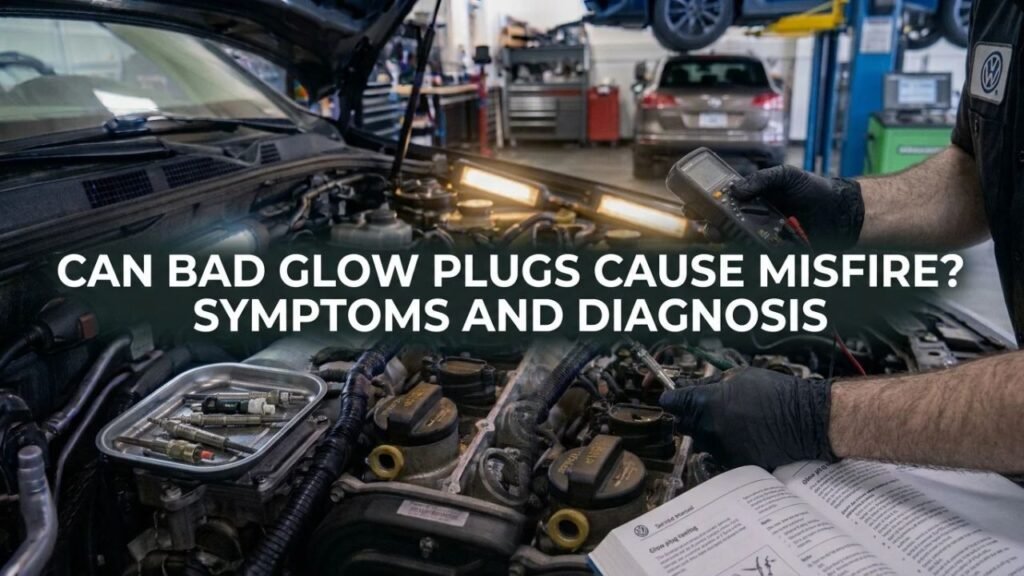
A diesel engine ignites fuel differently from a gasoline engine.
During the compression stroke, the piston compresses the air inside the cylinder very strongly. Compression raises the air temperature.
Fuel is then injected into that hot compressed air.
When conditions are correct, the diesel fuel begins burning without an electrical spark.
A cold engine creates a problem because the cylinder head, piston, valves, and cylinder walls absorb some of the heat generated by compression.
The air may not become hot enough for stable ignition immediately.
Glow plugs help by adding heat directly to the combustion area.
What Happens When One Glow Plug Does Not Heat?
Imagine a four-cylinder diesel after sitting outside overnight.
Three glow plugs heat normally.
The fourth has failed.
During cranking, the three heated cylinders may begin combusting normally while the cold cylinder struggles to ignite its injected fuel.
That cylinder may fire inconsistently or temporarily fail to contribute meaningful power.
The engine shakes because its cylinders are no longer producing balanced torque.
That behavior is commonly described as a diesel misfire.
As combustion continues, the cylinder warms naturally. The failed glow plug becomes less important, and the cylinder may begin firing normally.
This is why glow-plug misfires often disappear fairly quickly after startup.
Are Glow-Plug Misfires Different From Spark-Plug Misfires?
Yes.
Understanding this difference prevents a lot of confusion.
A gasoline engine needs a spark plug to ignite the mixture every time the cylinder reaches its combustion event.
If the spark plug or ignition coil stops working, that cylinder can continue misfiring no matter how warm the engine becomes.
A diesel glow plug is not creating a timed spark.
It is a heater.
Once compression and normal combustion create sufficient heat, a conventional diesel can continue running without depending on the glow plug for each firing event.
What This Means for Diagnosis
A rough-running gasoline engine with one completely dead spark plug can misfire continuously.
A diesel with one failed glow plug may misfire only for the first few seconds after starting.
This is one of the most useful diagnostic distinctions.
If your diesel becomes perfectly smooth once warm, investigate the glow system.
If it continues missing at operating temperature, investigate beyond the glow plugs.
Key Takeaways:
- Failed glow plugs can cause incomplete diesel combustion and misfire when the engine is cold.
- Glow plugs are heaters, not diesel versions of continuously firing spark plugs.
- A misfire that disappears as the engine warms is more consistent with a glow-system problem than a persistent warm-engine misfire.
Why Bad Glow Plugs Cause Cold-Start Misfires
Temperature is the key factor.
Diesel combustion requires sufficient heat.
Compression normally supplies that heat, but a cold engine absorbs a substantial amount of it.
A functioning glow plug helps compensate for those losses.
Cold Metal Absorbs Compression Heat
Imagine pouring hot water into a cold metal container.
The container immediately pulls heat away from the water.
A similar principle applies inside a cold engine.
The compressed air becomes hot, but surrounding engine components absorb part of that energy.
This is especially important during the first few engine revolutions when the cylinder has not yet accumulated combustion heat.
The Cold Cylinder Fails to Burn Fuel Properly
The injector may still deliver the correct quantity of diesel.
But if the combustion environment is too cold, that fuel may ignite late, burn incompletely, or fail to burn during that particular cycle.
The result is uneven engine torque and rough operation.
Once repeated combustion heats the cylinder, the problem may disappear.
Can One Bad Glow Plug Cause a Misfire?
Yes.
One bad glow plug can cause one cylinder to misfire or contribute weakly during cold startup.
How noticeable the problem is depends on several factors.
A four-cylinder diesel may show the symptoms more strongly because one affected cylinder represents 25% of the engine’s cylinders.
An eight-cylinder diesel with only one failed glow plug may still start relatively smoothly.
Ambient temperature also matters considerably.
Warm Weather Can Hide the Problem
On a hot summer morning, compression heat alone may be sufficient for all cylinders to ignite reliably.
The driver may notice no symptoms whatsoever.
When winter arrives, the same engine can suddenly shake and smoke during startup.
The glow plug may not have failed that morning.
The colder weather simply exposed a fault that had already existed.
Engine Condition Matters Too
An engine with excellent compression and a strong battery may tolerate one bad glow plug better than a worn engine with marginal compression and slow cranking speed.
Starting performance is the combined result of many systems.
Can Multiple Bad Glow Plugs Cause Severe Misfires?
Absolutely.
As more glow plugs fail, fewer cylinders receive proper preheating.
Cold-start performance becomes progressively worse.
A six-cylinder engine with one failed glow plug may still start fairly easily.
The same engine with four failed plugs could crank for a long time, smoke heavily, and struggle to remain running.
If enough glow plugs fail in cold conditions, the engine may not start at all.
More Failed Plugs Mean More Unburned Fuel
Each cold cylinder can receive injected fuel without burning it effectively.
That increases smoke and roughness.
Once combustion finally begins, the engine may run unevenly for several seconds or minutes until enough heat develops.
Repeatedly cranking an engine in this condition is also hard on the starter and battery.
Can Bad Glow Plugs Cause Rough Idle?
Yes, especially immediately after a cold start.
A cylinder that is not burning properly contributes less torque than the others.
The crankshaft therefore receives uneven power pulses.
You may feel this through the steering wheel, seat, dashboard, or body of the vehicle.
The exhaust note may also sound uneven.
Rough Idle Should Improve as the Engine Warms
This is an important clue.
A classic glow-plug-related rough idle is generally strongest when the engine is cold and becomes better as combustion temperature rises.
If the engine remains equally rough after 10 or 20 minutes of driving, a bad glow plug alone becomes a less convincing explanation.
At that point, injector performance, compression, fuel delivery, intake problems, and other faults should be checked.
Can Bad Glow Plugs Cause White Smoke?
Yes.
White or light gray exhaust smoke during a cold start is a common symptom associated with poor diesel combustion.
The injector supplies fuel, but the cylinder is too cold to burn all of it properly.
Some of the unburned or partially burned fuel then leaves through the exhaust.
White Smoke Plus Rough Running Is a Stronger Clue
A brief combination of these symptoms after a cold start can point toward the glow system:
- Longer-than-normal cranking.
- Engine shaking after startup.
- Uneven idle.
- White or gray smoke.
- Symptoms improving as the engine warms.
No single symptom proves the diagnosis.
Together, however, they make inadequate cold combustion much more plausible.
White Smoke Has Other Causes
Glow plugs are not the only explanation.
White diesel smoke can also result from poor compression, injector problems, incorrect injection timing, air in the fuel system, slow cranking speed, or coolant entering a combustion chamber.
If white smoke continues when the engine is fully warm, diagnosis should extend well beyond the glow plugs.
Key Takeaways:
- Multiple failed glow plugs can produce severe roughness, smoke, and difficult starting.
- White smoke during cold rough running can indicate diesel fuel that is not burning completely.
- Persistent white smoke after warm-up usually warrants investigation beyond the glow-plug system.
Can Bad Glow Plugs Cause a Misfire After the Engine Is Warm?
They are less likely to be the primary cause once the engine is fully warm.
By then, normal compression and combustion have raised cylinder temperatures substantially.
Traditional diesel combustion no longer requires a glow plug to provide the basic ignition heat.
However, modern glow-plug systems can remain active after startup.
Modern Diesels Use Post-Glow
Many modern diesel engines keep the glow plugs operating for a controlled period after the engine starts.
This is often called post-glow.
Post-glow helps stabilize combustion while the engine is still warming.
It can reduce cold-running noise, smoke, and emissions.
Therefore, failed glow plugs can affect the engine for longer than just the few seconds before cranking.
Some Modern Systems Use Glow Plugs During Other Conditions
Advanced diesel-management systems may reactivate or control glow plugs during certain running conditions.
They can also form part of broader emissions strategies.
But if the engine is fully at operating temperature and has a strong continuous misfire, do not automatically blame the glow plugs.
A warm persistent misfire deserves broader testing.
What Else Causes Diesel Misfires?
Diesel misfires have many potential causes.
The glow system is only one category.
Faulty Fuel Injector
An injector can deliver too much fuel, too little fuel, spray poorly, leak, or fail electrically.
Any of these problems can create uneven combustion.
Unlike a glow-plug-related cold misfire, an injector problem can continue after the engine is warm.
Injector faults can also produce smoke, knocking, rough idle, and reduced power.
Low Cylinder Compression
A diesel depends heavily on compression.
Worn piston rings, valve problems, cylinder damage, head-gasket issues, or incorrect valve timing can reduce compression enough to make ignition difficult.
Low compression often causes particularly noticeable cold-start problems because less compression means less heat.
This can imitate failed glow plugs.
Weak Battery or Slow Starter
Diesel engines need adequate cranking speed to generate compression heat.
A weak battery or worn starter may turn the engine too slowly.
Even perfectly good glow plugs cannot completely compensate for insufficient cranking speed.
Fuel Pressure Problems
Modern common-rail diesels require sufficient rail pressure for proper injection.
Low-pressure supply problems, a failing high-pressure pump, leaking injectors, or control faults can prevent stable combustion.
Air in the Fuel System
Air entering diesel fuel lines can cause extended cranking and irregular combustion.
This may happen after fuel-system service or because of leaks.
Intake and Boost Problems
Airflow-related faults can affect combustion.
Depending on the engine, intake leaks, boost leaks, EGR problems, or sensor faults may contribute to rough running and poor performance.
How Can You Tell if the Misfire Is From a Glow Plug?
Look at when the problem occurs.
Timing is one of your strongest diagnostic clues.
Misfire Only on the First Cold Start
Glow plugs move higher on the suspect list.
If the vehicle sits overnight, starts roughly, smokes for 10–30 seconds, and then becomes perfectly smooth, the glow system deserves testing.
Warm Restarts Are Perfect
This strengthens the case further.
If the engine restarts immediately and smoothly after being driven, the difference between cold and warm behavior is important.
Glow plugs matter far more during the cold start.
Colder Weather Makes It Worse
This is another classic clue.
A diesel that starts acceptably at 60°F but struggles at 20°F may have inadequate glow assistance.
The Misfire Never Goes Away
Look elsewhere.
A bad glow plug may still be present, but it probably does not explain the entire problem.
Will a Bad Glow Plug Trigger a Check-Engine Light?
It can.
Modern diesel engine control modules monitor the glow-plug system and may detect electrical faults.
A diagnostic trouble code can sometimes identify a specific cylinder’s glow-plug circuit.
Other codes may indicate a control-module or general system problem.
A Glow-Plug Code Does Not Always Mean the Plug Is Bad
This is important.
A code can refer to the electrical circuit rather than proving that the heating element itself has failed.
Possible causes include:
- Broken or corroded wiring.
- Loose electrical connections.
- Failed glow-plug control module.
- Relay problems on older systems.
- Power-supply faults.
- Incorrect resistance.
- Failed glow plug.
The correct response is to test the system rather than simply replacing whichever component appears in the code description.
How to Test Whether Glow Plugs Are Causing the Misfire
The exact test method depends on the engine and glow-plug design.
Modern glow plugs can operate at different controlled voltages, so random testing methods are not appropriate for every vehicle.
Start With Diagnostic Codes
Use a compatible scan tool.
Record glow-system codes and misfire or combustion-related codes before clearing anything.
Freeze-frame information can also reveal engine temperature when the fault occurred.
If the problem happens only when coolant temperature is very low, that clue is useful.
Check Electrical Resistance Where Appropriate
Some glow plugs can be tested by measuring electrical resistance.
A completely open heating element can indicate a failed plug.
However, very low resistance values make accurate testing dependent on meter quality and test technique.
Resistance testing alone may not identify every weak plug.
Current Testing Can Be Useful
A glow plug draws substantial current while heating.
On suitable systems, current measurement can reveal a plug that behaves differently from the others.
Professional diagnostic equipment may allow technicians to evaluate glow-plug current without removing each plug.
Check the Entire System
If every plug appears nonfunctional, consider a common power-supply or control problem.
It would be unusual for every glow plug to fail simultaneously without another reason.
Inspect the relevant fuses, relay or control module, wiring, connectors, and power supply according to vehicle-specific procedures.
Can You Test a Glow Plug With Direct Battery Voltage?
Do not do this unless the exact glow plug is specifically designed for that test procedure.
Older glow plugs may operate close to vehicle battery voltage.
Many modern fast-heating plugs do not.
Some are designed for much lower controlled voltages and can be damaged extremely quickly by direct 12-volt power.
Use service information for the exact system.
This is particularly important with modern ceramic glow plugs, which can heat very rapidly and may be damaged by incorrect electrical testing.
Will Replacing Bad Glow Plugs Fix the Misfire?
Yes, if inadequate glow-plug heating is genuinely causing the cold misfire.
After replacing the defective plugs and correcting any related electrical fault, you would expect cold starting to become easier, initial idle to become smoother, and white cold-start smoke to decrease.
But replacing glow plugs cannot fix a bad injector or low-compression cylinder.
Watch What Happens After Repair
If the engine still misfires when cold after the glow system is confirmed healthy, continue diagnosing.
Compression testing, injector evaluation, fuel-pressure data, battery and starter testing, and other engine-specific checks may be needed.
Do not repeatedly replace glow plugs because the symptoms happen to resemble a glow problem.
Should You Replace One Glow Plug or All of Them?
It depends.
If the failed plug is relatively new and the other plugs test correctly, replacing only the failed one may be reasonable.
If all plugs are the same age and one has failed from normal wear, the remaining plugs may also be approaching the end of their useful life.
Labor Matters
On an engine with easily accessible glow plugs, replacing them individually may be practical.
On an engine where intake components must be removed for access, replacing an aging set together may reduce the chance of paying for the same labor again soon.
Do Not Replace a Full Set Without Diagnosis
If the actual fault is the glow-plug controller, replacing eight perfectly functional glow plugs will not repair it.
Test first.
Can a Bad Glow-Plug Module Cause Misfires?
Yes, indirectly.
A glow-plug control module supplies and regulates electrical power to the glow plugs.
If it fails, one or several plugs may not receive the correct current.
The plugs themselves may be perfectly healthy but unable to heat.
The result can look exactly like multiple bad glow plugs: hard cold starting, rough idle, smoke, and cold-start misfire.
Control Problems Can Also Damage Plugs
A controller that supplies incorrect voltage can potentially shorten glow-plug life.
If multiple replacement plugs fail unusually quickly, investigate the electrical control system and engine condition rather than assuming you received a bad batch of plugs.
Can Bad Glow Plugs Affect DPF Regeneration?
On some modern diesel vehicles, yes.
Modern glow plugs can play roles beyond starting.
Engine management may use them to support combustion and exhaust-temperature strategies associated with diesel particulate filter regeneration.
A glow-system fault can therefore interfere with regeneration on certain vehicles.
Repeated regeneration failure can lead to increased soot loading in the DPF.
That is another reason modern glow-plug faults should not be ignored simply because the vehicle still starts.
Can Bad Glow Plugs Cause Black Smoke?
They can contribute to poor combustion, but black smoke generally points more strongly toward an air-fuel imbalance.
Black diesel smoke means there is more fuel than the available oxygen can burn cleanly.
Possible causes include injector problems, restricted air supply, boost issues, EGR faults, or excessive fueling.
A glow-plug problem is more classically associated with cold-start white or gray smoke.
If heavy black smoke continues under normal warm driving, investigate the air and fuel systems.
Can Bad Glow Plugs Reduce Fuel Economy?
Potentially.
Poor combustion during warm-up can waste fuel.
Modern post-glow systems can also contribute to efficient combustion and emissions control.
Still, a major continuous reduction in fuel economy after the engine is warm is unlikely to be explained solely by one failed glow plug.
Injectors, DPF regeneration frequency, EGR operation, boost leaks, tire pressure, driving conditions, engine temperature, and numerous other factors can affect diesel fuel economy.
Is It Safe to Drive With a Glow-Plug Misfire?
If the roughness occurs briefly during cold startup and the engine then runs perfectly normally, the vehicle may be driveable short-term while you arrange diagnosis.
But repeated cold misfires should not be ignored.
Incomplete combustion increases smoke and emissions and may place additional demand on the battery and starter because of longer cranking.
On modern diesels, glow-plug faults may also interfere with emissions-control strategies.
Seek Faster Diagnosis If
The engine is becoming increasingly difficult to start.
The rough running continues after warm-up.
There is heavy persistent smoke.
Multiple glow-plug codes are present.
The vehicle enters reduced-power mode.
A DPF warning appears.
You smell unburned fuel strongly.
There are unusual mechanical noises.
Those signs suggest either a more serious glow-system problem or a different engine fault.
Key Takeaways:
- Replace confirmed failed glow plugs, but also test the controller and wiring when appropriate.
- If a repaired glow system does not eliminate the misfire, investigate injectors, compression, fuel pressure, and other diesel systems.
- Persistent warm-engine misfire is less likely to be caused solely by a bad glow plug.
Bad Glow Plug vs. Bad Injector Misfire
These two problems can look surprisingly similar during a cold start.
Both can produce rough idle and smoke.
The symptom pattern can help distinguish them.
Bad Glow Plug Pattern
The engine is worst immediately after a cold start.
Cold weather makes the problem much worse.
The engine rapidly improves as temperature rises.
Warm restarts may be completely normal.
Bad Injector Pattern
The engine may run poorly both cold and warm.
You may notice diesel knock, excessive smoke, poor power, abnormal fuel correction values, or increased fuel consumption.
The symptoms may remain on the same cylinder regardless of engine temperature.
This is only a general comparison.
Actual diagnosis requires testing.
Bad Glow Plug vs. Low Compression
Low compression is particularly important because it can imitate a glow-plug failure very closely.
A worn cylinder produces less temperature during compression.
The engine may therefore start badly when cold and improve significantly as it warms.
This sounds almost exactly like a weak glow system.
Why Compression Testing Matters
If the glow plugs and their electrical supply test normally but one cylinder continues struggling during cold startup, checking compression can be the next logical step.
A cylinder with worn rings, leaking valves, or another mechanical problem may need far more heat assistance than the others.
Replacing its glow plug repeatedly will not correct the compression loss.
Does Every Diesel Misfire When a Glow Plug Fails?
No.
Some engines barely show symptoms with one failed plug.
Modern direct-injection diesels can often start very effectively because of high injection pressure, precise injection timing, and optimized combustion chambers.
In warm weather, one failed glow plug may go completely unnoticed.
Older indirect-injection engines can be much more sensitive.
Their prechamber designs lose more heat during cold starting, making glow assistance particularly important.
Therefore, the severity of the misfire depends on engine design as well as how many plugs have failed.
You cannot prevent every glow plug from eventually failing, but good maintenance reduces the likelihood of avoidable problems.
Address warning lights rather than ignoring them until winter.
Maintain the battery because proper cranking speed is important to diesel ignition.
Fix injector problems because abnormal fueling can damage glow plugs.
Use the exact glow plug specified for the engine.
Modern plugs differ in voltage, heating characteristics, dimensions, and materials.
Do not substitute a plug simply because it physically threads into the cylinder head.
And when removing old glow plugs, follow the engine-specific procedure. Carbon and corrosion can make them difficult to remove, and a broken glow plug can turn routine maintenance into a much larger repair.
FAQs about Can Bad Glow Plugs Cause Misfire
Can bad glow plugs cause misfire?
Yes. Bad glow plugs can cause a diesel engine to misfire or run roughly during cold starting because affected cylinders may not reach sufficient temperature for stable combustion.
Can one bad glow plug cause a misfire?
Yes.
One failed plug can cause the corresponding cylinder to burn fuel poorly immediately after a cold start.
The symptom may disappear as the engine warms.
Can bad glow plugs cause a misfire when warm?
They are less likely to cause a persistent misfire once the engine is fully warm.
A warm-engine misfire should prompt investigation of injectors, compression, fuel delivery, and other causes.
Can bad glow plugs cause rough idle?
Yes.
Rough idle for the first few seconds or minutes after a cold start is a common symptom of poor glow-plug operation.
Can bad glow plugs cause white smoke?
Yes.
Fuel that does not burn properly in a cold cylinder can produce white or gray exhaust smoke during startup.
Can bad glow plugs cause black smoke?
They can contribute to poor combustion, but persistent black smoke usually points more strongly toward excessive fueling or insufficient air.
Will a bad glow plug cause a check-engine light?
It can.
Modern diesel vehicles frequently monitor glow-plug circuits and may store a fault code when a problem is detected.
Does a glow-plug code mean the plug itself is bad?
Not necessarily.
The code may be caused by the plug, wiring, connector, control module, relay, fuse, or another circuit problem.
Can bad glow plugs make a diesel hard to start?
Yes.
Difficulty starting when cold is one of the classic glow-plug failure symptoms.
Why does my diesel misfire only when cold?
Possible causes include bad glow plugs, low compression, injector problems, slow cranking speed, or other cold-combustion issues.
Glow plugs are a strong suspect when the engine improves rapidly as it warms.
Why does the misfire disappear after a few minutes?
As combustion heats the cylinder, the diesel no longer requires as much external heating from the glow plug.
This is typical of some glow-plug-related cold misfires.
Can multiple bad glow plugs stop a diesel from starting?
Yes.
The more cylinders that lack proper preheating, the harder cold starting becomes.
In sufficiently cold conditions, the engine may not start.
Can a bad glow-plug relay cause misfires?
Yes.
If the relay or controller fails to supply proper power, several glow plugs may remain cold and the engine can run roughly after startup.
Can a faulty injector damage a glow plug?
Abnormal fuel spray or excessive fueling can expose the plug to harmful combustion conditions and contribute to premature failure.
Can low compression look like a bad glow plug?
Yes.
Low compression reduces the heat created during the compression stroke and can cause very similar cold-start symptoms.
Can bad glow plugs affect DPF regeneration?
On some modern diesel engines, yes.
The engine-management system may use glow plugs as part of its emissions and regeneration strategy.
Will replacing glow plugs fix a diesel misfire?
It will if inadequate glow heating is genuinely causing the problem.
If the misfire continues after the engine warms, another fault is likely involved.
Conclusion
Can bad glow plugs cause misfire? Yes, particularly when a diesel engine is cold. A failed glow plug can leave one cylinder without enough additional heat for reliable diesel ignition, resulting in incomplete combustion, rough idle, engine shaking, white smoke, and temporary misfiring after startup.
The timing of the symptoms is the most useful clue.
If the engine starts roughly after sitting overnight, runs poorly for a short period, and then becomes completely smooth as it warms, the glow-plug system deserves close attention. Cold weather making the problem substantially worse strengthens that suspicion.
However, glow plugs should not become the default explanation for every diesel misfire.
If the engine continues misfiring at normal operating temperature, check the fuel injectors, compression, fuel pressure, intake system, electrical controls, and other possible causes.
Also remember that a glow-plug fault code does not automatically prove the heating element itself has failed. Wiring, connectors, relays, control modules, and power supplies can create the same electrical fault.
Modern diesels make proper diagnosis even more important because glow plugs may continue operating after startup and can support emissions and DPF strategies.
The practical rule is simple: a cold-only misfire that improves as the diesel warms can absolutely be caused by bad glow plugs, while a persistent warm-engine misfire usually requires a broader diagnosis.