
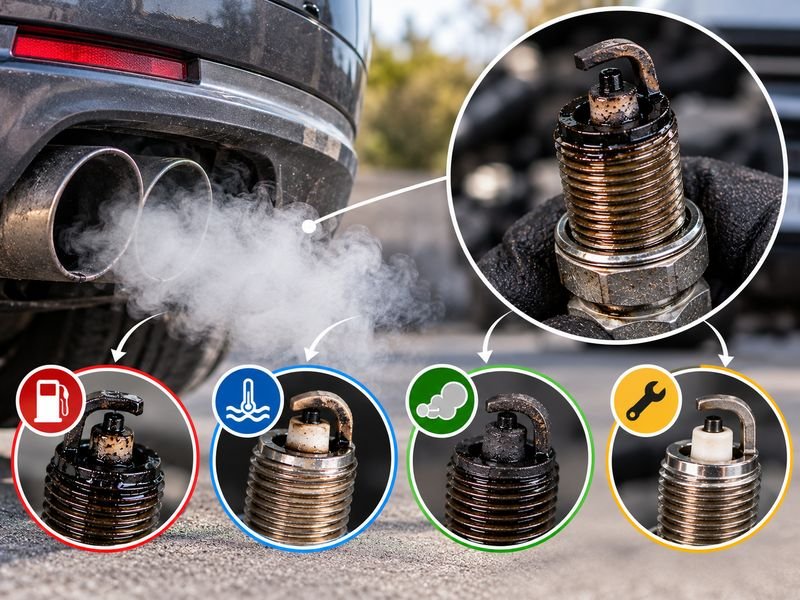
Yes, bad spark plugs can sometimes cause smoke from the exhaust, but usually indirectly. A worn, fouled, damaged, or incorrectly gapped spark plug can cause an engine misfire, which prevents the air-fuel mixture from burning completely. Some unburned fuel may then enter the exhaust and create dark exhaust, a strong gasoline smell, rough running, or unusual emissions.
However, bad spark plugs are not a common direct cause of thick white smoke or blue smoke.
Persistent white smoke more often points toward coolant entering the combustion chamber, while blue smoke usually means the engine is burning oil. A bad spark plug may become fouled because of either problem, but the plug is often a result of the underlying issue rather than its cause.
If smoke started immediately after changing spark plugs, check the plug installation, ignition coils, connectors, and whether the engine is actually misfiring. Thin white vapor during a cold start may simply be condensation, especially if it disappears once the exhaust warms up.
Understanding the color, smell, timing, and engine symptoms will help determine whether the spark plugs are really responsible.
Can Bad Spark Plugs Cause Smoke From Exhaust?
Yes. Bad spark plugs can contribute to exhaust smoke when they cause incomplete combustion or a misfire.
The spark plug’s job is to ignite the compressed air-fuel mixture inside each cylinder.
When a plug cannot create a strong, consistent spark, some or all of the fuel in that cylinder may fail to burn normally.
That can happen when a spark plug has:
- Excessive electrode wear
- An incorrect spark plug gap
- Heavy carbon deposits
- Fuel fouling
- Oil fouling
- A cracked insulator
- The wrong heat range
- Physical damage
DENSO identifies carbon-fouled, oil-fouled, fuel-fouled, worn, and damaged spark plugs as possible causes of poor starting and misfires. A wider plug gap also increases the voltage required to create a spark, making misfire more likely as the plug wears.
When a misfire occurs, fuel may pass into the exhaust instead of being completely burned in the cylinder.
That is why a bad plug can sometimes make a car appear to smoke.
How Can a Bad Spark Plug Make a Car Smoke?
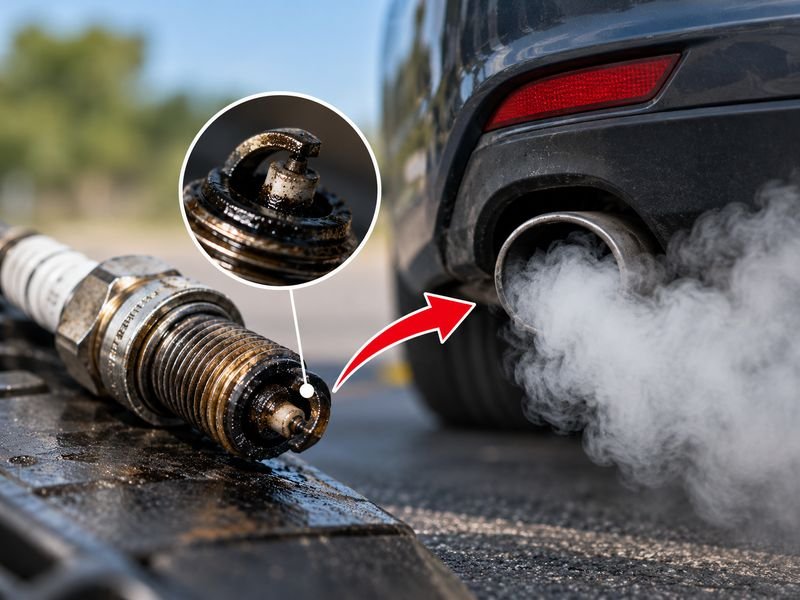
The relationship is usually:
Bad spark plug → weak or missing spark → misfire → incomplete combustion → unburned fuel in the exhaust
It is important to understand this distinction because the spark plug itself does not normally create smoke.
Instead, the plug changes how well combustion occurs.
A healthy cylinder requires the correct combination of:
- Air
- Fuel
- Compression
- Ignition
- Correct ignition timing
If the spark is missing or inconsistent, combustion may be incomplete.
The driver may then notice rough idle, hesitation, reduced power, gasoline odor, poor fuel economy, a check engine light, or dark exhaust.
How much visible smoke appears varies considerably between vehicles.
One car may misfire badly with almost no visible smoke, while another may produce a noticeable dark puff or strong fuel smell.
What Color Smoke Can Bad Spark Plugs Cause?
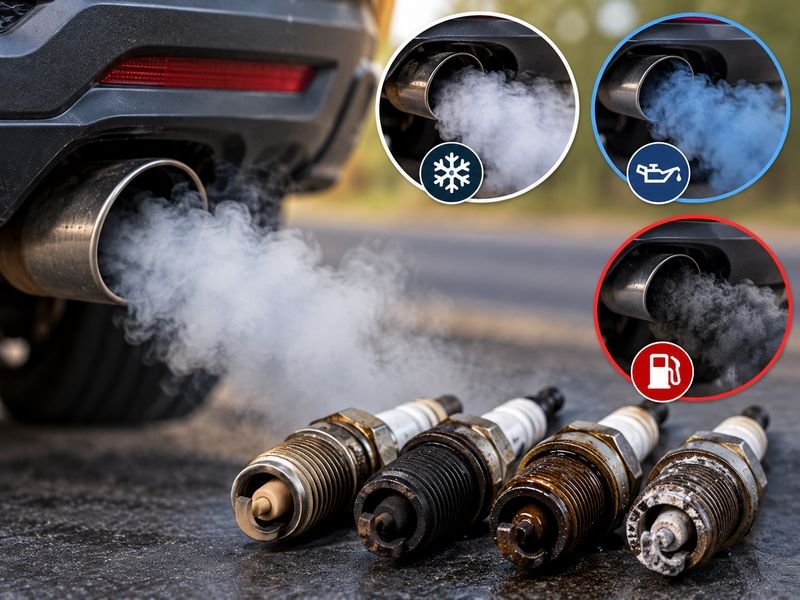
Smoke color provides one of the easiest clues about whether the spark plugs are likely involved.
| Exhaust Appearance | Can Bad Spark Plugs Cause It? | More Likely Meaning |
|---|---|---|
| Black or dark gray | Yes, indirectly | Rich mixture or incomplete combustion |
| Thin white vapor at startup | Usually no | Normal condensation |
| Thick persistent white smoke | Usually no | Coolant entering combustion chamber |
| Blue or blue-gray smoke | Usually no | Engine oil burning |
| Gray exhaust | Possibly | Fuel, oil, or combustion issue |
Smoke color alone cannot diagnose the vehicle, but it can quickly point the investigation in the right direction.
Can Bad Spark Plugs Cause Black Smoke?
Yes, this is the smoke color most reasonably associated with an ignition-related problem.
A spark plug that repeatedly misfires can prevent the cylinder from burning fuel efficiently.
The exhaust may become dark gray or black, particularly if the engine is also running rich.
You may notice:
A raw gasoline smell: Unburned fuel may reach the exhaust.
Rough idle: The engine may shake because one cylinder is contributing less power.
Poor acceleration: The vehicle may hesitate when the engine is under load.
Reduced fuel economy: Fuel is being supplied without producing its normal amount of useful power.
A check engine light: Misfire codes may be stored.
But black smoke does not automatically mean the spark plugs are bad.
Other possible causes include a leaking fuel injector, excessive fuel pressure, a restricted air filter, faulty airflow measurement, sensor problems, or an excessively rich air-fuel mixture.
Can Bad Spark Plugs Cause White Smoke?
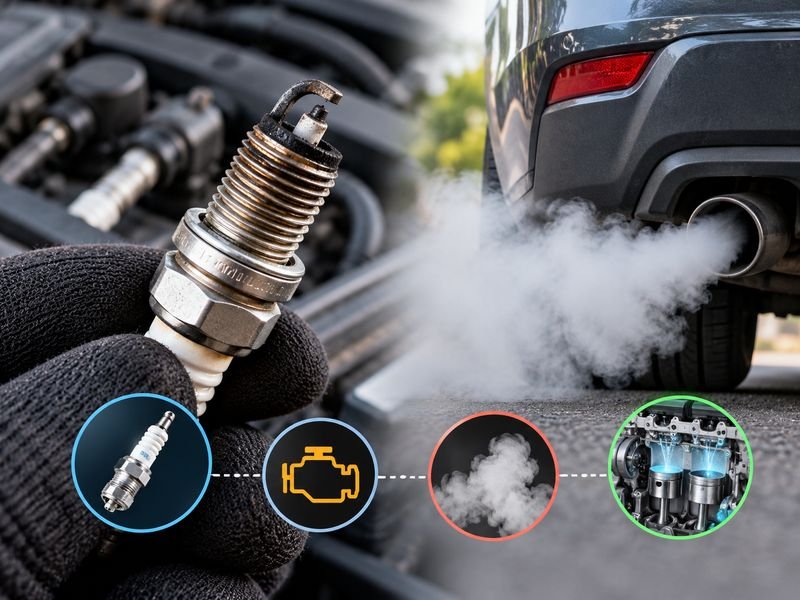
Usually, bad spark plugs do not directly cause thick white smoke from the exhaust.
This is one of the most important distinctions when diagnosing the problem.
Persistent thick white smoke after the engine has warmed up can indicate that coolant is entering the combustion chamber.
Possible causes can include internal coolant leakage such as a head-gasket or cylinder-head problem.
In that situation, coolant contamination may also foul a spark plug and cause a misfire.
That can make it look like the plug caused the smoke when the sequence is actually the opposite:
Coolant enters cylinder → plug becomes fouled → cylinder misfires
Replacing the fouled spark plug alone will not fix the underlying coolant problem.
White Smoke From Exhaust When Starting: Is It the Spark Plugs?
Usually not.
A small amount of thin white vapor when starting a cold engine is commonly caused by condensation.
Water naturally forms as part of combustion and can collect inside a cold exhaust system.
When the engine starts, that moisture heats up and leaves the tailpipe as visible vapor.
This type of vapor usually:
- Appears during a cold start
- Looks thin rather than dense
- Disappears into the air quickly
- Reduces as the exhaust warms
- Is not accompanied by coolant loss
Temporary exhaust condensation is normal and does not mean the spark plugs are bad. AAA also notes that temporary white vapor can occur from condensation, particularly after a vehicle has been sitting.
When White Smoke at Startup Is More Concerning
Pay closer attention if the white exhaust is:
Very thick: Dense clouds are less consistent with ordinary condensation.
Persistent: It continues after the engine has fully warmed.
Sweet-smelling: This can suggest coolant.
Accompanied by coolant loss: Coolant should not continually disappear from a healthy closed cooling system.
Combined with rough running: Coolant or another problem may be affecting combustion.
In those cases, further diagnosis is appropriate.
Is It Normal for Exhaust to Smoke After a Spark Plug Change?
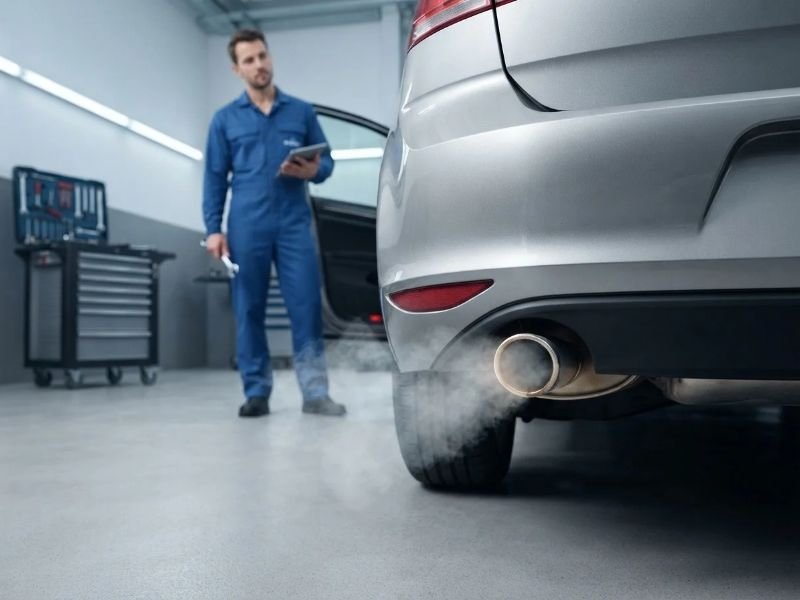
Changing spark plugs by itself should not normally make the exhaust start smoking.
If noticeable smoke begins immediately after new plugs are installed, first determine whether the smoke is actually coming from the tailpipe or from underneath the hood.
Then check whether the engine is running normally.
If it is shaking, misfiring, hesitating, or showing a check engine light, something related to the service may need to be rechecked.
Possible issues include:
Incorrect Spark Plug
The replacement plug must have the correct design, dimensions, and heat range for the engine.
Installing an incorrect spark plug can cause poor running or, in some applications, more serious problems.
Incorrect Spark Plug Gap
An incorrect spark plug gap can make ignition more difficult.
If the gap is excessive, the ignition system requires more voltage to fire the plug, increasing the chance of a misfire.
Loose Ignition Coil Connector
On coil-on-plug engines, the ignition coil connector normally has to be disconnected during plug replacement.
If one connector is not fully seated afterward, that cylinder may not fire correctly.
Damaged Coil Boot
A cracked, carbon-tracked, or improperly installed coil boot can allow ignition voltage to escape before reaching the spark plug.
Spark Plug Not Properly Installed
Improper installation can lead to ignition or sealing problems.
A plug should be installed using the correct procedure and tightening specification for the engine.
DENSO notes that incorrect spark-plug installation can damage the insulator and lead to misfiring.
Why Do I Have White Smoke After Changing Spark Plugs?
If you notice white smoke after changing spark plugs, do not immediately assume the new plugs created the smoke.
Start by asking three questions:
Does the smoke disappear after warm-up?
If yes, it may simply be condensation that happened to be noticed after the service.
Is the engine misfiring?
If the engine runs rough immediately after the plug change, recheck the plugs, ignition coils, connectors, and installation.
Is coolant disappearing?
Persistent white exhaust combined with coolant loss deserves a separate cooling-system and engine diagnosis.
The timing can be misleading.
A coolant leak, condensation, or another developing engine problem can appear at approximately the same time as spark plug replacement without being caused by the new plugs.
White Smoke From Exhaust After Changing Spark Plugs and Rough Idle
White-looking exhaust plus a rough idle immediately after changing plugs deserves closer inspection.
Begin with the ignition work that was just performed.
Check that:
- Every ignition coil is connected
- Coil boots are fully seated
- The correct spark plugs were installed
- Plug gaps are correct where applicable
- No plug insulator was damaged
- Wiring or vacuum connections were not accidentally disturbed
Then scan the vehicle for diagnostic trouble codes.
A cylinder-specific code such as P0301, P0302, P0303, or P0304 tells you which cylinder is misfiring, although it does not prove the spark plug itself is responsible.
If the exhaust is genuinely thick white smoke and coolant is dropping, do not stop the diagnosis after finding a misfire.
Coolant entering a cylinder can both create white exhaust and foul the plug.
Can a Misfire Cause Smoke From Exhaust?
Yes. An engine misfire can cause visible or unusual exhaust, especially when unburned fuel passes through the engine.
Misfires can be caused by more than spark plugs.
Common possibilities include:
- Bad spark plugs
- Weak ignition coils
- Damaged coil boots or plug wires
- Fuel injector problems
- Incorrect air-fuel mixture
- Vacuum leaks
- Low compression
- Valve problems
- Internal engine damage
This matters because replacing spark plugs will only solve the problem if the plugs are actually responsible for the misfire.
If new plugs are installed and the same cylinder continues to misfire, keep diagnosing.
Can One Bad Spark Plug Cause a Car to Smoke?
Yes.
One bad spark plug can cause a single-cylinder misfire.
If enough fuel passes through that cylinder without burning, you may notice unusual exhaust, a gasoline smell, or dark smoke.
The engine may also:
- Shake at idle
- Hesitate during acceleration
- Lose power
- Trigger a check engine light
However, a single bad plug does not guarantee visible smoke.
Many modern engines can misfire noticeably without producing an obvious cloud from the tailpipe.
Can Spark Plugs Cause a Car to Smoke Without a Check Engine Light?
It is possible, especially if the problem is intermittent or has only recently started.
The engine computer usually needs to detect a certain pattern of misfires before setting a diagnostic trouble code.
A plug may occasionally fail under heavy acceleration or high cylinder pressure before the problem becomes consistent enough to trigger a warning light.
Do not rely on the absence of a check engine light as proof that the ignition system is healthy.
Can Bad Spark Plugs Cause Smoke From the Engine?
If by “smoke from the engine” you mean smoke coming from underneath the hood, bad spark plugs themselves are usually not the cause.
Under-hood smoke or steam is more likely to come from something such as:
- Oil leaking onto a hot exhaust component
- Coolant leaking onto hot engine parts
- An electrical problem
- A damaged wire or connector
- Another fluid spill
This is different from exhaust smoke coming from the tailpipe.
If smoke begins under the hood immediately after replacing spark plugs, turn the engine off and inspect the area rather than assuming the new plugs simply need time to settle in.
Can Bad Spark Plugs Cause Blue Smoke?
Usually not.
Blue or blue-gray smoke generally indicates engine oil is being burned.
Possible causes include worn piston rings, valve-stem sealing problems, cylinder wear, or certain crankcase ventilation problems.
Oil entering a cylinder can foul the spark plug.
DENSO describes an oil-fouled plug as having wet, oily deposits and associates it with oil leakage into the combustion chamber and misfiring.
So once again, the direction of cause and effect matters.
The oil-burning problem may be causing both:
Blue smoke + fouled spark plug
Replacing the plug may improve the misfire temporarily, but the new plug can become fouled again if the oil problem remains.
How Do You Know If Spark Plugs Are Causing the Smoke?
Do not diagnose spark plugs based on exhaust smoke alone.
Look for several symptoms occurring together.
A plug-related problem becomes more likely when smoke or unusual exhaust is accompanied by:
Rough idle: The engine shakes or runs unevenly.
Misfire codes: The vehicle stores P0300 or a cylinder-specific P030x code.
Gasoline smell: Raw fuel can indicate incomplete combustion.
Hesitation: The engine stumbles during acceleration.
Hard starting: A weak or fouled plug may struggle to ignite the mixture.
Poor fuel economy: Misfires can waste fuel.
Dark plug deposits: Carbon or fuel fouling can provide useful clues.
The more of these symptoms that appear together, the more reasonable it becomes to investigate the ignition system.
What Does a Spark Plug Tell You About Exhaust Smoke?
Removing and inspecting the plugs can reveal useful information.
Dry Black Spark Plug
A plug covered in dry black carbon can indicate carbon fouling.
Possible causes include an overly rich mixture, repeated short-distance operation, incorrect ignition conditions, or other combustion problems.
Spark Plug Wet With Gasoline
A fuel-wet plug suggests fuel is reaching the cylinder but is not being burned properly.
Possible causes include a bad plug, weak coil, excessive fuel delivery, or another source of misfire.
Spark Plug Wet With Oil
An oily plug points more toward an oil-control problem than a simple worn spark plug.
Investigate why oil is reaching the cylinder or plug area.
Cracked Spark Plug Insulator
A cracked ceramic insulator can cause ignition leakage and misfires.
Worn Electrode or Excessive Gap
Electrodes wear over time.
As the plug gap increases, more voltage is required to create the spark, making misfire more likely under difficult operating conditions.
How to Diagnose Smoke That Might Be Caused by Spark Plugs
A good diagnosis starts with the exhaust rather than immediately replacing parts.
1. Identify the Smoke Color
Determine whether it is:
- Black or dark
- White
- Blue
- Gray
- Thin condensation-like vapor
Black or dark exhaust combined with a misfire makes an ignition or fuel problem more plausible.
Persistent thick white or blue smoke should move the diagnosis toward other engine problems.
2. Notice When the Smoke Appears
Does it happen:
- Only during cold startup?
- At idle?
- Under acceleration?
- After the engine warms?
- Continuously?
This information can quickly narrow the possibilities.
3. Smell the Exhaust Carefully From a Safe Distance
A strong gasoline odor supports an incomplete-combustion or rich-mixture problem.
A sweet smell can be associated with coolant.
Burning oil has a different odor and commonly accompanies blue-gray smoke.
Do not intentionally inhale exhaust fumes.
4. Scan for Trouble Codes
Use an OBD-II scanner to look for misfire codes.
Common examples include:
- P0300 — Random or multiple-cylinder misfire
- P0301 — Cylinder 1 misfire
- P0302 — Cylinder 2 misfire
Additional cylinder numbers follow the same pattern.
Remember that a misfire code identifies the affected cylinder, not automatically the failed component.
5. Inspect the Spark Plugs
Look for:
- Excessive wear
- Incorrect gap
- Carbon deposits
- Fuel wetness
- Oil
- Cracked ceramic
- Physical damage
Compare all of the plugs rather than looking at only one.
6. Check the Ignition Coils
A perfectly good new spark plug will still misfire if the ignition coil cannot provide adequate voltage.
Check coil connectors, boots, corrosion, and other ignition components.
7. Check Oil and Coolant
If the smoke is white or blue, fluid levels become especially important.
Falling coolant with persistent white exhaust or falling oil with blue smoke can point away from the spark plugs as the root cause.
Will Changing Spark Plugs Stop Exhaust Smoke?
Changing the spark plugs can stop the smoke if the old plugs were causing the misfire and there is no separate engine or fuel-system problem.
For example, replacement may help when an old plug has:
- Excessive electrode wear
- Severe carbon fouling
- A damaged insulator
- An incorrect gap
- Another ignition-related defect
But new plugs will not fix:
- An injector that is leaking fuel
- An engine burning oil
- Coolant entering a cylinder
- Low compression
- A failing ignition coil
- An overly rich air-fuel mixture
If a new spark plug quickly becomes fouled again, focus on finding what is contaminating it.
Can Bad Spark Plugs Cause Overheating?
Bad spark plugs are not a common primary cause of the engine itself overheating, so an overheating engine should be diagnosed separately.
A severe misfire can, however, send unburned fuel into the exhaust and place excessive heat stress on the catalytic converter.
If the temperature gauge is rising, coolant is being lost, or the engine is genuinely overheating, check the cooling system rather than assuming spark plugs are the main cause.
Can You Drive With Bad Spark Plugs if the Exhaust Is Smoking?
It depends on the severity, but continued driving with an active misfire is not a good idea.
A serious misfire can send unburned fuel into the catalytic converter, where it may create excessive heat and damage the catalyst.
Avoid unnecessary driving if:
- The check engine light is flashing
- The engine is shaking badly
- Power is significantly reduced
- Smoke is heavy
- The exhaust strongly smells of fuel
- Coolant or oil levels are dropping
A flashing check engine light deserves particular attention because it can indicate a misfire severe enough to threaten the catalytic converter.
FAQs About Bad Spark Plugs and Exhaust Smoke
Can Spark Plugs Cause Smoke From Exhaust?
Yes, indirectly. A bad spark plug can cause a misfire and incomplete combustion, allowing unburned fuel into the exhaust. This is more likely to create dark exhaust or a gasoline smell than persistent white or blue smoke.
Can Bad Plugs Cause Smoke?
They can. The plug itself does not normally create smoke, but the misfire caused by a faulty plug can change the exhaust and sometimes produce visible dark smoke.
Can Bad Spark Plugs Cause White Smoke?
Usually not directly. Persistent thick white smoke is more commonly associated with coolant entering the combustion chamber. A coolant problem can also foul a spark plug and cause a misfire.
Can a Bad Spark Plug Cause a Car to Smoke?
Yes. A failed plug can prevent proper combustion in one cylinder, allowing unburned fuel into the exhaust. Whether visible smoke appears depends on the severity of the misfire and the engine management system.
Can a Misfire Cause Smoke From Exhaust?
Yes. A misfire can allow unburned fuel to enter the exhaust and may cause dark exhaust, fuel odor, or unusual emissions. Spark plugs are only one of several possible causes of a misfire.
Can Spark Plugs Cause White Smoke?
Spark plugs are not a typical direct cause of thick white exhaust. Thin white vapor during a cold start is often condensation, while persistent white smoke can indicate a coolant-related issue.
Is It Normal for Exhaust to Smoke After a Spark Plug Change?
Persistent smoke is not a normal result of changing spark plugs. If the engine runs rough afterward, recheck the spark plugs, ignition coils, connectors, and installation. Thin white vapor during a cold start may simply be normal condensation.
Why Do I Have White Smoke After Changing Spark Plugs?
Possible explanations include normal condensation, a misfire caused by an installation issue, or an unrelated coolant problem that appeared around the same time. Persistent thick white smoke should not automatically be blamed on the new plugs.
What Causes White Smoke From the Exhaust When Starting?
A small amount of thin white vapor on a cold start is commonly condensation. Thick smoke that persists after warm-up, especially with coolant loss or a sweet odor, needs further diagnosis.
Can Bad Spark Plugs Cause Smoke From the Engine Bay?
Normally no. Smoke from under the hood is more likely to involve leaking oil or coolant, a fluid spilled onto a hot component, or an electrical issue. This is different from smoke coming from the tailpipe.
Will New Spark Plugs Fix Black Smoke?
They may if worn or damaged plugs are causing a misfire. If the engine is running excessively rich because of an injector, sensor, air-intake, or fuel-pressure problem, new plugs alone will not stop the black smoke.
Conclusion: Can Bad Spark Plugs Cause Smoke From Exhaust?
Yes, bad spark plugs can cause smoke from the exhaust indirectly by creating a misfire and incomplete combustion.
When a plug fails to ignite the air-fuel mixture correctly, unburned fuel can enter the exhaust. That may produce dark smoke, a gasoline smell, rough idle, hesitation, or a check engine light.
However, smoke color matters.
Black or dark exhaust can be consistent with incomplete combustion or a rich mixture.
Thin white vapor during a cold start is often normal condensation.
Persistent thick white smoke is more likely to involve coolant.
Blue smoke usually indicates that the engine is burning oil.
If smoke begins after changing spark plugs, do not assume the new plugs are supposed to cause it. Check the plug type and installation, spark plug gap, ignition coils, electrical connectors, trouble codes, oil level, and coolant level.
The best approach is to diagnose the reason for the smoke first. Replace the spark plugs when testing shows they are actually part of the problem—not simply because smoke is visible from the exhaust.