
The most common symptoms of bad spark plugs in car engines include hard starting, rough idle, misfires, weak acceleration, poor fuel economy, and a check engine light. A worn or fouled plug may also cause engine vibration, hesitation, or a strong fuel smell from the exhaust.
Spark plugs ignite the compressed air-fuel mixture inside each cylinder. When one or more plugs become worn, contaminated, cracked, or incorrectly gapped, combustion may become weak or inconsistent.
Some symptoms appear gradually as the electrodes wear. Others begin suddenly after a plug becomes fouled, physically damaged, or unable to handle normal ignition voltage.
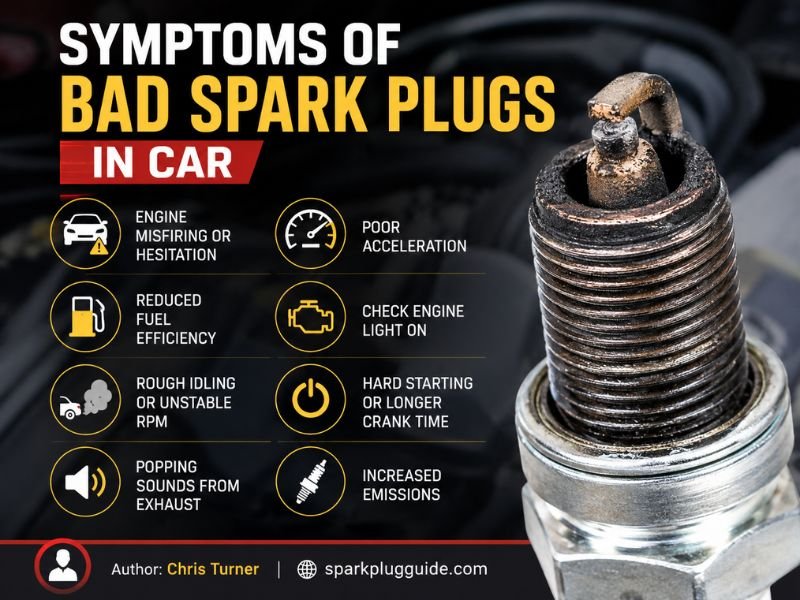
What Happens When Car Spark Plugs Go Bad?
A spark plug receives high voltage from the ignition coil and creates an electrical spark across the gap between its center and ground electrodes.
That spark must occur at the correct moment and with enough energy to ignite the mixture inside the combustion chamber. A bad spark plug may still fire occasionally, but it may not ignite every combustion cycle.
This can cause incomplete combustion, which affects engine smoothness, power, starting, fuel use, and exhaust emissions.
The severity depends on how many plugs are affected. One weak plug may create a cylinder-specific misfire, while several worn plugs may make the entire engine feel sluggish and unstable.
Common Symptoms of Bad Spark Plugs in Car Engines
A bad spark plug does not always produce every symptom. The engine may show only one or two warning signs at first, particularly when the plug damage is minor.
Hard or Delayed Starting
A car with worn spark plugs may take longer than usual to start.
During cranking, the ignition system must create a spark while the starter motor is drawing a large amount of battery power. If the plug gap is too wide or the electrodes are badly worn, the available ignition voltage may not produce a consistent spark.
The engine may crank normally but require several seconds before starting. In more severe cases, it may start only after multiple attempts.
Hard starting may be more noticeable in cold weather because cold fuel does not vaporize as easily. A weak spark has more difficulty igniting the mixture under these conditions.
A low battery, fuel-delivery problem, ignition coil fault, or compression issue can produce similar symptoms. Spark plugs become a stronger suspect when they have exceeded their service interval or the engine also runs roughly after starting.
Rough or Unstable Idle
A rough idle is one of the most recognizable signs of failing spark plugs.
At idle, each cylinder should produce evenly timed combustion events. If one plug fires inconsistently, the engine may shake, stumble, or produce an uneven exhaust rhythm.
You may feel the vibration through the steering wheel, seat, or floor. The tachometer may also show small RPM fluctuations.
A severely fouled plug can cause the engine to feel as though it is close to stalling. The roughness may improve slightly when engine speed increases, although the misfire can return under load.
Vacuum leaks, dirty injectors, worn engine mounts, and ignition coil problems can also cause rough idle. Physical inspection of the plugs helps separate these possibilities.
Engine Misfires
An engine misfire occurs when combustion does not happen correctly in one or more cylinders.
A worn, cracked, oil-fouled, or carbon-fouled spark plug may create a weak spark or fail to fire completely. The engine control module can often detect the resulting change in crankshaft speed.
A misfiring car may jerk, hesitate, shake, or briefly lose power. The exhaust may sound uneven, and the engine may produce occasional popping sounds.
The problem may occur continuously or only under certain conditions. A plug can fire normally at idle but misfire during acceleration because higher cylinder pressure makes it harder for the spark to cross the electrode gap.
Severe misfires should not be ignored. Unburned fuel can enter the exhaust and overheat the catalytic converter.
Sluggish Acceleration
Bad spark plugs can make a car feel slow or unresponsive when the accelerator is pressed.
Acceleration increases cylinder pressure and fuel demand. The ignition system must produce a strong spark to ignite the denser mixture.
If a plug cannot fire reliably, the affected cylinder produces less power. The vehicle may hesitate before accelerating, stumble during highway merging, or require more throttle than normal.
A single weak plug may create only mild hesitation. Several worn plugs can make the engine feel consistently underpowered.
Poor acceleration may also result from a clogged air filter, weak fuel pressure, transmission problems, or restricted exhaust flow. Spark plug problems are more likely when sluggish acceleration appears together with rough idle or misfire codes.
Reduced Engine Power
A bad spark plug can reduce overall engine output even when the car remains drivable.
Each cylinder contributes to the engine’s total power. When one cylinder burns fuel poorly, the other cylinders must work harder to maintain speed.
The car may struggle on hills, feel weak at higher RPM, or lose speed more easily when carrying passengers or cargo.
Power loss is often more obvious in smaller engines. One misfiring cylinder has a larger effect on a four-cylinder engine than it does on an engine with six or eight cylinders.
Continuing to drive with reduced power may worsen fuel consumption and place additional stress on the ignition and exhaust systems.
Poor Fuel Economy
Bad spark plugs can increase fuel consumption because the engine does not convert fuel into power efficiently.
When a plug misfires, some gasoline may remain unburned. The engine may also require more throttle to produce the same acceleration or maintain the same speed.
You may notice fewer miles from a full tank or a gradual reduction in the fuel economy displayed by the trip computer.
Poor fuel economy is not always caused by spark plugs. Tire pressure, driving style, short trips, cold weather, oxygen sensor faults, and fuel-system problems can all affect mileage.
Spark plugs become a more likely cause when reduced fuel economy appears with hesitation, misfires, or difficult starting.
Check Engine Light
A bad spark plug may cause the check engine light to turn on when the vehicle’s computer detects repeated misfires.
The light may remain steady if the fault is intermittent. It may flash when the misfire is severe and unburned fuel could damage the catalytic converter.
A scan tool may show a code for one specific cylinder or a random multiple-cylinder misfire.
The code identifies where the combustion problem is occurring, but it does not confirm that the spark plug is the only cause. The ignition coil, injector, wiring, and compression of the affected cylinder may also need to be checked.
A flashing check engine light requires immediate attention. Reducing engine load and stopping the vehicle as soon as it is safe can help prevent expensive exhaust-system damage.
Strong Fuel Smell or Unusual Exhaust
A bad spark plug may allow unburned gasoline to pass into the exhaust.
This can create a raw fuel smell, uneven exhaust pulses, or occasional popping from the tailpipe. In some cases, the exhaust may appear darker than normal.
A strong fuel smell after repeated starting attempts may also indicate that the engine is flooded. Fuel is entering the cylinders, but the plugs are not igniting it effectively.
Fuel odors should be treated carefully because an external fuel leak can create a fire risk. If the smell is strong around the engine compartment or fuel tank, the vehicle should be inspected before further driving.
Engine Vibration or Stalling
A badly misfiring spark plug may make the engine vibrate more than usual.
The vibration can become especially noticeable at idle or while stopped in gear. If engine speed drops too low, the car may stall.
Some vehicles restart immediately, while others require several attempts. The problem may worsen when the air conditioner, headlights, or other loads are operating.
Stalling can also be caused by fuel-pressure problems, throttle-body faults, crankshaft sensors, or charging-system issues. Spark plugs are more likely when stalling occurs with rough running and visible plug wear.
Symptoms of Bad Spark Plugs in Car at a Glance
| Symptom | What You May Notice | Why Bad Plugs Can Cause It |
| Hard starting | Longer cranking or repeated attempts | The mixture does not ignite consistently |
| Rough idle | Shaking or unstable RPM | One or more cylinders fire unevenly |
| Engine misfire | Jerking, stumbling, or popping | Combustion cycles are missed |
| Weak acceleration | Delayed or sluggish response | The plug fails under increased load |
| Power loss | Poor performance on hills | The cylinder produces less usable power |
| Poor fuel economy | More frequent refueling | Fuel burns incompletely |
| Check engine light | Misfire-related warning | The computer detects failed combustion |
| Fuel smell | Raw gasoline from the exhaust | Unburned fuel enters the exhaust |
| Stalling | Engine shuts off at idle | Misfires reduce engine speed |
What Do Bad Car Spark Plugs Look Like?
A bad spark plug may look worn, dirty, wet, burned, or physically damaged.
The appearance often provides clues about why the plug is failing.
Worn or Rounded Electrodes
Healthy electrodes have defined edges that help concentrate electrical energy.
As a plug wears, the center and ground electrodes become rounded or eroded. The gap may gradually widen, requiring more voltage to create a spark.
A plug with heavily worn electrodes should usually be replaced rather than regapped.
Dry Black Deposits
Dry, powdery black soot is known as carbon fouling.
The deposits may result from a rich air-fuel mixture, excessive idling, short trips, a dirty air filter, or a plug that operates below its intended temperature.
Heavy carbon deposits can create an electrical path that weakens the spark.
Wet Gasoline
A plug wet with gasoline may indicate that fuel is reaching the cylinder but is not burning.
This can happen after repeated failed starting attempts, an overly rich mixture, injector leakage, or ignition failure.
Gasoline usually has a strong smell and evaporates more quickly than engine oil.
Wet Oil Deposits
A plug coated with dark, shiny oil may indicate that engine oil is entering the combustion chamber.
Possible causes include worn piston rings, damaged valve stem seals, valve-guide wear, or crankcase ventilation problems.
An oil-fouled plug may continue to misfire even after cleaning if the underlying oil leak is not repaired.
Cracked Ceramic Insulator
The white ceramic section of a spark plug insulates the ignition voltage.
A visible crack or chip can allow the voltage to escape before reaching the electrode gap. This may produce intermittent misfires or complete loss of spark.
A cracked spark plug should always be replaced.
White or Blistered Firing Tip
A very white, blistered, or melted firing tip may indicate excessive heat.
Possible causes include an incorrect plug heat range, lean combustion, abnormal ignition timing, or engine overheating.
The plug should be replaced, and the condition that caused the overheating should be investigated.
Why Do Car Spark Plugs Go Bad?
Spark plugs naturally wear because they fire thousands of times during every drive.
Each spark removes a tiny amount of material from the electrodes. Over time, the edges become rounded and the gap increases.
Plugs may also fail prematurely because of oil fouling, carbon buildup, overheating, fuel contamination, incorrect installation, or use of the wrong plug type.
A damaged ignition coil boot can create external arcing along the ceramic insulator. Incorrect tightening can also damage the plug or cylinder-head threads.
Engine condition plays an important role. A new plug may foul quickly if the engine is burning oil, running too rich, or experiencing a fuel injector problem.
How to Confirm That the Spark Plugs Are Bad
I recommend combining engine symptoms with physical inspection and basic ignition testing.
First, scan the vehicle for misfire codes when the check engine light is on. A cylinder-specific code can help identify which plug should be inspected first.
Allow the engine to cool before removing ignition coils or spark plug wires. Clean around the plug wells to prevent debris from falling into the cylinders.
Inspect each plug and keep track of its cylinder position. Compare electrode wear, deposits, cracks, and gap measurements across the complete set.
A plug from the misfiring cylinder may look noticeably different from the others.
The gap should be measured with a proper tool and compared with the specification for the exact engine. Do not rely on a universal gap measurement.
When the plug appearance is inconclusive, the suspected plug or ignition coil may be moved to another cylinder during professional diagnosis. If the misfire follows the component, the fault becomes easier to identify.
Bad Spark Plug or Bad Ignition Coil?
Spark plugs and ignition coils can produce nearly identical symptoms because they work together.
A spark plug creates the spark inside the cylinder, while the coil supplies the high voltage needed to produce it.
A worn or fouled plug may show visible electrode damage, deposits, or an incorrect gap. A failed coil may look normal externally but stop supplying consistent voltage, especially when hot or under load.
If a new correctly specified plug does not correct the cylinder misfire, the ignition coil and its wiring should be tested.
Repeated coil failure may also be related to spark plugs that have been left in service too long. Excessive plug gap forces the coil to generate higher voltage.
Can You Drive With Bad Spark Plugs?
A car may continue running with bad spark plugs, but driving is not recommended when the engine is actively misfiring.
A mild problem may initially cause only poor fuel economy or slight hesitation. It can later develop into severe shaking, stalling, or loss of acceleration.
Continued driving may damage the catalytic converter because unburned fuel can ignite inside the exhaust system.
Stop driving as soon as it is safe when the check engine light flashes, the engine shakes heavily, acceleration becomes unsafe, or a strong fuel smell is present.
Will New Spark Plugs Fix the Symptoms?
New spark plugs can restore normal starting and performance when worn, fouled, damaged, or incorrectly gapped plugs are the actual cause.
However, replacement plugs will not correct another underlying fault.
A new plug may quickly foul again if the engine is burning oil, the injector is leaking, the air-fuel mixture is too rich, or the ignition coil is defective.
The old plugs should be inspected before disposal because their appearance can reveal important information about engine condition.
Always install the correct plug type, heat range, thread reach, seat design, and electrode gap specified for the vehicle.
When Should Car Spark Plugs Be Replaced?
Spark plug replacement intervals vary significantly by plug material and vehicle manufacturer.
Conventional copper plugs may have shorter service intervals, while platinum and iridium plugs often remain in service much longer.
The owner’s manual provides the most reliable schedule for the specific car.
Replacement may be needed earlier when the plugs are fouled, cracked, overheated, badly worn, or causing confirmed misfires.
A plug should also be replaced when its electrode gap cannot be corrected without damaging the electrode.
Frequently Asked Questions
What Is the First Sign of Bad Spark Plugs?
The first sign is often slight hesitation, longer cranking, or an occasional rough idle.
These early symptoms may appear only during cold starts or acceleration. As electrode wear or fouling becomes worse, the misfire may become more frequent and trigger the check engine light.
Can Bad Spark Plugs Cause a Car to Shake?
Yes. A bad plug can cause one cylinder to fire inconsistently, making the engine shake or vibrate.
The shaking may be most noticeable at idle, during acceleration, or while the vehicle is stopped in gear.
Can Bad Spark Plugs Cause a Car Not to Start?
Yes. If several plugs are heavily worn or fouled, the engine may crank without starting.
A single bad plug usually allows a multi-cylinder engine to start, but the engine may run roughly immediately afterward.
Can Bad Spark Plugs Cause Slow Acceleration?
Yes. Bad plugs can misfire when cylinder pressure increases during acceleration.
The car may hesitate, jerk, or feel unusually weak when more power is requested.
Can Bad Spark Plugs Affect Gas Mileage?
Yes. Incomplete combustion wastes fuel and reduces engine efficiency.
The driver may also use more throttle to compensate for lost power, further increasing fuel consumption.
Can Bad Spark Plugs Cause a Flashing Check Engine Light?
Yes. A severe spark plug misfire can cause the check engine light to flash.
A flashing light usually means unburned fuel may be entering the catalytic converter, so the vehicle should not be driven unnecessarily.
Do All Spark Plugs Go Bad at the Same Time?
Not always.
Plugs installed as a set often wear at a similar rate, but one plug may fail earlier because of oil contamination, injector problems, coil failure, or a cylinder-specific mechanical issue.
Can Cleaning Bad Spark Plugs Fix the Problem?
Cleaning may temporarily help a lightly carbon-fouled conventional plug.
It will not restore worn electrodes, repair cracked ceramic, or stop oil and fuel contamination. Replacement is usually more reliable when the plug has significant mileage or physical damage.
Conclusion
The most common symptoms of bad spark plugs in car engines are hard starting, rough idle, misfires, sluggish acceleration, reduced power, poor fuel economy, a check engine light, and increased engine vibration.
These symptoms can also result from ignition coil, fuel injector, airflow, or compression problems. Physical inspection of the plugs, gap measurement, and cylinder-specific misfire diagnosis provide stronger evidence than symptoms alone.
I recommend replacing spark plugs that are cracked, heavily fouled, overheated, or badly worn. The replacement plugs should match the exact vehicle specification, and any condition that caused premature fouling should be corrected before the new plugs develop the same problem.