
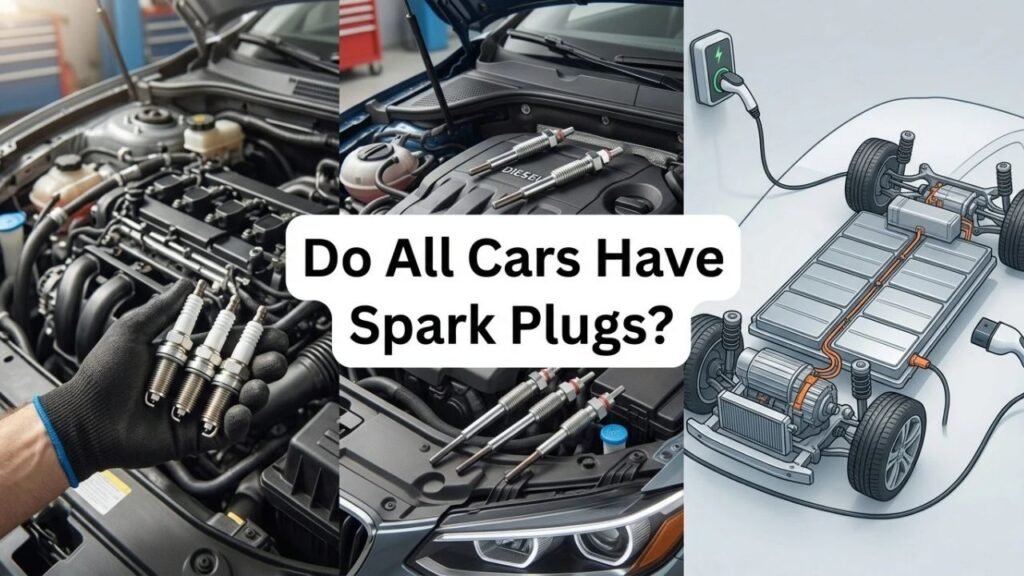
Do all cars have spark plugs? No. Cars with gasoline spark-ignition engines normally use spark plugs, while diesel engines do not use spark plugs for combustion. Fully electric vehicles have no spark plugs because they do not have an internal-combustion engine. Most hybrids still have spark plugs because they combine an electric motor with a gasoline engine.
The confusion usually comes from the fact that spark plugs have been a standard maintenance item on gasoline-powered cars for generations. They are so closely associated with engines that it is easy to assume every vehicle has them.
But spark plugs belong specifically to spark-ignition combustion engines. Their job is to create the electrical spark that ignites the compressed air-fuel mixture inside each cylinder. An engine that ignites fuel another way does not need them.
Diesel engines, for example, ignite fuel through the heat created by very high compression. Many diesels use glow plugs to help with cold starting, but a glow plug and a spark plug perform very different jobs.
Battery-electric vehicles such as many modern EVs do not burn fuel in cylinders at all. Their electric motors therefore have no spark plugs, ignition coils, or traditional ignition system.
In this guide, I’ll explain which cars have spark plugs, which ones do not, how gasoline and diesel engines differ, whether hybrids use spark plugs, how many plugs a typical car has, and how to tell what your own vehicle uses.
Which Cars Have Spark Plugs?
Most vehicles with a conventional gasoline engine have spark plugs.
This includes a huge variety of passenger cars, SUVs, pickup trucks, sports cars, vans, and other vehicles.
A gasoline engine normally mixes fuel with incoming air, compresses that mixture inside the cylinder, and then uses an electrical spark to initiate combustion.
The spark plug provides that spark.
Modern gasoline engines commonly use one spark plug per cylinder, although there are exceptions.
A four-cylinder engine usually has four spark plugs.
A V6 commonly has six.
A V8 commonly has eight.
Some engines use two plugs per cylinder, so cylinder count alone does not always tell you the exact number.
Gasoline Cars
Gasoline-powered cars are the most obvious example.
Whether the engine uses carburetion, port fuel injection, or gasoline direct injection, it still generally needs a spark source to ignite the mixture.
Older engines might use a distributor, ignition coil, plug wires, and spark plugs.
Modern cars commonly use individual ignition coils mounted directly over the plugs.
The surrounding ignition hardware has changed significantly, but the basic purpose of the spark plug remains the same.
Turbocharged Gasoline Cars
Turbocharging does not eliminate the need for spark plugs.
A turbocharged gasoline engine is still a spark-ignition engine.
In fact, spark plug condition and gap can be especially important in a turbo engine because higher cylinder pressure can make it more difficult for the spark to jump an excessively wide gap.
Supercharged Gasoline Cars
Supercharged gasoline engines also use spark plugs.
Like turbocharged engines, they operate under higher cylinder pressure when boost is present.
The manufacturer therefore specifies plugs with the appropriate heat range, electrode design, and gap for that application.
CNG and LPG Vehicles
Vehicles using compressed natural gas or liquefied petroleum gas generally use spark-ignition engines as well.
Therefore, they normally have spark plugs.
The exact plug specifications may differ because gaseous fuels have different combustion characteristics from gasoline.
Key Takeaways:
- Conventional gasoline cars normally have spark plugs.
- Turbocharged and supercharged gasoline engines still require spark plugs.
- Alternative spark-ignition fuels such as CNG and LPG generally use spark plugs too.
Which Cars Do Not Have Spark Plugs?
The two biggest groups are diesel vehicles and fully electric vehicles.
They avoid spark plugs for completely different reasons.
Diesel engines still burn fuel in cylinders, but combustion starts through compression heat.
Electric vehicles do not perform combustion at all.
Do Diesel Cars Have Spark Plugs?
No. Conventional diesel engines do not use spark plugs to ignite the fuel.
A diesel engine uses compression ignition.
During the intake stroke, the cylinder primarily draws in air.
The piston then compresses that air to a very high pressure.
Compressing the air raises its temperature substantially.
Near the appropriate point in the compression stroke, diesel fuel is injected into the hot compressed air.
The heat is sufficient to ignite the fuel without an electrical spark.
That is why a diesel engine does not need a normal ignition spark plug.
Then Why Do Diesels Have Glow Plugs?
Many passenger-car diesel engines have glow plugs.
These are sometimes mistakenly called diesel spark plugs, but that terminology is misleading.
A glow plug does not repeatedly produce an electrical arc across an electrode gap.
Instead, it contains an electrical heating element.
During cold starting, the glow plug heats the combustion area to help the diesel fuel ignite more easily when the engine and surrounding air are cold.
Once the engine is running and generating sufficient heat through compression and combustion, the diesel engine does not rely on glow plugs in the same way a gasoline engine continuously relies on spark plugs.
Spark Plug vs. Glow Plug
The difference can be summarized simply:
| Component | Main Purpose |
| Spark plug | Creates an electrical spark to ignite an air-fuel mixture |
| Glow plug | Heats the combustion area to assist diesel ignition, especially when cold |
Both may screw into an engine’s cylinder head, but their functions and designs are fundamentally different.
Do Electric Cars Have Spark Plugs?
No. A fully electric vehicle does not have spark plugs.
Battery-electric vehicles use electrical energy stored in a high-voltage battery to power one or more electric motors.
There is no gasoline combustion chamber and no controlled air-fuel explosion that needs to be initiated.
As a result, an EV does not need the traditional gasoline ignition system.
That means no:
Spark plugs, ignition coils, distributor, spark plug wires, fuel injectors for a gasoline engine, or traditional gasoline combustion process.
What Replaces the Engine?
Nothing directly “replaces” the spark plugs themselves.
The entire method of producing propulsion is different.
In an electric car, electrical current powers an electric motor.
The motor converts electrical energy into rotational motion.
That rotation ultimately turns the wheels through the vehicle’s drivetrain.
Because no combustion occurs, there is nothing for a spark plug to ignite.
Do EVs Need Tune-Ups?
EVs still require maintenance, but it is different from conventional gasoline-engine service.
There are no spark plug replacement intervals.
There is also no engine oil to change in the traditional gasoline-engine sense.
However, EVs still have components such as tires, brakes, cabin filters, coolant systems on many models, suspension parts, and drivetrain fluids in some designs.
So “no spark plugs” does not mean “no maintenance.”
Do Hybrid Cars Have Spark Plugs?
Most hybrid cars do have spark plugs because most hybrids contain a gasoline engine in addition to an electric motor.
A typical hybrid can move using the gasoline engine, electric motor, or both depending on driving conditions.
Whenever the gasoline engine operates, it still needs to ignite its air-fuel mixture.
Therefore, it needs spark plugs.
Conventional Hybrids
Vehicles such as many gasoline-electric hybrids use conventional spark-ignition engines.
Those engines have spark plugs just like other gasoline engines.
The difference is that the engine may operate less frequently or under different conditions because the electric motor assists with propulsion.
Plug-In Hybrids
Plug-in hybrids generally also use spark plugs.
A plug-in hybrid has a larger battery that can usually propel the vehicle electrically for a useful distance before the gasoline engine is needed.
But once that gasoline engine starts, it still relies on spark plugs.
Range-Extended Electric Vehicles
Some vehicles are designed so an internal-combustion engine primarily generates electricity rather than mechanically driving the wheels.
If that range-extender engine is gasoline-powered and uses spark ignition, it will still have spark plugs.
The fact that its mechanical role differs does not change how its combustion process is ignited.
Key Takeaways:
- Diesel cars use compression ignition rather than spark plugs.
- Fully electric cars have no spark plugs because they have no combustion engine.
- Most hybrids and plug-in hybrids still have spark plugs because they contain a gasoline engine.
Do All Gasoline Engines Have Spark Plugs?
Virtually all conventional automotive gasoline piston engines require an ignition source and therefore use spark plugs or an equivalent spark-ignition device.
However, saying “all” becomes difficult because automotive engineering includes experimental and specialized combustion technologies.
For normal passenger vehicles, the practical rule is simple:
If it has a conventional gasoline engine, expect it to have spark plugs.
You do not need to worry about rare experimental combustion concepts when doing normal vehicle maintenance.
Why Does a Gasoline Engine Need Spark Plugs?
Gasoline does not normally ignite simply because the piston compresses the mixture under the conditions used in a standard gasoline engine.
Instead, the ignition system creates a high voltage.
That voltage travels to the spark plug.
The electrical energy jumps the gap between the center electrode and ground electrode, creating a spark inside the combustion chamber.
This initiates a flame kernel.
The flame spreads through the air-fuel mixture, rapidly increasing pressure and pushing the piston downward.
That mechanical energy eventually becomes rotation at the crankshaft and propulsion at the wheels.
Spark Plugs Fire Repeatedly
Spark plugs do not fire only when the engine starts.
They operate continuously while the gasoline engine is running.
At highway speed, every plug may fire many times each second.
Over thousands of miles, this adds up to millions of ignition events.
That is why electrode durability matters.
How Many Spark Plugs Does a Car Have?
The number usually corresponds to the number of cylinders.
A typical four-cylinder has four plugs.
A six-cylinder normally has six.
An eight-cylinder normally has eight.
However, some engines use two spark plugs per cylinder.
Four-Cylinder Engine
Most standard four-cylinder gasoline engines use four plugs.
These are often among the easiest configurations to service because all four cylinders may be arranged in one straight line.
V6 Engine
A typical V6 uses six spark plugs.
Access can vary significantly.
Three may be relatively accessible while the other three sit near the firewall underneath intake components.
V8 Engine
Most V8 gasoline engines use eight spark plugs.
However, some V8 designs use sixteen because each cylinder has two spark plugs.
Engines With Two Spark Plugs per Cylinder
Dual-plug systems are used for different engineering reasons.
Two flame initiation points can help combustion occur more effectively in certain combustion-chamber designs.
Some manufacturers have also used dual plugs to support emissions, efficiency, or combustion stability goals.
Therefore, never buy a complete set of plugs based solely on cylinder count without checking the engine specification.
Why Do Some Engines Have Two Spark Plugs per Cylinder?
Two plugs can allow combustion to begin from two locations inside the chamber.
This can shorten the distance the flame front has to travel.
Depending on the engine design, that can improve combustion speed or completeness.
Dual-plug layouts have appeared in cars, trucks, motorcycles, and performance engines.
The exact reason varies by manufacturer.
Does Each Plug Need to Be Replaced?
Yes, if the engine uses two plugs per cylinder, both are part of the ignition system and require service according to the maintenance schedule.
A V8 with dual plugs may therefore require sixteen replacement spark plugs.
This is worth checking before purchasing parts or estimating service cost.
How Can You Tell if Your Car Has Spark Plugs?
The easiest method is to identify the engine type.
If your car is gasoline-powered, it almost certainly has spark plugs.
If it is diesel, it normally does not.
If it is fully electric, it definitely does not use gasoline-engine spark plugs.
If it is a hybrid, it most likely does.
Check the Owner’s Manual
Look at the maintenance schedule.
If you see a spark plug replacement interval, your vehicle obviously uses them.
The manual may also specify the required plug type and replacement mileage.
Check the Engine Bay
On many modern gasoline engines, individual ignition coils sit on top of the cylinder head.
Each coil commonly connects directly to a spark plug below it.
Older engines may have visible spark plug wires running from a distributor or coil pack toward the cylinder head.
However, engine covers can hide these components, so visual inspection is not always obvious.
Look Up the Engine Specification
Searching by exact year, make, model, and engine size will tell you the correct number of spark plugs and part specification.
This is particularly useful when one vehicle model was sold with gasoline, diesel, and hybrid engine options.
Are Spark Plugs the Same in Every Car?
No.
Spark plugs vary substantially.
Important differences include thread diameter, thread reach, seat design, heat range, electrode material, resistor design, projected tip configuration, and gap specification.
A plug that physically screws into the cylinder head is not necessarily correct.
Thread Size
The threads must exactly match the cylinder head.
Using an incorrect thread diameter can cause severe damage.
Reach
Reach describes how far the threaded portion extends into the cylinder head.
A plug that is too short can place the firing tip in the wrong location.
A plug that is too long may extend too far into the combustion chamber, potentially causing severe engine damage.
Heat Range
The heat range determines how effectively the plug transfers heat away from its firing end.
Too hot or too cold a plug can lead to operating problems.
Electrode Material
Common types include conventional nickel/copper-core plugs, platinum, double platinum, iridium, and other precious-metal designs.
The correct type depends on the engine.
Gap
The gap between the electrodes also varies by engine.
Do not assume every replacement plug should be set to the same value.
How Long Do Spark Plugs Last?
Service life varies significantly according to electrode material, engine design, and manufacturer recommendations.
Conventional nickel/copper-core plugs may require replacement much sooner than modern precious-metal plugs.
A conventional plug might be serviced somewhere around 20,000 to 30,000 miles in many older applications.
Platinum plugs can commonly last considerably longer.
Iridium and other long-life designs may be specified for approximately 60,000, 100,000, or even more miles in some modern engines.
These are general examples rather than universal service intervals.
Always follow the schedule for your exact vehicle.
What Happens When Spark Plugs Wear Out?
Electrode material gradually erodes.
As this occurs, the gap may increase and the electrode edges become less sharp.
The ignition system then has to generate more voltage to produce a spark.
Eventually, the engine may begin to show symptoms.
Possible signs include:
- Hard starting
- Rough idle
- Hesitation
- Misfires
- Reduced fuel economy
- Loss of power
- Check-engine light
These symptoms do not automatically mean the spark plugs are responsible, but worn plugs are one possible cause.
Can a Car Run Without One Spark Plug?
A gasoline engine should not normally be operated with a spark plug missing.
With the plug completely removed, the cylinder cannot maintain normal compression and the open spark plug hole allows combustion gases and other material to escape.
If the plug is installed but simply not firing, the engine may continue running on its remaining cylinders.
However, it will usually run poorly.
What Happens During a Dead-Cylinder Misfire?
Fuel may continue entering the cylinder even though it is not being burned.
Unburned fuel can enter the exhaust and overheat the catalytic converter.
A severe misfire can cause the check-engine light to flash.
Continuing to drive under those conditions may cause additional damage.
Can a Car Start With Bad Spark Plugs?
It depends on how bad they are.
One slightly worn plug may have very little effect on starting.
Several badly fouled or worn plugs can make the engine much harder to start.
If all plugs are severely contaminated or the ignition system fails to create spark, the engine may crank without starting at all.
Cold conditions can make marginal plugs and weak ignition components more noticeable.
Do Diesel Cars Ever Use Spark Plugs?
Not for conventional diesel combustion.
A diesel may have components that resemble spark plugs physically, particularly glow plugs, but they do not create the repeated ignition spark used by a gasoline engine.
Some unusual specialized systems may use additional ignition devices, but they are not representative of ordinary passenger diesel vehicles.
For routine automotive maintenance:
Diesel = no spark plugs.
Do Electric Cars Have Ignition Coils?
No conventional gasoline-engine ignition coils are needed in a battery-electric vehicle.
An ignition coil exists to transform lower electrical voltage into the very high voltage needed to create a spark across a spark plug gap.
Because an EV has no spark plug combustion process, this type of ignition coil has no job to perform.
EVs have many sophisticated power-electronics components, but they are different from internal-combustion ignition coils.
Do Hybrids Need Spark Plug Changes as Often?
Not necessarily.
Because a hybrid gasoline engine may run less often than the engine in a conventional gasoline car, operating conditions are different.
However, you should still follow the manufacturer’s maintenance schedule.
Some maintenance schedules are based on mileage, time, or specific operating conditions.
Do not extend the interval simply because you believe the engine did not run very much.
The automaker’s schedule already accounts for the vehicle’s hybrid design.
Do Hydrogen Cars Have Spark Plugs?
This depends on what kind of hydrogen vehicle you mean.
A hydrogen fuel-cell vehicle does not burn hydrogen in a traditional piston engine.
Instead, a fuel cell generates electricity through an electrochemical reaction, and an electric motor drives the vehicle.
That system does not need conventional spark plugs.
A hydrogen internal-combustion engine, however, burns hydrogen inside cylinders and may use spark ignition.
In that case, spark plugs can be part of the engine.
This distinction is similar to the difference between a battery EV and a gasoline car: the energy source alone does not tell you everything; the method used to create propulsion matters.
Key Takeaways:
- The number of spark plugs usually matches cylinder count, but dual-plug engines are an important exception.
- Spark plug design and replacement intervals vary substantially between engines.
- Identify the vehicle’s propulsion and engine type before assuming it has spark plugs.
Do Older Cars Have More Spark Plug Maintenance?
Often, yes.
Many older gasoline engines use conventional spark plugs with shorter service intervals.
Older distributor systems also contain additional maintenance components such as distributor caps, rotors, and plug wires.
Modern engines commonly use coil-on-plug ignition and long-life iridium or platinum plugs.
This can extend service intervals dramatically.
However, modern plug replacement is not always easier.
Some engines place plugs deep under intake manifolds or other components, increasing labor even if replacement is required less often.
Do All Motorcycles Have Spark Plugs?
Most gasoline motorcycles use spark plugs because their engines operate on the same spark-ignition principle.
However, electric motorcycles do not.
Some motorcycle engines also use multiple spark plugs per cylinder depending on design.
The same basic rule applies:
Gasoline spark-ignition engine = spark plugs.
Electric propulsion = no spark plugs.
Do Small Engines Have Spark Plugs?
Most gasoline lawn mowers, generators, pressure washers, snow blowers, and similar equipment use spark plugs.
Small engines usually have one cylinder and therefore one spark plug, although larger equipment may use more.
Diesel-powered equipment follows diesel principles and does not use spark plugs for normal combustion.
Spark Plugs vs. Fuel Injectors
These components perform entirely different jobs.
The fuel injector supplies fuel.
The spark plug ignites the air-fuel mixture.
A modern gasoline direct-injection engine therefore has both fuel injectors and spark plugs.
People sometimes assume that fuel injection replaces spark plugs because modern engines no longer use carburetors.
It does not.
Fuel injection replaced or supplemented the method of fuel delivery, not the ignition source.
Spark Plugs vs. Ignition Coils
An ignition coil and spark plug work together.
The vehicle’s battery does not directly provide enough voltage to jump the plug gap under combustion pressure.
The ignition coil transforms the electrical energy into a much higher voltage.
That high voltage reaches the spark plug and jumps across its electrodes.
A bad coil can therefore cause a misfire even when the spark plug itself is perfectly good.
Likewise, a worn or fouled plug can misfire even when the coil is healthy.
Common Misconceptions About Which Cars Have Spark Plugs
One misconception is that all engines must have spark plugs.
Diesel engines prove otherwise.
Another is that new cars no longer use spark plugs because they use electronic fuel injection.
Modern gasoline engines absolutely still use them.
Another common misconception is that hybrid vehicles are effectively electric vehicles and therefore have no spark plugs.
Most hybrids still contain a gasoline engine, so they still need spark plugs.
Finally, some people confuse glow plugs with diesel spark plugs.
Glow plugs assist with temperature, while spark plugs create ignition sparks.
How to Know What Spark Plugs Your Car Needs
Once you confirm that your vehicle has spark plugs, use the exact vehicle information to identify replacements.
You typically need:
Year, make, model, engine size, and sometimes engine code.
One vehicle model may have multiple engine options.
A spark plug listed for one engine may not fit another.
Use the vehicle manufacturer’s specification or a reputable spark plug manufacturer’s application catalog.
Avoid selecting plugs only because the thread looks similar.
Should You Upgrade Your Spark Plugs?
Not automatically.
If the manufacturer specifies iridium plugs, use the correct iridium design or an approved equivalent.
If an older engine was designed for conventional copper-core plugs, those may still be the most practical option.
Installing the most expensive spark plug available does not automatically improve horsepower, fuel economy, or reliability.
Correct fit, heat range, gap, and electrode design matter more than marketing labels.
FAQs about Do All Cars Have Spark Plugs
Do all cars have spark plugs?
No.
Gasoline cars generally have spark plugs, while conventional diesel cars and fully electric vehicles do not.
Do gasoline cars have spark plugs?
Yes.
A gasoline engine normally relies on spark plugs to ignite the compressed air-fuel mixture.
Do diesel cars have spark plugs?
No.
Diesel engines use compression heat to ignite fuel rather than an electrical spark.
Do diesel cars have glow plugs?
Many do.
Glow plugs heat the combustion chamber to assist cold starting, but they do not perform the same function as spark plugs.
Do electric cars have spark plugs?
No.
Battery-electric vehicles have electric motors rather than gasoline combustion engines.
Do Tesla vehicles have spark plugs?
Fully electric Tesla vehicles do not use conventional spark plugs because they do not have gasoline engines.
Do hybrid cars have spark plugs?
Most do.
A typical hybrid combines an electric motor with a gasoline engine, and that gasoline engine uses spark plugs.
Do plug-in hybrids have spark plugs?
Generally yes.
They may drive substantial distances electrically, but their gasoline engines still require spark ignition when operating.
Does a four-cylinder car have four spark plugs?
Usually.
However, a few engines use more than one plug per cylinder.
Check the exact engine specification.
Does a V6 have six spark plugs?
Most V6 gasoline engines have six.
Dual-plug engine designs are possible, so vehicle-specific information should be checked.
Does a V8 have eight spark plugs?
Usually, but not always.
Some V8 engines use two spark plugs per cylinder and therefore have sixteen.
Why don’t diesel engines need spark plugs?
Diesel engines compress air until it becomes hot enough to ignite injected diesel fuel.
They use compression ignition instead of spark ignition.
Is a glow plug the same as a spark plug?
No.
A glow plug is an electrical heater used primarily to assist diesel combustion under cold conditions.
A spark plug produces a high-voltage spark in a gasoline engine.
Do turbo cars have spark plugs?
Turbocharged gasoline cars do.
Turbocharged diesels do not use spark plugs for normal combustion.
Do fuel-injected cars have spark plugs?
Yes, if they use gasoline spark-ignition engines.
Fuel injection controls fuel delivery; it does not replace the ignition spark.
Do carbureted cars have spark plugs?
Yes.
Traditional gasoline carbureted engines rely on spark plugs just like fuel-injected gasoline engines.
Do CNG cars use spark plugs?
Most CNG spark-ignition vehicles do.
The gaseous fuel still requires an ignition spark.
Do LPG cars have spark plugs?
Yes, in normal spark-ignition LPG engines.
The correct plug and gap may differ from gasoline-only applications.
Does an EV need a tune-up?
An EV still needs maintenance, but not a traditional gasoline-engine tune-up.
There are no spark plugs or engine ignition components to replace.
How many spark plugs does my car have?
Most gasoline engines have one plug per cylinder, but some use two.
Check the owner’s manual or the exact engine specification.
How do I know whether my car uses spark plugs?
Identify whether it is gasoline, diesel, electric, or hybrid.
The owner’s manual and maintenance schedule will also show whether spark plug replacement is required.
Conclusion
So, do all cars have spark plugs? No.
Gasoline-powered cars generally use spark plugs because their engines rely on an electrical spark to ignite the air-fuel mixture inside each cylinder.
Diesel vehicles do not use spark plugs for normal combustion. They ignite fuel through heat generated by high compression and may use glow plugs to help during cold starting.
Fully electric vehicles have no spark plugs because they have no internal-combustion engine at all. Electric motors use energy from the battery instead of burning fuel.
Most hybrids and plug-in hybrids still have spark plugs because they contain a gasoline engine in addition to their electric propulsion system.
For a conventional gasoline vehicle, you can usually estimate spark plug count from the number of cylinders: four plugs for a four-cylinder, six for a V6, and eight for a V8. However, some engines use two plugs per cylinder, so always check the exact vehicle specification before purchasing replacements.
The simplest rule is: gasoline spark-ignition engine means spark plugs; diesel compression ignition means no spark plugs; fully electric propulsion means no spark plugs; and most gasoline-electric hybrids still use them.