
Yes, most modern spark plugs come pre gapped from the factory, but you should still verify that the gap matches your vehicle manufacturer’s specification before installation. A factory-set gap may be intended for several applications, and the ground electrode can occasionally be moved during shipping or handling. Some fine-wire iridium and platinum plugs are supplied at a preset gap that the manufacturer does not recommend adjusting.
This is why “pre-gapped” should not automatically be interpreted as “install without checking.”
Spark plug gap is the distance between the center electrode and ground electrode. That small distance directly affects how much voltage the ignition system needs to produce a spark and how reliably the mixture ignites. A gap that is substantially too wide can contribute to misfires, especially under load, while an incorrect gap in either direction can affect combustion quality.
The situation becomes more important with modern iridium, platinum, and other fine-wire spark plugs. Their center electrodes can be extremely small and delicate. Using the wrong gapping tool or prying directly against a fine-wire center electrode can damage a brand-new plug before it ever reaches the engine.
In this guide, I’ll explain do spark plugs come pre gapped, why you should still verify the gap, how to check it correctly, when adjustment is appropriate, why some iridium and platinum plugs should not be regapped, and what happens when the spark plug gap is wrong.
Do Spark Plugs Come Pre Gapped From the Factory?
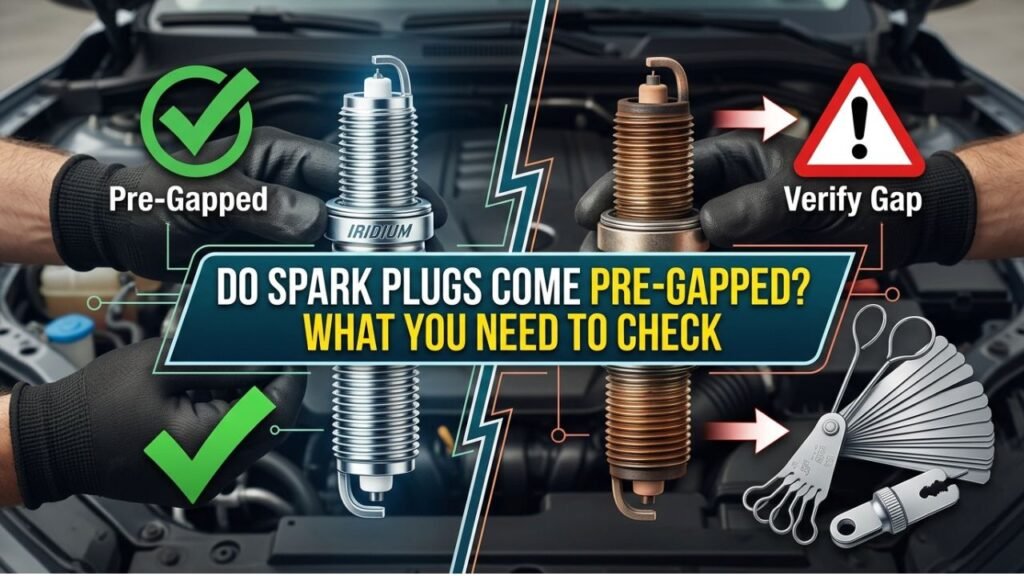
Most spark plugs sold for modern automotive applications are set to a predetermined gap during manufacturing.
That means when you open the box, there should already be space between the center electrode and the ground electrode.
In many vehicle-specific applications, that factory setting will already match the intended engine.
However, there is an important distinction between factory-gapped and guaranteed to match every engine that can use that plug part number.
A particular spark plug may sometimes be compatible with more than one engine or application. Those engines do not necessarily use exactly the same specified gap.
For that reason, the safest procedure is to compare the plug’s actual gap with the specification for your exact year, make, model, engine, and spark plug application.
Why You Should Check a Pre-Gapped Plug
Checking does not necessarily mean changing.
You may measure all of your new plugs and discover that every one is already exactly where it should be.
That is ideal.
But verification can identify a plug that was accidentally bent during transportation, dropped before installation, supplied for an application with a different required gap, or otherwise does not match your vehicle specification.
Checking each new plug takes little time compared with removing an intake manifold, ignition coils, or other components again because the engine misfires after installation.
Key Takeaways:
- Most modern spark plugs are factory-gapped before being sold.
- Pre-gapped does not always mean the setting matches every engine that can use that plug.
- Verify the gap against the specification for your exact engine before installation.
What Does Pre-Gapped Actually Mean?
A pre-gapped spark plug has had the distance between its center and ground electrodes set during manufacturing.
The manufacturer chooses a predetermined dimension based on the intended applications for that plug.
For example, one plug might leave the factory with a gap around 0.040 inch, while another might be set substantially narrower or wider.
Those numbers are only examples. There is no universal spark plug gap.
The correct specification depends on the engine and ignition system.
Spark Plug Gap Is an Engine Specification
Do not choose a gap simply because another vehicle uses it.
Two engines using visually similar spark plugs can have different ignition requirements.
Gap can vary because of differences in ignition-coil capability, cylinder pressure, combustion-chamber design, engine calibration, emissions requirements, and other engineering factors.
The correct specification should come from reliable service information for the vehicle or from the spark plug application information intended for that engine.
Pre-Gapped Does Not Mean Universal
This is where many DIY plug changes go wrong.
A driver buys the correct-looking plug, sees that there is already a gap, and assumes the distance must automatically be correct.
In many cases it is.
But you should confirm rather than assume.
Should You Gap New Spark Plugs?
You should generally check new spark plugs.
Whether you should adjust them is a separate question.
For a traditional adjustable plug, if the measured gap does not match the vehicle specification and the plug manufacturer allows adjustment, you can carefully move the ground electrode to the proper position.
For some modern fine-wire plugs, adjustment may be discouraged or specifically prohibited.
Always distinguish between these two actions:
Checking the gap means measuring the existing distance.
Gapping the plug means physically changing that distance.
You can check a plug without changing anything.
Follow the Plug Manufacturer’s Instructions
This becomes particularly important with premium iridium and platinum plugs.
Some product lines are designed with a factory-set gap and are intended to be installed as supplied.
Other fine-wire plugs may allow a small amount of adjustment, provided you use the correct method and never apply force to the delicate center electrode.
Do not assume all iridium plugs follow the same rule merely because they use the same electrode material.
Look at the instructions for the exact plug series.
How to Check a Pre-Gapped Spark Plug
Checking the gap is simple, but the correct tool and technique matter.
First identify the required gap for your engine.
Then remove the new plug from its box and inspect it before measuring.
The center electrode should look straight and undamaged. The ground electrode should not appear obviously bent sideways, and the ceramic insulator should have no visible cracks.
Use a Proper Spark Plug Gap Gauge
A wire-style gap gauge is an excellent option, particularly with modern fine-wire plugs.
Choose the wire corresponding to the required measurement and carefully pass it through the space between the electrodes.
You are looking for light, controlled resistance.
The gauge should not fall through with a large amount of clearance, but you also should not force it through.
Avoid Forcing Gauges Against Fine Electrodes
Modern iridium center electrodes can be extremely thin.
They are designed that way to concentrate the electric field and provide durable ignition performance—not to act as leverage points for a steel gapping tool.
Measure gently.
If you need to adjust an approved adjustable plug, move only the ground electrode using a suitable tool.
Do not pry between the electrodes.
Are Iridium Spark Plugs Pre-Gapped?
Most automotive iridium spark plugs are supplied with a factory-set gap.
However, what you should do with that gap depends on the particular product line.
Some iridium plugs can be carefully adjusted within limited parameters.
Others are explicitly intended to be installed at their factory setting and should not be regapped.
This is why blanket statements such as “never gap an iridium plug” or “always gap every spark plug” are both too simplistic.
Why Iridium Plugs Need Extra Care
Iridium is extremely hard and resistant to wear, allowing manufacturers to use a very fine center electrode.
That fine electrode is excellent for spark performance and durability, but its size makes it easier to damage with incorrect handling.
If a conventional wedge-style tool is jammed between the electrodes and twisted, it can place sideways pressure on the center electrode.
The electrode or surrounding ceramic can be damaged even when the damage is not immediately obvious.
Check Without Aggressively Adjusting
If you purchase the exact iridium plug specified for your engine and the measured gap matches the specification, leave it alone.
There is no benefit to bending the ground strap simply because you have a gapping tool available.
If it does not match, check the plug manufacturer’s instructions before attempting an adjustment.
Are Platinum Spark Plugs Pre-Gapped?
Most modern platinum spark plugs also arrive with a factory-set gap.
As with iridium plugs, some fine-wire platinum designs require special care.
A traditional single-platinum plug may have a platinum element on one electrode, while double-platinum and fine-wire designs can use precious metal in different ways.
You should not assume every platinum plug can be adjusted like an old conventional nickel plug.
The safest procedure is the same:
Verify the plug part number.
Check the vehicle’s gap specification.
Measure carefully.
Only adjust the plug if the manufacturer allows it.
Do Not Confuse Electrode Material With Gap Specification
An engine does not require a certain gap simply because the plug is platinum or iridium.
Gap is determined by the application.
If you replace an older-style plug with an approved iridium equivalent, use the specification associated with that exact engine and replacement plug rather than inventing a new gap based on electrode material.
Key Takeaways:
- Iridium and platinum spark plugs generally arrive factory-gapped.
- Some fine-wire plugs allow limited adjustment, while others are intended to remain at the factory setting.
- Never use the delicate center electrode as leverage when adjusting an approved fine-wire plug.
Can Spark Plug Gaps Change During Shipping?
They can.
Spark plugs are packaged to protect their electrodes, but boxes are transported, stacked, dropped, and handled before reaching you.
If enough force reaches the ground electrode, its position can change.
A plug that has been dropped directly onto its firing end deserves particularly careful inspection.
If the electrode is badly bent, the ceramic is damaged, or the plug has suffered an obvious impact, replacing it may be smarter than trying to rescue a questionable new part.
Why Checking All the Plugs Makes Sense
Suppose your six-cylinder engine requires six plugs.
Five may measure correctly and one may be noticeably different.
If you install all six without checking, one cylinder could behave differently from the others.
That does not guarantee a misfire, but there is no advantage to taking the chance when verification is easy.
Why Does Spark Plug Gap Matter?
The spark has to jump through the air-fuel environment between the two electrodes.
Increasing that distance generally increases the voltage required for the spark to cross it.
Modern ignition systems are designed around specific plug and gap requirements.
Changing the distance substantially can therefore change the demand placed on the ignition system.
What Happens if the Gap Is Too Wide?
A gap that is too wide requires more voltage to fire.
The problem may be especially noticeable during acceleration because increased cylinder pressure makes it more difficult for the spark to jump.
Symptoms can include hesitation, misfire, rough running under load, reduced power, and an illuminated check-engine light.
A very wide gap can also place additional demand on ignition components.
This is one reason worn plugs eventually become problematic: as the electrodes erode over time, the effective gap commonly becomes larger.
What Happens if the Gap Is Too Small?
A gap that is too narrow is not ideal either.
The spark has less space across which to expose the mixture to the initial ignition event.
An engine may still run, but the ignition system is no longer operating at the specification its designers intended.
Depending on the degree of error and engine conditions, combustion quality and performance can suffer.
The goal is not “the biggest gap possible” or “the smallest gap possible.”
The goal is the correct gap.
Do New Spark Plugs Ever Need Regapping?
Yes, some do.
This can happen when a plug part number is used across multiple compatible applications with different specified gaps or when the factory gap has shifted slightly during handling.
If the spark plug manufacturer allows adjustment, you can set the plug to your engine’s required specification.
How Much Adjustment Is Too Much?
A plug should not normally require dramatic reshaping to fit the intended application.
If the factory setting is far from your engine’s specification, stop and confirm that you purchased the correct part number.
Trying to turn a plug intended for one application into something completely different by bending its ground strap extensively is not a good substitute for buying the correct plug.
Modified Engines Are Different
Modified engines may use plug gaps that differ from stock specifications.
Forced induction, substantially increased cylinder pressure, upgraded ignition systems, racing applications, and custom engine calibrations can affect the gap selected by an experienced tuner.
If your engine is modified, do not automatically copy the original factory gap or a random internet recommendation.
Use specifications provided by the tuner, engine builder, ignition-system manufacturer, or other technically appropriate source for that particular setup.
How to Adjust Spark Plug Gap Safely
Only adjust the plug if its manufacturer permits it.
The ground electrode—the curved strap that extends over the center electrode—is the part that should be moved.
To Increase the Gap
Use a proper spark plug gapping tool that acts on the ground strap.
Move it outward slightly.
Then remeasure.
Do not insert a thick tool between the center and ground electrodes and pry against the center electrode.
To Decrease the Gap
Use an appropriate tool to move the ground electrode inward in a controlled manner.
Older instructions sometimes describe lightly tapping the ground electrode against a hard surface, but with modern fine-wire plugs I prefer using a dedicated tool whenever adjustment is permitted because it provides better control.
Remeasure after every small adjustment.
Make Small Changes
Do not repeatedly bend the ground strap backward and forward.
Metal can fatigue.
If you overshoot the gap slightly, correct it carefully, but repeated large movements suggest either poor technique or the wrong plug.
What Gap Tool Should You Use?
Several spark plug gap gauges exist.
A wire gauge is particularly useful because individual wires represent known gap dimensions and can measure the distance without wedging a tapered surface deeply between the electrodes.
Feeler gauges can also be appropriate in some applications.
Coin-style ramp gauges are common and inexpensive, but dragging a fine center electrode along a tapered metal edge or using the ramp to pry open a precious-metal plug is not ideal.
For modern iridium and platinum plugs, use a measuring method that minimizes contact with the center electrode.
Measuring and Adjusting Require Different Functions
A good tool should allow you to measure without bending anything.
If adjustment is needed, use a feature or separate tool designed to move the ground strap.
Do not treat the measuring surface itself as a pry bar unless the plug manufacturer specifically permits the method.
Should You Gap Spark Plugs Before or After Installing Them?
Always check the gap before installation.
Once the plug is threaded into the cylinder head, you cannot accurately measure or adjust the electrodes.
Checking beforehand also gives you an opportunity to inspect the plug for cracked ceramic, damaged threads, or a bent ground strap.
If something is wrong, it is much easier to deal with while the plug is still on your workbench.
Keep Plugs Organized
When working on a multi-cylinder engine, I like to verify all new plugs before removing too many components.
That way, you know the replacement set is correct before the vehicle is partially disassembled.
If a plug is damaged or incorrect, you can obtain a replacement without leaving the engine open unnecessarily.
How Do You Find the Correct Spark Plug Gap?
The most reliable specification is the one provided for your exact vehicle and engine.
Possible sources include the owner’s manual when listed, an underhood emissions label on some vehicles, a factory service manual, trusted service information, or the spark plug manufacturer’s application data.
Do not assume an old plug represents the correct specification.
It may be worn, incorrectly adjusted, or the wrong part installed by a previous owner.
Verify the Exact Engine
Vehicle model names can cover several engines.
A truck, SUV, or car may have been sold with multiple engine sizes during the same model year.
The gap for one engine should not automatically be applied to another.
Use the full vehicle and engine information when looking up plugs.
Does Spark Plug Type Change the Required Gap?
Not automatically.
Switching from a standard nickel plug to an approved platinum or iridium plug does not mean you should arbitrarily increase or decrease the gap.
Use the gap recommended for the engine and specific approved plug application.
Precious-metal electrodes mainly change properties such as electrode durability, size, and firing characteristics. They do not give you permission to ignore the vehicle specification.
Do Not Try to “Upgrade” by Opening the Gap
A larger gap can require more ignition voltage.
Opening it because you believe a bigger spark must be better can create misfires if the ignition system cannot reliably fire across the increased distance.
If an engine is stock, the factory specification is generally the appropriate target.
Signs the Spark Plug Gap May Be Wrong
An incorrect gap can produce symptoms similar to several other ignition and fuel-system problems, so symptoms alone cannot prove the gap is responsible.
A significantly incorrect gap may contribute to hard starting, rough idle, hesitation, loss of power, misfires, reduced fuel economy, or a check-engine light.
Problems can become more noticeable under acceleration or high load.
However, these symptoms can also come from ignition coils, injectors, vacuum leaks, compression problems, sensors, wiring, or many other faults.
If an engine develops a problem immediately after spark plug replacement, checking plug part numbers, installation, gap, and coil connections is a sensible first step.
Common Spark Plug Gapping Mistakes
One of the most common mistakes is assuming “pre-gapped” means “never measure.”
Another is going to the opposite extreme and automatically bending every new plug even when it is already correct.
Both approaches miss the point.
Verify first. Adjust only if necessary and permitted.
Another mistake is using a tapered coin tool aggressively on an iridium electrode. Fine-wire plugs need gentle measurement.
People also sometimes compare the new plug only with the old plug instead of checking the vehicle specification. An old electrode may have worn substantially enough to make its gap much larger than when new.
Finally, never correct a drastically wrong gap without first checking the part number. A major mismatch may be telling you that you bought the wrong spark plug.
Key Takeaways:
- Verify new spark plugs before installation, but do not change a correct factory setting unnecessarily.
- A drastically wrong factory gap should prompt you to confirm the plug part number.
- Use the vehicle’s specified gap rather than copying a worn plug removed from the engine.
Do You Need to Gap OEM Spark Plugs?
OEM-specification replacement plugs generally come configured for their intended applications and often require no adjustment.
Still, inspecting and checking them before installation is good practice.
This becomes especially easy when you purchase a vehicle-specific set and already know the required specification.
If every plug measures correctly, install them without bending the electrodes.
The goal is confirmation, not unnecessary adjustment.
What if the New Spark Plug Gap Is Slightly Different?
First determine whether the difference is real.
Measuring technique matters, particularly with small gaps.
Use an accurate gauge rather than visually estimating.
If the difference is outside the acceptable specification, check whether the plug is adjustable.
For an ordinary plug designed to be regapped, make a small correction to the ground electrode.
For a fine-wire plug whose manufacturer says not to adjust the factory setting, verify the part number. If the plug is correct but appears damaged or incorrectly gapped, replacing it is generally safer than forcing it into shape.
FAQs about Do Spark Plugs Come Pre Gapped
Do spark plugs come pre gapped?
Yes. Most modern automotive spark plugs are supplied with a factory-set gap.
You should still verify that the gap matches the specification for your exact engine before installing them.
Do NGK spark plugs come pre gapped?
NGK spark plugs are generally supplied with a preset factory gap. Depending on the plug and application, the gap may still need verification or adjustment.
Fine-wire plugs require particular care during measurement and adjustment.
Do DENSO spark plugs come pre gapped?
DENSO plugs are supplied with specified gaps, but the instructions vary by plug series. Some fine-wire iridium product lines are intended to remain at their preset gap.
Always follow the instructions for your exact plug.
Do Bosch spark plugs come pre gapped?
Bosch automotive spark plugs are generally supplied pre-gapped. Certain fine-wire Bosch plugs are intended to retain their factory-set gap rather than being adjusted.
Do iridium spark plugs need to be gapped?
They should be checked against the correct application specification, but whether they should be physically adjusted depends on the manufacturer and plug series.
Some manufacturers permit limited adjustment of the ground electrode, while other iridium plugs should not be regapped.
Can you damage an iridium plug while gapping it?
Yes.
Prying against the fine center electrode can damage the electrode or insulator.
If adjustment is allowed, move only the ground electrode using an appropriate tool.
Should I gap platinum spark plugs?
Check them first.
Only adjust a platinum plug if its manufacturer permits adjustment and the measured gap does not match the required specification.
Can spark plugs lose their gap during shipping?
The ground electrode can potentially be moved if a plug receives an impact during shipping, handling, or after being removed from its package.
That is one reason verification before installation is worthwhile.
What happens if I install spark plugs without checking the gap?
If the factory setting is correct, nothing unusual may happen.
If one or more plugs have an incorrect gap, you could experience misfires, hesitation, rough running, or other ignition problems.
What happens if the spark plug gap is too wide?
The ignition system requires more voltage to jump a wider gap.
If the gap exceeds what the system can reliably fire, especially under high cylinder pressure, misfires can occur.
What happens if the spark plug gap is too small?
The plug may still fire, but the spark configuration will not match the intended engine specification.
Performance and combustion quality can suffer depending on how far the gap is from the correct setting.
Can I use the old spark plug to determine the gap?
Do not rely on it.
Spark plug electrodes wear, and the gap can grow during service.
Use the specified gap for the vehicle instead.
Do all vehicles use the same spark plug gap?
No.
Spark plug gaps differ among engines and ignition systems.
Always look up the specification for your exact vehicle and engine.
Should I use a coin-style spark plug gap tool?
It can work with some conventional plugs, but fine-wire precious-metal plugs require extra care.
A wire-style gauge is often a better choice for checking iridium and platinum plugs without unnecessarily stressing the center electrode.
Can a wrong spark plug gap cause a misfire?
Yes.
A gap that is significantly too wide can increase the voltage requirement enough to cause misfires, especially under load.
Other gap errors can also contribute to poor ignition performance.
Should modified engines use the factory spark plug gap?
Not necessarily.
Engines with forced induction, higher cylinder pressure, upgraded ignition systems, or other major modifications may require a different gap determined by the tuner, engine builder, or relevant component manufacturer.
Conclusion
Do spark plugs come pre gapped? Yes, most modern spark plugs leave the factory with the electrodes already set to a predetermined gap. In many vehicle-specific applications, that setting will already be correct and no adjustment will be required.
But pre-gapped should not mean unchecked.
Before installation, verify the actual gap against the specification for your exact vehicle and engine. This confirms that you have the correct plug and helps identify an electrode that may have moved during handling.
If the gap is correct, leave it alone.
If it is incorrect, first confirm the part number and then determine whether the manufacturer allows the plug to be adjusted. Conventional plugs are often straightforward to regap by moving the ground electrode, while fine-wire iridium and platinum plugs require much greater care. Some are specifically designed to remain at their factory-set gap.
Never pry against a delicate center electrode simply to hit a number on your gauge.
For most DIY spark plug replacements, the best rule is simple: buy the exact plug specified for the engine, verify the factory gap before installation, and only adjust it when the plug manufacturer says adjustment is acceptable.