
If you are comparing glow plug vs spark plug, the main difference is that spark plugs create an electrical spark to ignite the air-fuel mixture in gasoline engines, while glow plugs heat the combustion chamber to help diesel engines start, especially when cold. Spark plugs normally operate continuously while a gasoline engine is running, whereas glow plugs are used mainly during starting and, on many modern diesels, for a period before or after startup.
Although both components screw into an engine’s cylinder head and are part of the combustion process, they perform fundamentally different jobs. A spark plug is an ignition device. A glow plug is primarily a heating device.
That distinction comes from the way gasoline and diesel engines ignite fuel. Gasoline engines generally rely on spark ignition. Diesel engines use compression ignition: air is compressed until its temperature becomes high enough for injected diesel fuel to ignite. During cold starts, however, the metal engine components absorb heat, making combustion more difficult. Glow plugs compensate by heating the area around the combustion chamber.
Because the two components look somewhat similar, it is easy to assume that a glow plug is simply a diesel version of a spark plug. That is not quite correct. Their operating principles, electrical systems, failure symptoms, service intervals, and replacement procedures differ substantially.
In this guide, I’ll compare glow plug vs spark plug operation, explain where each is used, how long each lasts, what happens when one fails, whether diesel engines ever use spark plugs, and which component requires more maintenance.
Glow Plug vs Spark Plug: What’s the Main Difference?
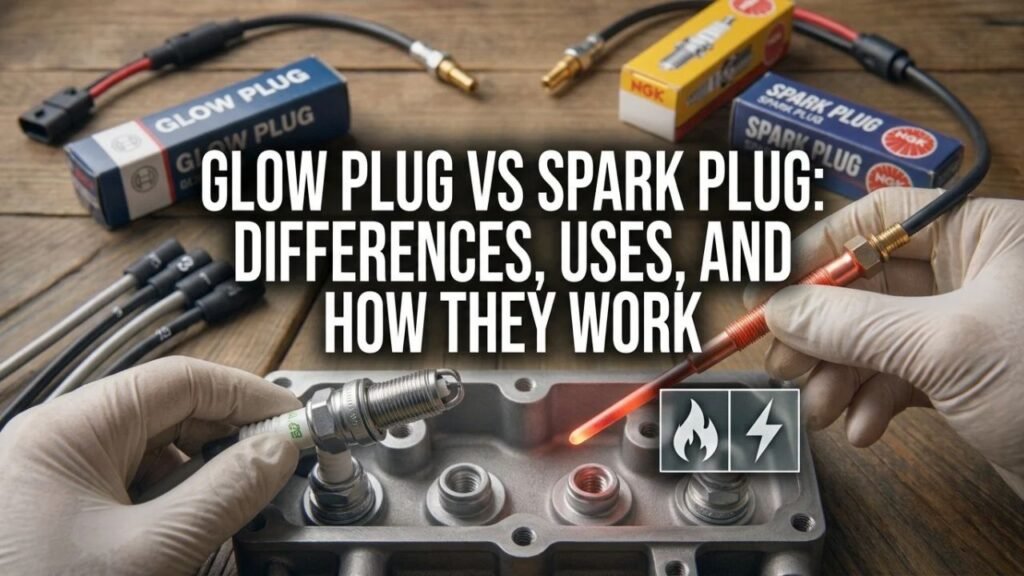
A spark plug creates a spark.
A glow plug creates heat.
That is the simplest way to remember the difference.
A gasoline engine mixes fuel with air and then needs a precisely timed ignition source. The ignition coil sends high voltage to the spark plug, electricity jumps across the electrode gap, and the resulting spark starts combustion.
A diesel engine works differently. It compresses air so heavily that the air becomes very hot. Diesel fuel is then injected into that hot compressed air and ignites without an electrical spark.
When the diesel engine is cold, however, achieving reliable ignition can be more difficult. The glow plug becomes extremely hot and raises the temperature near the combustion chamber to improve starting and early combustion.
Quick Glow Plug vs Spark Plug Comparison
| Feature | Spark Plug | Glow Plug |
| Main engine type | Gasoline | Diesel |
| Main function | Creates ignition spark | Produces heat |
| Ignition method | Spark ignition | Compression ignition |
| Operates while engine runs | Continuously | Mainly startup/warm-up, depending on system |
| Connected to | Ignition coil/wire | Glow plug controller/relay |
| Has electrode gap | Yes | No conventional spark gap |
| Major failure symptom | Misfire | Difficult cold starting |
| Typical quantity | Usually one per cylinder | Usually one per cylinder |
The exact system varies by engine, but this comparison covers the basic principle.
Key Takeaways:
- Spark plugs ignite gasoline with an electrical arc.
- Glow plugs heat diesel combustion chambers rather than creating ignition sparks.
- They may look similar, but they are not interchangeable.
How Does a Spark Plug Work?
A spark plug sits in the cylinder head with its firing end exposed to the combustion chamber.
The ignition system sends high voltage to the plug at exactly the right point in the engine cycle.
That voltage travels through the center electrode.
When the voltage becomes high enough, electricity jumps across the small gap between the center electrode and ground electrode.
This creates a spark.
The spark ignites the compressed air-fuel mixture, causing combustion that pushes the piston downward.
This happens repeatedly while the engine is running.
Spark Plugs Fire Continuously
In a normal gasoline engine, spark plugs do not operate only during startup.
They fire thousands of times per minute as engine speed increases.
At 3,000 RPM, each plug in a typical four-stroke engine is firing roughly 1,500 times per minute.
That is why electrode durability matters.
Modern platinum and iridium plugs can survive many millions of firing cycles while maintaining a usable electrode gap.
How Does a Glow Plug Work?
A glow plug operates more like a miniature electric heating element.
Electrical current passes through a resistance element inside the plug, causing the tip to become extremely hot.
That hot tip protrudes into or near the combustion chamber.
When the engine is cold, the added heat helps the compressed air reach conditions favorable for diesel ignition.
Pre-Glow
Before starting many diesel engines, the glow plug system activates for a short period.
This is sometimes called pre-glow or pre-heating.
Older diesel vehicles may display a dashboard glow-plug light that instructs the driver to wait before cranking.
Modern systems often control the process automatically and can heat much faster.
Post-Glow
Many modern diesel engines continue operating the glow plugs after the engine starts.
This post-glow operation can improve cold combustion, reduce smoke, stabilize idle, and lower emissions while the engine warms.
So it is not entirely accurate to say glow plugs turn off immediately once the engine starts.
Why Gasoline Engines Need Spark Plugs
Gasoline does not normally ignite simply because the piston compresses the mixture under ordinary gasoline-engine operating conditions.
The engine needs a controlled ignition event at a precise crankshaft position.
Spark plugs provide that event.
The engine control module decides when the spark should occur, and the ignition system supplies the necessary voltage.
Changing spark timing can significantly affect power, efficiency, emissions, and engine safety.
Why Gasoline Engines Don’t Use Glow Plugs Instead
A heated tip would not provide the precise ignition timing required in a conventional gasoline engine.
The air-fuel mixture could ignite unpredictably rather than at the exact commanded moment.
Spark ignition gives the engine management system precise control over combustion timing.
Why Diesel Engines Usually Don’t Need Spark Plugs
Diesel engines use much higher compression ratios than typical gasoline engines.
During the compression stroke, the piston squeezes air into a small volume.
Compressing the air raises its temperature dramatically.
Fuel is then injected into the hot compressed air.
The diesel fuel begins burning without requiring an electrical spark.
This is why diesel engines are called compression-ignition engines.
What the Glow Plug Adds
During a cold start, heat from compression can be absorbed rapidly by the cold cylinder head, piston, and surrounding components.
A glow plug provides an additional hot surface in the combustion area.
That makes the first few combustion events easier and more stable.
Once a diesel engine is sufficiently warm, normal compression provides much of the heat required for ignition.
Glow Plug vs Spark Plug Design
The physical designs reflect their different jobs.
A spark plug has a center electrode, ceramic insulator, metal shell, threaded body, ground electrode, and a precisely controlled spark gap.
Depending on the design, the firing electrodes may use nickel alloy, platinum, iridium, or other materials.
A glow plug does not need an exposed spark gap.
Instead, it has a heating element inside a narrow tip.
Metal Glow Plugs
Traditional glow plugs commonly use a metal heating tube containing the heating element.
They are durable and widely used.
Ceramic Glow Plugs
Some modern diesel engines use ceramic glow plugs.
Ceramic designs can heat extremely quickly and reach high operating temperatures.
They may also support advanced emissions-control strategies.
However, ceramic glow plugs can require particularly careful handling because physical damage can make them unsafe to reuse.
Does Every Cylinder Have Its Own Glow Plug or Spark Plug?
Usually, yes.
A four-cylinder gasoline engine generally has four spark plugs.
A six-cylinder gasoline engine generally has six.
Likewise, a four-cylinder diesel engine commonly has four glow plugs, and a six-cylinder diesel normally has six.
However, engine designs vary.
Some gasoline engines have used two spark plugs per cylinder.
Certain diesel engines may use alternative cold-start systems instead of conventional glow plugs.
Always identify the specific engine rather than relying entirely on cylinder count.
Glow Plug vs Spark Plug Electrical System
The electrical requirements differ dramatically.
Spark Plug Voltage
A spark plug does not normally receive ordinary battery voltage directly.
An ignition coil transforms the vehicle’s lower-voltage electrical supply into very high voltage.
That high voltage may reach tens of thousands of volts because it needs to jump the spark plug gap under cylinder pressure.
Glow Plug Current
Glow plugs typically operate from the vehicle’s electrical system through a controller, relay, or dedicated module.
Rather than generating a high-voltage arc, they draw substantial electrical current to produce heat.
This is why diesel glow-plug systems can place a noticeable load on the battery during cold starting.
A weak battery can therefore make cold diesel starting more difficult even when the glow plugs themselves are functional.
Glow Plug vs Spark Plug Failure Symptoms
The symptoms are often quite different.
A failing spark plug affects the ignition of a gasoline engine while it is running.
A failing glow plug is often most noticeable during cold starting.
Common Bad Spark Plug Symptoms
A worn, fouled, or damaged spark plug can cause rough idle, hesitation, misfire, hard starting, reduced power, or poor fuel economy.
The check-engine light may illuminate if the engine computer detects repeated misfires.
A failing spark plug can affect the engine at almost any temperature or operating condition.
Common Bad Glow Plug Symptoms
A failed glow plug commonly causes difficult cold starting.
The engine may need extended cranking before it starts.
Once it starts, you may notice rough running, white or gray exhaust smoke, uneven combustion, or a glow-plug warning light.
The symptoms can improve significantly after the diesel engine warms up.
One Failed Glow Plug May Be Hard to Notice
A diesel engine may still start when only one glow plug fails, especially in warm weather.
The problem often becomes much more obvious in winter.
If several glow plugs fail, cold starting can become extremely difficult or impossible.
Key Takeaways:
- Spark plug problems usually cause running misfires as well as starting problems.
- Glow plug problems are commonly worst during cold starts.
- Both systems can trigger warning lights or diagnostic trouble codes.
How Long Do Spark Plugs Last?
Spark plug life varies widely depending on electrode material and engine design.
Conventional nickel-electrode plugs generally have shorter service intervals.
Platinum and iridium spark plugs can last considerably longer.
Some modern vehicles specify spark plug replacement intervals approaching or exceeding 100,000 miles, while others require much earlier replacement.
The vehicle’s maintenance schedule should always be your primary guide.
Why Spark Plugs Wear Out
Each firing event causes tiny amounts of electrode erosion.
Over time, the gap can grow larger.
The plug may also accumulate deposits or become contaminated by oil, excessive fuel, or combustion problems.
Eventually, ignition voltage demand can become high enough to produce misfire.
How Long Do Glow Plugs Last?
Glow plugs do not have the same predictable maintenance interval across all diesel engines.
Some can remain functional for well over 100,000 miles, while others fail sooner because of heat cycles, electrical problems, carbon accumulation, or engine conditions.
Many manufacturers do not specify routine glow-plug replacement at the same fixed interval used for spark plugs.
Instead, the plugs may be tested when cold-start problems or glow-system fault codes appear.
Why Glow Plugs Fail
The heating element undergoes repeated thermal cycling from cold to extremely hot.
Over time, it can burn out, develop excessive resistance, or fail electrically.
Carbon accumulation around the tip can also complicate removal.
Controller or relay problems can damage glow plugs if they are energized incorrectly.
Are Glow Plugs More Expensive Than Spark Plugs?
It depends on the specific engine and plug design.
Basic conventional spark plugs can be very inexpensive.
Premium iridium plugs cost more.
Glow plugs can also range from relatively affordable metal designs to expensive modern ceramic units.
Labor may matter more than part price.
On some engines, plugs are easy to reach.
On others, intake components, fuel-system parts, or other hardware must be removed.
A relatively inexpensive plug can therefore result in significant repair cost if access is difficult.
Is Replacing Glow Plugs Harder Than Replacing Spark Plugs?
It can be.
Both components thread into the cylinder head, but glow plugs can present special challenges.
Glow Plug Breakage
Glow plugs are typically long and narrow.
Carbon buildup and corrosion can make them difficult to remove.
If excessive force is used, a glow plug can break in the cylinder head.
Extracting the broken portion may require specialized tools and considerable labor.
Spark Plug Thread Problems
Spark plugs have their own risks.
Cross-threading or overtightening can damage aluminum cylinder-head threads.
A plug that is installed too loosely can also damage the threads and potentially blow out.
Both jobs require correct technique.
Do Glow Plugs Need a Gap?
No.
A glow plug does not create a spark between two electrodes, so there is no traditional spark plug gap to measure or adjust.
This is a major difference in the glow plug vs spark plug comparison.
Spark plug gap is a critical ignition specification.
Glow plug service focuses instead on electrical resistance, heating performance, condition of the tip, and control-circuit operation.
Can You Test a Glow Plug With a Multimeter?
Yes.
One common diagnostic method is checking electrical resistance between the glow plug terminal and ground.
A failed open-circuit glow plug may show no continuity.
However, acceptable resistance values can be very low and may vary by plug design.
Your multimeter leads themselves can contribute measurable resistance, so interpreting extremely low readings requires care.
Another diagnostic method is checking current draw or using scan-tool data on electronically controlled systems.
Do not automatically replace a glow plug simply because its resistance differs slightly from a generic internet value.
Use specifications for the exact engine.
Can You Test a Spark Plug With a Multimeter?
A multimeter can provide limited information about certain spark plugs, such as checking internal resistor continuity.
However, it cannot prove the plug will fire correctly under combustion pressure.
A spark plug may pass a basic resistance test and still misfire because of worn electrodes, cracked insulation, fouling, or excessive gap.
For spark-plug diagnosis, visual inspection, gap measurement, trouble codes, and ignition-system testing are usually more useful.
Do Glow Plugs Produce a Spark?
No.
A healthy glow plug does not work by creating a visible spark across an electrode gap.
Its tip becomes hot.
This is why the term “glow” is appropriate—the heating element can become extremely hot during operation.
If you are diagnosing a diesel and expecting to see glow plugs firing like spark plugs, you are testing for the wrong phenomenon.
Can a Diesel Engine Start Without Glow Plugs?
Sometimes.
A warm diesel engine may start normally even with failed glow plugs because compression heat is sufficient for ignition.
In hot weather, some diesel engines may also start with one or more failed glow plugs.
Cold weather is where the difference becomes obvious.
If the engine is cold and several glow plugs are not working, starting can become extremely difficult.
This makes intermittent winter starting problems a common clue.
Can a Gasoline Engine Run Without Spark Plugs?
A conventional gasoline spark-ignition engine cannot operate normally without its spark plugs or an equivalent ignition source.
Without a spark, the compressed air-fuel mixture will not ignite as intended.
If one spark plug fails, the engine may continue running on the remaining cylinders, but it will misfire and lose power.
Running with a severe misfire can also damage the catalytic converter by allowing unburned fuel into the exhaust.
Do Diesel Engines Ever Have Spark Plugs?
Conventional automotive diesel engines generally do not use spark plugs for combustion.
They use compression ignition.
However, specialized combustion systems and certain nontraditional engines can differ, so broad statements should always allow for exceptions.
For normal passenger-car and light-truck diesels, you should expect glow plugs rather than ignition spark plugs.
Do Gasoline Engines Ever Have Glow Plugs?
Conventional gasoline engines do not use diesel-style glow plugs for normal combustion.
Spark plugs perform their required ignition function.
Special experimental, model, industrial, or unusual combustion systems can differ, but this is not relevant to the average gasoline automobile.
Glow Plug vs Spark Plug Maintenance
Spark plugs are often scheduled maintenance parts.
Manufacturers commonly provide a mileage interval for replacement based on plug material and engine design.
Glow plugs are often more condition-based.
You may replace them when diagnostic codes, resistance tests, or cold-start symptoms show that one or more have failed.
Should You Replace All at Once?
For spark plugs, replacing the complete set is generally recommended when the scheduled service interval arrives.
All of the plugs have experienced approximately the same number of firing cycles.
For glow plugs, practices vary.
If one fails at high mileage, replacing the full set may make sense because the others have experienced similar heat cycles.
However, difficult accessibility and individual plug condition can influence the decision.
Spark Plug vs Glow Plug Replacement Cost
The total cost consists of parts plus labor.
Spark plug replacement can be cheap on an accessible four-cylinder engine but expensive on engines where intake manifolds or other components block access.
Glow plug replacement presents the same issue and can become more expensive if plugs are seized.
The possibility of breaking an old glow plug during removal can make diesel service particularly challenging.
When a glow plug has been installed for many years, patience and correct removal technique are important.
Can a Bad Glow Plug Cause a Misfire?
Yes, particularly during cold starting and the initial warm-up period.
A cold cylinder with inadequate glow-plug heat may fail to ignite diesel fuel consistently.
The result can feel like a misfire or rough running.
You may also see white exhaust smoke because injected fuel is not burning properly.
Once the engine warms, the symptom may disappear.
This behavior differs from a bad spark plug, which can continue misfiring during normal warm operation.
Can a Bad Spark Plug Cause Hard Starting?
Yes.
If one or more spark plugs cannot consistently ignite the mixture during cranking, a gasoline engine may take longer to start.
Multiple worn or fouled plugs can make the problem more noticeable.
However, starting problems also have many other possible causes, including weak batteries, fuel-pressure problems, sensors, injectors, and compression loss.
Glow Plug Warning Light vs Check-Engine Light
Many diesel vehicles have a glow-plug symbol on the dashboard.
During normal startup, it may illuminate briefly while preheating occurs and then switch off.
If the light flashes or behaves abnormally while driving, the meaning depends on the vehicle. It may indicate a glow-system fault or another engine-management issue.
Gasoline vehicles generally do not have a glow-plug light.
Spark-plug misfires are typically communicated through the check-engine light and stored diagnostic codes.
Which Is More Important: Glow Plug or Spark Plug?
Neither is universally more important because they serve different engines.
A gasoline engine fundamentally depends on spark plugs for normal combustion.
A diesel engine fundamentally depends on compression for combustion and uses glow plugs mainly to improve cold operation.
That means a diesel can sometimes continue running perfectly after a glow plug stops working.
A gasoline cylinder with no spark will generally misfire immediately.
From that perspective, spark plugs are continuously essential while a conventional gasoline engine operates, whereas glow plugs support combustion mainly when temperature conditions require assistance.
Key Takeaways:
- Spark plugs are continually required by gasoline engines during operation.
- Diesel engines may run normally after warm-up even if one glow plug has failed.
- Maintenance and failure symptoms differ because the two components perform different jobs.
Glow Plug vs Spark Plug: Which One Gets Hotter?
Both operate in an extremely hot environment, but the question is slightly misleading because they create or encounter heat differently.
A glow plug intentionally generates heat electrically and can reach very high temperatures rapidly during preheating.
A spark plug’s primary function is electrical discharge, although its firing end also becomes extremely hot because it is exposed to combustion.
Spark plugs are designed with specific heat ranges that control how quickly heat travels from the firing end into the cylinder head.
A “hotter” spark plug does not mean it generates a more powerful spark. It means its construction retains more heat at the firing end.
Can You Clean Glow Plugs or Spark Plugs Instead of Replacing Them?
Cleaning may sometimes remove surface deposits, but it does not repair an electrically failed glow plug or restore worn spark plug electrodes.
For spark plugs, cleaning an old worn plug may make it look better while leaving enlarged gaps and rounded electrodes unchanged.
For glow plugs, a failed internal heating element cannot be repaired by cleaning the tip.
Replacement is normally the appropriate solution when either component has genuinely failed.
How to Choose the Correct Spark Plug or Glow Plug
Always select parts by exact engine application.
For a spark plug, important specifications include thread diameter, reach, seat design, heat range, resistor design, electrode configuration, and gap.
For a glow plug, length, thread design, operating voltage, temperature characteristics, heating speed, and control-system compatibility matter.
A part that physically screws into the cylinder head is not necessarily correct.
This is particularly important with modern electronically controlled glow-plug systems, where operating voltage may differ significantly between designs.
FAQs about glow plug vs spark plug
What is the main difference between a glow plug and a spark plug?
A spark plug creates an electrical spark to ignite gasoline.
A glow plug creates heat to help a diesel engine ignite fuel during cold operation.
Are glow plugs used in diesel engines?
Yes.
Most automotive glow-plug systems are found in diesel engines.
Are spark plugs used in diesel engines?
Conventional automotive diesel engines do not normally use spark plugs because diesel fuel ignites through compression heat.
Do gasoline engines use glow plugs?
Conventional gasoline engines use spark plugs rather than diesel-style glow plugs.
Does a glow plug create a spark?
No.
It operates as a heating element.
Does a spark plug get hot?
Yes.
Its firing end is exposed to combustion heat, but its main job is generating an electrical spark.
Does a glow plug have a gap?
No.
Glow plugs do not use the adjustable firing gap found on spark plugs.
Does every diesel cylinder have a glow plug?
Most automotive diesel engines using glow plugs have one per cylinder, although engine designs can vary.
Does every gasoline cylinder have a spark plug?
Usually at least one, although some engines use two spark plugs per cylinder.
Can a diesel run with a bad glow plug?
Yes, especially after the engine is warm.
Cold starting may become harder, particularly if several glow plugs have failed.
Can a gasoline engine run with a bad spark plug?
It may continue running on the other cylinders, but the affected cylinder can misfire and the engine will not run properly.
What are the symptoms of a bad glow plug?
Common symptoms include difficult cold starting, extended cranking, rough cold idle, white smoke, and glow-system warning codes.
What are the symptoms of a bad spark plug?
Common symptoms include misfire, rough idle, hesitation, reduced power, hard starting, and a check-engine light.
Which lasts longer, glow plugs or spark plugs?
There is no universal answer.
Modern precious-metal spark plugs can last a very long time, and good glow plugs can also remain functional for high mileage.
Follow application-specific service guidance.
Are glow plugs expensive to replace?
The plugs themselves vary in price, but labor can become expensive if access is difficult or a plug becomes seized or breaks during removal.
Are spark plugs easier to replace?
Often, but not always.
Some gasoline engines place spark plugs beneath intake components or in very deep wells, making replacement labor-intensive.
Can a bad glow plug cause white smoke?
Yes.
Poor cold combustion can allow partially burned or unburned diesel fuel to produce white or light-colored exhaust smoke during startup.
Can a bad spark plug cause black smoke?
A spark-related misfire can affect combustion, but black exhaust smoke more commonly suggests an overly rich air-fuel condition.
Diagnosis should not rely on smoke color alone.
Can you test glow plugs with a multimeter?
Yes.
Resistance or continuity testing can identify some failed glow plugs, although the correct values depend on the specific system.
Can you test spark plugs with a multimeter?
A multimeter can check certain internal resistance conditions but cannot fully prove how the plug will perform under combustion pressure.
Can I replace only one glow plug?
Yes in some cases, but if all plugs are old and one has failed from normal age, replacing the set may be worth considering.
Can I replace only one spark plug?
You can, but if the entire set has reached its scheduled service interval, replacing all spark plugs is normally better.
Conclusion
When comparing glow plug vs spark plug, the most important difference is their purpose.
A spark plug creates a precisely timed electrical spark that ignites the air-fuel mixture in a gasoline engine. It continues firing throughout normal engine operation.
A glow plug produces heat that helps a diesel engine start and burn fuel cleanly when the combustion chamber is cold. Diesel engines normally rely on compression rather than electrical sparks for ignition once operating conditions are sufficient.
Spark plugs contain firing electrodes separated by a carefully controlled gap. Glow plugs contain heating elements and do not have a traditional spark gap.
Their failure symptoms are also different. A worn spark plug commonly causes misfires, hesitation, rough idle, and reduced power while driving. A failed glow plug is most likely to cause difficult cold starts, rough operation immediately after startup, and white smoke until the diesel warms.
Neither component is an upgraded version of the other, and they cannot be substituted for one another.
For a gasoline engine, use the exact spark plugs specified for the vehicle and replace them according to the maintenance schedule. For a diesel, diagnose the glow-plug system when cold-start performance deteriorates or glow-system fault codes appear.
The easiest way to remember the glow plug vs spark plug difference is simple: spark plugs ignite gasoline with a spark; glow plugs help diesel ignite by adding heat.