
How long NGK spark plugs last depends on the plug type and vehicle: NGK says Iridium IX plugs are typically designed for about 40,000–50,000 miles, while its OE-style Laser Iridium plugs are typically designed for roughly 80,000–100,000 miles. The vehicle manufacturer’s scheduled replacement interval should still take priority over a generic mileage estimate.
NGK also makes standard nickel, platinum, Laser Platinum, Ruthenium HX, and application-specific OE plugs. Their useful life can vary considerably because electrode material, ignition-system design, engine operating conditions, and the original equipment specification all affect how quickly a plug wears.
NGK Spark Plug Lifespan Depends on the Type
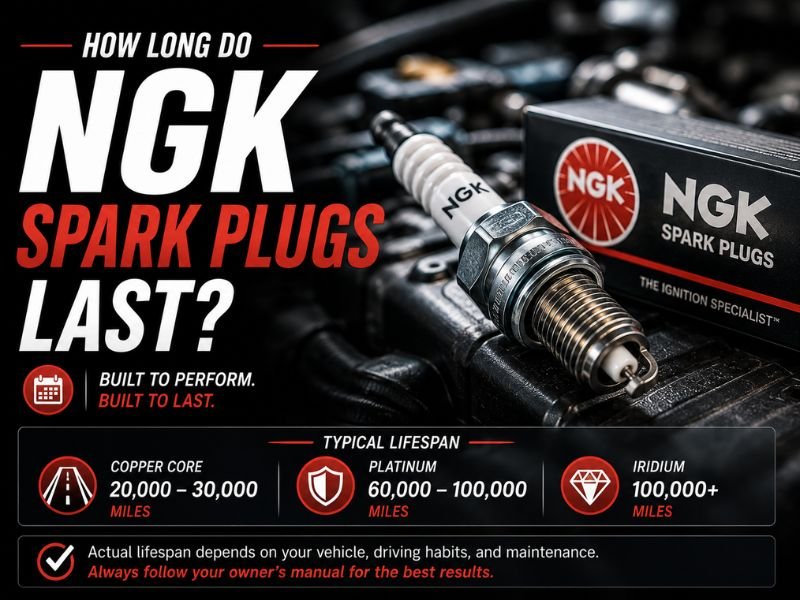
There is no single mileage interval for every NGK spark plug.
The easiest mistake is assuming that every plug from the same manufacturer lasts approximately the same amount of time. In reality, NGK designs different product families for different priorities, including affordability, OE replacement, performance, ignitability, and extended durability.
A useful general comparison looks like this:
| NGK Spark Plug Type | General Service-Life Characteristic |
| Nickel / V-Power | Usually shorter interval |
| G-Power Platinum | Longer-lasting than standard nickel |
| Iridium IX | Typically 40,000–50,000 miles |
| Laser Platinum | Long-life OE-style design; interval varies by vehicle |
| Laser Iridium | Typically 80,000–100,000 miles |
| Ruthenium HX | High-durability aftermarket design; use application-specific interval |
NGK specifically states that G-Power and Laser Platinum provide longer service intervals than standard nickel plugs, while its Iridium IX and Laser Iridium families have distinctly different service-life targets despite both using iridium.
How Long Do NGK Iridium IX Spark Plugs Last?
NGK says Iridium IX spark plugs are typically designed for approximately 40,000 to 50,000 miles.
This sometimes surprises drivers because iridium is commonly associated with 100,000-mile spark plugs.
The difference comes down to design.
NGK describes Iridium IX as a single precious-metal aftermarket performance plug. It uses a fine-wire iridium center electrode and is intended to provide strong ignitability and performance, but it is not the same construction as NGK’s long-life OE Laser Iridium plugs.
So an NGK plug can contain iridium without automatically being intended for a 100,000-mile service interval.
How Long Do NGK Laser Iridium Spark Plugs Last?
NGK says Laser Iridium plugs are typically designed to last approximately 80,000 to 100,000 miles.
These plugs are designed as OE-style replacements and commonly use precious metal on both sides of the spark gap—an iridium center electrode combined with platinum on the ground electrode. NGK says this dual precious-metal construction is designed for maximum longevity.
Protecting both electrodes matters because both surfaces can wear as the spark plug accumulates ignition cycles.
However, even a Laser Iridium plug should not automatically be left in an engine until 100,000 miles.
NGK’s own vehicle-specific service reference shows Laser Iridium applications with intervals such as 45,000, 50,000, 60,000, and 75,000 miles, demonstrating that the engine manufacturer’s maintenance requirement can be substantially shorter than the plug family’s maximum typical lifespan.
What About NGK Platinum Spark Plugs?
NGK offers both G-Power Platinum and Laser Platinum spark plugs.
G-Power uses a fine-wire platinum center electrode, while Laser Platinum is an OE-style line designed alongside vehicle manufacturers. NGK states that both G-Power and Laser Platinum provide longer service intervals than its standard nickel plugs.
There is not one universal NGK platinum mileage.
For example, NGK’s application-specific service chart lists certain Laser Platinum applications at around 35,000 miles and others at around 60,000 miles. Those numbers are vehicle-specific rather than a general lifetime claim for every Laser Platinum plug.
This is another reason plug material alone should not determine your replacement schedule.
How Long Do Standard NGK Spark Plugs Last?
Standard NGK nickel-based plugs generally have shorter service intervals than precious-metal designs.
NGK’s vehicle-specific reference shows examples of V-Power plugs scheduled around 25,000 to 30,000 miles, although some applications differ.
Those figures should not be treated as a universal replacement rule for every V-Power plug.
The correct interval depends on the vehicle.
If your owner’s manual specifies 30,000 miles, follow that schedule. If the engine manufacturer specifies a different interval for the exact NGK part used in your application, use the vehicle-specific requirement.
How Long Do NGK Ruthenium HX Spark Plugs Last?
NGK positions Ruthenium HX as a highly durable precious-metal aftermarket plug for modern engines.
The company says ruthenium provides strong wear resistance and is designed to withstand the high-temperature operating conditions found in modern efficient engines. Its PSPE design is specifically intended to provide strong service life in turbocharged and supercharged applications.
NGK does not provide one universal mileage figure on its Ruthenium HX product information that should be applied to every vehicle.
Use the correct Ruthenium HX application and follow the vehicle or NGK application-specific replacement recommendation rather than assuming a fixed 80,000- or 100,000-mile interval.
Why Do NGK Spark Plugs Eventually Wear Out?
Every spark plug experiences electrode erosion.
As the plug fires repeatedly, tiny amounts of material are gradually removed from the center and ground electrodes. The originally sharp electrode edges become rounded, and the spark gap increases.
A larger gap requires greater ignition voltage.
NGK explains that eventually the ignition system must work harder to bridge the worn gap. Once the system can no longer consistently provide the required ignition energy, misfires and incomplete combustion can occur.
Precious metals such as platinum, iridium, and ruthenium are useful because they resist this erosion better than conventional electrode materials, allowing manufacturers to extend service life while maintaining a fine firing tip.
Why Can the Same NGK Plug Type Have Different Intervals?
The engine matters just as much as the plug.
NGK’s own service chart shows the same general plug technology receiving different scheduled intervals in different vehicles. Laser Iridium plugs, for example, appear with manufacturer-specific intervals ranging from around 45,000 miles to 75,000 miles in several applications, even though NGK describes the Laser Iridium family itself as typically designed for 80,000–100,000 miles.
Several factors contribute to this difference.
Engine combustion characteristics, turbocharging, ignition design, spark plug location, operating temperatures, required gap, and manufacturer maintenance strategy can all affect how a plug is used.
For this reason, NGK explicitly says the vehicle manufacturer’s recommendation is the best guide for determining replacement mileage.
Waste-Spark Ignition Can Affect Plug Life
Some older distributorless ignition systems use waste-spark ignition, where one ignition coil fires two plugs simultaneously.
NGK explains that electrode wear differs according to polarity in these systems. One plug may experience greater center-electrode wear while its paired plug experiences greater ground-electrode wear.
This is why such vehicles often use double precious-metal spark plugs.
NGK says dual precious-metal plugs reduce gap erosion and provide a longer service interval in waste-spark applications. Substituting a nickel or single precious-metal plug where a double precious-metal design is required can result in more aggressive gap erosion and shorter plug life.
Correct plug construction therefore matters as much as the brand.
Can NGK Spark Plugs Fail Before Their Mileage Interval?
Yes.
The published service interval assumes reasonably normal engine operation. A plug can become unusable much sooner if another condition damages or contaminates it.
For example, a spark plug can develop carbon deposits, oil fouling, fuel fouling, overheating, physical damage, or abnormal electrode wear. A cracked insulator or incorrect plug application can also cause ignition problems before normal electrode life is exhausted.
In those situations, mileage becomes secondary to actual condition.
A 20,000-mile plug that has been badly oil fouled may need replacement even if its normal design life is much longer.
Likewise, installing another expensive long-life plug without addressing the engine condition responsible for the fouling may cause the replacement to fail early too.
Do Modified Engines Shorten NGK Spark Plug Life?
They can.
Modified engines may operate under higher cylinder pressures, increased boost, richer mixtures, or different ignition requirements than the original factory calibration.
NGK markets Iridium IX in part toward performance and modified-engine applications, but the company still distinguishes its approximately 40,000–50,000-mile typical interval from the much longer OE Laser Iridium interval.
For heavily modified or competition engines, normal passenger-vehicle maintenance assumptions may no longer apply.
The plug may need inspection or replacement according to the tuner, engine builder, or actual operating conditions rather than a generic street-car mileage interval.
Signs Your NGK Spark Plugs May Need Replacement
Do not assume a plug is healthy simply because it has not yet reached a particular mileage.
As electrodes wear and gap increases, the ignition system must produce higher voltage. NGK says replacing worn plugs restores sharper electrode edges and can reduce misfires while restoring ignition-system efficiency.
Possible warning signs include hard starting, rough idle, hesitation, misfires, reduced acceleration, or declining fuel economy.
Those symptoms should still be diagnosed rather than automatically blamed on the spark plugs.
Ignition coils, injectors, wiring, compression problems, and other engine faults can produce similar symptoms.
Should You Replace NGK Plugs Even if They Still Work?
Yes, when the vehicle reaches its scheduled spark plug replacement interval.
A plug can continue producing some spark after its ideal service life has passed. That does not mean it is operating as efficiently as a new plug.
NGK explains that as electrode wear enlarges the gap, the required firing voltage rises and places increasing demand on the ignition system.
Scheduled replacement is intended to prevent the plugs from reaching the point where obvious misfires become the reminder that service was overdue.
That is why “How long can I physically make these plugs work?” is less useful than “When does my engine manufacturer recommend replacing them?”
Frequently Asked Questions
How Many Miles Do NGK Spark Plugs Last?
It depends on the plug and vehicle. NGK says Iridium IX typically lasts around 40,000–50,000 miles, while Laser Iridium is typically designed for approximately 80,000–100,000 miles. Other NGK plug types and individual applications have different intervals.
Do NGK Spark Plugs Last 100,000 Miles?
Some do. NGK Laser Iridium plugs are typically designed for approximately 80,000–100,000 miles, but the vehicle manufacturer may specify replacement sooner.
How Long Do NGK Iridium IX Plugs Last?
NGK states that Iridium IX plugs are typically designed for about 40,000–50,000 miles.
Why Don’t Iridium IX Plugs Last 100,000 Miles?
Iridium IX is a single precious-metal performance-oriented design, while NGK’s longer-lasting OE Laser Iridium plugs use dual precious metals to maximize durability.
Do NGK Platinum Plugs Last Longer Than Standard Plugs?
Yes. NGK states that its G-Power and Laser Platinum spark plugs provide longer service intervals than standard nickel spark plugs. Exact mileage still depends on the application.
How Long Do NGK V-Power Spark Plugs Last?
There is no single interval for every V-Power application. NGK’s vehicle service reference contains examples around 25,000–30,000 miles, but owners should follow their vehicle-specific maintenance schedule.
Are NGK Ruthenium Plugs Longer Lasting?
NGK markets Ruthenium HX for maximum durability and strong high-temperature wear resistance, particularly in demanding modern engines. Use the application-specific service recommendation rather than assuming one universal mileage.
Can NGK Spark Plugs Last Longer Than the Recommended Interval?
They may continue firing, but electrode wear increases spark gap and required ignition voltage. NGK recommends following the vehicle manufacturer’s replacement schedule rather than waiting for obvious failure.
Should I Replace NGK Plugs Early if the Engine Misfires?
Inspect and diagnose the engine. A damaged or fouled plug may require early replacement, but a misfire can also result from the coil, injector, wiring, compression, or other engine problems.
What Is the Best Way to Know When My NGK Plugs Need Changing?
Check the vehicle owner’s maintenance schedule and verify the exact NGK plug installed. NGK itself says the vehicle manufacturer’s recommendation is the best guide for spark plug replacement mileage.
How Long Do NGK Spark Plugs Last Overall?
How long NGK spark plugs last varies significantly by design: Iridium IX plugs are typically rated around 40,000–50,000 miles, while NGK Laser Iridium plugs are typically designed for approximately 80,000–100,000 miles. Nickel, platinum, Ruthenium HX, and individual OE applications can follow different schedules.
Do not judge replacement time from the NGK brand name or electrode material alone. Even within the Laser Iridium family, NGK’s application-specific reference shows that some vehicle manufacturers call for replacement well before 100,000 miles.
For the most reliable maintenance decision, identify the exact NGK part number installed in your engine and follow the vehicle manufacturer’s specified interval. NGK recommends that approach because real spark plug life depends on the engine and application—not simply how long the plug might continue producing a spark.