
If you are wondering what causes a spark plug to blow out, the most common reasons are damaged cylinder-head threads, incorrect spark plug torque, installing the wrong plug, cross-threading, insufficient thread engagement, or repeated loosening from improper installation. When the threads can no longer hold the plug securely against combustion pressure, the spark plug can suddenly eject from the cylinder head.
A spark plug blowout is more serious than an ordinary worn-plug problem. Combustion pressure inside the cylinder is high, and the spark plug relies on properly formed threads and correct clamping force to remain sealed in the head. If that mechanical connection becomes weak, combustion gases can begin escaping around the plug. Eventually, the remaining threads may strip and allow the plug to shoot out.
Sometimes a blowout occurs immediately after incorrect installation. In other cases, a spark plug may gradually loosen over hundreds or thousands of miles before damaging the threads enough to eject.
The problem is particularly associated with aluminum cylinder heads because aluminum threads can be damaged more easily than steel spark plug threads when a plug is overtorqued, cross-threaded, repeatedly installed incorrectly, or operated loose.
In this guide, I’ll explain what causes a spark plug to blow out, the warning signs before failure, what actually happens when the plug ejects, whether you can drive afterward, how damaged threads are repaired, and how to prevent the same problem from happening again.
What Causes a Spark Plug to Blow Out?
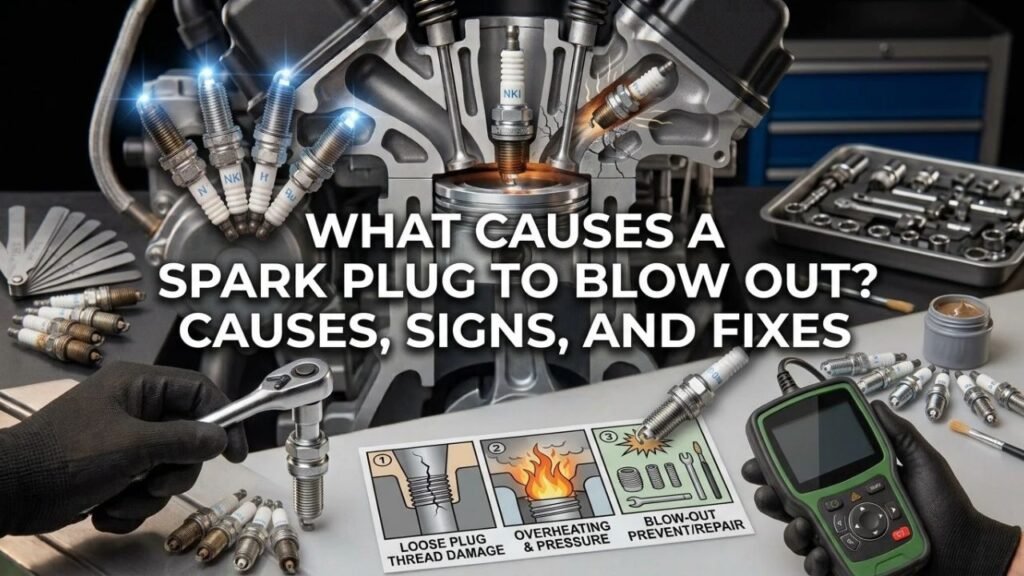
A spark plug normally stays in place because its threaded metal shell is screwed securely into matching threads in the cylinder head.
The plug is tightened enough to seal combustion pressure and transfer heat correctly into the head.
A blowout occurs when that threaded connection can no longer withstand the forces acting on it.
Several different problems can weaken that connection.
The most common are improper tightening, damaged threads, cross-threading, incorrect spark plug dimensions, and a plug that has gradually worked loose.
The Spark Plug Was Not Tightened Enough
An undertightened spark plug is one of the most important causes.
If the plug is not fully seated against its sealing surface, combustion pressure can escape around the threads.
You may initially hear a light ticking or puffing noise.
As the plug moves slightly during repeated combustion events, those high-pressure gases and mechanical loads can damage the cylinder-head threads.
The plug can then become progressively looser.
Eventually, the remaining threads may no longer be strong enough to hold it.
At that point, the plug can be forced out of the head.
The Spark Plug Was Overtightened
Too much torque can cause the opposite problem.
A spark plug does not become safer simply because it is tighter.
Overtightening can stretch the spark plug shell, damage the seat, distort the plug, or strip threads in an aluminum cylinder head.
The damage may not always cause an immediate blowout.
The threads can be weakened during one service and fail later after repeated heat cycles and combustion loads.
This is why following the correct torque specification matters.
The Plug Was Cross-Threaded
Cross-threading occurs when the plug enters the cylinder head at the wrong angle and its threads do not properly follow the existing threads.
A cross-threaded plug may become difficult to turn after only a small amount of engagement.
Forcing it farther can remove or deform cylinder-head material.
Even if the plug eventually appears tight, much of the original thread engagement may already have been destroyed.
That reduced holding strength makes a future blowout much more likely.
Cylinder-Head Threads Were Already Damaged
Sometimes the immediate installation is not the original cause.
The cylinder head may have been damaged during a previous spark plug replacement.
If several thread turns are stripped, the new plug may engage only a small portion of the remaining threads.
It can seem secure initially but fail when cylinder pressure and heat repeatedly load that limited contact area.
This is one reason a plug that suddenly becomes loose again after correct tightening should not simply be retightened repeatedly.
The threads themselves may need repair.
Key Takeaways:
- Spark plug blowout usually begins with a weakened threaded connection.
- Both undertightening and overtightening can contribute to failure.
- Cross-threading and previous cylinder-head damage are major warning signs.
How an Undertightened Spark Plug Leads to Blowout
A spark plug does more than sit in a threaded hole.
When tightened correctly, the plug’s gasket or tapered seat forms a combustion seal.
That seating load also keeps the threaded joint stable.
If the plug is left loose, it can move microscopically every time the cylinder fires.
That repeated movement is damaging.
Combustion Gas Starts Leaking
High-temperature combustion gases can escape past a loose plug.
Over time, those gases can erode deposits into the threads and surrounding area.
You may see dark carbon staining around the plug seat.
The escaping pressure can also create a distinctive tapping or chuffing sound.
The Plug Begins Hammering the Threads
A loose spark plug is repeatedly pushed against its threads by combustion pressure.
Instead of the load being distributed through a properly clamped threaded joint, the threads experience movement and impact.
Aluminum cylinder-head threads are especially vulnerable.
The plug may gradually remove material until only a small amount of thread engagement remains.
Eventually, a combustion event provides enough force to eject it.
Can Overtightening Cause a Spark Plug to Blow Out?
Yes.
This can seem counterintuitive because people often assume the tighter the plug is, the less likely it is to loosen.
But threaded fasteners work best within a designed clamping range.
Overtightening can damage the exact threads responsible for holding the plug.
Aluminum Heads Are Particularly Sensitive
Many modern engines use aluminum cylinder heads because aluminum reduces weight and transfers heat well.
The spark plug itself has steel threads.
Steel is harder than aluminum.
If a spark plug is forced beyond the correct tightening load, the harder steel threads can deform or strip the softer aluminum threads.
Once those threads are weakened, the plug may eventually pull out.
Overtightening Can Also Distort the Plug
Excessive torque can stretch the spark plug shell or damage the sealing area.
In severe cases, removal may later become difficult because the plug or threads have been distorted.
The correct approach is not maximum tightness.
It is correct torque.
Can the Wrong Spark Plug Cause a Blowout?
Yes, if the plug does not have the correct thread dimensions or reach.
Spark plugs can look very similar externally while having important differences.
Incorrect Thread Diameter or Pitch
A plug with the wrong thread diameter should obviously not be forced into the cylinder head.
But even a plug that appears close can destroy the threads if its pitch does not match.
If a plug does not thread smoothly by hand, stop immediately.
Do not use a ratchet to force it.
Incorrect Thread Reach
Reach is the length of the threaded section that extends into the cylinder head.
A plug with insufficient reach may engage fewer threads than the engine was designed to use.
Reduced engagement can reduce holding strength.
A plug with excessive reach creates a different set of dangers. It may extend too far into the combustion chamber, potentially interfering with engine components or accumulating deposits on exposed threads.
Use the exact plug specified for the engine.
Wrong Seat Type
Spark plugs may use a gasket seat or tapered seat.
These are not interchangeable simply because the threads happen to fit.
The seat helps establish the proper seal and installed position.
Using the wrong design can prevent correct clamping and create combustion leakage.
Can a Spark Plug Blow Out Because It Was Installed in a Hot Engine?
Servicing spark plugs in a very hot aluminum cylinder head can increase the chance of thread damage.
Aluminum expands significantly with heat.
For this reason, spark plug replacement is generally performed on an engine that has cooled unless the engine or plug manufacturer specifically provides another procedure.
Trying to remove a stubborn plug from an extremely hot aluminum head can increase the risk of thread problems.
Likewise, installing a new plug into hot threads can make achieving the intended final clamping condition more difficult.
For routine service, I recommend following the manufacturer’s temperature and installation instructions rather than removing plugs immediately after driving.
Can Carbon Buildup Cause a Plug to Blow Out?
Carbon is usually not the primary cause of a spark plug being ejected, but it can contribute to thread and installation problems.
Carbon may accumulate around a loose plug when combustion gases leak past the seat.
Deposits can also form on exposed threads in certain installations.
If a plug becomes difficult to remove because of deposits and excessive force is used, cylinder-head threads can be damaged.
The important distinction is that carbon by itself does not normally generate the mechanical failure.
The underlying issue is usually loose installation, damaged threads, improper plug design, or damage created during removal and installation.
What Happens When a Spark Plug Blows Out?
The engine will usually become extremely loud immediately.
The open spark plug hole allows cylinder pressure to escape directly into the engine compartment.
The sound can resemble a loud exhaust leak, sharp popping, or repetitive chuffing.
The affected cylinder usually stops producing normal power.
The Ignition Coil or Plug Wire May Be Damaged
On a coil-on-plug engine, the spark plug can eject upward into the ignition coil boot or coil assembly.
The sudden movement and escaping combustion gases can damage the boot, coil, connector, or surrounding wiring.
On an engine with spark plug wires, the plug may remain attached to the wire after leaving the cylinder head.
The Engine Will Misfire
With the spark plug no longer installed correctly, that cylinder cannot perform normal combustion.
The engine may shake heavily and lose power.
The check-engine light may illuminate or flash.
Hot Combustion Gas Escapes Into the Engine Bay
Each compression and combustion cycle pushes hot gases through the open hole.
That heat can damage nearby components if the engine continues running.
This is one reason you should not simply continue driving after a plug blowout.
What Does a Spark Plug Blowout Sound Like?
The sound is usually obvious.
Owners commonly describe it as a loud ticking, popping, chuffing, or exhaust-leak noise coming from the engine.
The frequency normally changes with engine RPM.
Before complete blowout, a loose plug may produce a quieter ticking sound.
That early warning should not be ignored.
A Ticking Spark Plug May Be Leaking Compression
A ticking noise near one spark plug location can indicate combustion pressure escaping around a loose plug.
The area may also develop black carbon staining.
Do not simply assume every ticking noise is a lifter or exhaust manifold leak.
If the sound began soon after spark plug replacement, inspect the plugs and their seating condition.
Key Takeaways:
- A blown-out spark plug usually produces an immediate loud popping or chuffing noise.
- A loose plug may tick before complete failure.
- Continuing to run the engine can damage the threads, ignition coil, and nearby components.
Warning Signs Before a Spark Plug Blows Out
Not every failure provides obvious advance warning, but several symptoms deserve attention.
Ticking or Puffing From the Plug Area
A rhythmic sound that increases with engine speed can indicate gas leakage around a loose plug.
This is one of the most important signs to investigate early.
Spark Plug Keeps Coming Loose
A correctly installed spark plug should not repeatedly work loose.
If the same plug has already been retightened and becomes loose again, stop treating it as a simple torque problem.
The cylinder-head threads or seating surface may be damaged.
Carbon Around the Spark Plug
Black soot or carbon staining around the spark plug hole can indicate combustion leakage.
Some surface contamination can have other causes, but heavy localized carbon around one plug deserves investigation.
Cylinder-Specific Misfire
A loose plug may produce a misfire before it completely ejects.
An OBD-II scanner may show a P030X code corresponding to that cylinder.
Plug Is Difficult to Tighten Correctly
If the spark plug turns unusually easily without reaching normal seating resistance, the threads may already be stripped.
If it becomes tight almost immediately after installation begins, it may be cross-threaded.
Either situation deserves attention before the engine is operated.
Why Do Aluminum Cylinder Heads Have Spark Plug Thread Problems?
Aluminum itself is not defective.
Millions of engines use aluminum heads successfully for very high mileage.
The issue is that aluminum is softer than the steel shell of the spark plug.
Correct installation is therefore particularly important.
If the plug is cross-threaded, overtightened, repeatedly removed incorrectly, or operated loose, the softer cylinder-head threads can be sacrificed first.
Once damaged, simply installing another steel plug cannot restore the missing aluminum.
The hole requires a proper thread repair.
Can a Spark Plug Blowout Damage the Cylinder Head?
Yes.
In fact, thread damage is often both a cause and a result of blowout.
As the plug leaves the head, it can strip the remaining threads.
Afterward, a replacement plug may no longer tighten securely.
The severity varies.
A small amount of damage may be repairable with a suitable threaded insert.
Severe damage, cracking, previous failed repairs, or unusual head designs may require more extensive machine work or cylinder-head replacement.
Can You Drive With a Blown-Out Spark Plug?
I would not recommend it.
The engine will be operating with one cylinder open through the spark plug hole.
You can experience severe misfire, loss of power, escaping hot gases, ignition-component damage, and additional thread damage.
A flashing check-engine light may also indicate a severe misfire condition.
If a plug has blown out while driving, shut the engine off as soon as you can do so safely and have the vehicle repaired.
Driving a significant distance can turn a repairable thread problem into a more expensive one.
Can You Put the Spark Plug Back In After It Blows Out?
Not until you inspect the threads.
If the plug blew out because the cylinder-head threads stripped, simply screwing it back in will not restore the original holding strength.
The plug may feel temporarily secure if a few damaged threads remain, but it can eject again.
That creates a safety risk and can cause more damage.
Inspect the Plug Too
Do not automatically reuse the ejected spark plug.
Its threads may be damaged, the ceramic may be cracked, and the ground electrode may have been hit.
The ignition coil or boot may also need inspection.
How Is a Blown-Out Spark Plug Repaired?
The correct repair depends on how much cylinder-head thread material remains.
The most common professional repair is installation of a thread insert designed for spark plug holes.
The damaged hole is machined or tapped to accept the insert, and the insert provides new correctly sized internal threads for the spark plug.
Thread Inserts
Several insert systems exist.
Some repairs use coil-style thread inserts, while others use solid steel inserts specifically designed for spark plug holes.
A quality insert repair can be durable when the head is suitable and the procedure is performed correctly.
The exact repair method depends on the engine, location, previous damage, and manufacturer recommendations.
Does the Cylinder Head Have to Come Off?
Not always.
Some spark plug thread-repair systems are designed to be installed with the cylinder head still on the engine.
However, keeping metal chips out of the cylinder becomes extremely important.
The repair procedure may involve piston positioning, grease on cutting tools, vacuum extraction, compressed air where appropriate, and other methods to control debris.
Because mistakes can introduce metal into the combustion chamber or leave the insert improperly aligned, I recommend professional repair if you are not experienced with this work.
When the Head May Need Removal
Head removal may be necessary when the hole is severely damaged, previous inserts have failed, the sealing surface is compromised, the head is cracked, or the correct repair cannot be performed accurately in place.
A machine shop can evaluate whether the head remains repairable.
Can You Repair Spark Plug Threads With a Helical Insert?
In some applications, yes.
Thread-repair inserts have been used successfully for damaged spark plug holes for many years.
However, not every insert system is equally appropriate for every engine.
Spark plug threads experience heat, repeated pressure cycles, and the need for reliable heat transfer.
Some applications benefit from a solid insert specifically designed for spark plug repair.
Use a repair system approved or widely accepted for the specific cylinder-head design rather than choosing the cheapest generic thread kit available.
How Much Does Spark Plug Blowout Repair Cost?
Repair cost varies too much to provide one reliable universal number.
Important factors include engine layout, spark plug accessibility, cylinder-head material, severity of thread damage, whether an insert has already failed, and whether the cylinder head must be removed.
A simple accessible insert repair can cost far less than removing and replacing a cylinder head.
This is another reason early diagnosis matters.
Repairing damaged threads before the plug repeatedly blows out can prevent additional damage to coils, wiring, and the head itself.
Can a Spark Plug Blow Out More Than Once?
Yes, particularly when the first failure was not repaired correctly.
If the damaged threads were simply chased with a tap and another plug installed without restoring sufficient thread engagement, the second plug may also eject.
A poorly installed repair insert can fail as well.
If a plug has blown out more than once from the same cylinder, I would have the hole inspected carefully before attempting another repair.
Repeated failures suggest that the underlying structural problem remains unresolved.
How to Prevent a Spark Plug From Blowing Out
Prevention is mainly about correct installation.
Use the Exact Spark Plug
Verify the application rather than selecting a plug because its threads appear to match.
Correct thread size, reach, seat, heat range, and plug design all matter.
Start the Spark Plug by Hand
This is one of the simplest and most effective ways to prevent thread damage.
Place the plug into the hole and turn it by hand for several rotations.
It should thread smoothly.
If you feel significant resistance immediately, stop and inspect the alignment.
Do not use a powered impact tool to start spark plugs.
Use the Correct Torque
Follow the vehicle or spark plug manufacturer’s installation specification.
A torque wrench is especially useful with aluminum cylinder heads.
Torque specifications can differ depending on plug size, seat type, cylinder-head material, and whether the plug uses a new crush gasket.
Do not use a generic torque number for every engine.
Be Careful With Thread Lubricants
Do not automatically apply anti-seize to spark plug threads.
Many modern spark plugs have plated threads and are designed to be installed dry unless otherwise specified.
Lubrication changes thread friction and can cause a torque wrench to create greater clamping force than intended.
That can lead to overtightening.
Follow the spark plug and engine manufacturer’s instructions for the exact application.
Avoid Repeated Unnecessary Removal
Spark plugs are service parts, but repeatedly removing and reinstalling them without a reason increases the opportunities for thread damage.
When plugs are removed, handle the cylinder-head threads carefully and start each plug correctly.
Key Takeaways:
- Hand-starting spark plugs greatly reduces cross-threading risk.
- Correct torque is essential; tighter is not safer.
- Do not automatically use anti-seize unless the specific plug or engine instructions call for it.
Can a Spark Plug Blow Out Because of High Compression or Boost?
High cylinder pressure increases the force acting on the spark plug, but a correctly designed and correctly installed spark plug connection should remain secure under the engine’s intended operating conditions.
If a modified engine produces substantially more cylinder pressure than stock, the threaded joint certainly experiences increased loading.
However, a properly intact spark plug hole should not normally eject a plug simply because the engine makes more power.
A blowout in such an engine still deserves investigation for insufficient thread engagement, prior damage, wrong plug reach, improper torque, or thread failure.
Do not treat the blowout as a normal consequence of boost.
Can Detonation Cause a Spark Plug to Blow Out?
Severe abnormal combustion creates unusually high cylinder-pressure spikes and can damage pistons, rings, plugs, head gaskets, and other components.
However, detonation is not the usual root cause of a spark plug physically ejecting from an otherwise healthy threaded hole.
If a plug blows out during an engine with serious detonation, inspect both the ignition/combustion problem and the mechanical condition of the threads.
There may be more than one fault.
Can a Loose Spark Plug Cause Engine Damage Before It Blows Out?
Yes.
A loose plug can overheat because proper seating helps conduct heat from the plug into the cylinder head.
Combustion gas leakage can damage threads and leave carbon deposits.
The ignition coil or boot may also be exposed to excessive heat.
If the plug becomes loose enough to misfire, unburned fuel may enter the exhaust and potentially overheat the catalytic converter.
A suspected loose plug should therefore be addressed before it ejects.
What Should You Do Immediately After a Spark Plug Blows Out?
Shut the engine off as soon as it is safe.
Allow the engine to cool before touching the plug area.
Inspect the spark plug, ignition coil or wire, plug hole, and surrounding components.
Do not restart the engine repeatedly to determine whether the noise goes away.
If the plug will not tighten normally by hand and to the proper torque, the threads need inspection and likely repair.
Keep foreign material out of the open spark plug hole.
If you are not equipped to inspect and repair cylinder-head threads correctly, have the vehicle transported to a qualified repair facility.
FAQs about what causes a spark plug to blow out
What causes a spark plug to blow out?
The most common causes are damaged cylinder-head threads, undertightening, overtightening, cross-threading, incorrect spark plug dimensions, or a plug that has repeatedly worked loose.
Can a loose spark plug blow out?
Yes.
A loose plug can move during combustion and gradually damage the cylinder-head threads until the plug is forced out.
Can overtightening a spark plug cause blowout?
Yes.
Excessive torque can strip or weaken cylinder-head threads, especially in aluminum heads, creating conditions for a later blowout.
Can cross-threading cause spark plug blowout?
Yes.
Cross-threading damages the threads and reduces the amount of material securely holding the plug.
Can the wrong spark plug blow out?
Yes, particularly if it has incorrect thread dimensions, reach, or seat design.
Always use the correct plug for the exact engine.
What does a loose spark plug sound like?
It can create a ticking, puffing, or chuffing noise that speeds up as engine RPM increases.
What does a blown-out spark plug sound like?
A full blowout usually creates a very loud popping or exhaust-like sound from the engine compartment, accompanied by severe misfire.
Will a blown-out spark plug cause a misfire?
Yes.
The affected cylinder can no longer perform normal combustion with the spark plug outside the cylinder head.
Can a blown spark plug cause the check-engine light to flash?
Yes.
The severe misfire can trigger a flashing check-engine light.
Can I drive after a spark plug blows out?
I do not recommend it.
Continuing to operate the engine can create additional thread damage, damage ignition components, and expose nearby parts to hot combustion gases.
Can I screw the spark plug back in?
Only if the cylinder-head threads are still intact and the cause is fully understood.
If the threads stripped during blowout, simply reinstalling the plug is not a reliable repair.
How do you fix stripped spark plug threads?
The common repair is installation of an appropriate threaded insert that restores the original spark plug thread size.
The exact procedure depends on the engine and severity of the damage.
Does the cylinder head have to be removed for thread repair?
Not always.
Some insert systems can be installed with the head in place, but correct chip control and alignment are critical.
Is a thread insert repair permanent?
A properly selected and correctly installed insert can provide a durable long-term repair.
Poor installation or severe head damage can lead to repeat failure.
Can an aluminum cylinder head be repaired after a spark plug blowout?
Often, yes.
Aluminum spark plug holes are commonly repaired with threaded inserts when the surrounding material is still suitable.
Can high compression blow a spark plug out?
Higher cylinder pressure increases loading, but a properly designed and undamaged threaded connection should hold the plug.
A blowout usually indicates a thread, installation, or plug-specification problem.
Can detonation blow out a spark plug?
Severe detonation creates abnormal pressure, but it is not the usual cause of plug ejection from healthy threads.
Inspect the threads and combustion problem separately.
Should spark plugs be installed with anti-seize?
Not automatically.
Many modern plugs have plated threads and are intended for dry installation. Follow the exact plug and engine manufacturer’s instructions.
Should you use a torque wrench on spark plugs?
I recommend one when a torque specification is available, particularly with aluminum cylinder heads.
Correct tightening helps prevent both loose plugs and thread damage.
Why does the same spark plug keep coming loose?
Repeated loosening can indicate damaged threads, a seating problem, incorrect plug design, or improper installation.
Do not keep retightening it without investigating the cause.
Can a spark plug blowout damage an ignition coil?
Yes.
The ejected plug and hot combustion gases can damage a coil-on-plug boot or coil assembly.
Conclusion
If you are asking what causes a spark plug to blow out, the underlying problem is usually that the cylinder-head threads can no longer hold the plug securely against combustion pressure.
That failure can begin with an undertightened plug that gradually works loose, an overtorqued plug that damages aluminum threads, cross-threading during installation, a previously damaged spark plug hole, or installation of the wrong plug.
A spark plug that starts ticking, leaking combustion gases, developing carbon around its seat, or repeatedly coming loose deserves immediate attention. Those can be warning signs that the threaded connection is deteriorating before complete blowout occurs.
If the plug does eject, I recommend shutting the engine off and inspecting the threads rather than simply screwing the plug back in. A blown-out plug often removes additional cylinder-head material as it leaves, so the hole may require a properly installed thread insert before it can hold a new spark plug safely.
Prevention is much easier than repair. Use the correct spark plug, start it by hand, make sure the threads engage smoothly, and tighten it to the engine or spark plug manufacturer’s specified procedure. Do not assume extra torque provides extra security, and do not automatically add anti-seize unless the application calls for it.
A correctly installed spark plug in healthy threads should remain securely seated through normal combustion pressure and heat cycles. When one blows out, the goal should be to identify why the mechanical connection failed and restore that connection properly rather than simply reinstalling another plug and hoping it stays in place.