
Gasoline and diesel engines both burn fuel to create power, but they start combustion in very different ways. A gasoline engine normally uses spark plugs to ignite a compressed air-fuel mixture. A diesel engine does not need an electrical spark during normal combustion.
If you are wondering what do diesel engines use instead of spark plugs, the main answer is compression ignition. Diesel engines compress air so strongly that its temperature rises enough to ignite diesel fuel when the fuel is injected into the cylinder.
Many diesel engines also use glow plugs, but glow plugs mainly help with cold starting rather than creating a spark for every combustion cycle.
This distinction is important because people often describe glow plugs as the diesel equivalent of spark plugs.
They do serve a somewhat similar starting-related purpose, but their actual function is very different. Understanding compression, fuel injection, and glow plugs makes it much easier to understand how a diesel engine starts and runs.
What Do Diesel Engines Use Instead of Spark Plugs?
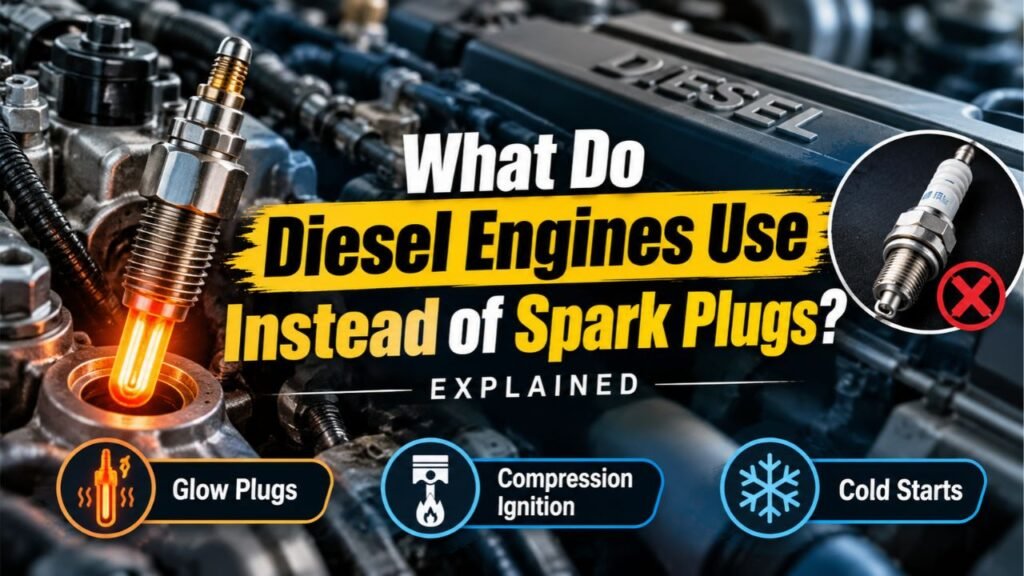
Diesel engines primarily use compression ignition instead of spark plugs.
During the compression stroke, a diesel engine squeezes air inside the cylinder to a much higher pressure than a typical gasoline engine. Compressing the air raises its temperature. Near the top of the compression stroke, the fuel injector sprays diesel fuel into the hot compressed air.
The fuel then ignites without requiring an electrical spark.
Many diesel engines also use glow plugs. A glow plug is an electrically heated component that warms the combustion chamber or incoming air enough to make cold starting easier.
So the simplest distinction is:
- Gasoline engine: spark plug ignites the air-fuel mixture.
- Diesel engine: compressed hot air ignites injected fuel.
- Glow plug: helps a diesel engine start when conditions are cold.
How Does a Diesel Engine Ignite Fuel Without Spark Plugs?
A diesel engine relies on heat created by compression.
A typical four-stroke diesel engine follows four basic stages:
- Intake
- Compression
- Power
- Exhaust
The key difference happens during compression and fuel injection.
Intake Stroke
The intake valve opens and the piston moves downward.
A diesel engine generally draws air into the cylinder rather than drawing in a premixed air-fuel mixture like many gasoline engines.
Compression Stroke
The piston moves upward and compresses the air into a much smaller space.
Compressing air raises its temperature significantly.
This hot, high-pressure air is what makes diesel combustion possible.
Fuel Injection and Ignition
Near the end of the compression stroke, the fuel injector sprays finely atomized diesel fuel into the combustion chamber.
When the fuel contacts the hot compressed air, it begins to ignite.
No spark plug is required.
Power Stroke
Combustion rapidly increases pressure inside the cylinder and pushes the piston downward.
That force turns the crankshaft and produces engine power.
Exhaust Stroke
The exhaust valve opens and the piston moves upward again, pushing burned gases out of the cylinder.
The cycle then repeats.
What Is Compression Ignition?
Compression ignition is the process in which fuel ignites because of the heat created by highly compressed air.
This is the defining combustion principle of a conventional diesel engine.
Diesel engines are therefore often called compression-ignition engines, while gasoline engines are commonly called spark-ignition engines.
The difference is fundamental.
A gasoline engine normally compresses an air-fuel mixture and then uses a timed spark to ignite it.
A diesel engine compresses air first and introduces the fuel near the end of compression.
Why Does Compressing Air Make It Hot?
When air is compressed rapidly, its temperature increases.
You may have noticed a similar effect when using a hand-operated air pump. The pump body can become warm because the air inside is being compressed.
Inside a diesel cylinder, the effect is much more intense.
The diesel engine’s relatively high compression ratio allows the air temperature to rise high enough for injected diesel fuel to ignite.
This eliminates the need for spark plugs during normal operation.
Do Diesel Engines Have Spark Plugs?
Conventional diesel engines do not use ignition spark plugs.
If you remove the engine cover from many diesel vehicles, you may see components that resemble spark plugs. These are often glow plugs, not spark plugs.
Some specialized combustion systems can differ, but standard automotive diesel engines rely on compression ignition.
Therefore, when someone asks whether a normal diesel truck or passenger car has spark plugs, the answer is generally no.
What Are Glow Plugs?
A glow plug is a small electrical heating device used in many diesel engines to improve cold starting.
It usually has a heating tip that extends into or near the combustion chamber.
When electrical current flows through the glow plug, the tip becomes very hot.
This additional heat helps the first fuel injections ignite when the engine itself is cold.
Glow plugs are especially important because a cold engine absorbs some of the heat generated during compression.
Do Glow Plugs Replace Spark Plugs?
Not exactly.
Glow plugs are sometimes casually called the diesel version of spark plugs, but their jobs are different.
A spark plug produces a high-voltage electrical spark at a precisely controlled point during every combustion cycle.
A glow plug normally provides heat rather than a spark.
Once a diesel engine is warm and running properly, compression heat is normally sufficient to sustain combustion.
That means glow plugs do not continuously trigger each combustion event in the way spark plugs do.
Spark Plugs vs. Glow Plugs
The differences are easier to see side by side.
| Feature | Spark Plug | Glow Plug |
| Common engine type | Gasoline | Diesel |
| Main purpose | Ignite air-fuel mixture | Assist cold starting and warm-up |
| How it works | Creates electrical spark | Produces heat |
| Used during normal combustion | Yes | Usually not as the primary ignition source |
| Engine ignition type | Spark ignition | Compression ignition |
| Installed in cylinder head | Yes | Usually yes |
| Main combustion trigger | Spark | Hot compressed air |
Both components may look somewhat similar from the outside, but they perform different functions.
Why Do Diesel Engines Need Glow Plugs If Compression Creates Heat?
Compression produces enough heat for combustion under normal operating conditions, but cold starting is more difficult.
When the engine is cold, the cylinder head, piston, and combustion chamber absorb heat from the compressed air.
This can make the temperature lower than ideal for immediate fuel ignition.
Glow plugs add heat to help overcome this problem.
They can improve:
- Cold starting
- Initial combustion stability
- Cold-idle quality
- Cold-weather emissions
- Warm-up behavior
Modern diesel engine-control systems may continue operating the glow plugs briefly after startup to improve combustion during warm-up.
Do All Diesel Engines Use Glow Plugs?
No.
Not every diesel engine uses conventional glow plugs.
Some diesel engines use alternative starting aids, depending on engine design and application.
Examples can include:
- Intake-air heaters
- Grid heaters
- Manifold heaters
- Other manufacturer-specific cold-start systems
Large heavy-duty diesel engines may use different starting strategies from small passenger-car diesel engines.
So while glow plugs are very common, they are not universal.
What Is an Intake Grid Heater?
An intake grid heater is an electrical heating element placed in the engine’s intake-air path.
Instead of heating each individual combustion chamber with a glow plug, the grid heater warms the incoming air before it enters the cylinders.
This warmer intake air helps improve ignition during cold starting.
Some diesel trucks use intake heaters rather than conventional glow plugs.
The exact system depends on the engine manufacturer and design.
What Is a Diesel Fuel Injector?
Because diesel engines do not use spark plugs for ignition, precise fuel injection is extremely important.
A fuel injector sprays diesel fuel into the combustion chamber at the proper time and in a carefully controlled pattern.
Modern diesel engines may use high-pressure common-rail fuel injection.
The engine-control module can control:
- Injection timing
- Fuel quantity
- Number of injection events
- Injection duration
Proper atomization helps the fuel mix with hot compressed air and burn efficiently.
Are Fuel Injectors the Replacement for Spark Plugs?
Not in a direct sense.
A diesel injector delivers fuel, while a spark plug creates ignition.
The diesel engine’s actual substitute for spark ignition is compression heat, not the injector itself.
However, the fuel injector plays a critical role because combustion begins only after the injector introduces fuel into the hot compressed air.
A more accurate way to describe the diesel system is:
Compression provides the ignition conditions, while the injector delivers the fuel.
Why Do Diesel Engines Use Higher Compression?
Diesel engines need enough compression to raise air temperature sufficiently for reliable ignition.
Higher compression also contributes to diesel-engine efficiency.
Because the engine can operate with very high compression and does not throttle incoming air in the same way many traditional gasoline engines do, diesel engines can achieve strong fuel efficiency.
Exact compression ratios vary widely by engine design, so there is no single ratio used by all diesel engines.
What Happens During a Cold Diesel Start?
When you start a cold diesel vehicle equipped with glow plugs, the process usually happens automatically.
The basic sequence is:
- The ignition is switched on or the start button is pressed.
- The engine-control system activates the glow plugs if necessary.
- The glow plugs heat the combustion chambers.
- The starter motor turns the engine.
- Air is compressed inside the cylinders.
- Fuel is injected.
- The fuel ignites and the engine starts.
Some vehicles display a glow-plug indicator on the dashboard.
Modern systems often control the entire process automatically, so the driver may not need to wait manually.
What Does the Glow Plug Warning Light Mean?
Many diesel vehicles have a dashboard symbol that resembles a coil or heating element.
This is commonly the glow plug indicator.
When starting a cold diesel engine, the light may illuminate while the glow system is heating.
Depending on the vehicle, the light turning off can indicate that the engine is ready to start.
If the glow-plug warning light flashes or remains illuminated unexpectedly, it may indicate a fault.
Always check the owner’s manual because warning-light behavior varies by manufacturer.
What Happens When Glow Plugs Go Bad?
A diesel engine may still run with one or more failed glow plugs, especially after it is warm.
However, starting can become difficult in cold weather.
Common symptoms of faulty glow plugs can include:
- Hard cold starts
- Extended cranking
- Rough running immediately after startup
- White exhaust smoke during cold starting
- Misfires when the engine is cold
- Glow-plug warning light
These symptoms can also be caused by other problems, including fuel-system faults, weak batteries, poor compression, or injector issues.
Proper diagnosis is important before replacing parts.
Can a Diesel Engine Start Without Glow Plugs?
Yes, under some conditions.
A healthy diesel engine may start without functioning glow plugs when ambient temperatures are warm enough and compression is strong.
However, cold weather can make starting much harder.
The importance of glow plugs depends on:
- Outdoor temperature
- Engine design
- Compression condition
- Battery strength
- Starter speed
- Fuel system condition
Glow plugs are starting aids rather than the main ignition mechanism.
Does a Diesel Engine Keep Using Glow Plugs While Driving?
Usually, glow plugs are not continuously responsible for combustion after the engine is running.
Some modern systems may continue using them temporarily after startup, a process sometimes called post-glow.
Post-glow can help improve:
- Cold combustion stability
- Engine smoothness
- Emissions during warm-up
Once the engine reaches suitable operating conditions, compression ignition takes over completely.
Why Don’t Gasoline Engines Use Compression Ignition?
Traditional gasoline engines are designed differently.
Gasoline is more prone to uncontrolled autoignition under high compression. In a conventional gasoline engine, uncontrolled ignition can cause knock or detonation.
Therefore, gasoline engines typically use spark plugs so combustion begins at a precisely controlled moment.
Diesel fuel behaves differently and is well suited to compression-ignition operation.
Modern engine technology continues to evolve, but this remains the basic distinction between conventional gasoline and diesel engines.
Are Diesel Engines More Efficient Because They Do Not Have Spark Plugs?
The absence of spark plugs is not the main reason diesel engines can be efficient.
Diesel efficiency comes from several factors, including:
- High compression ratios
- Lean combustion
- Efficient fuel injection
- Lower pumping losses in many operating conditions
- High thermodynamic efficiency
Compression ignition is part of the overall diesel design, but simply removing spark plugs from a gasoline engine would not turn it into an efficient diesel engine.
The two engine types are engineered differently from the beginning.
Do Diesel Engines Need Ignition Coils?
Conventional diesel engines generally do not need ignition coils for combustion.
A gasoline ignition coil produces the high voltage required for a spark plug.
Because diesel engines do not use spark ignition, there is no need for a conventional ignition-coil-and-spark-plug system.
Diesel vehicles still have extensive electrical systems, sensors, controllers, injectors, and glow-plug circuits.
Do Diesel Engines Need Tune-Ups Without Spark Plugs?
Yes, although diesel maintenance differs from gasoline-engine maintenance.
A diesel engine may require attention to components such as:
- Engine oil and filter
- Fuel filter
- Air filter
- Fuel injectors
- Glow plugs
- Cooling system
- Turbocharger components
- Emissions equipment
The exact maintenance schedule depends on the manufacturer and engine.
One advantage is that conventional diesel engines do not require periodic spark-plug replacement.
What Is the Difference Between Diesel and Gasoline Ignition?
The fundamental distinction is the way combustion begins.
Gasoline Engine
A gasoline engine typically:
- Takes in air and fuel.
- Compresses the mixture.
- Creates a spark.
- Burns the mixture.
Diesel Engine
A diesel engine typically:
- Takes in air.
- Compresses the air heavily.
- Injects fuel into the hot compressed air.
- Allows the fuel to ignite automatically.
This difference affects engine construction, compression ratio, fuel systems, emissions systems, and maintenance.
Common Misconceptions About Diesel Spark Plugs
“Glow Plugs Are Diesel Spark Plugs”
Not exactly.
Glow plugs provide heat to assist starting. They do not create timed sparks for every combustion event.
“Fuel Injectors Ignite Diesel Fuel”
Fuel injectors deliver and atomize fuel, but the hot compressed air causes ignition.
“A Diesel Engine Cannot Run With Bad Glow Plugs”
A diesel may run normally once warm even with failed glow plugs.
The main problems usually appear during cold starting and warm-up.
“Every Diesel Engine Has Glow Plugs”
No.
Some use intake heaters or other cold-start systems instead.
FAQs About What Do Diesel Engines Use Instead of Spark Plugs
What do diesel engines use instead of spark plugs?
Diesel engines use compression ignition. Air is compressed until it becomes hot enough to ignite diesel fuel when fuel is injected into the cylinder.
Many diesel engines also use glow plugs to help with cold starting.
Are glow plugs the same as spark plugs?
No.
Spark plugs produce an electrical spark that ignites gasoline.
Glow plugs produce heat that helps a diesel engine start when cold.
Do diesel engines have any type of ignition plug?
Many diesel engines have glow plugs, but they are not ignition plugs in the same sense as gasoline spark plugs.
Compression heat is what ignites the fuel during normal operation.
How does diesel fuel ignite without a spark?
The piston compresses air until its temperature rises significantly.
When diesel fuel is injected into this hot air, it ignites.
Can a diesel engine run without glow plugs?
Yes, depending on engine design and temperature.
A healthy diesel may start and run without glow plugs in warm conditions, but cold starting can become much more difficult.
Why do diesel engines have glow plugs?
Glow plugs add heat during cold starting because the cold engine absorbs some of the heat produced by compression.
They help the first combustion events occur more reliably.
Do diesel engines use ignition coils?
Conventional diesel engines do not require ignition coils for combustion because they do not use spark plugs.
Their combustion is based on compression ignition.
Do all diesel engines use glow plugs?
No.
Some diesel engines use intake-air heaters, grid heaters, or other systems to assist cold starting.
Conclusion
If you are asking what do diesel engines use instead of spark plugs, the most accurate answer is compression ignition. A diesel engine compresses air until it becomes hot enough to ignite diesel fuel when the injector sprays fuel into the cylinder.
Many diesel engines also use glow plugs, but glow plugs do not replace spark plugs in the traditional sense. They mainly provide extra heat for cold starting and warm-up, while compression remains the mechanism that actually ignites the fuel during normal engine operation.
Understanding this difference explains one of the most important distinctions between gasoline and diesel engines: gasoline engines normally depend on a spark, while diesel engines depend on heat created by compression.