
Spark plug heat range describes how quickly a spark plug transfers heat from its firing tip into the cylinder head—not how hot or powerful the spark itself is.
Understanding what does heat range mean on a spark plug is important because the plug must operate within a suitable temperature window. It needs to become hot enough to burn away normal carbon and fuel deposits, but not so hot that the firing tip overheats and contributes to pre-ignition, detonation-related problems, or plug damage.
A hot spark plug retains heat longer because it transfers heat away from the firing end more slowly. A cold spark plug transfers heat into the cylinder head more quickly and therefore keeps its firing tip cooler.
Neither type automatically produces more horsepower or a stronger spark. The correct heat range is simply the one that keeps the spark plug at an appropriate operating temperature for the engine and its operating conditions.
For a stock vehicle, the safest choice is normally the heat range specified by the vehicle or spark plug manufacturer. Different heat ranges may be appropriate for modified, turbocharged, supercharged, racing, or unusually demanding engines, but changing heat range should be based on engine requirements rather than guesswork.
What Does Heat Range Mean on a Spark Plug?
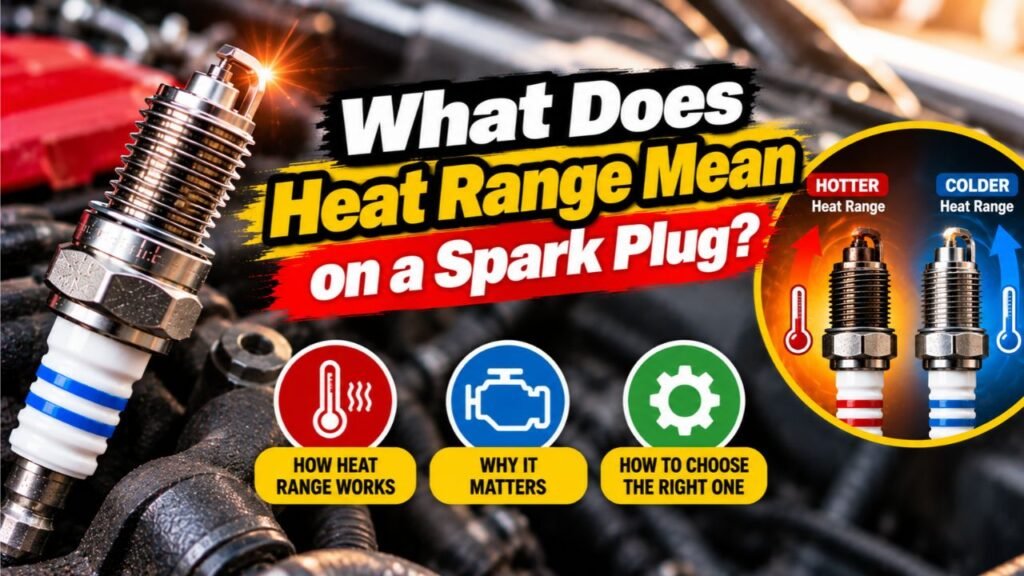
The heat range of a spark plug indicates its ability to remove heat from the firing tip and transfer that heat through the plug shell into the cylinder head and cooling system.
It does not refer directly to:
- Spark voltage
- Spark intensity
- Ignition timing
- Engine coolant temperature
- Spark plug electrical resistance
Instead, heat range is primarily about thermal management.
A spark plug has to operate hot enough to resist fouling while remaining cool enough to avoid overheating.
That balance is what the heat range is designed to control.
What Is a Hot Spark Plug?
A hot spark plug transfers heat away from the firing tip relatively slowly.
Because it retains more heat, its insulator nose and firing end tend to operate at a higher temperature.
Hotter plugs are sometimes used in engines that:
- Run relatively cool
- Spend much of their time at light load
- Are prone to carbon fouling
- Are specifically designed for that heat range
A hot plug does not produce a hotter electrical spark.
The term “hot” refers to the temperature retained at the firing end.
What Is a Cold Spark Plug?
A cold spark plug transfers heat into the cylinder head more quickly.
Its firing tip therefore tends to remain cooler under the same combustion conditions.
Colder plugs may be appropriate in engines that produce high combustion temperatures, such as:
- Turbocharged engines
- Supercharged engines
- High-compression engines
- Modified performance engines
- Racing engines
- Engines subjected to sustained heavy load
Again, colder does not mean weaker.
A cold spark plug can create the same type of ignition spark while simply managing heat differently.
Hot vs. Cold Spark Plug Comparison
| Feature | Hot Spark Plug | Cold Spark Plug |
| Heat transfer | Slower | Faster |
| Firing-tip temperature | Higher | Lower |
| Insulator nose | Generally longer | Generally shorter |
| Fouling resistance | Better in cooler operation | Can foul more easily if too cold |
| Overheating resistance | Lower | Better under high heat |
| Typical use | Cooler-running or light-duty applications | High-output or high-load engines |
| Spark strength | Not inherently stronger | Not inherently weaker |
The correct plug is not automatically the hottest or coldest option. It is the plug that matches the engine’s heat-management requirements.
How Does a Spark Plug Transfer Heat?
Most of the heat reaching the spark plug firing end comes from combustion.
That heat follows a path away from the plug tip.
A simplified heat-transfer path is:
Firing tip → insulator → metal shell → cylinder head → engine cooling system
The design of the ceramic insulator plays a major role in controlling how quickly this happens.
Hot Plug Design
A hotter plug usually has a longer insulator nose.
The longer heat path means heat takes longer to travel from the firing tip into the metal shell.
More heat therefore remains near the tip.
Cold Plug Design
A colder plug generally has a shorter insulator nose.
That shorter path allows heat to move into the shell and cylinder head more quickly.
The firing tip remains cooler.
Why Spark Plug Heat Range Matters
The spark plug works directly inside the combustion chamber, where it experiences extreme and rapidly changing temperatures.
If the plug operates too cold, deposits can accumulate.
If it operates too hot, the plug itself can become an unwanted heat source.
The correct heat range helps keep the firing tip within a useful operating temperature range where it can resist deposits without overheating.
What Is the Spark Plug Self-Cleaning Temperature?
Spark plugs need to reach sufficient temperature for normal deposits to burn away from the insulator nose.
This is often referred to as the self-cleaning temperature.
A commonly cited lower threshold is approximately 930°F (500°C) at the firing end.
Below this general range, carbon and fuel deposits are more likely to accumulate.
At excessively high firing-tip temperatures—often around 1,560°F (850°C) or above—the risk of abnormal ignition and plug damage increases.
These are general reference values rather than exact limits for every spark plug and engine.
Engine design, plug material, operating conditions, and manufacturer specifications all matter.
What Happens if a Spark Plug Is Too Hot?
Using a plug that is too hot for the engine can cause the firing end to retain excessive heat.
Possible signs or consequences include:
- Glazed or blistered insulator
- Electrode erosion
- Abnormal combustion
- Increased risk of pre-ignition
- Spark plug damage
- Engine damage in severe cases
Pre-Ignition Risk
Pre-ignition occurs when the air-fuel mixture ignites before the normal spark event because an excessively hot surface inside the cylinder acts as an ignition source.
An overheated spark plug can potentially become one of those hot spots.
Pre-ignition is particularly dangerous because cylinder pressure and temperature can rise dramatically.
It should not be confused with normal spark-controlled combustion.
What Happens if a Spark Plug Is Too Cold?
A plug that is too cold removes heat so quickly that its firing end may not reach an adequate self-cleaning temperature.
Deposits may then accumulate on the insulator and electrodes.
Possible symptoms include:
- Carbon-fouled spark plugs
- Misfires
- Rough idle
- Hard starting
- Poor acceleration
- Reduced fuel economy
The plug itself may appear dark, sooty, or wet depending on the cause of the fouling.
However, a black spark plug does not automatically prove that the heat range is wrong.
Rich fuel mixture, oil consumption, weak ignition, short-trip driving, and mechanical engine problems can create similar deposits.
Does Spark Plug Heat Range Affect Horsepower?
Not directly.
Installing a colder or hotter plug does not automatically increase horsepower.
A correctly selected heat range helps the spark plug operate reliably under the engine’s combustion conditions.
In a modified high-output engine, a colder plug may be necessary because combustion temperatures and cylinder pressures have increased.
The colder plug supports the new operating environment; it is not itself the source of the extra horsepower.
Installing an unnecessarily cold plug in a stock engine can actually increase the risk of fouling.
Does a Hotter Spark Plug Make a Stronger Spark?
No.
Heat range and spark energy are separate characteristics.
Spark energy depends more on the ignition system, including components such as:
- Ignition coil
- Supply voltage
- Coil dwell
- Spark plug gap
- Ignition system design
A hotter heat range simply means the plug retains more combustion heat at the firing end.
Does a Colder Spark Plug Reduce Engine Temperature?
Not in the way many people assume.
A colder spark plug does not meaningfully cool the entire engine.
It transfers heat away from its own firing tip more quickly.
Engine coolant temperature is controlled primarily by the:
- Cooling system
- Thermostat
- Radiator
- Water pump
- Cooling fans
- Combustion load
Changing to a colder plug is therefore not a solution for an overheating engine.
How Are Spark Plug Heat Ranges Numbered?
This is one of the most confusing parts of spark plug selection because heat-range numbering is not standardized across brands.
A higher number can mean a colder plug for one manufacturer, while another manufacturer may use a different numbering convention.
For example, some popular manufacturers generally use higher numbers for colder plugs, while others historically use the opposite direction.
Because of this, never assume that a “6” from one brand has the same heat range as a “6” from another.
Use a manufacturer-provided cross-reference when switching spark plug brands.
Are Spark Plug Heat Range Numbers Universal?
No.
Heat-range numbers are manufacturer-specific.
Two plugs from different manufacturers can have very different numbering while being intended for approximately equivalent applications.
Comparing only the printed heat-range number can therefore lead to the wrong plug.
Always compare the complete spark plug specification, including:
- Heat range
- Thread diameter
- Thread reach
- Seat type
- Hex size
- Electrode design
- Resistor configuration
- Spark gap requirements
Where Is the Heat Range Number on a Spark Plug?
The heat range is usually included within the manufacturer’s spark plug part number.
For example, a part number may contain several letters and numbers representing:
- Thread diameter
- Construction
- Resistor type
- Heat range
- Reach
- Electrode design
- Special features
The exact coding system differs by manufacturer.
Consult the plug manufacturer’s numbering guide rather than trying to interpret the code universally.
How Do You Choose the Correct Spark Plug Heat Range?
For an unmodified street vehicle, use the heat range specified by:
- Vehicle manufacturer
- Owner’s manual
- Factory service information
- Reputable spark plug application catalog
The original specification is designed around the engine’s:
- Compression ratio
- Combustion chamber
- Ignition timing
- Air-fuel calibration
- Cooling system
- Expected load
- Emissions requirements
There is usually no benefit to changing heat range on a stock engine that is operating correctly.
When Might You Need a Colder Spark Plug?
A colder plug may be appropriate when engine modifications significantly increase cylinder temperature or pressure.
Examples can include:
- Increased turbocharger boost
- Supercharger installation
- Higher compression ratio
- Nitrous oxide use
- Significant power increases
- Sustained racing operation
- Heavy high-load use in an engine specifically requiring it
Performance tuners sometimes move one or more heat ranges colder as power levels increase, but there is no universal rule such as “one step colder for every specific horsepower increase.”
The proper heat range depends on the engine and modification package.
Follow recommendations from the engine builder, tuner, vehicle manufacturer, or spark plug manufacturer.
When Might You Need a Hotter Spark Plug?
Moving to a hotter plug is less common on modern electronically controlled street vehicles.
It may be considered in specialized cases where the plugs consistently run too cool and foul despite the engine being mechanically and electronically healthy.
Before changing heat range, rule out causes such as:
- Rich air-fuel mixture
- Weak ignition
- Oil consumption
- Faulty fuel injector
- Excessive idling
- Frequent very short trips
- Low compression
- Incorrect spark plug
Using a hotter plug to hide an underlying engine problem is not a proper repair.
Can You Tell Heat Range From Spark Plug Color?
Spark plug appearance can provide clues, but it should not be treated as a perfect diagnostic tool.
A properly operating plug often develops a light tan, gray, or relatively clean insulator appearance depending on the engine, fuel, plug design, and operating conditions.
Signs That May Suggest Excessive Heat
Possible signs include:
- Very white or glazed insulator
- Blistering
- Melted electrode
- Heavy electrode erosion
However, lean air-fuel mixtures, advanced ignition timing, cooling problems, or detonation can create similar signs.
Signs That May Suggest a Plug Is Too Cold
Possible signs include:
- Dry black carbon
- Heavy soot
- Fouled insulator
Again, rich fueling, oil burning, or excessive idling can create the same appearance.
A plug reading should consider the entire engine condition.
Spark Plug Heat Range vs. Spark Plug Gap
Heat range and plug gap are different specifications.
Heat range controls heat transfer.
Spark plug gap is the distance between the center and ground electrodes that the electrical spark must jump.
Changing one does not automatically require changing the other.
Both specifications need to be correct for the engine.
Spark Plug Heat Range vs. Electrode Material
Heat range is also separate from electrode material.
Common spark plug materials include:
- Nickel alloy
- Platinum
- Double platinum
- Iridium
Electrode material mainly affects characteristics such as durability, erosion resistance, and electrode design.
An iridium plug can be available in several different heat ranges, just as a conventional nickel plug can.
Do not choose a plug’s heat range based only on whether it uses iridium or platinum.
Does Driving Style Affect Spark Plug Temperature?
Yes.
Spark plug firing-tip temperature changes constantly depending on engine load and operating conditions.
Tip temperature tends to rise with:
- High engine load
- High RPM
- Sustained highway operation
- Increased boost
- Heavy towing
- Aggressive acceleration
Temperature may remain lower during:
- Short trips
- Extended idling
- Light-load operation
- Repeated cold starts
This is one reason a plug’s heat range must provide a useful operating window rather than a single fixed temperature.
Can the Wrong Heat Range Cause a Misfire?
Yes.
A plug that is too cold can accumulate deposits that provide an electrical leakage path or interfere with the spark.
That can contribute to:
- Rough idle
- Hesitation
- Hard starting
- Misfire codes
- Loss of power
An excessively hot plug can also become damaged over time, leading to ignition problems.
However, misfires have many possible causes, so do not diagnose heat range from a misfire alone.
Can the Wrong Heat Range Damage an Engine?
Potentially, especially if the plug is much too hot.
An overheated spark plug may increase the risk of pre-ignition.
Severe pre-ignition can damage:
- Pistons
- Valves
- Rings
- Cylinder walls
- Spark plugs
A plug that is too cold is more likely to create fouling and drivability issues rather than immediate catastrophic damage, although prolonged misfiring can create additional problems such as catalytic converter damage.
Should You Go One Step Colder With a Tune?
Not automatically.
Some tuned engines require colder plugs because the tune increases:
- Boost
- Cylinder pressure
- Combustion temperature
- Engine load
But a mild software tune does not universally require a colder spark plug.
Use the recommendation from the tuner or spark plug manufacturer for that specific engine and power level.
Changing heat range without considering the complete setup can create new problems.
Should Turbo Engines Use Colder Spark Plugs?
Turbocharged engines often use relatively cold spark plugs because boost increases the mass of air and fuel burned inside the cylinder, which can increase thermal load.
However, factory turbocharged engines already come with plugs selected for their intended operating conditions.
You do not need to install colder plugs simply because your vehicle has a turbocharger.
A colder plug is more likely to become necessary when the engine has been modified beyond its factory output.
Do Spark Plugs Get Hotter as They Wear Out?
The relationship is not that simple.
As electrodes wear, the spark gap can grow and require greater ignition voltage, but that does not mean the plug has changed to a hotter heat range.
Heat range is primarily determined by the physical design of the plug.
A worn plug can certainly operate poorly, but wear does not convert one heat range into another.
Common Spark Plug Heat Range Mistakes
Assuming Hotter Means More Powerful
A hotter spark plug does not create more horsepower or a stronger spark.
It simply retains more heat at its firing end.
Choosing the Coldest Plug Possible
A plug that runs too cold can foul during normal street driving.
Colder is not automatically safer or better.
Comparing Heat-Range Numbers Across Brands
Manufacturer numbering systems differ.
Always use a reliable cross-reference.
Using Heat Range to Fix Engine Problems
A different plug should not be used to hide:
- Rich fueling
- Oil burning
- Cooling-system problems
- Weak ignition
- Injector problems
Repair the actual cause.
Ignoring Other Spark Plug Specifications
Correct heat range alone does not make a spark plug compatible.
Thread size, reach, seat, gap, and construction also need to match the engine.
FAQs About What Does Heat Range Mean on a Spark Plug
What Is the Difference Between a Hot and Cold Spark Plug?
A hot spark plug transfers heat away from its firing tip more slowly, so the tip operates hotter.
A cold spark plug transfers heat to the cylinder head more quickly, keeping the firing end cooler.
Does a Higher Heat Range Number Mean a Hotter Spark Plug?
Not necessarily.
Spark plug manufacturers use different numbering systems. For some brands, a higher number indicates a colder plug.
Always check the manufacturer’s heat-range chart.
Is a Colder Spark Plug Better for Performance?
Only when the engine’s operating conditions require it.
High-output engines may need colder plugs to prevent excessive firing-tip temperatures, but an unnecessarily cold plug can foul during normal driving.
Can a Spark Plug Be Too Hot?
Yes.
An excessively hot plug may overheat, erode its electrodes, or potentially contribute to pre-ignition.
Use the heat range recommended for the engine.
Can a Spark Plug Be Too Cold?
Yes.
A plug that runs too cold may not reach its self-cleaning temperature, allowing carbon and fuel deposits to build up and potentially causing misfires.
Does Heat Range Change the Spark Plug Gap?
No.
Heat range and spark plug gap are independent specifications.
Both need to match the engine manufacturer’s requirements.
Should I Use Colder Spark Plugs After Adding a Turbo?
Possibly, but the correct heat range depends on boost level, engine design, tune, fuel, and intended use.
Follow the recommendations of a qualified tuner, engine builder, or spark plug manufacturer.
How Do I Know What Spark Plug Heat Range My Car Needs?
Use the spark plug specification listed by the vehicle manufacturer or a reputable plug manufacturer’s application catalog.
For a stock engine, staying with the factory-specified heat range is generally the best choice.
Conclusion
Understanding what does heat range mean on a spark plug comes down to heat transfer. A hot plug retains heat at the firing tip longer, while a cold plug transfers heat into the cylinder head more quickly.
The correct heat range allows the plug to become hot enough to resist fouling without reaching temperatures that could promote pre-ignition or damage the electrodes. It does not determine spark strength or directly add horsepower.
For a stock vehicle, use the manufacturer-specified heat range. If an engine has been significantly modified, the appropriate heat range should be selected based on the engine’s actual thermal and combustion requirements rather than simply choosing a hotter or colder plug.