
If you are wondering what happens if one glow plug is not working, the engine will often still start and run, but cold starts may take longer, one cylinder may misfire briefly, and you may notice white or gray smoke until the engine warms up. The effect is usually more noticeable in cold weather because diesel engines depend more heavily on glow plug heat when the combustion chambers are cold.
One failed glow plug does not normally stop a healthy multi-cylinder diesel from running once it is warm. The other cylinders can often provide enough combustion to start the engine, and the cylinder with the failed plug may begin firing normally as heat builds inside the combustion chamber.
However, a single failed plug should not be ignored. If the remaining glow plugs are the same age, others may be close to failure. A bad plug can also trigger a warning light or diagnostic trouble code, and repeated poor cold combustion can increase smoke and make starts progressively harder.
The exact symptoms depend on engine design, cylinder count, ambient temperature, compression condition, battery strength, and whether the problem is truly the glow plug itself or the wiring and control circuit.
In this guide, I’ll explain what happens if one glow plug is not working, whether the engine can still start, what symptoms you may notice, whether it is safe to drive, and how to confirm that a single plug has failed.
What Happens If One Glow Plug Is Not Working?
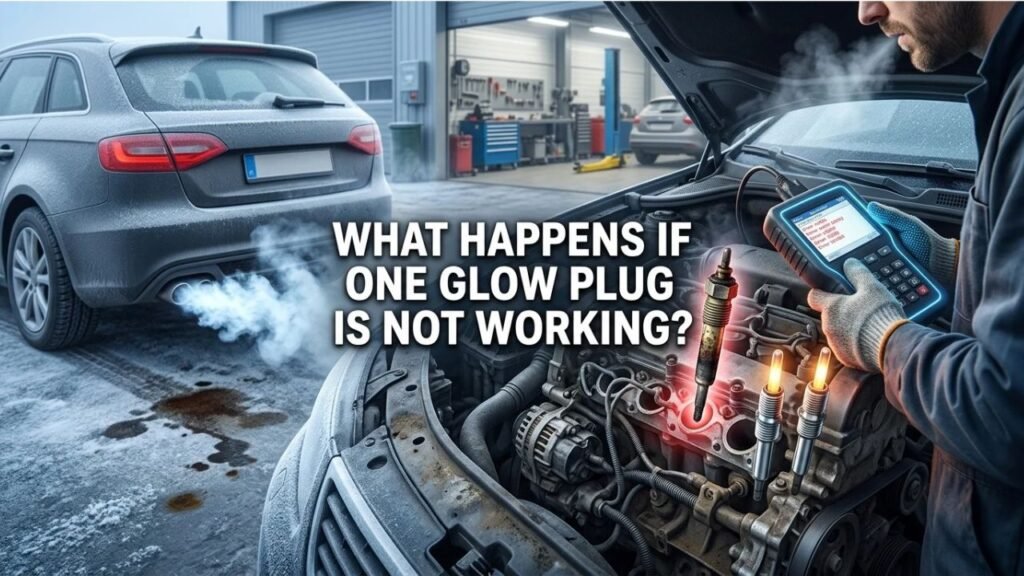
When one glow plug fails, one cylinder receives less preheating than the others during a cold start.
That cylinder may initially struggle to ignite the injected diesel fuel.
Meanwhile, the cylinders with functioning glow plugs can begin combustion normally.
If enough cylinders fire, the engine starts.
The cylinder with the failed glow plug may then join in as compression and combustion rapidly warm the chamber.
The Engine Usually Still Runs
Once the engine reaches operating temperature, the effect of one failed glow plug is often much smaller.
Diesel fuel is ignited by compression heat, not by the glow plug continuously.
That is why one failed plug commonly affects starting and warm-up much more than normal driving after the engine is hot.
Cold Weather Makes the Difference More Obvious
At low temperatures, the cylinder head and block absorb more compression heat.
The cylinder with the dead glow plug may take longer to begin firing.
The colder it gets, the more noticeable the symptoms can become.
Key Takeaways:
- One failed glow plug usually does not stop a healthy diesel from running.
- Cold starting is where the problem is most noticeable.
- The affected cylinder may misfire briefly until it warms.
- Cold weather can turn a mild problem into a difficult-start condition.
Can a Diesel Start With One Bad Glow Plug?
Yes, in many cases.
A four-, five-, six-, or eight-cylinder diesel can often start with one glow plug not working.
The remaining cylinders provide enough combustion to get the crankshaft turning faster and warm the engine.
The exact result depends on how healthy the engine is.
A Healthy Engine May Barely Notice
A diesel with strong compression, a good battery, and a fast starter may still start fairly quickly with one failed plug.
In mild or warm weather, you might not notice any obvious symptom at all.
The problem may only become visible when temperatures drop.
An Older Engine May Struggle More
An engine with marginal compression relies more heavily on preheating.
One failed glow plug can therefore have a greater effect on an older or worn engine.
A weak battery can make the problem worse because slow cranking creates less compression heat.
Can One Bad Glow Plug Cause a No-Start?
It is possible, but it is not the usual outcome on a healthy multi-cylinder diesel.
One failed glow plug more commonly causes longer cranking or rough startup rather than a complete no-start.
However, conditions matter.
A four-cylinder diesel in extremely cold weather may be more sensitive to one dead cylinder than a larger engine.
If the remaining plugs are weak, the battery is low, or compression is marginal, that one confirmed failure may be enough to push the engine from hard starting into no-start territory.
One Bad Plug May Not Be the Only Problem
If the engine will not start at all, test the complete system.
You may have:
A second failed glow plug.
A weak battery.
A faulty glow plug relay.
A failed control module.
Low compression.
A fuel-delivery problem.
A single bad plug should not automatically be blamed for a complete no-start without further diagnosis.
Will One Bad Glow Plug Cause Hard Starting?
Yes.
Longer cranking is one of the most common symptoms.
During the first few revolutions, one cylinder may not ignite properly.
The remaining cylinders have to work harder to get the engine running.
As the engine warms, the failed-plug cylinder begins to receive enough heat from compression and nearby combustion to participate normally.
If the vehicle starts easily after driving but struggles after sitting overnight, glow plug performance deserves attention.
A problem that gets significantly worse as outside temperatures fall is another strong clue.
Will One Bad Glow Plug Cause Rough Idle?
It can, particularly immediately after a cold start.
The cylinder with the failed glow plug may not burn fuel cleanly at first.
The engine can shake, stumble, or sound uneven.
After several seconds, the roughness may disappear as the cylinder warms.
Rough Idle When Warm Is Different
If the engine continues misfiring after reaching normal operating temperature, the glow plug is less likely to be the sole cause.
You should then consider:
- Injector problems
- Low compression
- Fuel pressure issues
- Air or intake faults
- Wiring or sensor problems
A glow plug failure is mainly a cold-combustion problem.
Can One Bad Glow Plug Cause White Smoke?
Yes.
White or light-gray smoke can appear during cold starting when fuel is injected into a cylinder that is too cold for efficient combustion.
The fuel may burn only partially or leave the cylinder largely unburned.
Once the engine warms, the smoke may decrease or disappear.
Smoke Does Not Prove the Glow Plug Is Bad
White smoke can also result from low compression, injector faults, incorrect timing, or coolant entering the combustion chamber.
A cold-start-only smoke pattern combined with a glow plug code or failed resistance test makes the diagnosis much stronger.
Can One Bad Glow Plug Cause a Check-Engine Light?
Yes.
Modern diesel engine computers often monitor individual glow plug circuits.
A fault may trigger the check-engine light or a dedicated diesel preheat warning.
The stored trouble code may identify a particular cylinder or circuit.
A Circuit Code Is Not Always a Bad Plug
The plug itself may be good while the wiring is damaged.
Possible causes include:
A loose connector.
Broken wire.
Corroded terminal.
Failed control module channel.
High resistance in the circuit.
Always test before replacing parts.
Can One Bad Glow Plug Cause a Misfire?
During cold startup, yes.
The affected cylinder may fail to produce normal combustion until it warms.
You may feel a brief misfire or hear the engine running unevenly.
Once warm, normal compression ignition often takes over and the misfire disappears.
Persistent Misfire Needs More Diagnosis
If the same cylinder continues misfiring while hot, check the injector and compression rather than assuming the glow plug is responsible.
A functioning glow plug is not normally required to ignite each combustion event once the engine is at operating temperature.
Key Takeaways:
- One failed glow plug can create a temporary cold-start misfire.
- White smoke and roughness may disappear as the engine warms.
- Persistent warm misfires point toward additional problems.
- Trouble codes identify a circuit but do not always prove the plug itself failed.
Does One Bad Glow Plug Affect Engine Power?
Usually not once the engine is fully warm.
Glow plugs are primarily starting and warm-up devices.
If combustion becomes normal after the engine warms, full engine power may return.
You might notice reduced power only during the first moments after a cold start if one cylinder is not firing properly.
If power remains low during normal driving, look for other problems.
Does One Bad Glow Plug Affect Fuel Economy?
The effect is usually small if the problem only lasts during cold starting.
However, incomplete cold combustion wastes some fuel.
Repeated long cranking also consumes fuel and battery energy.
Modern engines that use post-glow may experience more noticeable warm-up efficiency or emissions effects if a plug is not functioning.
Still, major ongoing fuel-economy loss usually points toward additional issues.
Can One Bad Glow Plug Cause Engine Damage?
A simple failed glow plug that has gone electrically open does not normally damage the engine directly.
The more common consequences are harder starts, smoke, rough warm-up, and extra stress on the battery and starter.
However, not every glow plug failure is a simple open circuit.
Swollen or Damaged Glow Plugs
A plug that overheats can sometimes swell or become physically damaged.
Removal may then become difficult.
If excessive force is used, a glow plug can break in the cylinder head.
That creates a much more serious repair.
Broken Glow Plug Tips
A physically broken glow plug tip is different from an electrically dead plug.
If part of the plug enters the combustion chamber, engine damage is possible.
This is uncommon, but it is one reason damaged plugs should be handled carefully.
Can You Drive With One Bad Glow Plug?
Usually, yes, once the engine starts and runs normally.
One failed glow plug does not generally create an immediate driving-safety problem in the same way as a severe engine misfire or oil-pressure failure.
However, leaving it unrepaired can lead to progressively worse cold-start performance.
When Driving May Be Reasonable
If the vehicle starts, runs smoothly once warm, and has no other serious symptoms, normal short-term driving is often possible.
You should still schedule diagnosis and repair.
When You Should Investigate More Urgently
If the engine is extremely difficult to start, produces heavy smoke, misfires continuously, or additional glow plug faults appear, address the problem promptly.
Those symptoms may indicate that more than one plug has failed.
Will One Bad Glow Plug Get Worse?
The failed plug itself will not repair itself.
If it is electrically open, it remains nonfunctional.
The vehicle may seem better or worse depending on temperature, but the component is still faulty.
The bigger concern is the remaining glow plugs.
If all were installed at the same time and have similar operating hours, other plugs may be approaching the end of their service life.
Do Glow Plugs Fail One at a Time?
Often, yes.
Each glow plug is an individual heating element.
One can fail while the others continue working normally.
Over time, more may fail.
This can make symptoms gradually worsen.
You might begin with a slightly longer start, then months later experience a much rougher startup as a second or third plug fails.
If several glow plugs appear to stop working at exactly the same time, investigate the common supply.
A blown fuse, failed relay, faulty control module, or wiring problem can disable multiple plugs simultaneously.
Should You Replace One Glow Plug or All of Them?
There is no universal answer.
If the plugs are relatively new and one has an isolated failure, replacing only that plug can be reasonable.
If one fails after many years and the entire set has the same service history, replacing all of them may save future labor.
Access Matters
On some engines, glow plugs are easy to reach.
On others, significant disassembly is needed.
If removing the intake manifold or other components is necessary, replacing an old matched set while access is available can make sense.
Use the Correct Replacement
Do not choose a glow plug only because the thread size matches.
The replacement needs the correct:
- Operating voltage
- Heating characteristics
- Tip length
- Thread size
- Electrical connector
- Control-system compatibility
Modern glow plug systems can be sensitive to these differences.
Can You Mix Old and New Glow Plugs?
You can sometimes replace a single plug, provided the new part is the correct specified replacement.
The engine does not necessarily require every plug to be physically the same age.
However, I would avoid mixing different plug technologies or voltage ratings.
Use the same correct specification across the engine whenever possible.
How Do You Test One Bad Glow Plug?
A multimeter resistance test can identify many failed glow plugs.
Turn the ignition off.
Disconnect the electrical connector or bus bar from the plug.
Set the multimeter to its lowest resistance range.
First touch the probes together and note the resistance of the leads.
Then place one probe on the glow plug terminal and the other on clean engine ground.
Compare Every Plug
Do not test only the suspected cylinder.
Check all of them.
Glow plugs normally have very low resistance, and exact specifications vary.
Comparison is extremely useful.
If most plugs read similarly and one displays OL or open circuit, that plug is likely failed.
If one shows substantially different resistance, investigate it further.
What Does OL Mean on a Glow Plug Test?
OL generally indicates an open circuit or resistance beyond the meter’s measuring range.
On a properly isolated conventional glow plug, an OL reading commonly means the internal heating element is broken.
Verify the test by checking your ground connection and confirming that the meter works on the other plugs.
If the others show low resistance while one consistently shows OL, that plug is very likely bad.
Can a Glow Plug Have Continuity and Still Be Bad?
Yes.
Continuity only proves that some electrical path remains.
A plug may still heat too slowly, develop an abnormal hot spot, or fail to reach the required temperature.
That is why actual resistance comparison and, when needed, current testing provide more information.
Modern engine control modules may also detect faults based on current draw rather than simple continuity.
Should You Bench-Test a Glow Plug With a Battery?
Not unless you know the exact glow plug specification.
Old-style 12-volt glow plugs can sometimes be bench-tested by applying appropriate power and observing how they heat.
But many modern plugs operate at significantly lower voltage.
Connecting them directly to a 12-volt battery can destroy them rapidly.
A hot glow plug can also cause severe burns or ignite flammable materials.
A multimeter test is a safer first step.
Can One Bad Glow Plug Be Caused by the Control Module?
Yes.
Some modern control modules operate individual glow plugs separately.
One output channel can fail while the other plugs receive proper power.
In that case, replacing the glow plug would not solve the issue.
Test the Supply Circuit
If the plug tests good but a fault code keeps returning, check whether it receives the correct command and voltage.
Inspect the connector and wiring.
Modern low-voltage or pulse-controlled systems may require manufacturer-specific diagnostics.
Can a Weak Battery Make One Glow Plug Look Bad?
A weak battery normally affects the entire glow plug and starting system rather than only one plug.
However, low system voltage can make overall cold starting worse and exaggerate the symptoms of one already failed plug.
That combination is common.
A diesel with one bad glow plug and a strong battery may start reasonably well.
The same vehicle with a weak battery may suddenly become very difficult to start.
Can a Bad Injector Look Like a Bad Glow Plug?
Yes.
A faulty injector in one cylinder can produce rough cold starts and white smoke.
If the injector does not atomize fuel properly, the cylinder may struggle to ignite when cold even though its glow plug works.
How to Tell the Difference
Testing is necessary.
Check the glow plug electrically.
Read diagnostic codes.
If the plug passes but the cylinder still misfires, investigate injector operation and compression.
Avoid replacing glow plugs repeatedly when the real fault is elsewhere.
Can Low Compression Make One Glow Plug Failure More Noticeable?
Yes.
An engine with marginal compression produces less heat during cranking.
The glow plugs become more important.
One failed plug in a high-compression healthy engine may produce almost no noticeable symptom.
One failed plug in a worn engine may produce significant roughness and smoke.
This is another reason identical glow plug failures can feel very different from one vehicle to another.
What Happens If You Ignore One Bad Glow Plug?
The most likely result is worsening cold-start inconvenience.
The engine may continue to start normally through warm weather.
Then colder conditions arrive and cranking time increases.
If another plug fails, the change can become dramatic.
You may also continue seeing a warning light or stored diagnostic code.
Extra Starter and Battery Wear
Long cranking sessions put additional load on the starter motor and battery.
Repairing the glow plug fault before starting becomes severe can reduce that unnecessary strain.
How Long Can You Drive With One Bad Glow Plug?
There is no universal mileage limit.
If the engine starts and runs normally after warm-up, you may be able to drive for some time.
But there is little benefit to deliberately postponing repair.
Cold weather can arrive unexpectedly, and the remaining plugs may not be far behind.
The better approach is to diagnose the circuit and repair the confirmed failure when practical.
Does One Bad Glow Plug Affect Emissions?
It can during cold startup.
Incomplete combustion can increase hydrocarbon emissions and visible smoke.
Modern diesels use sophisticated emissions systems, and cold-start combustion quality is important to overall emissions control.
That is one reason newer engines monitor glow plug circuits more closely.
Once fully warm, the effect of one failed plug may be much smaller if normal combustion resumes.
Key Takeaways:
- One failed plug mainly affects starting and cold warm-up.
- Driving may still be possible once the engine runs normally.
- Delaying repair can increase starter and battery stress.
- A bad injector or low compression can mimic glow plug symptoms.
What If One Glow Plug Keeps Failing?
Repeated failure on the same cylinder deserves investigation.
Do not simply keep replacing the plug.
Possible causes include incorrect plug specification, abnormal control voltage, a failing control module, injector problems, combustion abnormalities, or physical damage around the plug.
A plug that repeatedly overheats may point toward a control-system or combustion problem.
Should You Change Glow Plugs on a Hot or Cold Engine?
Follow the service procedure for the specific engine.
Glow plugs can be fragile, and carbon buildup can make removal difficult.
Some service procedures specify a particular engine temperature because cylinder-head expansion can affect removal.
Do not assume every glow plug should always be removed ice-cold or fully hot.
Never Force a Stuck Glow Plug
If the plug requires excessive torque, stop and use the correct removal procedure.
Breaking a glow plug in the cylinder head can turn a simple maintenance job into a complicated extraction repair.
Common Mistakes When One Glow Plug Fails
One mistake is assuming the engine must immediately stop running.
Usually it does not.
Another is assuming the failed glow plug is definitely responsible for every starting complaint.
Battery condition, compression, and fuel delivery still matter.
Some owners replace the bad plug without testing the remaining ones.
That can lead to another repair shortly afterward if a second plug is already weak.
Another common mistake is applying full battery voltage directly to an unknown modern glow plug.
Low-voltage fast-heating plugs can be damaged very quickly this way.
Finally, do not keep driving indefinitely just because the engine runs fine after warming up. A single failure is often the first warning that the system needs attention.
FAQs about What Happens If One Glow Plug Is Not Working
What happens if one glow plug is not working?
The engine will often still start, but it may crank longer, run roughly for a few seconds, and produce white or gray smoke during cold startup.
Can a diesel run with one bad glow plug?
Yes. Most multi-cylinder diesels can run normally once warm with one failed glow plug.
Can one bad glow plug cause a no-start?
It can contribute, especially in very cold weather or on an engine with weak compression or battery voltage, but one failed plug usually causes hard starting rather than a complete no-start.
Will one bad glow plug cause rough idle?
It can cause temporary roughness immediately after a cold start. Persistent warm roughness usually indicates another problem.
Can one bad glow plug cause white smoke?
Yes. Poor combustion in the cold cylinder can allow unburned fuel to produce white or gray startup smoke.
Will one bad glow plug cause a check-engine light?
Yes, on vehicles that monitor individual glow plug circuits.
Can you drive with one bad glow plug?
Usually yes if the engine starts and runs normally once warm, but the fault should still be repaired.
Should I replace one glow plug or all of them?
If the plugs are relatively new, one replacement may be enough. If the whole set is old, replacing all may be practical.
Can one bad glow plug reduce power?
Usually only during cold startup. Normal power often returns once the engine warms.
Can one bad glow plug affect fuel economy?
The effect is usually small, although poor cold combustion and extended cranking can waste fuel.
How do I test a bad glow plug?
Disconnect it electrically and measure resistance between the terminal and engine ground with a multimeter. Compare all cylinders.
What does OL mean when testing glow plugs?
OL usually means an open circuit. If the test connections are correct, the glow plug is likely failed.
Can a good glow plug still set a fault code?
Yes. Wiring, connector, or glow plug control module problems can create the same circuit fault.
Can a bad injector mimic one failed glow plug?
Yes. Injector faults can cause cold misfires and white smoke even when the glow plug is functioning.
Is it bad to ignore one failed glow plug?
It may not cause immediate engine damage, but cold-start performance can worsen, especially if additional plugs begin failing.
Conclusion
So, what happens if one glow plug is not working? In most multi-cylinder diesel engines, the vehicle will still start and run, but cold-start performance may become worse.
You may notice longer cranking, a brief rough idle, a temporary misfire, or white or gray smoke from the exhaust.
Once the engine warms, the affected cylinder usually begins combusting normally because diesel ignition primarily depends on compression heat rather than continuous glow plug operation.
That is why one failed glow plug may seem almost unnoticeable in warm weather but become obvious during winter.
A single bad plug does not usually cause a complete no-start by itself on a healthy engine. However, extremely cold conditions, weak batteries, marginal compression, or additional failing glow plugs can change that.
You should also confirm that the plug itself is actually bad.
A glow plug circuit code may be caused by damaged wiring, a connector problem, or a failed control-module output.
Testing resistance with a multimeter and comparing all cylinders is a good first step.
If the failed plug is relatively new while the others test correctly, replacing only that plug may be reasonable.
If the whole set has accumulated many years of use, replacing them together can sometimes save future labor.
The practical bottom line is simple: one failed glow plug usually will not stop a diesel from running, but it can make cold starts rougher, smokier, and progressively harder. Repairing it before more plugs fail helps prevent a minor starting issue from becoming a full no-start problem.