A spark plug may look like a small and simple engine component, but it plays one of the most important roles in how a gasoline engine works.
Every time you start your car, thousands of tiny combustion events happen inside the engine, and spark plugs are responsible for creating the spark that makes this process possible. Without properly working spark plugs, an engine can struggle to start, lose performance, use more fuel, or develop serious running problems.
Many drivers know that spark plugs need to be replaced from time to time, but few understand what they actually do, how they create a spark, or why different types of spark plugs are used in different vehicles. Understanding these basics can help you make better decisions about vehicle maintenance and avoid common ignition problems.
In this complete beginner-friendly guide, you will learn what a spark plug is, how spark plugs work inside an engine, what spark plugs are used for, the main parts of a spark plug, different types of spark plugs, common problems, maintenance basics, and how spark plugs affect engine performance.
Whether you are a new car owner, a DIY enthusiast, or someone who simply wants to understand how your vehicle works, this guide will give you a clear foundation. At SparkPlugGuide, Chris Turner focuses on explaining automotive topics in a simple and practical way so anyone can understand the technology behind everyday vehicles.
In This Spark Plug Guide, You Will Learn:
- What a spark plug is and why it is important
- How spark plugs create the spark needed for combustion
- What spark plugs are used for in cars and other engines
- How spark plugs affect fuel efficiency and engine performance
- The different parts and materials used in modern spark plugs
- The common types of spark plugs and their differences
- Basic spark plug maintenance and inspection tips
- How spark plugs connect with other ignition system components
By the end of this guide, you will have a complete understanding of spark plug basics and know why this small component is essential for keeping an engine running smoothly.
What Is a Spark Plug?
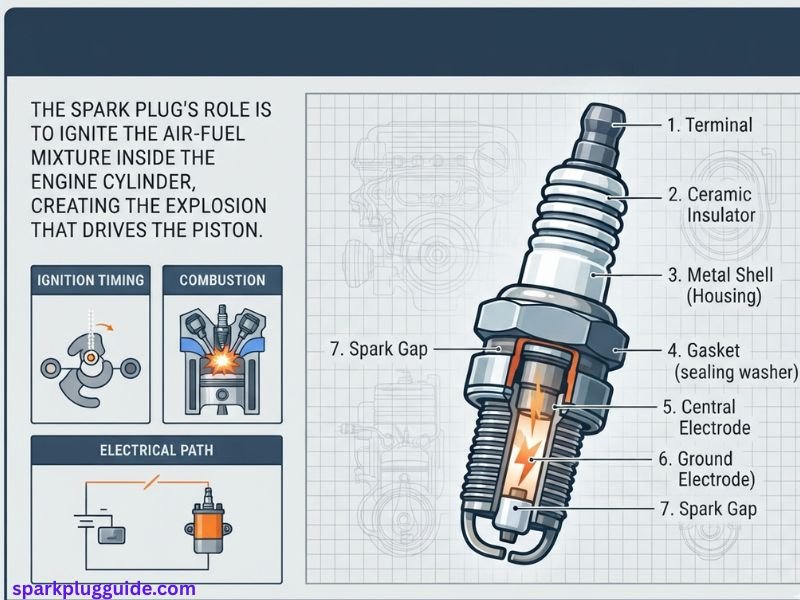
A spark plug is a small engine component that creates the electrical spark needed to ignite the air-fuel mixture inside a gasoline engine’s combustion chamber. This controlled ignition starts the combustion process, allowing the engine to generate power and keep the vehicle running.
Although spark plugs are small, they are one of the most important parts of a vehicle’s ignition system. Every time an engine completes a combustion cycle, spark plugs must deliver a precise spark at the correct moment to ensure efficient and smooth operation.
Understanding the Role of a Spark Plug
A gasoline engine requires three main elements to produce power:
- Air
- Fuel
- Ignition spark
The engine draws air into the combustion chamber, where it mixes with fuel delivered by the fuel injection system. The spark plug then produces a high-voltage electrical spark that ignites this compressed air-fuel mixture. This creates a small explosion that pushes the piston downward and generates mechanical power.
Without a properly functioning spark plug, the combustion process cannot happen correctly. This can result in problems such as engine misfires, reduced fuel efficiency, rough idling, and difficulty starting the vehicle.
Where Is a Spark Plug Located?
Spark plugs are installed in the cylinder head of gasoline-powered engines. Each spark plug is positioned above a combustion chamber so that the electrode tip extends into the area where the air-fuel mixture is compressed.
The number of spark plugs in a vehicle usually depends on the number of engine cylinders. For example:
- A 4-cylinder engine usually has 4 spark plugs
- A 6-cylinder engine usually has 6 spark plugs
- An 8-cylinder engine usually has 8 spark plugs
Some advanced engines may use different ignition designs, such as twin-spark systems, where each cylinder uses more than one spark plug for improved combustion efficiency.
Main Components of a Spark Plug
A spark plug contains several important parts that work together to create and deliver a reliable spark.
Center Electrode
The center electrode carries high-voltage electricity from the ignition system and releases it across the spark plug gap. Modern spark plugs may use materials such as iridium or platinum on the electrode tip because these materials can withstand high temperatures and provide longer service life.
Ground Electrode
The ground electrode is connected to the metal shell of the spark plug and creates the other side of the electrical path. The spark jumps between the center electrode and ground electrode across a small gap.
Ceramic Insulator
The ceramic insulator surrounds the center electrode and prevents electrical energy from escaping before reaching the spark gap. It also helps the spark plug handle the extreme temperatures found inside an engine.
Metal Shell
The metal shell provides structural support and allows the spark plug to be securely installed into the engine cylinder head. It also helps transfer heat away from the firing end of the spark plug.
Terminal
The terminal connects the spark plug to the ignition coil or spark plug wire, allowing electrical energy to reach the internal components.
Why Are Spark Plugs Important?
Spark plugs are essential because they directly control the ignition process inside a gasoline engine. A healthy spark plug helps maintain:
Smooth Engine Operation
A properly functioning spark plug creates consistent ignition, helping the engine run smoothly without hesitation or vibration.
Better Fuel Efficiency
When the air-fuel mixture burns completely, the engine can use fuel more efficiently. Worn or damaged spark plugs may cause incomplete combustion and increase fuel consumption.
Reliable Engine Starting
During startup, spark plugs must create a strong spark immediately. Weak spark plugs can make the engine harder to start, especially in cold conditions.
Proper Engine Performance
Spark plugs influence acceleration, power delivery, and overall driving experience. This is why choosing the correct spark plug type and maintaining it properly is important.
Understanding what a spark plug is provides the foundation for learning how it works, the different types available, and how it affects your vehicle’s performance.
What Do Spark Plugs Do?
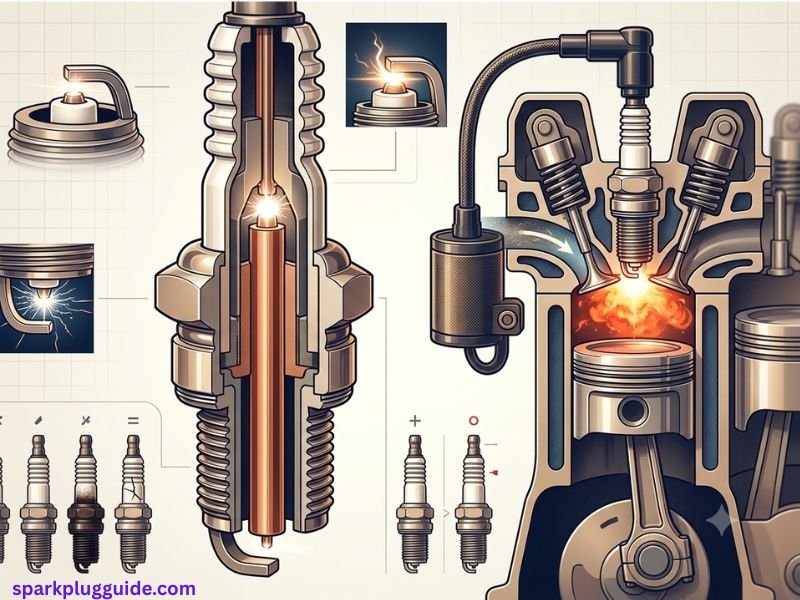
A spark plug creates the spark needed to ignite the compressed air-fuel mixture inside a gasoline engine’s combustion chamber. This ignition process starts combustion, which produces the energy required to move the pistons and power the vehicle.
Although a spark plug performs a simple function, the timing, strength, and consistency of the spark have a direct impact on engine performance, fuel efficiency, and reliability.
The Main Functions of Spark Plugs
Igniting the Air-Fuel Mixture
The primary function of a spark plug is to ignite the mixture of air and fuel inside the engine cylinder. During the compression stroke, the piston squeezes the air-fuel mixture, and the spark plug delivers a high-voltage spark at the exact right moment.
This spark creates a controlled combustion event that pushes the piston downward, producing the mechanical energy needed to run the engine.
Starting the Combustion Process
Every gasoline engine depends on a repeated combustion cycle to generate power. Spark plugs act as the starting point of this cycle by providing the ignition source.
The basic combustion process includes:
- Air enters the engine through the intake system
- Fuel is added by the fuel injection system
- The piston compresses the air-fuel mixture
- The spark plug creates an ignition spark
- Combustion forces the piston downward
- The engine produces power
This process happens thousands of times per minute while the engine is running.
Supporting Engine Performance
Spark plugs play an important role in maintaining smooth engine operation. A strong and consistent spark helps the engine burn fuel properly, which allows it to deliver reliable power.
Healthy spark plugs help maintain:
- Smooth acceleration
- Stable engine idle
- Quick throttle response
- Consistent power delivery
When spark plugs become worn or damaged, the engine may experience hesitation, reduced power, or rough operation.
Improving Fuel Efficiency
Proper combustion allows the engine to extract more energy from the fuel it uses. When spark plugs work correctly, the air-fuel mixture burns efficiently, helping reduce unnecessary fuel consumption.
A weak or inconsistent spark can cause incomplete combustion, meaning some fuel may not burn completely. This can lead to:
- Lower fuel economy
- Increased emissions
- Poor engine performance
Reducing Engine Misfires
A misfire happens when the air-fuel mixture inside a cylinder does not ignite properly. Since spark plugs are responsible for creating ignition, worn or faulty spark plugs are one of the common causes of engine misfires.
Signs related to spark plug ignition problems may include:
- Engine shaking or vibration
- Loss of power
- Rough idle
- Check engine light
- Difficulty starting
(For a detailed guide, see: Bad Spark Plug Symptoms)
How Spark Plugs Work Together With Other Engine Components
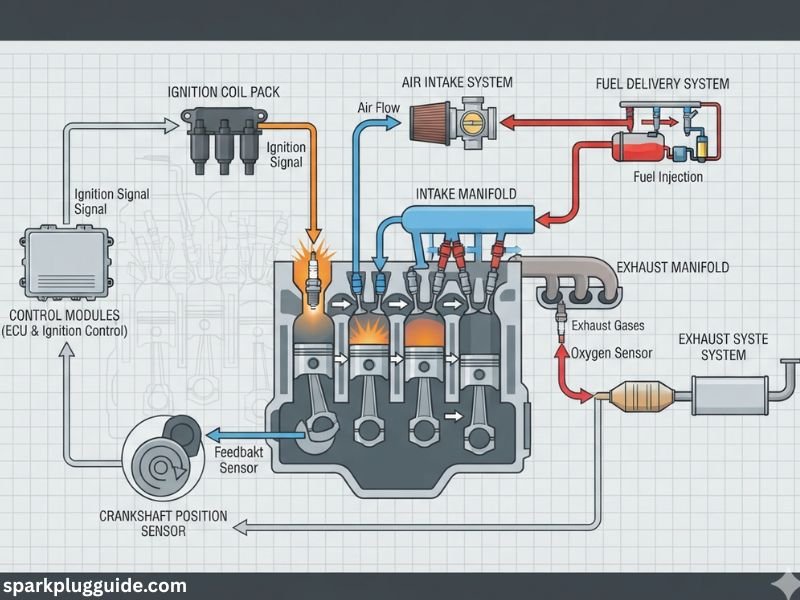
Spark plugs do not work alone. They are part of a larger ignition system that includes several important components.
Ignition Coil
The ignition coil converts the vehicle’s low-voltage battery power into the high voltage required to create a spark. This high-voltage electricity travels to the spark plug through the ignition system.
Fuel Injector
The fuel injector delivers the correct amount of fuel into the combustion chamber. The spark plug then ignites the air-fuel mixture created by this process.
Engine Control Unit (ECU)
The ECU controls ignition timing by deciding when the spark plug should fire. Proper timing ensures the spark happens at the most effective moment during the combustion cycle.
Why Spark Plug Function Matters
Because spark plugs control the ignition process, even a small issue can affect the entire engine system. The right spark plug, correct installation, and regular maintenance help ensure:
- Reliable engine starting
- Better fuel economy
- Smooth driving performance
- Reduced engine problems
- Longer engine life
Understanding what spark plugs do makes it easier to recognize their importance and explains why choosing the correct spark plug is essential for every gasoline-powered vehicle.
How Does a Spark Plug Work?
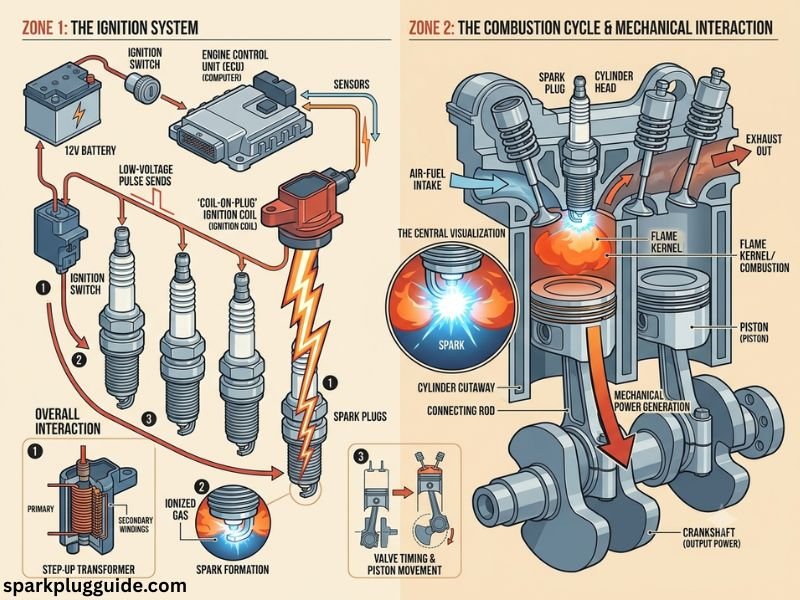
A spark plug works by receiving high-voltage electricity from the ignition system and creating a spark between its electrodes. This spark ignites the compressed air-fuel mixture inside the combustion chamber, starting the combustion process that produces engine power.
The process happens in a fraction of a second and repeats thousands of times while the engine is running. For the engine to operate smoothly, the spark must occur at the correct time with the right amount of energy.
The Step-by-Step Process of How a Spark Plug Works
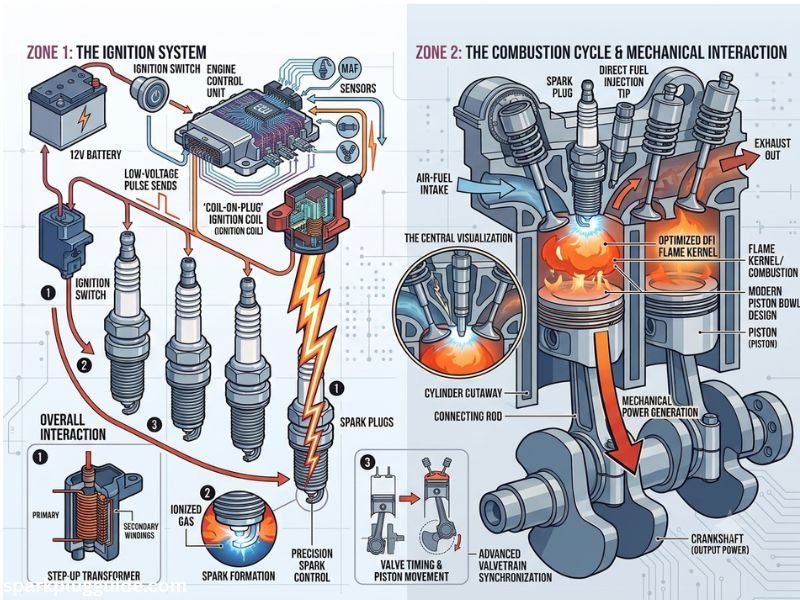
Electrical Energy Is Supplied by the Battery
The process begins with the vehicle’s electrical system. The battery provides the initial electrical power needed to operate the ignition system.
However, the battery only produces a relatively low voltage, which is not enough to create a spark across the spark plug gap. The ignition system must increase this voltage before it reaches the spark plug.
The Ignition Coil Increases Voltage
The ignition coil is responsible for converting low-voltage electricity from the battery into thousands of volts of electrical energy.
Modern vehicles often use a coil-on-plug ignition system, where each spark plug has its own ignition coil placed directly above it. Older vehicles may use spark plug wires connected to a shared ignition coil.
The high-voltage electricity created by the ignition coil is then sent to the spark plug terminal.
Electricity Travels Through the Spark Plug
Once high-voltage electricity reaches the spark plug, it travels through the internal components toward the center electrode.
The spark plug insulator helps control the electrical flow and prevents the voltage from escaping before it reaches the correct point.
The main electrical path includes:
- Spark plug terminal
- Internal conductor
- Center electrode
- Spark plug gap
The Spark Jumps Across the Electrode Gap
The most important moment happens when electricity reaches the spark plug gap.
The voltage becomes strong enough to overcome the air resistance between the center electrode and ground electrode. This creates a small but powerful electrical arc, known as the spark.
The spark plug gap must be correctly adjusted because:
- A gap that is too wide may require more voltage
- A gap that is too narrow may create a weak spark
- The wrong gap can affect combustion efficiency
This is why proper spark plug gapping is important during installation.
(For a detailed guide, see: How to Gap Spark Plugs)
The Spark Ignites the Air-Fuel Mixture
At the correct moment, the spark ignites the compressed air-fuel mixture inside the combustion chamber.
The combustion process creates expanding gases that push the piston downward. This movement transfers energy through the crankshaft and allows the vehicle to move.
The complete cycle includes:
- Intake stroke
- Compression stroke
- Power stroke
- Exhaust stroke
The spark plug operates during the compression stage to start the power-producing combustion event.
The Importance of Spark Timing
A spark plug does not simply create a spark randomly. The ignition must happen at a precise moment controlled by the engine management system.
Correct spark timing helps achieve:
- Maximum engine power
- Better fuel economy
- Smooth operation
- Lower emissions
If the spark occurs too early or too late, combustion efficiency can decrease and may cause engine problems.
How Modern Spark Plug Technology Improves Performance
Modern spark plugs use advanced materials and designs to improve durability and ignition performance.
Iridium Spark Plugs
Iridium has a very high melting point and allows manufacturers to create a smaller electrode tip. This design requires less voltage to create a strong spark and usually provides a longer service life.
Platinum Spark Plugs
Platinum spark plugs offer better durability than traditional copper spark plugs and are commonly used in many modern vehicles.
Copper Spark Plugs
Copper spark plugs provide excellent electrical conductivity and are often used in older vehicles or specific engine applications.
Spark Plug Operation in Modern Engines
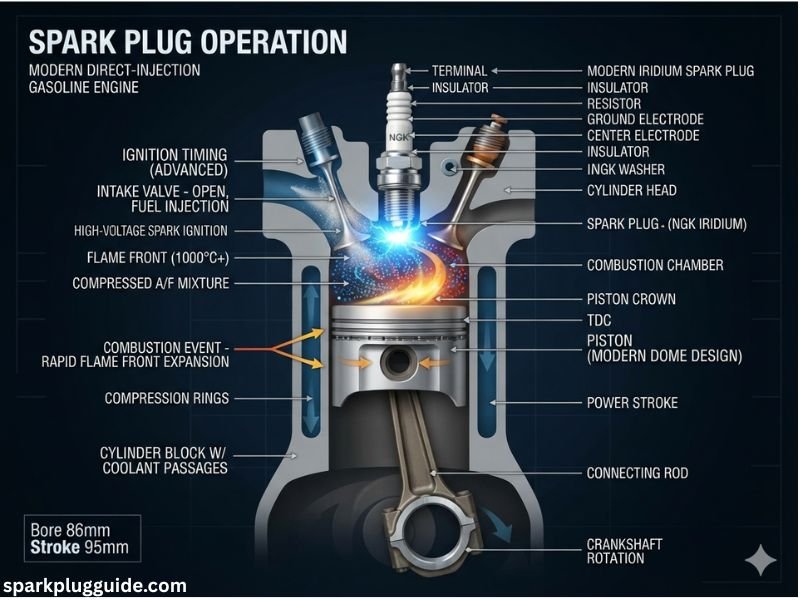
Modern engines rely on advanced computer-controlled ignition systems to optimize spark timing and performance. The Engine Control Unit (ECU) monitors various sensors and adjusts ignition timing based on:
- Engine speed
- Engine temperature
- Throttle position
- Driving conditions
- Load requirements
This allows spark plugs to deliver the right ignition performance under different situations.
Understanding how a spark plug works helps explain why this small component has such a major impact on engine reliability, fuel economy, and overall vehicle performance.
What Are Spark Plugs Used For?
Spark plugs are used to ignite the air-fuel mixture inside gasoline-powered engines, allowing the combustion process to create the power needed to operate a vehicle or machine. They are an essential component in cars, motorcycles, trucks, and many other engines that use gasoline as fuel.
While most people associate spark plugs with cars, they are used in many different applications where a gasoline engine requires a controlled ignition source.
Common Applications of Spark Plugs

Spark Plugs in Cars and Passenger Vehicles
The most common use of spark plugs is in passenger cars. Almost every gasoline-powered vehicle uses spark plugs as part of its ignition system.
In a typical car engine:
- The fuel injector delivers fuel into the combustion chamber
- The intake system provides air
- The spark plug ignites the compressed air-fuel mixture
- The combustion process creates engine power
Different vehicles require different spark plug specifications depending on factors such as:
- Engine design
- Cylinder count
- Manufacturer recommendations
- Driving conditions
- Performance requirements
Vehicle manufacturers such as Toyota, Honda, Ford, BMW, Chevrolet, and many others specify particular spark plug types designed for their engines.
Spark Plugs in Motorcycles
Motorcycles also rely on spark plugs to maintain efficient engine operation. Because motorcycle engines often operate at higher RPMs compared to many passenger vehicles, spark plug performance is especially important.
A properly functioning spark plug helps motorcycles achieve:
- Reliable starting
- Smooth acceleration
- Efficient fuel combustion
- Consistent engine performance
Motorcycle owners often pay close attention to spark plug condition because changes in spark quality can quickly affect riding performance.
Spark Plugs in Trucks and SUVs
Gasoline-powered trucks and SUVs use spark plugs to ignite fuel inside larger engines. These vehicles may place higher demands on spark plugs because of:
- Larger engine size
- Increased towing requirements
- Higher engine loads
- Frequent heavy-duty operation
Choosing the correct spark plug with the right heat range and durability is important for maintaining reliable performance.
Spark Plugs in Small Engines
Spark plugs are also commonly used in small gasoline engines found in everyday equipment.
Examples include:
- Lawn mowers
- Generators
- Pressure washers
- Chainsaws
- Snow blowers
- Garden equipment
Although these engines are smaller than car engines, they use the same basic ignition principle. The spark plug creates the ignition needed to burn fuel and produce mechanical power.
Spark Plugs in Performance and Racing Engines
High-performance and racing engines often use specially designed spark plugs to handle extreme conditions.
Performance engines may require spark plugs that can withstand:
- Higher temperatures
- Increased cylinder pressure
- Higher engine speeds
- More demanding combustion conditions
Enthusiasts and professional racers often choose specialized spark plugs with advanced materials such as iridium or racing-grade designs to support engine performance.
Do Diesel Engines Use Spark Plugs?
Diesel engines do not use traditional spark plugs because they ignite fuel differently.
Instead of using an electrical spark, diesel engines rely on:
- High compression pressure
- Heat created during compression
- Fuel injection timing
However, diesel engines may use a different component called a glow plug. Glow plugs help warm the combustion chamber during cold starts, but they do not create an ignition spark like spark plugs.
Why Spark Plug Applications Matter
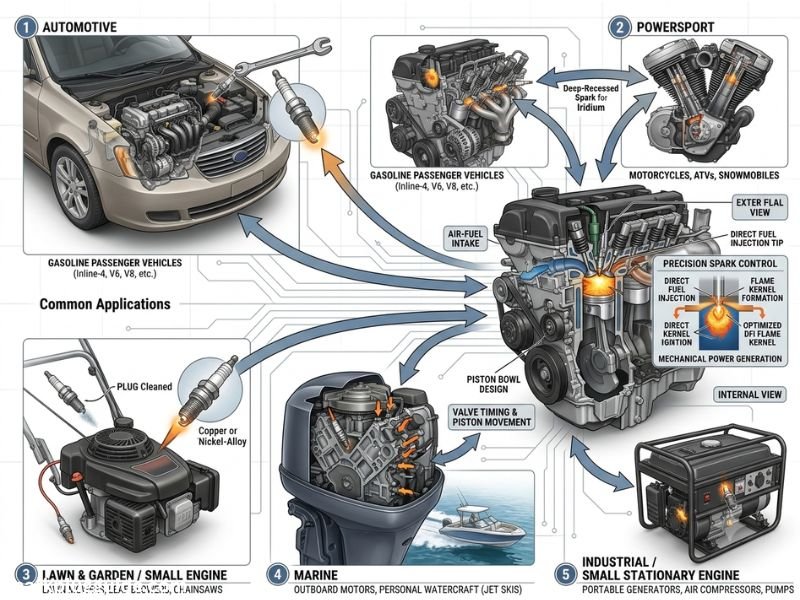
Understanding where spark plugs are used helps vehicle owners choose the correct component for their specific engine. A spark plug designed for a small motorcycle engine may not be suitable for a high-performance vehicle or a truck engine.
Factors that determine the correct spark plug include:
- Engine type
- Fuel system
- Manufacturer specifications
- Spark plug material
- Heat range
- Operating conditions
Choosing the right spark plug ensures proper combustion, better engine reliability, and efficient performance.
In the next sections, we will explore the different types of spark plugs, their materials, and how each design affects performance and lifespan.
Parts of a Spark Plug Explained
A spark plug may appear to be a simple component, but it is made up of several precisely designed parts that work together to create a reliable ignition spark. Each part has a specific purpose, from carrying electrical energy to controlling heat and creating the spark needed for combustion.
Understanding the different parts of a spark plug helps you identify how this small component manages extreme conditions inside an engine, including high temperatures, pressure, and electrical voltage.
Main Components of a Spark Plug
Terminal
The terminal is the top connection point of the spark plug where the ignition system delivers high-voltage electricity.
Depending on the vehicle design, the terminal connects to:
- Spark plug wires
- Ignition boots
- Ignition coils
The terminal ensures that electrical energy reaches the internal components of the spark plug without interruption.
Ceramic Insulator
The ceramic insulator is the white protective section surrounding the upper part of the spark plug. It plays an important role in controlling electrical flow and protecting the spark plug from heat.
The main functions of the ceramic insulator include:
- Preventing electrical leakage
- Directing voltage toward the electrode
- Providing heat resistance
- Protecting internal components
Most spark plug insulators are made from alumina ceramic because it can withstand extremely high temperatures and electrical stress.
Metal Shell
The metal shell is the threaded outer body of the spark plug that allows it to be installed into the engine cylinder head.
Its functions include:
- Holding the spark plug securely in place
- Providing a ground path for electrical current
- Transferring heat away from the firing end
- Protecting internal components
The metal shell size and thread design must match the vehicle manufacturer’s specifications to ensure proper installation.
Center Electrode
The center electrode is one of the most important parts of a spark plug because it carries high-voltage electricity and creates the spark.
The electrode material affects:
- Spark quality
- Durability
- Service life
- Ignition performance
Common center electrode materials include:
Copper Core Electrode
Copper spark plugs provide excellent electrical conductivity and are often used in older vehicles or specific engine applications.
Platinum Electrode
Platinum offers better durability than traditional materials and allows spark plugs to maintain performance for longer periods.
Iridium Electrode
Iridium is one of the most advanced spark plug materials. It has a very high melting point, allowing manufacturers to create a smaller electrode that produces an efficient spark.
Ground Electrode
The ground electrode is the metal part positioned near the center electrode. The electrical spark jumps across the gap between these two electrodes.
The design of the ground electrode affects:
- Ignition efficiency
- Spark direction
- Heat control
- Combustion performance
Some modern spark plugs use advanced ground electrode designs to improve ignition reliability and fuel efficiency.
Spark Plug Gap
The spark plug gap is the small distance between the center electrode and ground electrode where the spark occurs.
The correct gap is important because it affects:
- Required voltage
- Spark strength
- Combustion efficiency
- Engine performance
If the gap is too large:
- The ignition system may struggle to create a spark
- Misfires may occur
If the gap is too small:
- The spark may become weaker
- Combustion efficiency can decrease
This is why spark plugs must be installed with the correct gap according to vehicle specifications.
How Spark Plug Materials Affect Performance
The materials used in spark plugs influence their durability, price, and performance.
Copper Spark Plugs
- Excellent electrical conductivity
- Lower cost
- Shorter replacement interval
Platinum Spark Plugs
- Better durability
- Longer lifespan
- Common in many modern vehicles
Iridium Spark Plugs
- Highest durability
- Strong ignition performance
- Longer service life
- Used in many newer vehicles
Ruthenium Spark Plugs
- Advanced material technology
- Excellent wear resistance
- Designed for extended performance
Why Understanding Spark Plug Parts Is Important
Each spark plug component has a specific role in creating a reliable ignition event. A problem with any part, whether it is a damaged insulator, worn electrode, or incorrect gap, can affect engine operation.
Knowing the basic parts of a spark plug helps you better understand:
- Why spark plugs fail
- How different spark plug types work
- Why some spark plugs cost more than others
- How to choose the right spark plug for your vehicle
In the following sections, we will explore spark plug types, lifespan, common problems, and maintenance methods in more detail.
Why Are Spark Plugs Important?
Spark plugs are important because they control the ignition process that allows a gasoline engine to produce power. Without a properly working spark plug, the air-fuel mixture inside the combustion chamber cannot ignite correctly, preventing the engine from operating efficiently.
Although spark plugs are small compared to other engine components, their condition has a direct impact on engine performance, fuel economy, emissions, and overall reliability.
The Importance of Spark Plugs in Engine Performance
Maintaining Smooth Engine Operation
A healthy spark plug creates a consistent and properly timed spark, allowing each cylinder to complete the combustion process smoothly.
When spark plugs work correctly, drivers may experience:
- Smooth engine idle
- Better acceleration
- Consistent power delivery
- Reduced engine vibration
Worn or damaged spark plugs can interrupt combustion, causing the engine to run unevenly or lose performance.
Supporting Fuel Efficiency
Spark plugs play an important role in how efficiently an engine burns fuel. A strong spark helps ignite the air-fuel mixture completely, allowing the engine to extract more energy from every drop of fuel.
When spark plugs become worn, combustion may become incomplete, which can result in:
- Increased fuel consumption
- Lower mileage
- Higher emissions
- Reduced engine efficiency
Maintaining the correct spark plug condition helps the engine operate closer to its designed efficiency.
Ensuring Reliable Engine Starting
During engine startup, spark plugs must create a strong ignition spark immediately. If a spark plug is weak or worn, the engine may struggle to start.
Common starting problems related to spark plugs include:
- Delayed engine startup
- Multiple attempts before starting
- Poor performance in cold weather
Reliable spark plugs help ensure consistent ignition every time you turn the key or press the start button.
Reducing Engine Misfires
An engine misfire occurs when the air-fuel mixture inside a cylinder fails to ignite properly. Since spark plugs are responsible for creating ignition, they are often one of the first components checked when misfires occur.
A faulty spark plug may cause:
- Engine hesitation
- Shaking or vibration
- Loss of acceleration
- Check engine warning light
Regular inspection and replacement of spark plugs can help prevent these problems.
(For a detailed guide, see: Bad Spark Plug Symptoms)
Spark Plugs and Vehicle Emissions
Spark plugs also influence vehicle emissions because they affect how completely fuel burns inside the engine.
A properly functioning spark plug helps:
- Improve combustion efficiency
- Reduce unburned fuel
- Support emission control systems
When combustion is incomplete, more pollutants can enter the exhaust system, which may affect emissions performance.
Spark Plugs and Engine Longevity
Proper ignition is essential for maintaining long-term engine health. When spark plugs create consistent combustion, other engine components can operate under more stable conditions.
Poor spark quality may contribute to:
- Increased engine stress
- Poor combustion cycles
- Reduced overall performance
Replacing spark plugs at the recommended interval is a simple maintenance step that can protect engine reliability.
Why Choosing the Right Spark Plug Matters
Not every spark plug is suitable for every engine. Vehicle manufacturers design engines with specific requirements related to:
- Spark plug size
- Heat range
- Electrode material
- Gap specification
- Thread design
Using the correct spark plug helps ensure the ignition system works as intended.
Popular spark plug manufacturers include:
- NGK
- Denso
- Bosch
- Champion
- Autolite
Each brand offers different spark plug technologies designed for various engine applications.
Key Takeaway: Small Component, Major Impact
Spark plugs may be small, but they perform one of the most important tasks inside a gasoline engine. They help start combustion, maintain engine performance, improve fuel efficiency, and support reliable vehicle operation.
Understanding their importance makes it easier to recognize why regular inspection, proper maintenance, and choosing the correct spark plug are essential parts of vehicle care.
Different Types of Spark Plugs
Spark plugs are available in different designs and materials, each created to meet specific engine requirements. While all spark plugs perform the same basic function of creating an ignition spark, their electrode materials, durability, heat resistance, and performance characteristics can vary significantly.
Choosing the right type of spark plug depends on factors such as vehicle specifications, engine design, driving conditions, and manufacturer recommendations.
For a complete comparison of different spark plug types, including their advantages, disadvantages, and best applications, see our detailed guide: Types of Spark Plugs.
Copper Spark Plugs
Copper spark plugs are one of the oldest and most traditional types of spark plugs. They use a copper core electrode that provides excellent electrical conductivity and allows efficient current flow.
Advantages of Copper Spark Plugs
- Excellent electrical conductivity
- Reliable ignition performance
- Lower purchase cost
- Suitable for certain older engine designs
Disadvantages of Copper Spark Plugs
- Shorter lifespan compared to modern materials
- Lower resistance to extreme temperatures
- Require more frequent replacement
Copper spark plugs are still used in some vehicles because certain engines are specifically designed to work best with them.
Platinum Spark Plugs
Platinum spark plugs use a platinum disc or tip on the center electrode to improve durability compared to traditional copper spark plugs.
Platinum is a harder material that can withstand higher temperatures and reduce electrode wear.
Advantages of Platinum Spark Plugs
- Longer lifespan than copper spark plugs
- Better durability
- Stable ignition performance
- Reduced electrode wear
Common Applications
Platinum spark plugs are commonly found in many modern vehicles where manufacturers require improved durability and consistent performance.
Double Platinum Spark Plugs
Double platinum spark plugs use platinum material on both the center electrode and ground electrode.
This design provides better protection against electrode wear, especially in ignition systems where spark polarity changes during operation.
Advantages of Double Platinum Spark Plugs
- Improved durability
- Longer service life
- Better wear resistance
- Reliable performance in specific ignition systems
Double platinum spark plugs are often used in vehicles with waste spark ignition systems because both electrodes experience spark activity.
Iridium Spark Plugs
Iridium spark plugs are considered one of the most advanced and widely used spark plug types in modern vehicles.
Iridium is extremely durable and has a very high melting point, allowing manufacturers to create a smaller center electrode that requires less voltage to produce a strong spark.
Advantages of Iridium Spark Plugs
- Long service life
- Strong and efficient ignition
- Better performance under extreme conditions
- Improved fuel efficiency potential
- Excellent durability
Many modern vehicles from manufacturers such as Toyota, Honda, BMW, and others use iridium spark plugs as original equipment.
Ruthenium Spark Plugs
Ruthenium spark plugs are a newer technology designed to provide excellent durability and wear resistance.
They use ruthenium-based electrode materials to improve spark plug lifespan and maintain ignition performance over time.
Advantages of Ruthenium Spark Plugs
- Excellent wear resistance
- Long service life
- Stable ignition performance
- Advanced electrode technology
Ruthenium spark plugs are becoming more popular as manufacturers continue developing longer-lasting ignition components.
Performance and Racing Spark Plugs
Performance spark plugs are designed for engines that operate under demanding conditions, such as modified engines, racing vehicles, and high-performance applications.
These spark plugs may include:
- Specialized electrode designs
- Advanced heat ranges
- Improved ignition characteristics
- Materials designed for extreme temperatures
Performance spark plugs are selected based on engine modifications, fuel type, compression ratio, and operating conditions.
How to Choose the Right Spark Plug Type
Selecting the correct spark plug is not simply about choosing the most expensive option. The best spark plug depends on your specific engine requirements.
Important factors include:
Vehicle Manufacturer Recommendation
The owner’s manual or manufacturer specification is usually the best starting point when selecting spark plugs.
Engine Design
Different engines require different spark plug specifications based on:
- Compression ratio
- Ignition system design
- Operating temperature
Driving Conditions
Your driving habits may influence spark plug requirements.
Examples:
- Daily commuting
- Long-distance driving
- Heavy towing
- Performance driving
Spark Plug Material
Different materials provide different benefits:
- Copper → Strong conductivity and affordability
- Platinum → Improved durability
- Iridium → Long lifespan and advanced performance
- Ruthenium → Modern long-lasting technology
Spark Plug Types: Quick Comparison
| Spark Plug Type | Main Material | Lifespan | Best For |
| Copper | Copper core | Shorter | Older engines and specific applications |
| Platinum | Platinum tip | Medium | Modern everyday vehicles |
| Double Platinum | Platinum on both electrodes | Medium to long | Waste spark systems |
| Iridium | Iridium tip | Long | Modern vehicles and premium performance |
| Ruthenium | Ruthenium alloy | Very long | Advanced ignition applications |
Understanding spark plug types helps you make better decisions when replacing spark plugs. However, the correct choice should always match your vehicle’s engine specifications rather than simply selecting the newest or most expensive option.
How Long Do Spark Plugs Last?
The lifespan of spark plugs depends on the spark plug material, vehicle type, engine design, driving conditions, and manufacturer recommendations. In general, spark plugs can last anywhere from 20,000 miles to over 100,000 miles, depending on their construction and application.
Modern spark plugs made with advanced materials such as iridium and platinum usually last much longer than traditional copper spark plugs. However, even high-quality spark plugs eventually wear out and need replacement to maintain proper engine performance.
For a complete breakdown of replacement intervals, lifespan by material, and signs that your spark plugs need changing, see our detailed guide: How Long Do Spark Plugs Last.
Average Spark Plug Lifespan by Material
Different spark plug materials have different durability levels.
Copper Spark Plugs
Copper spark plugs generally have the shortest lifespan because the electrode material wears faster under normal engine conditions.
Typical lifespan:
- Around 20,000 to 30,000 miles
Advantages:
- Excellent electrical conductivity
- Affordable price
- Good performance for compatible engines
Disadvantages:
- Require more frequent replacement
- Less resistant to high temperatures
Platinum Spark Plugs
Platinum spark plugs provide better durability compared to copper spark plugs because platinum resists electrode wear.
Typical lifespan:
- Around 60,000 miles
Advantages:
- Longer service life
- Stable ignition performance
- Better durability
Iridium Spark Plugs
Iridium spark plugs are among the longest-lasting spark plugs available today. Their extremely durable electrode material allows them to maintain performance for extended periods.
Typical lifespan:
- Around 80,000 to 100,000+ miles
Advantages:
- Excellent durability
- Strong ignition performance
- Less frequent replacement
- Good performance in modern engines
Ruthenium Spark Plugs
Ruthenium spark plugs are designed with advanced electrode technology that provides excellent wear resistance.
Typical lifespan:
- Often comparable to or longer than premium spark plug types depending on application
Advantages:
- High durability
- Stable performance
- Advanced material technology
Factors That Affect Spark Plug Lifespan
Spark plug replacement intervals are not the same for every vehicle. Several factors can shorten or extend how long spark plugs last.
Engine Type and Design
Different engines place different demands on spark plugs. A high-performance engine with higher cylinder pressure and temperature may wear spark plugs faster than a standard commuter vehicle.
Factors include:
- Engine size
- Compression ratio
- Turbocharging
- Ignition system design
Driving Habits
The way a vehicle is driven can affect spark plug wear.
For example:
Short trips may reduce spark plug lifespan because:
- The engine may not reach optimal operating temperature
- Carbon deposits can build up more easily
Heavy driving conditions may also increase wear, including:
- Frequent acceleration
- Towing
- High-speed driving
Fuel Quality
Poor-quality fuel can contribute to combustion problems and carbon buildup, which may affect spark plug performance.
Using recommended fuel quality helps maintain cleaner combustion and better spark plug condition.
Engine Condition
Other engine problems can shorten spark plug life.
Examples include:
- Oil leaking into the combustion chamber
- Incorrect fuel mixture
- Faulty fuel injectors
- Engine overheating
These issues can cause abnormal deposits or excessive wear on spark plug electrodes.
How Do You Know When Spark Plugs Need Replacement?
Spark plugs often provide warning signs before they completely fail.
Common signs include:
- Difficulty starting the engine
- Rough idle
- Engine misfires
- Reduced acceleration
- Poor fuel economy
- Increased exhaust emissions
- Check engine light
If you notice these symptoms, inspecting the spark plugs can help identify whether replacement is needed.
(For a detailed guide, see: Bad Spark Plug Symptoms)
Should You Replace Spark Plugs Early?
Replacing spark plugs before they completely fail can help maintain consistent engine performance.
Early replacement may be beneficial when:
- The vehicle has reached the recommended service interval
- Engine performance has decreased
- Fuel economy has dropped
- The ignition system shows signs of problems
However, replacing spark plugs too early is usually unnecessary unless there is an existing issue or the manufacturer recommends it.
Following Manufacturer Recommendations
The best way to know when to replace spark plugs is to follow the vehicle manufacturer’s maintenance schedule.
Manufacturers consider:
- Engine design
- Spark plug material
- Operating temperature
- Ignition requirements
Using the recommended replacement interval helps ensure reliable performance and prevents unnecessary ignition problems.
Key Takeaway
Spark plugs can last anywhere from tens of thousands to over one hundred thousand miles depending on their material and operating conditions. While iridium and platinum spark plugs offer longer service life, every spark plug eventually wears down.
Regular inspection and following the recommended maintenance schedule can help keep your engine running smoothly, improve fuel efficiency, and prevent unexpected ignition problems.
Signs of Bad Spark Plugs
Bad spark plugs can affect almost every aspect of engine performance because they are responsible for starting the combustion process. When a spark plug becomes worn, damaged, or contaminated, it may not create a strong enough spark to ignite the air-fuel mixture properly.
Common signs of bad spark plugs include difficulty starting the engine, rough idling, reduced acceleration, poor fuel economy, and engine misfires.
For a complete guide covering all symptoms, causes, diagnosis methods, and solutions, see our detailed article: Bad Spark Plug Symptoms.
Common Symptoms of Bad Spark Plugs
Difficulty Starting the Engine
One of the first signs of worn spark plugs is trouble starting the vehicle. A weak spark may not ignite the air-fuel mixture effectively, especially when the engine requires extra ignition power during startup.
You may notice:
- Longer cranking time before the engine starts
- Multiple attempts needed to start the vehicle
- Weak engine response after startup
However, starting problems can also be caused by other issues, such as a weak battery, faulty starter motor, or fuel system problems.
Engine Misfires
An engine misfire occurs when the air-fuel mixture inside a cylinder fails to ignite properly. Since spark plugs create the ignition spark, worn or faulty spark plugs are a common cause of misfires.
Symptoms of engine misfires include:
- Engine shaking
- Sudden power loss
- Uneven acceleration
- Check engine light activation
A damaged spark plug can prevent one or more cylinders from producing normal combustion, affecting overall engine performance.
Rough Engine Idle
A healthy engine should run smoothly when idling. Bad spark plugs can interrupt the combustion process, causing the engine to vibrate or run unevenly while stopped.
Common signs include:
- Engine shaking at idle
- Unstable RPM readings
- Unusual engine sounds
- Feeling vibrations through the vehicle
A rough idle may also indicate problems with ignition coils, fuel injectors, or vacuum leaks, so proper diagnosis is important.
Poor Acceleration and Reduced Power
When spark plugs cannot create a strong and consistent spark, the engine may not produce its normal power output.
Drivers may experience:
- Slower acceleration
- Hesitation when pressing the accelerator
- Reduced engine responsiveness
- Lack of power during driving
This happens because incomplete combustion prevents the engine from converting fuel into energy efficiently.
Reduced Fuel Economy
Bad spark plugs can increase fuel consumption because they prevent the engine from burning fuel efficiently.
When combustion is incomplete:
- More fuel may be required to produce the same power
- The engine may compensate by adjusting fuel delivery
- Fuel efficiency can decrease
If you notice a sudden drop in fuel mileage, spark plugs should be one of the components to inspect.
Check Engine Light
Modern vehicles use sensors and computer systems to monitor engine performance. If faulty spark plugs cause ignition problems, the Engine Control Unit (ECU) may detect irregular combustion and trigger the check engine light.
Common related diagnostic trouble codes include:
- P0300 – Random/multiple cylinder misfire
- P0301-P0308 – Cylinder-specific misfire codes
A diagnostic scanner can help identify whether the issue is related to spark plugs or another ignition component.
Increased Exhaust Emissions
When spark plugs fail to ignite the fuel completely, unburned fuel can enter the exhaust system.
This may lead to:
- Higher emissions
- Poor combustion efficiency
- Potential damage to the catalytic converter over time
Maintaining healthy spark plugs helps support cleaner engine operation.
What Causes Spark Plugs to Become Bad?
Spark plugs can fail for several reasons.
Normal Electrode Wear
Over time, the center electrode and ground electrode naturally wear down because they are exposed to:
- High temperatures
- Electrical arcing
- Combustion pressure
As the electrode gap increases, the spark becomes less effective.
Carbon Deposits
Carbon buildup can form on the spark plug tip due to incomplete combustion.
Possible causes include:
- Rich fuel mixture
- Short driving trips
- Poor combustion conditions
Carbon deposits can weaken the spark and reduce ignition efficiency.
Oil Contamination
Engine oil entering the combustion chamber can cover the spark plug tip and interfere with ignition.
Possible causes:
- Worn piston rings
- Valve seal problems
- Engine gasket issues
Incorrect Spark Plug Gap
The spark plug gap must match manufacturer specifications.
A wrong gap can cause:
- Weak spark
- Misfires
- Poor engine performance
(For a detailed guide, see: How to Gap Spark Plugs)
How to Check If Spark Plugs Are Bad
A visual inspection can reveal several signs of spark plug problems.
Look for:
- Worn electrodes
- Excessive carbon buildup
- Oil deposits
- Cracked ceramic insulator
- Incorrect electrode gap
However, proper testing may require removing the spark plug and checking its condition with the correct tools.
(See: How to Check Spark Plugs and How to Test a Spark Plug)
Can You Drive With Bad Spark Plugs?
A vehicle may continue running with worn spark plugs, but ignoring the problem can lead to bigger issues.
Driving with bad spark plugs may cause:
- Reduced fuel economy
- Poor engine performance
- Increased emissions
- Damage to ignition components
- Possible catalytic converter damage
Replacing faulty spark plugs at the recommended time helps prevent additional repair costs.
Key Takeaway
Bad spark plugs can affect engine starting, power delivery, fuel efficiency, and overall reliability. Recognizing early warning signs allows you to fix ignition problems before they become more expensive.
Regular inspection and timely replacement are simple maintenance steps that help keep your engine running smoothly.
How to Check Spark Plugs
Checking spark plugs is a simple way to understand the condition of your engine’s ignition system. By inspecting spark plugs, you can identify signs of wear, carbon buildup, oil contamination, incorrect gaps, or other issues that may affect engine performance.
A spark plug inspection can help answer important questions such as whether your spark plugs are still in good condition, whether they need cleaning, adjustment, or replacement.
For a complete step-by-step inspection process, tools required, and detailed diagnosis methods, see our guide: How to Check Spark Plugs.
Why Should You Check Spark Plugs?
Spark plugs provide valuable information about what is happening inside the engine. Their condition can reveal problems related to:
- Ignition performance
- Fuel mixture
- Engine combustion
- Oil consumption
- Engine overheating
A healthy spark plug usually has a clean appearance with normal electrode wear. An abnormal spark plug condition may indicate a deeper engine or ignition system problem.
When Should You Check Spark Plugs?
You should consider checking spark plugs when:
- The engine performance decreases
- Fuel economy becomes worse
- The vehicle experiences misfires
- The engine becomes difficult to start
- The check engine light appears
- The vehicle reaches the recommended maintenance interval
Regular inspection is especially useful before replacing spark plugs because it helps confirm whether replacement is actually needed.
Tools Needed to Check Spark Plugs
Before inspecting spark plugs, you may need:
Spark Plug Socket
A spark plug socket is designed specifically to remove and install spark plugs without damaging them.
Common spark plug socket sizes include:
- 5/8 inch
- 13/16 inch
- 14mm
- 16mm
(See: What Size Socket for Spark Plug)
Ratchet and Extension
A ratchet handle and extension help access spark plugs located deep inside the engine.
Spark Plug Gap Gauge
A gap gauge measures the distance between the spark plug electrodes to ensure it matches manufacturer specifications.
Flashlight
A flashlight helps inspect the spark plug area and identify dirt, oil leaks, or damage.
Step-by-Step Process to Check Spark Plugs
1. Allow the Engine to Cool
Always check spark plugs when the engine is completely cool.
Removing spark plugs from a hot engine can:
- Damage threads
- Increase the risk of injury
- Make removal more difficult
2. Locate the Spark Plugs
The location of spark plugs depends on the engine design.
They are usually found:
- On top of the cylinder head
- Under ignition coils
- Connected to spark plug wires
Modern vehicles commonly use coil-on-plug ignition systems where individual ignition coils sit directly above each spark plug.
3. Remove the Ignition Coil or Spark Plug Wire
Before removing the spark plug, disconnect the electrical connection carefully.
Depending on the vehicle, this may involve removing:
- Ignition coil connectors
- Spark plug wires
- Protective covers
Avoid pulling wires forcefully because this can damage the ignition system.
4. Remove the Spark Plug
Use the correct spark plug socket and carefully loosen the spark plug.
Inspect the removed spark plug before cleaning it because its condition can provide important information about engine operation.
How to Read Spark Plug Condition
The appearance of a spark plug can tell you a lot about engine health.
Normal Spark Plug
A healthy spark plug usually shows:
- Light gray or brown deposits
- Moderate electrode wear
- Clean ceramic insulator
This generally indicates proper combustion.
Black Carbon Deposits
A black, sooty spark plug may indicate:
- Rich fuel mixture
- Incomplete combustion
- Frequent short trips
Oil-Fouled Spark Plug
Oil deposits on the spark plug may suggest:
- Worn piston rings
- Valve seal problems
- Engine oil entering the combustion chamber
White or Overheated Spark Plug
A white appearance may indicate:
- Excessive engine temperature
- Lean fuel mixture
- Incorrect heat range
Checking Spark Plug Gap
The spark plug gap is one of the most important things to inspect.
A gap that is too large or too small can affect ignition performance.
Use a spark plug gap tool to measure the distance and compare it with the vehicle manufacturer’s specification.
Should You Clean or Replace Spark Plugs?
After inspection, you can decide whether the spark plug needs cleaning or replacement.
Cleaning may be possible when:
- Deposits are minor
- The electrode is still in good condition
- The spark plug has not reached its service interval
Replacement is usually recommended when:
- Electrodes are worn
- Ceramic insulation is damaged
- The spark plug has reached its recommended lifespan
- Performance problems are present
Spark Plug Inspection Tips
For accurate inspection:
- Check all spark plugs, not just one
- Compare their condition with each other
- Use the correct tools
- Follow vehicle specifications
- Avoid forcing damaged spark plugs during removal
Key Takeaway
Checking spark plugs is an effective way to monitor engine health and identify ignition problems early. A simple inspection can reveal signs of wear, combustion issues, or maintenance needs before they develop into larger engine problems.
Understanding how to check spark plugs helps vehicle owners make better maintenance decisions and keep their engines performing efficiently.
How to Test a Spark Plug
Testing a spark plug helps determine whether it is creating a strong enough spark to ignite the air-fuel mixture inside the engine. A faulty spark plug can cause ignition problems, including misfires, rough running, poor acceleration, and difficulty starting the vehicle.
A spark plug test can help identify whether the problem is caused by the spark plug itself or another ignition component, such as the ignition coil, spark plug wire, or fuel system.
For a complete testing process, required tools, and different diagnostic methods, see our detailed guide: How to Test a Spark Plug.
Why Test a Spark Plug?
Spark plugs operate under extreme conditions, including high temperature, pressure, and electrical stress. Over time, they may develop problems that are not always visible during a simple inspection.
Testing a spark plug can help identify:
- Weak or inconsistent spark
- Complete spark failure
- Ignition system problems
- Damaged spark plug components
- Engine misfire causes
Proper testing prevents unnecessary replacement of parts and helps diagnose the actual cause of engine performance issues.
Common Signs That a Spark Plug May Need Testing
You may need to test your spark plugs if you notice:
Engine Misfires
A misfire occurs when one or more cylinders fail to ignite the air-fuel mixture correctly.
Possible signs include:
- Engine shaking
- Loss of power
- Uneven acceleration
- Check engine light
Difficulty Starting
A weak spark can prevent the engine from starting properly, especially during cold conditions.
Poor Engine Performance
Faulty spark plugs may cause:
- Sluggish acceleration
- Reduced power
- Rough engine operation
Reduced Fuel Economy
When combustion is incomplete, the engine may consume more fuel than normal.
Tools Used to Test a Spark Plug
Different testing methods require different tools.
Spark Tester
A spark tester is one of the safest and most reliable tools for checking whether a spark plug produces an ignition spark.
It connects between the spark plug and ignition system to show whether electrical energy is reaching the plug.
Multimeter
A digital multimeter can be used for some spark plug-related electrical checks, although it cannot fully measure spark quality.
It may help check:
- Electrical continuity
- Resistance
- Certain ignition components
Spark Plug Socket and Tools
Removing the spark plug may require:
- Spark plug socket
- Ratchet
- Extension bar
- Gap gauge
(See: What Size Socket for Spark Plug)
Methods to Test a Spark Plug
Method 1: Visual Spark Plug Inspection
Before performing electrical tests, inspect the spark plug condition.
Look for:
- Worn electrodes
- Carbon deposits
- Oil contamination
- Cracked ceramic insulator
- Incorrect spark plug gap
A damaged spark plug may need replacement even if it still produces a spark.
Method 2: Using a Spark Tester
A spark tester allows you to check whether the spark plug is receiving proper ignition energy.
Basic process:
- Remove the ignition connection
- Connect the spark tester
- Crank or start the engine
- Observe spark activity
A strong and consistent spark usually indicates that ignition energy is reaching the spark plug.
A weak or missing spark may indicate problems with:
- Spark plug
- Ignition coil
- Spark plug wire
- Electrical connection
Method 3: Checking Spark Plug Gap
The spark plug gap directly affects spark performance.
A gap that is incorrect may cause:
- Weak ignition
- Misfires
- Poor fuel combustion
Use a spark plug gap tool to measure and adjust the gap according to manufacturer specifications.
Testing a Spark Plug vs Testing an Ignition Coil
Spark plugs and ignition coils work together, but they are different components.
| Component | Main Function |
| Spark Plug | Creates the ignition spark inside the combustion chamber |
| Ignition Coil | Converts battery voltage into high-voltage electricity |
If a spark plug test shows no spark, the problem may not always be the spark plug itself. The ignition coil and electrical connections should also be checked.
Can You Test a Spark Plug Without Removing It?
Some basic ignition checks can be performed without removing the spark plug, but a complete inspection usually requires removal.
Removing the spark plug allows you to check:
- Electrode condition
- Deposits
- Physical damage
- Gap measurement
A visual inspection often provides valuable information about engine operation.
When Should You Replace Instead of Test?
Testing can help identify problems, but replacement is usually recommended when:
- Spark plugs have reached their service interval
- Electrodes are worn
- The ceramic insulator is damaged
- The spark plug has heavy deposits
- Engine problems continue after testing
Modern iridium and platinum spark plugs can last a long time, but they still require inspection and replacement when necessary.
Testing a spark plug is an important diagnostic step when an engine experiences ignition problems. A proper test can help determine whether the spark plug is working correctly or whether another component in the ignition system needs attention.
By understanding how to test spark plugs, vehicle owners can diagnose problems more accurately, avoid unnecessary repairs, and maintain better engine performance.
How to Clean Spark Plugs
Cleaning spark plugs can help remove light deposits and restore proper ignition performance in some situations. Over time, spark plugs may collect carbon buildup, dirt, or other deposits that can affect the strength and consistency of the spark.
However, cleaning is not always the best solution. Severely worn, damaged, or old spark plugs usually need to be replaced rather than cleaned.
For a complete cleaning process, recommended methods, safety precautions, and when to replace instead of clean, see our detailed guide: How to Clean Spark Plugs.
Why Do Spark Plugs Need Cleaning?
Spark plugs operate inside the combustion chamber where they are exposed to extreme heat, pressure, and combustion byproducts. Over time, deposits can form on the electrode and insulator areas.
Common causes of spark plug deposits include:
- Incomplete fuel combustion
- Rich fuel mixture
- Frequent short-distance driving
- Oil entering the combustion chamber
- Poor engine tuning
These deposits can interfere with spark production and reduce ignition efficiency.
Types of Spark Plug Deposits
The appearance of deposits can provide information about engine conditions.
Carbon Deposits
Carbon buildup appears as black, dry, and sooty deposits on the spark plug.
Possible causes include:
- Too much fuel compared to air
- Dirty air filter
- Short trips that prevent complete combustion
- Incorrect fuel mixture
Carbon deposits may weaken the spark and affect engine performance.
Oil Deposits
Oil-fouled spark plugs usually have dark, wet deposits.
Possible causes include:
- Worn piston rings
- Damaged valve seals
- Engine oil entering the combustion chamber
Cleaning may temporarily remove the deposits, but the underlying engine problem must also be addressed.
Fuel Deposits
Fuel-related deposits may occur when combustion is not working properly.
Possible causes include:
- Fuel system issues
- Incorrect fuel mixture
- Injector problems
Can All Spark Plugs Be Cleaned?
Not every spark plug should be cleaned and reused.
Cleaning may be suitable when:
- The spark plug is relatively new
- Deposits are light
- The electrodes are still in good condition
- The spark plug has not reached its replacement interval
Replacement is usually better when:
- Electrodes are worn
- The ceramic insulator is cracked
- The spark plug has severe deposits
- The spark plug has exceeded its expected lifespan
Modern iridium and platinum spark plugs require extra care because their fine electrodes can be easily damaged.
Tools Needed to Clean Spark Plugs
Basic cleaning may require:
Spark Plug Socket
Used to safely remove and install spark plugs.
Soft Wire Brush
A soft brush can help remove light deposits without damaging the electrode.
Spark Plug Cleaner
Professional spark plug cleaning tools use controlled methods to remove deposits.
Compressed Air
Compressed air can remove loose dirt and debris after cleaning.
Gap Gauge
After cleaning, the spark plug gap should be checked to ensure it matches manufacturer specifications.
How to Clean Spark Plugs: Step by Step
1. Remove the Spark Plug Carefully
Before removing spark plugs:
- Turn off the engine
- Allow the engine to cool completely
- Disconnect ignition components carefully
Use the correct spark plug socket to avoid damaging the plug.
2. Inspect the Spark Plug Condition
Before cleaning, check for:
- Electrode wear
- Cracks
- Heavy deposits
- Oil contamination
If the spark plug is damaged, replacement is recommended.
3. Remove Light Deposits
For minor deposits, gently clean the spark plug using appropriate tools.
Avoid aggressive cleaning methods that may damage:
- Fine electrodes
- Ceramic insulator
- Spark plug coating
4. Check the Spark Plug Gap
After cleaning, measure the spark plug gap using a gap gauge.
The correct gap ensures:
- Strong ignition
- Proper combustion
- Reliable engine performance
5. Reinstall the Spark Plug
Install the spark plug according to manufacturer specifications.
Important points:
- Avoid over-tightening
- Use correct torque settings
- Ensure proper electrical connection
Should You Clean or Replace Spark Plugs?
Cleaning and replacement serve different purposes.
Cleaning May Help When:
- The spark plug has minor deposits
- The plug is still within its service life
- Performance issues are caused by surface buildup
Replacement Is Better When:
- The spark plug is worn
- The electrode shape has changed
- The plug has been used beyond its recommended interval
- Engine problems continue after cleaning
How to Gap Spark Plugs
Spark plug gapping is the process of adjusting the distance between the center electrode and ground electrode to match the correct specification required by the engine. The spark plug gap directly affects how easily electricity can create a spark and how efficiently the air-fuel mixture burns inside the combustion chamber.
A correctly gapped spark plug helps maintain strong ignition, smooth engine operation, and reliable performance. An incorrect gap can lead to problems such as misfires, poor acceleration, rough idling, and difficulty starting the engine.
For a complete step-by-step process, tools, measurements, and vehicle-specific recommendations, see our detailed guide: How to Gap Spark Plugs.
What Is Spark Plug Gap?
The spark plug gap is the small space between the center electrode and the ground electrode where the electrical spark occurs.
When the ignition coil sends high-voltage electricity to the spark plug, the voltage must jump across this gap to create a spark.
The gap size determines:
- How much voltage is required
- Spark strength
- Ignition reliability
- Combustion efficiency
Every engine is designed with a specific spark plug gap requirement based on its ignition system and combustion characteristics.
Why Is Proper Spark Plug Gap Important?
The correct spark plug gap helps ensure that the ignition system works efficiently.
Strong and Reliable Spark
A properly adjusted gap allows the spark plug to create a strong spark at the correct time.
Better Combustion
A suitable gap helps ignite the air-fuel mixture completely, improving engine efficiency.
Smooth Engine Performance
Correct spark plug gapping helps reduce:
- Misfires
- Engine hesitation
- Rough idle
- Starting problems
Protecting Ignition Components
An incorrect gap can place extra stress on ignition components, especially the ignition coil.
What Happens If Spark Plug Gap Is Wrong?
The spark plug gap must not be too wide or too narrow.
Gap That Is Too Wide
When the gap is larger than recommended, the ignition system needs more voltage to create a spark.
Possible problems include:
- Weak or inconsistent ignition
- Engine misfires
- Increased stress on ignition coils
- Difficulty starting
This problem is more common in engines with high cylinder pressure or worn ignition components.
Gap That Is Too Small
When the gap is too narrow, the spark may be weaker and less effective.
Possible problems include:
- Poor combustion
- Reduced engine performance
- Lower fuel efficiency
- Incomplete fuel burning
Tools Needed to Gap Spark Plugs
Several tools can be used to measure and adjust spark plug gaps.
Spark Plug Gap Gauge
A gap gauge is the most common tool used to check the distance between electrodes.
Common types include:
- Coin-style gap gauge
- Wire-style gap gauge
- Feeler gauge
Spark Plug Gap Tool
A dedicated spark plug gapping tool can help adjust the electrode position carefully.
Vehicle Specifications
Before adjusting the gap, always check the recommended specification from:
- Owner’s manual
- Vehicle manufacturer
- Spark plug manufacturer
How to Gap Spark Plugs Step by Step
1. Find the Correct Spark Plug Gap Specification
Every engine has a recommended spark plug gap.
The correct measurement depends on:
- Engine design
- Ignition system
- Spark plug type
- Vehicle manufacturer requirements
Never assume all vehicles use the same gap.
2. Measure the Existing Gap
Place the gap gauge between the center electrode and ground electrode.
Compare the measurement with the required specification.
The gap may be:
- Correct
- Too wide
- Too narrow
3. Adjust the Gap if Necessary
If the gap needs adjustment:
- Carefully bend the ground electrode to increase or decrease the distance
- Avoid applying pressure to the center electrode
- Make small adjustments
The electrode should never be forced or damaged.
4. Recheck the Measurement
After adjustment, measure the gap again to confirm it matches the recommended specification.
A small difference can affect ignition performance, so accuracy matters.
Do New Spark Plugs Need to Be Gapped?
It depends on the spark plug type and manufacturer instructions.
Many modern spark plugs come pre-gapped, but the gap should still be checked before installation.
Reasons include:
- Shipping movement
- Incorrect previous adjustment
- Different engine applications
Always verify the gap before installing new spark plugs.
Can You Gap Iridium Spark Plugs?
Iridium spark plugs require extra care because they have very thin electrodes designed for precise ignition performance.
Aggressive adjustment can damage:
- Fine iridium tip
- Electrode structure
- Spark plug performance
Always follow the spark plug manufacturer’s instructions before adjusting iridium plugs.
Spark Plug Gap and Engine Performance
The correct gap helps balance ignition strength and combustion efficiency.
A properly gapped spark plug supports:
- Faster engine starting
- Smooth acceleration
- Stable idle
- Efficient fuel combustion
However, changing the spark plug gap beyond manufacturer recommendations does not automatically increase horsepower or performance.
Engine modifications, ignition system design, and fuel requirements must all be considered.
Spark plug gapping is a small but important maintenance step that can significantly affect ignition performance. The correct gap allows the spark plug to create a reliable spark while helping the engine run smoothly and efficiently.
Always follow manufacturer specifications when checking or adjusting spark plug gaps, especially with modern iridium and platinum spark plugs.
How Many Spark Plugs Does a Car Have?
Most cars have one spark plug for each engine cylinder, meaning the number of spark plugs depends on the number of cylinders in the engine. For example, a 4-cylinder engine usually has four spark plugs, while a V6 engine typically uses six spark plugs.
However, some engines use advanced ignition designs, such as twin-spark systems, where each cylinder may have more than one spark plug for improved combustion efficiency.
Understanding how many spark plugs your car has is important because it helps with maintenance planning, replacement costs, and diagnosing ignition problems.
Spark Plug Count Based on Engine Cylinders
The majority of gasoline engines follow a simple rule:
One cylinder = One spark plug
Common examples include:
4-Cylinder Engine
A 4-cylinder engine usually has:
- 4 spark plugs
- 4 ignition events working together during engine operation
These engines are common in:
- Compact cars
- Sedans
- Small SUVs
- Economy vehicles
Examples:
- Toyota Corolla
- Honda Civic
- Ford Focus
6-Cylinder Engine
A 6-cylinder engine usually has:
- 6 spark plugs
V6 engines are commonly found in:
- Larger sedans
- SUVs
- Trucks
- Performance vehicles
8-Cylinder Engine
A V8 engine generally uses:
- 8 spark plugs
These engines are common in:
- Pickup trucks
- Muscle cars
- High-performance vehicles
Examples:
- Ford Mustang GT
- Chevrolet Corvette
- Full-size trucks
Do All Cars Have the Same Number of Spark Plugs?
No. The number of spark plugs varies depending on the engine design and manufacturer specifications.
Factors that determine spark plug quantity include:
- Number of cylinders
- Ignition system design
- Engine technology
- Manufacturer engineering choices
Most modern gasoline vehicles use one spark plug per cylinder, but some engines use different configurations.
What Are Twin Spark Engines?
Some vehicles use a twin spark ignition system, where each cylinder has two spark plugs instead of one.
For example:
A 4-cylinder twin spark engine may have:
- 4 cylinders
- 8 spark plugs
The purpose of using multiple spark plugs per cylinder is to improve combustion efficiency.
Benefits may include:
- Faster fuel ignition
- More complete combustion
- Better fuel efficiency
- Reduced emissions
Twin spark technology has been used by manufacturers such as Alfa Romeo and some performance-focused engine designs.
How Many Spark Plugs Does a Hybrid Car Have?
It depends on the type of hybrid system.
Many hybrid vehicles still use gasoline engines, meaning they usually have spark plugs based on their engine cylinder count.
Examples:
- 4-cylinder hybrid engine → Usually 4 spark plugs
- 6-cylinder hybrid engine → Usually 6 spark plugs
However, fully electric vehicles do not use spark plugs because they do not have combustion engines.
Do Diesel Cars Have Spark Plugs?
Traditional diesel engines do not use spark plugs.
Instead, diesel engines rely on:
- High compression pressure
- Heat generated during compression
- Fuel injection timing
Diesel vehicles may use glow plugs, which are different from spark plugs.
Spark Plug vs Glow Plug
| Component | Used In | Main Function |
| Spark Plug | Gasoline engines | Creates an electrical spark to ignite fuel |
| Glow Plug | Diesel engines | Helps heat the combustion chamber during cold starts |
How Many Spark Plugs Does a Car Need for Replacement?
When replacing spark plugs, you normally replace all spark plugs in the engine rather than only one.
For example:
- 4-cylinder engine → Replace 4 spark plugs
- V6 engine → Replace 6 spark plugs
- V8 engine → Replace 8 spark plugs
Replacing all spark plugs together helps maintain consistent ignition performance across all cylinders.
How to Find Out How Many Spark Plugs Your Car Has
The easiest ways to determine your vehicle’s spark plug count are:
Check the Owner’s Manual
The vehicle manual usually provides information about:
- Engine specifications
- Maintenance schedule
- Spark plug requirements
Check Engine Cylinder Count
Knowing your engine size can provide a general estimate.
Examples:
- 1.5L 4-cylinder engine → Usually 4 spark plugs
- 3.0L V6 engine → Usually 6 spark plugs
Check Vehicle Specifications
Manufacturer websites and reliable automotive databases can provide exact engine information.
Why Spark Plug Count Matters
Knowing the number of spark plugs in your vehicle helps you understand:
- Replacement costs
- Maintenance requirements
- Required parts quantity
- Ignition system design
It also helps avoid buying the wrong number of spark plugs when performing DIY maintenance.
Key Takeaway
Most gasoline cars have one spark plug per cylinder, but the exact number depends on engine design. A standard 4-cylinder vehicle usually has four spark plugs, while larger engines may have six, eight, or more.
Before replacing spark plugs, always confirm your vehicle’s engine specifications to ensure you purchase the correct number and type of spark plugs.
What Size Socket Is Used for Spark Plugs?
The most common spark plug socket sizes are 5/8 inch (16mm), 13/16 inch (21mm), 14mm, and 18mm, but the correct size depends on the vehicle, engine design, and spark plug type. Using the wrong socket size can damage the spark plug or make removal difficult.
A spark plug socket is specially designed with a rubber insert or magnet to hold the spark plug securely while removing or installing it.
For a complete guide covering spark plug socket sizes, tools, and how to choose the correct socket for your vehicle, see our detailed article: What Size Socket for Spark Plug.
Why Do You Need a Special Spark Plug Socket?
Although spark plugs look similar to regular bolts, they require a specialized socket because of their location and design.
A spark plug socket provides:
- Proper fit around the spark plug hex area
- Protection against damage during removal
- Secure grip when installing the spark plug
- Easier access to deep engine locations
Many spark plugs are installed deep inside the cylinder head, making a standard socket unsuitable for the job.
Common Spark Plug Socket Sizes
Spark plug socket size varies depending on the vehicle manufacturer and engine design.
5/8 Inch (16mm) Spark Plug Socket
The 5/8-inch socket is one of the most common sizes used in modern vehicles.
Common applications include:
- Many passenger cars
- Compact vehicles
- Some Japanese and American vehicles
This size is frequently found in DIY spark plug replacement kits.
13/16 Inch (21mm) Spark Plug Socket
The 13/16-inch socket is another traditional spark plug size.
It is commonly used in:
- Older vehicles
- Certain trucks
- Some small engines
14mm Spark Plug Socket
Many modern engines use smaller 14mm spark plugs, especially those with advanced engine designs and compact cylinder heads.
These are commonly found in:
- European vehicles
- Modern performance engines
- Some Asian vehicles
18mm Spark Plug Socket
Some specialized engines use 18mm spark plugs, although this size is less common compared to 14mm, 16mm, or 21mm options.
How to Know the Correct Spark Plug Socket Size
The best way to identify the correct socket size is to check your vehicle-specific information.
Check the Owner’s Manual
The owner’s manual may provide:
- Spark plug specifications
- Recommended tools
- Maintenance information
Check the Existing Spark Plug
If you remove an old spark plug, you can measure the hex size to determine the correct socket.
Use Vehicle Specifications
Automotive databases and manufacturer information can provide exact spark plug details based on:
- Vehicle model
- Year
- Engine type
Types of Spark Plug Sockets
Spark plug sockets come in different designs depending on the application.
Standard Spark Plug Socket
A standard spark plug socket works for most common vehicles and includes a protective insert to hold the plug.
Magnetic Spark Plug Socket
A magnetic socket uses a magnet to securely hold the spark plug during removal and installation.
Benefits include:
- Easier handling
- Reduced risk of dropping the plug
- Better access in tight spaces
Thin-Wall Spark Plug Socket
Some modern engines have limited space around the spark plug area. A thin-wall socket provides better access without interfering with surrounding components.
Tools Commonly Used With Spark Plug Sockets
Replacing spark plugs usually requires more than just a socket.
Common tools include:
Ratchet Handle
Used to loosen and tighten the spark plug.
Extension Bar
Helps reach spark plugs located deep inside the engine.
Torque Wrench
A torque wrench ensures the spark plug is tightened according to manufacturer specifications.
Over-tightening can damage:
- Spark plug threads
- Cylinder head
- Spark plug shell
Under-tightening can cause:
- Poor heat transfer
- Loose spark plugs
- Compression problems
Spark Plug Gap Tool
Used to check or adjust the spark plug gap before installation.
Can You Use a Regular Socket for Spark Plugs?
Technically, a regular socket may fit the spark plug hex area, but it is not recommended.
Regular sockets may:
- Not hold the spark plug securely
- Damage the ceramic insulator
- Make installation more difficult
A proper spark plug socket is designed specifically for safe removal and installation.
Does Spark Plug Size Depend on Vehicle Type?
Yes. Spark plug socket size depends on:
- Engine design
- Manufacturer specifications
- Spark plug generation
- Available installation space
Two vehicles with the same engine size may still use different spark plug sizes.
The correct spark plug socket size depends on your specific vehicle and spark plug design. Common sizes include 5/8 inch (16mm), 13/16 inch (21mm), 14mm, and 18mm.
Before replacing spark plugs, always confirm the correct socket size and use the proper tools to avoid damaging the ignition system.
Spark Plugs vs Other Engine Components
Spark plugs are a critical part of the ignition system, but they do not work alone. A gasoline engine depends on several components working together to create combustion, deliver fuel, manage timing, and produce power.
Understanding how spark plugs compare with other engine components helps you see their specific role and makes it easier to diagnose performance problems.
Spark Plug vs Ignition Coil
Spark plugs and ignition coils work together, but they perform different jobs.
| Component | Main Function |
| Spark Plug | Creates the electrical spark that ignites the air-fuel mixture |
| Ignition Coil | Converts low-voltage battery power into high-voltage electricity needed by the spark plug |
The ignition coil provides the electrical energy, while the spark plug uses that energy to create the actual ignition spark inside the combustion chamber.
A problem with either component can create similar symptoms, including:
- Engine misfires
- Poor acceleration
- Rough idle
- Difficulty starting
Proper diagnosis is important because replacing spark plugs will not fix a failed ignition coil, and replacing coils will not solve worn spark plug problems.
Spark Plug vs Fuel Injector
Spark plugs and fuel injectors both affect the combustion process, but they control different parts of it.
| Component | Main Function |
| Spark Plug | Provides the ignition source |
| Fuel Injector | Delivers fuel into the combustion chamber |
The fuel injector must deliver the correct amount of fuel, while the spark plug must ignite the air-fuel mixture at the correct time.
Problems with fuel injectors may cause:
- Poor fuel economy
- Engine hesitation
- Rough running
- Difficult starting
However, these symptoms can also be related to spark plug or ignition problems.
Spark Plug vs Piston
The piston is another essential engine component involved in combustion.
| Component | Main Function |
| Spark Plug | Starts combustion by creating a spark |
| Piston | Compresses the air-fuel mixture and transfers combustion energy |
The piston moves up and down inside the cylinder. During the compression stroke, it squeezes the air-fuel mixture, allowing the spark plug to ignite it efficiently.
The combustion force then pushes the piston downward, creating mechanical power.
Spark Plug vs Battery
The battery and spark plug are connected through the ignition system, but their roles are different.
| Component | Main Function |
| Battery | Supplies electrical power to the vehicle |
| Spark Plug | Converts electrical energy into an ignition spark |
The battery provides the initial electrical energy, but the ignition coil increases the voltage before the spark plug creates the spark.
A weak battery can sometimes create starting issues that may appear similar to spark plug problems.
Spark Plug vs Glow Plug
Spark plugs and glow plugs are often confused because both are related to engine ignition, but they are used in different engine types.
| Component | Used In | Function |
| Spark Plug | Gasoline engines | Creates an electrical spark to ignite fuel |
| Glow Plug | Diesel engines | Provides heat to help diesel engines start |
Gasoline engines require spark plugs because fuel ignition depends on an electrical spark.
Diesel engines do not use spark plugs because they ignite fuel through compression pressure and heat.
Spark Plug vs Ignition System
The ignition system includes several components that work together to create combustion.
Main ignition system components include:
- Battery
- Ignition switch
- Engine Control Unit (ECU)
- Ignition coil
- Spark plug
- Spark plug wires (in some vehicles)
The spark plug is the final component in this process because it delivers the spark inside the combustion chamber.
How Spark Plugs Work With the Entire Engine System
For an engine to run efficiently, multiple systems must work together:
- The battery provides electrical energy
- The ignition coil increases voltage
- The fuel injector delivers fuel
- The intake system supplies air
- The piston compresses the mixture
- The spark plug ignites combustion
- The exhaust system removes combustion gases
A problem in any of these areas can affect engine performance.
Why Understanding These Differences Matters
Many engine problems share similar symptoms, which can make diagnosis difficult. For example, rough running or poor acceleration could be caused by:
- Worn spark plugs
- Faulty ignition coils
- Fuel delivery problems
- Air intake issues
- Sensor failures
Understanding the role of each component helps vehicle owners make better maintenance decisions and avoid replacing unnecessary parts.
As Chris Turner explains throughout SparkPlugGuide, learning how individual engine components work together is one of the easiest ways to understand vehicle maintenance and prevent common problems.
How to Choose the Right Spark Plug
Choosing the right spark plug depends on your vehicle’s engine specifications, manufacturer recommendations, driving conditions, and spark plug design. The best spark plug is not always the most expensive option; it is the one that matches your engine’s requirements and provides reliable ignition performance.
Using the wrong spark plug can lead to problems such as poor combustion, engine misfires, reduced fuel efficiency, and possible ignition system stress.
Why Choosing the Correct Spark Plug Matters
Every engine is designed with specific ignition requirements. Spark plugs must match factors such as:
- Engine type
- Cylinder design
- Heat range
- Electrode material
- Spark plug size
- Gap specification
- Manufacturer recommendations
A spark plug that works well in one vehicle may not perform correctly in another.
Check Your Vehicle Manufacturer Recommendation First
The best starting point when choosing spark plugs is your vehicle manufacturer’s recommendation.
You can find the correct spark plug information from:
- Owner’s manual
- Manufacturer service information
- Authorized service centers
- Trusted automotive parts databases
Manufacturer specifications usually include:
- Spark plug part number
- Recommended gap
- Heat range
- Thread size
- Torque specification
Following these recommendations helps ensure compatibility and proper engine performance.
Consider the Spark Plug Material
Spark plug materials affect durability, performance, and replacement intervals.
Copper Spark Plugs
Copper spark plugs are traditional designs known for excellent electrical conductivity.
Best suited for:
- Older vehicles
- Specific engine applications
- Drivers looking for affordable options
Advantages:
- Strong conductivity
- Lower cost
Limitations:
- Shorter lifespan
- More frequent replacement
Platinum Spark Plugs
Platinum spark plugs provide better durability compared to copper designs.
Advantages:
- Longer service life
- Better wear resistance
- Stable ignition performance
They are commonly used in many modern vehicles.
Iridium Spark Plugs
Iridium spark plugs are among the most popular premium options today.
Advantages:
- Excellent durability
- Long replacement intervals
- Efficient ignition
- Strong performance under high temperatures
Many newer vehicles use iridium spark plugs as original equipment.
Ruthenium Spark Plugs
Ruthenium spark plugs represent newer spark plug technology.
Advantages:
- High wear resistance
- Long-lasting performance
- Advanced electrode design
They are designed for drivers looking for extended durability.
Understand Spark Plug Heat Range
The heat range describes how effectively a spark plug transfers heat away from the firing end into the engine cylinder head.
Choosing the correct heat range is important because:
Spark Plug Too Hot
A spark plug that runs too hot may cause:
- Pre-ignition
- Overheating
- Electrode damage
Spark Plug Too Cold
A spark plug that runs too cold may cause:
- Carbon buildup
- Poor combustion
- Fouling problems
The correct heat range is determined by engine design and manufacturer specifications.
Check Spark Plug Size and Fitment
Spark plugs come in different sizes and designs.
Important specifications include:
- Thread diameter
- Thread reach
- Socket size
- Electrode design
- Seat type
Common spark plug socket sizes include:
- 5/8 inch (16mm)
- 13/16 inch (21mm)
- 14mm
Using the wrong size or design can prevent proper installation.
(See: What Size Socket for Spark Plug)
Consider Your Driving Conditions
Your driving habits can influence which spark plug is best.
Normal Daily Driving
For regular commuting, manufacturer-recommended platinum or iridium spark plugs are usually suitable.
Performance Driving
Performance engines may require spark plugs designed for:
- Higher temperatures
- Increased cylinder pressure
- Modified engine conditions
Heavy-Duty Use
Vehicles used for towing or carrying heavy loads may require spark plugs that can handle increased engine stress.
Should You Buy Expensive Spark Plugs?
A higher price does not automatically mean a spark plug is better for your vehicle.
The correct choice depends on:
- Engine compatibility
- Manufacturer requirements
- Driving conditions
- Expected lifespan
For example:
- An iridium spark plug may be unnecessary if your engine requires copper plugs
- A cheaper spark plug may not provide the durability required for a modern engine
The goal is to choose the correct spark plug, not simply the most expensive one.
Can Upgraded Spark Plugs Increase Horsepower?
Spark plugs alone usually do not create significant horsepower gains in a standard engine.
However, the correct spark plug can help maintain:
- Proper combustion
- Reliable ignition
- Consistent engine performance
Performance improvements usually come from a combination of engine modifications, tuning, fuel improvements, and ignition optimization.
Choosing the right spark plug requires understanding your vehicle’s requirements rather than selecting based only on price or marketing claims.
The best approach is to match the spark plug type, material, heat range, and specifications with your engine. A properly selected spark plug helps maintain reliable ignition, smooth performance, and long-term engine health.
Popular Spark Plug Brands
Several companies manufacture spark plugs for different types of vehicles, engines, and driving conditions. The best spark plug brand depends on your vehicle’s requirements, original equipment specifications, and the type of performance you need.
Some brands are widely recognized because they supply spark plugs to major automotive manufacturers, while others are popular among DIY drivers, mechanics, and performance enthusiasts.
When choosing a spark plug brand, it is important to focus on compatibility, quality, and manufacturer recommendations rather than choosing a brand only because of its reputation.
NGK Spark Plugs
NGK is one of the most recognized spark plug manufacturers in the world and is widely used by automotive manufacturers as original equipment.
The company produces a wide range of spark plugs, including:
- Copper spark plugs
- Platinum spark plugs
- Iridium spark plugs
- Racing spark plugs
- Specialty ignition products
NGK spark plugs are known for:
- Reliable ignition performance
- Advanced electrode technology
- Wide vehicle compatibility
- Long service life
Many modern vehicles use NGK spark plugs because of their consistent manufacturing quality and advanced materials.
Common NGK spark plug technologies include:
NGK Iridium Spark Plugs
NGK iridium spark plugs use fine-wire iridium electrodes designed to provide efficient ignition and extended durability.
Benefits include:
- Strong ignition performance
- Lower voltage requirements
- Long replacement intervals
Denso Spark Plugs
Denso is another major automotive supplier known for producing high-quality ignition components.
Denso spark plugs are commonly used as original equipment in many Japanese and global vehicle manufacturers.
The company is known for:
- Advanced spark plug designs
- Precision manufacturing
- Long-lasting electrode technology
Popular Denso spark plug types include:
Denso Iridium Spark Plugs
Denso iridium spark plugs use advanced electrode designs to improve ignition efficiency and durability.
Benefits include:
- Excellent wear resistance
- Reliable performance
- Efficient combustion
Bosch Spark Plugs
Bosch is a well-known automotive technology company that produces ignition components for many vehicle applications.
Bosch spark plugs are designed for:
- Passenger vehicles
- European vehicles
- Performance applications
Common Bosch spark plug options include:
- Copper spark plugs
- Platinum spark plugs
- Iridium spark plugs
Bosch focuses on:
- Engine compatibility
- Reliable ignition
- Advanced spark plug engineering
Champion Spark Plugs
Champion has a long history in ignition technology and has been producing spark plugs for automotive and small engine applications for many years.
Champion spark plugs are commonly used in:
- Cars
- Motorcycles
- Lawn equipment
- Small engines
The brand is recognized for:
- Durable designs
- Wide application coverage
- Reliable ignition performance
Champion also produces spark plugs for performance and specialty applications.
Autolite Spark Plugs
Autolite is a popular spark plug brand, especially in North American automotive markets.
The company produces spark plugs for:
- Passenger vehicles
- Trucks
- SUVs
- Small engines
Autolite spark plugs are known for:
- Affordable options
- Wide vehicle coverage
- Everyday reliability
They offer different materials, including:
- Copper
- Platinum
- Iridium
NGK vs Denso Spark Plugs
NGK and Denso are two of the most popular spark plug brands, and many drivers compare them when choosing replacement spark plugs.
Both brands offer:
- High-quality manufacturing
- Original equipment applications
- Advanced spark plug technology
The best choice usually depends on:
- Vehicle manufacturer recommendation
- Specific spark plug part number
- Engine compatibility
There is no universal winner because different engines are designed for different spark plug specifications.
How to Choose Between Spark Plug Brands
When selecting between brands, consider these factors:
Vehicle Compatibility
The correct spark plug part number matters more than the brand name.
A high-quality spark plug that does not match your engine specifications may not perform correctly.
Original Equipment Recommendation
If your vehicle originally came with NGK or Denso spark plugs, replacing them with the same specification is often a reliable choice.
Spark Plug Material
Consider whether your engine requires:
- Copper
- Platinum
- Iridium
- Ruthenium
Driving Requirements
Your choice may depend on:
- Daily driving
- Long-distance travel
- Performance use
- Heavy-duty operation
Premium brands often provide:
- Better manufacturing consistency
- Advanced materials
- Longer service life
- Improved reliability
However, the most expensive option is not always necessary.
A properly matched spark plug from a trusted manufacturer will usually perform better than an expensive spark plug that is not designed for your engine.
NGK, Denso, Bosch, Champion, and Autolite are among the most trusted spark plug brands available today. Each manufacturer offers different technologies and designs for various vehicle applications.
The best spark plug brand is the one that provides the correct specifications for your engine. Always prioritize vehicle compatibility, manufacturer recommendations, and spark plug quality when making a replacement decision.
Spark Plug Maintenance Basics
Regular spark plug maintenance helps ensure reliable ignition, smooth engine operation, and efficient fuel combustion. Although modern spark plugs are designed to last much longer than older designs, they still require inspection and replacement at the correct intervals.
Proper maintenance does not only involve replacing spark plugs. It also includes checking their condition, maintaining the correct gap, using the right installation methods, and identifying problems early.
For detailed guides on specific maintenance tasks, see our articles:
- How to Check Spark Plugs
- How to Test a Spark Plug
- How to Clean Spark Plugs
- How to Gap Spark Plugs
- How to Change Spark Plugs
Why Spark Plug Maintenance Is Important
Spark plugs operate in one of the harshest environments inside an engine. They are exposed to:
- Extremely high temperatures
- Combustion pressure
- Electrical stress
- Fuel and carbon deposits
Over time, these conditions can cause electrode wear and reduce ignition performance.
Regular maintenance helps maintain:
- Reliable engine starting
- Smooth acceleration
- Better fuel efficiency
- Lower emissions
- Consistent engine performance
How Often Should Spark Plugs Be Maintained?
The maintenance schedule depends on:
- Spark plug material
- Vehicle manufacturer recommendations
- Engine design
- Driving conditions
Typical intervals:
Copper Spark Plugs
Usually require more frequent inspection and replacement because the electrode wears faster.
Platinum Spark Plugs
Usually provide longer service life and require less frequent replacement.
Iridium Spark Plugs
Designed for extended service intervals and commonly last much longer than traditional spark plugs.
Always follow the maintenance schedule recommended by your vehicle manufacturer.
Regular Spark Plug Inspection
Inspecting spark plugs can reveal important information about engine condition.
During inspection, check for:
Electrode Wear
The center and ground electrodes naturally wear over time.
Signs of wear include:
- Rounded electrode edges
- Increased spark gap
- Reduced ignition performance
Carbon Deposits
Black deposits may indicate:
- Rich fuel mixture
- Incomplete combustion
- Short driving cycles
Oil Contamination
Oil on the spark plug may indicate:
- Engine oil entering the combustion chamber
- Worn internal engine components
Physical Damage
Look for:
- Cracked ceramic insulator
- Damaged threads
- Broken electrodes
Damaged spark plugs should always be replaced.
Maintaining the Correct Spark Plug Gap
The spark plug gap plays an important role in ignition performance.
A correct gap ensures:
- Strong spark formation
- Proper combustion
- Smooth engine operation
An incorrect gap may cause:
- Misfires
- Poor acceleration
- Starting problems
- Increased fuel consumption
Always check the recommended gap specification before installation.
Keeping the Ignition System Healthy
Spark plugs work together with other ignition components.
A healthy ignition system includes:
- Spark plugs
- Ignition coils
- Spark plug wires (where applicable)
- Engine control system
Problems with one component can affect the performance of the entire system.
For example:
A worn spark plug may require higher voltage from the ignition coil, which can increase stress on the coil over time.
Using the Correct Spark Plugs
One of the most important maintenance steps is using the correct spark plugs for your vehicle.
The correct spark plug should match:
- Engine model
- Heat range
- Thread size
- Electrode material
- Manufacturer specifications
Installing the wrong spark plug can lead to:
- Poor combustion
- Engine performance issues
- Increased wear
Common Spark Plug Maintenance Mistakes
Replacing Only One Spark Plug
Most vehicles should have all spark plugs replaced together to maintain balanced ignition performance.
Ignoring Manufacturer Recommendations
Waiting too long can allow worn spark plugs to affect engine performance.
Using Incorrect Tools
Using improper tools can damage:
- Spark plug ceramic insulator
- Threads
- Ignition components
Over-Tightening Spark Plugs
Incorrect installation torque can damage the cylinder head or prevent proper heat transfer.
Can Spark Plugs Be Maintained Instead of Replaced?
In some situations, cleaning or adjusting spark plugs may help extend their use.
However, maintenance cannot restore a spark plug that has:
- Excessive electrode wear
- Cracked insulation
- Severe damage
- Reached its service limit
Replacement is the correct solution when a spark plug is worn out.
DIY Spark Plug Maintenance Tips
For drivers who perform basic maintenance themselves:
- Always let the engine cool before working
- Use the correct tools
- Follow manufacturer specifications
- Inspect all spark plugs together
- Keep replacement records
Careful maintenance can prevent ignition problems and help identify issues before they become expensive repairs.
Key Takeaway
Spark plug maintenance is a simple but important part of vehicle care. Regular inspection, correct installation, and timely replacement help maintain engine performance, fuel efficiency, and reliability.
By understanding basic spark plug maintenance, drivers can make better decisions and keep their engines running smoothly for longer.
Frequently Asked Questions About Spark Plugs
Spark plugs are small components, but they create many questions among vehicle owners. From understanding their purpose to knowing when they need replacement, learning the basics can help drivers maintain better engine performance.
Below are answers to some of the most common spark plug questions.
What Is the Main Purpose of a Spark Plug?
A spark plug creates the electrical spark needed to ignite the air-fuel mixture inside a gasoline engine. This ignition starts the combustion process that allows the engine to produce power.
Without spark plugs, gasoline engines cannot burn fuel properly and generate the energy needed for operation.
How Often Should Spark Plugs Be Changed?
Spark plug replacement intervals depend on the spark plug material, vehicle manufacturer recommendations, and driving conditions.
Generally:
- Copper spark plugs may require replacement around 20,000–30,000 miles
- Platinum spark plugs may last around 60,000 miles
- Iridium spark plugs can often last 80,000–100,000+ miles
Always follow the maintenance schedule provided by your vehicle manufacturer.
(See: How Long Do Spark Plugs Last)
Can a Car Run With Bad Spark Plugs?
Yes, a car may continue running with worn spark plugs, but performance and reliability can suffer.
Bad spark plugs may cause:
- Engine misfires
- Poor acceleration
- Reduced fuel economy
- Difficulty starting
- Increased emissions
Driving for a long time with faulty spark plugs may also put extra stress on other ignition components.
Do Spark Plugs Improve Horsepower?
Spark plugs do not usually create additional horsepower by themselves. Their main purpose is to provide reliable ignition and efficient combustion.
However, using the correct spark plugs can help maintain:
- Proper engine performance
- Efficient fuel burning
- Consistent power delivery
Performance improvements usually require other modifications such as engine tuning, airflow improvements, or fuel system upgrades.
Can Spark Plugs Affect Fuel Economy?
Yes, spark plugs can affect fuel economy because they control how efficiently fuel burns inside the engine.
Worn or faulty spark plugs may cause:
- Incomplete combustion
- Increased fuel consumption
- Poor engine efficiency
Maintaining healthy spark plugs helps the engine use fuel more effectively.
Are Expensive Spark Plugs Better?
Not necessarily. The best spark plug is the one that matches your vehicle’s engine requirements.
Premium spark plugs made from materials such as iridium or platinum may provide:
- Longer lifespan
- Better durability
- Stable ignition performance
However, an expensive spark plug that does not match your engine specifications may not provide any benefit.
Do All Cars Have the Same Number of Spark Plugs?
No. The number of spark plugs depends on the number of engine cylinders and the ignition design.
Examples:
- 4-cylinder engine → Usually 4 spark plugs
- V6 engine → Usually 6 spark plugs
- V8 engine → Usually 8 spark plugs
Some engines use special designs, such as twin-spark systems, where each cylinder may have more than one spark plug.
(See: How Many Spark Plugs Does a Car Have)
Can Spark Plugs Be Cleaned and Reused?
Some spark plugs can be cleaned if they only have light deposits and are still in good condition.
However, cleaning will not fix:
- Worn electrodes
- Cracked ceramic insulation
- Excessive damage
- Expired service life
In many cases, replacing old spark plugs is the better solution.
(See: How to Clean Spark Plugs)
What Happens If Spark Plug Gap Is Wrong?
An incorrect spark plug gap can affect ignition performance.
A gap that is too large may cause:
- Weak ignition
- Misfires
- Increased stress on ignition coils
A gap that is too small may cause:
- Poor combustion
- Reduced engine performance
Always follow the recommended gap specification for your vehicle.
(See: How to Gap Spark Plugs)
Do Diesel Engines Use Spark Plugs?
No, diesel engines do not use traditional spark plugs.
Diesel engines ignite fuel through compression pressure and heat instead of an electrical spark.
However, many diesel engines use glow plugs, which help with cold starting but perform a different function from spark plugs.
How Do I Know Which Spark Plug My Car Needs?
The correct spark plug depends on:
- Vehicle make and model
- Engine type
- Year
- Manufacturer specifications
The best sources are:
- Owner’s manual
- Manufacturer recommendations
- Trusted automotive parts databases
Important specifications include:
- Spark plug type
- Heat range
- Thread size
- Electrode material
- Gap measurement
How Long Does It Take to Replace Spark Plugs?
Replacement time depends on vehicle design.
Some engines allow quick access, while others require removing additional components.
A professional mechanic may complete the job quickly, while DIY replacement time depends on:
- Experience level
- Engine layout
- Required tools
Spark plugs are simple components, but they have a major impact on engine performance, fuel efficiency, and reliability. Understanding how they work, when to replace them, and how to maintain them helps drivers make better decisions about vehicle care.
As Chris Turner continues to explore spark plug technology and automotive maintenance through SparkPlugGuide, the goal remains the same: making complex engine topics easier for everyday drivers to understand.
Final Thoughts: Understanding Spark Plugs
Spark plugs may be small engine components, but they play one of the most important roles in keeping a gasoline engine running efficiently. From creating the initial ignition spark to supporting fuel efficiency, engine performance, and reliable operation, spark plugs are a key part of the combustion process.
Throughout this guide, we covered the complete foundation of spark plugs, including what they are, how they work, what they are used for, their internal components, different types, maintenance basics, and their relationship with other ignition system parts.
The Key Things to Remember About Spark Plugs
A spark plug:
- Creates the spark needed for gasoline engine combustion
- Works together with ignition coils and the engine control system
- Directly affects engine performance and fuel efficiency
- Requires the correct specifications for each vehicle
- Needs regular inspection and replacement based on manufacturer recommendations
Choosing the right spark plug is not about selecting the most expensive option. The best choice depends on your vehicle’s engine design, driving conditions, and manufacturer requirements.
Why Spark Plug Knowledge Matters
Many vehicle problems, such as rough idling, poor acceleration, misfires, and reduced fuel economy, can be connected to ignition issues. Understanding how spark plugs work allows drivers to identify potential problems earlier and make more informed maintenance decisions.
A basic understanding of spark plugs also helps when comparing:
- Different spark plug materials
- Spark plug brands
- Replacement options
- Maintenance schedules
Continue Learning About Spark Plugs
This guide provides the foundation, but spark plugs have many specific topics that require deeper explanation.
If you want to learn more, explore our detailed guides covering:
- Different types of spark plugs
- Bad spark plug symptoms
- How to change spark plugs
- Spark plug replacement cost
- How long spark plugs last
- How to check and test spark plugs
- How to clean and gap spark plugs
- Spark plug tools and socket sizes
- Spark plug coils and ignition systems
A Note From Chris Turner
At SparkPlugGuide, my goal is to make automotive information easier to understand for drivers, DIY enthusiasts, and anyone interested in learning how engines work.
Spark plugs are often overlooked because of their small size, but understanding this simple component can help you maintain your vehicle better, avoid unnecessary repairs, and make smarter decisions when choosing replacement parts.
Whether you are replacing spark plugs for the first time or simply trying to understand your engine better, learning the basics is the first step toward becoming a more confident vehicle owner.