
If you are wondering what is the spark plug gap on a 5.3 Vortec, 0.040 inch (about 1.0–1.02 mm) is the correct specification for most current replacement spark plugs and later 5.3L Vortec applications. However, there is an important exception: many 1999–2003 5.3 Vortec engines originally left the factory with platinum plugs specified at 0.060 inch (1.52 mm). GM later introduced an iridium replacement plug with a factory-set 0.040-inch gap, which is why both numbers appear in manuals, forums, parts listings, and repair information.
That difference causes a lot of unnecessary confusion. A 2001 Silverado owner may see 0.060 inch in the original owner’s manual but purchase a modern GM-approved iridium replacement plug that is supplied at 0.040 inch. In that situation, blindly opening the new iridium plug to 0.060 inch is not the correct approach. GM’s replacement-plug guidance specifically changed the gap along with the plug design.
For 2004 Chevrolet Silverado 5.3L applications, the owner’s manual lists 0.040 inch (1.01 mm), and later 5.3 Vortec applications such as 2005, 2006, 2007, and 2013 Silverado engines also specify approximately 0.040 inch.
In this guide, I’ll explain the correct 5.3 Vortec spark plug gap by year, why GM changed from 0.060 to 0.040 inch, whether you should gap modern iridium plugs yourself, what happens when the gap is too wide or too narrow, and how to avoid installing the wrong plug specification.
What Is the Spark Plug Gap on a 5.3 Vortec by Year?
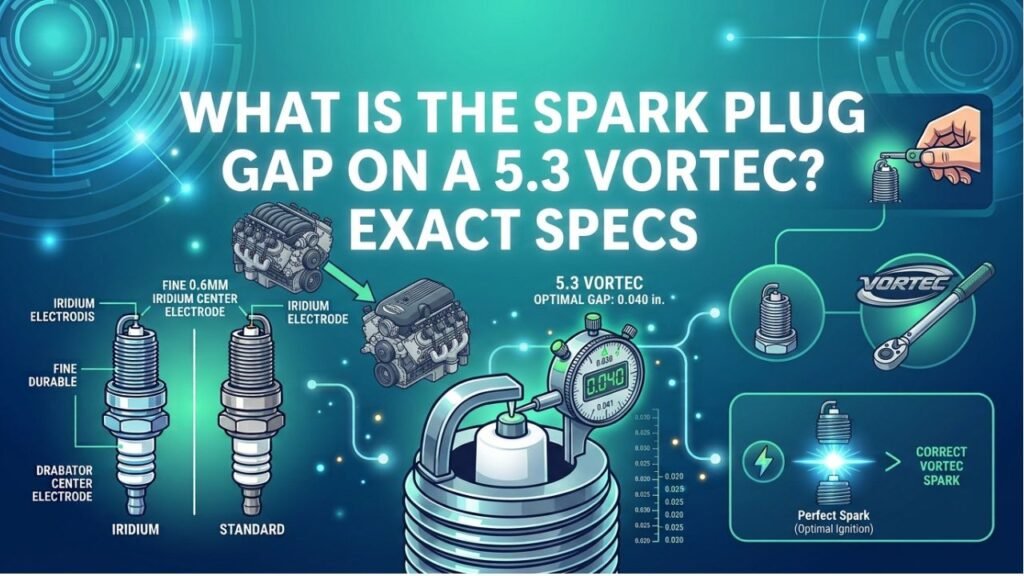
For stock GM 5.3L Vortec engines, the most useful way to understand the specification is to separate the original factory plug specification from the later replacement-plug specification.
| 5.3 Vortec Application | Spark Plug Gap |
| 1999–2003 original factory platinum-style specification | 0.060 in. / 1.52 mm |
| 1999–2003 with GM-approved later iridium replacement plug | 0.040 in. / about 1.01 mm |
| 2004 5.3L Vortec | 0.040 in. / 1.01 mm |
| 2005–2006 5.3L Vortec | 0.040 in. / 1.01 mm |
| 2007–2013 common 5.3L Vortec applications | 0.040 in. / about 1.02 mm |
Original Chevrolet documentation for 1999, 2000, 2001, 2002, and 2003 Silverado Vortec 5300 engines lists a 0.060-inch gap. Chevrolet’s 2004 Silverado owner’s manual changed the Vortec 5300 specification to 0.040 inch.
The situation becomes more interesting because GM later approved a 0.040-inch iridium replacement plug for a broad group of earlier 4.8L, 5.3L, 5.7L, and 6.0L applications, including 1999–2004 Silverado trucks. This replacement plug’s gap was intentionally different from the earlier platinum plug design.
That means the correct question is not merely, “What year is my truck?”
You also need to ask:
Which spark plug design and part number am I actually installing?
The Simple Answer for Most Owners Today
If your stock 5.3 Vortec uses a current OE-style iridium replacement plug specified by the manufacturer at 0.040 inch, leave it at that specification.
Do not take a modern fine-wire iridium plug that is designed to operate at 0.040 inch and open it to 0.060 inch simply because an old 1999–2003 owner’s manual shows the larger number.
Key Takeaways:
- Early 1999–2003 5.3 Vortec engines originally used a 0.060-inch specification with their factory-style plugs.
- GM later introduced a 0.040-inch iridium replacement plug for many of those same engines.
- Most later 5.3 Vortec applications use approximately 0.040 inch.
Why Do Some 5.3 Vortec Manuals Say 0.060 While Others Say 0.040?
The difference is mainly related to a change in spark plug design.
Earlier Vortec 5300 engines were equipped with platinum-style plugs using the wider 0.060-inch specification.
GM later released an iridium replacement plug. Because the electrode design changed, GM also changed the intended gap to approximately 0.040 inch.
This was not simply an arbitrary change in measurement.
Spark plug electrode material, center-electrode diameter, firing characteristics, ignition-system capability, and combustion requirements all influence the ideal gap.
A fine-wire iridium center electrode can create a reliable spark without requiring exactly the same gap used by the older platinum plug.
Why Online Answers Conflict
Suppose you have a 2002 Silverado 5.3.
The original 2002 owner’s manual says:
0.060 inch.
Then you search for a modern replacement plug and find a current iridium plug listed around:
0.040 inch.
Both pieces of information can be legitimate because they refer to different plug generations.
The mistake is assuming the old gap must always be applied to every replacement plug.
What Was the Original Gap on a 1999 5.3 Vortec?
The original Vortec 5300 specification in the 1999 Silverado owner’s information was 0.060 inch, or 1.52 mm.
If you are maintaining a completely stock 1999 engine but installing a modern OE-approved iridium replacement plug that is specified at 0.040 inch, use the replacement-plug manufacturer’s current specification rather than opening it to the old platinum-plug gap.
This same basic situation applies to many early GMT800 trucks.
What Is the Spark Plug Gap on a 2000 5.3 Vortec?
The original 2000 Vortec 5300 specification was 0.060 inch (1.52 mm).
Again, current replacement iridium plugs may use 0.040 inch.
Always match the gap to the actual approved plug rather than assuming that an original owner’s-manual specification must be transferred to a completely different electrode design.
What Is the Spark Plug Gap on a 2001 5.3 Vortec?
For a 2001 Chevrolet Silverado Vortec 5300, the original owner’s manual specifies 0.060 inch (1.52 mm).
A later GM iridium replacement may be supplied at 0.040 inch.
This is one of the years where owners most commonly encounter contradictory answers because both specifications have appeared in legitimate GM information at different times.
What Is the Spark Plug Gap on a 2002 5.3 Vortec?
The original specification for a 2002 Silverado Vortec 5300 was also 0.060 inch (1.52 mm).
If the engine is using the later iridium replacement plug approved under GM’s updated service guidance, the plug is instead designed around approximately 0.040 inch.
What Is the Spark Plug Gap on a 2003 5.3 Vortec?
The original 2003 Silverado owner’s manual lists the Vortec 5300 at 0.060 inch (1.52 mm).
GM’s later service information included 1999–2004 Silverado 4.8L and 5.3L engines among applications receiving the newer iridium plug with a factory-set 0.040-inch gap.
So for a 2003 engine, the plug part number matters.
What Is the Spark Plug Gap on a 2004 5.3 Vortec?
The 2004 Silverado owner’s manual specifies 0.040 inch (1.01 mm) for the Vortec 5300.
This is the point where the commonly published vehicle specification clearly moves to the smaller gap in Silverado owner documentation.
If you have a stock 2004 5.3 and the correct replacement plug, 0.040 inch is the number you should normally expect.
What Is the Spark Plug Gap on a 2005 or 2006 5.3 Vortec?
For both 2005 and 2006 Silverado Vortec 5300 applications, Chevrolet lists 0.040 inch (1.01 mm). The 2005 information includes both common VIN T and VIN Z 5.3L versions.
There should therefore be much less confusion with these years than with 1999–2003 trucks.
What About 2007–2013 5.3 Vortec Engines?
Common Gen IV 5.3L truck engines continued using approximately 0.040 inch.
For example, the 2007 Silverado owner’s manual lists the various 5.3L iron- and aluminum-block Active Fuel Management applications at 0.040 inch. The 2013 Silverado manual likewise gives its LMG and LC9 5.3L engines a 1.02 mm/0.040-inch specification.
These engines may have different RPO codes and technologies than the original LM7 Vortec 5300, but the familiar 0.040-inch gap remains common.
Which 5.3 Vortec Engines Are We Talking About?
“5.3 Vortec” does not identify one single engine used for one model year.
GM produced several 5.3L truck-engine variants under the broader Vortec family.
Depending on year and vehicle, you may encounter engine codes such as LM7, L59, LM4, LH6, LMG, LC9, and related variants.
They appeared in vehicles such as the Chevrolet Silverado, GMC Sierra, Tahoe, Suburban, Yukon, Avalanche, and some vans and SUVs.
That is why year, VIN, engine RPO, and plug part number provide more reliable identification than simply saying “5.3.”
How to Confirm Your Engine
The eighth character of the VIN can help distinguish certain engine configurations.
You can also check the vehicle’s RPO information or identify the engine using the exact model year and application.
Once you know the specific engine, verify the current recommended spark plug part number.
Then use the gap supplied for that plug.
Key Takeaways:
- “5.3 Vortec” covers multiple engine variants and model years.
- The vehicle year alone may not explain the correct gap when an older plug design has been superseded.
- Confirm both the engine application and the exact replacement spark plug.
Should You Gap New Iridium Spark Plugs for a 5.3 Vortec?
Be very careful.
Many modern ACDelco GM OE iridium spark plugs are manufactured with their final gap already set. Current ACDelco guidance states that its GM OE iridium plugs are pre-gapped and that an incorrectly gapped plug should be replaced rather than adjusted because attempting to alter the gap can damage the fine electrode.
You can still inspect the plug before installation.
Shipping damage is possible.
But checking a fine-wire iridium plug and aggressively bending its ground electrode are two very different things.
Why Iridium Electrodes Need Extra Care
The center electrode on an iridium plug can be extremely small compared with a conventional copper plug.
A traditional round wire-style gap gauge or careless prying can put pressure against the delicate center electrode.
That can chip or damage the fine tip.
If the plug manufacturer tells you not to adjust the plug, follow that instruction.
Never Assume Every “Pre-Gapped” Plug Is Correct for Every Vehicle
Spark plugs are often used in multiple applications.
When ordering aftermarket plugs, verify the exact part number for your engine.
Do not simply purchase a plug with matching threads and then force the gap to whatever number you found online.
Heat range, reach, seat design, resistor characteristics, and electrode configuration are also important.
How Do You Measure a 0.040-Inch Spark Plug Gap?
A spark plug gap is the distance between the center electrode and ground electrode.
For a 0.040-inch specification, the measurement is approximately:
0.040 inch = 1.016 mm, commonly rounded to 1.01 or 1.02 mm.
Use a proper spark plug gap gauge that is suitable for the plug design.
The gauge should indicate whether the spacing is within specification without damaging the electrodes.
For delicate iridium plugs, avoid dragging a thick tool aggressively between the fine center electrode and ground strap.
If the manufacturer says the plug is factory-set and should not be adjusted, use the measurement only as a careful inspection.
What Happens If the Spark Plug Gap Is Too Wide?
A wider gap requires more voltage for the spark to jump between the electrodes.
Within the designed range, a larger gap can expose more of the air-fuel mixture to the spark kernel.
But once the gap becomes excessive, the ignition coil may struggle to fire the plug consistently.
This often shows up most noticeably under load.
Cylinder pressure rises when you accelerate hard, tow, or climb a hill, making it more difficult for the spark to jump the gap.
A plug that fires normally at idle may therefore misfire during acceleration if the gap is excessive.
Possible symptoms include hesitation, misfire codes, rough operation under load, harder starting, and reduced performance.
An excessive gap can also increase demand on the ignition coil and other secondary ignition components.
What Happens If the Spark Plug Gap Is Too Narrow?
A narrow gap is generally easier for the ignition system to fire.
However, reducing the gap too far also reduces the size and exposure of the spark.
On a stock naturally aspirated engine designed for a particular plug and gap, there is generally no advantage to randomly tightening the gap.
Potential results include less effective ignition under some operating conditions, incomplete combustion, reduced performance, and increased deposits.
The correct approach is not to choose the widest or narrowest possible gap.
It is to use the gap intended for the engine and spark plug design.
Will a Wrong Spark Plug Gap Cause a Misfire on a 5.3 Vortec?
Yes.
An incorrect gap can contribute to a misfire, especially when the plug gap has grown wider through electrode wear.
However, a misfire on a 5.3 Vortec should not automatically be blamed on the plugs.
These engines also use spark plug wires or boots and individual ignition coils that can create similar symptoms.
Fuel injectors, vacuum leaks, compression problems, and other mechanical or electrical faults can also produce cylinder-specific misfire codes.
If new plugs do not solve the problem, diagnose the entire cylinder rather than continuing to change spark plug gaps.
Does the Spark Plug Gap Increase With Age?
Normally, yes.
Every time the plug fires, a tiny amount of electrode material can erode.
After tens of thousands of miles, the distance between the center and ground electrodes can increase.
Fine-wire precious-metal plugs resist erosion much better than traditional copper designs, which is one reason they can last significantly longer.
But they still wear.
An old plug that originally measured 0.040 inch may eventually be noticeably wider.
The ignition system then needs more voltage to fire it.
This can contribute to misfire under load before the engine develops a constant idle problem.
What Spark Plugs Should You Use in a 5.3 Vortec?
The safest recommendation is to look up the current OE-approved plug for the exact year, VIN, and engine RPO rather than relying on one universal part number for every 5.3.
GM part numbers and ACDelco replacement numbers can be superseded over time.
For example, older service information refers to earlier iridium part numbers that may now have newer replacements.
Current GM OE iridium plugs can still carry a 0.040-inch specification while using a different part number than the one printed in an older service bulletin.
That is normal.
A newer superseding part does not automatically mean the specification is wrong.
Do Not Buy Based Only on Gap
Two spark plugs can both have a 0.040-inch gap but be completely different in reach, heat range, thread size, seat design, and electrode projection.
Always match the plug to the engine first.
Gap comes second.
Should You Use Anti-Seize on 5.3 Vortec Spark Plugs?
Do not automatically apply anti-seize simply because the spark plug threads go into an aluminum cylinder head.
Many modern spark plug manufacturers use thread coatings and recommend installing the plug without additional anti-seize.
Adding lubricant changes thread friction and can alter the relationship between applied torque and actual clamping force.
That makes over-tightening more likely when you use a dry-thread torque specification.
Follow the current instructions for the exact plug you are installing.
If the plug manufacturer specifies dry installation, install it dry.
How Tight Should 5.3 Vortec Spark Plugs Be?
Spark plug torque should be verified for the exact year and cylinder-head application rather than treated as universally identical across every 5.3 Vortec.
Some early GM 5.3 service information specifies approximately 11 lb-ft (15 N·m) for used cylinder heads, with a higher value during assembly involving new heads.
The important practical point is not to overtighten plugs in an aluminum head.
Start each spark plug by hand so you know it is not cross-threaded.
Then tighten according to the current service specification for your engine and plug.
Never use an impact wrench.
Do You Need to Change Spark Plug Wires With the Plugs?
Not automatically, but it is an excellent time to inspect them.
Many earlier 5.3 Vortec engines use short spark plug wires between individual coils and the plugs.
Heat from the exhaust manifolds can age the wire insulation and boots.
Look for cracks, burned areas, hardened boots, carbon tracking, or damage caused during removal.
A perfect new spark plug cannot compensate for ignition voltage leaking through a damaged wire or boot.
If the wires are old and show deterioration, replacement can prevent future misfire problems.
Key Takeaways:
- Too wide a gap can create misfires, particularly under heavy engine load.
- Too narrow a gap is not a performance upgrade for a stock engine.
- Inspect plug wires and boots whenever you replace spark plugs on a 5.3 Vortec.
Does a Modified 5.3 Vortec Need the Same Spark Plug Gap?
Not necessarily.
A stock naturally aspirated engine should use the stock plug and gap specification.
A heavily modified engine is different.
Forced induction dramatically increases cylinder pressure, which makes it harder for the spark to jump a large gap. Tuned supercharged or turbocharged engines may therefore use a smaller gap than a factory naturally aspirated 5.3.
However, there is no single “boosted 5.3 gap” that is correct for every build.
Boost pressure, ignition coil capability, fuel type, compression ratio, spark plug heat range, power level, and calibration all matter.
If your 5.3 Vortec is turbocharged, supercharged, running nitrous, or significantly modified, use the specification provided by your tuner and spark plug manufacturer rather than automatically using 0.040 inch.
Common 5.3 Vortec Spark Plug Gap Mistakes
The biggest mistake is seeing 0.060 inch in an early owner’s manual and assuming every replacement spark plug for that engine must be manually opened to 0.060.
That ignores GM’s later change to a 0.040-inch iridium service plug.
The second mistake is treating every 5.3 Vortec as identical. GM produced several 5.3L variants over many years.
Another common mistake is aggressively regapping a fine-wire iridium plug. If the manufacturer says the plug is factory-set and should not be adjusted, replace a damaged or incorrect plug rather than bending it.
Finally, do not use gap as a substitute for diagnosing an actual ignition problem. If one cylinder continues to misfire after the correct plug is installed, inspect the coil, wire, boot, injector, compression, and related systems.
FAQs About What Is the Spark Plug Gap on a 5.3 Vortec
What is the standard spark plug gap for a 5.3 Vortec?
For most later and current OE-style replacement applications, the common specification is 0.040 inch, approximately 1.0–1.02 mm.
Why does my 5.3 Vortec manual say 0.060?
Many 1999–2003 5.3 Vortec engines originally used a platinum-style spark plug with a 0.060-inch gap. GM later introduced an iridium replacement plug designed around a 0.040-inch gap.
Should I gap my 2001 5.3 Vortec plugs to 0.060 or 0.040?
If you are installing the original-style plug specified for 0.060 inch, follow that specification. If you are installing the later GM-approved iridium replacement designed for 0.040 inch, leave it at 0.040. Always follow the specification for the exact replacement plug.
What is the gap on a 2004 5.3 Vortec?
The 2004 Silverado Vortec 5300 specification is 0.040 inch (1.01 mm).
What is the gap on a 2005 5.3 Vortec?
The common specification is 0.040 inch (1.01 mm).
What is the gap on a 2006 5.3 Vortec?
Chevrolet lists 0.040 inch (1.01 mm) for the common 5.3L Vortec applications.
What is the spark plug gap on a 2007 5.3 Vortec?
The common 2007 Silverado 5.3L V8 applications use 0.040 inch (1.01 mm).
What is the spark plug gap on a 2013 5.3 Vortec?
Common 2013 5.3L Silverado LMG and LC9 engines specify approximately 0.040 inch (1.02 mm).
Are ACDelco iridium spark plugs already gapped?
Current ACDelco GM OE iridium plugs are manufactured pre-gapped. ACDelco advises against attempting to adjust an incorrectly gapped GM OE iridium plug because the electrode may be damaged.
Can I use a 0.060 gap with iridium plugs?
Only if the manufacturer specifically specifies that gap for the exact iridium plug and engine application. Do not automatically use the old 0.060-inch platinum specification with a newer 0.040-inch iridium replacement.
Will 0.060 instead of 0.040 cause a misfire?
It can. The wider gap requires more ignition voltage, and misfires may become especially noticeable under acceleration or heavy load.
Can a spark plug gap be too small?
Yes. An unnecessarily narrow gap may reduce spark exposure and is not recommended on an otherwise stock engine.
Is 0.040 inch the same as 1 mm?
Almost. Exactly 0.040 inch equals about 1.016 mm, which manufacturers commonly list as approximately 1.01 or 1.02 mm.
Do all eight spark plugs need the same gap?
On a stock 5.3 Vortec using one specified plug type, all eight plugs should use the same correct specification.
Should I check pre-gapped spark plugs?
A careful visual or gauge inspection is reasonable, especially for shipping damage. However, do not damage a fine-wire iridium electrode while checking it, and follow the manufacturer’s instructions about whether adjustment is permitted.
Does a turbo 5.3 Vortec use a 0.040 gap?
Not necessarily. Forced-induction engines often require a different plug and gap strategy. Follow the tune and spark plug manufacturer’s recommendation for the specific build.
Conclusion
So, what is the spark plug gap on a 5.3 Vortec? For most 5.3 Vortec engines using current OE-style iridium replacement plugs, 0.040 inch—about 1.01 to 1.02 mm—is the number you are most likely to need.
The major exception involves early 1999–2003 Vortec 5300 engines. Their original owner’s manuals commonly specify 0.060 inch (1.52 mm) because they were designed around an earlier platinum-style plug.
GM later released an iridium replacement plug for many of those engines with a factory-set 0.040-inch gap. That update explains why you can find both 0.060 and 0.040 listed for the same older truck without either number necessarily being a typo.
For 2004 and later common 5.3 Vortec truck applications, 0.040 inch became the normal published specification.
The most reliable approach is therefore to identify your model year, engine, and current approved spark plug part number before touching the gap. If you are installing a factory-pre-gapped fine-wire iridium plug that is specified at 0.040 inch, do not open it to 0.060 just because an older manual lists the larger gap.
For a stock engine, use the plug manufacturer’s current OE application and its intended gap. That gives the ignition system the spark characteristics it was designed to deliver and avoids many of the misfire problems caused by using an outdated or mismatched specification.