
If you are wondering what to do with old spark plugs, the best option is usually to recycle them as scrap metal when a local recycler accepts them. Used spark plugs contain a steel shell along with ceramic insulation and small amounts of other metals, so they should not automatically be treated as ordinary household trash if convenient recycling is available. Before disposal, keep them dry, contain any oil or fuel residue, and check local recycling or household-waste rules.
You can also keep a few used plugs for diagnostic comparison, mechanical demonstrations, crafts, or emergency reference, but old worn spark plugs should generally not be reinstalled in an engine simply to avoid throwing them away.
A removed spark plug may contain carbon deposits, oil residue, fuel contamination, sharp edges, and brittle ceramic. That means handling and storage deserve a little more care than simply tossing plugs loose into a toolbox.
In this guide, I’ll explain how to recycle old spark plugs, whether they can go in the trash, when they are worth keeping, whether cleaning and reusing them makes sense, what scrap yards may accept, and how to handle oil-fouled or damaged plugs safely.
What to Do With Old Spark Plugs After Replacement
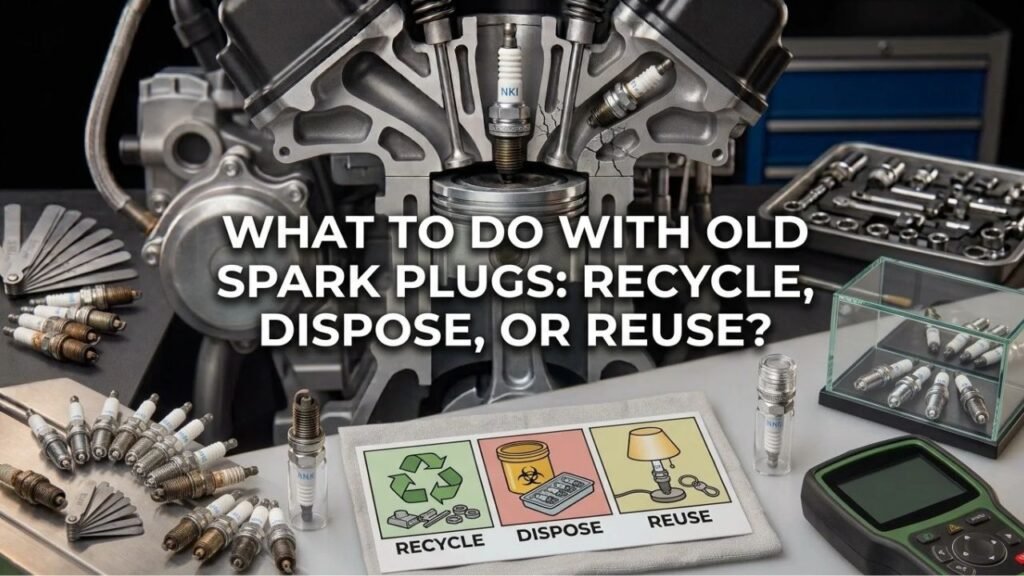
Once new spark plugs are installed and the engine is running correctly, you have several practical options for the old ones.
For most vehicle owners, I recommend this order:
- Inspect the old plugs before discarding them.
- Keep any plugs that provide useful diagnostic information until the repair is confirmed.
- Recycle the plugs through a scrap-metal or automotive recycling facility if practical.
- Dispose of them according to local waste rules if recycling is not available.
- Save a clean plug only if you have a legitimate reuse, educational, or reference purpose.
The inspection step is particularly useful.
Old spark plugs can reveal a surprising amount about what was happening inside the engine. One plug may be oil-fouled while the others look normal. Another may have an unusually wide gap, heavy carbon deposits, cracked porcelain, or evidence of overheating.
Throwing them away immediately removes that evidence.
Label Them by Cylinder
If you are replacing plugs while diagnosing an engine problem, keep them organized.
Mark each one by cylinder number before setting it aside.
A simple piece of masking tape or a divided cardboard box works well.
If one cylinder has been misfiring, comparing its spark plug with the others can help determine whether the problem relates to oil, fuel, ignition, overheating, or mechanical condition.
Once the engine repair is confirmed, you can recycle or dispose of the plugs.
Key Takeaways:
- Inspect old spark plugs before throwing them away because their condition can provide useful diagnostic information.
- Recycling is generally preferable when a local metal recycler accepts them.
- Do not automatically reinstall worn plugs just because they still look usable.
Can Old Spark Plugs Be Recycled?
Yes, old spark plugs can often be recycled, although not every curbside program accepts them.
A spark plug contains several materials.
The outer shell and threaded portion are primarily steel. The central and ground electrodes may contain nickel alloys, platinum, iridium, or other metals depending on the plug design. The insulator is ceramic.
Because spark plugs are mixed-material components rather than simple pieces of steel, curbside recycling facilities may not want them mixed with cans and household metal packaging.
A scrap-metal recycler, automotive recycler, repair shop, or specialized metal recycling facility is often a better option.
Where Can You Recycle Spark Plugs?
Possible places include scrap-metal yards, automotive recycling centers, municipal recycling facilities, auto repair shops that collect metal scrap, and some automotive parts retailers.
Acceptance varies by location.
Before making a special trip with four old spark plugs, contact the facility and ask whether they accept small steel automotive parts with ceramic components.
Some recyclers may want them placed with mixed ferrous scrap.
Others may decline them because the quantity is too small or because their processing system is not designed for ceramic-containing components.
Are Spark Plugs Worth Money as Scrap?
For a typical vehicle owner, not really.
Four, six, or eight used spark plugs contain only a small amount of recoverable metal.
Even platinum or iridium spark plugs contain very small quantities of precious metal in their electrode tips.
That does not mean recycling is pointless. It simply means you should not expect significant payment for a handful of plugs.
Professional repair shops that accumulate hundreds or thousands of plugs may have more reason to include them in bulk scrap recycling.
Can Old Spark Plugs Go in the Trash?
In many locations, ordinary used spark plugs are not classified the same way as batteries, motor oil, or other commonly regulated automotive wastes.
However, waste rules vary by municipality.
If local rules allow ordinary household disposal and recycling is unavailable, contain the plugs before throwing them away.
Do not leave them loose where the ceramic can break and create sharp fragments.
A small box, heavy container, or wrapped package can help protect sanitation workers and prevent the threaded shell from tearing through a trash bag.
Why Recycling Is Still Better
Even when trash disposal is legally permitted, a spark plug contains usable metal.
Recycling keeps that material in the recovery stream rather than sending it to a landfill.
For environmentally conscious disposal, metal recycling is therefore my preferred option.
Do Not Put Them in Curbside Recycling Unless Approved
Your blue recycling bin is not automatically the right destination.
Most curbside programs are designed for specific packaging materials such as aluminum cans, steel food cans, paper, cardboard, glass, and selected plastics.
A spark plug may damage sorting equipment or be removed as contamination.
Use curbside recycling only if your local program specifically accepts small automotive metal parts.
What About Oil-Fouled Spark Plugs?
Oil-fouled spark plugs need slightly more careful handling.
A small amount of dried engine oil on a plug does not necessarily transform it into hazardous waste, but you should avoid leaving wet oil to drip into a trash container or recycling bin.
Wipe off excess oil with an appropriate disposable shop towel.
Handle the oily towel according to your local rules and your normal automotive waste practices.
If the plugs are heavily soaked in oil, fuel, solvent, or another chemical, ask the recycling or household hazardous waste facility how they want the material handled.
Do not wash oily spark plugs over a sink or storm drain.
That simply moves the contamination into the wastewater or environment.
Fuel-Wet Spark Plugs
If a plug was removed from a flooded engine and is wet with gasoline, allow it to remain in a safe, well-ventilated area away from flames and ignition sources until the volatile fuel has evaporated.
Do not put a gasoline-wet plug immediately into an enclosed container.
Gasoline vapors are flammable.
Key Takeaways:
- Scrap-metal recycling is usually preferable to throwing spark plugs away.
- Do not assume curbside recycling accepts automotive parts.
- Wipe off oil and allow fuel-wet plugs to dry safely before storage or disposal.
Should You Keep Old Spark Plugs for Diagnosis?
Sometimes, yes.
If you just completed routine maintenance on a perfectly running engine, there may be little reason to keep them.
If you replaced the plugs because the engine was misfiring, burning oil, running rich, overheating, or experiencing poor fuel economy, keep them until the issue is resolved.
What Old Spark Plugs Can Tell You
The condition of the firing end can provide clues about combustion.
A dry light-colored deposit may reflect normal operation depending on the engine and fuel.
Dry black carbon can suggest excessive fuel, extended idling, a cold-running engine, ignition problems, or other combustion issues.
Wet oily deposits may indicate oil entering the cylinder.
A fuel-wet plug may suggest that the cylinder was receiving fuel but not igniting it.
A blistered, damaged, or unusually white insulator can point toward excessive heat or abnormal combustion conditions.
These observations do not diagnose an engine by themselves, but comparing all cylinders can be very useful.
Why Cylinder Identification Matters
Suppose seven plugs look normal and one is covered in wet oil.
That pattern is much more useful than simply knowing the engine had “old spark plugs.”
It suggests looking closely at that cylinder.
If all plugs are similarly carbon-fouled, the problem may affect the entire engine.
Keep each plug associated with its cylinder until you understand the pattern.
Can You Clean and Reuse Old Spark Plugs?
Sometimes technically, but in most modern automotive applications I do not recommend it as routine maintenance.
Traditional spark plugs with large conventional electrodes could often be cleaned and regapped during older service practices.
Modern platinum and iridium plugs are different.
They use very small precious-metal firing surfaces that can be damaged by aggressive wire brushing, sandblasting, scraping, or filing.
If a plug has reached its scheduled replacement interval, cleaning it does not restore lost electrode material.
Why Cleaning Does Not Make an Old Plug New
As spark plugs operate, their electrodes gradually erode.
This increases the gap and rounds the firing edges.
You can remove deposits from the surface, but you cannot replace the electrode material that has already worn away.
A cleaned plug may look much better while still requiring more ignition voltage than a new one.
When Temporary Reuse May Make Sense
Temporary reuse can be reasonable during troubleshooting.
For example, you may remove a relatively new plug to inspect a cylinder and then reinstall it if the plug is undamaged, correctly gapped, and still within its service life.
That is very different from taking a worn 100,000-mile plug out of the recycling pile, cleaning it, and expecting another full service interval.
Avoid Aggressive Cleaning of Iridium and Platinum Plugs
The fine-wire center electrode on an iridium plug can be extremely small.
Do not attack it with a steel wire wheel or file.
You can damage the precious-metal tip or alter the electrode geometry.
If a modern plug is badly fouled, replacement is usually the more reliable solution.
Can Old Spark Plugs Be Used as Emergency Spares?
Possibly, but only under limited circumstances.
If you replaced relatively good plugs early—for example, while performing preventive maintenance—you might keep one or two as emergency diagnostic spares.
The plug should have the correct part number, undamaged threads, intact porcelain, and a usable electrode.
Store it clean and dry.
However, an old plug is not the same as carrying a new spare.
If the vehicle has an actual spark plug failure, a new correct replacement is far preferable.
With modern long-life spark plugs, failures are uncommon enough that most drivers do not need to carry old plugs as emergency equipment.
Can You Reuse Old Spark Plugs in Lawn Mowers or Other Engines?
Only if the plug specifications happen to match exactly—which is uncommon and should not be assumed.
Spark plugs that look similar can differ in thread diameter, reach, seat type, heat range, resistance, electrode projection, and other dimensions.
A plug removed from a car should not be installed in a lawn mower, generator, motorcycle, or small engine simply because the threads appear to fit.
The wrong reach can be especially dangerous.
A plug extending too far into the combustion chamber could contact a piston or valve on some engines.
A plug that is too short may not place the spark in the correct location and may leave exposed threads in the cylinder head.
Use the exact plug specification required by the engine.
Are Old Iridium or Platinum Spark Plugs Valuable?
Not individually.
Iridium and platinum are valuable metals, but the amount used on each spark plug electrode is tiny.
You should be suspicious of the idea that a few used iridium plugs contain a valuable quantity of recoverable precious metal.
Large-scale recyclers may process industrial quantities of spark plugs and recover material economically, but that does not mean an individual set has meaningful resale value.
Can You Remove the Precious Metal Yourself?
I do not recommend attempting it.
The valuable material is present in very small electrode tips or pads.
Recovering it efficiently requires specialized processing.
Cutting, grinding, heating, or chemically processing plugs at home creates unnecessary injury and exposure risks for minimal potential value.
Recycle the complete plug instead.
Can Old Spark Plugs Be Used for Crafts?
Yes, provided they are clean and handled safely.
Their mechanical appearance makes them popular for automotive-themed art and workshop decorations.
Possible projects include sculptures, desk ornaments, automotive displays, coat hooks when properly constructed, or educational cutaway displays.
However, remember that the ceramic insulator can break.
Broken ceramic edges can be extremely sharp.
Do not use intact or broken spark plugs as toys, jewelry for children, or objects likely to be dropped or struck.
Clean Them Before Craft Use
Remove oil, fuel, loose carbon, and grease before bringing used automotive parts into living spaces.
Use appropriate cleaning products in a ventilated work area and follow their safety instructions.
Do not aggressively grind the ceramic.
Can Old Spark Plugs Be Used for Tool or Engine Training?
Absolutely.
One of the most useful non-automotive reuses is educational.
An old plug can demonstrate electrode gap, thread reach, gasket versus tapered seats, fouling patterns, terminal design, and basic ignition principles.
If you teach automotive repair, keep several plugs showing different conditions.
A normal plug, oil-fouled plug, carbon-fouled plug, overheated plug, and mechanically damaged plug make a useful comparison set.
You can also practice using a spark plug gap gauge on an old conventional plug before handling expensive new fine-wire plugs.
Can You Break the Ceramic Off Old Spark Plugs?
You should not do this casually.
Spark plug ceramic is a hard, brittle material.
Breaking it can produce sharp fragments that can injure skin and eyes.
There is also no normal recycling or maintenance reason for a vehicle owner to separate the ceramic manually from the metal shell.
Let a recycling facility handle material separation.
Wear eye protection if you are performing any legitimate mechanical work that could accidentally fracture the insulator.
Do Not Use Spark Plug Ceramic to Break Glass
You may encounter demonstrations or internet discussions involving broken spark plug ceramic and automotive glass.
There is no practical reason to turn old plugs into glass-breaking tools.
Keep them intact for recycling or legitimate reuse instead.
How to Store Old Spark Plugs Before Recycling
If you are collecting several sets, use a sturdy container.
A metal coffee can, thick plastic container, or small cardboard box works well.
Do not leave used plugs loose in a drawer where the threads can damage tools or the ceramic can chip.
Label the container “used spark plugs” if it will remain in the shop for a while.
Keep oily parts separate from clean parts.
If you run a repair shop, establish a dedicated small-metal scrap container and confirm with your recycler that spark plugs are accepted.
Should Auto Repair Shops Recycle Spark Plugs?
For a repair shop, recycling makes much more sense than it does for an individual owner.
A shop can accumulate hundreds of used plugs over time.
Combining them with other acceptable ferrous automotive scrap creates enough volume to justify regular collection.
Shops should still confirm the recycler’s requirements.
Do not mix spark plugs with waste oil, batteries, aerosol cans, filters, or other regulated automotive waste unless the disposal company specifically allows that combination.
Separating waste streams makes recycling safer and easier.
Key Takeaways:
- Old plugs can be useful for diagnosis, teaching, and limited craft projects.
- Cleaning does not restore electrode material lost through normal wear.
- Do not break spark plug ceramic apart simply to recycle the metal.
What Should You Do With Spark Plugs After an Engine Failure?
Keep them temporarily.
If an engine has suffered a serious problem—such as a burned valve, piston damage, coolant intrusion, heavy oil consumption, detonation, or repeated misfire—the plugs may contain important evidence.
Photograph each plug and label it by cylinder.
Do not scrub the deposits away before diagnosis.
A mechanic or engine builder may want to compare them.
Once the failure has been identified and repairs are complete, recycle or dispose of them normally.
Should You Throw Away New Spark Plugs That Were Installed Briefly?
Not necessarily.
A spark plug that was installed for a short diagnostic test may still be perfectly serviceable.
Inspect it for damage, contamination, and correct gap.
If it is the correct part number and has not been fouled or mechanically damaged, it can often be stored for future use in the same compatible engine.
Protect the threads and electrode during storage.
A small labeled box is ideal.
Do not mix it with heavily worn used plugs or you may forget which one is actually serviceable.
When an Old Spark Plug Should Never Be Reused
Some conditions make replacement the obvious choice.
A cracked ceramic insulator is one.
A spark plug with damaged or cross-threaded threads should not be reinstalled.
A plug with a loose center electrode, broken ground strap, damaged terminal, or severely eroded electrodes should also be discarded.
Heavy oil fouling, overheating damage, severe carbon buildup, or contamination may indicate an engine problem that should be fixed before new plugs are installed.
If there is any doubt about the structural condition of a spark plug, replacement is inexpensive compared with the risk of plug failure inside the engine.
Common Mistakes With Old Spark Plugs
One mistake is throwing all the plugs away before comparing them.
If the vehicle was experiencing a misfire, you may discard useful diagnostic evidence.
Another mistake is assuming precious-metal plugs have significant scrap value. The quantity of platinum or iridium per plug is tiny.
Some people clean badly worn plugs and reinstall them because they look better afterward. Appearance does not restore electrode life.
Putting automotive spark plugs into household curbside recycling without checking local rules is another common mistake.
And finally, avoid storing oily, fuel-wet plugs loosely indoors. Clean or safely dry them first and keep them in a suitable container.
FAQs about What to Do With Old Spark Plugs
What should I do with old spark plugs?
Inspect them first, especially if the engine had a problem. Afterward, recycle them as automotive or mixed-metal scrap when a local facility accepts them.
Can old spark plugs be recycled?
Yes. Their steel shells and other metal components can often be recycled through scrap-metal or automotive recycling facilities.
Can spark plugs go in normal recycling bins?
Not necessarily. Curbside programs often do not accept automotive components. Check your local rules before putting them in household recycling.
Can old spark plugs go in the garbage?
In many areas they can if no recycling option exists, but local rules vary. Contain them safely so broken ceramic or sharp metal cannot injure anyone.
Are used spark plugs hazardous waste?
Normal dry used spark plugs are generally not handled like waste oil or batteries, but plugs contaminated with significant fuel, oil, or chemicals may need additional care. Follow local waste requirements.
Are old spark plugs worth money?
A few used plugs normally have very little scrap value. Even platinum and iridium plugs contain only tiny quantities of precious metal.
Can I sell old iridium spark plugs?
You may find recyclers that process them in bulk, but an individual set generally has little resale value.
Can old spark plugs be cleaned and reused?
Some plugs can technically be cleaned, but worn electrodes cannot be restored by cleaning. Modern iridium and platinum plugs are usually better replaced when they reach the end of their service life.
Can I reuse old plugs as emergency spares?
A relatively new, undamaged plug can be saved as a temporary spare for the same correct application, but a new plug is preferable.
Should I keep old spark plugs after changing them?
Keep them temporarily if you are diagnosing misfires, oil consumption, overheating, or another engine problem. Their deposits can provide useful clues.
Can I use a car spark plug in a lawn mower?
Only if every required specification matches the engine manufacturer’s requirements. Physical appearance alone is not enough.
What should I do with oil-covered spark plugs?
Wipe away excess oil, keep it out of drains, and repair the source of the oil. Check local recycling requirements for contaminated automotive parts.
What should I do with fuel-wet spark plugs?
Keep them away from flames and sparks and allow volatile fuel to evaporate safely in a suitable ventilated area before storage or disposal.
Can old spark plugs be used for crafts?
Yes, after cleaning. They can be used for automotive-themed displays and art, but handle the brittle ceramic carefully.
Should I break the ceramic off before recycling a spark plug?
No. There is normally no need to dismantle the plug yourself. Take it intact to a recycler that accepts it.
Can I keep old plugs for diagnostic comparison?
Yes. Label them by cylinder before removal if you are investigating an engine problem.
Conclusion
If you are deciding what to do with old spark plugs, start by inspecting them rather than immediately throwing them away. Their appearance can provide useful information about combustion, oil consumption, fuel mixture, overheating, and cylinder-specific problems.
Once you no longer need them for diagnosis, recycling is generally the best option. Spark plugs contain recyclable steel and small amounts of other metals, although their mixed metal-and-ceramic construction means they may need to go to a scrap-metal or automotive recycling facility rather than your household curbside bin.
Do not expect significant scrap value from a handful of platinum or iridium plugs. The amount of precious metal in each one is extremely small.
Old plugs can also be saved for educational demonstrations, comparison purposes, or clean automotive-themed craft projects. A relatively new undamaged plug may even be kept temporarily as a spare for the correct application.
What I would not recommend is cleaning badly worn plugs and reinstalling them simply to avoid replacement. Cleaning removes deposits but does not restore electrode material lost through thousands of miles of use.
My preferred approach is simple: inspect the plugs, keep any useful diagnostic evidence, clean off excess contamination, and recycle the complete plugs intact whenever a suitable local recycling option is available.