
If you are asking what type of spark plugs do I need, the correct answer is the exact spark plug specification recommended for your vehicle’s year, make, model, engine, and ignition system. Do not choose a plug simply because it is iridium, platinum, copper, or physically fits the cylinder head. The correct plug must also have the proper thread size, reach, seat type, heat range, resistor design, electrode configuration, and recommended gap.
For most modern vehicles, the simplest and safest approach is to use the same spark plug technology the engine originally came with or a reputable manufacturer’s direct replacement for that exact application.
If your engine came with iridium plugs, I would normally replace them with the correct iridium equivalent. If it came with double-platinum plugs, there may be a specific ignition-system reason for that design. An older engine originally designed for conventional nickel-alloy plugs does not automatically need iridium simply because iridium is newer and more expensive.
Spark plug material affects durability and electrode design, but it is only one part of compatibility.
In this guide, I’ll explain what type of spark plugs you need, how copper, platinum, iridium, and ruthenium plugs differ, what heat range and gap mean, and how to identify the exact plug your engine requires without guessing.
What Type of Spark Plugs Do I Need?
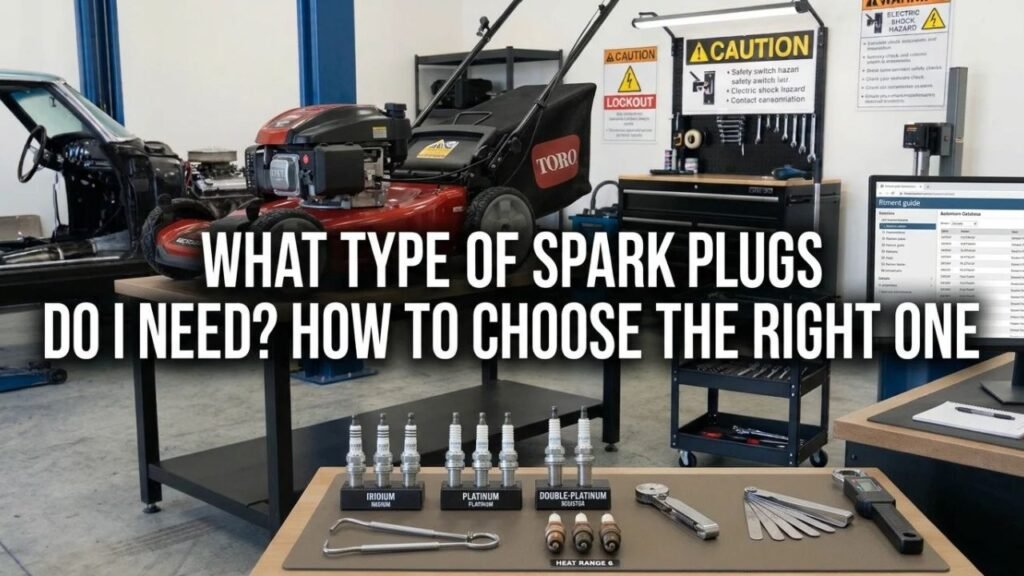
You need a spark plug specifically listed for your exact engine.
The most important identifying information usually includes:
- Vehicle year
- Make and model
- Engine size or engine code
- Sometimes the VIN or production date
Once those details are known, you can identify the manufacturer-specified plug or an approved equivalent.
Do not begin by deciding that you want “the best iridium plug” and then look for one that fits.
Begin with the engine application and work backward to the correct spark plug.
Why Vehicle Fitment Matters So Much
Two plugs can have the same thread diameter and still be completely different internally.
One may extend farther into the combustion chamber.
One may use a different heat range.
One may have a tapered seat while another uses a gasket.
One may have a projected firing tip.
Even if both physically screw into the cylinder head, the wrong plug can cause poor performance and, in extreme cases, engine damage.
The correct spark plug is therefore not simply the one that fits the hole.
Key Takeaways:
- Choose spark plugs by exact engine application first.
- Electrode material alone does not determine compatibility.
- Thread size, reach, seat type, heat range, and gap all matter.
- The OEM plug specification is the best starting point.
How Do I Find Out Which Spark Plugs My Car Needs?
There are several reliable ways.
The vehicle owner’s maintenance information may identify the recommended spark plug type or replacement specification.
A parts catalog matched to your exact vehicle and engine can also provide compatible plug numbers.
You can additionally check the part number printed on the currently installed plugs, although you should confirm that the existing plugs are actually correct before buying replacements.
Use the Exact Engine, Not Just the Vehicle Model
Many vehicles are available with several engines.
For example, the same model may have a naturally aspirated four-cylinder, turbocharged four-cylinder, V6, or hybrid powertrain depending on trim and year.
Those engines may require completely different spark plugs.
Searching only by model name can therefore produce the wrong result.
VIN Can Help
The vehicle identification number can help distinguish engine and production variations when a model has multiple possible configurations.
Parts stores and service databases often use the VIN to narrow fitment.
This can be especially helpful when an engine changed halfway through a model generation.
Should I Use the Same Spark Plugs That Came From the Factory?
Usually, yes.
If the engine has been running correctly and remains in stock configuration, using the original plug specification or a reputable direct equivalent is the safest choice.
Manufacturers select plugs based on combustion-chamber design, ignition voltage, operating temperature, emissions requirements, durability targets, and service intervals.
Changing plug technology without a specific reason may provide little benefit.
OEM Does Not Always Mean One Brand Only
A vehicle may have originally been assembled with a plug from one manufacturer while another reputable spark plug company offers an equivalent replacement.
You do not necessarily have to buy the identical brand.
But the replacement should be specifically cataloged for the engine and match the required technical characteristics.
What Are the Main Types of Spark Plugs?
Spark plugs are commonly described according to the material used on their firing surfaces.
The major categories are conventional nickel-alloy or copper-core plugs, platinum, double platinum, iridium, and increasingly ruthenium.
Each has advantages, but none is automatically best for every engine.
Conventional Copper-Core or Nickel Spark Plugs
What people commonly call “copper spark plugs” usually have a copper core inside the center electrode for heat transfer, while the exposed firing surface uses a nickel alloy.
These are traditional spark plugs and are generally inexpensive.
They can perform extremely well when fresh.
Their primary disadvantage is shorter electrode life compared with precious-metal plugs.
When Conventional Plugs Make Sense
Some older vehicles were designed around conventional plugs.
They are also used in certain performance applications where plugs are inspected or replaced frequently.
If your engine specifically calls for this style, there may be no practical reason to replace it with a more expensive plug.
Are Copper Plugs Better for Performance?
Not automatically.
A fresh conventional plug can provide excellent ignition.
The major difference is that its electrodes generally wear more quickly.
If an engine is designed for iridium plugs with very long service intervals, installing short-life conventional plugs simply because they are cheaper can increase maintenance requirements.
Platinum Spark Plugs
Platinum spark plugs use platinum at one or more firing surfaces.
Platinum resists erosion better than ordinary nickel alloy.
This allows the plug to maintain its electrode shape and gap longer.
Single-Platinum Spark Plugs
A single-platinum plug generally has platinum on one primary firing surface, often the center electrode.
It offers longer service life than a basic conventional plug.
Double-Platinum Spark Plugs
Double-platinum plugs have precious-metal material on both firing surfaces.
This can be particularly useful in certain waste-spark ignition systems where electrical polarity differs between paired cylinders and electrode wear can occur on opposite sides of the spark gap.
If your engine originally uses double-platinum plugs, do not automatically replace them with single-platinum versions just because the threads match.
The original electrode design may be important for longevity.
Iridium Spark Plugs
Iridium spark plugs are extremely common in modern vehicles.
Iridium is hard, heat-resistant, and highly resistant to electrical erosion.
This allows manufacturers to use a very fine center electrode.
The fine electrode can make spark initiation easier while maintaining excellent durability.
When Do You Need Iridium Plugs?
If your engine was designed with iridium plugs, use the correct iridium specification or approved equivalent.
Many modern engines use them because manufacturers want long replacement intervals and stable ignition performance over many miles.
Do Iridium Plugs Add Horsepower?
Not simply because they contain iridium.
If you replace badly worn plugs with fresh iridium plugs, you may restore lost performance.
But replacing healthy properly specified plugs with a more expensive iridium design does not automatically create additional horsepower.
Ruthenium Spark Plugs
Ruthenium is another precious metal used in some newer premium spark plug designs.
It can provide excellent resistance to wear and allows manufacturers to create specialized electrode shapes.
Whether ruthenium is right for your engine depends on application compatibility.
Do not assume it is superior simply because it is newer.
A correctly specified iridium plug is better than an incompatible ruthenium plug.
Copper vs. Platinum vs. Iridium vs. Ruthenium
The differences are easiest to understand in terms of longevity and application rather than trying to rank them universally.
| Spark Plug Type | Typical Strength | General Consideration |
| Conventional nickel/copper-core | Low cost, good fresh performance | Shorter service life |
| Platinum | Improved wear resistance | Good for many longer-life applications |
| Double platinum | Durable on both firing surfaces | Useful in certain ignition systems |
| Iridium | Fine electrode and long life | Common in modern engines |
| Ruthenium | Advanced wear-resistant design | Application-specific premium option |
The engine specification should always determine the final choice.
Key Takeaways:
- Conventional plugs can work perfectly in engines designed for them.
- Platinum and iridium mainly improve durability and electrode design.
- Double-platinum designs may be important for certain ignition systems.
- More expensive does not automatically mean more compatible.
What Spark Plug Heat Range Do I Need?
Heat range is one of the most important and misunderstood spark plug specifications.
It describes how effectively the plug transfers heat away from its firing end into the cylinder head.
A “hotter” plug retains more heat around the firing tip.
A “colder” plug transfers heat away more quickly.
Why Heat Range Matters
The spark plug must become warm enough to resist deposit fouling but not so hot that it contributes to pre-ignition or electrode damage.
The engine manufacturer selects a heat range that matches the combustion temperature and operating conditions.
Installing a significantly hotter or colder plug without a valid reason can create problems.
Do Not Choose Heat Range by Weather
A colder spark plug does not mean it is designed for cold weather.
Likewise, a hotter spark plug is not simply for hot climates.
Heat range refers to how the plug manages combustion heat internally.
Modified Engines May Need Different Heat Ranges
High-boost turbocharged, supercharged, nitrous, or heavily modified engines sometimes use colder plugs because combustion temperatures and cylinder pressures may be higher.
That type of change should be based on the engine setup and tuning requirements.
For a stock engine, stay with the specified heat range.
What Spark Plug Gap Do I Need?
Spark plug gap is the distance between the center and ground electrodes.
The ignition voltage must jump across this gap to create the spark.
Your engine has a specified gap designed to work with its ignition system and combustion conditions.
Do New Spark Plugs Come Pre-Gapped?
Many modern plugs are supplied with a preset gap.
You should still verify that the gap matches your engine specification.
Fine-wire iridium and platinum plugs should be handled carefully because aggressive adjustment can damage the firing tip.
Do Not Change Gap to Gain Power
A wider gap is not automatically better.
It requires more voltage to fire.
If the gap becomes too wide, the engine can misfire under load.
A smaller gap may be easier to fire but is not automatically better either.
For a stock vehicle, use the specified gap.
What Spark Plug Thread Size Do I Need?
Spark plugs use different thread diameters and pitches.
Common sizes vary by automotive, motorcycle, powersports, and small-engine applications.
You generally do not need to manually determine the thread size if you are using a proper application catalog.
However, understanding that threads differ helps explain why spark plugs are not universal.
Thread Size Alone Is Not Enough
Even if two plugs share the same thread diameter and pitch, they can have different reach, seat designs, or heat ranges.
Do not substitute solely on thread size.
What Is Spark Plug Reach?
Reach is the length of the threaded section that extends into the cylinder head.
This dimension is critical.
A plug with insufficient reach may leave the firing tip recessed too far.
A plug with excessive reach may extend too deeply into the combustion chamber.
In extreme cases, an excessively long plug could interfere with internal engine components.
Never substitute a different reach unless it is specifically approved for the engine.
What Spark Plug Seat Type Do I Need?
Spark plugs generally seal against the cylinder head using either a gasket-style seat or a tapered seat.
A gasket-seat plug uses a crush washer.
A tapered-seat plug seals through the machined taper.
These designs are not interchangeable simply because the threads happen to match.
The cylinder head is designed for a specific sealing method.
The seat type also affects how the plug is tightened.
Do I Need Resistor Spark Plugs?
Most modern automotive engines use resistor spark plugs.
A resistor inside the plug helps suppress electromagnetic and radio-frequency interference generated by the ignition system.
This can protect electronic systems and reduce interference with radios and engine-management electronics.
If the engine specifies resistor plugs, use them.
Do not remove the resistor function because someone claims a non-resistor plug will provide a “stronger spark.”
Modern electronic ignition and engine-control systems are designed around the specified plug.
What Is a Projected-Tip Spark Plug?
Some spark plugs position the firing tip farther into the combustion chamber.
This is called a projected tip or projected nose design.
The location can influence how the spark interacts with the air-fuel mixture and how the plug manages temperature.
Again, this is an engine-design specification rather than an upgrade you choose independently.
Use the electrode projection specified for the application.
Do I Need One, Two, or More Spark Plugs Per Cylinder?
Most gasoline passenger vehicles use one spark plug per cylinder.
A four-cylinder engine therefore usually uses four plugs.
A V6 typically uses six.
A V8 typically uses eight.
However, some engines use two spark plugs per cylinder.
A four-cylinder dual-spark engine could therefore require eight.
Do not assume the plug count solely from cylinder count if you are unfamiliar with the engine.
Should I Replace All Spark Plugs at Once?
Usually, yes, when performing scheduled maintenance.
All the plugs have normally experienced similar operating time.
Replacing the complete set helps keep ignition performance consistent and prevents you from repeating the same labor shortly afterward.
When Replacing One Plug Can Make Sense
If one nearly new plug is accidentally damaged or has an isolated defect, replacing that single plug may be reasonable.
But if one plug is worn because the entire set has exceeded its service interval, replacing only one usually does not make much sense.
What Type of Spark Plugs Do I Need for a Turbocharged Engine?
Use the exact plugs specified for the turbocharged engine.
Turbo engines often experience higher cylinder pressures, making reliable ignition especially important.
Many modern turbocharged engines use fine-wire iridium plugs.
They may also use a particular heat range and gap that differs from a naturally aspirated version of the same engine family.
Do not automatically install colder plugs or reduce the gap simply because the vehicle has a turbocharger.
For a stock engine, follow the factory specification.
Only tuned or modified engines may require a different setup.
What Type of Spark Plugs Do I Need for an Older Car?
Start with the original specification.
Many older cars were designed for conventional nickel/copper-core plugs.
Some may accept approved platinum or iridium replacements, but an upgrade is not mandatory.
Older ignition systems can also have design characteristics that make original-style plugs preferable.
If the vehicle uses a distributor, spark plug wires, or a waste-spark ignition system, choose plugs recommended specifically for that system rather than simply buying the newest available technology.
What Type of Spark Plugs Do I Need for a High-Mileage Engine?
Mileage by itself does not normally change the required spark plug specification.
A 150,000-mile engine generally still requires the same correct heat range, reach, and electrode design it used when newer unless mechanical modifications have been made.
Do not install a hotter plug simply because the engine is old.
If plugs are repeatedly fouling because the engine burns oil, changing heat range may mask symptoms rather than fixing the underlying mechanical problem.
What Type of Spark Plug Do I Need for a Lawn Mower?
Small engines have their own spark plug specifications.
A riding mower, push mower, generator, or other small engine may use a plug that looks similar to an automotive plug but has different dimensions and heat characteristics.
Use the exact engine model number when identifying the replacement.
The mower brand alone may not be sufficient because mower manufacturers often use engines from Briggs & Stratton, Kohler, Kawasaki, Honda, and other suppliers.
What Type of Spark Plug Do I Need for a Motorcycle?
Motorcycle engines often use smaller plugs and may require specific electrode designs, heat ranges, or thread dimensions.
High-revving engines can be especially sensitive to the correct specification.
Use the motorcycle’s exact year, model, and engine specification.
Do not assume an automotive plug with similar dimensions is interchangeable.
Can I Change Spark Plug Brands?
Usually, yes, if the replacement plug is specifically cross-referenced for your engine.
Major manufacturers may offer equivalent plugs with different part numbers.
However, cross-referencing should account for more than physical dimensions.
The equivalent plug needs the correct heat range, resistor design, reach, electrode configuration, and other characteristics.
Be Careful With Generic Cross-Reference Charts
A cross-reference can be a helpful starting point, but verify actual application compatibility.
Spark plug heat-range numbering systems are not standardized across brands.
For example, a higher number may mean a colder plug for one manufacturer and something different for another.
Do not compare heat-range numbers directly between brands without a proper conversion.
Should I Buy OEM or Aftermarket Spark Plugs?
Both can work well.
An OEM-branded plug offers straightforward fitment when purchased from a reliable source.
A quality aftermarket plug from a reputable manufacturer can also be an excellent choice if it is explicitly listed for your engine.
The critical issue is specification accuracy, not the logo on the box.
Counterfeit spark plugs can be difficult to distinguish from genuine products.
Premium iridium and platinum plugs are common targets because they sell for more than conventional plugs.
Buy from reputable suppliers.
A cheap counterfeit plug can create misfires and make diagnosis unnecessarily difficult.
Key Takeaways:
- Match the exact application, not simply the brand or material.
- High mileage alone does not normally justify changing plug specification.
- Turbocharged and modified engines can have more demanding ignition requirements.
- Quality aftermarket plugs are fine when they are verified equivalents.
How Do I Know If I Bought the Wrong Spark Plugs?
The first warning sign may be that the plug does not physically match the original.
The threads, hex, seat, or length may look different.
Do not install it merely to see whether it works.
Other signs can appear after installation.
The engine may run roughly, misfire, hesitate, illuminate the check-engine light, or become harder to start.
But these symptoms can also come from incorrect installation or unrelated ignition problems.
Compare the Part Number First
If something seems wrong, confirm the part number against the exact engine application.
Then compare the new and old plugs for physical characteristics.
Do not rely on appearance alone, because correct replacement plugs from different brands may look somewhat different.
Can the Wrong Spark Plug Damage an Engine?
Potentially, yes.
A plug with excessive reach can physically extend too far into the combustion chamber.
An incorrect heat range can operate at an unsuitable temperature.
An incorrect seat may not seal properly.
A badly mismatched plug can therefore create more than a simple misfire.
This is why spark plug substitutions should be based on verified application data.
How Often Should Spark Plugs Be Replaced?
The interval depends heavily on plug design and vehicle manufacturer.
Conventional plugs generally have shorter replacement intervals than long-life platinum or iridium plugs.
Some modern engines are designed for very long spark plug service intervals.
Rather than using a universal mileage number, follow the maintenance schedule for your exact vehicle.
Severe Conditions Can Affect Plug Life
Oil burning, rich fuel mixtures, overheating, repeated short trips, and other engine problems can shorten plug life.
If a plug fails unusually early, diagnose why rather than automatically assuming the plug itself was defective.
Should You Gap New Spark Plugs?
Check the specification and verify the gap.
If a new plug already matches the required setting, leave it alone.
If adjustment is allowed and necessary, move only the ground electrode.
Fine-wire iridium and platinum center electrodes should not be used as leverage points.
If a new plug is dramatically outside the specified gap, verify that you purchased the correct part before bending it substantially.
Should You Use Anti-Seize on Spark Plugs?
Do not automatically apply anti-seize.
Many modern spark plugs have plated threads and are intended to be installed without additional thread lubricant unless the manufacturer specifically recommends otherwise.
Anti-seize changes thread friction and can alter the relationship between torque-wrench reading and actual clamping force.
Follow the instructions for your engine and spark plug.
How Tight Should Spark Plugs Be?
Use the specified torque or installation procedure for the exact plug and engine.
Torque can vary based on thread diameter, gasket versus tapered seat, cylinder-head material, and whether the plug is new.
Overtightening can damage the plug or cylinder-head threads.
Undertightening can prevent proper sealing and heat transfer.
Start the plug by hand to reduce the risk of cross-threading, particularly in aluminum cylinder heads.
Can Spark Plug Choice Fix a Misfire?
Only if the existing plugs are incorrect, damaged, fouled, or worn.
A misfire can also result from an ignition coil, injector, vacuum leak, wiring fault, or low compression.
Do not repeatedly experiment with different plug types if a cylinder continues to misfire.
Diagnose the cause.
A spark plug can provide useful clues, but it cannot repair an unrelated mechanical or fuel-system problem.
What Spark Plugs Should I Buy for Better Performance?
For a stock engine, buy the correct specification.
That is usually the best performance choice.
The manufacturer has already selected a plug that can operate across cold starts, highway cruising, heavy acceleration, hot weather, and normal emissions conditions.
A more expensive spark plug does not automatically generate more power.
For a modified engine, plug selection becomes part of the overall tune.
Boost level, compression, fuel type, ignition timing, and combustion temperature may influence gap and heat-range requirements.
That is a different situation from routine maintenance.
Simple Way to Choose the Correct Spark Plug
The process does not need to be complicated.
First, identify the exact vehicle and engine.
Then look up the original plug specification or a verified replacement.
Confirm the plug’s heat range, thread, reach, seat style, resistor design, and gap.
Choose the electrode material specified for the application or a manufacturer-approved upgrade.
Finally, purchase from a reputable supplier.
That approach is far more reliable than shopping primarily by price, advertising claims, or electrode material.
FAQs about What Type of Spark Plugs Do I Need
What type of spark plugs do I need?
You need spark plugs specifically listed for your vehicle’s year, make, model, and exact engine. Match the required heat range, thread size, reach, seat type, electrode design, resistor specification, and gap.
How can I find the correct spark plugs for my car?
Check the vehicle maintenance information, identify the exact engine, or use a reputable application catalog. Your VIN can help when multiple engines or production variations exist.
Should I use iridium or platinum spark plugs?
Use whichever design is specified or approved for your engine. Iridium usually provides excellent longevity, but it is not automatically correct for every application.
Are iridium spark plugs better?
They generally last longer than conventional plugs and allow very fine electrode designs. However, a correctly specified conventional or platinum plug is better than an incompatible iridium plug.
Are platinum spark plugs good?
Yes. Platinum provides good resistance to electrode wear and is used in many long-life spark plug applications.
Are copper spark plugs bad?
No. Conventional copper-core/nickel plugs can provide excellent performance in engines designed for them. They simply tend to have shorter electrode life.
Should I use the same spark plugs that came with my vehicle?
For an unmodified engine, using the original specification or a verified equivalent is generally the safest choice.
Can I use a different brand of spark plug?
Yes, if that manufacturer’s plug is specifically listed as compatible with your exact engine.
Do all spark plugs fit every engine?
No. Spark plugs differ in thread size, reach, heat range, seat style, resistor design, electrode configuration, and gap.
How many spark plugs do I need?
Most engines use one plug per cylinder, but some use two. Check the engine specification rather than relying only on cylinder count.
What heat range spark plug do I need?
Use the heat range specified for your stock engine. Modified engines may require a different range based on their tuning and operating conditions.
What spark plug gap do I need?
Use the gap specified for your exact engine and plug application. Do not copy the gap from an old worn plug.
Do new spark plugs come pre-gapped?
Many do, especially modern iridium and platinum plugs. You should still verify the gap before installation.
Can the wrong spark plug cause a misfire?
Yes. Incorrect gap, heat range, dimensions, electrode design, or other specifications can contribute to poor running and misfires.
Do high-mileage cars need different spark plugs?
Usually not. An otherwise stock high-mileage engine normally continues to use the spark plug specification originally intended for it.
Conclusion
If you are asking what type of spark plugs do I need, start with the exact engine specification rather than deciding between copper, platinum, iridium, or ruthenium first.
The correct spark plug needs to match far more than electrode material.
It must have the proper thread size, reach, seat type, heat range, resistor design, electrode configuration, and spark gap.
For an unmodified vehicle, I recommend using the same spark plug technology that the manufacturer originally specified or a reputable direct equivalent.
If the engine came with iridium plugs, use the correct iridium replacement.
If it uses double-platinum plugs, there may be a specific ignition-system reason for that design.
If an older engine was designed for conventional plugs, those plugs may still be exactly what it needs.
Do not assume that the most expensive spark plug is automatically the best choice.
Iridium and ruthenium provide excellent durability, but they cannot compensate for the wrong heat range or incorrect physical dimensions.
The easiest way to choose correctly is to identify your year, make, model, exact engine, and preferably VIN when necessary, then verify the plug application before buying.
Once you have the correct plugs, confirm the specified gap, handle fine-wire electrodes carefully, start each plug by hand, and tighten it according to the correct procedure.
The practical bottom line is simple: the best spark plug is not the newest or most expensive type—it is the plug engineered to match your exact engine.