
If you are wondering where to put spark plug grease, apply a small amount of dielectric grease inside the spark plug boot where the rubber contacts the ceramic insulator of the spark plug. Do not put dielectric grease on the spark plug electrodes, firing tip, or metal electrical contact surfaces. The grease is primarily used to keep moisture out, reduce corrosion, and prevent the rubber boot from sticking to the spark plug.
This applies to both traditional spark plug wires and many coil-on-plug ignition systems. On a coil-on-plug engine, the grease goes inside the rubber coil boot before the boot is pushed over the spark plug. On an older ignition system, it goes inside the spark plug wire boot.
One of the biggest mistakes is applying too much. Dielectric grease is an electrical insulator, not a conductive paste. You only need a thin film around the inside wall of the boot. Filling the entire boot with grease can trap air, make the boot difficult to seat, and create unnecessary mess.
Another common mistake is confusing dielectric grease with anti-seize compound. Dielectric grease belongs around the rubber boot and ceramic insulator. Anti-seize, when specifically recommended, is used on threads. They are not interchangeable, and many modern spark plugs are designed to be installed with clean, dry threads rather than anti-seize.
In this guide, I’ll explain exactly where to put spark plug grease, how much to use, whether it should touch the terminal, where not to apply it, how dielectric grease works, and the correct procedure for using it on spark plug wires and coil-on-plug ignition systems.
What Is Spark Plug Grease?
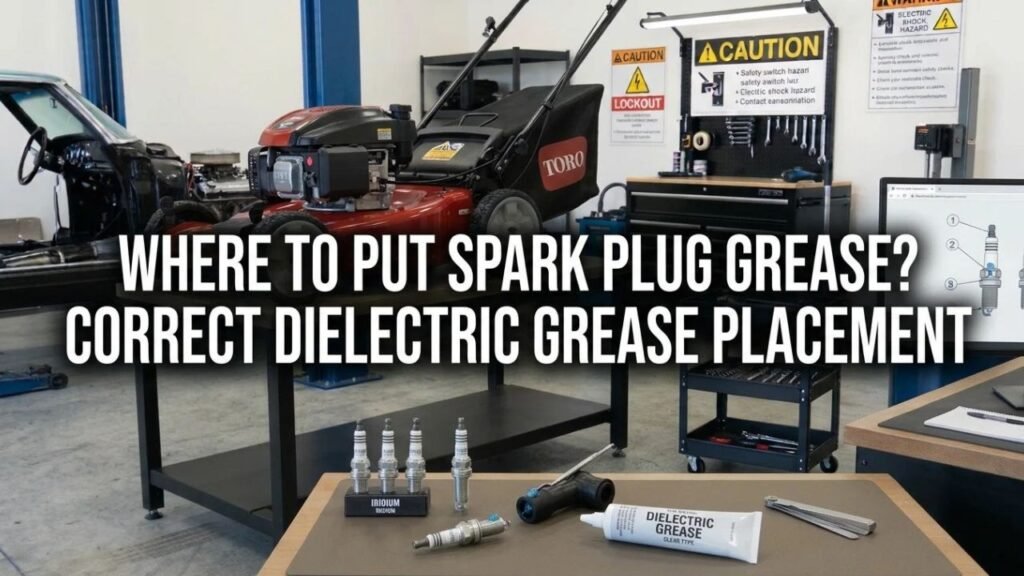
When people refer to “spark plug grease,” they usually mean dielectric grease.
Dielectric grease is typically a silicone-based, non-conductive grease used to protect electrical connections from moisture, contamination, and corrosion.
In a spark plug application, its main purposes are to:
Keep water and moisture away from the boot.
Prevent the rubber boot from sticking to the ceramic insulator.
Reduce corrosion around the boot and terminal area.
Make future spark plug or coil removal easier.
Help protect the ignition connection in wet or dirty environments.
It does not improve the spark by conducting more electricity.
In fact, dielectric grease is designed to resist electrical current.
That sounds strange when you are using it around an ignition connection, but the actual metal-to-metal electrical contact still occurs where the spring terminal, connector, or spark plug wire terminal physically clamps onto the spark plug terminal.
The grease protects the surrounding area while the mechanical contact carries the electrical current.
Where Exactly Do You Put Dielectric Grease on a Spark Plug?
The correct place is inside the rubber spark plug boot.
You want the grease on the inside surface of the rubber where it slides over the spark plug’s ceramic insulator.
Imagine the spark plug installed in the cylinder head.
From bottom to top, you have the firing electrodes, threaded metal shell, ceramic insulator, and terminal.
The rubber boot slides down around the top portion of the ceramic.
Apply a very small amount of dielectric grease to the inner circumference of that boot.
You do not need to coat the entire spark plug.
You also do not need to smear grease over the top terminal.
The goal is to create a thin moisture-resistant film between the rubber and ceramic.
Best Area to Apply It
Place a small dab just inside the mouth of the boot.
Then use a clean applicator, cotton swab, or the tip of the grease packet to spread it around the inner rubber wall.
When you install the boot, the grease will spread slightly along the ceramic surface.
That is generally enough.
Key Takeaways:
- Put dielectric grease inside the rubber spark plug or ignition-coil boot.
- Apply it mainly where the rubber contacts the spark plug’s ceramic insulator.
- Use only a thin film rather than filling the boot.
Where Do You Put Spark Plug Grease on a Coil-on-Plug Engine?
Modern vehicles commonly use coil-on-plug ignition.
Instead of a long spark plug wire, each cylinder has an individual ignition coil that sits directly over the spark plug.
At the bottom of the coil is a long rubber boot.
Inside that boot is usually a spring or metal conductor that connects the coil electrically to the spark plug terminal.
For these systems, apply dielectric grease inside the end of the rubber coil boot.
You only need enough to lightly coat the rubber.
Do not pack grease all the way up around the internal spring.
The metal spring or terminal needs to make proper physical contact with the spark plug terminal when the coil is installed.
Why Coil Boots Benefit From Dielectric Grease
Spark plugs on coil-on-plug engines often sit deep inside tubes in the cylinder head.
Moisture can sometimes enter these wells because of:
Engine washing.
Rainwater intrusion.
Valve-cover leaks.
Condensation.
Damaged seals.
Dielectric grease adds an additional moisture barrier around the boot.
It also helps keep the rubber from bonding to the ceramic spark plug insulator after years of engine heat.
Without lubrication, an old boot can sometimes tear when you pull the ignition coil off the plug.
Where Do You Put Grease on Spark Plug Wires?
Older ignition systems use spark plug wires running from a distributor or ignition coil to the spark plugs.
The procedure is very similar.
Apply a small amount of dielectric grease inside the spark plug end of the wire boot.
Spread it lightly around the rubber portion.
Then push the boot completely onto the spark plug until the metal terminal inside securely engages the plug terminal.
You may feel or hear a slight click depending on the connector design.
Do not assume the boot is connected simply because the rubber has covered the spark plug.
The internal metal terminal must actually seat on the spark plug terminal.
Should Dielectric Grease Go on the Spark Plug Terminal?
Generally, you do not need to deliberately coat the metal terminal itself.
The preferred approach is to place grease around the inside wall of the boot.
As the boot is installed, a small amount may naturally move toward the terminal area.
That is fine.
What you do not want to do is intentionally pack a thick layer of grease between the two metal electrical contacts.
Dielectric grease does not conduct electricity.
The mechanical terminal is designed to push through or displace a thin film of grease and make direct contact.
A small incidental amount does not usually prevent proper connection.
A large quantity packed directly into the terminal connection is unnecessary.
Should You Put Dielectric Grease on the Spark Plug Threads?
No. Dielectric grease should not be used on spark plug threads.
This is one of the most important distinctions.
Spark plug threads require the installation condition specified by the spark plug and engine manufacturer.
Most modern spark plugs have plated shells designed for installation on clean, dry threads.
Dielectric grease on the threads changes friction.
That changes the relationship between your torque-wrench reading and the actual clamping force produced.
You could overtighten the plug even though the torque wrench appears to show the correct number.
If the manufacturer specifically recommends a thread lubricant, use the exact recommended product and adjusted torque procedure.
Do not substitute dielectric grease.
Is Spark Plug Grease the Same as Anti-Seize?
No.
These are two different products with different jobs.
Dielectric Grease
Dielectric grease is usually silicone based.
Use it around:
Spark plug boots.
Ignition coil boots.
Electrical connector seals.
Rubber-to-ceramic contact areas.
Its main purpose is moisture protection, corrosion resistance, and easier removal.
Anti-Seize Compound
Anti-seize contains metallic or ceramic solids designed to prevent threaded fasteners from seizing.
It may be used on certain threaded components where the manufacturer specifically recommends it.
Many modern spark plug manufacturers advise installing their plated spark plugs without anti-seize because the thread coating already provides protection and additional lubrication can lead to overtightening.
Therefore, never assume new spark plugs need anti-seize.
Follow the exact installation instructions for the plug and engine.
Should You Put Grease on Spark Plug Electrodes?
Absolutely not.
Do not apply dielectric grease to:
The center electrode.
Ground electrode.
Spark plug gap.
Firing tip.
Lower insulator nose.
These components extend into the combustion chamber.
They need to remain clean and dry.
Grease on the firing end can contaminate the plug and interfere with normal combustion until it burns away.
It can also create deposits.
If you accidentally get grease on the electrode, clean it thoroughly before installing the plug.
Should You Put Grease on the Ceramic Insulator?
A very small amount may end up on the upper ceramic portion after the boot is installed, and that is normal.
But there is no need to coat the whole ceramic insulator manually.
The better method is to apply the grease to the inside of the boot.
This controls the amount and keeps the grease exactly where it is needed.
A heavy coating over the ceramic can collect dirt and make the ignition area messy.
The firing-end ceramic below the metal shell should remain completely grease-free.
How Much Dielectric Grease Should You Use?
Very little.
For most automotive spark plug boots, a small dab roughly comparable to a grain of rice or small pea can be enough, depending on boot size.
You are trying to create a thin coating.
You are not trying to fill the boot.
What Happens if You Use Too Much?
Too much grease can cause several inconveniences.
The boot may become difficult to seat because trapped grease and air create hydraulic or pneumatic resistance.
The coil may feel as though it is fully installed when it is not.
Grease may be pushed into places where it is not needed.
It may also make future inspection messy.
More grease does not provide more electrical protection after the rubber surface is already lightly coated.
Use the minimum amount necessary.
How to Apply Dielectric Grease to a Spark Plug Boot
The process is simple.
First, make sure the engine is cool.
Remove the ignition coil or plug wire.
If you are replacing spark plugs, complete the plug installation first and tighten each plug to the correct manufacturer specification.
Then inspect the rubber boot.
Look for:
Tears.
Cracks.
Hard or brittle rubber.
Carbon tracking.
Oil contamination.
Corrosion around the internal terminal.
If the boot is damaged, grease will not repair it.
Replace the damaged component.
Next, place a small dab of dielectric grease inside the end of the boot.
Spread it around the inside circumference.
Do not fill the center cavity.
Reinstall the coil or plug wire straight over the spark plug.
Push until the terminal is fully seated.
If the vehicle uses a retaining bolt for the ignition coil, reinstall and tighten that bolt to specification.
Finally, reconnect the electrical connector.
Why You Should Not Fill the Spark Plug Boot With Grease
A common misconception is that because dielectric grease blocks moisture, completely filling the boot must provide maximum protection.
That is unnecessary.
The rubber boot is designed to fit closely around the spark plug and seal the connection.
The grease only supplements that seal.
A thick pocket of grease can resist compression as you insert the plug or coil terminal.
This can make it difficult to know whether the electrical contact is fully seated.
In extreme cases, the boot may try to push itself upward.
A thin film achieves the desired purpose without creating these problems.
Does Dielectric Grease Conduct Electricity?
No.
Dielectric grease is intentionally non-conductive.
This is why it can be safely used around high-voltage ignition connections.
The metal electrical contacts still touch each other mechanically.
When the connector is installed, the spring or terminal pushes through the small amount of grease and creates direct contact with the spark plug terminal.
The grease surrounding that connection helps exclude air and moisture.
Why Doesn’t It Stop the Spark?
The ignition current does not need to travel through a thick layer of grease when the connection is assembled correctly.
The metal terminal in the boot contacts the metal terminal of the spark plug.
The grease is displaced from the direct contact point.
This is why using a thin coating is important.
Does Dielectric Grease Improve Spark?
No.
Dielectric grease does not increase ignition voltage or spark energy.
It can indirectly help maintain reliable ignition by protecting the connection from moisture and corrosion.
For example, water inside a spark plug well can provide an alternative path for high voltage to leak to ground.
Keeping moisture out helps prevent that problem.
But the grease itself does not make the ignition coil stronger.
Can Dielectric Grease Prevent Misfires?
It can help prevent some misfires caused by moisture or electrical leakage around the spark plug boot.
For example, a vehicle that misfires after heavy rain or engine washing may have moisture entering a damaged or poorly sealed coil boot.
A thin coating of dielectric grease can improve moisture resistance.
However, dielectric grease cannot repair:
A bad ignition coil.
A cracked boot.
A worn spark plug.
Incorrect plug gap.
A faulty fuel injector.
Low compression.
Damaged wiring.
A large vacuum leak.
If an engine is already misfiring, diagnose the cause rather than simply adding grease.
Key Takeaways:
- Dielectric grease can help prevent moisture-related ignition problems.
- It does not increase spark power or repair failed components.
- Damaged boots should be replaced rather than covered with grease.
Can Dielectric Grease Stop Spark Plug Boots From Sticking?
Yes, and this is one of its biggest practical advantages.
Spark plug boots experience repeated heat cycles.
Over thousands of miles, rubber can begin sticking strongly to the smooth ceramic insulator.
When you later try to remove the coil or plug wire, the boot may resist or tear.
A small film of dielectric grease keeps the surfaces from bonding tightly.
This makes future maintenance much easier.
It is especially useful on engines with deep spark plug wells where you cannot easily grip the bottom of the boot.
Should You Use Dielectric Grease Every Time You Change Spark Plugs?
It is generally useful when the ignition system uses rubber spark plug or coil boots, provided the component manufacturer does not instruct otherwise.
You do not need much.
If the existing boot already has a clean film of dielectric grease, adding a large additional amount is unnecessary.
Wipe away old contaminated grease if necessary and apply a fresh thin layer.
The important part is keeping the internal terminal and boot clean.
Should You Put Grease on Both Ends of a Spark Plug Wire?
For traditional spark plug wires, dielectric grease can be useful inside both boots:
The spark plug end.
The distributor or ignition-coil end.
Again, the grease goes primarily around the rubber sealing area rather than being packed between electrical contacts.
This can protect both ends from moisture and make future removal easier.
If the vehicle manufacturer provides specific instructions for the ignition wires, follow those instead.
Can You Use Too Little Dielectric Grease?
You only need enough to create a thin film.
Even a very small amount can provide useful lubrication and moisture resistance.
If you can see a light coating on the inside rubber surface, you generally have enough.
There is no benefit to making the grease visibly thick.
What If Dielectric Grease Gets on the Metal Contact?
A small amount is normally not a problem.
When the terminal is pushed together firmly, metal-to-metal contact should still occur.
If you accidentally pack the entire connector full of grease, however, remove the excess before installation.
The safest approach is simply not to deliberately apply it directly to the electrical terminal.
Place it around the rubber sealing area instead.
Can You Use Regular Grease on Spark Plug Boots?
No.
Do not substitute ordinary automotive grease, bearing grease, chassis grease, or petroleum jelly unless the ignition-component manufacturer specifically approves it.
Some petroleum-based lubricants can damage or swell rubber over time.
Dielectric grease is formulated for compatibility with electrical connections and many rubber sealing components.
Use a product specifically identified as dielectric or spark plug boot grease.
Can You Use Vaseline Instead of Dielectric Grease?
I would not recommend it as the normal choice.
Petroleum jelly may provide some moisture resistance, but dielectric silicone grease is specifically made for electrical sealing and typically offers better temperature stability and compatibility for automotive ignition use.
Spark plug boots operate in a very hot environment.
Use the product designed for the job.
Does Dielectric Grease Handle High Voltage?
Yes.
One reason dielectric grease is commonly used around spark plug boots is its excellent electrical insulating property.
Modern ignition systems can generate tens of thousands of volts.
The grease helps discourage electrical leakage across contaminated or damp surfaces.
However, it cannot compensate for a badly cracked boot.
High voltage can still arc through damaged insulation.
If you see a thin black line along a plug or boot—often called carbon tracking—replace the affected parts rather than simply adding grease.
What Is Carbon Tracking on a Spark Plug?
Carbon tracking appears as a dark line on the ceramic insulator or inside the coil boot.
It forms when high voltage repeatedly arcs along the surface instead of jumping the intended electrode gap.
Once the carbon path develops, it can become electrically conductive and continue providing an easier path for the spark.
This can create persistent misfires.
Replacing only the spark plug may not solve it if the matching boot is also contaminated.
If both surfaces show carbon tracking, replacement of both the plug and damaged boot is often appropriate.
Dielectric grease can help reduce moisture-related surface leakage, but it cannot reliably erase an established carbon track.
Should Spark Plug Grease Go Above or Below the Boot Spring?
Keep most of the grease around the rubber portion at the open end of the boot.
There is usually no reason to push grease deep past the spring or metal contact.
The spring needs to make firm contact with the spark plug terminal.
A light incidental coating is generally harmless, but deliberately packing the spring area is unnecessary.
Common Mistakes When Using Spark Plug Grease
The most common mistake is using far too much.
A tiny amount is enough.
Another mistake is putting dielectric grease on the spark plug threads.
That can alter installation torque.
People also sometimes smear it on the firing electrodes, which serves no useful purpose.
Another mistake is treating grease as a repair for damaged ignition components.
A torn coil boot, corroded connector, cracked spark plug, or failed ignition coil still needs to be repaired or replaced.
Finally, some people mistake dielectric grease for a conductive electrical enhancer.
It is not.
Its benefits come from insulation, sealing, corrosion protection, and lubrication.
Spark Plug Grease and Anti-Seize: Easy Rule to Remember
A simple way to remember the difference is:
Dielectric grease = boot.
Anti-seize = threads only if specifically approved.
Even then, many modern spark plug applications call for no anti-seize at all.
Never put either product on the firing electrodes.
This simple distinction prevents most spark plug lubrication mistakes.
Safety Tips When Applying Spark Plug Grease
Work on a cool engine.
Ignition coils and cylinder heads can remain extremely hot after the engine is shut off.
Disconnect the ignition connector before removing the coil.
Keep dirt out of open spark plug wells.
If the spark plug itself is being removed, clean around the hole first.
Do not allow grease, dirt, or tools to fall into the cylinder.
When reinstalling the spark plug, start it by hand before applying final torque.
Dielectric grease should be applied only after you are confident that the plug itself is installed correctly.
FAQs About Where to Put Spark Plug Grease
Where do you put spark plug grease?
Put a small amount of dielectric grease inside the rubber spark plug boot where it contacts the ceramic portion of the spark plug.
Do you put dielectric grease directly on a spark plug?
A small amount may naturally transfer to the upper ceramic insulator, but it is better to apply the grease inside the boot rather than coating the entire spark plug.
Do you put dielectric grease on spark plug threads?
No.
Dielectric grease is not intended for spark plug threads and can change the relationship between torque and clamping force.
Do you put grease on the spark plug electrode?
No.
Keep grease completely away from the center electrode, ground electrode, gap, and firing tip.
Should dielectric grease go on the spark plug terminal?
There is normally no need to deliberately coat the metal terminal.
Apply a thin film around the inside rubber surface of the boot instead.
How much dielectric grease should I use?
Use only enough to create a thin film around the inner wall of the boot.
A small dab is usually sufficient.
Can you use too much spark plug grease?
Yes.
Excess grease can make the boot difficult to seat and create unnecessary mess.
Does dielectric grease conduct electricity?
No.
Dielectric grease is an electrical insulator.
The metal terminals make direct physical contact when the boot is correctly installed.
Why use non-conductive grease on an electrical connection?
The grease seals moisture out around the connection while the metal contacts themselves provide the electrical path.
Is dielectric grease the same as anti-seize?
No.
Dielectric grease is used around electrical boots and seals. Anti-seize is a thread compound used only where specifically recommended.
Should I use anti-seize on spark plugs?
Only if the spark plug or engine manufacturer calls for it.
Many modern plated spark plugs are designed for installation on clean, dry threads.
Can dielectric grease prevent spark plug misfires?
It may help prevent moisture-related electrical leakage, but it will not fix a bad coil, worn plug, injector fault, or mechanical engine problem.
Should I put dielectric grease inside the ignition coil boot?
Yes, a thin film inside the rubber end of the coil boot is the normal location.
Can I fill the coil boot with dielectric grease?
No.
Only use a light coating.
The boot should not be packed full.
Should I use dielectric grease on spark plug wires?
Yes, a small amount inside the rubber spark plug wire boot can help protect against moisture and sticking.
Can dielectric grease help remove spark plug boots later?
Yes.
It helps prevent the rubber boot from bonding to the ceramic insulator after repeated heat cycles.
Can I use regular grease instead of dielectric grease?
I would not.
Use grease specifically designed for electrical and spark plug boot applications.
Can I use petroleum jelly on spark plug boots?
Dielectric silicone grease is the better choice because it is specifically designed for electrical connections and high-temperature automotive environments.
What if dielectric grease gets on the spark plug terminal?
A small amount is usually harmless because the metal contacts displace the grease when assembled.
Remove excessive amounts before installation.
What happens if grease gets on the spark plug firing tip?
Clean it off before installation.
The firing electrodes should remain clean and dry.
Do new ignition coils need dielectric grease?
Many benefit from a thin coating inside the rubber boot, but follow any instructions supplied by the coil manufacturer.
Does dielectric grease make spark plugs last longer?
It does not directly extend electrode life, but it can protect boots and connections from moisture and corrosion and make future servicing easier.
Conclusion
So, where to put spark plug grease? Apply a small amount of dielectric grease inside the rubber spark plug boot or ignition-coil boot, primarily where the rubber slides over the spark plug’s ceramic insulator.
That is the correct location.
You only need a thin film.
Do not fill the entire boot with grease, and do not deliberately pack grease between the electrical contacts.
Most importantly, keep dielectric grease away from the spark plug threads, center electrode, ground electrode, and firing gap.
Spark plug grease and anti-seize are not the same product. Dielectric grease is intended for boots and electrical sealing. Anti-seize is a threaded-fastener compound and should be used on spark plug threads only when the relevant manufacturer specifically calls for it. Many modern spark plugs require no anti-seize at all.
On a coil-on-plug engine, put a small dab around the inside end of each rubber coil boot before pushing the coil onto the spark plug.
On an older engine with plug wires, apply it inside the spark plug wire boot in the same way.
My recommendation is to use just enough dielectric grease to lightly coat the rubber sealing surface. That small amount can keep moisture out, reduce corrosion, prevent the boot from sticking to the ceramic, and make the next spark plug service much easier without interfering with the electrical connection.