
Yes, new spark plugs can increase gas mileage if the old plugs are worn, fouled, incorrectly gapped, or causing weak ignition or misfires. However, replacing healthy spark plugs that are already firing correctly usually produces little or no measurable improvement in fuel economy. New plugs are best viewed as a way to restore lost efficiency rather than as a modification that automatically makes an engine use less fuel.
Spark plugs ignite the compressed air-fuel mixture inside a gasoline engine. When they are in good condition, combustion occurs reliably and the engine control system can operate as intended. As plugs wear, their electrodes can erode, the effective gap can increase, deposits may accumulate, and the ignition system may need progressively more voltage to fire them.
If the deterioration becomes severe enough to create incomplete combustion or misfires, fuel economy can drop. Installing the correct new plugs can then restore smoother combustion and potentially recover some of the lost MPG.
That does not mean every vehicle will suddenly gain several miles per gallon after a tune-up. If the old spark plugs were still well within their service life and the engine was running normally, the difference may be too small to detect.
In this guide, I’ll explain can new spark plugs increase gas mileage, why worn plugs can reduce efficiency, how much MPG improvement is realistic, which symptoms suggest the plugs may be affecting fuel consumption, and what else you should check if replacing them does not improve mileage.
Can New Spark Plugs Increase Gas Mileage Directly?
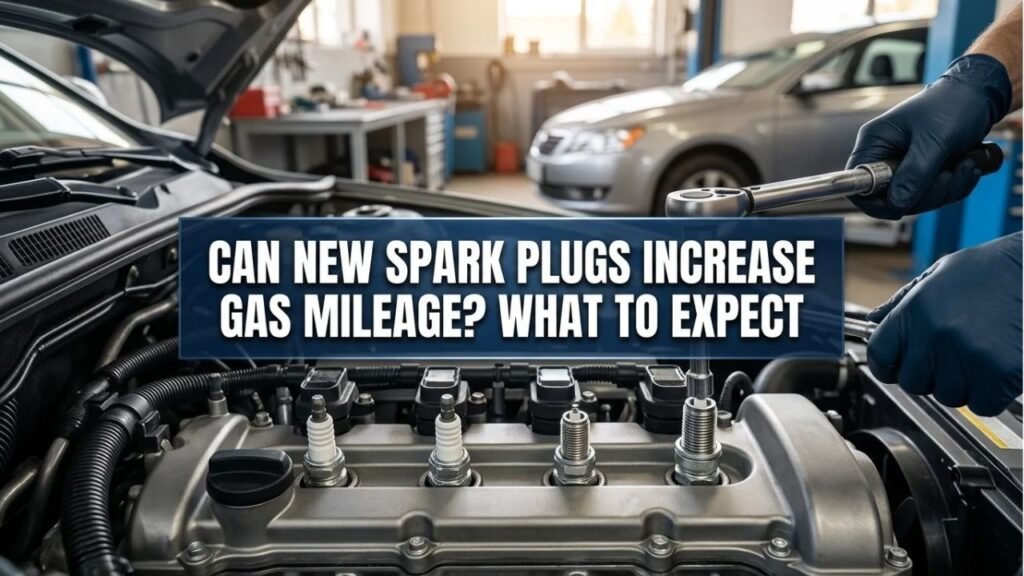
They can, but the improvement depends almost entirely on the condition of the plugs being replaced.
A new spark plug does not make gasoline contain more energy.
It also does not change the engine’s displacement, compression ratio, gearing, aerodynamics, or rolling resistance.
What it can do is help the engine ignite the air-fuel charge reliably.
If an old plug occasionally fails to fire, burns the mixture inconsistently, or forces the ignition system to work near its limit, replacing it can restore normal combustion.
That can reduce wasted fuel and bring mileage closer to what the vehicle achieved when its ignition system was healthy.
Think of It as Restoring Efficiency
Suppose a car originally averaged around 30 MPG.
As the spark plugs age, the engine develops a slight high-load misfire and fuel economy drops to 28 MPG.
Replacing the plugs might help the vehicle return toward 30 MPG if the plugs were actually responsible.
It would be misleading, however, to say the new plugs “added 2 MPG” as though they were a fuel-saving performance modification.
They restored performance that had been lost.
Key Takeaways:
- New spark plugs can improve MPG when old plugs are worn or causing poor ignition.
- Healthy plugs generally leave very little fuel economy for new plugs to recover.
- Spark plug replacement should be considered maintenance rather than an MPG modification.
How Worn Spark Plugs Can Reduce Fuel Economy
Spark plugs work in an extremely demanding environment.
They experience combustion pressure, heat, electrical voltage, and millions of firing cycles.
Over time, the electrodes wear.
As electrode material erodes, the gap between the center and ground electrodes can become larger.
A larger gap generally requires more ignition voltage.
Eventually, the ignition system may struggle to create a reliable spark under demanding conditions.
Misfires Waste Fuel
A misfire occurs when combustion in a cylinder fails or is incomplete.
If fuel enters the cylinder but does not burn properly, the engine does not receive the expected amount of power from that combustion event.
The vehicle still needs power to maintain speed.
The driver may press the accelerator farther, and the engine-management system continues trying to operate normally.
Repeated misfires therefore can contribute to increased fuel consumption.
Severe misfires can also send unburned fuel into the exhaust, potentially overheating the catalytic converter.
Weak Ignition Can Affect Drivability Before a Major Misfire Appears
Not every worn plug produces an obvious, violent misfire.
The first symptoms may be more subtle.
The engine may hesitate slightly during acceleration, require more throttle than before, feel less responsive, or idle less smoothly.
These problems can cause the vehicle to use fuel less effectively even before the driver sees a flashing check-engine light.
Do Spark Plugs Actually Affect MPG?
Yes, but their influence has limits.
Fuel economy depends on the entire vehicle and engine-management system.
Spark plugs are one component in that system.
If ignition is already reliable, changing electrode material or installing a more expensive plug does not fundamentally alter how much energy is needed to move the vehicle down the road.
Spark Plugs Matter Most When Something Is Wrong
The largest improvement will generally occur when the old plugs have one or more of these problems:
They are worn beyond their intended service interval.
The gaps have increased substantially.
They are fouled with oil, carbon, or fuel.
One or more plugs are misfiring.
The wrong plugs were previously installed.
The plugs were incorrectly gapped.
Their heat range is inappropriate for the engine.
In those situations, correcting the plug problem can improve both efficiency and drivability.
How Much Can New Spark Plugs Improve Gas Mileage?
There is no universal percentage.
The result can range from essentially 0% on a healthy engine to a noticeable improvement on an engine with badly worn or misfiring plugs.
Back-of-the-Envelope Estimate
Assume a vehicle normally gets 25 MPG but worn ignition components reduce real-world economy by roughly 3% to 8%.
A 5% loss from 25 MPG is approximately:
25 × 0.05 = 1.25 MPG
So an engine that had dropped from around 25 MPG to roughly 23.75 MPG because of ignition deterioration could potentially recover about 1 MPG or a little more after the underlying problem is corrected.
That is an estimate, not a guaranteed improvement.
The biggest uncertainty is whether the spark plugs are actually responsible for the mileage loss. Driving conditions, weather, tires, fuel formulation, traffic, and other mechanical problems can easily produce changes of similar or greater size.
What If the Old Plugs Are Still Good?
If the vehicle currently gets 30 MPG, the plugs are within specification, there are no misfires, and combustion is already reliable, new plugs might leave the car at essentially the same 30 MPG.
You may notice smoother starting or no change at all.
That is normal.
Why Mileage Can Improve After a Tune-Up
Drivers sometimes replace spark plugs as part of a larger maintenance service and then notice better fuel economy.
The improvement may be real, but it is difficult to attribute all of it to the plugs.
A tune-up might also include a new air filter, repaired intake leaks, cleaned sensors, correct tire pressure, new ignition coils, injector service, oil replacement, or other maintenance.
Several changes happening at the same time can influence MPG.
If you want to know whether spark plugs specifically made the difference, compare fuel economy over several tanks before and after changing only the plugs under similar driving conditions.
What Symptoms Suggest Spark Plugs Are Hurting Fuel Economy?
Poor gas mileage by itself is not enough to diagnose spark plugs.
However, fuel economy loss combined with ignition-related symptoms makes them a stronger suspect.
Rough Idle
An engine with worn or fouled plugs may shake more than normal at idle.
The rpm may fluctuate, or the exhaust note may sound uneven.
Hesitation During Acceleration
A worn plug can fire properly at idle but struggle when cylinder pressure increases under acceleration.
The engine may hesitate, stumble, or briefly lose power.
Hard Starting
Worn or fouled plugs can make cold or hot starting more difficult.
The engine may crank longer than usual before firing.
Reduced Power
If combustion is inconsistent, the vehicle may feel sluggish.
Drivers often compensate unconsciously by using more throttle, which can contribute to higher fuel consumption.
Check-Engine Light
Misfires can trigger diagnostic trouble codes such as P0300 or cylinder-specific P0301, P0302, and similar codes.
A code does not prove that the spark plug itself is bad, but it tells you a misfire requires diagnosis.
Can Incorrect Spark Plug Gap Reduce Gas Mileage?
Yes.
The correct spark plug gap is part of the ignition system’s design.
A gap that is too wide requires more voltage to fire.
As the gap becomes excessive, ignition may become unreliable, particularly during acceleration and high cylinder pressure.
This can create misfires and reduce efficiency.
What If the Gap Is Too Narrow?
An excessively narrow gap is not ideal either.
Although it requires less voltage to jump, the spark is occurring over a smaller distance than intended.
The engine may still run, but ignition characteristics no longer match the specified design.
The objective is not to find the widest or narrowest gap possible.
Use the specification for the exact engine and approved spark plug.
Can Fouled Spark Plugs Reduce Gas Mileage?
Yes.
A fouled plug can have deposits that interfere with reliable spark formation.
Fuel fouling, carbon fouling, or oil contamination can all create ignition problems.
But fouling is often a symptom of another problem.
For example, an oil-fouled plug can point to oil entering the combustion chamber.
A new plug may temporarily restore good ignition, but if oil contamination continues, the replacement can foul again.
The real repair is identifying why the plug became contaminated.
Will Iridium Spark Plugs Improve Gas Mileage?
Iridium plugs can help maintain reliable ignition for a long time, but simply switching from healthy OEM plugs to iridium does not guarantee better MPG.
Iridium’s main advantages include excellent wear resistance and the ability to use a fine center electrode.
That can support consistent ignition over a long service interval.
If you replace badly worn conventional plugs with correct new iridium plugs, the vehicle may run more efficiently.
But much of that improvement comes from replacing worn plugs, not from the word “iridium” on the box.
What If the Vehicle Already Uses Iridium?
Use the correct replacement plug specified for the engine.
Installing a different “performance” iridium plug is unlikely to improve fuel economy if the OEM plug already provides stable combustion.
Will Ruthenium Spark Plugs Improve MPG?
The same principle applies.
Ruthenium spark plugs can offer excellent durability and ignition characteristics when a compatible application exists.
However, replacing healthy iridium plugs with ruthenium plugs should not be expected to create a dramatic MPG increase.
If the old plugs are worn and the ruthenium plugs restore reliable ignition, fuel economy can improve.
That is maintenance recovery rather than a guaranteed efficiency upgrade.
Can Platinum Spark Plugs Improve Fuel Economy?
Platinum plugs resist electrode wear better than many traditional nickel designs.
That can help maintain the intended gap and ignition performance over a longer service interval.
Again, the actual fuel-economy benefit depends on what you are replacing.
A new platinum plug replacing a badly worn plug may help.
A new platinum plug replacing another healthy, correctly functioning premium plug may change virtually nothing.
Does a Stronger Spark Automatically Mean Better Gas Mileage?
No.
Once the air-fuel mixture is being ignited reliably under all operating conditions, making the spark system theoretically “stronger” does not continuously increase efficiency.
There is a point where the ignition system is already doing its job.
Modern engines are designed around specific plug gaps, ignition coils, dwell control, fuel mixtures, and combustion geometry.
Changing plugs outside the approved specification can make performance worse rather than better.
When Should You Replace Spark Plugs for Better Fuel Economy?
Replace them according to the maintenance schedule for your exact vehicle or when diagnosis indicates that they are worn, damaged, or fouled.
There is no universal mileage interval.
Different plug designs and engines have very different replacement schedules.
Some conventional plugs have relatively short service lives, while certain premium precious-metal plugs are designed for very long intervals.
Don’t Wait for Severe Misfires
Following the recommended maintenance schedule helps replace plugs before electrode wear becomes severe enough to noticeably affect performance.
That can help maintain consistent fuel economy rather than trying to recover efficiency after drivability has deteriorated.
Don’t Replace Them Too Early Without a Reason
Changing perfectly good long-life spark plugs significantly ahead of schedule usually will not save enough gasoline to justify the parts and labor.
Inspection and manufacturer recommendations should guide the decision.
Key Takeaways:
- Replace plugs when they are worn, faulty, or due according to the maintenance schedule.
- Premium electrode materials help preserve ignition performance but do not automatically increase MPG.
- Replacing healthy plugs very early generally provides little fuel-economy benefit.
How to Tell if New Spark Plugs Improved Your Gas Mileage
Do not judge MPG from a short trip or the dashboard display immediately after replacement.
Fuel economy varies naturally from day to day.
Use several full tanks if you want a meaningful comparison.
Calculate MPG Manually
Fill the fuel tank completely.
Reset the trip odometer.
Drive normally.
At the next fill-up, divide the miles driven by the gallons required to refill the tank.
Repeat this over several tanks.
A longer test period reduces the influence of traffic, weather, short trips, and fueling differences.
Compare Similar Driving
A before-and-after comparison is only useful when conditions are reasonably similar.
If the old plugs were tested during winter city traffic and the new plugs during warm-weather highway driving, the difference cannot fairly be attributed to spark plugs.
Other Reasons Your Gas Mileage May Be Dropping
If new spark plugs do not improve fuel economy, the plugs may never have been the problem.
Tire Pressure
Underinflated tires increase rolling resistance.
Even modest pressure differences can affect fuel consumption over time.
Use the vehicle manufacturer’s recommended cold tire pressure rather than the maximum pressure printed on the tire sidewall.
Driving Habits
Hard acceleration, high speed, frequent braking, extended idling, and short trips can have a much larger effect on fuel economy than spark plug condition.
Cold Weather
Engines take longer to reach efficient operating temperature during cold weather.
Winter fuel blends, increased accessory use, colder tires, and greater aerodynamic drag from dense air can also reduce MPG.
Fuel Injector Problems
A dirty, leaking, or poorly performing injector can disturb fuel delivery.
Replacing spark plugs will not correct an injector that is delivering the wrong amount of fuel.
Oxygen Sensors and Air-Fuel Control
Modern engines rely on sensor feedback to adjust fueling.
A sensor problem can affect efficiency even when the engine still seems to run reasonably well.
Diagnosis should be based on trouble codes and live data rather than replacing sensors purely because MPG decreased.
Intake or Vacuum Leaks
Unmetered air can affect fuel trims and combustion.
Depending on engine design and severity, an intake leak may also produce rough idle or lean-condition trouble codes.
Thermostat Problems
An engine that runs too cool because of a stuck-open thermostat may remain in a less efficient operating condition.
If the temperature gauge takes unusually long to reach normal or drops during highway driving, cooling-system diagnosis may be worthwhile.
Brake Drag
A sticking brake caliper or parking brake can dramatically reduce mileage because the engine is continuously working against extra resistance.
Alignment and Tires
Poor alignment, aggressive tread designs, oversized tires, and changes in wheel-and-tire weight can all affect MPG.
Can Bad Ignition Coils Reduce Gas Mileage Too?
Yes.
A weak ignition coil can produce the same type of incomplete combustion or misfire that a bad spark plug can create.
This is why replacing plugs does not always solve an ignition-related fuel economy problem.
On coil-on-plug engines, each cylinder may have its own ignition coil.
A failing coil can affect only one cylinder.
If the engine has a misfire code, diagnosing whether the fault follows the coil when components are safely swapped can be useful on vehicles where that test is appropriate.
Can New Spark Plugs Make Mileage Worse?
They can if the wrong plugs are installed or if installation is incorrect.
Examples include incorrect heat range, wrong part number, inappropriate gap, damaged plug, or installation problems.
If fuel economy and drivability suddenly become worse immediately after spark plug replacement, recheck the work.
Wrong Gap
A plug gap substantially outside specification can create misfires.
Wrong Heat Range
A spark plug that runs too cold may foul more readily.
A plug that runs too hot can increase the risk of overheating and abnormal combustion.
Wrong Plug Reach
Spark plug reach determines how far the threaded portion extends into the cylinder head.
An incorrect reach can create serious problems and should never be treated as a minor substitution.
Damaged Ignition Coil or Connector
Changing plugs often requires removing ignition coils.
A damaged boot, loose connector, or coil that was not seated correctly can create a new misfire after the plug replacement.
Are Expensive Spark Plugs Better for Gas Mileage?
Not necessarily.
The best plug is the correct plug for your engine.
A $20 premium plug does not automatically improve efficiency more than a $7 OEM-spec plug.
If both ignite the mixture reliably and one is the approved application, fuel economy can be essentially the same.
Premium plugs may offer longer service life, specialized electrode designs, or improved durability under demanding operating conditions.
Those benefits can be valuable without producing a dramatic MPG difference.
Can New Spark Plugs Improve Idle and Acceleration Even Without Better MPG?
Yes.
A vehicle can feel noticeably smoother after replacing worn plugs even if the measured fuel economy changes very little.
Starting may improve.
Idle may become steadier.
Throttle response may feel cleaner.
High-load hesitation may disappear.
Those are worthwhile improvements even if MPG stays almost unchanged.
Fuel economy is only one way to evaluate ignition maintenance.
Is Better Fuel Economy After Spark Plug Replacement Permanent?
If worn plugs were the cause and the engine is otherwise healthy, the recovered efficiency should generally remain until normal wear or another issue develops.
However, new plugs will not prevent future problems elsewhere in the engine.
If the original plugs were fouled because the engine burns oil, the new set may eventually develop the same deposits.
If an ignition coil is failing, fresh plugs may temporarily make ignition easier but cannot repair the coil.
Long-lasting improvement requires addressing the underlying condition.
Common Mistakes When Replacing Spark Plugs for Better MPG
One mistake is replacing plugs solely because fuel economy dropped by one MPG.
Small MPG changes can occur naturally because of weather, traffic, fuel, or measurement variation.
Another mistake is assuming a more expensive plug must save more fuel.
Plug compatibility matters more than price.
Installing an unnecessarily wide gap in an attempt to create a “bigger spark” can also hurt ignition reliability.
Finally, do not ignore other maintenance issues.
If tire pressure is low, brakes are dragging, and the engine never reaches operating temperature, spark plugs are unlikely to be the main reason MPG is poor.
FAQs about Can New Spark Plugs Increase Gas Mileage
Can new spark plugs increase gas mileage?
Yes, if the old plugs are worn, fouled, incorrectly gapped, or causing misfires.
If the existing plugs are still healthy, the improvement may be negligible.
How much MPG can new spark plugs add?
There is no guaranteed amount.
A healthy vehicle may see essentially no change, while a vehicle that had lost efficiency from badly worn plugs may recover a few percent of its previous fuel economy.
Will changing old spark plugs improve fuel economy?
It can, particularly when electrode wear has increased the gap or the plugs are causing incomplete combustion.
Can bad spark plugs lower gas mileage?
Yes.
Misfires and poor combustion can waste fuel and reduce engine efficiency.
Can worn spark plug gaps affect MPG?
Yes.
As electrode wear increases the gap, the ignition system requires more voltage to fire the plug.
If the gap becomes excessive, misfires can occur.
Do iridium spark plugs improve gas mileage?
They can help maintain reliable ignition for a long service interval, but switching from healthy OEM plugs to iridium does not guarantee an MPG increase.
Do ruthenium spark plugs increase MPG?
They may restore efficiency when replacing worn plugs, but they should not be expected to produce a major mileage improvement over other healthy premium plugs.
Do platinum spark plugs save gas?
Their durability can help maintain proper ignition over time.
However, they do not automatically use less fuel simply because the electrodes contain platinum.
Can new plugs improve acceleration?
Yes, if worn plugs were causing hesitation or misfire.
The engine may respond more smoothly after replacement.
Can new spark plugs improve idle?
Yes.
If poor plug condition was contributing to an uneven idle, fresh correctly specified plugs can restore smoothness.
Can spark plugs cause poor MPG without a check-engine light?
Yes.
Minor deterioration can affect drivability before the engine computer detects enough misfire activity to illuminate the warning light.
However, many non-ignition issues can also lower MPG without triggering a warning light.
Will changing spark plugs fix a rich-running engine?
Not usually.
A rich condition is generally caused by fuel-control, sensor, injector, air-intake, or other issues.
Fouled plugs may be a result of the rich condition rather than its cause.
Should I replace spark plugs just to save fuel?
Replace them when they are due, worn, damaged, or identified as faulty.
Replacing healthy plugs early solely to improve MPG usually offers poor value.
Can a bad ignition coil reduce gas mileage?
Yes.
A weak coil can cause incomplete ignition and misfires just like a faulty plug.
Why did my MPG not improve after new spark plugs?
The old plugs may not have been affecting efficiency, or another issue may be responsible for the poor mileage.
Check driving conditions, tire pressure, fuel trims, brakes, engine temperature, sensors, injectors, and other relevant systems.
Conclusion
Can new spark plugs increase gas mileage? Yes, but primarily when the old plugs have deteriorated enough to reduce combustion efficiency. Worn electrodes, excessive gap, fouling, and misfires can all make an engine use fuel less effectively, and installing the correct new plugs can restore some of that lost mileage.
What new plugs usually do not do is create a major MPG increase in an engine that was already running correctly.
If the original plugs are healthy, properly gapped, and within their service interval, the fuel-economy difference after replacement may be essentially zero.
A realistic way to think about spark plug replacement is as preventive maintenance and efficiency restoration. If worn plugs have reduced fuel economy by a few percent, correcting the ignition problem may recover a similar amount. The largest uncertainty is always whether the plugs were actually responsible for the loss in the first place.
Use the exact spark plugs specified for your engine, follow the recommended replacement interval, verify the gap as appropriate, and install them correctly.
If gas mileage remains poor after replacement, continue diagnosing the vehicle rather than assuming you need more expensive plugs. Tire pressure, driving conditions, fuel delivery, engine temperature, sensors, brakes, alignment, and other mechanical conditions can have a much larger effect on fuel consumption.
The bottom line is simple: new spark plugs can restore lost gas mileage, but healthy new plugs do not magically make a properly running engine dramatically more fuel-efficient.