
If you are wondering how to apply dielectric grease to spark plugs, put only a small amount inside the rubber spark plug boot, usually around the inner lip or ceramic-contact area, before pushing the boot onto the spark plug. Do not coat the spark plug threads or intentionally pack dielectric grease onto the metal electrical terminal.
Dielectric grease is a silicone-based, electrically insulating grease commonly used around ignition-system connections. Its main job is not to improve electrical conductivity. Instead, it helps seal out moisture, reduces corrosion, prevents the rubber boot from sticking to the spark plug’s ceramic insulator, and can reduce the chance of high-voltage arcing along contaminated or damp surfaces.
That distinction is important because dielectric grease is frequently misunderstood. More grease does not produce a stronger spark, and filling an entire coil boot with it is unnecessary. The ignition terminal still needs proper metal-to-metal contact between the spark plug terminal and the spring or connector inside the boot.
The correct amount is usually just a small dab spread into a thin film where the rubber boot seals around the spark plug’s ceramic insulator. When the boot is installed, the grease spreads around the sealing area naturally.
The exact ignition design varies among vehicles. Older engines may use traditional spark plug wires, while modern engines often use coil-on-plug ignition with a long rubber boot extending from the ignition coil to the spark plug. The basic grease application principle is the same for both.
In this guide, I’ll explain how to apply dielectric grease to spark plugs, exactly where it should go, how much you need, whether it belongs on the terminal or threads, how to use it with coil-on-plug systems and spark plug wires, and what happens if you apply too much.
Where Does Dielectric Grease Go on a Spark Plug?
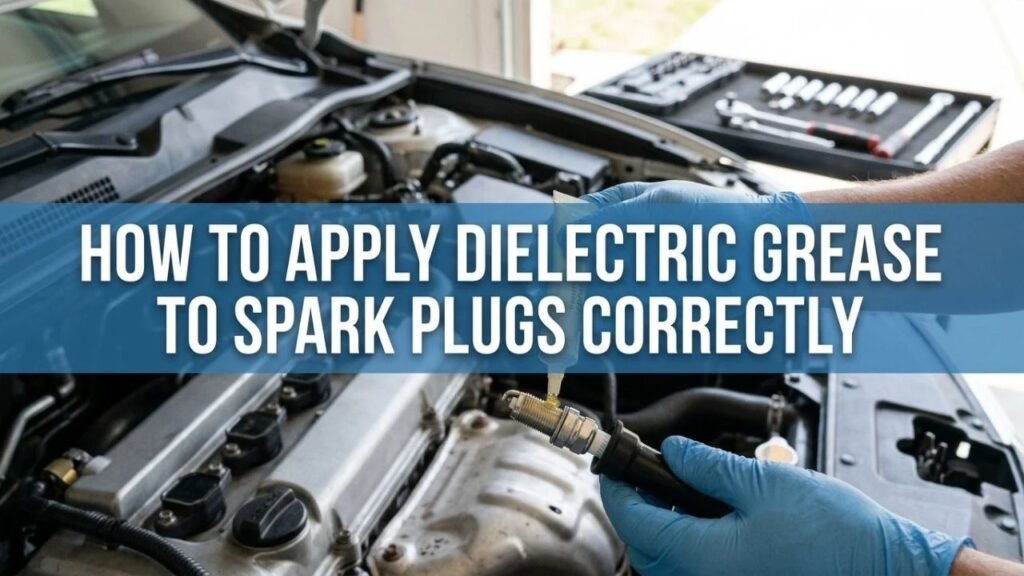
Dielectric grease normally goes inside the rubber spark plug boot, not directly over every part of the spark plug.
The most useful location is around the inside of the boot where it contacts and seals against the spark plug’s ceramic insulator.
You can also put a very light film around the inner lip of the boot before installation.
When the boot slides over the spark plug, the grease spreads around the ceramic surface and rubber seal.
This helps keep moisture from traveling down the boot and makes future removal easier.
The Areas to Understand
A spark plug has several very different surfaces.
At the top is the metal terminal, where the ignition coil or plug wire makes electrical contact.
Below that is the ceramic insulator.
Farther down are the metal hex and threaded shell that screw into the cylinder head.
Dielectric grease is mainly useful at the boot-to-ceramic sealing area.
It is not intended to be a general coating for the entire spark plug.
Do Not Coat the Threads With Dielectric Grease
Spark plug threads should not be coated with dielectric grease.
The threads must provide correct mechanical seating and heat transfer into the cylinder head.
Adding grease can alter tightening friction and therefore change the relationship between the torque wrench reading and actual clamping force.
If a spark plug manufacturer specifies dry installation, install the threads dry.
Dielectric grease and anti-seize are also completely different products and should not be treated as interchangeable.
Key Takeaways:
- Put dielectric grease inside the spark plug boot, mainly around its sealing surface.
- Use only a thin film rather than filling the entire boot.
- Keep dielectric grease off the spark plug threads.
What Is Dielectric Grease Used for on Spark Plugs?
Dielectric grease is used primarily for protection.
Ignition systems operate at extremely high voltage, and moisture or contamination around a spark plug boot can create unwanted electrical leakage paths.
A properly sealed boot helps keep the ignition energy traveling through the intended path: from the coil or plug wire to the spark plug terminal and then across the firing gap inside the combustion chamber.
Moisture Protection
Water inside a spark plug well can contribute to corrosion and electrical leakage.
This is especially relevant on engines where deep spark plug wells can collect water from washing, rain intrusion, leaking seals, or condensation.
A light coating of dielectric grease around the boot seal helps exclude moisture.
Preventing Boot Adhesion
Rubber spark plug boots can become stuck to ceramic insulators after years of heat cycles.
That makes future plug replacement frustrating and can cause the boot to tear when pulled.
Dielectric grease provides lubrication between the rubber and ceramic so the boot is easier to remove later.
Helping Prevent Arcing
High ignition voltage can sometimes travel along the outside of a contaminated ceramic insulator rather than through the intended plug gap.
This is sometimes called flashover or external arcing.
Keeping the boot and insulator clean, dry, and properly sealed helps reduce that risk.
Dielectric grease can be part of that protection, although it cannot repair a cracked boot, cracked spark plug, damaged ignition coil, or severely contaminated plug well.
Is Dielectric Grease Conductive?
No.
This is one of the most important things to understand before applying it.
Dielectric grease is intentionally electrically insulating.
That is why you should not think of it as a conductive paste.
Then Why Can It Be Used Around Electrical Connections?
The metal terminal inside the spark plug boot physically contacts the metal spark plug terminal.
That mechanical contact displaces the small amount of grease at the contact point.
The surrounding grease then helps seal the connection from moisture and contamination.
In other words, the connection works because the metal pieces still physically touch each other—not because the dielectric grease carries electricity between them.
Should You Put It Directly on the Spark Plug Terminal?
A tiny amount reaching the terminal during normal installation generally is not a problem because the connector wipes through it.
However, I do not recommend deliberately packing the terminal cavity with large amounts of dielectric grease.
Apply the grease primarily to the rubber sealing surfaces and ceramic-contact area.
That achieves the protective benefit without unnecessarily filling the electrical-contact area.
How Much Dielectric Grease Should You Use?
Very little.
For most spark plug boots, a small dab is enough.
You are trying to create a thin protective film rather than a reservoir of grease.
An amount roughly comparable to a small pea or less is usually plenty for one conventional boot, although actual boot size varies.
More Is Not Better
Packing a coil boot completely full can make installation messy and may trap excess grease around the connector.
It can also create hydraulic resistance when you push the boot onto the spark plug, making it harder to tell whether the boot is fully seated.
A thin coating gives you the benefits without those disadvantages.
Spread It Around the Inner Lip
Use a clean cotton swab, small applicator, or clean fingertip to spread a very thin film around the inside circumference of the boot.
You do not need to coat several inches of the entire boot interior.
Concentrate on the lower portion that seals against the spark plug’s ceramic insulator.
How to Apply Dielectric Grease to Spark Plugs Step by Step
The process is straightforward, but good preparation matters.
Let the Engine Cool
Before removing ignition coils or spark plug wires, allow the engine to cool.
Spark plugs can become extremely hot, and working around a hot cylinder head increases the chance of burns.
A cool engine is also generally the preferred condition for spark plug service unless the vehicle manufacturer specifically instructs otherwise.
Disconnect the Ignition Coil or Spark Plug Wire
On a coil-on-plug engine, disconnect the electrical connector from the ignition coil if you are removing it.
Then remove the retaining fastener when applicable and carefully pull the coil upward.
Avoid yanking on the wiring harness.
On older engines with spark plug wires, grasp the boot rather than pulling directly on the cable.
Twisting the boot slightly can help break it loose from the ceramic insulator.
Inspect the Boot
Before applying fresh grease, inspect the rubber carefully.
Look for cracking, burns, carbon tracking, swelling, hardening, tears, or other damage.
A damaged boot should be replaced.
Dielectric grease cannot restore insulation that has already failed.
Also inspect inside the boot for corrosion, moisture, dirt, or oil contamination.
Clean the Spark Plug Well
If the spark plug sits deep in a well, remove loose debris before pulling the spark plug.
You do not want dirt falling into the combustion chamber after the plug is removed.
If oil is present in the spark plug well, determine why.
A leaking valve-cover gasket or spark plug tube seal may need repair.
Simply applying dielectric grease will not solve an oil-filled plug well.
Install the Correct Spark Plug
If you are replacing plugs, verify the correct part number and gap.
Start the plug by hand to avoid cross-threading.
Tighten it according to the vehicle or spark plug manufacturer’s specified procedure.
Do not put dielectric grease on the spark plug threads.
Apply a Small Dab to the Boot
Put a small amount of dielectric grease inside the rubber boot.
The best location is usually around the inside lip and the area that surrounds the ceramic portion of the spark plug.
Spread it into a thin, even coating.
Avoid filling the entire boot.
Reinstall the Boot
Align the boot straight over the spark plug and push it down firmly.
You should feel or hear the terminal engage depending on the design.
The boot should fully seat on the plug.
On a coil-on-plug system, reinstall the coil fastener to the appropriate specification and reconnect the electrical connector.
Verify Everything Is Connected
Before starting the engine, make sure every coil connector or plug wire is fully installed.
A loose coil connector can cause an immediate misfire that has nothing to do with the dielectric grease.
Start the engine and verify smooth operation.
Key Takeaways:
- Inspect and clean the boot before applying grease.
- Use a small amount around the boot’s sealing area.
- Make sure the boot fully seats on the spark plug after application.
How to Apply Dielectric Grease to Coil-on-Plug Ignition
Most modern vehicles use coil-on-plug ignition.
Each cylinder has an individual ignition coil positioned directly over the spark plug or connected to it through a short boot.
The rubber boot often extends down a deep spark plug well.
Where to Put the Grease in a Coil Boot
Apply a thin film inside the lower end of the boot where it slides around the spark plug ceramic.
The goal is to seal the interface between the boot and insulator.
You can spread the grease around the inside wall with a clean applicator.
Do not coat the entire coil spring with a thick layer.
Check the Coil Spring
Many coil-on-plug boots contain a metal spring that contacts the spark plug terminal.
Make sure that spring is present, clean, properly positioned, and not corroded.
If the spring is badly damaged, replacing the boot or coil may be necessary.
Grease will not compensate for poor mechanical contact.
Replace Damaged Coil Boots
Some ignition coils allow the rubber boot to be replaced separately.
If you find carbon tracking, cracks, burns, or deterioration on the boot, replacement may be cheaper than replacing the entire coil.
Follow the design of your specific ignition system.
How to Apply Dielectric Grease to Spark Plug Wires
Older vehicles commonly use high-voltage spark plug wires running from a distributor or coil pack to each spark plug.
Dielectric grease works very well on these boots too.
Apply a small amount inside the spark plug end of the rubber boot.
Spread it around the inner sealing surface.
Then push the boot straight onto the spark plug until the terminal connection is fully engaged.
You Can Also Protect the Other End
Depending on the ignition design, a small amount may also be used around the rubber sealing area at the distributor or coil-pack end of the wire.
Again, the objective is moisture sealing and boot lubrication—not covering the conductive terminal with a large quantity of grease.
Should You Put Dielectric Grease on Spark Plug Threads?
No.
Dielectric grease is not intended for spark plug threads.
Thread treatment is a separate issue from ignition boot protection.
Why Thread Lubrication Matters
Torque specifications depend partly on thread friction.
Adding grease to threads can reduce friction, meaning the same torque-wrench reading can generate more actual clamping force.
That can increase the possibility of overtightening, thread damage, or spark plug shell distortion.
Many modern spark plugs have plated threads designed for installation without additional lubricant.
Follow the exact spark plug and engine manufacturer’s directions.
Is Dielectric Grease the Same as Anti-Seize?
No.
They serve completely different purposes.
Dielectric grease is a silicone insulating grease primarily used for electrical sealing and boot lubrication.
Anti-seize is a thread compound designed to reduce sticking, galling, and corrosion on threaded fasteners.
Neither should be substituted for the other.
More importantly, many modern spark plug manufacturers do not recommend adding anti-seize to their plated spark plug threads because it can affect tightening torque.
Do not apply either product to spark plug threads unless the applicable manufacturer specifically instructs you to do so.
Can You Put Dielectric Grease on the Spark Plug Ceramic?
Yes, but only where the rubber boot contacts the ceramic and only as a thin film.
In practice, it is usually cleaner to apply the grease to the inside of the boot rather than smearing the entire ceramic insulator.
When you push the boot onto the plug, the grease transfers to the appropriate sealing area naturally.
Keep the Firing End Clean
Never put dielectric grease on the electrode end of the spark plug that enters the combustion chamber.
The center electrode, ground electrode, and insulator nose should remain clean.
Grease in the combustion chamber can contaminate the firing end and interfere with normal plug operation.
What Happens If You Use Too Much Dielectric Grease?
Usually, the biggest problems are mess and improper seating.
If the boot is packed full, the excess grease has to go somewhere when the spark plug terminal enters.
It may squeeze upward around the coil spring or outward around the boot.
The Boot May Be Difficult to Seat
A large trapped quantity of grease can resist compression.
You may think the boot is installed when it is actually sitting slightly above its correct position.
That could create poor terminal contact.
Excess Grease Can Hide Other Problems
A boot full of grease can make it harder to inspect the internal terminal and spring.
It may also disguise existing corrosion or damage.
Use only enough to create a light coating.
Can Too Much Dielectric Grease Cause a Misfire?
Potentially, if overapplication prevents the ignition terminal from making proper physical contact or keeps the boot from seating fully.
Dielectric grease itself is nonconductive.
A properly installed connection displaces the grease at the metal contact point.
But if excessive grease or incorrect assembly leaves the spring or terminal poorly engaged, ignition performance can suffer.
If an engine starts misfiring immediately after you serviced the plugs and applied dielectric grease, check:
The coil connector, coil boot seating, internal spring position, spark plug terminal, spark plug gap, and whether the correct plugs were installed.
Do not automatically assume the grease itself is chemically causing the misfire.
Can Dielectric Grease Fix an Existing Misfire?
Usually not.
Dielectric grease can help prevent moisture-related ignition leakage and improve boot sealing, but it is not a repair for a worn spark plug, weak ignition coil, cracked ceramic, damaged plug wire, failed injector, or compression problem.
If an engine already has a misfire, diagnose the cause.
Adding dielectric grease might help if moisture inside a healthy boot is genuinely responsible, but it should not be used as a substitute for troubleshooting.
Does Dielectric Grease Prevent Spark Plug Corrosion?
It can help protect the boot and upper terminal area from moisture and atmospheric contamination.
Because the grease forms a water-resistant barrier, it can reduce corrosion around electrical connections.
However, it does not protect the spark plug firing end inside the combustion chamber.
It also cannot stop corrosion caused by coolant, oil, or water accumulating in a spark plug well due to a mechanical leak.
Correct those leaks first.
Does Dielectric Grease Help Prevent Carbon Tracking?
It can reduce conditions that contribute to external high-voltage leakage by helping keep moisture and contamination away from the boot-to-insulator interface.
Carbon tracking appears as a thin dark line or mark where high voltage repeatedly traveled along an unintended path.
If a spark plug or boot already has significant carbon tracking, cleaning and adding grease may not be enough.
The damaged component often needs replacement because the established track can provide an easier path for future electrical leakage.
Do New Spark Plug Wires Need Dielectric Grease?
It is often useful, particularly when the wire or vehicle manufacturer allows it.
A light film can protect the sealing surfaces and make future removal easier.
Some replacement ignition wire sets or coil boots may already contain grease or include a small packet for installation.
If the component manufacturer provides specific instructions, follow them.
Do New Ignition Coils Need Dielectric Grease?
Not always.
Some replacement coils or boots come ready to install without additional grease.
Others may include dielectric grease or recommend its use.
If the boot is already adequately lubricated and sealed from the factory, adding more is unnecessary.
If you choose to use it, a very light film around the lower boot seal is enough.
Should You Reapply Dielectric Grease Every Time You Change Spark Plugs?
If the old grease is contaminated, dried, dirty, or largely removed when you pull the boot off, clean the boot and apply a fresh small amount.
You do not need to keep layering new grease over a large existing buildup.
Remove excessive or contaminated material first.
A clean thin coating is better than a boot packed with old grease and debris.
Can You Use Dielectric Grease on Iridium or Platinum Spark Plugs?
Yes.
The grease is used around the upper ceramic insulator and boot, so the electrode material inside the combustion chamber does not change how the grease is applied.
Whether the spark plug uses conventional nickel, platinum, or iridium firing surfaces, the boot-sealing procedure is basically the same.
Just keep the grease away from the firing electrodes and threads.
Common Mistakes When Using Dielectric Grease on Spark Plugs
The most common mistake is using far too much.
Another is putting it on the threads because the word “grease” makes people assume it should lubricate installation.
It should not.
A third mistake is coating the metal terminal heavily in an attempt to improve electrical conductivity.
Dielectric grease is not conductive grease.
Applying Grease to a Dirty Boot
Do not seal dirt, oil, or corrosion underneath fresh grease.
Clean the boot first.
If oil keeps returning to the spark plug well, repair the oil leak.
Ignoring Damaged Rubber
A cracked ignition boot cannot be permanently repaired by filling it with grease.
High-voltage ignition energy can still leak through the damaged insulation.
Replace the boot or coil assembly as appropriate.
Assuming Grease Fixes Every Moisture Problem
If water repeatedly appears in the spark plug wells, find the source.
Dielectric grease helps seal a correctly assembled connection, but it cannot compensate for missing engine covers, leaking seals, damaged connectors, or substantial water intrusion.
Key Takeaways:
- Dielectric grease is a preventative sealant, not a cure for damaged ignition parts.
- Clean contamination before applying fresh grease.
- Replace cracked, burned, or carbon-tracked boots instead of covering the damage.
How to Remove Excess Dielectric Grease
If you accidentally used too much, remove the boot and wipe out the excess with a clean lint-free cloth or appropriate swab.
You do not need to remove every microscopic trace.
Leave a thin coating around the sealing area.
Inspect the metal terminal or spring and confirm it is clean enough to make reliable mechanical contact.
Then reinstall the boot firmly.
If the engine was already running poorly, inspect the spark plug and coil connection as well rather than assuming wiping away grease alone will solve the issue.
How to Know the Spark Plug Boot Is Fully Seated
On many systems you can feel a distinct engagement as the terminal connects to the spark plug.
Some traditional plug wires produce a small click.
Coil-on-plug systems may simply feel firmly seated at the bottom of the well.
The coil should sit in its normal mounting position without needing excessive force.
If a coil appears to sit unusually high after grease application, remove it and check for excessive grease, a displaced spring, incorrect spark plug terminal, or obstruction in the well.
Do not use the coil mounting bolt to force an improperly seated boot downward.
Safety When Applying Dielectric Grease to Spark Plugs
Turn the engine off before servicing the ignition system.
Allow it to cool enough to work safely.
Modern ignition coils can produce very high voltage, so do not handle coil boots or plug wires while the engine is running unless you are following a proper diagnostic procedure with appropriate equipment.
Disconnect electrical connectors by their housings rather than pulling on wires.
Keep dirt and loose debris away from open spark plug holes.
If you remove spark plugs, start replacements by hand and follow the proper tightening specification.
Most importantly, use dielectric grease only where it belongs.
A small amount in the boot is useful. Smearing it over every part of the spark plug is not.
FAQs about how to apply dielectric grease to spark plugs
How do I apply dielectric grease to spark plugs?
Put a small dab inside the rubber spark plug boot and spread it into a thin film around the inner sealing surface.
Then push the boot fully onto the spark plug.
Where exactly does dielectric grease go on a spark plug?
It mainly goes inside the rubber boot where the boot seals around the spark plug’s ceramic insulator.
Do you put dielectric grease directly on the spark plug?
You can allow a thin film on the upper ceramic where the boot contacts it, but applying it inside the boot is usually cleaner and easier.
Should dielectric grease go on spark plug threads?
No.
Keep it off the threads and follow the spark plug manufacturer’s thread-installation instructions.
Do you put dielectric grease on the spark plug terminal?
Do not deliberately pack the metal terminal connection with grease.
A small amount transferred there during boot installation is generally fine because proper metal contact displaces it.
Is dielectric grease conductive?
No.
It is electrically insulating and primarily used to keep moisture and contamination away from electrical connections.
How does electricity pass through dielectric grease?
The metal ignition terminal physically contacts the spark plug terminal and displaces the grease at the contact point.
The electrical path is through metal-to-metal contact, not through the grease.
How much dielectric grease should I use?
Only a small amount.
A thin film around the inner boot sealing surface is enough.
Can I fill the spark plug boot with dielectric grease?
I do not recommend it.
Filling the boot wastes grease and can interfere with proper seating or make the connection difficult to inspect.
Can too much dielectric grease cause a misfire?
It can contribute if excessive grease prevents the terminal or boot from seating correctly.
A properly applied thin film should not cause a misfire.
Will dielectric grease improve spark strength?
No.
It does not increase electrical conductivity or ignition-coil output.
Its purpose is sealing, insulation, moisture resistance, and lubrication of the rubber boot.
Does dielectric grease prevent moisture?
Yes.
One of its primary benefits is helping seal moisture away from the spark plug boot and upper electrical connection.
Can dielectric grease stop arcing?
It can help reduce external electrical leakage associated with moisture and contamination, but it cannot repair damaged boots, cracked spark plugs, or failing coils.
Can I use dielectric grease on coil-on-plug systems?
Yes.
Apply a small amount inside the lower end of the rubber coil boot where it contacts the spark plug ceramic.
Can I use dielectric grease on spark plug wires?
Yes.
A thin film inside the rubber spark plug wire boot can improve moisture sealing and make future removal easier.
Should I put grease on both ends of a spark plug wire?
A small amount can be used around the rubber sealing surfaces at both ends when appropriate for the ignition system.
Avoid packing the metal terminal areas excessively.
Is dielectric grease the same as anti-seize?
No.
Dielectric grease is mainly an electrical sealing and insulating compound. Anti-seize is a thread compound.
They are not interchangeable.
Can dielectric grease be used on iridium spark plugs?
Yes.
Apply it to the boot-to-ceramic sealing area just as you would with other spark plug types.
Keep it away from the firing electrodes.
Does dielectric grease go on the spark plug electrode?
No.
Never intentionally coat the center or ground electrodes with dielectric grease.
Should I use dielectric grease every time I replace spark plugs?
It can be beneficial when recommended for the ignition system.
If you use it, clean away contaminated old grease and apply a fresh thin film.
Can dielectric grease fix a bad ignition coil?
No.
It cannot repair an electrically failed coil, cracked housing, damaged boot, or corroded terminal.
What should I do if the engine misfires after applying dielectric grease?
Check that every boot and coil connector is fully seated, inspect the internal spring or terminal, verify the spark plug gap and part number, and remove excessive grease if the boot was overfilled.
Conclusion
If you are learning how to apply dielectric grease to spark plugs, the most important rule is to keep the application small and targeted.
Place a small dab inside the spark plug boot, mainly around the area that seals against the ceramic insulator. Spread it into a thin film and then push the boot fully onto the spark plug.
You do not need to fill the boot.
You also should not coat the spark plug threads, firing electrodes, or entire metal terminal with dielectric grease.
Remember that dielectric grease is nonconductive. Its purpose is not to carry ignition current. Instead, it helps keep moisture and contamination away from the connection, prevents the rubber boot from bonding tightly to the ceramic, and can help reduce external electrical leakage along damp or dirty surfaces.
For coil-on-plug systems, apply the grease to the lower inside portion of the coil boot. For traditional spark plug wires, use the same basic method inside the plug-wire boot.
Before applying grease, inspect the boot carefully. If it is cracked, burned, oil-soaked, or carbon-tracked, replace the damaged component instead of relying on grease to hide the problem.
My recommendation is simple: use a very thin coating inside a clean, undamaged spark plug boot, keep it away from the threads and firing end, and make sure the electrical terminal is fully seated after installation. Applied this way, dielectric grease is an inexpensive and useful part of proper spark plug and ignition-system maintenance.