
Spark plug thread size is the diameter and pitch of the threaded portion that screws into the cylinder head. Common automotive spark plug sizes include M10 × 1.0, M12 × 1.25, and M14 × 1.25, while M18 × 1.5 is found in some older or specialized applications. However, these are not universal standards for every engine, and some older motorcycles, lawn equipment, industrial engines, and small engines use different metric or imperial threads.
For example, M14 × 1.25 means the spark plug has an approximately 14 mm thread diameter and a 1.25 mm distance between adjacent thread peaks. The thread size does not tell you the entire spark plug specification. Thread reach, seat type, hex size, heat range, electrode projection, and gap can all differ even between plugs sharing exactly the same thread diameter and pitch.
This distinction is important because two spark plugs may screw into the same hole yet still be incompatible with the engine. A plug with excessive reach can protrude too far into the combustion chamber, while a plug that is too short can expose cylinder-head threads and position the spark incorrectly.
In this guide, I’ll explain common spark plug thread sizes, how spark plug thread measurements work, what pitch and reach mean, how to measure an unknown spark plug, and why you should never choose a replacement plug based on thread size alone.
What Is a Spark Plug Thread Size?
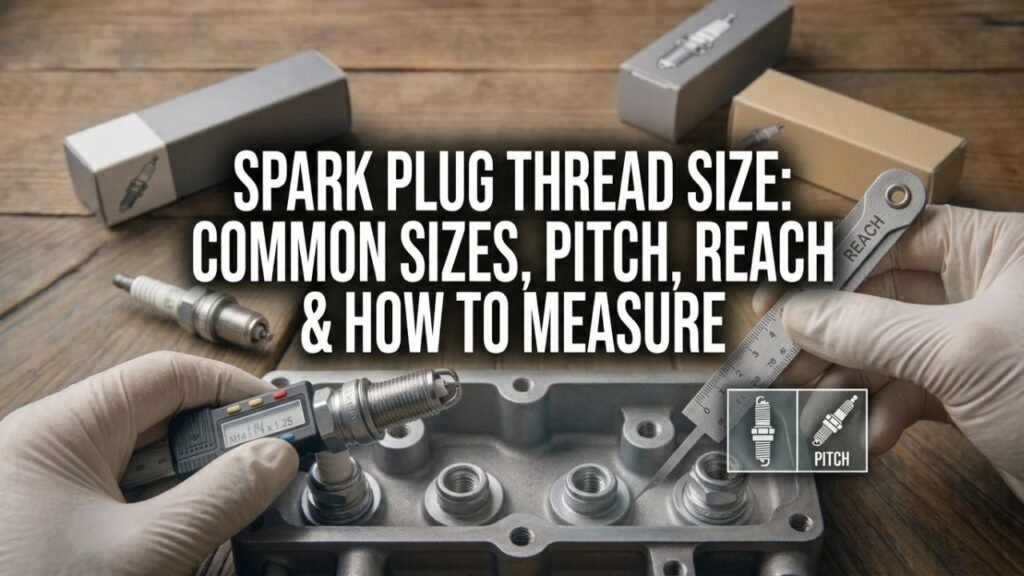
The thread size describes the external threads machined into the steel shell of the spark plug.
These threads engage with matching female threads in the cylinder head and hold the plug securely against its sealing surface.
A metric spark plug thread specification normally contains two measurements.
For example:
M14 × 1.25
The M14 identifies a metric thread with a nominal outside diameter of 14 millimeters.
The 1.25 identifies the thread pitch, meaning adjacent threads are spaced 1.25 millimeters apart.
The complete thread designation is therefore not simply “14 mm.”
A 14 mm spark plug with a different thread pitch would not correctly fit a 14 × 1.25 cylinder head even though the outside diameters appear similar.
Common Spark Plug Thread Sizes
| Thread Size | Typical Applications |
| M8 × 1.0 | Some newer compact motorcycle and specialty plugs |
| M10 × 1.0 | Many modern motorcycles and compact spark plug designs |
| M12 × 1.25 | Modern automotive and motorcycle applications |
| M14 × 1.25 | Extremely common automotive and small-engine size |
| M18 × 1.5 | Older, industrial, specialty, and some large-engine applications |
These are common examples rather than a complete list.
Some older or specialized plugs use other pitches, including M10 × 1.25, and certain legacy equipment uses imperial thread systems rather than metric threads.
That is why the safest method is always to identify the correct spark plug by engine application or exact part number.
Key Takeaways:
- Spark plug thread size includes both diameter and pitch.
- M14 × 1.25 is one of the most common automotive spark plug thread specifications.
- Matching the thread alone does not guarantee that a spark plug is safe for an engine.
What Does M14 × 1.25 Mean on a Spark Plug?
M14 × 1.25 is one of the most commonly encountered spark plug thread specifications.
Breaking the number down makes it much easier to understand.
M means the thread uses the metric system.
14 means the nominal outside thread diameter is 14 mm.
1.25 means there is 1.25 mm between corresponding points on adjacent threads.
So if you measure from the peak of one thread to the peak of the next, the distance should be approximately 1.25 mm.
Is M14 × 1.25 the Standard Spark Plug Size?
It is very common, but there is no single universal standard spark plug size.
Many older and current passenger vehicles use 14 mm spark plugs, but modern engine design has increasingly adopted smaller plugs in certain applications.
M12 and M10 plugs give engine designers more room for larger valves, direct fuel injectors, centrally located ignition, and compact combustion chambers.
Modern multi-valve and turbocharged engines therefore may use much smaller spark plugs than older engines.
What Are the Most Common Automotive Spark Plug Thread Sizes?
For passenger vehicles, you are most likely to encounter M14 × 1.25, M12 × 1.25, or M10 × 1.0, depending on the engine design and plug manufacturer.
M14 × 1.25 Spark Plugs
M14 × 1.25 has historically been one of the dominant automotive spark plug sizes.
It is used across a huge variety of engines and is also common in lawn and garden equipment.
However, an M14 plug can still have many different configurations.
One may have a short reach and gasket seat, while another uses a long reach and taper seat.
Do not assume one M14 plug can replace another.
M12 × 1.25 Spark Plugs
M12 × 1.25 plugs are common in modern automotive and motorcycle applications.
Their smaller diameter allows manufacturers to package the spark plug into compact cylinder heads where space around the valves and combustion chamber is limited.
Modern engines may use relatively long M12 plugs that extend through deep cylinder-head castings.
M10 Spark Plugs
Many modern motorcycles and compact engine designs use 10 mm spark plugs.
A common modern specification is M10 × 1.0.
However, this is an area where you should be careful about making assumptions. Some older and specialty spark plugs have used other pitches, including M10 × 1.25.
If you are dealing with lawn equipment, vintage motorcycles, or older machinery, verify the exact thread specification.
M18 Spark Plugs
M18 plugs are much larger and are less common in modern passenger vehicles.
They have been used in older engines, industrial equipment, specialty engines, and other legacy applications.
M18 × 1.5 is a common metric configuration.
Their large diameter immediately distinguishes them from the smaller plugs used in most modern cars.
Is Spark Plug Reach the Same as Thread Size?
No.
This is one of the most important spark plug measurements to understand.
Thread size describes thread diameter and pitch.
Thread reach describes how far the threaded portion extends into the cylinder head.
Two plugs can both be M14 × 1.25 yet have completely different thread reaches.
Common reaches include approximately:
- 9.5 mm
- 12.7 mm
- 19 mm
- 26.5 mm
- Other manufacturer-specific dimensions
Reach varies substantially among plug families.
Why Correct Spark Plug Reach Is Critical
If the spark plug reach is too short, the firing tip may sit too far back from the combustion chamber.
Unused cylinder-head threads can also become exposed to combustion deposits.
Later installing the correct longer plug can become difficult if those exposed threads are heavily carboned.
A plug that is too long is potentially much more dangerous.
Its threads or electrodes may protrude excessively into the combustion chamber.
Depending on engine design, this can create incorrect heat behavior, excessive deposit formation, interference with moving parts, or possible piston or valve contact.
Never choose a spark plug simply because its thread diameter and pitch match.
Key Takeaways:
- Thread size and thread reach are separate measurements.
- Two M14 × 1.25 plugs can have entirely different reaches and applications.
- Installing a plug with the wrong reach can cause serious engine problems.
What Is Spark Plug Thread Pitch?
Thread pitch is the distance from one thread to the next.
Metric thread pitch is measured in millimeters.
If a plug is marked M12 × 1.25, its threads repeat every 1.25 mm.
For many current DENSO spark plug families, 12 mm and 14 mm threads use a 1.25 mm pitch, while 10 mm and smaller threads commonly use a 1.0 mm pitch.
However, spark plug history includes plenty of exceptions.
Older Champion small-engine designs, for example, include M10 × 1.25 plugs as well as several imperial-thread designs.
This is why visually estimating thread pitch is risky.
Why Pitch Must Match Exactly
Suppose you have a hole designed for a 1.25 mm thread pitch.
Trying to install a similar-diameter plug with 1.0 mm pitch will quickly cause the threads to bind.
If you force it with a wrench, the steel spark plug can damage the softer aluminum cylinder-head threads.
What began as a wrong spark plug can then become an expensive stripped spark plug hole repair.
A correct spark plug should begin threading smoothly by hand.
If it becomes tight almost immediately, stop.
How to Measure Spark Plug Thread Size
If you have an unidentified spark plug and need to determine its dimensions, start with a digital or vernier caliper.
Measure across the outside of the threaded section.
Do not measure only the smooth shell above the threads.
A plug measuring close to 14 mm across the thread crests is likely an M14 plug. One measuring approximately 12 mm is likely M12, and so on.
Because thread crests, plating, and measurement technique can create slight differences, do not expect every measurement to display the nominal size perfectly.
Measuring Thread Pitch
The easiest tool is a metric thread pitch gauge.
Try the appropriate gauge leaves against the spark plug threads until one fits the thread valleys cleanly along several threads.
Do not judge pitch from one groove.
If you do not own a pitch gauge, you can measure across several threads with a caliper and divide the distance by the number of intervals, but this is less convenient and more prone to error.
For a spark plug replacement, looking up the exact plug number is much more reliable than manually measuring an unknown part.
How to Measure Spark Plug Reach
Reach is generally measured from the spark plug’s sealing reference point to the end of its threaded shell.
The reference point depends on seat design.
On a gasket-seat plug, measurement relates to the seating surface where the gasket contacts the cylinder head.
On a taper-seat plug, the conical seating area serves as the reference.
The electrode itself is not included simply as extra thread reach.
Because different manufacturers publish detailed dimensions for each plug, checking the specification sheet is preferable whenever possible.
Spark Plug Thread Size vs Hex Size
Thread diameter and wrench size are completely different measurements.
A spark plug may have M14 threads but use a relatively small hex.
Modern compact plugs often combine long, small-diameter shells with reduced hex sizes to fit inside narrow cylinder-head wells.
Common spark plug hex sizes include approximately:
- 13 mm
- 14 mm
- 16 mm
- 18 mm
- 20.8 or 21 mm
- Other specialty sizes
In U.S. tool terminology, common spark plug sockets include 5/8 inch and 13/16 inch, along with smaller metric sockets used on many modern vehicles.
Do not determine spark plug thread size from socket size.
A 5/8-inch socket does not mean the spark plug has a 5/8-inch thread.
Spark Plug Thread Size vs Seat Type
Spark plugs generally use either a gasket seat or taper seat.
A gasket-seat spark plug uses a crush washer between the plug shell and cylinder head.
A taper-seat plug seals through a machined conical surface and normally does not use a conventional gasket.
Two plugs can have the same M14 × 1.25 thread specification while using different seat designs.
They should not be interchanged simply because they screw into the same thread.
The cylinder head is machined for the correct sealing surface.
Using the wrong seat can cause poor sealing, incorrect plug positioning, heat-transfer problems, or combustion leakage.
Why Modern Engines Use Smaller Spark Plug Threads
Older engines frequently had relatively simple two-valve cylinder heads with substantial space around the spark plug.
Modern engines often have four valves per cylinder, direct fuel injectors, complex coolant passages, and tightly packaged combustion chambers.
A smaller spark plug allows engineers to fit these components around the cylinder while still placing the spark near the ideal ignition point.
This is one reason M12 and M10 plugs have become more common.
Smaller Does Not Mean Weaker
A smaller spark plug thread can safely retain the plug when the cylinder head and plug are engineered correctly.
The fastening system is designed around the required combustion pressure and installation torque.
Problems usually occur because of cross-threading, contamination, excessive torque, or incorrect parts—not simply because the plug diameter is small.
What Spark Plug Thread Size Do Motorcycles Use?
Motorcycles use a wide range of spark plug sizes.
Modern motorcycle engines frequently use:
M10 × 1.0, M12 × 1.25, and M14 × 1.25 plugs.
Some newer compact designs even use 8 mm threads.
The smaller plug sizes are particularly useful in high-revving multi-valve motorcycle cylinder heads where combustion-chamber space is limited.
Older motorcycles may use larger or less common specifications.
Always identify the plug from the exact motorcycle model and engine.
What Spark Plug Thread Size Do Lawn Mowers Use?
There is no single lawn mower spark plug thread size.
M14 × 1.25 is extremely common among small gasoline engines, but other metric and imperial designs exist.
Older small engines may use unusual reaches, larger threads, or thread pitches that differ from common automotive standards.
Champion’s small-engine catalogs include examples ranging from M10 and M12 to M14 and M18, as well as older imperial thread sizes.
This is why matching a mower plug by appearance at a hardware store can be risky.
Use the engine manufacturer, engine model number, and original plug cross-reference.
What Spark Plug Thread Size Do Cars Use?
Passenger cars historically used many M14 × 1.25 plugs.
Modern cars increasingly use M12 and M10 spark plug designs, although M14 remains widespread.
Engine design rather than vehicle size determines the thread.
A large V8 may use a relatively small plug, while an older four-cylinder engine may use M14 plugs.
Do not assume all cars from one manufacturer share the same thread size either.
Different engine families within the same model line can use completely different plugs.
Are All 14 mm Spark Plugs Interchangeable?
Absolutely not.
Even if two plugs are both M14 × 1.25, they may differ in:
thread reach, seat type, hex size, heat range, resistor design, electrode projection, electrode material, gap, and firing-end construction.
For example, one M14 plug may be a short-reach gasket-seat plug for a small engine.
Another may be a long-reach taper-seat iridium plug for a modern automobile.
Both can technically share the same nominal thread diameter and pitch while being completely unsuitable replacements for each other.
Think of thread size as only one line on a long spark plug specification sheet.
Can You Use an Adapter for a Different Spark Plug Thread Size?
Spark plug adapters exist for certain specialized applications, but I would not use one simply to make the wrong spark plug fit a normal automotive engine.
An adapter changes the position of the plug and can influence heat transfer, electrode location, and combustion behavior.
If the cylinder head is undamaged, use the correct plug.
If the reason you are considering an adapter is stripped cylinder-head threads, use a proper spark plug thread-repair insert designed to restore the original spark plug size.
A repair insert is intended to recreate the factory thread and plug position rather than adapting the engine to a random replacement plug.
What Thread Size Is Used to Repair a Stripped Spark Plug Hole?
The replacement insert must restore the original internal spark plug thread size.
For example, if an engine uses an M14 × 1.25 spark plug, the finished inside of the repair insert must also be M14 × 1.25.
The outside of the insert is intentionally larger because it needs to engage newly cut material in the damaged cylinder head.
Do not confuse the insert’s external repair thread with the spark plug’s original thread.
This is another reason to buy a spark-plug-specific repair kit rather than an arbitrary threaded insert.
Can You Re-Tap a Spark Plug Hole to a Bigger Size?
Technically, cylinder heads can be machined in many ways, but simply tapping a stripped spark plug hole for a larger plug is not a proper general repair strategy.
A larger spark plug can have a different reach, heat range, electrode position, and sealing geometry.
There may also be insufficient metal around the plug hole to safely increase its diameter.
A proper insert restores the original thread specification while preserving the correct spark plug.
If the head has been severely damaged or a previous insert has failed, have a machine shop evaluate it.
How Important Is Spark Plug Thread Torque?
Very important.
Thread diameter influences how much installation torque a plug can tolerate, but thread size alone does not determine the correct torque.
Seat type, plug construction, cylinder-head material, gasket design, and manufacturer specifications all matter.
For example, manufacturers publish different tightening values for M14 gasket-seat and M14 taper-seat spark plugs.
They may also specify lower torque for aluminum cylinder heads than for cast iron.
This means you should not see “M14” and automatically apply one memorized torque value.
Use the torque specification for the exact plug and engine.
Why Overtightening Is Dangerous
Excessive torque can stretch the spark plug shell or damage the cylinder-head threads.
Aluminum heads are especially vulnerable because the aluminum threads are softer than the steel spark plug.
Overtightening can eventually leave you with a stripped plug hole.
Why Undertightening Is Also a Problem
A loose spark plug may not transfer heat correctly into the cylinder head.
Combustion gases can leak around the seat, and vibration can allow the plug to loosen further.
In severe cases, combustion pressure can blow a loose plug out of the cylinder head and destroy the remaining threads.
Key Takeaways:
- Thread diameter affects installation characteristics but does not determine torque by itself.
- Seat style and cylinder-head material must also be considered.
- Start spark plugs by hand and use the exact torque specified for the application.
How to Avoid Cross-Threading a Spark Plug
A spark plug should begin turning easily by hand.
Clean dirt from around the plug hole before removing the old plug so debris does not enter or contaminate the threads.
When installing the new plug, place it squarely into the hole and turn it several rotations by hand before attaching a ratchet.
Many technicians use a short piece of rubber hose or a spark plug socket attached only to an extension for this stage.
The idea is to prevent yourself from applying enough leverage to force a cross-threaded plug.
If the plug does not turn freely, back it out.
Never use the wrench to “make it start.”
Should You Put Anti-Seize on Spark Plug Threads?
Do not automatically apply anti-seize.
Many modern spark plugs use plated shells and are intended to be installed dry.
Lubricating the thread reduces friction, which can cause substantially greater clamping force at the same torque-wrench reading.
That can lead to overtightening and thread damage.
Follow the spark plug or vehicle manufacturer’s installation instructions.
If anti-seize is specifically required for an unusual application, follow the adjusted torque procedure provided for that application.
How to Find Your Exact Spark Plug Thread Size
The easiest and safest method is not measuring the cylinder head.
Look up the correct spark plug using the vehicle or engine identification information.
For a car, you normally need the year, make, model, engine size, and sometimes engine code.
For a motorcycle, use the exact model and production year.
For a lawn mower or generator, the engine model number is often more useful than the equipment model itself because manufacturers may install different engines in otherwise similar machines.
Once you identify the correct spark plug part number, the manufacturer’s specification will provide its thread diameter, reach, seat, and other dimensions.
This is much more reliable than removing an unknown plug and assuming it was correct.
Common Spark Plug Thread Size Mistakes
One common mistake is calling a plug simply “14 mm” and assuming that provides enough information to replace it.
It does not.
Another is confusing reach with diameter. A specification such as “14 mm × 19 mm” may refer to a 14 mm thread diameter with approximately 19 mm reach, not a 19 mm thread pitch.
People also confuse socket size with thread size.
A 16 mm hex does not mean the plug has M16 threads.
Finally, never force a plug because the diameter looks right. If the pitch differs, only a few turns can seriously damage an aluminum cylinder head.
FAQs about Spark Plug Thread Size
What is the most common spark plug thread size?
M14 × 1.25 is one of the most common traditional automotive spark plug thread sizes.
Modern engines also frequently use M12 × 1.25 and M10-size plugs.
What does M14 × 1.25 mean?
M14 means the spark plug has a nominal 14 mm metric thread diameter.
The 1.25 means each thread is spaced 1.25 mm from the next.
What is the thread pitch of a 14 mm spark plug?
Many common 14 mm automotive spark plugs use a 1.25 mm pitch, making them M14 × 1.25.
Always verify the actual plug because specialized exceptions can exist.
What is the thread pitch of a 12 mm spark plug?
M12 automotive spark plugs commonly use a 1.25 mm thread pitch.
What is the thread pitch of a 10 mm spark plug?
Many current spark plug designs use M10 × 1.0 threads.
However, some older or specialty plugs use M10 × 1.25, so check the exact specification.
What is an M18 spark plug thread?
A common M18 spark plug specification is M18 × 1.5.
M18 plugs are more common in older, industrial, and specialty engine applications than in modern passenger cars.
Are all spark plugs M14 × 1.25?
No.
Spark plugs are available in numerous diameters and pitches, including M8, M10, M12, M14, M18, and various specialty or legacy sizes.
Is spark plug reach part of thread size?
Technically, thread diameter and pitch identify the basic thread.
Reach is a separate measurement that describes the length of the threaded portion entering the cylinder head.
You need all of these measurements for correct fitment.
Can two spark plugs have the same thread but different reach?
Yes.
This is extremely common.
Never assume two plugs are interchangeable solely because they share M14 × 1.25 or another thread specification.
How do I measure spark plug thread diameter?
Measure across the outer crests of the threaded shell with a caliper.
A reading close to 14 mm indicates an M14 thread, for example.
How do I measure thread pitch?
Use a metric thread pitch gauge and match its teeth against several threads on the spark plug.
The gauge should fit cleanly without visible gaps.
Is spark plug socket size the same as thread size?
No.
Socket size refers to the hex on the outside of the spark plug.
Thread size refers to the diameter and pitch of the section that screws into the cylinder head.
What thread size do lawn mower spark plugs use?
Many use M14 × 1.25, but lawn and garden engines also use other metric and imperial spark plug threads.
Check the engine model before ordering a plug.
What thread size do motorcycles use?
Modern motorcycles commonly use M10, M12, or M14 spark plugs.
Compact high-performance engines increasingly use smaller thread diameters.
Can I install an M12 plug in an M14 hole?
No, not directly.
The thread diameters are different, and the engine is designed for a specific spark plug geometry.
Use the specified spark plug.
Can I use a bigger spark plug after stripping the threads?
I do not recommend it.
Use a dedicated thread insert to restore the cylinder head to its original spark plug thread size.
Conclusion
Understanding spark plug thread size is important whenever you are identifying a replacement plug, checking compatibility, or repairing damaged cylinder-head threads.
The specification usually combines thread diameter and pitch. For example, M14 × 1.25 means a 14 mm nominal thread diameter with 1.25 mm between adjacent threads.
M14 × 1.25 remains one of the most familiar automotive sizes, while M12 × 1.25 and M10-size spark plugs are increasingly common in compact modern cylinder heads. Larger M18 plugs and several specialty metric or imperial thread designs remain in use in older and specialized engines.
However, thread size is only one part of spark plug fitment.
A replacement also needs the correct thread reach, seat type, heat range, electrode projection, resistor design, gap, and overall construction. Two plugs can have identical threads and still be completely incompatible.
If you need to identify an unknown spark plug, measure its outside thread diameter with a caliper and determine pitch using a thread gauge. Measure reach separately and identify whether the plug uses a gasket or taper seat.
For an actual engine repair, my recommendation is even simpler: look up the exact vehicle or engine application and use the specified spark plug part number instead of selecting by thread size alone.
Correct thread size allows the plug to screw into the cylinder head. Correct overall spark plug design ensures that it actually belongs there.