
Spark plug torque varies by engine, plug thread diameter, seat design, cylinder-head material, and spark plug manufacturer. Many passenger-car plugs fall somewhere between about 7 and 30 lb-ft, but that range is only a reference. The exact vehicle or engine specification should always take priority over a generic torque chart.
Correct torque does more than keep the plug from coming loose. The spark plug must seat firmly enough to transfer heat into the cylinder head while sealing combustion pressure around its seat.
Too little torque can leave the plug loose, reduce heat transfer, and allow combustion gases to leak past the seat. Too much torque can stretch the plug shell, damage threads, crack the insulator, or damage an aluminum cylinder head. NGK warns that both under-tightening and over-tightening can lead to plug or engine damage.
For what is the torque for spark plugs, there is no single number that fits every engine. A 10 mm gasket-seat plug in an aluminum head may require only around 7–9 lb-ft according to one NGK chart, while some 18 mm gasket-seat plugs require more than 25 lb-ft.
The seat style matters too. Flat-seat plugs use a crush gasket, while tapered-seat plugs seal directly against a conical surface. Their tightening values can differ even when thread diameter is the same.
Spark plug torque specifications also normally assume clean, dry threads unless the manufacturer states otherwise. DENSO notes that its listed torque values apply to new plugs with unlubricated threads and warns that lubricated threads alter the clamping force produced by the same torque reading.
The safest installation method is to identify the exact spark plug and engine, start the plug by hand, and finish with a calibrated torque wrench set to the manufacturer-specified value.
What Is the Torque for Spark Plugs?
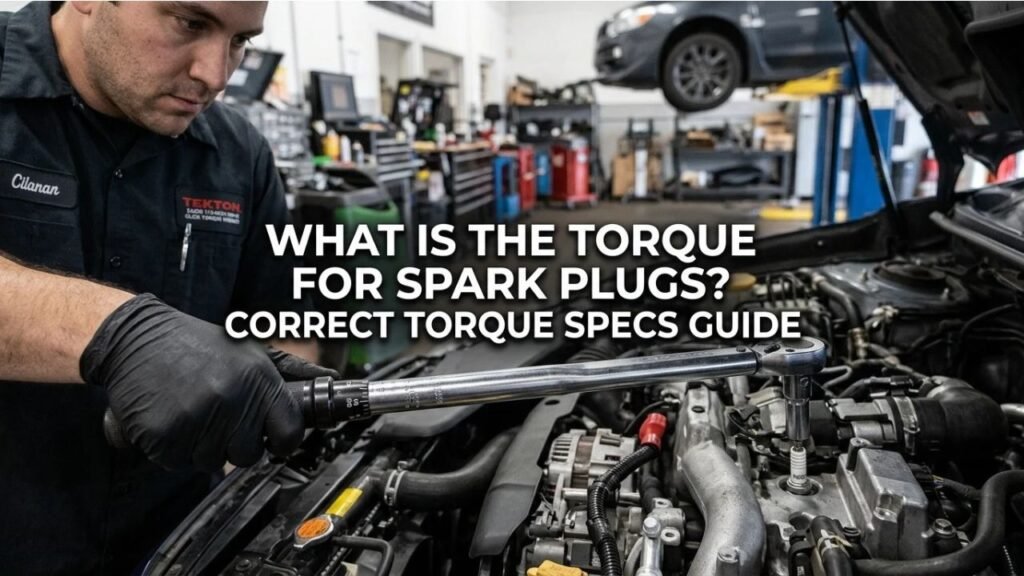
A typical spark plug torque can range from roughly 7 to more than 30 lb-ft, but the exact specification must come from the vehicle, engine, or spark plug manufacturer.
The main factors are:
- Spark plug thread diameter
- Flat or tapered seat
- Aluminum or cast-iron cylinder head
- Spark plug design
- New or previously compressed gasket
- Dry or lubricated threads
- Vehicle-specific engine specification
Common Spark Plug Torque Chart
The following table summarizes NGK’s general torque recommendations for common automotive spark plugs. Vehicle-specific specifications should take priority.
| Spark Plug Type | Thread Size | Cast-Iron Head | Aluminum Head |
| Flat seat with gasket | 18 mm | 25.3–32.5 lb-ft | 25.3–32.5 lb-ft |
| Flat seat with gasket | 14 mm | 18.0–25.3 lb-ft | 18.0–21.6 lb-ft |
| Flat seat with gasket | 12 mm | 10.8–18.0 lb-ft | 10.8–14.5 lb-ft |
| Flat seat with gasket | 10 mm | 7.2–10.8 lb-ft | 7.2–8.7 lb-ft |
| Flat seat with gasket | 8 mm | Not listed | 5.8–7.2 lb-ft |
| Tapered seat | 18 mm | 14.5–21.6 lb-ft | 14.5–21.6 lb-ft |
| Tapered seat | 14 mm | 10.8–18.0 lb-ft | 7.2–14.5 lb-ft |
DENSO publishes a similar general chart but some values differ. For example, DENSO lists a 14 mm flat-seat plug at 26–30 lb-ft in a cast-iron head and 15–22 lb-ft in an aluminum head.
That difference is exactly why a generic table should not override the specification for the exact plug and engine.
Torque in Newton-Meters
Spark plug torque may also be listed in Newton-meters rather than pound-feet.
Some common DENSO reference ranges include:
| Plug Type | Typical DENSO Reference |
| 10 mm flat seat | 10–15 N·m |
| 12 mm flat seat | 15–25 N·m |
| 14 mm flat seat, aluminum head | 20–30 N·m |
| 14 mm tapered seat | 9–20 N·m |
| 18 mm flat seat, aluminum head | 38–46 N·m |
| 18 mm tapered seat | 20–27 N·m |
Use the units printed in the service manual or torque specification so conversion errors do not create an installation problem.
Key Takeaway: Spark plug torque is not universal. Thread diameter, seat design, head material, and engine-specific specifications determine the correct setting.
Why Spark Plug Torque Matters
The spark plug has to perform several jobs at once.
It must seal combustion pressure, conduct heat into the cylinder head, stay securely mounted, and remain removable during future service.
Proper Torque Controls Heat Transfer
A spark plug transfers much of its heat through the metal shell and seat into the cylinder head.
NGK states that an under-torqued plug may not seat fully, reducing heat dissipation and allowing the firing end to become hotter than intended.
Correct seating keeps the plug’s heat path working as designed.
Proper Torque Seals the Combustion Chamber
The gasket or tapered seat forms a seal between the spark plug and cylinder head.
If the plug is too loose, combustion gases may leak around the seat.
Possible signs include:
- Soot around the plug
- Puffing or ticking noise
- Loose plug
- Damaged threads
- Overheated plug
- Misfire
Correct Torque Protects the Cylinder-Head Threads
Many modern engines use aluminum cylinder heads.
Aluminum threads can be damaged by excessive tightening force.
A stripped spark plug hole can turn a routine plug replacement into a thread-repair job or cylinder-head repair.
Correct Torque Protects the Spark Plug
NGK warns that excessive torque can stretch the metal shell, damage internal seals, fracture the insulator, or contribute to abnormal plug temperature.
The plug may look intact from outside while internal damage has already occurred.
Key Takeaway: Correct torque supports proper heat transfer and sealing while protecting both the spark plug and cylinder-head threads.
What Torque for Spark Plugs With an Aluminum Head?
Aluminum cylinder heads often use lower torque than cast-iron heads for the same spark plug size.
For example, NGK lists a 14 mm flat-seat plug at:
- 18.0–25.3 lb-ft in cast iron
- 18.0–21.6 lb-ft in aluminum
A 10 mm flat-seat plug is listed at:
- 7.2–10.8 lb-ft in cast iron
- 7.2–8.7 lb-ft in aluminum
The exact engine specification still comes first.
Why Aluminum Needs Care
Aluminum is softer than cast iron.
Overtightening may damage threads more easily, mainly if the plug is installed hot, cross-threaded, or lubricated when the torque specification assumes dry threads.
Work on a Cool Engine
NGK recommends removing and installing spark plugs with the engine cool because heat changes metal dimensions and can raise the risk of thread damage.
Allowing the engine to cool also makes coil and boot removal safer.
Key Takeaway: Aluminum cylinder heads often use lower tightening values, and plug installation should be performed on a cool engine using the exact engine specification.
Flat-Seat vs Tapered-Seat Spark Plug Torque
Seat design changes the way the plug seals against the cylinder head.
Flat-Seat Spark Plugs
A flat-seat plug normally uses a crush gasket.
The gasket compresses as the plug is tightened.
This creates the seal between the plug and cylinder head.
A new gasket usually requires more rotation after initial contact than a previously compressed gasket.
Tapered-Seat Spark Plugs
A tapered-seat plug does not use the same flat crush washer.
The conical plug seat contacts a matching surface in the cylinder head.
These plugs usually need less rotation after the seat touches the head.
NGK and DENSO both publish lower rotation recommendations for tapered-seat plugs when a torque wrench is unavailable.
Do Not Swap Seat Types
A flat-seat plug cannot simply replace a tapered-seat plug because the thread diameter looks the same.
Seat shape is part of the plug’s fit.
The correct plug must match the cylinder head design.
Key Takeaway: Flat-seat plugs use a gasket while tapered-seat plugs seal directly against a conical surface, so their torque and tightening-angle requirements differ.
How to Torque Spark Plugs Correctly
A torque wrench is the most controlled way to tighten spark plugs.
DENSO recommends using one whenever possible.
Step 1: Confirm the Correct Spark Plug
Verify:
- Part number
- Thread diameter
- Thread reach
- Seat type
- Heat range
- Required gap
NGK notes that thread size, reach, projection, and seat style are all key fit specifications.
Do not install a plug solely because the threads seem to fit.
Step 2: Let the Engine Cool
Do not remove plugs immediately after hard driving.
A cool cylinder head reduces the chance of thread damage and gives a more predictable installation condition.
Step 3: Clean Around the Plug Hole
Remove loose dirt before taking the old plug out.
This keeps debris from falling into the cylinder.
Once the old plug is removed, make sure the sealing surface and threads are free of obvious debris.
Step 4: Start the New Plug by Hand
Thread the plug in by hand first.
It should turn smoothly for several rotations.
NGK and DENSO both instruct users to finger-tighten the plug until its gasket or seat contacts the cylinder head before applying final tightening force.
If the plug becomes tight after only a turn or two, stop.
It may be cross-threaded.
Step 5: Set the Torque Wrench
Find the exact specification for the engine.
Set the torque wrench to the stated value and confirm its measurement unit.
Do not confuse:
- lb-ft
- lb-in
- N·m
A specification of 120 lb-in is only 10 lb-ft.
Mixing those units can badly overtighten a plug.
Step 6: Tighten Smoothly
Keep the socket aligned with the plug.
Apply smooth force until the torque wrench reaches its setting.
Avoid jerking the wrench or pulling sideways.
Step 7: Reinstall the Ignition Components
Reinstall the spark plug boot or coil.
Make sure the boot is fully seated on the plug terminal.
Reconnect any electrical connectors and reinstall coil bolts to their separate specifications.
Key Takeaway: Start the plug by hand, keep the threads dry unless instructed otherwise, and use a torque wrench set to the engine’s exact specification.
How Tight Should Spark Plugs Be Without a Torque Wrench?
A torque wrench is preferred, but spark plug manufacturers provide tightening-angle instructions for some applications.
The correct angle changes with plug type and gasket condition.
Flat-Seat Plug With a New Gasket
DENSO’s general installation guidance says a new flat-seat plug may be tightened approximately 1/4 to 1/2 turn after finger-tight seating when a torque wrench is unavailable.
NGK publishes different rotation values according to plug thread diameter and gasket condition.
Follow the instructions supplied for the exact spark plug.
Tapered-Seat Plug
Tapered-seat plugs require much less additional rotation.
DENSO generally specifies about 1/16 turn after hand seating for its taper-seat installation method without a torque wrench.
Reused Spark Plugs Need Different Treatment
A gasket that has already been compressed does not behave like a new gasket.
NGK provides a smaller tightening angle for reused gasket-seat plugs.
This is another reason a torque wrench is preferable when reinstalling plugs.
Key Takeaway: Manufacturer tightening-angle instructions can be used when no torque wrench is available, but new gasket, reused gasket, and tapered-seat plugs require different amounts of rotation.
Should Spark Plug Threads Be Lubricated Before Torquing?
Usually not unless the spark plug or engine manufacturer specifically says to lubricate them.
Torque specifications are based on a certain amount of friction between the threads.
Lubricant changes that friction.
Lubrication Changes Clamping Force
With less friction, the same torque-wrench reading can produce more thread tension.
DENSO states that its torque chart applies to new spark plugs with unlubricated threads and says torque should be reduced by roughly one-third if the threads are lubricated.
Bosch also states that its listed tightening torques apply to dry, non-greased, non-oiled threads.
Anti-Seize Is Often Unnecessary
NGK states that anti-seize is not recommended on its spark plugs and notes that added lubricant changes torque behavior.
Many modern spark plugs already have thread coatings intended to reduce corrosion and seizure.
Follow the plug maker’s instructions rather than automatically applying anti-seize.
Key Takeaway: Most published spark plug torque values assume dry threads. Adding anti-seize or another lubricant can increase clamping force and lead to overtightening.
What Happens if Spark Plugs Are Too Tight?
Overtorquing can damage both the plug and engine.
Thread Damage
Excessive torque can strip threads in the cylinder head.
Aluminum heads are at greater risk.
Spark Plug Shell Damage
NGK states that excessive torque can stretch or distort the metal shell and damage internal seals.
Cracked Insulator
Side loading or excessive tightening can damage the ceramic insulator.
A cracked insulator can lead to misfire.
Difficult Future Removal
A badly overtightened plug may be difficult to remove later.
Excessive force during removal raises the chance of thread or spark plug breakage.
Key Takeaway: Overtightening can strip cylinder-head threads, damage the plug shell or insulator, and make future removal much harder.
What Happens if Spark Plugs Are Too Loose?
Under-tightening creates its own problems.
Poor Heat Transfer
The plug relies on solid contact with the cylinder head to shed heat.
NGK states that insufficient tightening slows heat dissipation and may allow the firing end to overheat.
Combustion Gas Leakage
A loose seat may allow gases to escape around the plug.
You might notice:
- Ticking or puffing sound
- Soot around the plug
- Burn marks
- Hot-gas damage
Plug Can Work Loose
Repeated heat cycles and engine vibration can make an under-tightened plug loosen further.
In severe cases, the plug can damage the cylinder-head threads or be forced out.
Key Takeaway: Too little torque can reduce heat transfer, weaken the combustion seal, and allow the plug to work loose.
How to Find the Exact Spark Plug Torque for Your Vehicle
Generic charts are useful for reference, but the exact engine specification is better.
Check the Factory Service Information
Search by:
- Model year
- Make
- Model
- Engine size
Different engines in the same vehicle can use different plugs and torque values.
Check the Spark Plug Manufacturer
NGK, DENSO, Bosch, and other manufacturers publish installation information for their products.
DENSO’s current U.S. catalog directs users to vehicle-specific part lookup information for current applications.
Use the Exact Plug Part Number
Do not base torque only on socket size.
Two plugs that use the same wrench size can have different:
- Thread diameter
- Thread reach
- Seat type
- Gasket design
The part number is a much stronger reference.
Give Priority to Vehicle-Specific Specifications
If a generic spark plug chart says 18–22 lb-ft but the factory service information for your exact engine says 15 lb-ft, use the engine specification.
Generic charts cannot account for every cylinder-head design.
Key Takeaway: Use the factory service manual or exact spark plug application information whenever possible; generic charts are secondary references.
Conclusion
For what is the torque for spark plugs, there is no single correct number. Common automotive spark plugs can require anywhere from roughly 7 lb-ft to more than 30 lb-ft depending on thread diameter, seat type, head material, and engine design.
A 14 mm gasket-seat plug in an aluminum head, for example, is listed by NGK at about 18.0–21.6 lb-ft, while smaller 10 mm plugs can require less than 10 lb-ft. Other manufacturers publish somewhat different ranges, reinforcing the need to check the exact application.
Install plugs in a cool engine, start each plug by hand, keep the threads dry unless the manufacturer says otherwise, and finish with a calibrated torque wrench.
Correct tightening protects the cylinder-head threads, creates a proper combustion seal, and lets the spark plug transfer heat into the head as intended.
FAQs About Spark Plug Torque
What Torque for Spark Plugs Is Most Common?
Many passenger-car plugs fall between roughly 10 and 25 lb-ft, but that is not a specification for every engine.
Small 8 mm or 10 mm plugs may require less, while larger plugs can require more than 25 lb-ft. Check the exact engine specification before tightening.
Is 20 lb-ft Too Tight for Spark Plugs?
Not necessarily.
Twenty lb-ft can be correct for some 14 mm gasket-seat plugs, but it can be far too tight for smaller 8 mm or 10 mm plugs.
Thread size and cylinder-head material must be checked first.
What Is the Torque for 14 mm Spark Plugs?
NGK’s general chart lists 14 mm flat-seat plugs at 18.0–25.3 lb-ft in cast iron and 18.0–21.6 lb-ft in aluminum.
For 14 mm tapered-seat plugs, its general ranges are lower. Vehicle-specific specifications take priority.
What Is the Torque for 12 mm Spark Plugs?
NGK lists 12 mm flat-seat plugs at approximately 10.8–18.0 lb-ft for cast-iron heads and 10.8–14.5 lb-ft for aluminum heads.
DENSO publishes 11–18 lb-ft as a general reference for its 12 mm flat-seat plugs.
Do Spark Plugs Need a Torque Wrench?
A torque wrench is the preferred method.
DENSO recommends using one whenever possible because it provides a measurable tightening force instead of relying on feel.
Should Spark Plugs Be Torqued Hot or Cold?
Install spark plugs with the engine cool unless the vehicle manufacturer states otherwise.
NGK advises cool-engine installation because metal expands when hot and thread damage can occur during removal or installation.
Does Anti-Seize Change Spark Plug Torque?
Yes.
Lubricating the threads reduces friction, which means the same torque reading can create greater clamping force. DENSO notes that lubricated threads require a lower torque than its dry-thread chart, while NGK advises against anti-seize on its plugs.
Can You Hand-Tighten Spark Plugs Without a Torque Wrench?
Spark plug manufacturers publish turn-angle methods for situations where a torque wrench is unavailable.
The amount of additional rotation changes with gasket type, thread diameter, and whether the plug is new or reused. A torque wrench remains the more controlled method.