
Oil around a spark plug is not normal, but the source matters. Oil pooled around the top of the plug usually comes from a leaking valve-cover gasket or spark-plug tube seal. Oil coating the firing tip inside the combustion chamber can point to piston-ring, valve-seal, PCV, or other internal engine problems.
The first thing to determine is exactly where the oil is located. Oil inside the spark plug well and oil on the electrode may look like the same problem when the plug is removed, yet they often require completely different repairs.
If you are asking why there is oil on my spark plug, inspect the plug before wiping it clean. Check the ceramic body, threads, electrode, ignition-coil boot, and bottom of the plug well. Those details can reveal if the oil came from above the cylinder head or entered the combustion chamber.
Oil leaking into spark plugs can eventually cause ignition problems. Oil can soak the coil boot, damage rubber components, create an electrical path for the spark, and lead to misfires. Internal oil burning can foul the firing tip and produce blue exhaust smoke or increased oil consumption.
One oily spark plug can point toward a problem isolated to one cylinder or plug tube. Oil affecting every plug may suggest a valve-cover sealing problem, PCV issue, widespread engine wear, or another condition affecting the entire engine.
The sections below explain what oil on spark plugs means, the most common causes, how to identify where it came from, and how to repair the problem without replacing unnecessary parts.
Are Spark Plugs Supposed to Have Oil on Them?
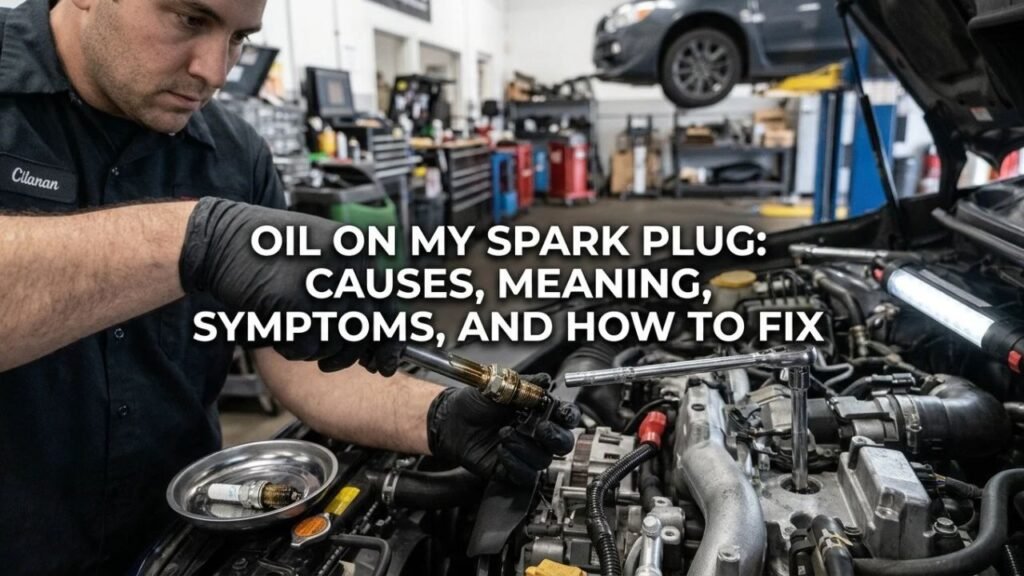
No. Spark plugs should not normally be covered in liquid engine oil.
A small amount of dry discoloration or combustion residue on the firing end is normal after use. Wet engine oil is different.
Oil Around the Top of the Spark Plug
If oil is sitting around the ceramic body or ignition coil, the oil is usually outside the combustion chamber.
Common causes include:
- Leaking spark plug tube seal
- Valve-cover gasket leak
- Cracked valve cover
- Oil spilled during filling
This type of leak is often much easier to repair than internal engine oil burning.
Oil on the Spark Plug Electrode
Oil directly on the firing tip usually means oil is entering the combustion chamber.
Possible causes include:
- Worn piston rings
- Worn valve-stem seals
- Worn valve guides
- PCV-system problems
- Cylinder wear
- Turbocharger oil leakage on applicable engines
This condition deserves more engine testing.
Oil on the Threads
Oil on spark plug threads can be misleading.
If the plug well contains oil, the threads may become coated as you unscrew the plug. That does not automatically mean oil was burning inside the cylinder.
Look closely at the electrode and insulator nose before deciding the engine has an internal problem.
Key Takeaway: Spark plugs are not supposed to be wet with engine oil. Oil around the plug body usually comes from an external seal leak, while oil on the firing tip points more strongly toward oil entering the cylinder.
What Does Oil on Spark Plugs Mean?
The what does oil on spark plugs mean question has two main answers: an external leak into the plug well or internal oil entering the combustion chamber.
External Spark Plug Well Leak
Many modern engines place the spark plugs deep inside tubes running through the valve cover or cylinder head.
Seals around those tubes keep engine oil from entering the plug wells.
When a seal hardens, shrinks, tears, or separates, oil can collect around:
- Ignition coil
- Coil boot
- Spark plug ceramic
- Plug threads
The engine may still run normally when the leak first develops.
Internal Oil Fouling
Oil on the lower firing end is more concerning.
The oil has reached the combustion chamber and coated the spark plug during engine operation.
You may also notice:
- Blue exhaust smoke
- Falling engine-oil level
- Misfire
- Rough idle
- Oily tailpipe residue
- Increased oil consumption
Oil After Removing the Spark Plug
If a plug was sitting in an oil-filled well, oil can run down the threads during removal.
The plug may come out looking completely soaked.
That can make an external valve-cover leak look like internal engine damage.
Inspect the well before removing the remaining plugs.
Key Takeaway: Oil location matters more than the fact that the plug looks oily. Oil above the threads commonly indicates a plug-well leak, while oil concentrated on the electrode and insulator nose points toward combustion-chamber oil entry.
What Causes Oil on a Spark Plug?
Several faults can put oil on or around a spark plug.
Some are inexpensive gasket repairs. Others may involve engine wear.
Leaking Spark Plug Tube Seals
Spark plug tube seals are one of the most common causes of oil collecting inside deep plug wells.
The seals are often part of the valve-cover gasket set.
Age and heat can make them:
- Brittle
- Flattened
- Cracked
- Unable to seal tightly
Oil then leaks from the valve-train area into the spark plug tubes.
Leaking Valve-Cover Gasket
A valve-cover gasket seals the upper part of the engine.
On some engines, the plug-tube seals are integrated into the valve cover or gasket assembly.
A failing gasket can allow oil to enter the plug area.
Other signs may include:
- Oil around the valve-cover edge
- Burning-oil smell
- Oil running down the engine
- Smoke from oil touching hot exhaust parts
Cracked or Warped Valve Cover
Plastic valve covers can warp or crack after years of heat cycles.
Replacing only the gasket may not fix the leak if the cover itself no longer seals properly.
Inspect the cover carefully during gasket replacement.
Oil Spilled During an Oil Change
Not every oily plug well indicates a failed engine seal.
Oil spilled around the filler opening can run into nearby plug wells on certain engines.
If the oil appeared immediately after adding engine oil, clean the area thoroughly and monitor it before assuming a gasket has failed.
Worn Piston Rings
Piston rings help control engine oil on the cylinder walls.
Worn or stuck oil-control rings can allow oil into the combustion chamber.
Possible signs include:
- Oily spark plug tip
- Blue exhaust smoke
- High oil consumption
- Low compression in some cases
- Excessive crankcase pressure
A compression test alone may not identify every oil-control-ring problem, so further testing can sometimes be necessary.
Worn Valve-Stem Seals
Valve-stem seals control how much oil reaches the valve stems.
When they wear, oil can move down the valve guide and enter the combustion chamber.
A common clue is blue smoke:
- After startup
- After long idling
- After deceleration
- When accelerating after coasting
One or several cylinders can be affected.
Worn Valve Guides
Excessive clearance between a valve stem and its guide can allow more oil past the valve seal.
Replacing seals alone may not provide a lasting repair if guide wear is excessive.
PCV-System Problems
The positive crankcase ventilation system controls crankcase vapors.
A malfunctioning PCV valve or blocked ventilation passage can contribute to:
- Excess crankcase pressure
- Oil being pulled into the intake
- Oil leaks
- Increased oil consumption
Inspect the complete PCV system rather than replacing the valve automatically.
Turbocharger Oil Leakage
Turbocharged engines route intake air through a turbocharger containing oil-lubricated bearings.
A failing turbo oil seal or bearing system can allow oil into the intake or exhaust side.
Possible signs include:
- Blue smoke
- Oil inside charge pipes
- Rapid oil consumption
- Reduced boost
- Oily spark plugs in severe cases
A light oil film in some intake systems does not automatically prove turbo failure.
Key Takeaway: What causes oil on a spark plug ranges from simple tube-seal and valve-cover leaks to worn rings, valve seals, PCV faults, or turbocharger problems.
Why Is There Oil in My Spark Plugs?
People often say there is oil “in the spark plugs” when they mean oil is filling the spark plug wells.
That distinction points strongly toward the top of the engine.
Failed Spark Plug Tube Seal
If oil pools around the ignition coil and the upper half of the plug, a failed tube seal is a primary suspect.
A flashlight can usually reveal the oil before the plug is removed.
Valve-Cover Gasket Failure
Some engines use a single molded valve-cover gasket that incorporates tube seals.
In that design, the repair may involve replacing the complete gasket assembly.
Other engines require a complete valve cover because the tube seals are permanently installed.
Excessive Crankcase Pressure
High crankcase pressure can push oil past seals that would otherwise remain dry.
Possible causes include:
- Blocked PCV passages
- Failed PCV valve
- Excessive engine blow-by
If new seals begin leaking again quickly, crankcase pressure deserves attention.
Cracked Valve Cover
A crack near a plug tube can imitate a failed seal.
Plastic covers should be checked for deformation around bolt holes and plug openings.
Key Takeaway: Oil sitting inside spark plug wells usually comes from the valve cover, plug-tube seals, or excessive crankcase pressure rather than directly from the combustion chamber.
Oil Leaking Into Spark Plugs: What Symptoms Can It Cause?
A small external leak may cause no drivability problem at first.
Symptoms often appear after enough oil accumulates around the coil or plug.
Engine Misfire
Oil can contaminate the coil boot and plug connection.
The ignition voltage may begin escaping through the contaminated area rather than crossing the spark plug gap.
You may experience:
- Engine shaking
- Hesitation
- Rough acceleration
- Flashing check engine light
- P0300
- Cylinder-specific P0301-P0308 codes
Rough Idle
A cylinder with weak ignition may fire inconsistently at idle.
The engine may shake more when stopped than while cruising.
Hard Starting
Several oil-contaminated plugs or coil boots can reduce ignition quality during cranking.
The engine may take longer to start.
Burning Oil Smell
An external valve-cover leak can allow oil to reach hot engine or exhaust components.
That may produce a noticeable burning smell.
Check Engine Light
An ignition misfire caused by oil contamination may trigger the check engine light.
A flashing light deserves faster attention because prolonged misfire can overheat the catalytic converter.
Damaged Coil Boots
Prolonged exposure to hot oil can cause rubber boots to:
- Swell
- Soften
- Crack
- Lose insulation quality
A repaired gasket leak may still be followed by misfires if contaminated boots are not inspected.
Key Takeaway: Oil in a plug well can eventually cause coil-boot damage, ignition leakage, rough idle, hard starting, misfires, and a check engine light.
What Does an Oil-Fouled Spark Plug Look Like?
An oil-fouled plug usually looks different from a dry carbon-fouled plug.
Wet and Greasy Deposits
Engine oil typically leaves a shiny, slippery coating.
The firing end may look:
- Wet
- Glossy
- Dark brown
- Black
- Thickly coated
Deposits on the Electrode
Burned oil can leave heavy deposits around:
- Center electrode
- Ground electrode
- Insulator nose
Those deposits may interfere with spark formation.
Dry Black Soot Is Different
A dry, powdery black plug commonly points toward carbon fouling from:
- Rich mixture
- Weak ignition
- Excessive idling
- Plug heat range too cold
Oil fouling normally has a wetter or heavier appearance.
Ash Deposits Can Come From Oil Consumption
Oil additives can leave light-colored, crusty ash on the firing end after oil is burned.
An engine consuming oil does not always produce a plug that remains visibly wet.
Key Takeaway: An oil-fouled spark plug is usually greasy or heavily deposited, while dry powdery black soot more strongly suggests carbon fouling or rich combustion.
Why Is Oil on Only One Spark Plug?
One oily plug can provide a useful clue.
One Plug Well Seal Is Leaking
Spark plug tube seals can fail individually.
One well may be full of oil while every other well remains dry.
One Valve Seal Is Worn
A valve-stem seal problem can affect one cylinder more than the others.
The corresponding plug may become oil fouled.
One Cylinder Has Ring Problems
Cylinder-wall damage or ring wear may be localized.
Possible supporting evidence includes:
- Lower compression
- Higher leak-down
- Oil consumption
- Blue smoke
Localized Head or Valve-Guide Problem
Damage around one valve guide or cylinder can also direct oil toward a single combustion chamber.
Key Takeaway: One oily plug often indicates a localized tube seal, valve seal, valve guide, piston-ring, or cylinder problem rather than a fault affecting the entire engine.
Why Is Oil on All My Spark Plugs?
Oil affecting all plugs suggests a broader condition.
Multiple Tube Seals Have Failed
Valve-cover gaskets and tube seals usually age under similar heat conditions.
Several can begin leaking around the same time.
Crankcase Pressure Is Too High
A restricted PCV system or heavy blow-by can push oil toward several seals.
Engine Is Burning Oil Across Multiple Cylinders
Widespread piston-ring or cylinder wear can cause several oily plugs.
This may be accompanied by:
- Heavy oil consumption
- Blue exhaust smoke
- Low compression
- Blow-by
Intake System Is Carrying Oil
A PCV or turbocharger problem can introduce oil into the intake, allowing it to reach multiple cylinders.
Does Oil on Spark Plug Threads Mean Bad Piston Rings?
Not necessarily.
Oil-covered threads are often misinterpreted.
Oil Can Come From the Plug Well
If oil surrounds the outside of the plug before removal, the threads pass through that oil as the plug is unscrewed.
The plug then appears oily from top to bottom.
Inspect the Firing End
A dry electrode combined with oily upper threads points more strongly toward an external tube-seal leak.
An oily electrode and insulator nose raise greater concern about oil burning inside the cylinder.
Test the Engine Before Assuming Ring Failure
If internal oil consumption is suspected, useful tests can include:
- Compression test
- Leak-down test
- Crankcase pressure assessment
- Borescope inspection
- Oil-consumption measurement
Replacing piston rings is major engine work and should not be recommended from plug-thread oil alone.
Key Takeaway: Oil on spark plug threads does not automatically mean worn piston rings. An oil-filled plug well can coat the threads during removal while the combustion chamber remains healthy.
How to Fix Oil in Spark Plugs
The correct repair depends on where the oil originates.
1. Check the Plug Wells Before Removing the Plugs
Remove the engine cover and ignition coils as required.
Use a flashlight to inspect each plug well.
If oil is pooled around the plug, document which cylinders are affected.
2. Remove the Oil From the Well
Extract as much oil as possible before removing the spark plug.
Possible methods include:
- Suction tool
- Absorbent shop material
- Small fluid extractor
Avoid forcing large amounts of oil and debris into the cylinder.
The engine should be cool and switched off.
3. Replace the Spark Plug Tube Seals
If the tube seals are leaking, replace them according to the engine’s service procedure.
On many engines this means removing the valve cover.
4. Replace the Valve-Cover Gasket
A new valve-cover gasket is commonly installed at the same time as tube seals.
Clean the sealing surfaces carefully.
Use sealant only where the manufacturer specifies it.
Applying excessive RTV can create leaks or allow cured material to enter the engine.
5. Inspect the Valve Cover
Check for:
- Cracks
- Warping
- Damaged sealing surfaces
- Broken bolt bosses
Replace the cover if it cannot seal correctly.
6. Clean or Replace Oil-Contaminated Ignition Parts
Inspect the ignition coil boots.
Clean reusable components with products compatible with the materials.
Replace boots or coils that are:
- Swollen
- Cracked
- Carbon tracked
- Damaged by oil
7. Inspect the Spark Plugs
A lightly contaminated plug may be serviceable depending on plug type and manufacturer guidance.
Replace plugs that are:
- Heavily oil fouled
- Worn
- Damaged
- Misfiring
- Near their scheduled replacement interval
8. Diagnose Internal Oil Fouling
If the electrode itself is repeatedly oily, inspect for internal causes.
Testing may include:
- Compression test
- Cylinder leak-down test
- PCV inspection
- Borescope inspection
- Valve-seal diagnosis
- Oil-consumption monitoring
9. Recheck After the Repair
After replacing seals and cleaning the plug wells, monitor them.
Fresh oil appearing again means the source has not been fully corrected.
Key Takeaway: How to fix oil in spark plugs starts with identifying if the oil is outside or inside the cylinder. External leaks usually need tube seals or valve-cover repairs; oily electrodes require deeper engine diagnosis.
Can You Drive With Oil in the Spark Plug Wells?
A small amount of oil may not stop the engine immediately, but delaying the repair is not a good idea.
Oil can eventually damage ignition components.
Possible consequences include:
- Misfires
- Failed coil boots
- Coil damage
- Rough running
- Catalytic converter stress from misfires
If the engine is running smoothly and only a small external leak is present, you may have time to arrange repair.
Stop or limit driving if:
- Check engine light flashes
- Engine misfires badly
- Oil is reaching hot exhaust components
- Smoke appears from the engine compartment
- Oil level is dropping rapidly
Can Oil on Spark Plugs Damage Ignition Coils?
Yes.
Ignition coils on coil-on-plug engines sit directly over the spark plug wells.
Oil can surround the boot and lower section of the coil.
Over time it may:
- Soften rubber
- Cause swelling
- Promote electrical leakage
- Create carbon tracking
- Contribute to misfires
Replacing the gasket without checking the coil boots can leave the engine with an ignition problem after the oil leak has been repaired.
Can Oil on Spark Plugs Cause a Misfire?
Yes.
Oil can cause misfire in two main ways.
External Oil Can Affect Spark Insulation
Oil inside the plug well can contaminate the coil boot and provide an unwanted electrical path.
The ignition spark may leak before reaching the electrode.
Internal Oil Can Foul the Electrode
Oil burned inside the cylinder can coat the spark plug.
Heavy deposits can interfere with the spark gap.
A misfiring cylinder may produce codes such as:
- P0300
- P0301
- P0302
- P0303
- P0304
and equivalent cylinder numbers on larger engines.
Key Takeaway: External oil can interfere with the coil-to-plug connection, while internal oil can foul the firing end; either condition can produce a misfire.
Can Oil on Spark Plugs Cause Blue Smoke?
Yes, if the oil is entering the combustion chamber.
Blue or blue-gray exhaust usually indicates engine oil is being burned.
The timing of the smoke can provide clues.
Smoke at Startup
A brief blue puff after sitting may point toward valve-stem seals on some engines.
Smoke During Acceleration
Blue smoke under load can be associated with ring, cylinder, or turbocharger problems.
Smoke After Deceleration
Oil entering through valve guides or seals may become more noticeable after extended high-vacuum deceleration.
An external spark plug well leak does not normally cause blue tailpipe smoke because that oil is outside the combustion chamber.
Can a Bad Valve-Cover Gasket Put Oil on Spark Plugs?
Yes, and it is one of the most common causes of oil around the upper portion of a plug.
The exact design matters.
Some valve-cover gaskets include separate spark plug tube seals.
Other engines integrate the seals into the cover.
Signs supporting a valve-cover leak include:
- Oil inside plug wells
- Dry spark plug electrode
- Oil around valve-cover perimeter
- Burning-oil smell
- Oil running down cylinder head
The repair is usually much less serious than worn piston rings.
Can a Bad PCV Valve Cause Oil on Spark Plugs?
Yes.
A PCV problem can contribute in more than one way.
Excess crankcase pressure can push oil past:
- Valve-cover gasket
- Tube seals
- Other engine seals
A PCV fault can also increase oil being drawn through the intake on some engines.
Check hoses and passages as well as the valve itself.
Can Oil on Spark Plugs Mean a Blown Head Gasket?
It is possible, but a blown head gasket is not the most common explanation for an oily spark plug.
Head-gasket failures more commonly produce combinations such as:
- Coolant loss
- Overheating
- White exhaust
- Combustion pressure in cooling system
- Low compression between cylinders
- Coolant contamination
Oil reaching a plug is more often caused by tube seals, valve-cover leaks, valve seals, piston rings, or PCV-related problems.
Do not diagnose a head gasket based on an oily plug alone.
Oil in Spark Plug Well vs. Oil on Spark Plug Tip
This comparison can narrow the diagnosis quickly.
| Oil Location | More Likely Causes | Repair Direction |
| Oil pooled around coil | Tube seal, valve-cover gasket | Replace leaking seals/gasket |
| Oil on upper ceramic | Plug-well leak | Inspect valve cover |
| Oily threads, dry tip | Oil picked up during removal | Check plug well first |
| Oily electrode | Rings, valve seals, PCV, cylinder wear | Internal engine diagnosis |
| One oily plug | Local seal, injector/ignition or cylinder issue | Compare that cylinder |
| All oily plugs | Multiple seals, PCV, widespread engine wear | Inspect shared systems |
The firing tip is usually the most useful part of the plug when deciding if oil is being burned.
How Much Does It Cost to Fix Oil in Spark Plug Wells?
Repair cost depends mainly on engine layout.
A basic valve-cover gasket and tube-seal job can be relatively straightforward on an inline four-cylinder engine.
Costs rise when technicians must remove components such as:
- Intake manifold
- Fuel-system parts
- Wiring harnesses
- Multiple valve covers
V6 and V8 engines may require more labor because both cylinder banks can need service.
Internal engine repairs for worn rings, valve guides, or cylinders cost far more than an external gasket replacement.
Get the leak location confirmed before approving major work.
Conclusion
If you find oil on my spark plug, the most important question is where the oil is located. Oil around the upper plug body usually comes from the valve-cover gasket or spark plug tube seals, while oil on the firing tip points more strongly toward oil entering the combustion chamber.
For oil leaking into spark plugs, inspect the plug wells before removing the plugs. A pool of oil around the ignition coil is strong evidence of an external sealing problem.
If you are asking what causes oil on spark plugs, common causes include leaking tube seals, valve-cover gasket failure, worn valve-stem seals, piston-ring wear, PCV problems, and in some turbocharged engines, turbo oil leakage.
And for how to fix oil in spark plugs, repair the actual leak before installing new ignition parts. External leaks usually call for valve-cover or tube-seal service. Repeated oil fouling on the electrode calls for compression, leak-down, PCV, valve-seal, and oil-consumption diagnosis.
FAQs About Oil on Spark Plugs
Why is there oil in my spark plugs?
Oil in the spark plug wells commonly comes from leaking spark plug tube seals or a valve-cover gasket. Inspect the wells before removing the plugs. If oil is only on the firing tips, an internal oil-burning problem becomes more likely.
Are spark plugs supposed to have oil on them?
No. A normal spark plug should not be wet with engine oil. Oil around the upper plug points toward an external leak, while oil coating the electrode usually means oil is entering the combustion chamber.
What causes oil on spark plugs?
Common causes include leaking valve-cover gaskets, failed plug-tube seals, worn piston rings, worn valve-stem seals, valve-guide wear, PCV faults, and some turbocharger oil leaks.
What does oil on spark plugs mean?
It can mean either an external oil leak around the spark plug tube or an internal oil-burning problem. Check where the oil appears before deciding which repair is needed.
Can a valve-cover gasket cause oil on spark plugs?
Yes. A leaking valve-cover gasket or its spark plug tube seals can allow oil to pool around the plugs and ignition coils. This is a common cause on engines with deep plug wells.
Is oil on a spark plug always caused by worn piston rings?
No. Oil on the threads may simply come from an oil-filled spark plug well. Worn rings are more suspicious when the firing end is oily and the engine also consumes oil, produces blue smoke, or shows supporting test results.
How do you fix oil leaking into spark plugs?
For oil in the wells, replace the leaking tube seals or valve-cover gasket and inspect the valve cover for cracks. Clean the wells and check coil boots and spark plugs for oil damage before reassembly.
Can I drive with oil on my spark plugs?
A minor plug-well leak may not cause immediate trouble, but it should be repaired before oil damages the coils or causes misfires. Limit driving if the engine misfires, the check engine light flashes, oil reaches hot exhaust parts, or oil consumption is severe.