
The spark plug gap is the small distance between the center electrode and ground electrode at the firing end of a spark plug. The ignition spark must jump across this space to ignite the compressed air-fuel mixture. Correct gap size is important because a gap that is too wide or too narrow can affect ignition quality and engine operation.
Spark plug gaps are normally measured in thousandths of an inch or millimeters. A specification might be written as 0.044 inch, 1.1 mm, or both.
There is no universal gap for every engine. Champion notes that many vehicle applications fall somewhere between about 0.028 and 0.060 inch, but the correct value must come from the specification for the exact engine and spark plug application.
For what is the spark plug gap, the most important point is that this tiny distance controls how much voltage the ignition system needs to produce before electricity can jump between the electrodes. NGK states that increasing the gap increases the voltage requirement.
Many replacement spark plugs arrive pre-gapped, but that does not always mean you should install them without checking. NGK recommends verifying the factory setting against the vehicle manufacturer’s specification because one plug part number can be used in several engine applications.
Fine-wire iridium and platinum plugs need extra care. Depending on the exact product, the manufacturer may discourage adjustment or permit only a small correction made by moving the ground electrode without touching the delicate center electrode.
The sections below explain what the gap does, how to find the correct specification, when new plugs need checking, how to measure and adjust the gap, and what happens when the setting is wrong.
What Is the Spark Plug Gap?
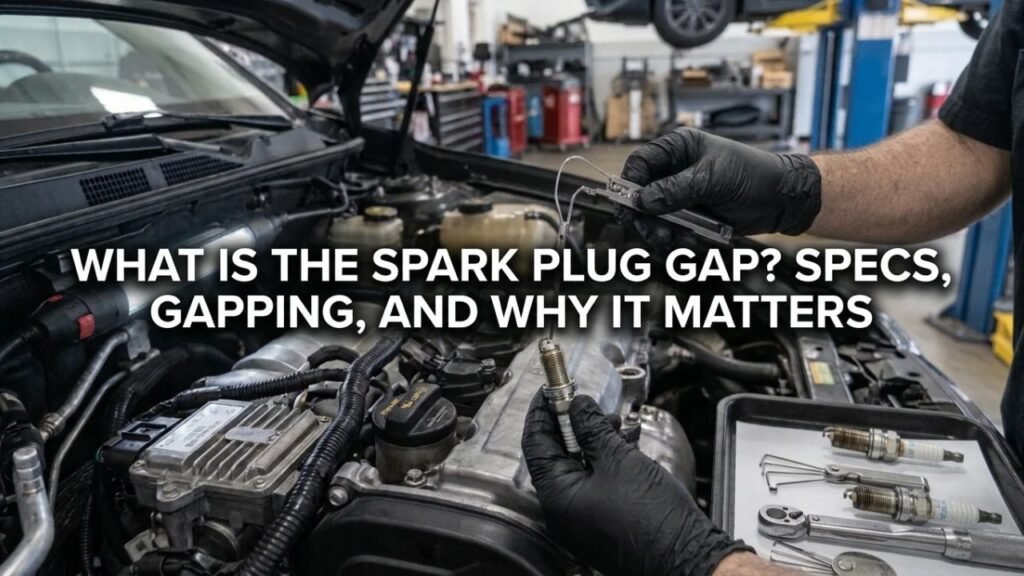
The spark plug gap is the open space separating the center electrode from the ground electrode at the firing end of the plug.
Electricity from the ignition coil must jump across this space before a spark can ignite the mixture inside the cylinder.
Where Is the Gap Located?
Look at the firing end of a conventional spark plug.
You will see:
- A center electrode extending from the ceramic insulator
- A curved or shaped ground electrode positioned beside or above it
- A small open space separating the two
That open space is the spark plug gap.
The ground electrode is also called the side electrode.
How Is Spark Plug Gap Measured?
Gap is commonly measured in:
- Inches
- Millimeters
For example:
| Gap in Inches | Approximate Metric Gap |
| 0.028 in | 0.71 mm |
| 0.032 in | 0.81 mm |
| 0.035 in | 0.89 mm |
| 0.040 in | 1.02 mm |
| 0.044 in | 1.12 mm |
| 0.050 in | 1.27 mm |
| 0.054 in | 1.37 mm |
| 0.060 in | 1.52 mm |
These are conversion examples, not recommendations for a particular vehicle.
Your engine may require a value inside or outside this range.
Why Is the Gap So Small?
The ignition system has to generate enough voltage to ionize the gases between the two electrodes.
Once the voltage becomes high enough, current jumps across the gap as an electrical arc.
That spark starts combustion.
The gap therefore has to be large enough to expose a useful spark to the air-fuel charge but small enough for the ignition system to fire reliably under cylinder pressure.
Key Takeaway: The spark plug gap is the measured space between the center and ground electrodes where the ignition spark jumps to begin combustion.**
What Does Spark Plug Gap Do?
Gap size changes the electrical demand placed on the ignition system.
Even a difference of a few thousandths of an inch can matter in some engines.
A Larger Gap Requires More Voltage
NGK states that voltage requirement rises as spark plug gap increases.
A larger gap exposes the spark across a wider area, but the ignition coil must have enough available voltage to bridge that distance under compression.
If the gap becomes too large, the spark may fail to jump consistently.
Cylinder Pressure Makes Spark Formation Harder
A plug that sparks easily outside the engine may behave differently inside a running cylinder.
Compression increases the electrical resistance across the plug gap.
Engines with:
- Turbochargers
- Superchargers
- High compression
- Heavy boost
can place greater demand on the ignition system.
This is one reason performance engines may use different gap specifications from a standard engine.
Correct Gap Supports Reliable Combustion
A correctly specified gap helps the ignition system fire consistently during:
- Cold starting
- Idle
- Acceleration
- Highway cruising
- Heavy engine load
The engine manufacturer chooses a gap that works with the ignition coil output, combustion chamber, compression ratio, plug design, and calibration.
Key Takeaway: Gap size determines part of the voltage needed to create a spark, so the correct setting has to match the engine and ignition system.**
Do You Have to Gap Spark Plugs?
Not always, but it is smart to check the specification and verify the plug before installation.
Many modern plugs leave the factory with a preset gap.
Many New Spark Plugs Are Pre-Gapped
NGK says its plugs are set to a predetermined gap at the factory, while Champion also notes that modern spark plugs are commonly supplied pre-gapped.
That greatly reduces the amount of adjustment needed during normal maintenance.
Pre-Gapped Does Not Always Mean Correct for Your Engine
One spark plug part number can fit several vehicles.
The manufacturer’s preset value may therefore differ from the specification required for a particular engine.
NGK specifically recommends checking the factory gap against the vehicle manufacturer’s specification before installation.
Shipping or handling can also occasionally move a conventional ground electrode.
Checking the plug takes only a few moments.
Some Fine-Wire Plugs Should Not Be Adjusted Casually
Iridium and platinum plugs use very small center electrodes.
They can be damaged by the wrong gapping technique.
NGK advises moving only the ground electrode and says its fine-wire plugs should not be adjusted more than about ±0.008 inch from their factory preset gap.
DENSO states that its Iridium Power plugs are normally preset and generally do not need adjustment. Its guidance stresses avoiding any contact with the iridium center electrode or porcelain if correction is required.
Follow the directions for the exact plug series you bought.
Key Takeaway: You may not need to adjust new spark plugs, but you should verify their gap against the engine specification and follow special rules for fine-wire iridium or platinum plugs.**
What Should the Spark Plug Gap Be?
There is no single correct number for all gasoline engines.
The proper setting is vehicle-specific.
Common Spark Plug Gap Sizes
Champion states that many applications use specifications somewhere between approximately 0.028 and 0.060 inch.
You may encounter specifications such as:
- 0.028 inch
- 0.032 inch
- 0.035 inch
- 0.040 inch
- 0.044 inch
- 0.050 inch
- 0.054 inch
- 0.060 inch
Do not choose one from this list based on what looks common.
Where to Find the Correct Gap
Check sources such as:
- Vehicle owner’s manual
- Factory service information
- Underhood emissions label on applicable vehicles
- Spark plug manufacturer’s application catalog
- OEM parts information
Use the exact:
- Year
- Make
- Model
- Engine
- Spark plug part number
Two engines in the same vehicle model can require different plugs or gaps.
Do Not Copy the Gap From the Old Plug
An old spark plug is not always a reliable reference.
Spark plug electrodes gradually erode during use.
NGK explains that normal electrode erosion causes the gap to increase over time, which also raises the voltage demand on the ignition system.
If an old plug measures 0.050 inch, that does not necessarily mean it started life at 0.050 inch.
Key Takeaway: Use the engine manufacturer’s specified gap rather than guessing from a generic chart or copying the measurement from a worn plug.**
How to Measure Spark Plug Gap
Gap measurement should be performed before installation when the plug design permits checking.
Use the Correct Gap Tool
Depending on the spark plug manufacturer and electrode design, suitable tools may include:
- Wire-style gap gauge
- Pin gauge
- Calibrated feeler gauge
- Manufacturer-approved gapping gauge
NGK recommends a round wire-style or pin-type gauge for measuring its fine-wire spark plugs.
Avoid forcing a thick wedge or tool between delicate fine-wire electrodes.
Insert the Gauge Between the Electrodes
Place the gauge between the center and ground electrodes.
The correct gauge should pass through with light resistance rather than:
- Falling through loosely
- Requiring excessive force
- Bending the electrodes during measurement
Read the gauge value and compare it with the specified gap.
Measure Every New Plug
Even when a complete set carries the same part number, checking each plug provides a chance to catch:
- Shipping damage
- Bent ground electrode
- Incorrect preset gap
- Damaged insulator
- Electrode defects
Do not install a plug with visible physical damage simply because its gap measures correctly.
Key Takeaway: Measure the space between the center and ground electrodes with the gauge recommended for that plug design, using only enough force to determine the gap.**
How to Gap Spark Plugs
If the plug manufacturer permits adjustment and the measured gap is outside specification, change it by moving the ground electrode only.
How to Increase the Gap
To make the gap larger:
- Secure the plug carefully.
- Use the proper gapping tool on the ground electrode.
- Bend the ground electrode slightly away from the center electrode.
- Measure again.
- Repeat in very small increments if needed.
Never pry against the center electrode or ceramic insulator.
How to Decrease the Gap
To make the gap smaller:
- Use an approved tool to move the ground electrode toward the center.
- Apply very little force.
- Recheck with the gauge.
- Stop as soon as the specification is reached.
Do not strike the plug hard against a bench or solid surface.
Adjust in Small Steps
Spark plug electrodes require very little movement.
Repeatedly bending the ground electrode back and forth can weaken it.
DENSO directs users adjusting applicable Iridium Power plugs to move the ground strap while avoiding all contact with the iridium center electrode and porcelain.
Never Bend the Center Electrode
The center electrode is not the adjustment point.
This is especially important on fine-wire iridium and platinum plugs.
Pressure against the center electrode can:
- Crack the ceramic
- Bend the fine wire
- Break off the electrode
- Permanently damage the plug
Key Takeaway: Adjust gap only by carefully moving the ground electrode, then measure again; never use the center electrode or ceramic as a leverage point.**
What Happens if the Spark Plug Gap Is Too Wide?
A gap that is wider than the engine specification requires more ignition voltage.
At some point, the coil may not be able to fire the plug consistently.
Misfires Under Load
High cylinder pressure makes a large gap harder to fire.
The problem may become most noticeable during:
- Hard acceleration
- Climbing hills
- High RPM
- Turbo boost
- Heavy towing
NGK identifies an excessive gap as one possible cause of ignition misfire.
Hard Starting
Battery voltage falls while the starter motor is cranking the engine.
An excessive plug gap adds more demand to the ignition system during an already demanding operating condition.
Starting can become more difficult.
Extra Stress on Ignition Components
A larger gap requires greater voltage.
Champion notes that excessive gap from normal electrode wear increases the workload on the ignition system and can contribute to misfires and damage to other ignition components.
Gap Naturally Gets Larger With Wear
Every spark event removes a tiny amount of electrode material.
Over many miles, the electrode edges become rounded and the gap increases.
Precious-metal plugs use materials such as iridium and platinum partly because they resist erosion better than conventional nickel electrode designs.
Key Takeaway: An overly wide gap raises ignition voltage demand and can lead to hard starting, load-related misfires, and greater strain on coils and other ignition components.**
What Happens if the Spark Plug Gap Is Too Small?
A narrow gap is easier for the ignition voltage to cross, but that does not mean smaller is better.
The engine was calibrated around a specified spark location and gap.
Spark Exposure Is Reduced
A smaller gap creates a shorter electrical arc.
That may reduce the amount of mixture directly exposed to the initial spark kernel compared with the intended specification.
The result can be less dependable combustion under some operating conditions.
Engine Performance May Suffer
Depending on how far the gap is from specification, symptoms may include:
- Rough idle
- Hesitation
- Misfires
- Reduced throttle response
- Poor combustion quality
The exact symptoms vary with the engine and ignition design.
Smaller Is Not a Fix for a Weak Ignition System
Closing the gap may temporarily make a weak coil fire more easily.
That does not repair:
- Worn ignition coil
- Damaged plug wire
- Weak electrical supply
- Cracked spark plug
- Other ignition faults
A stock engine should normally use its specified gap.
Key Takeaway: Too small a gap can change spark exposure and combustion quality; it should not be used to hide a weak ignition component.**
Does Spark Plug Gap Change as the Plug Wears?
Yes.
Electrode erosion gradually increases the space between the electrodes.
Every Spark Causes Small Electrode Wear
A spark jumps across the electrodes thousands of times during normal driving.
Tiny amounts of electrode material are lost over time.
The sharp edges eventually become rounded.
The Gap Becomes Wider
NGK states that normal plug wear expands the gap through electrode erosion and therefore increases the voltage required from the ignition system.
This is one reason old plugs can begin misfiring even though they still look relatively clean.
Iridium and Platinum Reduce Gap Erosion
Fine-wire precious-metal plugs use harder, more wear-resistant firing surfaces.
NGK notes that iridium and platinum reduce gap erosion and support longer service intervals, especially in ignition systems that place heavy wear on the electrodes.
They still eventually wear and should be replaced according to the vehicle’s service requirements.
Key Takeaway: Normal electrode erosion makes spark plug gaps wider over time, which raises ignition voltage demand and can eventually contribute to misfires.**
Do Iridium Spark Plugs Need to Be Gapped?
Many iridium plugs are supplied at a factory setting intended for their listed applications.
The exact instruction depends on the brand and plug series.
Check the Specification First
NGK recommends checking its factory-set gap against the vehicle specification even when the plug comes pre-gapped.
Checking does not mean you must adjust it.
If the measurement is already correct, leave it alone.
Be Careful With Adjustment
The iridium center electrode is extremely fine.
NGK says any required adjustment should move only the ground electrode and should stay within the allowed correction range for the plug.
DENSO states that its Iridium Power plugs are preset and generally should not require adjustment.
Follow the Exact Plug Manufacturer
Do not apply a generic gapping rule to every iridium plug.
Check the installation instructions for the exact:
- Brand
- Series
- Part number
If the new plug is substantially different from the required engine specification, confirm that you have the correct part before trying to bend it into range.
Key Takeaway: Most iridium plugs arrive pre-gapped, but the specification should still be verified; adjust only when the exact manufacturer permits it and never pry on the fine center electrode.**
Can the Wrong Spark Plug Gap Cause a Check Engine Light?
Yes, indirectly.
The engine computer does not normally monitor the physical gap itself.
Instead, it detects the combustion problems caused by an incorrect gap.
Misfire Codes May Appear
A large gap that fails to fire consistently can lead to codes such as:
- P0300 — Random/Multiple Cylinder Misfire
- P0301 — Cylinder 1 Misfire
- P0302 — Cylinder 2 Misfire
- Similar P030X cylinder codes
A flashing Check Engine Light can indicate severe active misfire.
Do Not Assume Gap Is Always the Cause
Misfires can also come from:
- Failed ignition coil
- Fuel injector problem
- Vacuum leak
- Low compression
- Fuel pressure fault
- Damaged spark plug
- Incorrect ignition timing
Measure the plugs and diagnose the full system rather than simply changing the gap.
Should You Regap Old Spark Plugs?
It depends on the plug type, condition, and service interval, but replacing worn plugs is often the better repair.
Worn Electrodes Cannot Be Restored by Closing the Gap
You can physically reduce the distance by bending the ground electrode.
That does not restore the metal that has eroded from the electrodes.
Rounded, worn firing surfaces remain worn.
Inspect the Plug Condition
Replacement makes more sense when you see:
- Severely rounded electrodes
- Excessive erosion
- Oil fouling
- Heavy deposits
- Cracked ceramic
- Burned ground electrode
- Melted electrode
Champion recommends replacing a worn plug with excessive electrode gap rather than treating adjustment as a substitute for normal plug replacement.
Follow the Service Interval
If the plugs have reached their scheduled replacement interval, install the correct new plugs rather than trying to extend their life by repeatedly closing the gap.
Conclusion
For what is the spark plug gap, it is the small measured distance between the center electrode and ground electrode where the ignition spark jumps.
There is no universal correct setting. Many automotive applications fall somewhere around 0.028 to 0.060 inch, but the exact value must match the vehicle and engine specification.
Most modern replacement plugs are pre-gapped, yet checking them before installation is still worthwhile. If correction is required, adjust only the ground electrode and follow the instructions for the exact plug type.
Fine-wire iridium and platinum plugs deserve extra care because their center electrodes can be damaged easily. If a new plug’s factory gap is far from the specified value, confirm that the part number is correct before attempting a large adjustment.
Correct spark plug gap keeps ignition voltage demand within the range the engine was designed for and gives the spark the conditions it needs for dependable combustion.
FAQs About Spark Plug Gap
What Is a Normal Spark Plug Gap?
There is no single normal value.
Champion states that many automotive specifications fall between about 0.028 and 0.060 inch, but the proper gap must come from the specification for your exact engine.
Do You Have to Gap New Spark Plugs?
Not necessarily.
Most modern plugs are supplied pre-gapped, but NGK recommends verifying the measurement against the vehicle manufacturer’s specification. Adjustment is needed only when the plug instructions permit it and the measurement is incorrect.
What Happens if Spark Plug Gap Is Too Big?
A large gap requires more ignition voltage.
If the coil cannot supply enough voltage under cylinder pressure, the engine may develop hard starting, hesitation, or misfires, mainly under high load.
What Happens if Spark Plug Gap Is Too Small?
A gap that is too narrow changes the size and exposure of the spark from what the engine was designed to use.
It can contribute to poor combustion, roughness, hesitation, or misfires when far enough outside specification.
Do Pre-Gapped Spark Plugs Need to Be Checked?
Yes, checking is sensible.
A factory preset may not match every application for which a particular plug part number is sold, and the ground electrode can occasionally be moved during handling.
Do Iridium Spark Plugs Need Gapping?
Many iridium plugs do not need adjustment.
Verify the specification first. If adjustment is allowed, move only the ground electrode and avoid contacting the iridium center electrode or ceramic.
Does Spark Plug Gap Get Bigger Over Time?
Yes.
Normal electrode erosion gradually widens the gap. As the distance increases, the ignition system needs more voltage to fire the plug.
Where Can I Find My Vehicle’s Spark Plug Gap?
Check the owner’s manual, factory service information, underhood emissions label where applicable, or the spark plug manufacturer’s application catalog.
Use the exact year, model, engine, and plug part number instead of relying on a generic gap chart.