
Iridium spark plugs can often have their gap checked, but adjustment requires much more care than with conventional nickel plugs. The fine iridium center electrode is fragile and should never be pushed, bent, or used as a leverage point. Some manufacturers permit careful adjustment of the ground electrode, while others recommend leaving specific iridium plugs at their factory-set gap.
Most replacement spark plugs arrive with a factory-set gap. That does not always mean the setting matches every engine that can use the same spark plug part number.
For anyone asking can you gap iridium spark plugs, the answer is yes for some designs, but first check the spark plug manufacturer’s instructions and your vehicle’s specified gap. NGK permits careful adjustment of its fine-wire plugs when necessary, while DENSO specifically advises against adjusting the gap on its Iridium Power line.
NGK says most of its spark plugs are pre-gapped, yet it still recommends checking the gap against the engine manufacturer’s specification before installation. NGK also warns against applying pressure to the fine-wire center electrode or ceramic insulator.
The safest approach is simple: verify the specification, measure gently with the correct gauge, and adjust only the ground electrode if the manufacturer allows it.
Do You Gap Iridium Spark Plugs?
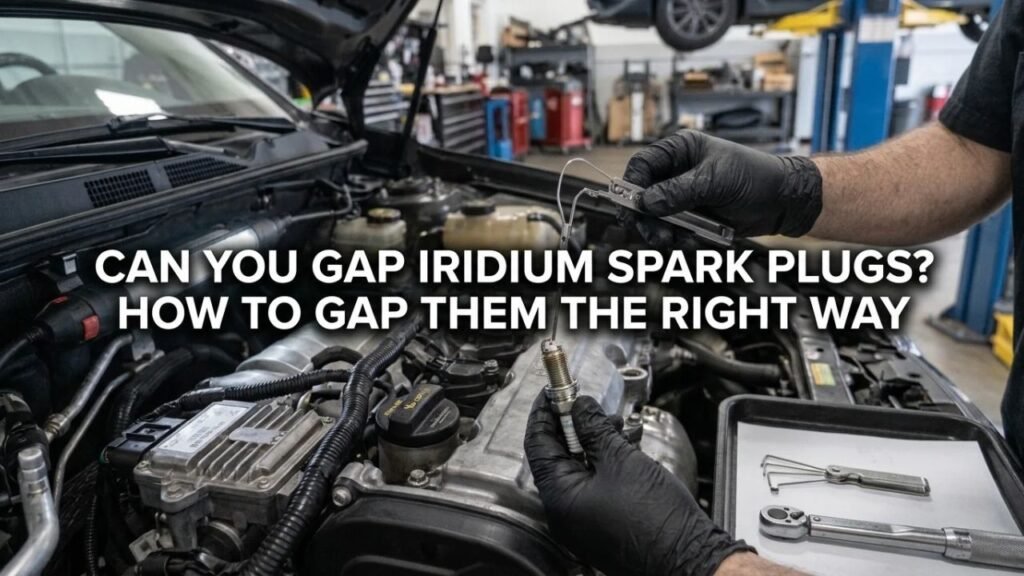
You normally check the gap on an iridium plug before installation. Actual adjustment is only needed when the measured gap does not match the specification and the plug manufacturer permits adjustment.
Many Iridium Plugs Are Already Factory-Gapped
Modern spark plug manufacturers set the electrode gap during production.
NGK states that the vast majority of its plugs are pre-gapped. The factory setting may already match the vehicle specification, meaning nothing needs to be changed.
This is common with direct-fit OE-style iridium plugs.
If the new plug measures correctly, leave it alone.
Unnecessary adjustment creates a chance of damaging the fine electrode.
Pre-Gapped Does Not Always Mean Correct for Every Engine
One spark plug part number can sometimes be used in several engine applications.
Those engines may not all call for exactly the same gap.
NGK specifically notes that a plug can fit hundreds of different engines, which is why checking the vehicle manufacturer’s gap specification is still recommended.
For example, the plug might arrive at:
- 0.032 inch
- 0.040 inch
- 0.044 inch
while your particular engine specifies a different measurement.
Some Manufacturers Do Not Want Certain Iridium Plugs Adjusted
Manufacturer guidance matters.
DENSO states that its Iridium Power plugs have their gap set at the intended distance and advises against adjusting that gap because electrode damage can reduce plug performance.
That means there is no universal rule saying every iridium plug should be adjusted in the same manner.
Key Takeaway: Do you gap iridium spark plugs? Check the gap before installation, but only adjust it when the specification is wrong and the spark plug manufacturer permits adjustment.
Are NGK Iridium Spark Plugs Pre Gapped?
Yes. Most NGK iridium spark plugs leave the factory with a preset gap.
NGK still recommends verifying that measurement before installation.
NGK Plugs Have a Factory Gap
NGK states that its plugs are factory-gapped to a predetermined setting.
Many NGK part numbers also use suffixes that indicate the preset gap.
For example, depending on the specific plug family:
- -8 can indicate 0.8 mm
- -9 can indicate 0.9 mm
- -10 can indicate 1.0 mm
- -11 can indicate 1.1 mm
NGK’s plug-number documentation identifies these as preset spark-gap values.
Factory Gap Can Still Need Verification
Shipping and handling can sometimes move the ground electrode.
A box that looks perfect does not guarantee the electrode was never bumped.
Measure each plug before installation.
NGK’s installation material recommends checking the gap on every plug and following the engine manufacturer’s specified gap unless the engine has been modified.
NGK Allows Careful Adjustment of Fine-Wire Plugs
NGK permits adjustment if it is needed, but the method matters.
The company recommends:
- A round wire-style or pin gap gauge
- Moving only the ground electrode
- No pressure against the center electrode
- No prying against the insulator
NGK also recommends keeping adjustment within about ±0.008 inch (0.20 mm) of the factory preset on fine-wire plugs.
If your required gap is much farther from the factory setting, the plug may not be the correct version for the application.
Key Takeaway: Are NGK iridium spark plugs pre gapped? Yes, most are factory-set, but NGK still recommends checking the measurement and permits small, careful adjustments when necessary.
How to Gap Iridium Spark Plugs Safely
Fine-wire iridium plugs should be handled much more gently than traditional large-electrode plugs.
1. Find the Correct Gap Specification
Before touching the plug, find the gap required for your exact engine.
Good sources include:
- Vehicle owner’s manual
- Factory service manual
- Underhood emissions label where applicable
- Spark plug manufacturer’s application catalog
Do not copy the gap from another vehicle just because both engines use similar plugs.
Engine-specific requirements can differ.
2. Check the Spark Plug Part Number
Make sure the plug itself is correct.
Verify:
- Thread diameter
- Thread reach
- Heat range
- Seat type
- Resistor specification
- Electrode design
- Factory gap
If a new plug is far from the required gap, double-check the part number before bending anything.
3. Use a Round Wire or Pin-Style Gap Gauge
A round wire-style gauge is a good choice for fine-wire iridium plugs.
NGK recommends a round wire-style or pin gauge when checking fine-wire spark plugs.
The correct wire should pass through the electrode gap with a light drag.
Do not force an oversized gauge between the electrodes.
4. Avoid Pressing Against the Iridium Center Electrode
This is the most important rule.
The iridium center tip is extremely small.
Do not:
- Push it sideways
- Pry against it
- Hit it with a gap tool
- Use it as a fulcrum
- Force a gauge against it
NGK warns that pressure on the fine-wire electrode or insulator can damage the plug.
5. Move Only the Ground Electrode
If the plug manufacturer permits adjustment, change the gap by carefully bending the ground electrode.
The ground electrode is the curved metal strap above the center electrode.
Use a tool designed to grip or move the ground strap without contacting the iridium tip.
6. Make Very Small Adjustments
Move the electrode a tiny amount.
Then measure again.
Do not try to move it directly from a large gap to a much smaller setting in one motion.
Small steps reduce the chance of:
- Cracking the weld
- Changing electrode alignment
- Damaging the center tip
- Overshooting the target
7. Keep the Electrodes Aligned
The ground electrode should remain centered over the fine iridium tip.
A badly angled ground strap changes the geometry of the spark gap.
If the plug has been bent enough that the electrodes no longer align properly, replacement is usually the safer option.
8. Recheck the Gap
After adjustment, measure it again with the wire gauge.
Check from the correct position and make sure the tool is measuring the actual distance between the firing surfaces.
9. Inspect the Plug Before Installation
Look for:
- Cracked porcelain
- Bent center electrode
- Damaged ground strap
- Loose terminal
- Damaged threads
Do not install a plug that was damaged while being gapped.
Key Takeaway: How to gap iridium spark plugs safely comes down to using a wire gauge, protecting the fine center electrode, moving only the ground strap, and making very small adjustments.
What Spark Plug Gap Tool Should You Use for Iridium Plugs?
The gap tool matters because fine-wire electrodes can be damaged by methods that work adequately on conventional plugs.
Round Wire Gap Gauge
A round wire gauge uses wires of known diameters.
It lets you measure the space between the electrodes without forcing a tapered edge through the gap.
This is one of the preferred tools for fine-wire plugs.
Pin Gauge
A pin-style gauge performs a similar job.
NGK specifically lists both pin gauges and round wire-style gauges for its fine-wire plugs.
Dedicated Ground-Electrode Adjustment Tool
For adjustment, use a tool that acts only on the ground strap.
The tool should not press against:
- Center electrode
- Fine iridium tip
- Ceramic insulator
Avoid Using the Center Electrode for Leverage
Some inexpensive gap tools encourage the user to wedge the tool between the electrodes and twist.
That method can be risky on an iridium plug.
The center electrode may be only a fraction of the diameter of the electrode on an older conventional plug.
Key Takeaway: Measure iridium plugs with a wire or pin gauge and use a separate method to move only the ground electrode if adjustment is approved.
Why Are Iridium Spark Plugs Easy to Damage When Gapping?
Iridium plugs get part of their performance from very small center electrodes.
Iridium Allows a Fine Center Tip
Iridium has a high melting point and strong wear resistance.
Manufacturers can therefore make the center electrode much smaller than the large electrode used on many conventional plugs.
DENSO’s Iridium Power line, for example, uses a 0.4 mm fine iridium center electrode.
NGK also describes its iridium plugs as fine-wire designs.
The Small Tip Requires Less Ignition Voltage
A fine electrode concentrates the electrical field at the firing point.
That design supports reliable spark formation without requiring a large center electrode.
Mechanical Force Is the Main Gapping Risk
Iridium itself is highly durable under combustion conditions.
The problem during manual gapping is the tiny welded electrode assembly.
Side-loading it with a tool can:
- Bend the tip
- Damage the weld
- Crack the insulator
- Misalign the electrodes
That is why the ground electrode should be the only part deliberately moved.
Key Takeaway: Iridium plugs survive extreme combustion conditions well, but their tiny fine-wire center electrodes can still be physically damaged by careless gapping tools.
What Happens If an Iridium Spark Plug Gap Is Too Wide?
Spark gap directly affects how much voltage the ignition system needs.
A larger gap generally needs more voltage to fire.
NGK notes that increasing the gap raises the voltage requirement.
Misfire Under Load
Cylinder pressure rises when the engine is working hard.
A gap that is already too wide can become difficult for the ignition system to fire under those conditions.
Symptoms may include:
- Hesitation
- Misfire
- Bucking
- Poor acceleration
- Flashing check engine light
Hard Starting
Cranking conditions can expose a marginal ignition system.
An excessive gap may contribute to:
- Long cranking
- Rough startup
- Start-and-stall behavior
Increased Coil Stress
A larger gap demands more ignition voltage.
That does not automatically destroy an ignition coil, but operating far outside the specified gap adds unnecessary demand to the ignition system.
Plug Fouling
If the plug repeatedly fails to ignite the mixture, fuel and deposits may begin accumulating on the firing end.
What Happens If the Iridium Spark Plug Gap Is Too Small?
A gap that is too small can also affect combustion.
Smaller Spark Exposure
A narrow gap creates a shorter spark path.
The spark may be less exposed to the surrounding air-fuel mixture than intended by the engine design.
Performance Problems
Depending on the engine, symptoms may include:
- Rough running
- Reduced throttle response
- Misfire
- Poor combustion quality
A tiny deviation may cause no noticeable problem, but there is little reason to ignore a clearly incorrect measurement.
Do Not Open the Gap Just for a “Bigger Spark”
More gap is not automatically better.
NGK notes that excessive gap can exceed the ignition system’s ability to fire consistently.
Use the engine specification rather than choosing a gap based on the idea that wider must produce more power.
Key Takeaway: Too much gap can increase voltage demand and misfire risk, while too little gap can reduce spark exposure. The manufacturer-specified setting is the correct target for a stock engine.
Should You Gap New Iridium Spark Plugs?
Check them—yes.
Change them automatically—no.
Measure Before Installation
Checking takes only a few moments and can identify:
- Shipping damage
- Bent ground electrode
- Wrong factory setting for the application
- Incorrect part number
Leave Correct Plugs Alone
If the gap matches the specification, do not bend the electrode.
There is no advantage to disturbing a correctly set fine-wire plug.
Investigate a Large Difference
If the plug arrives at 0.028 inch and your engine requires 0.044 inch, for example, do not immediately bend it a large amount.
First verify:
- Correct plug number
- Correct engine application
- Correct published specification
A large difference can mean the wrong plug variant was purchased.
Do Modified Engines Need a Different Iridium Spark Plug Gap?
Sometimes.
Turbocharged, supercharged, nitrous, and high-compression engines can place greater demands on the ignition system.
Boosted Engines May Use a Smaller Gap
Higher cylinder pressure makes the spark more difficult to initiate.
Performance tuners sometimes reduce the gap to improve spark stability under boost.
NGK notes that higher compression and forced induction commonly call for reduced gaps.
Do Not Guess at the Gap
The correct performance gap depends on:
- Boost pressure
- Compression ratio
- Ignition coil output
- Fuel
- Engine management
- Spark plug heat range
- Tuning strategy
Use the recommendation from the engine tuner or plug manufacturer.
A Smaller Gap Does Not Fix a Weak Ignition System
Closing the plug gap can sometimes hide an ignition problem.
If a previously stock engine suddenly needs a much smaller gap to stop misfiring, inspect the coils, plugs, wiring, fuel mixture, and compression.
Key Takeaway: Modified engines may need a different gap, especially under high cylinder pressure, but the correct setting should come from the tuning combination rather than guesswork.
Can You Regap Used Iridium Spark Plugs?
Physically, some designs can be measured and adjusted, but used plugs deserve careful inspection first.
Electrode Wear Changes the Situation
Iridium center electrodes wear slowly, but the ground electrode can still erode with mileage.
A worn gap should not always be corrected by simply bending the ground electrode inward.
If the plug has reached its replacement interval, install new plugs.
Inspect for Deposits
Look for:
- Carbon fouling
- Oil fouling
- Ash deposits
- Overheating
- Cracked porcelain
A damaged or heavily fouled plug needs diagnosis rather than gap adjustment alone.
High-Mileage OE Iridium Plugs Are Usually Replaced
OE iridium plugs are often selected for long service intervals.
Once they have accumulated substantial mileage and the gap has grown from electrode wear, replacement usually makes more sense than reshaping the old ground strap.
Can You Use a Coin-Style Gap Tool on Iridium Spark Plugs?
It is better to use a round wire or pin-style gauge.
A tapered coin-style tool can place unwanted force on fine electrodes if it is pushed between them.
The problem is not simply reading the measurement.
It is the possibility of using the tapered edge as a wedge against the fragile center electrode.
For fine-wire iridium plugs, use a measuring tool that does not require prying the electrodes apart.
Is the Spark Plug Box Gap Always Correct?
No.
The number on the box or catalog identifies the factory setting for that plug.
Your engine specification remains the main reference for installation.
A spark plug can be cataloged for several applications.
NGK explicitly recommends comparing the preset gap with the engine manufacturer’s requirement.
Also inspect for shipping damage before assuming the plug still measures exactly as it did at the factory.
Conclusion
So, can you gap iridium spark plugs? Some iridium plugs can be adjusted carefully, but you should first verify the manufacturer’s instructions. The fine-wire center electrode should never be bent, pushed, or used as a leverage point.
For how to gap iridium spark plugs, start by measuring with a round wire or pin-style gauge. If adjustment is permitted, move only the ground electrode in small increments and recheck the measurement after every adjustment.
If you are asking are NGK iridium spark plugs pre gapped, the answer is yes—most NGK plugs come with a factory preset. NGK still recommends checking that preset against the vehicle manufacturer’s specified gap before installation.
And do you gap iridium spark plugs automatically? No. If the factory gap already matches the engine specification, leave it alone. Adjustment is only needed when the measurement is incorrect and the plug design allows it.
FAQs About Gapping Iridium Spark Plugs
Can you adjust the gap on NGK iridium spark plugs?
Yes, NGK permits careful adjustment when necessary. Move only the ground electrode and never pry against the fine center electrode or ceramic insulator. NGK recommends limiting fine-wire adjustment to about ±0.008 inch from the factory preset.
Are NGK Iridium IX plugs pre-gapped?
Yes. NGK spark plugs generally arrive with a factory-set gap. Check the actual measurement against the specification for your engine because the same plug part number may fit more than one application.
Should I gap iridium spark plugs straight out of the box?
Measure them first. If the factory setting matches your vehicle specification, no adjustment is needed. If it differs, confirm the plug part number and follow that spark plug manufacturer’s instructions before changing the gap.
What gap tool should I use for iridium spark plugs?
A round wire-style gauge or pin gauge is preferable for fine-wire plugs. NGK recommends these types of tools and advises moving only the ground electrode if adjustment is required.
Can gapping an iridium spark plug damage it?
Yes. Prying against the fine center electrode can bend or break the electrode, damage its weld, or crack the ceramic insulator. Adjust only the ground electrode when the manufacturer permits gapping.
Do DENSO iridium spark plugs need to be gapped?
DENSO specifically states that its Iridium Power plugs are set to their intended gap and advises against adjusting them. Check instructions for the exact DENSO plug family rather than applying one rule to every iridium plug.
What happens if my iridium spark plug gap is too wide?
An excessive gap requires more ignition voltage and can contribute to misfires, hesitation, hard starting, and weak performance under load. Follow the engine manufacturer’s gap specification.
Can I regap old iridium spark plugs?
Some can physically be regapped, but a worn high-mileage plug is usually better replaced. If the gap has enlarged because of electrode erosion, bending the ground strap back does not restore the material that has already worn away.