
If you are wondering are glow plugs only used for starting, no—modern diesel glow plugs are often used before startup, during cranking, and for a period after the engine starts. Their main purpose is to provide extra heat when the engine is cold, but many modern diesel systems keep the glow plugs operating after startup to improve combustion, smooth cold idle, reduce white smoke, lower emissions, and help the engine warm more cleanly.
Older diesel engines often used glow plugs primarily as a preheating device. You turned the key, waited for the glow-plug light to go out, and then started the engine. Once the engine was running, the glow plugs usually had much less involvement.
Modern diesel engines can be very different. Electronic glow-plug controllers can switch individual plugs on and off, operate them at different power levels, and continue using them after the engine has already started. Some systems may also reactivate glow plugs during particular operating conditions to improve combustion or emissions performance.
This does not mean glow plugs are operating continuously whenever you drive. Once the combustion chambers are sufficiently warm and compression alone can reliably ignite the injected diesel fuel, glow-plug assistance usually becomes unnecessary.
In this guide, I’ll explain whether glow plugs are only used for starting, how pre-glow and post-glow work, how long glow plugs stay on, whether they operate while driving, why modern diesels use them after startup, and what happens when one or more glow plugs fail.
Are Glow Plugs Only Used for Starting?
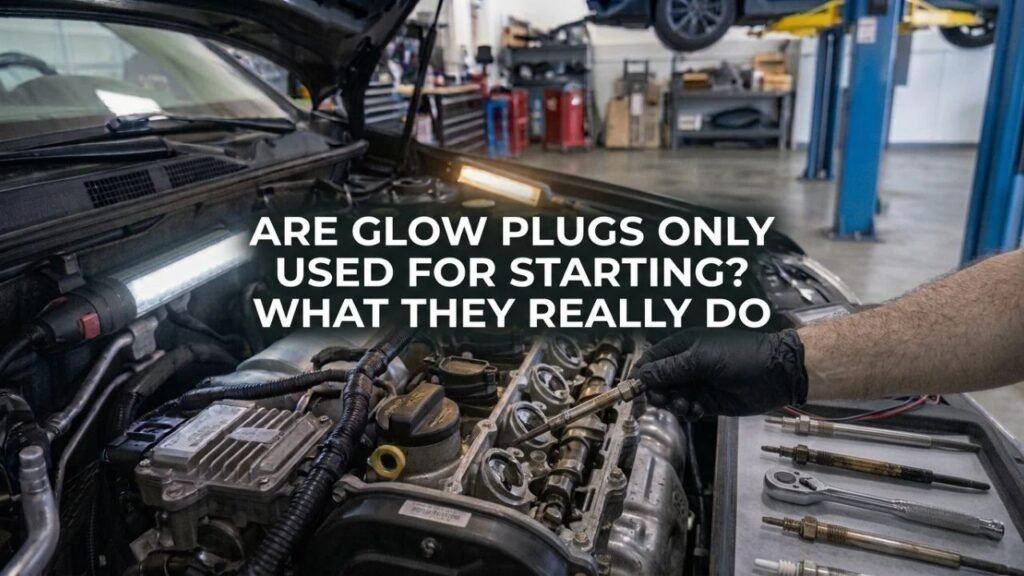
No.
Glow plugs are most closely associated with starting a cold diesel engine, but their function can extend beyond the moment the starter motor turns.
Depending on engine design, a glow plug may operate during three main stages:
Pre-glow, before the engine starts.
Start-glow, while the engine is cranking.
Post-glow, for a period after the engine has started.
Modern electronic diesel systems can control these stages automatically based on coolant temperature, intake-air temperature, battery voltage, engine speed, load, emissions requirements, and other operating conditions.
Why People Think Glow Plugs Work Only Before Starting
On many older diesel vehicles, the driver had to wait for a dashboard glow-plug indicator before cranking the engine.
That made the preheating function very obvious.
Once the engine started, there was usually no obvious indication that the glow system was doing anything else.
This led to the common idea that glow plugs simply heat up before startup and then switch off.
That description can be reasonably accurate for some older systems, but it is incomplete for many modern diesels.
Key Takeaways:
- Glow plugs are primarily cold-start aids, but many modern systems use them after startup too.
- Pre-glow happens before cranking, while post-glow happens after the engine starts.
- Glow plugs normally stop operating once the engine is sufficiently warm.
What Do Glow Plugs Actually Do?
A glow plug is an electric heating element installed in or near a diesel engine’s combustion chamber.
When electrical current flows through the plug, the tip becomes extremely hot.
That heat helps the diesel fuel ignite more reliably when the engine is cold.
Unlike a gasoline spark plug, a glow plug does not normally create an electrical arc to ignite the mixture.
Diesel engines rely on compression ignition.
The piston compresses the intake air to such a high pressure that its temperature rises dramatically. Fuel is then injected into the hot compressed air and begins burning.
The problem is that a cold engine absorbs a great deal of this heat.
The cylinder head, piston, and combustion chamber surfaces can pull temperature away from the compressed air, making initial combustion difficult.
The glow plug supplies localized heat to compensate.
What Is Pre-Glow?
Pre-glow is the heating period before the engine starts.
When you switch on a cold diesel vehicle, the engine-control system may energize the glow plugs before the starter engages.
The glow-plug tips rapidly become hot enough to assist combustion.
The Glow-Plug Dashboard Light
Many diesel vehicles display a symbol that resembles a coiled wire.
On older systems, you may need to wait until this light turns off before cranking.
Modern fast-heating glow plugs may require such a short preheating period that the driver barely notices any delay.
In some vehicles, pressing the start button handles the entire process automatically.
The engine computer can briefly delay cranking while the glow system reaches the required temperature.
Is Pre-Glow Always Needed?
No.
If the engine is already warm, the controller may shorten the pre-glow period dramatically or not activate it at all.
The same can happen in hot weather.
A warm combustion chamber may already provide enough heat for reliable compression ignition.
Do Glow Plugs Work While the Engine Is Cranking?
They often do.
Keeping the glow plugs energized while the starter turns can help the first injected fuel charges ignite.
This is particularly useful during very cold starts.
The control system may alter plug power as the engine transitions from stationary preheating to actual cranking.
This helps stabilize the first combustion events and reduces the chance that the engine starts on only some cylinders.
What Is Post-Glow?
Post-glow is one of the main reasons the answer to “are glow plugs only used for starting?” is no.
After a modern diesel starts, the glow-plug controller may continue supplying power to the plugs for seconds or even several minutes depending on the system and conditions.
The purpose is no longer simply to make the engine start.
It is to improve combustion while the engine is still cold.
Post-Glow Helps Smooth Cold Idle
A cold diesel may not burn fuel as completely or consistently as a warm one.
Keeping the glow plugs hot can stabilize combustion in each cylinder.
That can reduce shaking, rough idle, and uneven firing during the first part of warm-up.
Post-Glow Can Reduce White Smoke
White exhaust smoke after a cold diesel start often results from fuel that has not burned completely.
Additional glow-plug heat helps improve ignition and fuel burning.
This can reduce visible smoke during the warm-up period.
Post-Glow Can Reduce Emissions
Modern diesel engines have strict emissions-control requirements.
Cold combustion generally creates more undesirable emissions because the engine and exhaust aftertreatment system have not yet reached normal operating temperature.
Post-glow can improve combustion quality during this period.
It may help reduce hydrocarbon emissions, smoke, and other cold-start pollutants.
How Long Do Glow Plugs Stay On After Starting?
There is no universal time.
Some older systems may turn the plugs off shortly after startup.
Modern diesel systems can keep them active for seconds or several minutes.
The exact duration depends on factors such as:
- Engine coolant temperature
- Outside temperature
- Intake-air temperature
- Engine speed
- Battery voltage
- Engine load
- Emissions strategy
The system may also vary the electrical power supplied to the plugs instead of simply switching them fully on or off.
Don’t Judge Glow-Plug Operation by the Dashboard Light
The glow-plug warning light does not necessarily tell you exactly how long the plugs themselves remain energized.
The indicator may go out when the engine is ready to start even though the controller continues operating the glow plugs afterward.
So a dashboard light that turns off after two seconds does not prove the plugs stopped heating at that exact moment.
Are Glow Plugs Used While Driving?
Sometimes, but generally only under specific conditions.
Once the engine reaches normal operating temperature, glow plugs are usually not required for routine combustion.
Compression heat is sufficient to ignite diesel fuel.
However, some modern electronic diesel systems may use glow plugs beyond initial warm-up for emissions or combustion-management purposes.
The exact strategy depends on the engine.
Modern Glow-Plug Systems Are Computer Controlled
Older glow systems were relatively simple.
A relay supplied power for a set period.
Modern systems may use a dedicated glow-plug control module connected to the engine computer.
That module can regulate individual plugs and vary their electrical input.
This allows far more precise control.
The engine computer can decide when supplemental heat is useful rather than treating the plugs as a simple start-only device.
Do Glow Plugs Stay On All the Time?
No.
Glow plugs are not normally energized continuously throughout every trip.
Once the engine has warmed enough, continued electrical heating would usually provide little benefit.
Glow plugs draw substantial electrical power and operate at very high temperatures.
The control system therefore activates them only when required.
If a glow plug remained continuously energized because of a stuck relay or faulty control module, it could overheat and fail prematurely.
Why Don’t Diesel Engines Need Glow Plugs When Warm?
A warm diesel engine already has favorable combustion conditions.
The cylinder walls, combustion chambers, and pistons retain heat.
During compression, the air temperature rises further.
When fuel is injected, the combination of high compression temperature and warm engine components is enough for reliable ignition.
That is why a diesel with failed glow plugs can sometimes restart easily after being driven.
The same vehicle may be extremely difficult to start the next morning after sitting overnight in cold weather.
Can a Diesel Run Without Glow Plugs After It Starts?
Usually, yes.
Once a diesel engine is running and sufficiently warm, it does not depend on glow plugs for every combustion event.
Unlike spark plugs in a gasoline engine, glow plugs are not continuously timing the ignition of every cylinder.
Diesel fuel continues to ignite through compression.
One Bad Glow Plug
An engine with one failed glow plug may still start and run normally in mild weather.
The problem may be noticeable only during a cold start.
You may experience a few seconds of rough running until the affected cylinder warms sufficiently.
Several Bad Glow Plugs
If multiple glow plugs fail, cold starting can become much more difficult.
The engine may crank for a long time, start unevenly, smoke heavily, or fail to start at all in very cold conditions.
Once running and warm, it may still operate normally.
Can a Diesel Start Without Any Glow Plugs?
Possibly, depending on temperature and engine design.
A high-compression diesel in warm weather may start even if its glow system is completely inoperative.
In cold weather, the same engine may struggle badly.
Some diesel engines rely more heavily on glow plugs than others.
Direct-injection designs, combustion-chamber shape, compression ratio, injection strategy, and ambient temperature all influence starting behavior.
This is why “diesels don’t really need glow plugs” is not a useful general rule.
A properly functioning glow system should be maintained even if the vehicle happens to start without it during summer.
Do All Diesel Engines Have Glow Plugs?
No.
Most modern light-duty automotive diesel engines use glow plugs, but not every diesel engine design relies on them.
Some engines use alternative cold-start aids.
Historically, certain diesels have used intake-air heaters, grid heaters, flame-start systems, or other heating methods.
Large commercial and industrial engines may also use different strategies.
So while glow plugs are extremely common, they are not universal to every diesel engine.
Key Takeaways:
- A warm diesel can often run perfectly without glow-plug assistance.
- Glow plugs are most important during cold starting and warm-up.
- Not every diesel engine uses conventional glow plugs.
Glow Plugs vs. Spark Plugs During Engine Operation
The difference becomes particularly clear after the engine has started.
A gasoline spark plug must keep operating for as long as the engine runs.
Each cylinder needs a precisely timed spark during its combustion cycle.
If one spark plug stops firing, that cylinder misfires immediately.
A diesel glow plug works differently.
Once compression heat is sufficient, the cylinder can continue normal combustion without the glow plug.
That is why a failed glow plug may have no noticeable effect on a fully warm diesel.
Spark Plug = Ignition Device
A spark plug initiates combustion at a specific moment.
It is continuously essential.
Glow Plug = Heating Aid
A glow plug makes diesel ignition easier when conditions are cold.
It supports combustion rather than directly timing every combustion event.
Why Modern Diesel Engines Use Post-Glow More Than Older Engines
Modern diesel engines face much stricter demands for emissions, refinement, noise, and cold-start performance.
Drivers expect a modern diesel to start quickly and idle smoothly even in cold weather.
Manufacturers also need to minimize pollutants immediately after startup.
Improved glow-plug technology makes extended operation possible.
Faster Heating
Modern glow plugs can reach operating temperature much faster than older designs.
The waiting period before cranking can therefore be very short.
Higher Temperature Capability
Some advanced metal and ceramic glow plugs can operate at very high temperatures.
This gives engine-management systems greater flexibility.
Electronic Control
Modern glow modules can control plugs individually and adjust heating according to actual operating conditions.
The system can provide strong preheating, reduce power after startup, and shut the plugs down once they are no longer useful.
What Is a Glow-Plug Control Module?
The glow-plug control module regulates electrical power to the glow plugs.
On older diesel engines, this job may have been handled primarily by a relay and timer.
Modern modules can be substantially more sophisticated.
They may communicate directly with the engine control unit.
The engine computer considers temperature and operating data and tells the module how much heating is required.
Individual Glow-Plug Control
Some systems can control each cylinder independently.
This improves diagnostics because the module may detect abnormal current through a particular glow plug and store a cylinder-specific fault code.
It can also allow more precise heating than a simple all-or-nothing relay.
What Happens If Glow Plugs Stop Working After Startup?
If the engine is already warm enough, you may notice nothing.
If the engine is still cold and depends on post-glow, however, you might experience rough idle, smoke, increased noise, or unstable combustion during warm-up.
The severity depends on how many plugs have failed and how cold the engine is.
White Smoke
Poorly burned fuel can appear as white or gray smoke.
If this happens mainly during cold starts and disappears quickly as the engine warms, the glow system is one possible cause.
However, injectors, low compression, coolant problems, and other faults can cause similar smoke.
Rough Cold Idle
A cylinder with a failed glow plug may take longer to reach stable combustion.
That can make the engine sound or feel uneven immediately after startup.
As cylinder temperature rises, the symptom may disappear.
Can Bad Glow Plugs Affect Fuel Economy?
During normal warm operation, a failed glow plug usually has little direct impact on fuel economy because the engine no longer requires its heat.
However, poor cold combustion caused by failed plugs can waste fuel during startup and warm-up.
If the engine repeatedly cranks for long periods or runs poorly while cold, overall efficiency can suffer somewhat.
A major long-term fuel-economy loss is more likely to involve another engine or fuel-system problem.
Can Bad Glow Plugs Affect Emissions?
Yes.
This is one reason modern engines use post-glow.
A cylinder that does not burn injected fuel cleanly during cold operation can produce greater amounts of smoke and unburned hydrocarbons.
Glow-plug assistance helps improve combustion until the cylinder is warm enough to operate normally without it.
A glow-system fault can therefore trigger emissions-related diagnostic codes on some vehicles.
Does the Glow-Plug Light Mean the Plugs Are Working?
Not necessarily.
The dashboard light primarily tells you that the control system is performing a preheat sequence or has information to communicate.
It does not prove that every individual glow plug is actually heating correctly.
One or more plugs can fail while the warning light still behaves normally.
Modern vehicles may instead store diagnostic codes or illuminate the check-engine light.
If you suspect a glow problem, test the plugs and control circuit rather than relying entirely on the dashboard indicator.
Should You Wait for the Glow-Plug Light Before Starting?
On vehicles designed with a traditional wait-to-start procedure, yes.
Wait until the indicator shows that preheating is complete before cranking.
Modern push-button vehicles may manage the process automatically.
You should follow the starting procedure in the owner’s manual rather than repeatedly cycling the ignition in an attempt to make the plugs hotter.
Repeated Glow Cycling Usually Isn’t Necessary
Some owners switch the ignition on and off several times before cranking in cold weather.
That may have helped certain old diesel systems, but modern controllers are designed to manage heating automatically.
Repeated cycling can place unnecessary load on the battery and glow plugs.
If a modern diesel needs repeated preheating to start, diagnose the battery, glow system, fuel system, and engine condition.
How Do You Know Whether Post-Glow Is Working?
On most vehicles, you cannot determine it from the dashboard alone.
A capable scan tool can often show glow-plug control information or allow the system to be commanded for testing.
Electrical testing can also confirm voltage or current at the plugs after startup.
Remember that modern modules may use rapidly pulsed power rather than a steady voltage.
A simple voltmeter can therefore provide confusing readings on some systems.
If precise diagnosis is required, use the manufacturer’s test procedure.
Can a Bad Glow-Plug Relay Keep the Plugs On Too Long?
Yes, particularly on older relay-controlled systems.
A relay that sticks closed can keep the plugs energized longer than intended.
That can overheat the glow plugs and cause premature failure.
Modern electronic controllers can fail in different ways as well.
Signs of an Overactive Glow System
Possible symptoms include repeated glow-plug failures, unusually high electrical load, battery drain, or plugs with heat-related damage.
These symptoms require circuit diagnosis rather than simply replacing the failed plugs again.
If multiple new glow plugs fail unusually quickly, investigate the control system.
Can Post-Glow Drain the Battery?
Under normal conditions, no meaningful problem should occur because the system is designed with battery capacity and charging-system output in mind.
Glow plugs draw high current, but once the engine starts, the alternator begins supporting the electrical system.
The controller also limits operating time and power according to conditions.
A weak battery or charging-system problem can still make glow operation more noticeable.
If battery voltage is already low, cold cranking and glow-plug heating together place a substantial load on it.
Do Glow Plugs Help Warm the Whole Engine?
Not directly in the same way an engine-block heater does.
Glow plugs heat a relatively small area around the combustion chamber.
Their purpose is to improve combustion, not to heat the entire engine block.
However, better combustion after startup helps the engine begin warming normally.
Glow Plug vs. Block Heater
A block heater warms the engine before startup by heating coolant, oil, or part of the engine structure depending on design.
A glow plug heats the combustion area electrically for starting and cold combustion.
Using a block heater in extremely cold conditions can reduce the amount of assistance the glow plugs need to provide.
Do Glow Plugs Help Diesel Particulate Filter Regeneration?
On some modern diesel systems, glow-plug strategies can be integrated into broader emissions and thermal-management functions.
However, the exact role varies considerably by manufacturer and engine.
You should not assume that every vehicle activates glow plugs during DPF regeneration.
Fuel injection, exhaust temperature management, EGR control, intake throttling, and other systems typically play major roles.
For application-specific information, the factory service documentation is the correct reference.
How Do You Know If Glow Plugs Are Bad?
Common signs include hard starting when cold, long cranking time, rough cold idle, white smoke after startup, and glow-system fault codes.
Testing can involve resistance measurement, current draw, supply voltage, and scan-tool diagnostics.
If symptoms occur only when the engine is cold and disappear once it warms, the glow system deserves particular attention.
Test More Than the Glow Plugs
Do not assume the heating elements are automatically responsible.
A failed glow-plug control module, relay, fuse, wiring harness, weak battery, or poor electrical connection can prevent perfectly healthy glow plugs from working.
Test the circuit as a system.
Key Takeaways:
- Cold-start symptoms point toward the glow system more strongly than warm-running problems.
- Glow plugs may be good while the controller or wiring is faulty.
- Repeated premature glow-plug failure can indicate a control-system problem.
Should Glow Plugs Be Replaced If the Engine Starts Normally?
Not necessarily.
Glow plugs are usually replaced when testing confirms failure, when diagnostic codes identify a problem, or according to any maintenance guidance specified by the manufacturer.
If the engine starts and runs normally and the glow system has no faults, there is generally no reason to replace plugs merely because they have accumulated a certain arbitrary mileage.
However, if one plug fails in a high-mileage set, replacing multiple plugs at the same time may make practical sense depending on access and condition.
Can Glow Plugs Fail Gradually?
Yes.
A glow plug does not always change instantly from perfect operation to a completely open circuit.
Heating performance can deteriorate.
A plug may take longer to reach temperature or fail to become as hot as the others.
This is one reason a simple continuity test is not always enough.
Current-draw testing and comparison among cylinders can reveal a weak plug that still has electrical continuity.
FAQs about are glow plugs only used for starting
Are glow plugs only used for starting?
No. Modern diesel engines may use glow plugs before starting, during cranking, and for a period after startup to improve cold combustion and reduce emissions.
Do glow plugs stay on after the engine starts?
Yes, on many modern diesel engines.
This is called post-glow.
How long do glow plugs stay on after starting?
It varies by engine and conditions.
They may remain active for seconds or several minutes, sometimes at reduced power.
Do glow plugs work while driving?
They can on some modern diesel engines during specific cold-operation or emissions-control conditions, but they are not normally energized continuously throughout every drive.
Do glow plugs stay on when the engine is warm?
Usually not for normal combustion.
A warm diesel generally no longer needs supplemental glow-plug heat.
What is pre-glow?
Pre-glow is the heating period before engine cranking.
The glow plugs heat the combustion area to improve cold starting.
What is post-glow?
Post-glow is continued glow-plug operation after the engine starts.
It helps improve combustion during warm-up.
Why do glow plugs stay on after startup?
They can improve cold idle, reduce white smoke, stabilize combustion, and lower emissions.
Can a diesel run without glow plugs?
Yes, once warm in many cases.
Cold starting may become difficult if the glow system is not working.
Can a diesel start with one bad glow plug?
Often, yes, especially in mild weather.
The engine may run rough briefly after starting.
Can a diesel start with all glow plugs bad?
It may in warm conditions depending on the engine, but cold starting can become extremely difficult or impossible.
Does a diesel need glow plugs to keep running?
Normally not once the combustion chambers are sufficiently warm.
Diesel fuel then continues to ignite through compression heat.
Do glow plugs fire like spark plugs?
No.
Glow plugs heat up; they do not create timed ignition sparks.
Are glow plugs continuously powered?
No.
The control system operates them only when needed.
Can glow plugs cause rough idle after startup?
Yes.
Failed glow plugs can contribute to uneven cold combustion and rough idle until the engine warms.
Can bad glow plugs cause white smoke?
Yes.
Poor fuel combustion during a cold start can produce white or gray exhaust smoke.
Do glow plugs help reduce emissions?
Yes, particularly during cold starts and warm-up when combustion is more difficult.
Does the glow-plug dashboard light show how long the plugs stay on?
Not necessarily.
The plugs may continue operating after the dashboard indicator goes out.
Can a bad relay leave glow plugs on too long?
Yes, especially in simpler relay-controlled systems.
A faulty controller can also cause incorrect operation.
Can glow plugs drain a battery?
Normal glow operation is accounted for by the vehicle’s electrical system, but a stuck relay, control fault, weak battery, or charging problem can create battery issues.
Are glow plugs used for DPF regeneration?
Some modern diesel strategies may involve glow plugs in broader thermal or emissions management, but this varies by engine. They should not be assumed to operate during every regeneration event.
Do all diesels use glow plugs?
No.
Some diesel engines use alternative cold-start heating systems such as intake-air or grid heaters.
Conclusion
If you are asking are glow plugs only used for starting, the answer is no.
Glow plugs are best known for helping a cold diesel engine start, but modern diesel systems often use them during several stages of operation.
Before starting, pre-glow heats the combustion area so the first injections of diesel fuel can ignite more reliably.
Glow plugs may stay energized while the engine is cranking.
After startup, post-glow can continue for seconds or several minutes to smooth cold idle, reduce white smoke, improve combustion, and help control emissions while the engine warms.
Once the engine reaches sufficient temperature, glow plugs are normally no longer required for routine combustion. Unlike gasoline spark plugs, they do not need to fire continuously to keep the engine running because a diesel relies on compression ignition.
That explains why a diesel with one failed glow plug can sometimes run perfectly once warm but struggle significantly the next morning when cold.
For older diesel engines, the glow system may operate mainly around startup. For modern electronically controlled engines, its role can be considerably more sophisticated.
The simplest way to remember it is: glow plugs primarily help a diesel when it is cold—not merely during the instant it starts. They can assist before cranking, during cranking, and throughout the early warm-up period until normal compression heat can handle combustion without additional electrical heating.