
Lawn mower bad spark plug symptoms commonly include hard starting, repeated starter-rope pulls, rough running, sputtering, stalling, power loss, and increased fuel consumption. A bad plug may also have black deposits, a wet tip, worn electrodes, or cracked porcelain.
A gas-powered lawn mower needs a strong and consistent spark to ignite the air-fuel mixture inside the combustion chamber. When the spark plug becomes dirty, damaged, worn, or incorrectly gapped, it may fail to ignite the mixture properly.
The result is often incomplete or inconsistent combustion. The mower may become difficult to start, run unevenly, lose power while cutting, or stop running unexpectedly.
However, these symptoms do not always confirm that the spark plug is bad. Fuel problems, a dirty carburetor, a clogged air filter, a loose plug wire, or a failing ignition coil can produce similar issues.
In this guide, I explain the most common symptoms of a bad lawn mower spark plug, what a damaged plug may look like, and how to determine whether the plug is likely causing the problem.
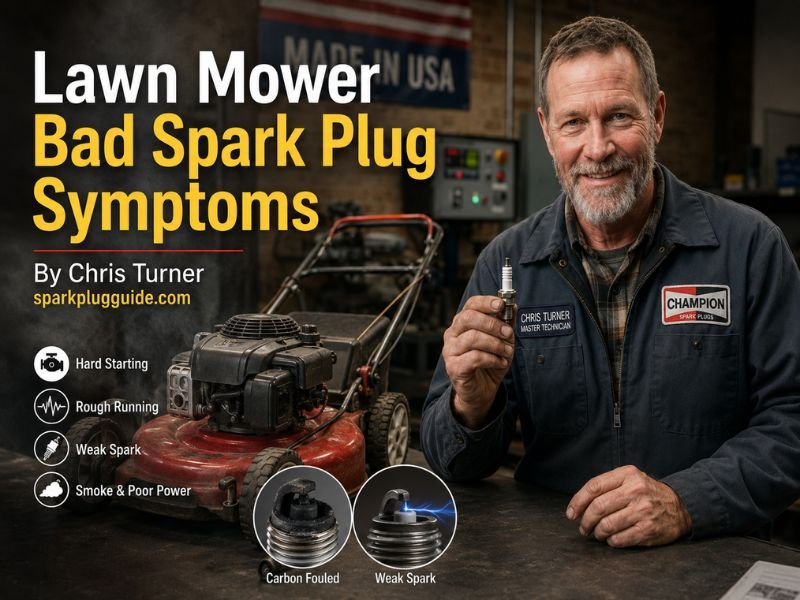
What Are the Most Common Lawn Mower Bad Spark Plug Symptoms?
The most common signs are difficulty starting, rough engine operation, misfiring, stalling, loss of power, poor fuel efficiency, and visible damage or deposits on the spark plug.
A single symptom may not prove that the spark plug has failed. The diagnosis becomes more reliable when several symptoms appear together or when the plug has visible damage.
The Lawn Mower Is Hard to Start
A lawn mower that suddenly requires more starter-rope pulls than usual may have a weak or fouled spark plug.
A healthy spark plug produces a strong electrical spark at the correct moment. That spark ignites the compressed air-fuel mixture and starts the engine.
When the plug becomes worn, contaminated, or incorrectly gapped, the spark may be too weak or inconsistent to ignite the mixture immediately. You may notice that:
- The mower takes several pulls to start.
- The engine starts only after repeated attempts.
- An electric-start mower cranks longer than normal.
- The mower starts more easily when the engine is cold or warm, but not both.
Hard starting alone does not confirm a bad spark plug. Old gasoline, a dirty carburetor, a blocked air filter, or a weak ignition coil can cause the same symptom.
However, the spark plug becomes a likely suspect when the mower previously started easily and the problem developed gradually.
The Engine Cranks but Does Not Start
Another common symptom is an engine that turns over but refuses to start.
On a pull-start mower, you may feel the engine rotating normally when pulling the recoil starter. On an electric-start mower, the starter may crank the engine, but combustion never begins.
This can happen when the spark plug:
- Is heavily covered with carbon deposits
- Is wet with gasoline or oil
- Has a cracked ceramic insulator
- Has badly worn electrodes
- Has an incorrect electrode gap
- Cannot produce a strong spark
The engine needs fuel, air, compression, and ignition to run. If fuel reaches the cylinder but the spark plug does not ignite it, the engine may crank continuously without starting.
A loose or disconnected spark plug boot can create the same symptom. Before removing the plug, make sure the wire is firmly attached.
The Engine Runs Rough or Sputters
A bad spark plug may cause the lawn mower engine to run unevenly after it starts.
Instead of producing a steady engine sound, the mower may shake, hesitate, or sputter. Engine speed may rise and fall without any change in throttle position.
This happens because the plug is not igniting every combustion cycle consistently. Some cycles burn normally, while others produce weak or incomplete combustion.
Common signs of rough running include:
- An uneven engine rhythm
- Noticeable vibration
- Brief drops in engine speed
- Sputtering during operation
- Hesitation when the mower encounters thicker grass
- An engine that sounds like it is repeatedly skipping
A dirty carburetor or restricted fuel flow can also make a mower surge or sputter. The spark plug is more likely to be involved when rough running appears together with hard starting, misfires, or visible plug fouling.
The Lawn Mower Misfires or Makes Popping Sounds
A misfire occurs when the air-fuel mixture inside the combustion chamber fails to ignite correctly.
A weak or inconsistent spark plug may cause occasional missed combustion cycles. You may hear irregular popping sounds from the engine or exhaust.
Other possible signs include:
- Brief hesitation
- Sudden interruptions in engine power
- Uneven exhaust sounds
- Intermittent popping
- Increased vibration
A small-engine misfire may be more noticeable when the mower is under load. For example, the engine may sound normal while idling but begin missing when cutting dense or wet grass.
Not every popping sound is caused by the spark plug. Incorrect fuel mixture, ignition timing problems, a sticking valve, or an overheated engine can also cause popping or backfiring.
The spark plug is a stronger suspect when the popping is accompanied by a worn electrode, heavy deposits, or a weak spark-test result.
The Mower Starts and Then Stalls
A failing spark plug may allow the engine to start but prevent it from continuing to run reliably.
The mower may operate for a few seconds or minutes before shutting off. In some cases, the engine may restart after several pulls. In others, it may restart only after cooling down.
This pattern can occur when the plug produces a spark intermittently. The spark may be strong enough to start the engine but become unreliable as the engine vibrates or heats up.
You may notice that the mower:
- Starts normally and dies shortly afterward
- Runs unevenly before stopping
- Stalls when the blade encounters resistance
- Restarts after cooling
- Requires repeated starting attempts during one mowing session
A failing ignition coil, blocked fuel-cap vent, dirty carburetor, or restricted fuel supply can cause similar stalling.
If the plug is visibly cracked, heavily fouled, or badly worn, it should be replaced before investigating more complex causes.
The Engine Loses Power While Cutting Grass
A lawn mower with a bad spark plug may run but fail to produce its normal power.
The mower may work acceptably on a driveway or short grass but struggle when the blade encounters thicker growth.
Common signs of power loss include:
- The engine bogs down more easily.
- Blade speed drops in thicker grass.
- The mower takes longer to cut the same area.
- The engine hesitates when load increases.
- The mower can no longer handle grass it previously cut without difficulty.
The spark plug helps convert the air-fuel mixture into controlled combustion. If ignition is weak or inconsistent, the engine produces less usable power.
Power loss is not exclusive to spark plug problems. A dirty air filter, dull blade, clogged mower deck, poor-quality fuel, or carburetor problem may also reduce performance.
The spark plug becomes a more likely cause when power loss occurs with hard starting, rough running, or misfiring.
Fuel Consumption Increases
A bad lawn mower spark plug can contribute to increased fuel consumption.
When the plug does not ignite the air-fuel mixture completely, some fuel may leave the combustion chamber without producing useful power. The engine must consume more gasoline to perform the same amount of work.
You may notice:
- The fuel tank needs refilling more often.
- The mower runs for less time on a full tank.
- Fuel usage increases without a change in mowing conditions.
- The exhaust has a stronger gasoline smell.
- The engine runs poorly despite using more fuel.
Increased fuel consumption can also be caused by an overly rich fuel mixture, a dirty air filter, carburetor problems, or fuel leakage.
A bad plug is more likely when higher fuel use appears with soot deposits, misfires, or rough engine performance.
The Exhaust Smells Strongly of Gasoline
A strong gasoline smell from the exhaust may indicate that fuel is entering the combustion chamber but is not burning completely.
A weak, fouled, or damaged spark plug may fail to ignite some of the fuel. The unburned gasoline then passes into the exhaust system.
Possible signs include:
- A raw gasoline smell near the exhaust
- A wet spark plug tip
- Difficult starting after repeated pulls
- Dark exhaust smoke
- Engine flooding
- Rough running after startup
A strong gasoline smell can also result from a rich carburetor mixture, repeated use of the choke, or excessive priming.
If gasoline is leaking from the fuel tank, hose, carburetor, or primer system, stop using the mower until the leak is repaired. A spark plug problem may cause unburned fuel in the exhaust, but it does not normally cause an external fuel leak.
The Spark Plug Has Visible Damage or Deposits
The physical condition of the plug can provide useful evidence.
After removing the plug, inspect the electrodes, ceramic insulator, threads, and firing tip.
Visible signs of a bad lawn mower spark plug may include:
- Dry black carbon deposits
- Wet gasoline
- Oily deposits
- Rounded electrodes
- Burned electrodes
- Cracked porcelain
- Chipped ceramic
- An excessively wide gap
- Heavy deposits that cannot be removed
A plug with light deposits may sometimes be cleaned and reused if the electrodes and insulator remain undamaged. A plug with cracked porcelain, severe electrode wear, or heavy fouling should be replaced.
Lawn Mower Bad Spark Plug Symptoms at a Glance
| Symptom | What You May Notice | Why a Bad Plug Can Cause It |
| Hard starting | Multiple pulls or long cranking | A weak spark delays ignition |
| No start | The engine turns but does not run | The air-fuel mixture does not ignite |
| Rough running | Shaking, sputtering, or uneven sound | The spark fires inconsistently |
| Misfiring | Hesitation or occasional popping | Some combustion cycles are missed |
| Stalling | The mower starts and then stops | The spark becomes intermittent |
| Power loss | The engine bogs down under load | Incomplete combustion reduces output |
| Higher fuel use | More frequent refilling | Fuel does not burn efficiently |
| Gasoline smell | Raw fuel odor from the exhaust | Some fuel remains unburned |
| Visible damage | Deposits, cracks, or worn electrodes | The plug cannot produce a reliable spark |
What Does a Bad Lawn Mower Spark Plug Look Like?
A bad lawn mower spark plug may appear black, wet, oily, burned, cracked, or physically worn.
The exact appearance can provide clues about the condition of the plug, although it may also reveal a separate engine or fuel problem.
Dry Black Carbon Deposits
A plug covered with dry, powdery black soot is often described as carbon-fouled.
The deposits may create an electrical path that prevents the spark from jumping cleanly across the electrode gap. This can lead to hard starting, rough running, and misfires.
Carbon deposits may develop because of:
- An overly rich air-fuel mixture
- A dirty or restricted air filter
- Repeated short operating periods
- Excessive choke use
- A plug with the wrong heat range
- Extended low-speed operation
Cleaning may temporarily restore a lightly fouled plug. However, if the black deposits return quickly, the underlying cause must be identified.
A Wet Spark Plug Tip
A wet plug may be covered with gasoline, engine oil, or moisture.
A plug wet with gasoline often indicates that fuel is entering the cylinder but is not igniting. This may happen after repeated unsuccessful starting attempts.
A plug wet with oil may indicate oil entering the combustion chamber. Oil fouling can prevent the plug from producing a strong spark.
A wet plug should not automatically be blamed for the problem. The moisture may be a result of failed starting rather than the original cause.
Worn or Rounded Electrodes
New spark plug electrodes have defined edges that help concentrate the electrical charge.
As the plug wears, these edges become rounded or eroded. The gap may also become wider.
A worn plug may require more voltage to create a spark. The ignition system may still fire the plug under ideal conditions but struggle during startup or under engine load.
Worn electrodes are a strong reason to replace the plug rather than clean it.
Cracked or Chipped Porcelain
The white ceramic section of a spark plug is the porcelain insulator.
A visible crack or chip can allow electrical energy to escape before it reaches the electrode gap. This may cause weak ignition, intermittent misfires, or complete loss of spark.
Do not attempt to repair a plug with cracked porcelain. Replace it with the exact plug type specified for the mower engine.
Burned, White, or Blistered Tip
A spark plug with a very white, blistered, melted, or burned firing tip may have been exposed to excessive heat.
The electrodes may appear thin, distorted, or damaged. The ceramic may also look glazed.
An overheated plug should be replaced. The engine should also be checked for conditions that could cause excessive temperature, such as an incorrect plug type, cooling restriction, or lean fuel mixture.
How to Confirm That the Spark Plug Is Causing the Symptoms
I confirm a suspected bad lawn mower spark plug by checking its connection, inspecting its physical condition, verifying the gap, and testing whether the ignition system produces a consistent spark.
Always turn off the mower, allow the engine to cool, and disconnect the spark plug wire before working near the blade or engine components.
Check the Spark Plug Wire and Boot
Before removing the plug, inspect the spark plug wire and rubber boot.
The boot should fit firmly over the top terminal of the spark plug. A loose connection may interrupt the electrical path and imitate a failed plug.
Look for:
- A loose spark plug boot
- Cracked insulation
- Corrosion inside the connector
- A damaged terminal
- A wire touching a hot engine surface
- Dirt or moisture around the connection
Push the boot firmly onto the plug after inspection.
If the boot or wire is damaged, replacing the spark plug alone may not correct the symptoms.
Remove and Inspect the Spark Plug
Clean loose debris from the area around the spark plug before removing it. This helps prevent dirt from falling into the cylinder.
Use the correct spark plug socket and carefully loosen the plug.
Inspect the plug for:
- Black carbon deposits
- Wet gasoline
- Oil contamination
- Cracked ceramic
- Burned electrodes
- Rounded electrode edges
- Damaged threads
- Heavy corrosion
A lightly dirty plug may sometimes be cleaned. A physically damaged or badly worn plug should be replaced.
Check the Spark Plug Gap
The spark plug gap is the distance between the center electrode and ground electrode.
If the gap is too wide, the ignition system may struggle to produce a spark. If it is too narrow, the spark may be too small to ignite the mixture efficiently.
Use a proper gap gauge and compare the measurement with the specification in the lawn mower or engine owner’s manual.
Do not assume that every lawn mower uses the same gap. The correct measurement depends on the engine model and spark plug type.
Test for Spark Safely
A proper inline spark tester can help determine whether the ignition system is producing a spark.
Install the tester according to its instructions and keep hands, clothing, and tools away from moving engine parts.
A visible, consistent spark suggests that the ignition circuit is functioning. A weak, intermittent, or missing spark may involve:
- The spark plug
- The spark plug wire
- The ignition coil
- The engine stop switch
- Damaged wiring
- A safety interlock
A no-spark result does not automatically prove that the plug is defective. Additional ignition-system testing may be required.
Compare Performance With a Correct New Plug
Installing a new, manufacturer-specified spark plug is often the simplest practical comparison.
If the mower starts more easily, runs smoothly, and regains power after the correct plug is installed, the old spark plug was likely contributing to the symptoms.
If nothing changes, the problem may involve fuel delivery, airflow, compression, wiring, or the ignition coil.
Always use the plug model and gap specified for the exact mower engine.
Bad Spark Plug or Another Lawn Mower Problem?
Several lawn mower problems can imitate the symptoms of a bad spark plug.
| Possible Problem | Clues That May Point Away From the Spark Plug |
| Stale or contaminated fuel | The mower was stored for months or contains old gasoline |
| Clogged carburetor | The engine runs only with choke or starting fluid |
| Dirty air filter | Airflow is restricted or dark smoke is present |
| Loose spark plug wire | The plug looks normal but the electrical connection is intermittent |
| Failing ignition coil | Spark disappears after the engine becomes hot |
| Blocked fuel-cap vent | The mower runs briefly and restarts after the fuel cap is loosened |
| Low compression | The pull cord feels unusually easy and engine pressure is weak |
| Clogged mower deck | Engine power drops only when grass builds under the deck |
| Dull mower blade | Cutting performance is poor even though the engine sounds normal |
A symptom does not confirm a failed spark plug by itself.
The diagnosis becomes stronger when performance problems appear together with visible plug damage, severe fouling, an incorrect gap, or a failed spark test.
When Should a Lawn Mower Spark Plug Be Replaced?
A lawn mower spark plug should be replaced when it is physically damaged, severely fouled, badly worn, or no longer produces a reliable spark.
Replacement is usually appropriate when the plug has:
- A cracked ceramic insulator
- A chipped porcelain body
- Burned or eroded electrodes
- Rounded electrode edges
- Heavy deposits that cannot be removed
- Damaged threads
- An electrode gap that cannot be corrected
- Repeated fouling
- Weak or inconsistent spark
- Symptoms that disappear after installing a new plug
The replacement interval varies by engine manufacturer and operating conditions. Follow the maintenance schedule in the mower or engine owner’s manual rather than relying on one universal replacement interval.
A plug that repeatedly becomes black, wet, or oily may indicate another problem. Replacing it may restore operation temporarily, but the underlying cause should still be corrected.
Can You Continue Using a Lawn Mower With a Bad Spark Plug?
A mower may continue running with a weak spark plug, but starting, power, fuel efficiency, and reliability can progressively worsen.
The mower may stall unexpectedly, misfire under load, consume more gasoline, or become impossible to restart.
Repeated starting attempts can also flood the engine with fuel. Unburned gasoline may foul the replacement plug if the original cause is not corrected.
Replace the plug before further use when it has:
- Cracked porcelain
- Loose internal components
- Melted electrodes
- Severe corrosion
- Heavy oil fouling
- Damaged threads
Continuing to operate a mower with a damaged plug offers no practical benefit. A correct replacement plug is usually inexpensive and easier to install than many other ignition components.
Frequently Asked Questions
Can a Bad Spark Plug Cause a Lawn Mower Not to Start?
Yes. A bad spark plug can prevent a lawn mower from starting if it is fouled, cracked, badly worn, incorrectly gapped, or unable to produce a strong spark.
However, a no-start condition may also involve stale fuel, a dirty carburetor, a loose plug wire, low compression, a safety switch, or a failing ignition coil.
Can a Bad Spark Plug Cause a Lawn Mower to Start and Then Die?
Yes. An intermittent spark may allow the engine to start but cause it to stall shortly afterward.
However, the same pattern can result from restricted fuel flow, a blocked fuel-cap vent, carburetor contamination, or an ignition coil that fails when hot. Inspecting the plug and testing for spark can help narrow down the cause.
What Does a Lawn Mower With a Bad Spark Plug Sound Like?
A lawn mower with a bad spark plug may sound uneven, rough, or inconsistent.
You may hear sputtering, brief hesitation, missed combustion, irregular exhaust pulses, or occasional popping. There is no single sound that confirms a bad plug, so the sound should be considered together with starting problems and visible plug condition.
Can a Bad Spark Plug Cause Lawn Mower Smoke?
A bad spark plug may contribute to dark exhaust or a strong gasoline smell when fuel does not burn completely.
However, smoke can also result from too much oil, oil entering the cylinder, a dirty air filter, excessive choke use, or carburetor problems. The smoke color and plug condition can provide additional clues.
How Do I Know Whether the Spark Plug or Carburetor Is Bad?
A spark plug problem is more likely when the plug is cracked, heavily fouled, worn, incorrectly gapped, or unable to produce a consistent spark.
A carburetor problem is more likely when the engine runs only with the choke engaged, starts briefly with starting fluid, or shows clear signs of restricted fuel delivery.
Both problems can occur at the same time.
Can Cleaning a Spark Plug Fix the Symptoms?
Cleaning may restore a spark plug with light, dry deposits if the electrodes and ceramic insulator are still in good condition.
Cleaning will not repair cracked porcelain, burned electrodes, severe corrosion, internal damage, or advanced wear. A plug that quickly becomes dirty again may indicate a rich fuel mixture, oil consumption, or another engine problem.
Conclusion
Lawn mower bad spark plug symptoms include hard starting, repeated starter-rope pulls, rough running, misfires, stalling, power loss, increased fuel use, and visible spark plug damage.
A single symptom does not always prove that the plug has failed. Fuel, carburetor, air-filter, wiring, ignition-coil, and compression problems can cause similar behavior.
I recommend checking the spark plug wire, removing and inspecting the plug, confirming the correct electrode gap, and testing for a consistent spark. A plug with cracked porcelain, severe deposits, burned electrodes, or excessive wear should be replaced with the exact type specified by the engine manufacturer.
When the mower starts more easily and runs normally after the correct new plug is installed, the old spark plug was likely the source of the problem.
এটি publication-ready draft। Final upload-এর আগে site-specific internal links এবং author bio যোগ করতে হবে।