
If you are wondering are Autolite glow plugs any good, the answer is that they are legitimate aftermarket glow plugs and can work properly when correctly matched to the diesel engine, but I would be cautious about using them in some older Ford diesel applications where Motorcraft/Beru plugs have a stronger reputation. Autolite currently sells glow plugs for passenger-car and light-truck diesels and describes them as using nickel-chrome heating material, sheathed coil heaters, and nickel-plated threads.
The complication is that Autolite glow plugs have developed a mixed reputation among diesel owners. Long-running Ford diesel communities, particularly those discussing older 6.9L/7.3L IDI and 7.3L Power Stroke engines, contain repeated reports of Autolite plugs burning out prematurely or developing swollen tips that make removal difficult. Those reports are anecdotal rather than controlled failure-rate data, so they should not be treated as proof that every current Autolite glow plug is defective. Still, the pattern is strong enough that I would give it serious consideration on engines known for difficult glow plug removal.
For many diesel engines, the safest approach is to use the glow plug brand and technology originally specified by the engine manufacturer, especially when access is difficult. A glow plug that costs a few dollars less is not much of a bargain if it swells, breaks during removal, or forces additional cylinder-head work.
In this guide, I’ll explain how good Autolite glow plugs are, why opinions about them are mixed, whether they are suitable for Power Stroke diesels, how long glow plugs should last, what makes a good glow plug, and when alternatives such as Motorcraft, Beru, Bosch, or NGK may be a better choice.
What Are Autolite Glow Plugs?
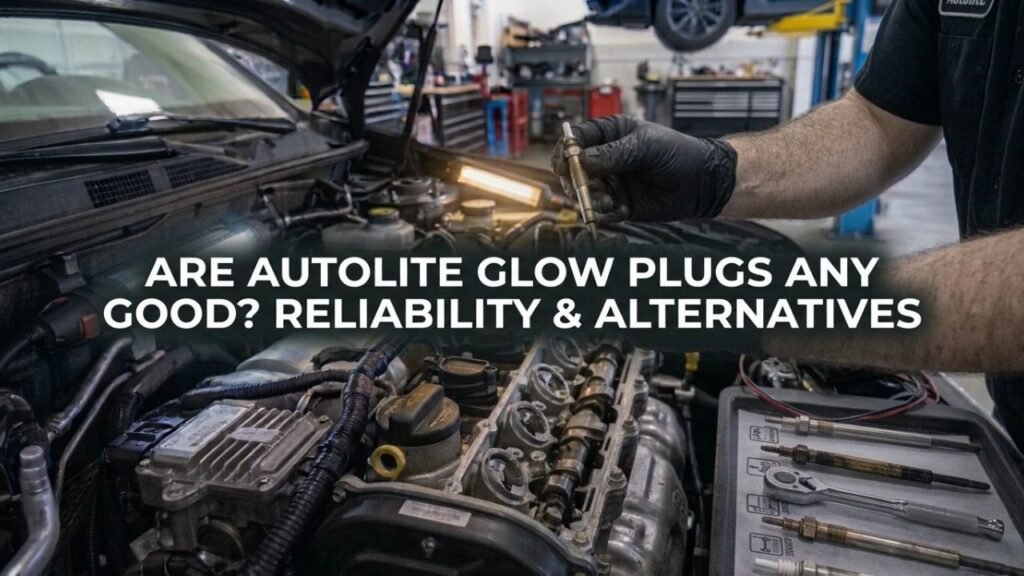
Autolite is best known for spark plugs, but the company also sells glow plugs for diesel engines.
Glow plugs are electrically heated elements installed in the cylinder head. During cold starting, they increase combustion-chamber temperature so compressed diesel fuel can ignite more reliably.
Autolite’s current glow plug line uses a nickel-chrome alloy heating element and a sheathed coil design intended to heat quickly. The company also advertises precision-machined nickel-plated threads to assist installation.
Those are normal, legitimate glow plug design features.
There is nothing inherently unusual about Autolite’s basic approach to glow plug construction.
The important issue is whether the particular plug is correctly designed for your engine’s electrical system, temperature requirements, physical dimensions, and glow plug controller.
Are Autolite Glow Plugs Good Quality?
I would describe Autolite glow plugs as a mainstream aftermarket option rather than automatically labeling them either excellent or poor.
Autolite is an established ignition-parts brand, and its current product catalog includes glow plugs specifically designed for diesel passenger cars and light trucks.
However, glow plug quality cannot be judged entirely from the brand name.
The plug must match the engine in several critical areas:
voltage, electrical resistance, heating speed, thread size, reach, tip length, temperature characteristics, and controller compatibility.
Even a well-made glow plug can perform poorly if one of those characteristics does not match the engine.
Application Matters More Than Price
Suppose two glow plugs both thread perfectly into the cylinder head.
That does not mean they are interchangeable.
One may be designed to reach operating temperature more quickly.
Another may operate at a different voltage.
A different tip length may place the heating element farther into the prechamber or combustion area.
These differences can affect starting performance and durability.
This is why you should select Autolite glow plugs through an application catalog rather than by appearance.
Key Takeaways:
- Autolite currently produces legitimate aftermarket glow plugs for passenger-car and light-truck diesel applications.
- Correct voltage, reach, heating characteristics, and controller compatibility matter more than brand name alone.
- I would be more cautious with Autolite in certain older Ford diesels because of their longstanding reputation in those owner communities.
Why Do Autolite Glow Plugs Have a Mixed Reputation?
Much of the negative reputation comes from older Ford diesel engines.
Owners and technicians discussing 6.9L and 7.3L Ford diesels have repeatedly warned about certain aftermarket glow plugs developing swollen heating tips.
When a glow plug tip swells after repeated heating cycles, the plug may unscrew from the threads but refuse to come out of the cylinder head.
That creates a difficult situation.
Pulling harder can potentially break the tip.
A broken portion may remain inside the head or, depending on the failure, present a risk of entering the combustion chamber.
Are the Swelling Reports Real?
There are numerous owner reports describing this problem, particularly in Ford diesel communities.
For example, older Ford Truck Enthusiasts discussions repeatedly recommend Motorcraft/Beru over Autolite for 7.3L applications and specifically mention swelling and premature burnout. A recent 2026 Power Stroke community discussion still included the same warning about encountering Autolite plugs with swollen tips.
However, there is an important limitation.
Forum reports are not the same as controlled reliability statistics.
They often involve older plug designs, unknown installation history, controller problems, incorrect part selection, excessive glow time, or engines that have been modified.
Therefore, I would not conclude that every modern Autolite glow plug will swell.
The more reasonable conclusion is that the brand has enough negative history in certain Ford diesel applications that an OEM-style alternative may be the lower-risk choice.
Are Autolite Glow Plugs Good for a 7.3 Power Stroke?
This is one application where I would generally choose Motorcraft/Beru instead.
The 7.3L Power Stroke has a large owner community and a long maintenance history.
Within that community, Motorcraft glow plugs have consistently been recommended over various aftermarket options.
Autolite has frequently been singled out in older discussions because of reported short life and swollen tips.
That matters because glow plug replacement on a 7.3 Power Stroke requires removing valve covers and working beneath the valve-cover gasket/harness area.
Saving a modest amount on plugs becomes less attractive when you consider the labor involved in doing the job again.
Why Motorcraft/Beru Is Popular on the 7.3
OEM-style plugs have a long track record with the engine’s glow plug control system and physical cylinder-head design.
That established compatibility is valuable.
When I am working with a component that can potentially become difficult to remove if it fails mechanically, I prefer the plug with the strongest proven application history.
That does not mean an Autolite glow plug cannot start a 7.3 successfully.
It means the risk-versus-savings calculation favors the proven OEM-style option.
Are Autolite Glow Plugs Good for a 7.3 IDI?
I would use similar caution.
The naturally aspirated and turbocharged 7.3 IDI engines also rely heavily on glow plug condition for cold starting.
Their glow plug controllers are sensitive to the electrical characteristics of the plugs.
Older Ford diesel discussions frequently recommend Motorcraft/Beru plugs for these engines and warn against Autolite alternatives.
A plug that heats differently from what the controller expects can potentially affect controller cycling.
In an older vehicle, the controller, wiring resistance, battery condition, and glow plug harness may already be less than perfect.
Using the known correct plug removes one additional variable from the system.
Are Autolite Glow Plugs Good for a 6.0 Power Stroke?
I would again lean toward the factory-recommended Motorcraft-style glow plug.
The 6.0L Power Stroke uses a more electronically controlled glow plug system than older Ford diesels.
Correct electrical characteristics are essential.
There are also anecdotal technician reports of Autolite glow plugs showing tip problems in 6.0L applications. One widely discussed example involved newly installed plugs that appeared damaged after very limited use, although one case cannot establish the reliability of an entire product line.
Because a 6.0 Power Stroke already has a well-established OEM plug specification, there is little reason for me to experiment simply to save a small amount of money.
What Makes a Good Glow Plug?
A good glow plug needs to do much more than become hot.
It must reach the correct temperature at the correct rate.
It must survive thousands of heating cycles.
It must resist combustion pressure and extreme temperature changes.
Its heating tip must remain mechanically stable.
And its resistance has to work correctly with the vehicle’s glow plug controller.
Fast Heating
Modern diesel engines may require glow plugs to reach extremely high temperatures quickly.
Faster heating improves cold-start performance and reduces the amount of time the driver needs to wait before cranking.
Autolite specifically promotes its nickel-chrome alloy and sheathed heating coil as providing rapid preheating.
Stable Tip Construction
This is particularly important.
The heating tip must retain its original shape after repeated thermal cycling.
If it swells excessively, removal becomes difficult.
If it cracks or separates, the consequences can be much more serious.
Correct Electrical Resistance
Glow plugs operate as part of an electrical system rather than independently.
The control module or relay may use current draw or resistance to determine system operation.
A plug whose characteristics differ substantially from the OEM design can potentially affect the system even if it becomes hot.
Corrosion Resistance
Glow plugs remain threaded into the cylinder head for years.
Heat, combustion deposits, moisture, and dissimilar metals can make removal difficult.
Quality thread construction and corrosion-resistant surface treatment help.
Autolite currently advertises precision-machined nickel-plated threads on its glow plug line.
Autolite vs. Motorcraft Glow Plugs
For Ford diesel engines, Motorcraft usually gets my preference.
That is not because every Motorcraft part is automatically superior to every aftermarket component.
It is because Motorcraft provides a straightforward path to the plug specification around which the Ford system was designed.
This becomes particularly important on older Ford diesels where Autolite has accumulated a less favorable owner reputation.
| Factor | Autolite | Motorcraft |
| Type | Aftermarket replacement | Ford OEM/service brand |
| Ford diesel application history | Mixed owner feedback | Strong established reputation |
| Availability | Generally good | Generally good |
| Price | Often competitive | May cost somewhat more |
| Older Ford diesel preference | Not my first choice | Usually my preferred choice |
| Exact fitment required | Yes | Yes |
If the price difference for eight glow plugs is modest, I would rather pay slightly more once than take unnecessary risk on a labor-intensive installation.
Key Takeaways:
- On older Ford diesels, Motorcraft/Beru has the stronger application-specific reputation.
- Autolite can be a legitimate replacement, but saving a small amount may not justify extra risk where removal is difficult.
- Never assume one Autolite part works across several diesel engines simply because the threads match.
Autolite vs. Beru Glow Plugs
Beru has a strong reputation in diesel cold-start systems and has long been associated with OEM-style glow plug applications.
For engines where a Beru plug is the original or recognized OE supplier, I generally prefer staying with it.
Glow plugs are inexpensive relative to the labor and potential complications of removal.
If you have to remove intake components, valve covers, or other hardware to access them, using a proven OE-equivalent plug makes sense.
Autolite becomes more attractive when its catalog specifically covers the engine and there is no known application-specific concern.
Autolite vs. Bosch Glow Plugs
Bosch also has extensive diesel fuel and cold-start experience.
For many European diesel applications, Bosch may be an OEM or well-established replacement choice.
I would not choose between Bosch and Autolite based solely on brand reputation.
Check what the engine originally used.
If Bosch is the known OE-style plug for your diesel, I would generally stay with Bosch.
If Autolite has the proper application and is readily available, it may work perfectly well.
The exact engine matters more than creating a universal brand ranking.
Autolite vs. NGK Glow Plugs
NGK/NTK also produces diesel glow plugs for numerous applications.
As with Bosch and Beru, I would prioritize the plug whose specifications most closely match the original application.
Different glow plug brands can use different heating-element technologies.
That makes cross-referencing more sensitive than simply matching thread diameter.
A properly specified Autolite is better than an incorrect NGK, and a correctly specified NGK is better than an incorrect Autolite.
How Long Do Autolite Glow Plugs Last?
There is no reliable universal mileage at which every Autolite glow plug should fail or be replaced.
Glow plugs operate during cold-start cycles rather than simply according to miles driven.
A vehicle making several cold starts every day can accumulate far more glow plug heating cycles than a long-distance highway vehicle with the same mileage.
Modern systems may also use post-glow operation after the engine has started.
That increases operating time.
Factors That Affect Glow Plug Life
Controller operation is especially important.
If a glow plug remains energized too long, it can overheat.
Low battery voltage and poor connections can affect system performance.
Engine deposits may also influence plug temperature and removal difficulty.
Repeated short trips in extremely cold weather create a very different duty cycle from warm-climate highway driving.
Therefore, I would replace glow plugs based on diagnosis, manufacturer guidance, and overall condition rather than relying on a generic mileage claim.
How Can You Tell If an Autolite Glow Plug Is Bad?
The symptoms are the same as with other brands.
A diesel may become difficult to start when cold.
It may crank longer than normal.
Once started, it may run roughly for several seconds.
White or gray smoke may appear from partially burned diesel fuel during the first moments after startup.
A glow plug or check-engine warning may also appear.
However, those symptoms do not automatically prove the glow plug itself has failed.
Test the Electrical System
Glow plugs can be checked using resistance measurements, current-draw testing, or scan-tool diagnostics depending on engine design.
Because glow plug resistance is extremely low, cheap meters and poor meter-lead contact can make readings misleading.
Compare plugs on the same engine and use the manufacturer’s specification where available.
The wiring harness and glow plug control module should also be tested.
Can One Bad Glow Plug Cause Hard Starting?
Yes, particularly in very cold weather.
Many diesel engines will still start with one failed plug, but the affected cylinder may not begin firing cleanly immediately.
The engine may shake or smoke for several seconds.
Two or more failed plugs make cold starting progressively more difficult.
In warmer weather, you may not notice the problem at all.
This is why glow plug faults sometimes appear suddenly when winter arrives even though the plug may have failed months earlier.
Should You Replace All Autolite Glow Plugs at Once?
If several are old and one has failed from normal wear, replacing the full set can make sense.
However, removal risk matters.
If an engine has known concerns about glow plug swelling or breakage, I would not automatically disturb seven healthy plugs solely because one electrical test failed.
First determine what plugs are installed.
If you discover older Autolite plugs in an application known for swelling concerns, proceed carefully.
Do not simply apply more force if one unscrews but refuses to come out.
A swollen tip may be hanging below the threaded section.
What Should You Do If an Autolite Glow Plug Is Stuck?
Do not force it.
This is particularly important if the threaded portion has already loosened.
A plug that rotates but will not withdraw may have carbon buildup or an enlarged heating tip.
Pulling aggressively can break it.
Specialized extraction methods may be required.
Depending on the engine, technicians may use penetrating products, controlled back-and-forth movement, specialized pullers, or other procedures to remove a stuck plug.
If you suspect the heating tip has swollen significantly, professional removal may be cheaper than dealing with a broken piece inside the cylinder head.
Can Autolite Glow Plugs Swell?
There is a longstanding history of owner reports describing swollen Autolite glow plug tips, particularly in older Ford diesel applications.
I would not extrapolate those anecdotes to every Autolite glow plug manufactured today.
Products change.
Applications differ.
Failures can also be influenced by incorrect controller operation and overheating.
But if you are specifically servicing an older Ford 6.9L or 7.3L diesel, the reputation is relevant enough that I would favor Motorcraft/Beru replacements.
Are Autolite Glow Plugs Cheap Because They Are Low Quality?
Not necessarily.
Aftermarket pricing depends on manufacturing volume, distribution, branding, retail markup, and application.
A lower price does not prove poor quality.
At the same time, glow plugs are not a component where I would prioritize saving the maximum possible amount.
The plug itself is relatively inexpensive.
The labor required to reach it—and the potential difficulty of extracting a failed plug—is where the real cost lies.
If an OE plug costs moderately more but has a stronger track record in the engine, I view the price difference as inexpensive insurance.
Key Takeaways:
- Glow plug lifespan depends heavily on cold-start cycles, controller behavior, engine condition, and climate.
- Never force a glow plug that loosens but will not withdraw from the head.
- The small savings from cheaper plugs can disappear quickly if one becomes difficult to remove.
Do Autolite Glow Plugs Need Anti-Seize?
Do not automatically apply anti-seize.
Autolite currently describes its glow plug threads as nickel-plated, which is relevant because surface coatings affect corrosion resistance and installation friction.
Adding anti-seize changes thread friction.
That can change the actual clamping force produced by a particular torque-wrench reading.
Follow the glow plug or vehicle manufacturer’s installation instructions.
If dry installation is specified, install them dry.
If a particular compound is required, use exactly what is specified.
How Tight Should Autolite Glow Plugs Be?
Use the engine-specific torque specification.
Do not tighten them by feel unless no alternative exists.
Glow plugs are slender components, and many use relatively low torque values.
Overtightening can damage the plug or cylinder-head threads.
It may also make future removal more difficult.
A small, accurate torque wrench is preferable to a large torque wrench operating at the extreme bottom of its range.
Should You Buy Autolite Glow Plugs?
For a general diesel application where Autolite specifically catalogs the correct part and there is no known engine-specific concern, I would consider them a reasonable aftermarket option.
For certain older Ford diesels, I would choose differently.
On engines such as the 6.9L/7.3L IDI and 7.3L Power Stroke, I would generally buy the proper Motorcraft/Beru plug because of its strong application history and the repeated negative experiences associated with some Autolite plugs in those communities.
For European diesels, I might prefer Bosch or Beru if those are the established OE suppliers.
The goal is not to find the universally “best” glow plug brand.
The goal is to use the plug that has the correct electrical characteristics, physical dimensions, heating behavior, and proven track record in your specific engine.
Common Mistakes When Buying Glow Plugs
The biggest mistake is selecting by price alone.
A glow plug is not simply a threaded heater.
Another mistake is using an online cross-reference without confirming the exact engine code and model year.
Different versions of the same diesel engine family may use different plugs.
Do not assume a hotter or faster-heating glow plug is an upgrade.
The glow plug controller was designed around specific heating characteristics.
An incompatible plug can shorten its own life or prevent the system from operating correctly.
Finally, do not replace glow plugs before testing the controller and harness.
Eight new plugs cannot fix a relay or module that is not supplying power.
FAQs about Are Autolite Glow Plugs Any Good
Are Autolite glow plugs any good?
Yes, they can be satisfactory aftermarket glow plugs when correctly matched to the engine. However, they have a mixed reputation in certain older Ford diesel applications, where I generally prefer Motorcraft/Beru.
Are Autolite glow plugs reliable?
Reliability depends on the exact application and operating conditions. Autolite currently manufactures dedicated diesel glow plugs, but there are longstanding owner reports of problems with some older Ford applications.
Do Autolite glow plugs swell?
There are numerous anecdotal reports of swollen Autolite glow plug tips in older Ford diesels. That does not prove every current Autolite plug has the problem, but it is worth considering for those engines.
Are Autolite glow plugs good for a 7.3 Power Stroke?
I would generally use the correct Motorcraft/Beru glow plug instead. It has a stronger reputation and long application history in the 7.3 Power Stroke.
Are Autolite glow plugs good for a 7.3 IDI?
They may function, but Motorcraft/Beru is generally the more conservative choice due to longstanding concerns about aftermarket plug swelling and controller compatibility.
Are Autolite glow plugs good for a 6.0 Power Stroke?
I would favor the factory-specified Motorcraft-style plug. Correct electrical and physical characteristics are particularly important on electronically controlled glow systems.
Are Motorcraft glow plugs better than Autolite?
For Ford diesel engines, I generally prefer Motorcraft because of its application-specific track record and OEM compatibility.
Are Bosch glow plugs better than Autolite?
It depends on the engine. Bosch is an established OEM-style supplier for many diesels. If your engine originally uses Bosch, I would normally stay with that specification.
Are Beru glow plugs good?
Yes. Beru has a strong reputation in diesel glow systems and is often an excellent OE-style choice where specified.
How long do Autolite glow plugs last?
There is no universal lifespan. Cold-start cycles, control-system operation, engine condition, and climate influence glow plug life considerably.
Can one bad Autolite glow plug cause hard starting?
Yes. One failed glow plug can make a diesel start rougher in cold weather, while several failed plugs can cause extended cranking or failure to start.
Should I replace all glow plugs at once?
It may make sense if all plugs are the same age and easy to remove. If removal carries a significant risk of breakage, replacing only confirmed failed plugs may sometimes be preferable.
Can a bad glow plug cause white smoke?
Yes. A cold cylinder that fails to ignite diesel fuel completely can produce white or gray exhaust smoke shortly after startup.
Should I put anti-seize on Autolite glow plugs?
Only if the engine or glow plug manufacturer specifies it. Added lubricant changes thread friction and can alter installation torque.
Can I mix Autolite and Motorcraft glow plugs?
An engine may physically run with different brands if all plugs have the correct electrical and dimensional specifications, but using a matched set is generally preferable, particularly on systems that monitor overall current or resistance.
Are expensive glow plugs worth it?
If the more expensive plug is the proven OEM design for an engine with difficult access, the additional cost is usually easy to justify.
Conclusion
So, are Autolite glow plugs any good? They are legitimate aftermarket diesel glow plugs and Autolite’s current products use features such as nickel-chrome heating material, sheathed coil heaters, and nickel-plated threads.
That means I would not dismiss the entire brand as universally poor.
However, application history matters.
Autolite glow plugs have a longstanding mixed reputation among owners of older Ford diesel engines, particularly because of reports involving premature failure and swollen tips that become difficult to remove. Those reports are anecdotal rather than controlled reliability statistics, but they are frequent enough that I would take them seriously when working on a 6.9L/7.3L IDI or 7.3L Power Stroke.
For those Ford applications, my preference is the correct Motorcraft/Beru glow plug.
For another diesel engine where Autolite specifically lists the correct replacement and the brand does not have a known application-specific issue, Autolite can be a reasonable aftermarket option.
Whichever brand you choose, verify the exact voltage, heating characteristics, thread size, reach, tip design, and controller compatibility.
My final recommendation is to prioritize proven engine-specific fitment over saving a few dollars. Glow plugs are relatively inexpensive, but a swollen or broken plug can turn a simple cold-start repair into a difficult cylinder-head job.