
If you are wondering are glow plugs and injectors the same, the answer is no. Glow plugs and fuel injectors are completely different diesel-engine components with different jobs. A glow plug is an electrical heating element that helps a cold diesel engine start, while a fuel injector sprays a precisely measured amount of diesel fuel into the combustion chamber.
A diesel engine may use both components in the same cylinder, which is one reason they are sometimes confused. On many engines, the glow plug and injector are mounted close together in the cylinder head. They can also cause some similar symptoms when they fail, including hard starting, rough running, white smoke, or poor cold performance.
Their operating principles, however, are very different.
The glow plug creates heat.
The injector delivers fuel.
Once the engine is warm, a diesel can usually continue running even if a glow plug is no longer heating properly. A failed injector is much more serious because the affected cylinder cannot receive the correct amount of fuel for normal combustion.
In this guide, I’ll explain the difference between glow plugs and injectors, how each part works, where they are located, how their symptoms compare, whether a diesel can run with either one failed, how they are tested, and how to tell which component may be causing your diesel problem.
What Is a Glow Plug?
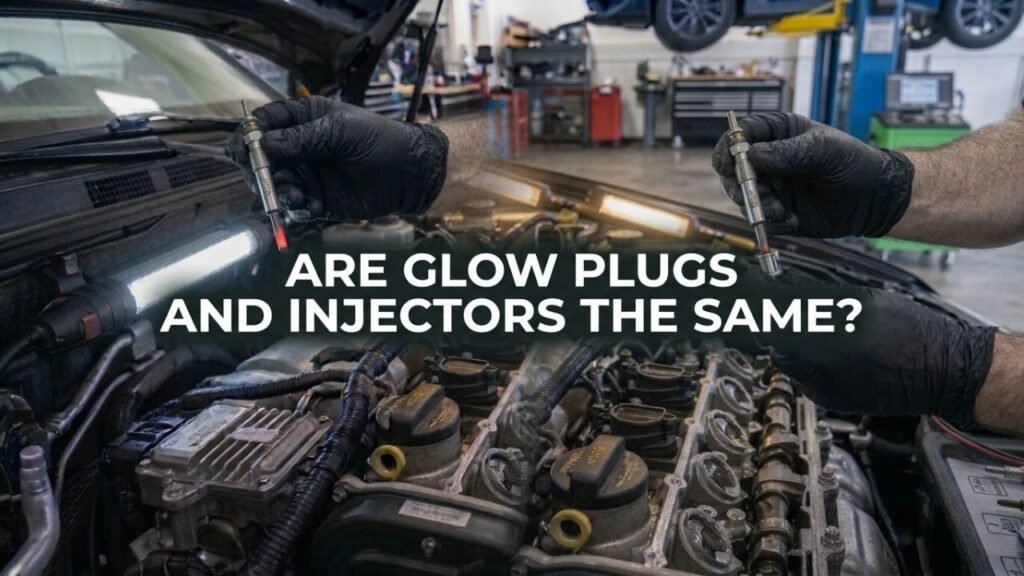
A glow plug is an electrical heater used in many diesel engines to help start combustion when the engine is cold.
Diesel engines operate by compression ignition.
Instead of using spark plugs to ignite an air-fuel mixture, a diesel engine compresses air until its temperature rises substantially. Fuel is then injected into that hot compressed air, where it ignites.
When the engine is cold, some of the heat created by compression is absorbed by the cold cylinder head, piston, and combustion-chamber surfaces.
This can make the first fuel injections difficult to ignite.
The glow plug solves this problem by providing extra heat inside or near the combustion chamber.
What Happens When You Turn the Key?
On a glow-plug-equipped diesel, the engine-control system may energize the plugs before the engine starts.
Electric current flows through a heating element inside each plug.
The tip becomes extremely hot.
When the starter begins cranking, the injected fuel encounters a much warmer combustion environment.
That improves the chances of clean ignition.
Many modern diesel engines also keep the glow plugs operating for a short period after startup. This is sometimes called post-glow.
Post-glow can help reduce cold-engine smoke, combustion noise, roughness, and emissions while the engine warms.
What Is a Diesel Fuel Injector?
A diesel fuel injector is a precision fuel-delivery component.
Its job is to inject the correct amount of diesel fuel into the cylinder at the correct time and in the correct spray pattern.
Modern diesel injection systems operate at extremely high fuel pressures.
The injector must open and close precisely, sometimes several times during a single combustion cycle.
A modern common-rail diesel may use multiple injection events such as:
Pilot injection.
Main injection.
Post injection.
These events help control combustion pressure, noise, emissions, and engine performance.
The injector is therefore much more than a simple fuel nozzle.
It is one of the most precise and important components in the diesel fuel system.
Glow Plug vs. Injector: Main Difference
The easiest way to understand the difference is to compare their basic jobs.
| Feature | Glow Plug | Fuel Injector |
| Main function | Produces heat | Delivers fuel |
| Used primarily for | Cold starting and warm-up | Engine combustion at all times |
| Uses electricity | Yes | Usually electronically controlled on modern engines |
| Handles fuel | No | Yes |
| Creates spark | No | No |
| Needed while engine runs | Not continuously on many engines | Yes |
| Usually one per cylinder | Often | Usually |
| Failure can cause hard starting | Yes | Yes |
| Failure can affect power | Mostly during cold operation | Very commonly |
| Failure can cause smoke | Yes | Yes |
Both components are important, but they perform completely different tasks.
Key Takeaways:
- Glow plugs heat the combustion area.
- Injectors spray diesel fuel into the cylinder.
- A diesel may have one glow plug and one injector per cylinder.
- Similar symptoms do not mean the components perform the same function.
Are Glow Plugs Fuel Injectors?
No.
A glow plug never injects fuel.
There is no pressurized diesel supply connected to a conventional glow plug.
It only receives electrical power.
A fuel injector, on the other hand, is connected to the engine’s high-pressure fuel system.
Fuel enters the injector and exits through extremely small nozzle openings.
The injector controls the quantity and atomization of fuel delivered to the engine.
The two components can sit close together but are not connected in the way many beginners imagine.
Do Glow Plugs Spray Diesel?
No.
A normal cylinder-mounted glow plug does not spray anything.
Its heated tip sits in the combustion environment and warms the surrounding area.
Some older diesel engines use thermostart or flame-start systems, which can combine an electrical heating element with fuel in an intake-heating device.
That type of system can create confusion because it involves both heat and fuel.
However, a standard diesel glow plug is simply a heater.
It is not a fuel injector.
Do Injectors Heat Up Like Glow Plugs?
Injectors naturally become hot because they are installed in or near a hot cylinder head, but they are not designed to act as combustion heaters.
Their purpose is fuel metering and atomization.
A glow plug deliberately converts electrical energy into heat.
An injector deliberately controls pressurized fuel.
Those are fundamentally different functions.
Where Are Glow Plugs Located?
Glow plugs are normally installed in the cylinder head.
Their heated tips extend into the combustion chamber or pre-combustion area, depending on the engine design.
On many direct-injection diesels, the glow plug sits relatively close to the injector.
This allows its heat to help the injected fuel ignite during cold starting.
On some engines, access is easy.
On others, intake manifolds, wiring, valve covers, or other components must be removed before the plugs can be reached.
Does Every Diesel Have Glow Plugs?
No.
Some diesel engines use intake heaters, grid heaters, flame-start systems, block heaters, or other cold-start strategies.
Glow plugs are extremely common in passenger diesels and many light-duty engines, but they are not universal.
Where Are Diesel Injectors Located?
Diesel injectors are also usually mounted in or around the cylinder head.
The nozzle end must deliver fuel directly into the combustion chamber or, on older indirect-injection diesels, into a prechamber.
On a common-rail diesel, high-pressure fuel lines or an internal rail system supply the injectors.
Electrical connectors control injector operation.
On older mechanical diesels, the injection pump and mechanical injector design determine fuel delivery.
Because both glow plugs and injectors enter the cylinder-head area, they may appear close together when the engine is disassembled.
That physical proximity is probably the biggest reason some people confuse them.
Does Every Cylinder Have a Glow Plug and Injector?
On many passenger-car and light-truck diesels, yes.
A four-cylinder diesel may have four injectors and four glow plugs.
A six-cylinder may have six injectors and six glow plugs.
A V8 may have eight of each.
But this is not a universal rule.
Every diesel cylinder needs some method of receiving fuel, so individual injectors or an equivalent injection method are fundamental to engine operation.
Glow plugs are optional depending on the engine’s cold-start design.
An engine using a grid heater may have injectors in every cylinder but no individual glow plugs.
How Glow Plugs and Injectors Work Together
Although they have different jobs, glow plugs and injectors cooperate during cold starting.
Imagine starting a diesel on a freezing morning.
First, the glow plugs heat the combustion chambers.
Then the starter rotates the engine and the pistons compress incoming air.
The injectors spray diesel fuel into that hot compressed air.
The heat from compression plus the extra heat supplied by the glow plugs makes ignition easier.
Once combustion begins and the engine warms, the glow plugs become much less important.
The injectors, however, continue operating every time the engine needs fuel.
This explains one of the most important differences between the components.
A glow plug is primarily a starting and warm-up aid.
An injector is required for continuous engine operation.
Can a Diesel Run With a Bad Glow Plug?
Often, yes.
Suppose a four-cylinder diesel has one failed glow plug.
On a warm day, the engine may start almost normally.
On a cold day, the affected cylinder may fail to ignite properly during the first several seconds.
You may notice:
Longer cranking.
Rough cold idle.
White smoke.
Temporary misfire.
Hard starting.
Once the engine becomes warm, it may run normally.
That is because combustion heat replaces the heat that the failed glow plug would have provided.
Multiple Failed Glow Plugs
The symptoms become much more severe when several plugs fail.
A diesel with multiple failed glow plugs may crank for a long time in cold weather.
In extreme cold, it may not start at all.
But if it eventually starts and warms up, it may still run normally.
Can a Diesel Run With a Bad Injector?
It depends on the type and severity of failure, but a failed injector is generally more serious.
If an injector stops delivering fuel completely, that cylinder cannot produce normal power.
The engine may run on the remaining cylinders, but you can experience severe roughness, vibration, low power, smoke, and diagnostic trouble codes.
If the injector sticks open or leaks excessive fuel, the situation can be even more dangerous.
Too much fuel can lead to:
Heavy smoke.
Cylinder washing.
Fuel dilution of engine oil.
Excessive exhaust temperature.
Piston damage.
Catalyst or diesel particulate filter damage.
In severe cases, engine damage.
Therefore, an injector failure should not be treated like a simple cold-start inconvenience.
Bad Glow Plug vs. Bad Injector Symptoms
Because some symptoms overlap, it helps to look at when the problem occurs.
Bad Glow Plug Symptoms
A glow-plug problem is usually most obvious when the engine is cold.
Common symptoms include:
Hard cold starting.
Long cranking when temperatures are low.
White smoke immediately after startup.
Rough idle for the first few seconds.
A glow-plug warning light.
Glow-plug circuit codes.
Once warm, the engine may run normally.
Bad Injector Symptoms
Injector problems can affect the engine at almost any temperature.
Symptoms can include:
Hard starting hot or cold.
Constant rough idle.
Loss of power.
Hesitation.
Knocking or unusual combustion noise.
Black smoke.
White smoke.
Poor fuel economy.
Fuel smell.
Cylinder imbalance.
Check-engine light.
Fuel in the engine oil.
An injector problem is therefore more likely to continue after the engine has warmed.
Key Takeaways:
- Glow-plug problems are usually most noticeable during cold starting.
- Injector problems commonly affect performance even after the engine is warm.
- White smoke can occur with either problem, so diagnosis should not rely on smoke alone.
Can Bad Glow Plugs Cause White Smoke?
Yes.
During a cold start, a cylinder with insufficient heat may receive fuel from a perfectly good injector but fail to burn all of it.
Some of that unburned or partially burned diesel leaves the exhaust as white or light-gray smoke.
As the cylinder warms and begins firing normally, the smoke may disappear.
This is a classic pattern for glow-plug-related cold-start problems.
Can Bad Injectors Cause White Smoke?
Yes.
An injector that does not atomize fuel properly, delivers incorrect fuel quantity, or has poor timing can also cause white smoke.
This is why white smoke alone cannot tell you whether you have a glow-plug or injector problem.
Consider whether the smoke occurs:
Only during cold startup.
When the engine is hot.
At idle.
Under acceleration.
Continuously.
A cold-only problem points more strongly toward glow plugs or compression.
A warm engine that continuously smokes and misfires deserves injector and mechanical diagnosis.
Can Bad Injectors Cause Black Smoke?
Yes.
An injector delivering excessive fuel or producing a poor spray pattern can contribute to black smoke.
Black smoke generally indicates that the engine has more fuel than it can burn cleanly for the available air.
Other possible causes include:
Boost problems.
Dirty air filter.
EGR issues.
Turbocharger problems.
Incorrect engine tuning.
Airflow-sensor faults.
Do not replace injectors based on smoke color alone.
Can Glow Plugs Cause Black Smoke?
Glow-plug failure is less commonly associated with persistent black smoke.
Because glow plugs primarily affect cold ignition, their characteristic smoke symptom is more often temporary white or gray smoke during startup.
If black smoke continues after the engine warms, investigate fuel delivery and airflow rather than focusing only on glow plugs.
Are Glow Plugs Connected to the Fuel System?
Normally, no.
Glow plugs belong primarily to the electrical cold-start system.
They receive power through a relay, glow plug control module, wiring harness, or bus bar.
Fuel injectors belong to the fuel-injection system.
They receive diesel fuel under pressure and may also have electrical connections for electronic control.
This difference is useful during diagnosis.
If the glow-plug electrical circuit has no power, the injectors can still deliver fuel.
The engine may crank and produce white smoke without starting because fuel is present but the combustion chambers are too cold.
Are Diesel Injectors Electrical?
Modern injectors usually have electrical control.
Common-rail diesel injectors may use solenoid or piezoelectric actuators controlled by the engine computer.
The ECU determines when the injector opens and how long it remains open.
However, electrical control is only part of the injector’s operation.
The injector also handles very high-pressure fuel.
A glow plug, by comparison, is much simpler electrically.
Current passes through a heating element and makes it hot.
How Are Glow Plugs Tested?
One common method is electrical resistance testing.
A healthy glow plug has very low resistance.
An open circuit generally indicates that the internal heating element is broken.
Technicians may also test:
Current draw.
Voltage supply.
Glow-plug relay operation.
Control-module commands.
Heating time.
Diagnostic trouble codes.
Because resistance is very low, a quality meter and careful testing technique are important.
The resistance of the meter leads themselves can affect the reading.
Never Apply Random Battery Voltage
Modern glow plugs are not all designed for continuous 12-volt operation.
Some fast-heating plugs use lower controlled voltages.
Applying full battery voltage directly to an unknown modern glow plug can damage it quickly.
Follow the engine’s diagnostic procedure.
How Are Diesel Injectors Tested?
Injector diagnosis is usually more complex.
Depending on the fuel system, technicians may use:
Scan-tool cylinder-balance data.
Injector contribution testing.
Return-flow testing.
Fuel-pressure measurements.
Electrical resistance tests.
Oscilloscope analysis.
Injector correction values.
Mechanical bench testing.
Leak-down testing.
Combustion analysis.
A common-rail injector operates at extremely high pressure, so fuel-system diagnosis should be approached carefully.
Never loosen a high-pressure diesel line on a running modern engine to “see if fuel comes out.”
High-pressure diesel fuel can penetrate skin and cause a medical emergency.
Which Is More Expensive to Replace: Glow Plugs or Injectors?
Injectors are generally much more expensive.
Glow plugs themselves are relatively inexpensive components, although labor can become substantial if access is difficult or if a plug breaks during removal.
Diesel injectors are precision high-pressure components.
Individual injectors can be expensive, and replacing a complete set can cost significantly more.
Some engines also require injector coding or calibration after installation.
The price difference makes accurate diagnosis important.
You do not want to replace injectors when the actual problem is a glow-plug circuit.
Are Glow Plugs Easier to Replace Than Injectors?
Usually, yes, but not always.
A basic accessible glow plug may be similar to changing a small threaded sensor.
However, carbon buildup, corrosion, or age can make a glow plug difficult to remove.
A broken glow plug can become a major repair.
Injectors may require removal of high-pressure fuel lines, return lines, wiring, hold-down hardware, seals, and other components.
Some injectors can become stuck in the cylinder head due to carbon and corrosion.
Therefore, although injector replacement is generally more involved, both jobs can become difficult on an older engine.
Can You Replace Glow Plugs Without Replacing Injectors?
Absolutely.
They are independent components.
Replacing glow plugs does not normally require replacing the injectors.
If the injectors are operating properly, leave them alone.
Likewise, replacing an injector does not mean the glow plugs must automatically be replaced.
If access overlaps significantly, you may inspect both systems while the engine is disassembled, but there is no mechanical rule requiring replacement as a pair.
Can a Bad Injector Damage a Glow Plug?
It can indirectly affect the combustion environment around the glow plug.
For example, an injector delivering too much fuel may produce abnormal combustion temperatures, deposits, or carbon accumulation.
A poor spray pattern can also affect the area near the plug.
However, injector failure does not automatically mean the glow plug will fail electrically.
If a glow plug is damaged unusually, the injector and combustion conditions in that cylinder may be worth inspecting.
Can a Bad Glow Plug Damage an Injector?
Usually, no.
A failed glow plug does not normally damage the fuel injector.
During cold starting, the injector may continue spraying fuel into a cylinder that does not ignite immediately.
That can create temporary unburned fuel and smoke.
But the injector itself does not usually fail simply because the glow plug is not heating.
Glow Plugs vs. Injectors on a 7.3 Power Stroke
The 7.3 Power Stroke is a useful example because both components are located underneath the valve covers.
Each cylinder has both a glow plug and an electronically controlled fuel injector.
The glow plug helps the cylinder start when cold.
The injector supplies the fuel necessary for combustion.
The under-valve-cover wiring system carries electrical connections for both, which can add to the confusion.
A wiring fault under the valve cover can potentially affect an injector or a glow plug, but the components remain separate.
If a 7.3 starts badly only when cold, glow-plug-system diagnosis makes sense.
If it continues running poorly after warm-up, injector, wiring, compression, or other engine problems become more likely.
Glow Plugs vs. Injectors on Common-Rail Diesels
On a modern common-rail diesel, the distinction is even clearer.
The glow plugs are controlled by a dedicated glow-plug control system.
The injectors receive high-pressure fuel from the common rail and are electronically commanded by the ECU.
The engine may energize the glow plugs for cold starting and emissions management.
The injectors operate continuously whenever the engine is running.
A glow-plug code therefore points toward an electrical heating circuit.
An injector code may point toward fuel delivery, electrical control, or cylinder contribution.
Do Gasoline Engines Have Glow Plugs or Injectors?
Most modern gasoline engines have fuel injectors but do not have diesel-style glow plugs.
Gasoline engines use spark plugs to initiate combustion.
A gasoline direct-injection engine may therefore have:
Fuel injectors.
Spark plugs.
But no glow plugs.
A diesel may have:
Fuel injectors.
Glow plugs.
But no ignition spark plugs.
Understanding this difference helps separate the three components.
Spark Plug vs. Glow Plug vs. Injector
Here is the simplest comparison:
| Component | Spark Plug | Glow Plug | Fuel Injector |
| Commonly used in | Gasoline engines | Diesel engines | Gasoline and diesel engines |
| Delivers fuel | No | No | Yes |
| Creates spark | Yes | No | No |
| Produces heat | Spark creates ignition | Yes, deliberate heating | Not its primary function |
| Main role | Ignites mixture | Helps cold diesel ignition | Meters and sprays fuel |
| Needed continuously while engine runs | Yes | Usually not | Yes |
This is the easiest way to remember the difference.
Which Problem Should You Diagnose First?
Look at the symptoms.
If the diesel:
Starts poorly only when cold.
Produces white smoke for a few seconds.
Runs normally after warming.
Then glow plugs, glow-plug relay/control module, wiring, batteries, and compression deserve attention.
If it:
Runs rough even when warm.
Has poor power.
Knocks.
Smokes continuously.
Shows cylinder-balance problems.
Has poor fuel economy.
Then injectors become more likely, although many other faults remain possible.
Do not replace either component solely from symptoms.
Use scan-tool codes, electrical testing, fuel-system testing, and engine-specific diagnostics.
Key Takeaways:
- Cold-only problems point more strongly toward glow-plug operation.
- Warm-engine drivability problems make injector faults more likely.
- Neither system should be diagnosed by guesswork because other diesel problems can produce similar symptoms.
Common Misconceptions About Glow Plugs and Injectors
One misconception is that glow plugs inject fuel because they sit close to the injectors.
They do not.
Another is that a glow plug fires repeatedly like a gasoline spark plug.
It does not create an ignition spark.
It becomes hot.
Another misconception is that an injector itself ignites diesel fuel.
The injector atomizes and delivers the fuel, but ignition occurs because the compressed air in the cylinder is sufficiently hot.
Glow plugs simply help create favorable temperature conditions when the engine is cold.
Finally, replacing glow plugs does not “clean” or repair injectors.
The systems should be treated independently.
FAQs About Are Glow Plugs and Injectors the Same
Are glow plugs and injectors the same thing?
No. Glow plugs are electrical heating elements, while injectors deliver pressurized diesel fuel into the engine.
Does a glow plug inject fuel?
No. A normal glow plug has no fuel-delivery function.
Does an injector heat the cylinder?
Not intentionally. The injector’s job is to meter and atomize fuel.
Does every diesel have glow plugs and injectors?
Every diesel requires a fuel-injection system, but not every diesel has glow plugs. Some use intake or grid heaters instead.
Does each cylinder have one glow plug?
Many automotive diesels use one per cylinder, but engines with centralized intake heaters may have none.
Does each diesel cylinder have an injector?
In most modern automotive diesels, yes—each cylinder has its own injector.
Can a diesel run without glow plugs?
Often yes once the engine is warm. Cold starting can become difficult when one or more glow plugs fail.
Can a diesel run without injectors?
It cannot run normally without fuel injection. A multi-cylinder engine may continue running with one failed injector, but the affected cylinder will not produce normal power.
Can a bad glow plug cause rough idle?
Yes, especially immediately after a cold start.
The roughness may disappear as the engine warms.
Can a bad injector cause rough idle?
Yes, and injector-related roughness can continue even after the engine reaches operating temperature.
Can glow plugs cause white smoke?
Failed glow plugs can cause temporary white smoke during a cold start because injected fuel may not ignite completely.
Can injectors cause white smoke?
Yes. Poor fuel atomization, incorrect fuel quantity, or timing problems can also produce white smoke.
Can injectors cause black smoke?
Yes. Excessive fuel delivery or poor spray patterns can contribute to black exhaust smoke.
Can a bad glow plug cause black smoke?
Persistent black smoke is less typical of a glow-plug problem and usually deserves fuel- and air-system diagnosis.
Which costs more, glow plugs or injectors?
Injectors generally cost considerably more because they are precision high-pressure fuel components.
Do injectors need to be replaced when changing glow plugs?
No. Replace injectors only when diagnosis shows they are faulty.
Do glow plugs need to be replaced when changing injectors?
Not automatically. Inspect or test them if convenient, but the components are independent.
Can bad injectors damage glow plugs?
Abnormal combustion caused by injector faults may indirectly affect the glow plug area, but injector failure does not automatically destroy the plug.
Can bad glow plugs damage injectors?
Normally, no.
A failed glow plug mainly affects cold-start combustion.
Are glow plugs connected to the fuel rail?
No. Glow plugs are electrical heaters and are not part of the high-pressure fuel rail.
Are injectors connected to electricity?
Most modern diesel injectors are electronically controlled as well as connected to high-pressure fuel.
Can I test glow plugs with a multimeter?
Yes. Resistance, current draw, voltage supply, and control-circuit tests are commonly used.
Can I test diesel injectors with a multimeter?
Some electrical checks are possible, but complete injector diagnosis usually requires more advanced fuel-system or scan-tool testing.
Do common-rail diesels use both glow plugs and injectors?
Many do.
The common rail feeds the injectors while a separate glow-plug system helps with cold starting and warm-up.
Does a 7.3 Power Stroke have both?
Yes. A 7.3 Power Stroke has one injector and one glow plug for each of its eight cylinders.
Conclusion
So, are glow plugs and injectors the same? No. They are completely different components that perform different jobs in a diesel engine.
A glow plug is an electrical heater. Its primary purpose is to warm the combustion area so diesel fuel can ignite more easily when the engine is cold.
A fuel injector is a precision fuel-delivery component. It meters, atomizes, and injects diesel fuel into the cylinder at the correct time.
The easiest way to remember the difference is:
Glow plug = heat.
Injector = fuel.
Many diesel engines use one of each per cylinder, and the components often sit close together in the cylinder head. That physical proximity—and the fact that both can cause hard starting or smoke—is why they are sometimes confused.
Their failure patterns can help separate them.
If the engine starts badly only when cold, smokes white for a short time, and then runs normally once warm, the glow-plug system deserves attention.
If the engine continues running rough when warm, loses power, smokes excessively, knocks, or shows cylinder-balance problems, an injector or another fuel-system problem becomes more likely.
Neither component should be replaced based on symptoms alone.
Test the glow-plug circuit, check diagnostic trouble codes, evaluate injector performance, and consider compression, fuel pressure, batteries, and related systems before buying expensive parts.
The practical rule is simple: glow plugs help the diesel start; injectors make it possible for the diesel to receive fuel and keep running.