
Yes, bad glow plugs can cause a no-start condition in a diesel engine, especially when several plugs have failed and the engine is cold. However, one failed glow plug will not always prevent a healthy diesel from starting, particularly in warm weather. A complete no-start can also be caused by a weak battery, slow starter, fuel-delivery problem, failed glow plug relay or control module, low compression, immobilizer issue, or other engine fault.
Glow plugs help cold diesel engines reach the temperature needed for reliable combustion. When they fail, the engine may crank normally but struggle to ignite the injected fuel. The colder the engine and outside temperature, the more important glow plug operation becomes.
This is why a diesel with weak glow plugs may start fairly normally on a warm afternoon but crank excessively or refuse to start on a cold morning.
A no-start also does not automatically mean the glow plugs themselves are bad. All of the plugs can test perfectly while a blown fuse, faulty relay, damaged wiring, or defective glow plug control module prevents them from receiving power.
In this guide, I’ll explain can bad glow plugs cause no start, how many failed plugs it may take, how weather affects the symptoms, how to test the system, and what other problems can imitate a glow plug failure.
Can Bad Glow Plugs Cause No Start?
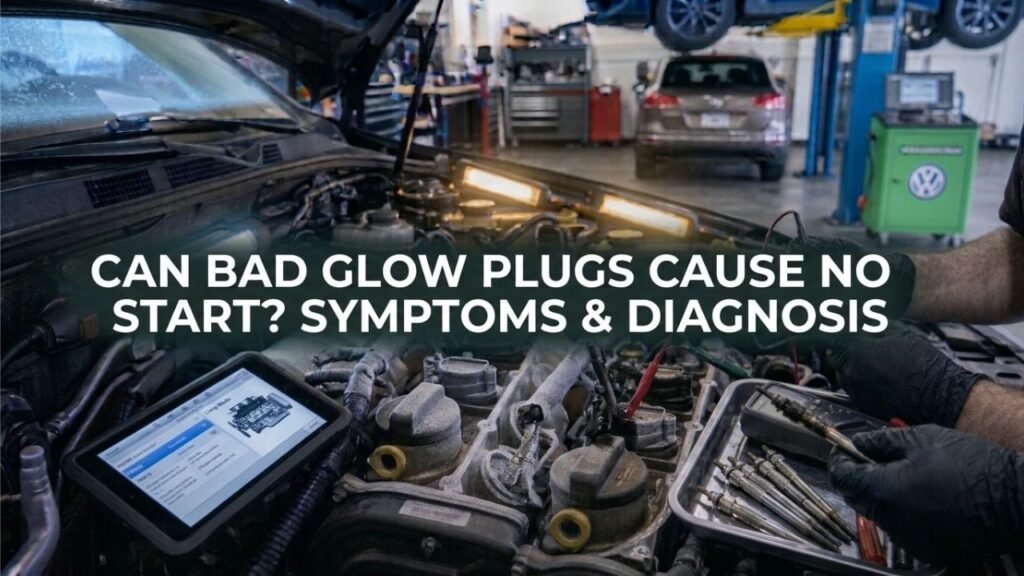
Yes.
Glow plugs can absolutely contribute to a diesel engine that cranks but does not start.
Their importance is greatest during cold starts because diesel combustion depends on heat generated by compression.
When the engine is already warm, the air inside the cylinders becomes hot enough during compression that glow plug assistance may be much less important.
When the engine block, cylinder head, intake air, and combustion chambers are cold, much of that compression heat is absorbed by the surrounding metal.
Glow plugs compensate by providing localized heat in or near the combustion chambers.
If several plugs are not heating, the injected diesel fuel may fail to ignite consistently.
One Bad Glow Plug May Not Cause a Complete No-Start
If a four-, six-, or eight-cylinder diesel has only one failed glow plug, the remaining cylinders may still start the engine.
You might notice a longer crank time, rough initial idle, white smoke, or a temporary misfire from the affected cylinder.
A healthy engine may start surprisingly well with one defective plug in mild weather.
The situation changes when multiple plugs fail.
The fewer cylinders capable of producing strong combustion during cranking, the harder it becomes for the engine to gain enough speed and heat to continue running on its own.
Several Bad Glow Plugs Can Prevent Starting
If several plugs are dead, a cold diesel can crank for a long time without firing.
You may hear occasional attempts to start, but the engine never fully catches.
This becomes much more likely in low temperatures.
An engine with marginal compression, weak battery voltage, or slow cranking speed may be even more dependent on the glow plug system.
Key Takeaways:
- Bad glow plugs can cause a diesel to crank but not start.
- One failed plug may cause only rough cold starting.
- Multiple failed plugs make a complete no-start much more likely.
- Cold weather increases the engine’s dependence on glow plugs.
Why Diesel Engines Need Glow Plugs
A gasoline engine uses spark plugs to ignite the air-fuel mixture.
A diesel engine works differently.
Air is compressed so strongly inside the cylinder that its temperature rises significantly.
Fuel is then injected into that hot compressed air and ignites without a conventional spark.
This works extremely well once the engine is warm.
Cold starting is more difficult.
Cold Metal Absorbs Compression Heat
When the engine has been sitting overnight, the cylinder walls, head, piston, and surrounding components may all be cold.
As air is compressed, some of the heat generated by compression transfers into those cold surfaces.
The final temperature may not be ideal for immediate fuel ignition.
A glow plug creates an intense hot spot inside or near the combustion chamber.
That localized heat helps the first injections of fuel ignite.
Once combustion begins repeatedly, the cylinders warm quickly and the engine can run normally without relying as heavily on the plugs.
What Happens When Glow Plugs Fail?
A failed glow plug no longer generates the heat the engine expects in that cylinder.
If only one plug is bad, that cylinder may initially contribute little or no power.
The other cylinders may start the engine anyway.
As the engine warms, the weak cylinder often begins firing normally.
If multiple plugs fail, too few cylinders may ignite properly during cranking.
The starter continues turning the engine, fuel continues being injected, but combustion may be too weak or inconsistent to start.
The Engine May Almost Start
A glow plug-related no-start does not always sound completely dead.
You may hear the engine try to catch.
It may fire on one or two cylinders and then stop.
Sometimes it starts after a very long crank and runs roughly for several seconds before smoothing out.
These symptoms strongly fit a cold-combustion problem, although they are not exclusive to glow plugs.
Common Symptoms of Bad Glow Plugs Before a No-Start
Glow plugs often deteriorate before the engine reaches the point of not starting at all.
The first symptom may simply be longer cranking on cold mornings.
You may also notice a rough idle immediately after startup.
White or light-gray exhaust smoke is another common sign.
Why White Smoke Appears
Diesel fuel may be injected into a cold cylinder without burning completely.
Some of that unburned or partially burned fuel leaves through the exhaust.
This can create white or gray smoke.
As combustion temperatures increase, the smoke often disappears.
Cold Misfire
A cylinder with a failed glow plug may misfire for several seconds after startup.
The engine can shake noticeably and then become smooth as the combustion chamber warms.
This is a useful clue.
A problem that happens only during the first cold seconds but disappears completely when warm can point toward glow plug operation or another cold-start condition.
Can One Bad Glow Plug Cause No Start?
Usually not on an otherwise healthy multi-cylinder diesel, although there are exceptions.
If the engine has strong compression, good fuel delivery, a powerful battery, and warm ambient temperature, one failed plug may barely be noticeable.
In very cold weather, that same failure may become more obvious.
The engine may crank longer and run unevenly after it finally starts.
Small Diesel Engines Can Be More Sensitive
The effect depends partly on cylinder count.
Losing one glow plug on a four-cylinder engine means 25% of the cylinders begin with reduced preheating.
One failed plug on an eight-cylinder engine represents a smaller percentage of the engine.
Engine design and compression condition also matter, so there is no universal rule that one bad plug can never cause a no-start.
How Many Bad Glow Plugs Cause a No-Start?
There is no fixed number.
A four-cylinder engine with two or three failed plugs may have serious difficulty starting cold.
A six-cylinder diesel might still start with two failed plugs under moderate conditions.
A worn engine with low compression may refuse to start with fewer failures.
Temperature also changes the answer dramatically.
Cold Weather Makes Every Failed Plug More Important
Near freezing temperatures, the engine loses heat rapidly into the cylinder head and block.
A glow plug system that seemed acceptable in summer may suddenly reveal its weakness.
This is why many owners first discover bad glow plugs when winter arrives.
Engine Compression Matters
A diesel with excellent compression creates more heat during cranking.
An older engine with worn rings, valve leakage, or cylinder wear may produce less compression heat.
That engine may rely heavily on functioning glow plugs.
The glow plugs can therefore appear to be the sole problem when they are actually exposing marginal compression.
Can Bad Glow Plugs Cause No Start in Warm Weather?
Yes, but it is less common.
When ambient temperatures are warm, a healthy diesel may start with little glow plug assistance.
Some engines shorten or eliminate the pre-glow period when coolant and intake temperatures are high.
If a diesel refuses to start on a warm day, I would not assume the glow plugs are responsible without testing.
Fuel supply, battery voltage, cranking speed, injection control, crankshaft position sensing, immobilizer operation, and compression may deserve more attention.
Temperature Is a Diagnostic Clue
If the vehicle starts perfectly when warm but struggles only after sitting overnight in cold conditions, glow plug system failure moves higher on the list.
If it will not start hot or cold, the fault is more likely to involve something that affects the engine under all conditions.
Key Takeaways:
- Glow plug problems are most obvious during cold starts.
- A warm-weather no-start often points toward additional causes.
- Temperature-related symptoms can help narrow the diagnosis.
- Weak compression can make an engine unusually dependent on glow plugs.
Can a Bad Glow Plug Relay Cause No Start?
Yes.
The glow plugs can all be perfectly healthy but useless if the relay never supplies power.
Older systems often use a heavy-duty relay to connect battery power to the plugs.
If the relay fails, none of the plugs may heat.
This can produce a symptom that looks exactly like several glow plugs failing at once.
How a Failed Relay Behaves
You may notice that the normal glow indicator behaves differently, although the dashboard light is not always a direct indicator of actual plug power.
The engine may become suddenly difficult to start rather than worsening gradually as individual plugs fail.
A multimeter can help verify whether power reaches the glow plug bus bar or connectors while preheating is commanded.
Can a Bad Glow Plug Control Module Cause No Start?
Yes.
Many modern diesels use an electronic glow plug control module rather than a simple relay.
The module may control each plug individually, regulate voltage, monitor current, and communicate with the engine control unit.
A module failure can disable one, several, or all glow plugs.
Modern Systems Can Be Low Voltage
Do not assume that every glow plug should receive 12 volts.
Some modern fast-heating glow plugs operate at much lower voltage.
The module may also use rapid pulses that a basic multimeter displays as an average voltage.
Always compare readings with the system specification.
Applying direct battery voltage to an unknown modern glow plug can destroy it.
Can a Blown Glow Plug Fuse Cause a No-Start?
Yes.
Glow plugs draw a large amount of current, so the circuit normally uses a high-amperage fuse or fusible link.
If that protection device opens, power to the entire glow system can disappear.
A cold engine may then become extremely difficult or impossible to start.
Why Did the Fuse Blow?
Do not simply install a larger fuse.
A blown glow plug fuse may indicate shorted wiring, a shorted plug, failed relay, or another electrical fault.
If the correct replacement fuse fails again, investigate the cause.
Can a Weak Battery Look Like Bad Glow Plugs?
Absolutely.
A diesel engine needs strong cranking speed.
A weak battery can create two problems at once.
First, voltage available to the glow plug system may fall.
Second, the starter turns the engine more slowly.
Slower cranking produces less compression heat.
The combination can make the engine act as though all of the glow plugs are weak.
Check Cranking Speed
If the starter sounds slower than normal, address battery and starter condition before replacing glow plugs blindly.
Diesel engines are particularly sensitive to cranking speed.
A battery may still illuminate the lights and operate accessories while being too weak to crank the engine properly.
Can a Bad Starter Cause a Diesel No-Start?
Yes.
A worn starter may turn the engine too slowly to generate enough compression temperature.
The engine can receive fuel and have functioning glow plugs but still fail to start.
This is another reason to listen carefully to cranking speed.
If the starter sounds unusually slow despite a fully charged battery and good cable connections, test the starting system.
Can Fuel Problems Cause the Same No-Start?
Yes.
A diesel needs fuel delivered at the correct pressure and timing.
Air in the fuel system, clogged filters, failed lift pumps, inadequate rail pressure, injector faults, contaminated fuel, or other problems can cause a crank-no-start.
How Fuel Problems Differ
Glow plug failures are strongly associated with cold-temperature difficulty.
Fuel problems often affect both hot and cold starting, although there are exceptions.
Scan data showing inadequate fuel-rail pressure during cranking can point away from the glow plugs and toward the fuel system.
Can Low Compression Cause No Start?
Yes.
Diesel combustion depends heavily on compression.
If cylinder pressure is too low, the compressed air may never become hot enough to ignite fuel reliably.
Bad glow plugs can make the problem worse, but replacing them will not restore lost compression.
Causes of Low Compression
Possible causes include worn piston rings, cylinder wear, leaking valves, valve-timing problems, head-gasket issues, or other mechanical damage.
If a diesel remains extremely difficult to start after the glow plug system and fuel delivery test normally, compression testing may be necessary.
Can Bad Injectors Cause a No-Start?
Yes.
An injector that does not deliver fuel correctly can cause hard starting, rough running, smoke, or no start.
Modern common-rail diesel systems require adequate rail pressure before the control unit will command normal injection.
A major injector leak or fuel-system fault can prevent that pressure from being reached.
This type of problem can sometimes be mistaken for bad glow plugs because both may cause long cranking.
Can a Crankshaft Position Sensor Cause No Start?
Yes.
The engine computer needs to know crankshaft position and speed before it can properly time fuel injection.
If the crankshaft sensor fails, the engine may crank normally but never inject fuel correctly.
In that situation, glow plugs could be functioning perfectly.
Scan-tool data can help determine whether the control unit detects engine RPM during cranking.
How to Tell If Glow Plugs Are Causing the No-Start
Begin with the pattern of symptoms.
Ask whether the problem is much worse when the engine is cold.
Does it start normally after being warmed?
Does it produce white smoke while cranking?
Has cold-start performance gradually become worse?
Those clues support a glow plug problem.
Then test the system rather than guessing.
Check Glow Plug Resistance
With the ignition off, disconnect each glow plug electrically.
Set a multimeter to its lowest resistance range.
Touch the probes together first and note their resistance.
Then measure between each glow plug terminal and clean engine ground.
Compare the readings.
A plug showing an open circuit or one with a dramatically different resistance from the others is suspicious.
Check for Power
If all plugs test similarly, verify that the glow plug system actually supplies power during the preheat cycle.
Use the correct voltage-test procedure for your engine.
No voltage to all plugs can indicate a fuse, relay, module, wiring, or control problem.
Key Takeaways:
- Test both the plugs and their power supply.
- An open-circuit glow plug is usually failed.
- If all plugs test good but none receives power, look upstream.
- Cold-only starting trouble strongly supports glow-system diagnosis.
Does the Glow Plug Warning Light Prove the Plugs Work?
No.
The dashboard glow plug indicator tells you what the control system is commanding or monitoring, depending on the vehicle.
It does not necessarily confirm that every individual plug is actually heating.
A light can behave normally while one or more plugs are open.
Likewise, some vehicles use the same warning indicator for other diesel-engine faults.
Use electrical testing and diagnostic trouble codes rather than relying only on the dashboard lamp.
Can You Start a Diesel With Bad Glow Plugs Using Starting Fluid?
This requires extreme caution.
Some diesel engines can be damaged by improper starting-fluid use, particularly when functioning glow plugs or intake heaters are present.
Ether-based starting fluids ignite very easily.
If they encounter an energized heating element, ignition can occur at the wrong time and cause severe engine damage or injury.
Do not use starting fluid unless the engine manufacturer specifically permits it and provides a safe procedure.
Using starting fluid to bypass an unresolved glow plug problem is not a proper repair.
Does Plugging in a Block Heater Help With Bad Glow Plugs?
Yes, a block heater can sometimes make a diesel with weak glow plugs easier to start because it warms the engine before cranking.
This does not repair the failed plugs.
But the warmer cylinder head and block absorb less compression heat, allowing combustion to begin more easily.
If a diesel refuses to start cold but starts readily after using the block heater, that is a useful clue that the problem is temperature-related.
Glow plug operation, compression, and cranking condition should then be checked.
Will a Diesel Start If All Glow Plugs Are Bad?
It may in sufficiently warm conditions, depending on the engine.
A high-compression diesel with a strong starter can sometimes start without glow plugs when the engine and ambient air are warm enough.
In cold conditions, an engine with all plugs failed may crank indefinitely without starting.
Older indirect-injection diesels often rely heavily on glow plug heat and can be particularly difficult to start without it.
Modern direct-injection designs may be more capable in certain conditions, but they still use glow plugs for important cold-start and emissions functions.
Can Bad Glow Plugs Cause a No-Start After Sitting Overnight?
Yes.
This is a classic situation.
After hours of sitting, the engine becomes completely cold.
If several plugs are weak, the engine may crank unsuccessfully first thing in the morning.
Later in the day, after ambient temperatures rise or the engine has been warmed once, starting may become much easier.
This cold-soak pattern makes glow plug testing worthwhile.
Can Glow Plugs Fail All at Once?
Individual plugs often fail gradually or one at a time.
If the engine suddenly behaves as though every glow plug stopped working, I would investigate the shared power supply.
A relay, control module, fuse, main wiring connection, or ground problem can disable the whole system instantly.
Replacing all plugs without checking power could waste money.
Should You Replace All Glow Plugs if One Is Bad?
Not necessarily.
If the plugs are relatively new and one has failed unusually early, replacing only that plug may be reasonable.
If all of them have similar high mileage or operating hours and one has reached the end of its life, replacing the full set can reduce the chance of repeating the same labor soon.
Accessibility also matters.
If substantial engine disassembly is required to reach the plugs, replacing an aging set together may be economically sensible.
Use Matching Plugs
Modern electronic glow plug systems can be sensitive to resistance and heating characteristics.
Use the exact specified part number or a verified equivalent.
I would avoid mixing random glow plug types simply because their threads fit.
Can New Glow Plugs Still Cause No Start?
Yes, if something else is wrong.
New plugs may not receive power because of a bad relay or module.
The battery may be weak.
Fuel pressure may be insufficient.
Compression may be low.
The plugs may also be the wrong type for the engine.
A low-voltage modern glow plug installed in the wrong control system can fail quickly.
Whenever new glow plugs do not solve a no-start, return to systematic diagnosis rather than immediately replacing them again.
What If the Engine Starts Only After Several Attempts?
Glow plugs are one possible cause.
Each cranking attempt adds some heat to the cylinders.
Repeated glow cycles may also warm the combustion area gradually.
A weak glow plug system can therefore allow the engine to start after two or three attempts.
But repeated attempts also build fuel pressure and may compensate for fuel drain-back or other fuel-system problems.
The pattern alone does not prove glow plugs are responsible.
What If the Diesel Starts Fine Warm but Not Cold?
This is one of the strongest reasons to inspect the glow plug system.
When warm, the engine already contains enough residual heat to support ignition.
When completely cold, it needs more preheating.
Potential causes include failed glow plugs, a faulty control module, incorrect coolant-temperature input, weak battery, marginal compression, or a combination of these.
Glow plug testing is a logical early step.
Common Mistakes When Diagnosing a Diesel No-Start
One of the biggest mistakes is replacing every glow plug without checking whether they receive power.
Another is assuming one failed plug must explain a total no-start.
In many healthy multi-cylinder engines, one bad plug causes rough cold starting rather than complete failure to start.
A third mistake is ignoring battery condition.
A diesel that cranks too slowly may behave exactly like one with poor glow plug performance.
Some owners also apply 12 volts directly to modern low-voltage glow plugs during testing and accidentally destroy them.
Finally, avoid using starting fluid casually around active glow plugs.
Simple Diagnostic Order for a Glow Plug No-Start
Begin with the battery and cranking speed.
If the starter is slow, correct that first.
Next, read diagnostic trouble codes if possible.
Then test individual glow plug resistance.
After that, confirm whether the system supplies the proper voltage or control signal.
If the entire glow system tests correctly, move on to fuel delivery, engine speed sensing, compression, injector operation, and other no-start causes.
This sequence helps avoid replacing parts randomly.
FAQs about Can Bad Glow Plugs Cause No Start
Can bad glow plugs cause no start?
Yes. Multiple failed glow plugs can prevent a cold diesel engine from starting, particularly in low temperatures.
Can one bad glow plug stop a diesel from starting?
Usually not on a healthy multi-cylinder engine, although it can make cold starting harder and may contribute to a no-start if other conditions are marginal.
Can two bad glow plugs cause no start?
They can, especially on a four-cylinder engine in cold weather or if the engine has low compression or slow cranking.
Will a diesel start with no glow plugs?
Some diesels may start without them in warm conditions, while others—particularly in cold weather—may be extremely difficult or impossible to start.
Do bad glow plugs cause long cranking?
Yes. Long cold cranking is one of the most common symptoms.
Can bad glow plugs cause white smoke?
Yes. Unburned or poorly burned diesel fuel during a cold start can create white or gray smoke.
Can bad glow plugs cause rough idle?
They can cause rough running immediately after a cold start. If the engine remains rough when fully warm, investigate additional causes.
Can a bad glow plug relay cause no start?
Yes. If the relay does not supply power, all the glow plugs can remain cold even though the plugs themselves are good.
Can a glow plug control module cause no start?
Yes. Modern electronic modules can fail and prevent proper glow plug operation.
Can a blown glow plug fuse cause no start?
Yes, especially in cold weather because it may disable the entire preheating system.
Can a weak battery look like bad glow plugs?
Yes. Low battery voltage can reduce glow plug heating and slow starter speed at the same time.
Can low compression cause the same symptoms?
Yes. A low-compression diesel often has difficult cold starts and may depend heavily on functioning glow plugs.
How do I test glow plugs?
Disconnect each plug electrically and use a multimeter to measure resistance between the terminal and engine ground. Compare all readings and check the manufacturer’s specification.
Should glow plugs have 12 volts?
Not necessarily. Many modern glow plugs operate at lower voltage or with electronically pulsed power.
Should I replace all glow plugs if one fails?
Not always. Consider the age of the set, access difficulty, and manufacturer recommendations. Use matching specified replacements.
Conclusion
So, can bad glow plugs cause no start? Yes—especially when several plugs have failed and the diesel engine is cold.
Glow plugs help create the heat needed for reliable combustion during cold cranking. When one plug fails, a healthy multi-cylinder diesel may still start but can crank longer, smoke, or run roughly for a few seconds.
When several plugs fail, there may not be enough cylinders producing strong combustion to get the engine running.
Cold temperatures make the problem much worse.
However, a diesel no-start should never be diagnosed by replacing glow plugs alone.
A failed glow plug relay, control module, fuse, wiring connection, or battery can prevent perfectly good plugs from heating.
Weak batteries and slow starters are particularly important because diesels depend heavily on cranking speed to generate compression heat.
Fuel-delivery problems and low compression can also create nearly identical symptoms.
A practical diagnosis begins by checking battery condition and cranking speed, then testing each glow plug with a multimeter. If the plugs have similar low resistance, verify that the glow plug system actually supplies the correct voltage or control signal during preheating.
If both the plugs and control system work correctly, investigate fuel pressure, injection, engine-speed signals, and compression.
The practical bottom line is simple: bad glow plugs can absolutely cause a no-start, but the colder the engine and the more plugs that have failed, the more likely they are to be the primary cause. Test the complete glow plug system before replacing parts.