
Can bad glow plugs cause limp mode? Yes, they can on some modern diesel vehicles, but bad glow plugs are usually not the most common direct cause of limp mode. A failed glow plug normally causes difficult cold starting, rough running immediately after startup, white smoke, or a glow-plug warning light. However, a glow plug circuit or control-module fault can sometimes trigger reduced-power operation, interfere with emissions systems, or contribute indirectly to limp mode.
This distinction is important because replacing glow plugs whenever a diesel enters limp mode can waste money without solving the underlying problem.
Turbocharger boost faults, DPF restriction, EGR problems, fuel-pressure issues, airflow sensor faults, exhaust sensors, and transmission problems are generally more common limp-mode causes than the heating elements themselves.
Modern glow plugs also do more than help the engine start. Depending on the diesel system, they may operate after startup to reduce emissions, improve cold combustion, and support exhaust-temperature management. As a result, a glow plug system fault can sometimes have consequences beyond cold starting.
In this guide, I’ll explain when bad glow plugs can cause limp mode, when they probably are not responsible, which symptoms and trouble codes to look for, how the DPF can be involved, and what you should diagnose before replacing parts.
What Is Limp Mode?
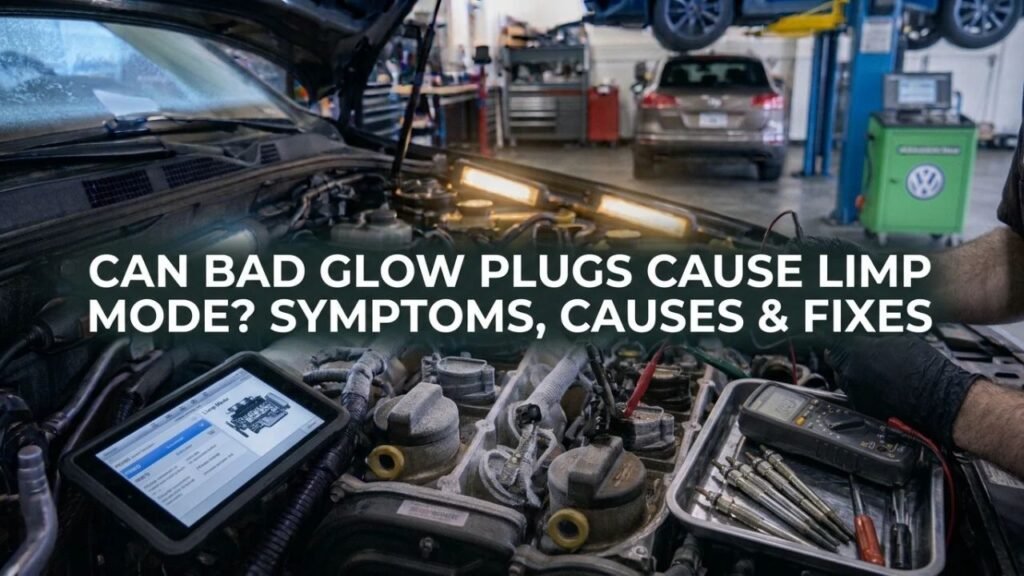
Limp mode, also called reduced-power mode, fail-safe mode, or emergency running mode, is a protective strategy used by a vehicle’s electronic control system.
When the engine or transmission control module detects a fault that could damage components, increase emissions significantly, or make normal operation unreliable, it may deliberately limit performance.
The exact response varies by vehicle.
You might notice dramatically reduced acceleration, restricted engine RPM, limited turbo boost, unusual transmission shifting, or a warning message indicating reduced engine power.
The vehicle may still be driveable enough to move to a safe location or repair facility.
Limp mode is therefore a symptom of a detected problem rather than a diagnosis itself.
Can Bad Glow Plugs Cause Limp Mode Directly?
On many diesel engines, one failed glow plug will not directly put the engine into limp mode.
The control module may store a fault code and illuminate the check-engine or glow-plug warning light, but the engine may still produce normal power once it is warm.
That is because glow plugs are most important when combustion chambers are cold.
After the engine reaches operating temperature, compression heat is normally sufficient for diesel combustion.
However, modern diesel engine management is more complicated.
Some vehicles monitor the glow plug system closely enough that a major electrical fault, glow plug control-module malfunction, or multiple failed circuits can contribute to a reduced-power strategy.
Whether that happens depends entirely on the manufacturer and engine calibration.
One Bad Glow Plug vs. Complete Glow System Failure
A single failed glow plug commonly causes a cylinder-specific fault without severe performance limitation.
A complete glow plug control failure can be more significant.
If the module detects electrical faults throughout the system, the engine may have poor cold combustion and elevated emissions.
The vehicle computer may respond more aggressively.
Still, even in that situation, the diagnostic codes should be checked rather than assuming the glow plugs themselves are responsible for limp mode.
Key Takeaways:
- One failed glow plug usually causes cold-start problems rather than limp mode.
- Some modern diesels can enter reduced-power operation because of broader glow system or emissions-related faults.
- Read diagnostic trouble codes before replacing glow plugs.
How Bad Glow Plugs Can Cause Limp Mode Indirectly
The indirect connection is often more important than a direct one.
A failed glow system can affect cold combustion and emissions.
On certain modern diesels, glow plugs can also assist emissions-control strategies.
If those strategies stop working correctly, another system—particularly the diesel particulate filter—may eventually trigger limp mode.
Glow Plugs and DPF Regeneration
A diesel particulate filter traps soot from the exhaust.
Periodically, the engine must raise exhaust temperature enough to burn much of that soot during regeneration.
Depending on engine design and operating conditions, glow plug operation can be part of the thermal-management strategy.
A glow system fault may therefore interfere with normal emissions operation on some vehicles.
If regeneration becomes ineffective, soot loading can rise.
Eventually, a heavily restricted DPF may cause reduced engine power or limp mode.
In this scenario, the glow plug fault is an indirect contributor.
The actual immediate reason for limp mode may be excessive DPF restriction.
Cold Combustion and Emissions
Failed glow plugs can cause incomplete combustion immediately after cold startup.
You may see white or gray exhaust smoke because diesel fuel is not burning completely in one or more cylinders.
Modern emissions systems monitor many engine parameters.
Repeated abnormal combustion or associated sensor readings may trigger additional faults.
Again, the response depends on the particular diesel system.
Can a Bad Glow Plug Control Module Cause Limp Mode?
Potentially, and it is more plausible than a single failed glow plug on some vehicles.
The glow plug control module regulates power to the heating elements.
Modern modules may control each glow plug individually and communicate directly with the engine control module.
A module failure can produce several cylinder-specific glow plug faults at once.
It may also prevent post-glow operation after startup.
Signs of a Glow Plug Control Module Problem
A vehicle with a failing module may have several glow plug codes simultaneously.
It may start poorly when cold even though individual glow plugs test good.
You may also find that no voltage or current reaches the plugs during the expected glow cycle.
The warning light may illuminate.
If the engine-management software considers the control failure important enough, reduced-power operation is possible.
Do not replace every glow plug simply because multiple glow-plug codes appear together.
Check the controller, power supply, grounds, fuses, and wiring.
What Glow Plug Trouble Codes Might You See?
Glow plug fault codes vary among manufacturers, but several generic OBD-II codes are common.
P0380 generally relates to a glow plug/heater circuit fault.
Codes in the P0670 range can indicate glow plug control-module or individual cylinder circuit problems.
For example, P0671 may identify the glow plug circuit associated with cylinder 1, while subsequent codes can correspond to other cylinders.
The exact code definitions should always be verified for the particular vehicle.
A Code Does Not Automatically Mean the Plug Is Bad
Suppose the scan tool shows a cylinder 3 glow plug circuit fault.
Possible causes may include the glow plug itself, damaged wiring, corroded connectors, excessive resistance, a control-module fault, or poor electrical connections.
Diagnosis should verify the component rather than replacing it based solely on the code description.
What Does a Bad Glow Plug Normally Cause?
Glow plug failure is most noticeable when the engine is cold.
The engine may crank longer than usual.
It may initially fire on fewer cylinders.
The idle may be rough for several seconds until combustion chambers warm up.
White or light-gray smoke may appear from the exhaust.
In very cold weather, multiple failed glow plugs can prevent the engine from starting.
Once the diesel is fully warm, however, a simple glow plug failure often has little effect on normal engine power.
That is one reason limp mode during normal warm driving frequently points somewhere else.
Can Bad Glow Plugs Cause Loss of Power?
Usually not significant continuous power loss by themselves once the engine has warmed.
During the first moments after a cold start, a cylinder with a failed glow plug may not contribute normally.
That can make the engine feel weak or uneven temporarily.
But if the engine loses substantial power after driving for 20 minutes, the glow plugs are probably not the first place I would look.
More likely causes include turbocharger control problems, fuel-pressure faults, DPF restriction, EGR malfunction, intake leaks, airflow sensor issues, or transmission protection strategies.
Key Takeaways:
- Glow plugs mainly affect cold combustion.
- Significant power loss on a fully warm diesel usually deserves investigation beyond the glow plugs.
- Multiple glow-related codes can indicate a module, wiring, or power-supply fault rather than several plugs failing simultaneously.
Common Causes of Diesel Limp Mode Besides Glow Plugs
If your diesel is in limp mode, several systems deserve attention before you focus entirely on glow plugs.
Turbocharger and Boost Problems
Boost-related problems are among the most common causes of reduced power on turbocharged diesel engines.
The computer expects actual boost pressure to follow its commanded value.
If pressure is too high or too low, the control module may protect the engine by reducing power.
Possible causes include boost leaks, split intercooler hoses, stuck turbo vanes, wastegate problems, actuator faults, vacuum-control issues, or faulty boost sensors.
What It Feels Like
The engine may feel normal at low speed but suddenly lose power when you accelerate.
Turbo response may disappear.
Switching the ignition off and restarting may temporarily restore normal performance on some vehicles until the fault happens again.
That behavior is much more typical of a boost-control limp mode than a bad glow plug.
DPF Restriction
A diesel particulate filter that becomes excessively loaded with soot can create substantial exhaust backpressure.
The engine control system may limit power to protect the engine and exhaust system.
You may see a DPF warning, check-engine light, or reduced-power message.
Frequent interrupted regenerations, short trips, sensor faults, EGR problems, injector problems, or other combustion issues can contribute to DPF loading.
A glow plug system malfunction can sometimes be part of that chain, but the DPF restriction itself may be what actually activates limp mode.
EGR System Problems
The exhaust gas recirculation system controls the amount of exhaust routed back into the intake.
Carbon buildup can cause EGR valves to stick.
Electrical actuators and position sensors can also fail.
If actual EGR flow differs substantially from the commanded amount, the engine computer may store codes and reduce power.
An EGR fault can also affect DPF regeneration and soot production.
Fuel-Pressure Problems
Modern common-rail diesels require extremely precise fuel pressure.
A weak supply pump, restricted fuel filter, failing high-pressure pump, pressure-regulator problem, injector leak-off, or rail-pressure sensor fault can prevent the system from reaching commanded pressure.
The engine computer may then limit torque or enter limp mode.
Fuel-pressure problems can also cause hard starting, which sometimes leads owners to suspect glow plugs incorrectly.
MAF and MAP Sensor Faults
The mass airflow sensor and manifold pressure sensor provide critical information for fuel, boost, and EGR control.
Incorrect readings can trigger reduced performance.
Contaminated sensors, wiring problems, intake leaks, or sensor failure can all cause faults.
Exhaust Temperature and Pressure Sensors
Modern diesel aftertreatment systems use multiple sensors to monitor DPF operation.
A faulty differential-pressure sensor may incorrectly report that the particulate filter is blocked.
An exhaust gas temperature sensor can interfere with regeneration.
These faults are much more directly connected with limp mode than one failed glow plug.
Transmission Problems
Not every limp mode is caused by the engine.
Automatic transmissions have their own protection strategies.
A transmission may become locked in a particular gear if the control module detects excessive slip, hydraulic-pressure faults, temperature problems, or sensor failures.
If engine RPM rises but the vehicle behaves as though it is stuck in one gear, transmission diagnostics may be necessary.
How to Tell Whether Glow Plugs Are Causing Your Limp Mode
Begin with diagnostic codes.
A scan tool gives you far more information than guessing from symptoms.
If the only codes present are glow plug circuit faults and the vehicle mainly struggles when cold, the glow system deserves attention.
If you also have boost, DPF, fuel-pressure, airflow, or EGR codes, those may be more directly related to limp mode.
Pay Attention to When Limp Mode Occurs
Timing is a valuable clue.
If reduced power appears immediately during a freezing cold startup and several glow plugs are dead, the glow system becomes more relevant.
If the vehicle enters limp mode only during hard acceleration, boost and fuel-delivery problems deserve more attention.
If limp mode appears after extended highway driving with a DPF warning, exhaust aftertreatment becomes a stronger suspect.
If the car drives normally until the transmission warms up, look at transmission faults.
Diagnosis should follow the pattern rather than starting with the easiest part to replace.
How to Test Glow Plugs Before Replacing Them
Glow plugs can often be evaluated electrically without immediately removing them.
One method is resistance testing with a digital multimeter.
Glow plug resistance is typically very low, so meter-lead resistance must be considered.
Rather than relying on a universal resistance number, compare the readings with the specification for your exact engine.
A plug showing an open circuit is clearly suspicious.
Current-Draw Testing
Professional diagnostic equipment can measure how much current each glow plug draws.
This can reveal a weak or open heating element.
On modern systems, scan tools may also display glow plug control information.
Testing the system under actual operating conditions can be more informative than measuring resistance alone.
Verify Power Supply
If all glow plugs appear dead, do not immediately assume every plug failed simultaneously.
Check the fuse, relay or control module, power supply, ground, and wiring.
A single electrical fault can disable the whole system.
Can You Drive in Limp Mode With Bad Glow Plugs?
That depends on why the vehicle is actually in limp mode.
A single failed glow plug on an otherwise healthy diesel may not create an urgent driving hazard once the engine is running.
But if the vehicle is genuinely in reduced-power mode, you do not yet know whether the cause is only a glow plug.
Continuing to drive with a severely restricted DPF, low fuel pressure, overboost condition, overheating transmission, or another significant fault can make the problem worse.
Use limp mode primarily to reach a safe location or obtain diagnosis rather than treating it as a normal operating condition.
Can Restarting the Engine Clear Limp Mode?
Sometimes temporarily.
Turning the engine off and restarting may reset certain protection strategies until the control module detects the fault again.
For example, an intermittent boost-control problem may disappear after a restart and return during the next hard acceleration.
This does not mean the problem has been fixed.
A glow plug fault code may remain stored even after restarting.
Read stored and pending trouble codes before clearing them whenever possible.
They provide valuable diagnostic evidence.
Will Replacing Glow Plugs Clear Limp Mode?
Only if the glow plug system was actually responsible for the reduced-power condition.
Replacing plugs may correct cold starting and clear glow plug circuit codes after the system recognizes proper operation.
However, if limp mode was triggered by a blocked DPF or turbocharger fault, new glow plugs will not immediately repair those problems.
An indirect glow-plug-related DPF problem may require additional work.
The DPF may need a successful regeneration or professional cleaning after the glow system has been repaired.
Can a Faulty Glow Plug Relay Cause Reduced Power?
Potentially.
Older diesel systems may use a conventional relay, while newer vehicles often use an electronic glow plug control unit.
A relay stuck open prevents the plugs from heating.
A relay stuck closed could keep them energized too long, potentially damaging the plugs and placing a heavy electrical load on the system.
Whether this directly triggers limp mode depends on the vehicle.
A relay or control-unit fault should be diagnosed electrically rather than inferred from the glow-plug warning light alone.
Can Glow Plugs Affect DPF Regeneration?
On some modern diesel systems, yes.
Glow plugs may be used beyond initial starting as part of emissions and temperature management.
A malfunction can potentially prevent certain regeneration strategies from operating normally.
If repeated regeneration attempts fail, soot load can rise until the vehicle generates a DPF warning or reduced-power condition.
This is one of the strongest ways a glow plug fault can become connected to limp mode indirectly.
Do Not Force Regeneration Without Diagnosis
A forced DPF regeneration produces extremely high exhaust temperatures.
It should not be used casually when the underlying reason for regeneration failure is unknown.
If the DPF is severely overloaded or another engine fault is present, professional diagnosis may be appropriate.
Repair glow system faults and any other blocking faults first.
Key Takeaways:
- Bad glow plugs can contribute indirectly to DPF-related reduced power on some modern diesels.
- Repairing the glow plugs may not immediately clear limp mode if the DPF is already heavily restricted.
- Avoid replacing parts or forcing DPF regeneration without reading the fault codes first.
Does a Glow Plug Warning Light Mean Limp Mode?
Not necessarily.
The meaning of the glow plug light varies between manufacturers.
During normal cold starting, it may simply indicate that the engine is preheating.
A light that remains on, flashes, or appears while driving can indicate a fault.
On some vehicles, a flashing glow plug symbol may represent a broader engine-management problem rather than a failed glow plug specifically.
That means you should not interpret the symbol literally without checking the vehicle’s diagnostic information.
Can Bad Glow Plugs Cause the Check-Engine Light?
Yes.
Modern engine computers monitor glow plug circuits.
A failed heating element, wiring fault, or control-module problem can set a diagnostic code and illuminate the check-engine light.
The vehicle may still run normally when warm.
The presence of a check-engine light therefore does not prove limp mode should occur.
The severity of the control response depends on the fault and engine calibration.
Can All Glow Plugs Fail at Once?
It is possible, but if several glow plug codes appear suddenly, suspect the shared electrical system.
Check the glow plug module or relay.
Inspect the main fuse.
Check power and ground.
Look for damaged wiring.
Individual plugs often fail gradually rather than all at exactly the same moment.
Replacing an entire set without testing the controller can leave you with eight new glow plugs and exactly the same fault.
What Happens If You Ignore Bad Glow Plugs?
The most obvious consequence is increasingly difficult cold starting.
Repeated extended cranking can place additional strain on the starter and battery.
Cold combustion may also produce more smoke and rough running.
On modern diesels where glow plug operation supports emissions strategies, ignoring the fault can potentially contribute to additional aftertreatment issues.
A broken or swollen glow plug can also become much harder to remove later.
Fix confirmed faults rather than leaving them indefinitely.
Common Mistakes When Diagnosing Glow Plug Limp Mode
One mistake is assuming every glow plug warning light means the heating element has failed.
Scan the control modules first.
Another mistake is replacing all the glow plugs when the real problem is a failed controller or blown fuse.
The opposite mistake is ignoring glow plug faults because the engine still starts normally in warm weather.
Some modern systems use the plugs for functions beyond initial starting.
Finally, do not overlook simultaneous faults.
An older diesel can have one bad glow plug and a boost leak.
Repairing the glow plug will improve cold starting but will not restore turbo boost.
FAQs about Can Bad Glow Plugs Cause Limp Mode
Can bad glow plugs cause limp mode?
Yes, on some modern diesel vehicles, but it is not the most common direct cause. Glow plug control or emissions-related faults may sometimes cause reduced power or contribute indirectly through DPF problems.
Will one bad glow plug cause limp mode?
Usually not. One failed plug more commonly causes hard cold starting, rough running after startup, or a fault code.
Can multiple bad glow plugs cause limp mode?
Possibly, especially on engines that closely monitor glow system operation. A complete glow plug system failure may be treated more seriously than one failed cylinder.
Can a bad glow plug control module cause limp mode?
Yes, depending on the vehicle. A module failure can disable the entire glow system and may set multiple faults.
Can bad glow plugs cause loss of power?
They can cause temporary weak or rough operation during a cold start, but significant power loss after the engine is fully warm usually suggests another problem.
Can glow plugs affect DPF regeneration?
On some modern diesel systems, yes. Glow plugs can contribute to emissions and temperature management, so faults may interfere with regeneration.
Can bad glow plugs block DPF regeneration?
On certain vehicles they can prevent or interfere with regeneration strategies. Check vehicle-specific diagnostic information.
Can a blocked DPF cause limp mode?
Yes. Excessive soot loading and exhaust restriction are common causes of reduced-power mode on modern diesels.
Can a bad turbo cause limp mode?
Yes. Underboost and overboost faults are common reasons a turbocharged diesel enters limp mode.
Can bad glow plugs cause a check-engine light?
Yes. The engine computer can detect failed glow plug circuits and store diagnostic trouble codes.
Can bad glow plugs cause white smoke?
Yes. A cold cylinder may fail to burn diesel fuel completely, producing white or gray smoke after startup.
Can bad glow plugs cause rough idle?
Yes, especially immediately after a cold start. The symptom commonly improves as the engine warms.
Can bad glow plugs cause hard starting?
Yes. That is one of the most typical glow plug failure symptoms.
What codes indicate bad glow plugs?
Common generic codes include P0380 and cylinder-specific P067x codes, although exact definitions vary by vehicle.
Will limp mode disappear after replacing glow plugs?
It can if the glow plug fault was the actual cause. If the vehicle also has DPF, turbo, EGR, or fuel-pressure problems, reduced power may remain.
Should I replace glow plugs without scanning for codes?
I would not. Reading stored codes first helps distinguish failed plugs from controller, wiring, DPF, turbo, and other faults.
Conclusion
So, can bad glow plugs cause limp mode? Yes, but in most diesel vehicles they are not the first or most common direct cause of reduced-power operation.
A single failed glow plug normally causes cold-start symptoms such as extended cranking, rough running immediately after startup, white smoke, or a stored glow plug circuit code. Once the engine is warm, that failed plug may have very little effect on engine power.
The situation becomes more complicated on modern diesels.
A failed glow plug control module, multiple dead glow plugs, or a glow system fault that interferes with emissions management can potentially contribute to limp mode. In some vehicles, malfunctioning glow plugs may prevent normal DPF regeneration, allowing soot loading to increase until the DPF itself triggers reduced power.
However, if your diesel suddenly enters limp mode while driving, I would also investigate turbo boost, DPF restriction, EGR operation, fuel pressure, airflow and boost sensors, exhaust sensors, and transmission faults.
My recommendation is to scan the vehicle before replacing anything. If the diagnostic system shows only glow plug circuit faults, test the plugs, wiring, controller, and power supply. If it also shows boost or DPF codes, those faults may explain the limp mode more directly.
In short, bad glow plugs can be connected with limp mode, particularly on electronically controlled modern diesels, but they should not automatically be blamed whenever a diesel loses power.