
If you are wondering can faulty glow plugs cause battery drain, a normally failed glow plug usually does not directly drain the battery while the vehicle is parked. Most failed glow plugs develop an open circuit and simply stop drawing current. However, a shorted glow plug, stuck glow plug relay, faulty control module, or wiring problem can keep the glow plug circuit energized when it should be off and potentially discharge the battery.
There is also an important indirect connection. Bad glow plugs can make a diesel engine difficult to start, especially in cold weather. Long or repeated cranking places a heavy load on the battery. The battery may therefore become discharged even though the defective glow plugs are not creating a true parasitic draw while the vehicle is parked.
Glow plug systems themselves consume substantial electrical power when operating. That is normal because each plug is essentially a small high-output heating element. Modern systems carefully control how long the plugs operate and may continue powering them for a period after the engine starts. Problems occur when that power does not shut off when commanded.
In this guide, I’ll explain how faulty glow plugs can affect the battery, the difference between a bad plug and a stuck glow plug relay, how to recognize a parasitic glow-system drain, and what to test if your diesel battery keeps going dead.
Can Faulty Glow Plugs Cause Battery Drain?
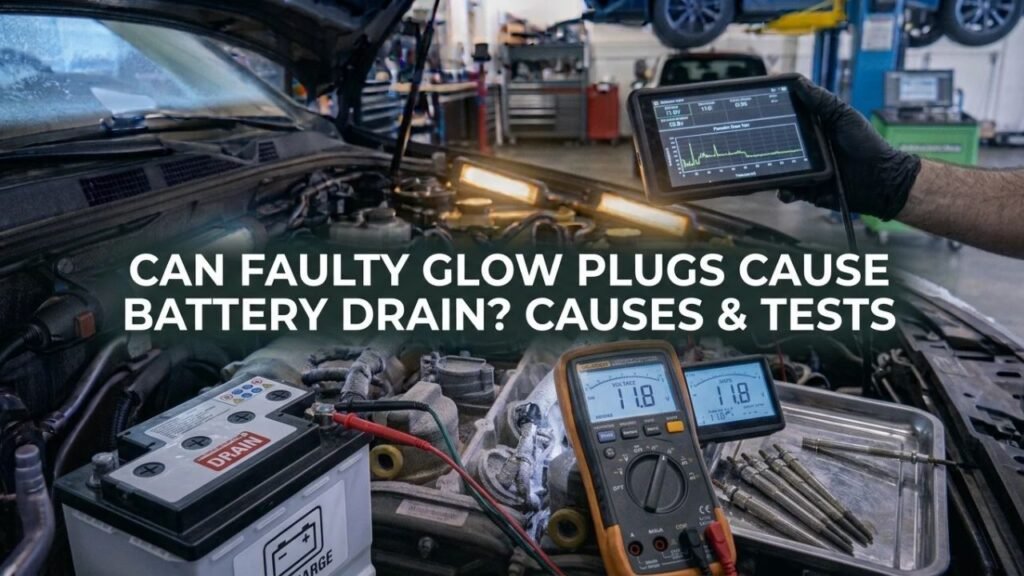
Yes, but the glow plug itself is not usually the first component I would suspect when a diesel battery goes dead while parked.
A common failed glow plug develops an internal break in its heating element.
Electrically, that creates an open circuit.
An open circuit does not continue consuming battery power. In fact, that plug draws no normal heating current at all.
A battery-drain problem becomes more likely when the fault involves:
A shorted glow plug, a stuck relay, a control module that continues commanding the plugs on, damaged wiring, or another electrical fault that keeps part of the glow system energized after shutdown.
The distinction is important because replacing all the glow plugs will not fix a battery drain caused by a stuck relay or faulty controller.
Quick Comparison
| Glow System Problem | Can It Drain Battery While Parked? |
| Glow plug failed open | Usually no |
| High-resistance/weak glow plug | Usually no direct parasitic drain |
| Internally shorted glow plug | Potentially |
| Glow plug relay stuck closed | Yes |
| Glow plug control module stays active | Yes |
| Shorted glow plug wiring | Yes |
| Bad plugs causing long cranking | Indirectly drains battery |
| Normal post-glow after startup | Normal operation, not usually a fault |
The most common glow-related battery drain is therefore usually a control or switching problem rather than an ordinary burned-out glow plug.
Why Glow Plugs Use So Much Battery Power
Glow plugs are electrical heaters.
When the engine is cold, the glow plug system sends a large amount of electrical current through the plugs so their tips heat rapidly.
That heat assists diesel ignition.
Because multiple plugs may operate at once, the entire system can place a considerable temporary load on the battery.
That is normal during starting.
The battery is designed to supply this electrical load while also powering the starter motor.
Once the engine starts, the alternator begins replacing the energy used during preheating and cranking.
Modern Glow Systems May Stay On After Startup
You may assume the glow plugs turn off as soon as the Wait to Start light disappears.
That often isn’t true.
Many modern diesel engines use post-glow, meaning the glow plugs continue receiving controlled power after startup.
Post-glow can help reduce smoke, improve combustion stability, reduce noise, and support emissions control while the engine warms.
This normal activity should not be confused with battery drain.
The important question is whether the system turns off when the engine control strategy says it should.
Key Takeaways:
- A burned-out open-circuit glow plug normally does not cause a parked battery drain.
- Glow plug systems naturally use significant current during normal operation.
- A stuck relay or control module is much more likely than a typical bad plug to create continuous battery consumption.
Can a Bad Glow Plug Relay Drain the Battery?
Yes.
A stuck glow plug relay is one of the most important glow-system faults to investigate when a diesel battery keeps dying.
Older diesel engines commonly use a heavy-duty relay to connect battery power to the glow plugs.
When the engine needs preheating, the relay closes.
When glow operation is finished, the relay opens and disconnects the high-current circuit.
If the relay contacts weld or stick together, battery power may continue flowing to the glow plugs even after the controller tells the relay to shut off.
Why Relay Contacts Can Stick
Glow plugs draw high current.
Every time the relay switches that current, its electrical contacts experience heat and electrical arcing.
After many operating cycles, the contacts can become burned or damaged.
In some cases they can weld together.
A relay that has mechanically stuck closed can continue supplying current with the key off.
That can discharge a healthy battery surprisingly quickly compared with the small parasitic loads normally present in a parked vehicle.
Symptoms of a Stuck Glow Plug Relay
Possible signs include:
Glow plugs or related wiring staying unusually hot after shutdown, a battery that dies after the vehicle sits, abnormal relay behavior, excessive electrical load, or glow plugs failing repeatedly from overheating.
On some older vehicles, you may also hear or feel relay operation.
However, simply hearing a relay click does not prove that its high-current contacts are functioning correctly.
A relay can click normally and still have damaged electrical contacts.
Can a Faulty Glow Plug Control Module Drain the Battery?
Yes.
Many newer diesels do not use a simple traditional on/off relay.
Instead, they use an electronic glow plug control module.
The module may regulate voltage and current precisely, control individual plugs separately, and communicate with the engine control module.
A faulty module can potentially keep part of the glow plug circuit energized when it should be inactive.
It may also fail in other ways, such as:
Not powering the plugs at all, supplying incorrect current, producing trouble codes, or damaging individual glow plugs.
Modern Systems Require More Careful Testing
Do not assume the presence of battery voltage at a glow plug means the module is faulty.
Modern controllers can use pulse-width modulation and low-voltage glow plugs.
A digital multimeter may display an averaged voltage that looks unusual even when the system is operating correctly.
Vehicle-specific diagnostic information is especially important with modern diesel glow systems.
Can a Shorted Glow Plug Drain a Battery?
Potentially, although complete open-circuit failure is more typical.
A glow plug contains an internal heating element.
If the element or internal insulation develops a short in a way that creates abnormally low resistance, current draw can increase.
Depending on the system design, the fuse, fusible link, relay, or control module may react to the excessive current.
A severe short may blow circuit protection rather than quietly drain the battery for hours.
Don’t Judge a Plug by Resistance Alone Without Specifications
Glow plug resistance is naturally very low.
A perfectly good plug can measure well below one ohm depending on its design.
That means a very low number on a multimeter does not automatically prove the plug is shorted.
You need to account for meter lead resistance and compare your measurements with the manufacturer’s specification and the other plugs.
An open circuit is usually much easier to identify.
Bad Glow Plugs Can Drain the Battery Indirectly
This is far more common than a bad glow plug creating a direct parasitic draw.
When one or more glow plugs fail, the diesel may become difficult to start when cold.
Instead of starting after a few seconds of cranking, the engine may crank repeatedly.
The starter motor draws a very large amount of current.
Several extended starting attempts can remove a significant amount of energy from the battery.
Typical Sequence
Imagine a diesel with several failed glow plugs on a cold morning.
You turn the key.
The engine cranks for ten seconds without starting.
You stop and try again.
Then again.
Eventually the engine starts, but the battery has been heavily discharged.
If you only make a short trip afterward, the alternator may not have enough time to fully recharge it.
The next morning, the battery seems “dead because of the glow plugs.”
Technically, the plugs did not drain it overnight.
They caused poor starting, which forced the starter to consume much more battery energy.
Repeated Glow Cycling Also Uses Battery Power
Some drivers respond to hard starting by cycling the glow plugs repeatedly.
They turn the ignition on, wait for the glow period, switch it off, and repeat several times before cranking.
Each glow cycle consumes battery energy.
Doing this repeatedly can weaken the battery before the starter motor even begins turning.
If a modern diesel routinely requires several glow cycles, diagnose the starting problem instead of treating repeated cycling as the permanent solution.
Key Takeaways:
- Bad glow plugs commonly affect the battery indirectly through extended cranking.
- Repeatedly cycling the glow system also uses substantial battery energy.
- A diesel that becomes increasingly difficult to start should be diagnosed before the battery is repeatedly discharged.
How Do You Know Whether You Have a Parasitic Battery Drain?
A parasitic drain occurs when electrical current continues leaving the battery after the vehicle is turned off and its electronic modules should have entered sleep mode.
All modern vehicles normally use a small amount of standby current for functions such as:
Security systems, memory circuits, keyless-entry systems, and computer memory.
The problem begins when one circuit consumes much more than the vehicle was designed to tolerate.
Common Signs
A battery that is fully charged in the evening but weak or dead the next morning is a classic clue.
Other possibilities include:
The battery repeatedly going flat after one or two days of parking, needing frequent jump starts, or testing healthy after charging but discharging again while the vehicle sits.
However, a dead battery does not automatically mean parasitic drain.
You also need to rule out:
A weak battery, failing alternator, poor battery terminals, bad grounds, excessive starter draw, or a charging-system problem.
How to Check Whether the Glow Plug System Is Staying On
Glow plug circuits carry high current, so work carefully.
Do not disconnect heavy electrical cables or bridge terminals with metal tools while the circuit is energized.
For a basic diagnosis, you can check whether voltage remains present at the glow plug supply after the system should have shut down.
Check the Glow Plug Supply
Identify the glow plug bus bar, harness, relay output, or control-module output using the vehicle’s wiring information.
With a voltmeter set to DC voltage, connect the negative lead to a good ground.
Measure the glow plug supply during the normal preheat cycle.
You should see the system activate according to its design.
Then observe what happens afterward.
If battery voltage remains continuously present long after the vehicle has been shut off and the system should be asleep, investigate the relay or controller.
Modern Vehicles Need Special Caution
Do not apply a universal rule such as:
“Any voltage after ten seconds means the module is bad.”
Some vehicles legitimately continue post-glow for much longer than that while the engine is running.
What matters is whether the glow circuit remains energized after shutdown beyond the manufacturer’s intended behavior.
Use the correct wiring diagram and operational description for the vehicle.
How to Test for Parasitic Draw With a Multimeter
A parasitic-current test can determine whether the vehicle is consuming excessive power with the ignition off.
This procedure must be performed carefully.
Most handheld multimeters have a limited current capacity.
Placing a meter configured for low-current testing across the battery terminals can blow the meter fuse or damage the meter.
If you are unfamiliar with automotive parasitic-draw testing, a DC clamp meter is often safer because it can measure current without disconnecting the battery circuit.
Allow the Vehicle to Enter Sleep Mode
After shutting down a modern vehicle, many modules remain awake for a period.
Opening doors, unlocking the vehicle, or touching certain controls may wake them again.
You therefore need to allow the vehicle to reach its normal sleep state before evaluating the final current draw.
The required time varies by vehicle.
Isolate the Circuit
If excessive draw is confirmed, remove fuses or disconnect suspect circuits methodically while monitoring current.
When the draw drops significantly, you have found the branch of the electrical system responsible.
If disabling the glow plug relay or control module eliminates the drain, the glow circuit deserves closer inspection.
Do not randomly pull high-current fuses without recording their positions.
Can You Test a Glow Plug Relay for Battery Drain?
Yes.
On a conventional relay-controlled system, you can compare the relay’s input and output behavior.
The battery feed side may have constant voltage.
That is normal.
The glow-plug output side should only receive power when the relay is commanded on.
If the output remains powered after the relay should have opened, the contacts may be stuck.
Remove the Relay as a Diagnostic Step
On some older systems, temporarily removing the glow plug relay after shutdown can help confirm whether it is responsible for a parasitic drain.
If the battery no longer discharges after the relay is disconnected, the relay or its control circuit becomes a strong suspect.
However, do not use this as a permanent repair.
A diesel without functioning glow plugs may be difficult to start and can create additional cold-start problems.
Find and repair the actual fault.
Can a Glow Plug Relay Get Hot When the Engine Is Off?
A relay can become warm during normal high-current operation.
It should not remain abnormally hot indefinitely after the vehicle has been turned off and the glow system should be inactive.
A hot relay with the engine off can indicate:
Stuck contacts, continued control voltage, excessive resistance at a connection, or another electrical problem.
Similarly, hot glow plug wiring long after shutdown should be investigated.
High-current electrical faults can overheat connectors and wiring, so do not ignore obvious heat or a burning smell.
Could the Glow Plug Light Cause Battery Drain?
The dashboard glow plug indicator itself consumes very little power compared with the actual glow plugs.
If the light remains on abnormally, it is more useful as a symptom of a control problem than as a likely source of major battery drain.
An illuminated glow indicator after startup can also mean different things depending on the manufacturer.
On some vehicles, a flashing or persistent glow symbol indicates an engine-management fault rather than continuous glow plug operation.
Read the owner’s manual and scan for diagnostic codes.
Can Bad Glow Plugs Damage the Battery?
They can contribute to accelerated battery wear indirectly.
Automotive lead-acid batteries do not benefit from repeatedly being discharged deeply.
If failed glow plugs cause difficult starting every morning, the battery may repeatedly experience heavy cranking loads followed by incomplete recharging.
Over time, this can reduce battery capacity.
Cold weather makes the situation worse because:
The glow plugs need more heating time, the starter requires more effort to turn a cold engine, cold oil increases drag, and battery output itself decreases as temperature drops.
A marginal battery and weak glow system can therefore create a cycle in which each problem makes the other more noticeable.
Can a Weak Battery Make Glow Plugs Look Bad?
Yes.
The relationship works both ways.
A weak battery can reduce the voltage available to the glow plug system while also lowering starter cranking speed.
The engine then struggles to develop enough compression temperature for reliable ignition.
You may conclude that the glow plugs are failing when the battery is actually the primary problem.
Test the Battery First
When diagnosing a cold-start problem, evaluate battery condition and charging-system performance as part of the process.
Check for:
Low resting voltage, excessive voltage drop during cranking, corroded terminals, weak battery capacity, or inadequate alternator charging.
A diesel places heavy demands on the starting system, so a battery that still starts a small gasoline engine might not perform adequately in a diesel application.
Key Takeaways:
- A weak battery can mimic glow plug problems by reducing glow-system voltage and cranking speed.
- Repeated hard starts can shorten battery life even when there is no parked parasitic drain.
- Diagnose the battery, charging system, glow system, and starter together rather than treating each symptom in isolation.
Can a Bad Alternator Be Mistaken for Glow Plug Battery Drain?
Absolutely.
If the alternator does not recharge the battery properly, the vehicle can start with a full battery but gradually lose electrical reserve each time it is driven.
The next morning, the battery may appear to have drained overnight.
Before blaming the glow plugs, verify charging voltage and alternator output according to the vehicle’s specification.
Also remember that some alternator faults can themselves cause parasitic drain.
A failed rectifier diode can allow current to flow backward through the alternator when the engine is off.
Therefore, an overnight battery drain on a diesel is not automatically related to the glow system just because the vehicle has glow plugs.
Other Common Causes of Diesel Battery Drain
Glow-system faults are only one possibility.
Common causes of parked battery drain include:
Interior lights that remain on, aftermarket stereos or alarms, dash cameras wired to constant power, defective alternator diodes, control modules that fail to enter sleep mode, trailer wiring problems, sticking relays, damaged door switches, and improperly installed accessories.
Modern diesel trucks also contain numerous electronic modules that can remain awake when a network or sensor fault prevents normal shutdown.
That is why measuring the actual parasitic draw is usually better than guessing.
Can One Bad Glow Plug Drain the Battery Overnight?
An ordinary open-circuit glow plug generally cannot.
If one plug’s heating element has simply burned open, no current flows through it.
Therefore, it cannot by itself consume enough current overnight to discharge the battery.
If you replace one open plug and the battery still dies while parked, continue diagnosing the electrical system.
The actual problem may be the relay, controller, wiring, or an entirely unrelated vehicle circuit.
A shorted plug is different, but circuit protection or electronic monitoring may detect that condition.
Can All Bad Glow Plugs Drain the Battery?
If “bad” means they are all open circuit, no.
They would consume less current because they are not functioning.
But having several failed plugs can make starting so difficult that repeated glow cycles and cranking quickly discharge the battery.
Again, this is an indirect drain rather than a parasitic overnight load.
This distinction helps explain why testing is important.
You want to know whether the battery is losing charge:
While parked
or
During repeated starting attempts.
Those two symptoms lead to very different diagnostic paths.
What Should You Do If Your Diesel Battery Keeps Dying?
Start with the battery itself.
Make sure it is fully charged and passes an appropriate load or conductance test.
Inspect battery terminals and grounds for corrosion or looseness.
Then test the charging system.
If the battery and alternator are healthy, investigate parasitic current with the vehicle shut down.
If excessive draw is present, isolate circuits systematically.
If You Suspect the Glow System
Check for:
A glow plug relay that stays closed, a glow control module that remains active, voltage at the glow plugs after the system should be off, damaged harness wiring, and related diagnostic trouble codes.
Also test the individual glow plugs.
Knowing whether they are open, normal, or abnormal helps distinguish a plug failure from a control-system failure.
Don’t Replace Parts Based Only on Symptoms
It is tempting to replace the battery first, then the glow plugs, then the relay.
That can become expensive quickly.
A few electrical tests can usually narrow the problem much more effectively.
Common Mistakes When Diagnosing Glow Plug Battery Drain
One common mistake is assuming that because glow plugs use a lot of electricity, any bad plug must drain the battery.
Most failed-open plugs actually draw no current.
Another mistake is ignoring the relay or electronic controller.
These components determine whether power reaches the plugs, making them much more important when diagnosing continuous current draw.
Repeatedly jump-starting the vehicle without identifying the drain is another bad strategy. Deep discharge can shorten the life of a new battery.
Finally, do not assume the glow circuit is guilty without testing the rest of the vehicle.
Alternators, accessories, modules, and lighting circuits are all common causes of parasitic battery drain.
FAQs About Can Faulty Glow Plugs Cause Battery Drain
Can faulty glow plugs cause battery drain?
Yes, but a typical glow plug that fails open usually does not directly drain the battery. A shorted plug, stuck relay, faulty controller, or repeated hard-starting attempts are more likely to cause battery problems.
Can one bad glow plug drain a battery overnight?
Normally not if the plug has failed open, which is a common failure mode. Investigate the relay, control module, wiring, and other parasitic loads.
Can a glow plug relay drain the battery?
Yes. A relay with welded or stuck contacts can continue supplying high current to the glow plugs after the system should be off.
Can a glow plug module drain the battery?
Yes. A failed electronic control module can potentially keep the glow circuit powered or fail to enter its normal sleep state.
Do glow plugs use a lot of battery power?
Yes. Glow plugs are high-current electrical heaters. Their large temporary current draw is normal during preheating and controlled post-glow.
Do glow plugs stay on after starting?
Many modern systems use post-glow and continue powering the plugs after startup. This is normal when electronically controlled.
Should glow plugs stay on after the engine is shut off?
They generally should not remain continuously powered after shutdown once the vehicle’s normal control sequence has ended.
Can repeated glow cycles kill a battery?
Repeated cycling uses significant battery energy, especially when combined with extended starter cranking.
Can bad glow plugs make the battery seem weak?
Yes. Failed plugs can make the engine crank much longer, which places a heavy load on the battery.
Can a weak battery cause glow plug problems?
A weak battery can reduce glow-system performance and cranking speed, making cold starting more difficult even when the plugs themselves are functional.
How do I know if my glow plug relay is stuck?
Check whether voltage remains at the glow plug output when the system should be off. Vehicle-specific wiring information is important.
Can a stuck glow plug relay damage the plugs?
Yes. Excessive heating time can overheat glow plugs and may shorten their life or cause physical damage.
Can bad glow plugs cause hard starting?
Yes. This is one of the most common symptoms, especially in cold weather.
Can bad glow plugs cause a no-start?
Multiple failed plugs can contribute to a cold no-start, although fuel delivery, compression, battery condition, and cranking speed should also be checked.
Can a glow plug fuse cause battery drain?
A normal fuse does not create significant parasitic drain. Its purpose is to protect the circuit. A blown fuse usually indicates excessive current or another fault rather than causing the drain itself.
Can an alternator cause an overnight battery drain?
Yes. Certain alternator faults, particularly defective diodes, can create parasitic current with the engine off.
How do you check for parasitic battery drain?
Measure key-off current after the vehicle has entered sleep mode, then isolate circuits systematically. A DC clamp meter can simplify high-current and parasitic-current testing.
Should I replace the glow plugs if the battery keeps dying?
Not without testing. Ordinary failed-open glow plugs usually do not cause an overnight drain, so replacing them may not solve the actual problem.
Why does my diesel battery die only in winter?
Cold temperatures reduce battery output while increasing glow time and starter load. Bad glow plugs can also cause longer cranking, exposing a battery that seemed adequate during summer.
Can a shorted glow plug blow a fuse?
Yes. An abnormally high-current fault can cause a fuse or fusible link to open, depending on the system design.
Conclusion
So, can faulty glow plugs cause battery drain? Yes, but ordinary failed glow plugs are usually not the direct cause of an overnight battery drain. A glow plug that has burned open stops drawing current rather than continuing to consume electricity.
The glow system becomes a much stronger battery-drain suspect when a relay sticks closed, the glow plug control module remains active, wiring shorts occur, or a plug develops an abnormal low-resistance fault. These problems can keep a high-current circuit energized after it should have shut down.
Bad glow plugs can also drain the battery indirectly. If they make the diesel difficult to start, repeated preheat cycles and extended starter cranking can remove a substantial amount of battery energy. Cold weather amplifies the problem because battery output decreases just as the glow system and starter require more power.
If your diesel battery repeatedly goes dead while parked, do not automatically replace the glow plugs. First make sure the battery itself is healthy and the alternator is charging correctly. Then test for parasitic current and determine whether the glow plug relay or controller remains energized after shutdown.
If the battery mainly becomes weak after difficult cold starts, test the individual glow plugs, battery condition, starter performance, and glow control system.
The key distinction is simple: a typical bad glow plug usually causes hard starting, while a bad glow plug relay or control module is much more likely to cause a true parked battery drain.